
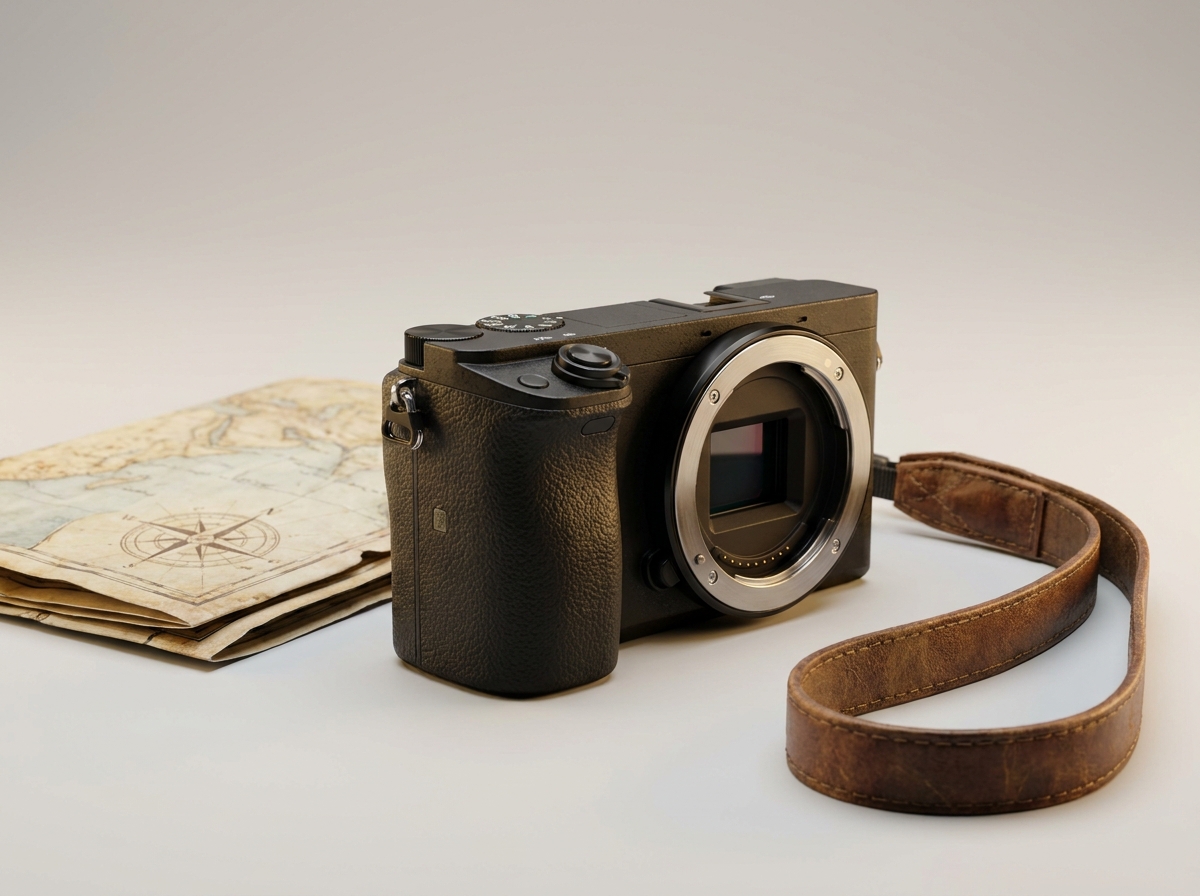
In short
- For travel, total weight (camera body + lens + 2 batteries) matters more than the body alone: under 900 g is comfortable, over 1,200 g you will feel it after 3 hours.
- Sony A6400 and Nikon Z30 are the most balanced APS-C options under 700 euros: 400-450 g weight, real-world battery life of 350-400 shutter count, and an honest travel lens lineup.
- Full frame makes sense for travel only if you accept a dedicated backpack: Sony A7 II at 550-580 euros and Canon EOS RP at 600 euros remain the most affordable entry points on the used market.
- Micro 4/3 (Olympus PEN E-PL9, Panasonic G90) is the true featherweight: bodies under 500 g and a 14-140 zoom that covers everything in a single lens.
A travel mirrorless isn't the best mirrorless overall: it's the one you carry all day without cursing it at the third museum. In the last ten years at the ReflexMania counter, I've seen more than one full frame bought for holidays and abandoned in the hotel after two days, replaced by the smartphone.
In this article, I outline the criteria that truly matter when the camera body must fit in a carry-on backpack: actual weight, battery life, versatility of the lens kit, and resistance to dust and moisture. I do this using the certified used models we currently have in stock, ranging from 300 to 800 euros, with concrete prices and figures.
The three real constraints of travel: weight, battery life, size
A travel mirrorless camera isn't judged by the grams on the spec sheet, but by the weight on your neck by the third day of walking. The camera body is only part of the equation: the mounted lens, spare batteries, charger, and possibly a secondary zoom all count. Before looking at specific models, you need to lock in three numbers that determine whether you'll actually use the camera on vacation or leave it in the hotel.
Why the weight of the body alone is not enough
A 400-gram body sounds light, but you rarely use it bare. Mount an 18-135 zoom and add 480 grams, and you're at 880 grams around your neck. Add two spare batteries to your bag, a backup SD card, and the USB-C charger: the complete kit easily tops 1.5 kg.
To help you navigate, these are the actual thresholds measured in our lab on a complete kit (body + standard zoom + 2 batteries + charger):
- Under 900 grams: You can carry the camera on your body all day without noticing it. Typical compact Micro 4/3 or APS-C with a prime lens.
- Between 900 and 1,200 grams: Comfortable for 4-5 hours, after which you start to feel it. APS-C with a mid-range zoom.
- Over 1,200 grams: You feel it after 3 hours, and after 6 you are looking for a bench. Full frame with a standard zoom.
Battery life: 300 certified shutter count, how many real
The CIPA standard used by manufacturers to declare battery life is a laboratory procedure: flash every two shutter counts, regular power-off and power-on cycles, and EVF at fixed brightness. In the field, reality is different.
If you use continuous live view for framing, take short bursts, record a few video clips, or frequently use the EVF due to strong sunlight, the real battery life drops by 30-40% compared to the CIPA rating. A camera rated at 410 shutter count, like the Sony A6400, delivers around 280-300 certified shutter count in normal travel conditions. A full day of photography requires 500-700 shots. Two spare batteries are not a luxury; they are the bare minimum.
Size: the 40x20x25 backpack rule
European low-cost airlines require hand luggage to fit under the seat in 40x20x25 cm. Your photography kit and everything else must fit inside. In practice, this means:
- Fits easily: APS-C or micro 4/3 camera body + one universal zoom lens + 2 batteries + charger + memory card. Volume approximately 4-5 liters.
- Fits with a squeeze: Compact full frame camera body (Canon EOS RP, Sony A7 II) + 24-105mm zoom lens + accessories. Volume 6-7 liters, leaving little room for clothes.
- Leave at home: Second camera body, third lens, full size tripod, external flash. On a low cost trip, these are an unsustainable luxury.
These three figures — total kit weight, actual shutter count per charge, and liters occupied in the backpack — determine whether the camera is truly travel-ready or just a compromise that leaves the kit in the reception closet.
Sensor: APS-C, full frame or micro 4/3 for travel
The sensor format determines the weight of your backpack before you even choose the model. A full-frame body with a standard zoom lens weighs nearly twice as much as a Micro 4/3 system with a universal zoom, and on the road, you feel that difference after three hours of walking. Before looking at the camera body specifications, choose the format based on how much weight you are willing to carry.
APS-C: the compromise that works for most
APS-C is the format we most often recommend to travelers. The 1.5x crop factor turns a 70-300 into a 105-450 equivalent, meaning more compact telephoto lenses for safaris and landscapes. Image quality up to ISO 3200 is virtually indistinguishable from full frame in prints up to 30x40.
The lens lineup has grown significantly in recent years: Sony E, Fuji X, and Nikon Z DX cover all useful focal lengths for travel without forcing you to carry 1.500-gram lenses. The price of used camera bodies under 700 euros makes them the most rational choice for those who do not want to spend over 1.200 euros on a complete kit. For choosing a specific system, we refer you to the comparison Canon vs Nikon vs Sony.
Micro 4/3: the true featherweight for travel
The 2x crop is the secret of the format. A 14-140 zoom, equivalent to 28-280, weighs 265 grams and covers from wide-angle to telephoto in a single piece. No lens changes on the go, no sensor exposed to dust.
- Olympus PEN E-PL9 at 300 euros: 380 grams, 3-axis in-body image stabilization, perfect for those who want the lightest possible kit.
- Panasonic Lumix G90 at 450 euros: weather-sealed, EVF viewfinder, 4K video without crop, the choice for active travel.
The limit is real: above ISO 3200, noise becomes visible, and the bokeh in portraits is less creamy. If you frequently shoot indoors or at night without a tripod, the Micro 4/3 system demands compromises.
Full frame: does it make sense on vacation?
Honest answer: only if you accept a dedicated backpack and don't mind changing lenses multiple times a day. The Sony A7 Mark II at 550-580 euros is the most affordable used full-frame on the market, featuring 5-axis stabilization and an E-mount open to dozens of compact Samyang and Tamron lenses.
The real advantage is dynamic range and high ISO performance: shadow shots at noon, church interiors, and handheld sunsets up to ISO 6400 without worry. If you travel to photograph rather than photograph while traveling, full frame justifies the weight. For those who simply want good holiday photos, it is overkill.
APS-C travel cameras: balanced choices under 700 euros
Under 700 euros, APS-C is the sweet spot for travel. You get a sensor large enough to handle ISO 3200 without ruining the image, a body weighing 350-450 grams, and dedicated lenses that won't empty your backpack. Above this range, you pay for weather sealing and better EVFs; below it, you face compromises that are noticeable while traveling. In our catalog, four models cover this range well: Sony A6100 at 600 euros, Nikon Z30 at 450 euros, Sony ZV-E10 at 500 euros, and Canon EOS R100 at 400 euros.
Sony A6100: the most complete
The A6100 is the most balanced camera in its class. OLED electronic viewfinder, eye-detection autofocus that remains among the best in the category even today, 4K video and 11 fps burst. It weighs 396 grams with battery and the NP-FW50 battery gets you home with 400 real shutter counts per charge. The A6400 you will find at 650-700 euros is the bigger sibling, with partial weather sealing and an updated processor. If the budget allows, the A6400 is the choice that lasts more years. If you want to spend 50 euros less and grab a bright prime right away, the A6100 does the same job in 90% of travel situations. On the Sony APS-C lens lineup you find the 16-50 kit lens, the 18-135 travel zoom and honest primes like the Sigma 30mm f/1.4.
Nikon Z30 and Sony ZV-E10: video-oriented
Both drop the viewfinder. This is what makes them light (Z30 at 405 grams, ZV-E10 at 343), but in full sun on the beach or in the mountains, the rear screen is hard to see, even at maximum brightness. For vlogging, they are perfect: front-facing flip-out screen, above-average microphone, and a clearly visible rec indicator. For classic travel photography, they are a compromise. The Z30 at 450 euros has reliable AF and the Z mount opens up to more modern lenses, but the native APS-C lens lineup is still limited. The ZV-E10 at 500 euros shares the sensor and AF with the A6100 but removes the EVF and the full hot-shoe. If most of your memories will be video, both are sensible choices. If you take photos 70% of the time, get the A6100.
Canon EOS R100: the 400 euro entry point
The R100 is the lowest entry price in the RF segment. 24 MP sensor, face-detection AF, EVF included. What you give up: fixed non-tilting screen, 4K video with heavy crop, modest burst rate. What you get: perfectly respectable photos and access to the RF system, which currently has the most new lenses arriving. If it's your first mirrorless and you want to see if photography is a passion that stays, it's an honest choice. To dig deeper into the reasoning behind buying from scratch, read how to choose your first used mirrorless.
Micro 4/3: the 700-gram kit that covers everything
If you truly want to forget your camera is in your backpack, Micro 4/3 is the only format that allows it. Yes, the sensor is smaller than APS-C, but bodies under 500 grams and universal zooms that cover wide-angle to telephoto in a single piece. For pure travel, where arriving at night without neck pain matters, it is the system we most often recommend at the counter.
The price of used gear is the real argument here: with 300-500 euros, you get a camera body that cost three times as much ten years ago. And Micro 4/3 lenses are compact by nature, not by marketing choice.
Olympus PEN E-PL9 at 300 euros: the most compact
The Olympus PEN E-PL9 at 300 euros is the most honest entry point into Micro 4/3. A 380-gram camera body, 3-axis in-body image stabilization, a flip-down screen for selfies, and that retro design that stands out. It is perfect for street travel and city breaks: you can wear it around your neck all day without noticing it.
The limitations are clear: usable ISO up to 3200, beyond which noise becomes visible. No electronic viewfinder, only the rear screen. In bright sunlight, you have to shade the screen with your hand to frame the shot. But for those who travel during the day and value discretion, it is an acceptable compromise.
Panasonic G90 at 450 euros: more robust and tropicalized
The Panasonic Lumix G90 at 450 euros is the other side of the system: a more substantial camera body, a 2.36-million-dot electronic viewfinder, weather sealing against rain and dust, and 4K video at 30p without crop. It weighs more than the PEN but stays under 540 grams, and features a proper grip that makes all the difference with telephoto lenses.
It is the choice for those traveling in variable conditions: summer trekking, safaris, stops in the rain. The weather sealing here is not just a label on the box; it truly withstands short downpours.
The lenses that complete the system
The real strength of Micro 4/3 is its versatile zooms. Two relevant options for travel:
- Lumix 14-140 mm f/3.5-5.6: equivalent to a 28-280 mm on full frame, weighs approximately 265 grams, costs around 350 euros used. It is the classic "one zoom for everything".
- Olympus 14-150 mm f/4-5.6: 28-300 mm equivalent, 285 grams, weather-sealed in the II version. It pairs better with the G90 for consistent moisture protection.
The math is simple: the PEN E-PL9 + Lumix 14-140 combo weighs under 650 grams in total. An equivalent APS-C setup easily reaches 900 grams. Over a three-hour hike, you'll feel the difference.
Affordable full frame for those who do not compromise on quality
Under 700 euros today, you can enter the used full-frame market without much hesitation. Three bodies cover all needs: those who want just the large sensor for the lowest price, those looking for the lightest full-frame available, and those demanding dual slots and weather sealing. The fourth is a niche: the Sony A7r with 36 megapixels for those who truly print large. In all cases, the quality leap in the sensor comes at the cost of weight: expect bodies between 485 and 700 grams, less generous batteries than APS-C, and bulkier native lenses.
Sony A7 II at 550 euros: the most affordable full-frame on the market
The Sony A7 Mark II at 550-580 euros is the lowest entry point into full-frame mirrorless on today's used market. The real advantage is the 5-axis stabilization in the camera body: mount an adapted vintage 50mm lens and shoot at 1/15 handheld without worries. The serious limitation is battery life: 270 certified shutter count CIPA shots mean two spare batteries are mandatory for a full day of reportage. It is suitable for those who travel light but want true blurred backgrounds and clean ISO 3200. I would avoid the A7 II if the trip involves bursts of action: the autofocus is from the 2014 generation, it works well on a single stationary subject, but suffers in tracking.
Canon EOS RP and Nikon Z5: modern entry-level models
The Canon EOS RP at 600 euros weighs 485 grams: it is the lightest full-frame camera on the market, featuring a 26-megapixel sensor and Dual Pixel autofocus that performs well in video and portrait photography. It lacks in-body image stabilization, so an IS lens is required for handheld shooting in low light. The Nikon Z5 at 680 euros weighs 675 grams but compensates with 5-axis stabilization, dual SD card slots, serious weather sealing, and a battery life of 470 certified shutter counts (CIPA). It is the choice for those who accept 200 extra grams in exchange for field reliability.
- Canon EOS RP — 485 g, weight-focused choice, €600
- Nikon Z5 — 675 g, reliability-focused choice, €680
- Sony A7 II — 599 g, price-focused choice, €550-580
Sony A7r at 700 euros: for those who print large
The Sony A7r at 700 euros is a model you should only buy if you know exactly why you need it. 36 megapixels on a full-frame sensor mean 70 MB files and detail for prints over 70 cm. It lacks in-body stabilization and the shutter is noisy, two real limitations in the field. It is the camera for serious photographic travel, where you plan your shutter count on a tripod. To choose between full-frame mirrorless and equivalent DSLRs, we compared the two worlds in DSLR vs mirrorless in 2026.
Battery life on the go: real numbers and strategies
The battery life stated by manufacturers is measured using the CIPA standard, which simulates a repeatable but unrealistic scenario: flash every two shutter counts, frequent power on/off cycles, and no extended review sessions. In real-world travel use, the numbers change in both directions. Those who shoot bursts and review less often often reach twice the stated figure. Those who spend time composing calmly in the EVF drop below half.
Real battery life table for in-stock models
These are the figures we see in the field, gathered from customer feedback on using these camera bodies while traveling. The "real-world usage" column is an average estimate: a mix of EVF and LCD, some bursts, and some short videos.
| Model | Declared CIPA | Real travel use | Battery |
|---|---|---|---|
| Sony A6400 | 410 shutter count | 500-600 | NP-FW50 |
| Sony A6600 | 810 shutter count | 900-1100 | NP-FZ100 |
| Nikon Z30 | 330 shutter count | 400-500 | EN-EL25 |
| Canon EOS RP | 250 shutter count | 300-400 | LP-E17 |
| Olympus PEN E-PL9 | 350 shutter count | 400-500 | BLS-50 |
| Panasonic G90 | 290 shutter count | 350-450 | DMW-BLC12 |
The interesting case is the Sony A6600, currently listed in our catalog at 800 euros. It uses the NP-FZ100 battery, the same one found in Sony full-frame bodies. A single charge comfortably covers a full day of city tours, even a demanding one. It is the Sony APS-C model with the best battery life by far, and when traveling, that difference means one less spare battery to carry around.
USB-C Charging: Which Models Support It
USB-C charging on the go is a paradigm shift. It means charging the camera body with the same power bank as your smartphone, whether on a train or a plane, without needing dedicated battery chargers. Models supporting in-body USB-C charging include: Sony A6600, ZV-E10, all Nikon Z series (Z30, Z50, Z5, Z6), Canon EOS R and RP, and Fujifilm from the X-T3 onwards. Models not supporting USB-C charging: Olympus PEN E-PL9, Panasonic G90, Sony A6000, A6100, A6400, and A7 II (these feature micro-USB ports, resulting in slower or absent charging).
A 10,000 mAh power bank with 18W USB-C PD output charges an NP-FZ100 in about two hours. It's worth spending 30 euros to have it in your backpack.
How many spare batteries to bring
The rule we apply at the counter is simple and effective:
- Real battery life under 400 shutter count (Canon EOS RP, Panasonic G90): two spare batteries. One in your pocket, one in your backpack.
- Real battery life 400-600 shutter count (A6400, Z30, E-PL9): one spare battery is enough, two if you don't have access to a power outlet in the evening.
- Real battery life over 800 shutter count (A6600): just one spare even for long trips, plus a power bank.
Used original batteries in good condition cost half as much as new ones. Compatible batteries from reputable brands like Patona or Newell retain 90% of their capacity at one-third of the price. Avoid 10-euro no-name brands from Chinese marketplaces: out-of-spec voltages pose a real risk of damaging the camera's electronics.
Weather sealing and durability: when it truly matters
Let's start with a truth that marketing hides: no weather-sealed mirrorless camera is waterproof. It resists splashes and fine dust, not a fall into a stream or an hour under heavy rain without protection. If you go to Rome in spring or New York in summer, weather sealing is an overprice you pay for a feature you will never use.
What "tropicalized" really means
The term refers to a series of rubber gaskets on battery doors, SD card slots, dials, and the lens mount. It keeps out splashes, light rain, fine sand, and humidity. There is no universal IP standard: each manufacturer decides what to test and to what extent. A Sony A6600 and a Nikon Z5 are both "weather sealed," but the level of sealing differs, and neither has an official IP certification.
It is truly necessary in three scenarios: trekking where rain catches you halfway up the trail, safaris with constant dust getting everywhere, and beach shoots with salt spray and wind-blown sand. For everything else, a freezer bag in your backpack is enough, and the problem is solved at zero cost.
Catalog models that have it
Three concrete options, three different philosophies:
- Sony A6600 — 800 euros. Serious weather-sealed APS-C, large NP-FZ100 battery delivering 800 certified shutter counts, 5-axis in-body stabilization. The choice for those wanting a compact but robust camera body with a wide range of Sony E lenses. The sealing holds up well even under continuous rain for 10-15 minutes.
- Panasonic Lumix G90 — 450 euros. Micro 4/3 with complete seals on the camera body and kit zoom. It weighs little, costs less, and the combination with the 14-140 (same brand, same seals) gives you a sealed system from the mount to the front element. Unbeatable for budget trekking.
- Nikon Z5 — 680 euros. The only weather-sealed full frame under 700 euros we keep in our catalog. Magnesium construction, sealing derived from the Z6/Z7. Weighs 675 g, should be paired with weather-sealed Z lenses to have a coherent system. A sealed mount on a non-sealed lens is useless.
A detail we point out at the counter: tropicalization degrades over time. Seals dry out after 6-8 years of intensive use. On a used camera from 2017, always check the condition of the door seals before taking it on safari. We visually inspect them during the service, but we cannot certify their sealing performance as if it were new.
The travel lens: one zoom or two primes
The choice of lens weighs on the journey more than the choice of body. A 450 g body with a 24-105 f/4 in front becomes a 1.150 g kit: the problem is never the camera, it's what you put in front of it. Before you leave, you must decide whether you want to never change the lens or whether you accept the change in exchange for less weight and more light.
Universal zoom: total convenience, honest quality
The do-it-all zoom handles 90% of travel scenarios in a single piece. An 18-135 on APS-C or a 14-140 on Micro 4/3 takes you from wide-angle for cathedral interiors to moderate telephoto for a candid portrait at the market. No lens changes in the rain, no dust on the sensor, no bag open in the middle of a crowd.
The price to pay is the variable aperture, typically f/3.5-5.6 or f/3.5-6.3. In full daylight, you won't notice. Inside a bar at sunset, you will: at 135 mm, you end up at f/5.6 and ISO 3200 to stay at 1/60. On modern APS-C, it's manageable; on Micro 4/3, noise starts to show. Edge sharpness at the extreme focal lengths is honest, not exceptional: if you print 30x40, you'll notice; if you share on Instagram, you won't.
Two fast primes: less weight, more quality, more versatility
The alternative is a 35mm equivalent plus an 85mm equivalent, both f/1.8 or f/2. On Sony APS-C this means a Sigma 23mm f/1.4 plus a 56mm f/1.4. On micro 4/3 a Panasonic 25mm f/1.7 plus a 42.5mm f/1.7. The total weight often drops below 500 g for the two lenses combined, with two and a half stops more light.
What you actually get:
- Indoors and evening: handheld shots where you had to push the ISOs or use the flash.
- Bokeh: you truly get that portrait at the market with a soft background, not just in words.
- Discretion: a small prime lens attracts fewer looks than an extended telephoto.
The price is for the lens swap. If you travel with kids, on safari, or on trekking trips where the moment lasts three seconds, the zoom wins hands down. If you travel slowly, walking through cities, markets, and dinners, the two primes will give you better photos.
A smart compromise exists: an all-purpose zoom mounted by default, and a single 35mm equivalent f/1.8 prime in your pocket for the evening. Add 150 g and cover the scenario where the zoom truly struggles. If you are still choosing your system, before considering the optics, read our guide to migrating from DSLR to mirrorless: it changes the rules of the game even for the gear.
What we check at our lab before selling it
Every mirrorless that enters ReflexMania goes through the bench before it makes it to the display. It’s not marketing: it’s the reason we can offer a 2-year warranty on a camera that has already been used. A used mirrorless that has been "checked" properly isn’t the one that just turns on the screen and focuses instantly in the store. It’s the one where you know the real numbers.
Tests we perform on every used mirrorless
The first piece of data is the certified shutter count. On mirrorless cameras, this value is readable via software or the EXIF of dedicated test shots, and we align it with what we declare in the product listing. A Sony A6400 with 12,000 shutter count out of an expected 200,000 shutter life is practically like new, and the customer must be able to verify this at a glance.
For the rest of the camera body, we perform the following checks:
- Sensor: shot on a uniform background at f/11 and f/16, 100% inspection for dust, oil spots, and hot pixels. If needed, cleaning in a clean room with a swab and dedicated liquid.
- Shutter: tests at all speeds, from 30" to 1/4000 or 1/8000 depending on the model, to rule out sluggish or irregular curtains.
- Autofocus: tests on static and moving subjects, with verification of eye-AF and continuous tracking where available.
- EVF and screen: check for dead pixels, color casts, and touch delamination.
- Sealing and mechanics: inspection of seals where declared, mount play, dials, buttons, and SD slots.
- Battery: measurement of residual capacity. Below 70% of nominal, we replace it or explicitly declare it with a reduced price.
On travel models, the battery is the area where we are most strict. A Z30 or an A6100 sold with an end-of-life battery will ruin your first day of vacation, and the customer will rightfully come back angry. It is better to reject it in the lab.
Why a 2-year warranty changes the game in the used market
Italian consumer law provides a 24-month warranty on used goods sold by professionals, unless contractually reduced to 12 months. We do not reduce it. A full two-year warranty, on the same camera body that has already worked for someone else.
It may seem like a bureaucratic detail, but in the used market, it makes the difference between a worry-free purchase and a gamble. If the shutter of that mirrorless fails in the fourteenth month, you get it back to the workshop for free. The same applies to AF issues, screen problems, or power failures. On the private market, after thirty days, you are on your own with the risk.
For those buying a camera to take on trips, this is a practical point, not a philosophical one: a 2-year warranty covers at least three or four major vacations, and it is on the road that things really break.
Frequently Asked Questions
What is the lightest mirrorless camera for travel under 500 euros?
The Olympus PEN E-PL9 at 300 euros: 380 g camera body, 93 g 14-42 zoom kit, total under 500 g with two batteries. Unbeatable in weight for city breaks and street photography.
APS-C or full frame: which is better for frequent travel?
For most travelers, APS-C: complete kit under 900 g, better battery life, smaller lenses. Full frame only if image quality is prioritized over weight and you are willing to carry a dedicated backpack.
How many shutter counts does a mirrorless battery really last?
From 70 to 90% of the CIPA rating declared by the manufacturer. An A6400 rated at 410 shutter count performs 350-400 real shutter count with mixed photo+video use. The Sony A6600 is the only one in our price range that exceeds 600 real shutter count.
Can I charge the mirrorless with a power bank while traveling?
Yes, if the camera body has a USB-C port with in-body charging: Sony A6600, ZV-E10, Nikon Z30, Z5, Canon EOS RP. No USB-C on Sony A6400, A6100, A7 II, Olympus PEN E-PL9 and Panasonic G90 — these have micro-USB, and some do not support direct charging. Always check before you leave.
Is a used mirrorless camera reliable for an important trip?
If it is certified, yes. At ReflexMania we check the shutter count, sensor, shutter, and battery of every camera. A Sony A6400 with 15,000 shutter count out of an average shutter life of 200,000 still has 92% of its remaining life. The 2-year warranty covers any potential issues.
Is a single universal zoom better than two fast primes?
Universal zoom if you travel as a couple or family: fewer lens changes, no missed moments. Two primes (35mm + 85mm equivalents) if you are a dedicated photographer seeking better quality and bokeh. They weigh less but force you to change lenses.
Do you need a weather-sealed camera for regular travel?
No. Weather sealing is useful for trekking, safaris, and travel in humid or desert areas. For city breaks, beach holidays, and standard trips, it is excessive. If you really need it, our catalog includes the Sony A6600, Panasonic G90, and Nikon Z5.
Need help choosing the right mirrorless for your next trip?
If you have any doubts about a purchase or need advice for your specific case, contact us. We offer free advice because we are photographers first and sellers second, and because a customer who makes a poor purchase does not return to photography.
Three ways to get in touch:
- Contact form — response within 24 business hours
- WhatsApp at 342 362 3454 (messages only)
- Phone: 071 291 6347 (Mon-Fri 9-13/15-18, Sat 9-13)
If you want to see what we have in stock right away, explore the used cameras available today: every camera is certified, comes with a 2-year warranty, and ships within 24-48 hours.
Article written by Matteo for the ReflexMania Team. Last updated: May 2026. Prices and availability as of the time of publication.