
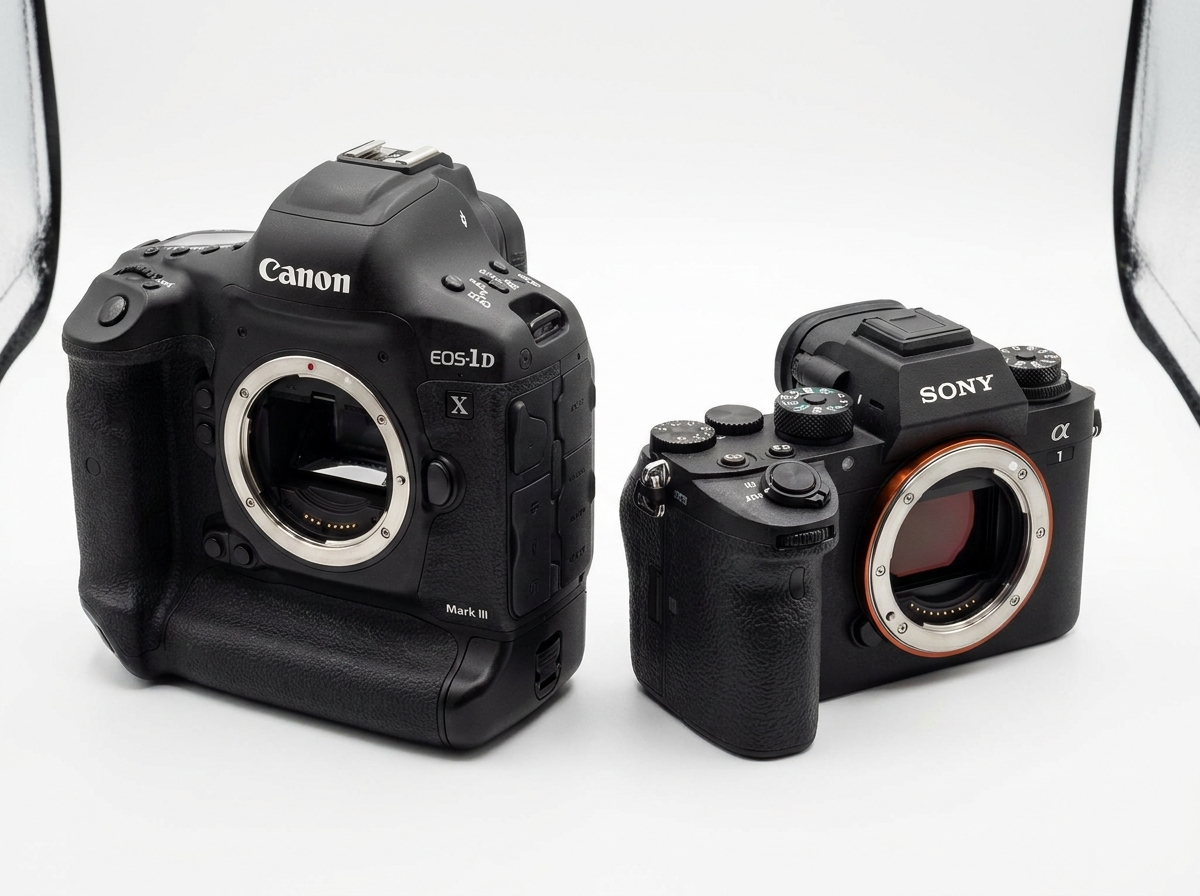
In short
- Mirrorless cameras have dominated new production since 2023: Canon, Nikon, and Sony have stopped developing new DSLRs.
- A used DSLR costs 30-50% less than an equivalent mirrorless camera: a Nikon D750 is available for 500 euros, while a similar Z5 starts at 680 euros.
- Eye autofocus, 4K video, and in-body image stabilization are standard on entry-level mirrorless cameras: they are absent or limited on DSLRs.
- The used DSLR lens park is huge and prices are dropping: those who already own EF or F-mount lenses save hundreds of euros.
Every week at the ReflexMania counter, someone asks me the same question: "Matteo, should I buy a DSLR today or switch to mirrorless?" Ten years ago, the answer was obvious. In 2026, it no longer is, and anyone who gives you an answer in three seconds is trying to sell you something.
In this article, I lay out the real technical differences, the current used prices I see coming through the workshop, and a series of concrete scenarios to help you understand what actually makes sense. No magazine-style rankings, no empty talk about "mirrorless being the future." Just what works for your way of shooting.
DSLR and mirrorless: what really changes inside the camera
The difference is not the sensor: the sensors in both categories are often identical, made by the same suppliers (Sony Semiconductor in primis). What changes is what lies between the sensor and your eye. In a DSLR, there is a mirror tilted at 45 degrees that deflects the light towards a pentaprism and then into the optical viewfinder. In a mirrorless, that space is empty: the light hits the sensor directly, always, and what you see in the viewfinder is a small OLED screen that reproduces the sensor's signal in real time. Everything else — weight, autofocus, size — stems from this.
The viewfinder: optical vs electronic
The optical viewfinder (OVF) of the DSLR shows reality through a lens system. Zero latency, no battery involved, natural behavior in full light. The limitation is that you see the scene, not the photo: you only discover the final exposure after the shutter count, by looking at the rear display.
The electronic viewfinder (EVF) of current mirrorless cameras — OLED panels with 3.69 or 5.76 million dots on models priced at 700 euros and above — displays the actual exposure preview: if you underexpose by two stops, you see the dark image in the viewfinder before pressing the shutter button. In low light, the EVF amplifies the signal, allowing you to compose in conditions where an OVF is practically black. The historical drawback was latency, but on current stacked sensors (Sony A1, Nikon Z9, Canon R3), it is measured in mere milliseconds: invisible to the human eye.
Size, weight, and balance
The weight advantage is less dramatic than the spec sheets suggest. Real-world comparison, body plus standard zoom:
- Nikon D750 + 24-120 f/4: 840 g + 710 g = 1550 g
- Nikon Z5 + 24-70 f/4: 675 g + 500 g = 1175 g
- Canon 6D Mark II + 24-105 f/4: 765 g + 795 g = 1560 g
- Canon EOS RP + 24-105 f/4 RF: 485 g + 700 g = 1185 g
You save 300-400 grams in total, not a kilo. And with fast telephoto lenses, the advantage disappears: a 70-200 f/2.8 weighs the same regardless of the mount. A full-frame mirrorless with a 70-200 attached is less balanced than a DSLR: the center of gravity shifts forward because the body is smaller than the lens barrel.
Autofocus: where mirrorless cameras have won
There is no contest here, and the reason is structural. DSLRs focus using a dedicated AF module that sees a limited portion of the frame, typically the central 60-70%, with 39, 51, or 153 points. Mirrorless cameras focus directly on the sensor, with points covering 90-100% of the frame and algorithms that recognize human eyes, animals, and vehicles.
The Eye-AF is particularly the generational leap: it locks onto the subject's pupil and stays there while they move. On a Sony A7 IV, a Nikon Z6 II, or a Canon R6, it works even with a subject at three-quarter angle or in backlighting. On top-tier DSLRs — D850, 5D Mark IV — Eye-AF is only available in Live View, meaning with the mirror up and using the rear display: in practice, the camera behaves like a first-generation mirrorless, slow and inconvenient.
2026 marks the end of new DSLRs (but not the ecosystem)
Canon announced the 1D X Mark III as the brand's last professional DSLR. Nikon removed the D6 from its lineup in early 2025. Sony stopped producing the A-mount system in 2021. Only Pentax remains, continuing to develop the K-3 Mark III and the K-1 Mark II because it chose to differentiate itself by staying in pure DSLR. This does not mean that DSLRs are dead: it means that the new market has closed, while the used market has become the main channel.
Who still produces DSLRs and who doesn't
The situation at the beginning of 2026 is clear. The big three have shifted R&D, production, and marketing to mirrorless. Pentax (Ricoh Group) is the only one maintaining a live DSLR line, with niche sales but full support.
| Manufacturer | Last DSLR | Production Status |
|---|---|---|
| Canon | EOS-1D X Mark III (2020) | Discontinued, price list closed |
| Nikon | D6 (2020) | Off price list since 2025 |
| Sony | A99 II (2016, A-mount) | System discontinued since 2021 |
| Pentax | K-3 Mark III (2021) | In production, active development |
Setting Pentax aside, anyone looking for a Canon or Nikon DSLR in 2026 buys used. Period. There is no alternative, and this changes the perspective: you are not choosing obsolete technology, you are choosing a much more mature secondary market with favorable prices for buyers. If you are wondering whether it makes sense to stick with the DSLR system or switch to mirrorless, we addressed the issue in detail in the guide to migrating from DSLR to mirrorless.
What happens to support and spare parts
The question we get most often at the counter is: "If I buy it now, how long will support last?" Here is the concrete answer. Canon Italia guarantees official parts and service for 7 years after end of production. Nikon states 5 years, but in practice continues to repair older models as long as parts are available. Sony is the strictest: after 5 years from discontinuation, repairs are only possible if parts are available.
Translated into dates: a Canon 5D Mark IV, discontinued in 2024, will be officially supported until approximately 2031. A Nikon D850, out of production since 2023, until 2028. For older models (Canon 6D, Nikon D750, D7200), official support has already expired, but a network of reputable independent labs exists, and the most critical spare parts (shutters, mirrors, LCD screens) are still available at reasonable prices.
In our workshop, we keep shutters in stock for the best-selling series precisely because we know that the first structural failure, after 100,000-150,000 shutter count, is that one. A shutter replacement on a D750 costs 180-220 euros against a camera body value of 500: it is still worth doing.
Real prices in the 2026 used market
The price gap between used DSLRs and mirrorless cameras has settled around 30-40% for the same year and class. It is no longer an opinion: we see it every week on the price tags at the counter. Let's see what it really costs to enter each of the two worlds in 2026, starting from the actual prices in our catalog.
Entry-level range (300-500 euros)
With 300-500 euros, you can buy second-generation APS-C or Micro 4/3 mirrorless cameras today, featuring modern sensors and eye-detection autofocus. The same budget, in the used DSLR market, gets you a Nikon D5300 or a Canon 750D: solid machines, but with technology stuck in 2014-2016.
- Olympus PEN E-PL9 at 300 euros: 16 MP Micro 4/3 sensor, 5-axis in-body stabilization, compact body for street and travel.
- Canon EOS R100 at 400 euros: new RF mount, 24 MP APS-C, a clean entry into the Canon mirrorless system.
- Nikon Z30 at 450 euros: designed for vlogging, flip-out screen, crop-free 4K, no viewfinder but modern autofocus.
- Sony ZV-E10 at 500 euros: vast E-mount lens lineup, top-tier eye-AF, a strong choice for those who also shoot video.
A DSLR at the same price point doesn't offer all of these features together: you either get 4K video or stabilization, never both.
Mid-range (500-800 euros)
This is where used full-frame mirrorless cameras come into play, and it is the point where the comparison with semi-pro DSLRs becomes interesting.
| Model | Price | Key Feature |
|---|---|---|
| Canon EOS RP | 600 euros | 26 MP full-frame, the lightest in its category, excellent for portrait |
| Nikon Z5 | 680 euros | 24 MP full-frame, dual SD slots, 5-axis stabilization, solid build |
A used Nikon D750 in good condition goes for around 500 euros today, while a Canon 6D Mark II is priced at 550-600. They are still excellent cameras, but adding 100-150 euros gets you eye autofocus, 4K video, and an electronic viewfinder with exposure preview. For those starting from scratch, the upgrade is worth the difference.
Why mirrorless cameras hold their value better
At the counter, we see depreciation curves in real time. Over the last three years, a Canon EOS RP has lost about 25% of its new purchase value. A Canon 6D Mark II has lost over 45% in the same period. Same price range, same brand, opposite dynamics.
The reason is simple: new production has shifted, demand for DSLRs is declining, and the used supply is increasing because those switching to mirrorless are selling their old gear. For the buyer, this is an immediate advantage, as semi-pro DSLRs can be found at unprecedented prices. However, in the medium term, a DSLR purchased today will be worth significantly less than its mirrorless equivalent in five years. If the idea is to keep it forever, this point is irrelevant. If, however, you plan to change camera body within three or four years, the calculation changes.
The lens park: the factor that changes the choice
When you buy a camera body, you are buying the start of a system. Lenses stay in your bag for ten or fifteen years, while bodies are replaced every five. For this reason, if you already have a set of DSLR lenses, the cost-benefit calculation changes radically: ignoring them to switch to a new system means throwing away hundreds of euros of working glass.
Used DSLR lenses: excellent and discounted
The used market is full of DSLR lenses sold by those who have switched to mirrorless. Prices have dropped by 20-30% over the last three years and continue to fall. We are talking about optics designed for full-frame sensors, built when margins were higher, often mechanically more robust than mid-range mirrorless equivalents.
A few concrete references on what is available today:
- Canon EF 50mm f/1.8 STM: 80-100 euro used, silent autofocus, perfect for portraits.
- Canon EF 24-105mm f/4 L IS: 350-450 euro used, was the kit lens for the 5D Mark III.
- Nikon AF-S 50mm f/1.8 G: 130-160 euro, internal AF motor, works on D3500 and D5600.
- Nikon AF-S 70-200mm f/4 G: 600-750 euro, lightweight alternative to the f/2.8.
- Sigma 17-50mm f/2.8 EX DC OS: 180-230 euro, fast zoom for APS-C.
- Tamron 70-300mm Di VC USD: 150-200 euro, suitable for amateur sports.
Pairing a used DSLR body with three to four solid lenses results in a complete kit for under €1,500. Replicating the same kit in native mirrorless requires at least €2,800–3,200.
Adapters: when they work and when they disappoint
Adapters from the same manufacturer work well. The Canon EF-EOS R retains autofocus, stabilization, and electronic aperture on all EF lenses from the last twenty years. The Nikon FTZ II does the same with F-mount lenses featuring an internal AF motor (AF-S or AF-P designation). Sony's LA-EA5 adapts A-mount lenses, but on non-recent bodies it loses continuous tracking and speed.
Third-party cross-brand adapters (EF to Sony E, F to Sony E) exist but are compromises: autofocus lags, and tracking of moving subjects is unreliable. They are suitable for static work, landscape, and posed portraits. Not for sports or events.
Native mirrorless lenses: prices and availability
New RF, Z, and Sony E lenses cost on average 30-50% more than their EF and F-mount equivalents, as manufacturers are amortizing R&D costs. Used stock is arriving now: a Sony FE 28-70mm kit lens can be found for 220-280 euros, a Canon RF 50mm f/1.8 STM for 150-180 euros, and a Nikon Z 50mm f/1.8 S for 380-450 euros.
As a first native lens, a 50mm f/1.8 or a used kit zoom is always a good choice. To help you navigate between the three brands before choosing a system, we have written a dedicated comparison in Canon vs Nikon vs Sony: which to choose, which is especially useful if you are starting from scratch with no previous lenses.
When a used DSLR is still the right choice today
Mirrorless cameras have won the commercial war, but at our counter we see three situations where a used DSLR remains the most rational choice. It’s not nostalgia: the numbers add up. Let’s look at them one by one, with real figures and no beating around the bush.
Under €400 and looking for full-frame?
Under €400, the full-frame mirrorless market simply does not exist. We do not recommend a first-generation Sony A7 with a certified shutter count above 50,000; a used Canon EOS R or Nikon Z5 starts at €680–750. A Nikon D750 in excellent condition is found around €500, while a first-generation Canon 6D drops to €350–400 with basic accessories.
What you get for that price:
- 24-megapixel full-frame sensor (D750) or 20-megapixel (6D), dynamic range still competitive in 2026
- 100% coverage optical viewfinder, zero lag, zero battery consumption
- Native compatibility with a vast used lens park: a 50mm f/1.8 EF or AF-D costs 80-120 euros
For those starting out with full-frame, there is no mirrorless at the same price that can match the file quality.
Landscape and studio portrait: the optical viewfinder wins
If you shoot on a tripod, with controlled or planned light, most of the mirrorless advantages vanish. Eye-AF is not needed if you focus manually on the model's eye at f/8. In-body stabilization is not needed at 1/250 at ISO 100 on a tripod. 4K video is not needed if you do not shoot video.
The optical viewfinder remains, showing the real scene without any electronic interpretation, and a battery that delivers 1200-1500 shutter count against the 400-500 of an equivalent mirrorless. On a cold landscape day, where lithium-ion batteries drain faster, the difference is noticeable.
Do you want a camera that lasts ten years without worries?
High-end professional and semi-pro DSLRs were built to last. Certified shutter counts of 150,000–300,000, tested weather sealing, and refined ergonomics across three generations of product. A 2014 Nikon D750 still performs as it did on day one: in our lab, we have seen units pass through with 80,000 shutter counts and a healthy shutter.
First-generation mirrorless cameras (2018-2020) are now showing the first issues with stuck IBIS sensors and electronic viewfinders with dead lines. These are repairable but expensive problems. A mechanically sound DSLR, with a certified shutter count from the lab, is an investment that pays off over a decade without firmware obsolescence worries.
When mirrorless is the undisputed answer
There are three scenarios where we don't even discuss it at the counter: the mirrorless wins, full stop. It's not a matter of trend or price; the DSLR has stopped competing in these areas years ago. If you fit any of these profiles, stop looking at used DSLRs, even if they cost less.
Do you want to shoot video beyond occasional 1080p
Video-capable DSLRs have been poorly executed for a decade, with only a few expensive exceptions. The issue is structural: when the mirror is raised for video recording, phase-detection autofocus stops working, leaving only contrast detection, which is slow and pulsating. On mirrorless cameras, video autofocus is the same as for stills, and it shows.
Three cameras that come through our workshop and are still highly relevant for those who shoot:
- Panasonic GH5 at 470 euros: internal 4K 10-bit, excellent in-body stabilization, true camera ergonomics. It remains the used reference for those who edit seriously in post.
- Sony ZV-E10 at 500 euros: designed for vlogging and talking to camera, decent internal directional microphone, side-flip screen. For talking-head YouTube, it is unbeatable at this price.
- Nikon Z30 at 450 euros: the most compact of the three, no viewfinder (a design choice for creators), 4K recording without crop and affordable Z DX lenses.
Moving subjects: children, animals, amateur sports
Eye autofocus is not a marketing feature; it is a paradigm shift. An entry-level DSLR with 9 or 11 AF points has to "guess" where to focus. A Sony A6100 at 600 euros features 425 phase-detection points distributed across the sensor, recognizes human and animal eyes, and locks onto them as long as the subject is in frame.
In practical terms: a photo of a dog running towards you, three out of four sharp with the mirrorless, one out of four with an equivalent DSLR. Parents who want to photograph three-year-old children who never stand still for a second understand this on the first in-store test. If this is your case, also read our guide to your first used mirrorless before deciding on the model.
Travel and street: weight and dimensions matter
A Olympus PEN E-PL9 at 300 euros weighs approximately 470 grams with a pancake lens (380 g for the camera body alone). An entry-level APS-C DSLR with the 18-55 kit weighs more than double, around 800 grams. After eight hours of walking in Lisbon, the difference is not theoretical: it is whether your hand hurts or not, whether you carry the camera with you or leave it in the hotel. On Micro Four Thirds, bright prime lenses are also cheaper and tiny. For street and light travel, the DSLR has nothing left to say.
Three typical profiles we see at the counter
70% of customers visiting the store for their first serious purchase fall into one of these three profiles. Needs and budgets vary, and the right advice changes drastically. Here is how we approach each of them.
The enthusiast picking back up after 10 years
They arrive with a heavy bag: an old Canon 5D Mark II or a Nikon D7000, two or three EF or F-mount zooms, maybe a 50mm prime. They want to know if they "have to" switch to mirrorless. The honest answer is: it depends on how much they shoot.
If you shoot landscapes and posed portraits, the DSLR is still a great choice today. The lenses are worth more than the body, and the optical viewfinder has never let you down. It is worth investing 200-300 euros in a full service for the body you already own and keeping your entire lens collection.
If, however, you find yourself wanting to shoot sports, wildlife, or video, the upgrade makes sense. We recommend a mirrorless body from the same brand along with an original adapter: EF lenses on Canon RF deliver 95% of native performance, while F-mount lenses on Nikon Z lose some functionality only on older motors. Cost: €600–900 for the body, €200 for the adapter. It retains full lens compatibility and adds eye-AF and stabilization.
The parent who wants serious photos of their kids
This is the easiest choice to recommend. Running children, school plays, swimming competitions: you need eye autofocus to track the moving subject. On a DSLR, it simply isn't there.
The two options we almost always propose are entry-level APS-C mirrorless. The Sony A6100 at 600 euros features the tracking system Sony still uses on its higher-end models: it locks onto a child's eye and doesn't let go. The Canon EOS R100 at 400 euros is the most affordable in the group, lightweight, and intuitive for those who have never used a real camera before.
Between the two, if your budget allows, the A6100 is the more complete option. The R100 is perfect for those who want to spend the bare minimum and get home with usable photos without post-processing.
For those coming from a smartphone and looking to step up
You want true background blur, not the fake kind from your phone. The answer is full-frame, and the good news is that under €700, you can find serious gear today.
The Canon EOS RP at 600 euros is the most user-friendly entry point into full-frame: lightweight, with a very clear menu system and a tilting screen. Paired with a used 50mm f/1.8 RF lens at 150 euros, it delivers portraits that will change your mind about photography. It is the camera we recommend to anyone who has never held a DSLR before and does not want to spend time studying a 300-page manual.
What we check in the lab before selling
Every camera that enters ReflexMania goes through our workbench before it makes it to the display. This is no mere formality: a variable percentage between 15 and 20% of the used DSLR and mirrorless cameras we receive is rejected or sent back to the supplier because it fails our tests. The rest reach the customer with a 2-year warranty because we know exactly what’s inside.
DSLR and mirrorless cameras require different protocols. A D750 is not inspected like a Z6, even though they are cousins. The weak points change, the tools change, and the threshold changes beyond which we say "we sell this one refurbished" or "we do not sell this one at all".
Shutter count and shutter condition
The first piece of data we check is the actual shutter count, extracted from internal EXIF metadata or via dedicated software (ExifTool, ShutterCount, proprietary software). The number printed by the previous seller is worthless: we have seen it reset dozens of times.
The warning thresholds we use internally:
- Professional full frame DSLR (D750, 5D Mark III, 6D Mark II): declared shutter count of 150,000. Above 120,000 shutter count, the camera body falls into the "refurbished" category with a discount; above 150,000, we only keep it if the shutter has already been replaced with a receipt.
- Consumer APS-C DSLR (D5300, 750D, 200D): technical threshold of 100,000 shutter count. Shutter replacement costs 200-280 euros plus labor, often not worth it.
- Full frame mirrorless (Z6, A7 III, R6): mechanical shutters with declared shutter counts of 200,000-500,000. The mechanical shutter is simpler to replace and costs less (150-220 euros).
Beyond the count, we check the sound of the shutter at different speeds. A dry, metallic click at 1/4000 often signals the end of a shutter blade's life. A mirrorless with an electronic-first shutter is tested differently, as part of the wear has migrated to the sensor itself.
Sensor, electronic viewfinder, AF systems
We perform two mandatory tests on the sensor. A shutter count at f/16 against a uniformly illuminated white sheet reveals dust and fingerprints (dust mapping); a shutter count with the lens cap on, a long exposure, and high ISO reveals hot pixels and dead pixels. A couple of hot pixels on a 24-megapixel sensor are normal, ten are not.
On DSLRs, we separately test the phase-detection AF of the dedicated module: a 45° calibration chart on a tripod verifies front-focus and back-focus with three different lenses. If a peripheral point misses focus by 5 cm at one meter, the AF module is misaligned and requires laboratory service.
For mirrorless cameras, the focus shifts to the electronic viewfinder (we check for tearing, dead lines, and lag) and eye-detection AF: a test session with a moving subject measures the percentage of shots that are actually in focus. If it falls below 85%, we flag the defect on the product sheet and apply the corresponding discount.
Frequently Asked Questions
Will DSLRs become unusable in the coming years?
No. Canon and Nikon guarantee support and spare parts for at least 7-10 years after the last production. DSLR lenses will continue to function for decades, even with adapters on mirrorless bodies. A DSLR bought today is perfectly operational until 2035 and beyond.
Can I use my old Canon EF lenses on a Canon mirrorless?
Yes, with the Canon EF-EOS R adapter you retain autofocus, stabilization, and optical quality. The same applies to Nikon F→Z with the FTZ II. The Sony A-mount→E-mount LA-EA5 works, though with some autofocus limitations on older lenses.
Is a used DSLR for 400 euros better than a new entry-level mirrorless at the same price?
In terms of pure image quality, often yes - a used Nikon D7200 outperforms a new Canon R50 in many contexts. But you lose eye-AF, decent 4K video, and stabilization. It depends on what you shoot: landscapes yes, moving children no.
How long do mirrorless batteries last compared to DSLRs?
A DSLR like the Nikon D750 takes 1,230 shots per charge. A mirrorless like the Sony A7 II takes 350. Latest-generation mirrorless cameras (Z5, A7 IV) reach 500-600 shots. When traveling, 2-3 spare batteries are needed for mirrorless cameras, almost never for DSLRs.
Is it worth waiting until 2027 to buy a used mirrorless camera for less?
Not particularly. Prices for used mirrorless cameras drop by 10-15% per year on older models, but the pool of qualified used equipment is already extensive. Waiting 12 months to save 50-80 euros on a Sony A6400 means a year less of photography.
Do mirrorless cameras have overheating issues in video?
Some models do, especially in 4K beyond 20 minutes of continuous recording (Sony A7 III, Canon EOS R). On models designed for video - GH5, Z30, ZV-E10 - the issue is marginal or non-existent. For occasional video, any mirrorless is fine.
Does buying from a private seller or a specialized store make a big difference?
You save 10-20% on price compared to buying from a private seller. However, you lose the warranty, certified shutter count, laboratory inspection, and legal protections. At ReflexMania, every camera goes through our lab for shutter, sensor, AF, and viewfinder checks, with a 2-year warranty included.
Want personalized advice? Let's talk
If you have doubts about a purchase or need advice for your specific case, write to us. We offer free advice because we are photographers first, not just sellers, and because a customer who buys poorly won't return to photography.
Three ways to get in touch:
- Contact form — response within 24 business hours
- WhatsApp at 342 362 3454 (messages only)
- Phone: 071 291 6347 (Mon-Fri 9-13/15-18, Sat 9-13)
And if you want to see what we have in stock right away, explore the used gear available today: every camera body is certified, comes with a 2-year warranty, and ships within 24-48 hours.
Article written by Matteo for the ReflexMania Team. Last updated: May 2026. Prices and availability refer to the time of publication.