
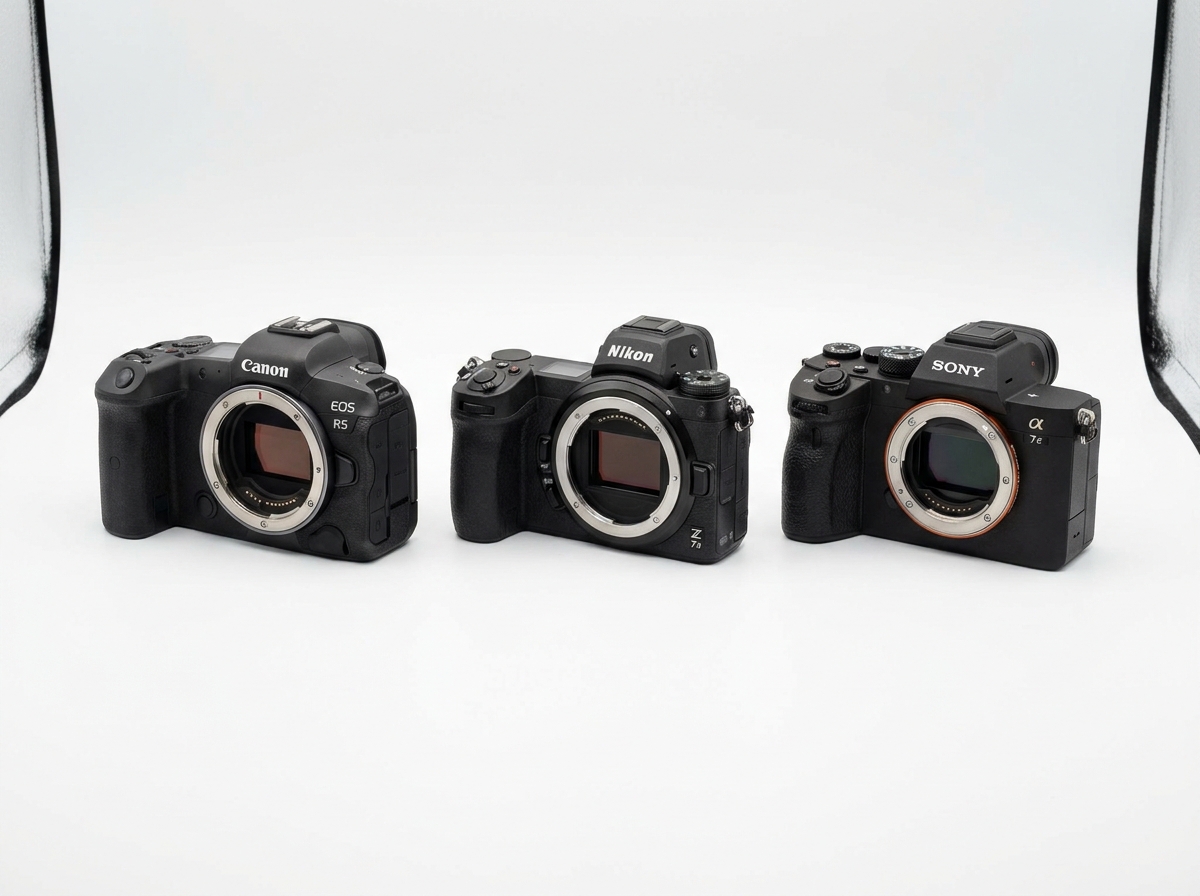
In summary
- Sony dominates eye-AF autofocus and has the widest E-mount lens lineup, with over 70 native lenses in stock from both first-party and third-party manufacturers.
- Canon RF offers the most refined ergonomics and reference JPEG colors, but the third-party RF lens lineup has only grown since 2024.
- Nikon Z provides the best value for money on the used market: a Z5 is currently around 700 euros, while a Z30 starts at 450 euros with us.
- In the used market, the real difference isn't the brand but the individual unit: certified shutter count, sensor condition, and repair history matter more than the logo.
I get asked this at least three times a week, right here at the counter. A customer walks in with a printed sheet from YouTube reviews and says: "Matteo, I have to decide between the Sony A6100, Canon R100, and Nikon Z30—which one should I get?" The honest answer is that it depends, but not in a vague sense. It depends on concrete things: which lenses you already have at home, what you photograph, and how much you are willing to spend on lenses over the next two years.
In this article, I lay out what I actually see coming through the workshop. Not reviews of cameras I’ve never handled, but a comparison of three systems I have repaired, certified, and sold to hundreds of clients. The goal is to give you the facts to make a decision without being dragged along by the marketing of whichever manufacturer is in vogue.
The three systems in two lines: what they mean today
In 2026, the choice between Canon, Nikon, and Sony is no longer about "who has the best mirrorless," as all three have mature camera bodies. The difference lies in system philosophy: what you mount on the body, how it feels in your hand, and what you pay to reach a complete set. Below, I outline the three ecosystems without beating around the bush, then dive into the details in the following sections.
Canon RF: ergonomics and color, expanding lens lineup
Canon RF is the youngest of the three systems, launched in 2018. Canon's historical strength remains intact: a refined grip, logical menus, and JPEG colors that many wedding photographers refuse to give up. The limitation has been, for years, the RF lens lineup closed to third parties. Since late 2024, Canon has opened up to Sigma and Tamron for APS-C, and in 2026 the RF-S catalog is finally growing. The situation is slower for full-frame RF: native lenses are excellent, but Canon's price list remains high.
On the used market, a Canon EOS R100 at 400 euros is an honest entry into the RF-S system, featuring a 24-megapixel sensor and access to all RF lenses via an EF adapter at zero cost if you have old DSLR lenses.
Nikon Z: the best value for money on the used market
Nikon Z is the choice I most often recommend to those who watch their budget. Nikon DSLR ergonomics transferred directly, one of the best viewfinders in the category, and native Z lenses with optical performance often superior to their Canon and Sony equivalents. The limitation is the mirror image of Canon's: few third-party options, although Tamron and Viltrox are making moves.
A Nikon Z30 from us starts at 450 euros: 20-megapixel APS-C, perfect for those looking to enter the Z system for vlogging or street photography, with access to the same lens lineup as the Z full-frame models.
Sony E-mount: the most mature system, reference AF
Sony got there first, and it shows. The E-mount system boasts over 70 native lenses in the catalog from Sony, Sigma, Tamron, Samyang, Viltrox, and Zeiss. Eye-AF autofocus remains the industry benchmark, particularly for tracking moving subjects. The downside is ergonomics: smaller bodies, a less generous grip, and historically more cumbersome menus (though they have improved since the A7 IV).
A Sony A6100 at 600 euros fits into the broader market system, with the possibility of mounting lenses ranging from 200 euros up to full-frame bodies without changing the mount.
Ergonomics and grip: which one feels natural in your hand
Ergonomics is the first reason a photographer switches systems after six months. Not the autofocus, not the image quality: how the camera body feels in your hand during an eight-hour wedding or a mountain hike. The three brands have different philosophies, and you notice it within the first five minutes at the counter.
Canon: the most comfortable grip for large hands
Canon has the deepest and most sculpted grip of the three, a direct legacy of its EOS DSLRs. The Canon EOS RP at 600 euros weighs 485 grams with battery and remains balanced even with medium-sized RF lenses like the 24-105 STM. The shutter button falls naturally under the index finger, and the front dial is exactly where it should be.
Canon menus are the most intuitive for beginners: color-coded tabs, clear Italian language options, no confusing labyrinths. If you have large hands or frequently use telephoto lenses, this is the system that will tire your wrist the least by the end of the day.
Nikon: controls close to the DSLR world
The Nikon Z retains the DSLR layout with dual dials (front and rear) and the ISO button on the top right. Users coming from a D750 or D7500 will find almost everything in its place, reducing the learning curve by weeks.
The monochrome top display on mid-range models (Z6 II, Z7 II) is a detail appreciated by those shooting in the studio or at night. The grip is less pronounced than Canon's but more than Sony's, a middle ground that works for most hands.
Sony: compact bodies, historically complex menu
Sony has always focused on compactness, and it shows. The Sony ZV-E10 at 500 euros weighs 343 grams: you can slip it into a small backpack and forget about it. The Sony A6100, also at 600 euros, has the same rectangular form factor with a reduced grip.
The downside is the menu. Until 2021, it was a labyrinth of entries with cryptic abbreviations. From 2021, Sony redesigned the interface with horizontal tabs and clearer categories, but it remains the densest system of the three. On compact APS-C camera bodies, the shutter button sits close to the edge: users with large hands tend to cover the flash or the viewfinder eyepiece with their thumb.
One thing we often repeat at the counter: before choosing a system, pick up the three bodies. The difference between a grip you like and one that tires you out matters more than any review. If you are still considering the switch from a DSLR, our DSLR vs mirrorless comparison clarifies the structural differences before you even look at the brand.
Lens lineup: what you can mount and what it costs
You choose the system once, but you keep the lenses for ten years. That’s why the lens lineup matters more than the camera body, especially in the used market where the body depreciates quickly while lenses hold their value.
Sony E-mount: the widest range, competitive third parties
The E-mount has always been open, and it shows. The lineup features over 70 native lenses from Sony, Sigma, Tamron, Samyang, Viltrox, and Tokina. Third-party pricing is the real selling point.
- Viltrox AF 50mm f/1.8: new around 250 euros, delivering performance that until 2022 required a 600 euro Zeiss.
- Sigma 35mm f/1.4 DG DN Art: used under 700 euros, one of the best 35mm lenses ever made.
- Tamron 28-75 f/2.8 G2: used 600-700 euros, the standard zoom mounted on three quarters of our Sony customers' bodies.
A Sony A7 Mark II at 565 euros plus a Tamron 28-75 gets you a full-frame f/2.8 kit under 1,300 euros. Five years ago, that was unthinkable.
Canon RF: third-party lenses available only from 2024
Canon kept the RF protocol closed until 2024. For five years, choosing RF meant buying only Canon, and Canon raised prices accordingly. You can find a new RF 50mm f/1.8 STM for 220 euros, but above that level, the price list gets serious: the RF 24-70 f/2.8 costs over 2,500 euros.
Since January 2024, Sigma and Tamron have started releasing RF-S lenses for APS-C, and in 2025, the first third-party RF full-frame lenses arrived. It is a young movement: if you buy a Canon EOS RP for 600 euros today, the third-party lens lineup improves month by month, but Sony's historical advantage remains.
Nikon Z: few third-party options, native optics of the highest quality
The Z 50mm f/1.8 S is the category benchmark on any system. The Z 24-70 f/4 is a solid buy at 500 euros used. The issue is variety: the third-party Z lineup has grown slowly, mainly with Viltrox and Tamron, but it remains the narrowest of the three.
What about older lenses? Adapters and compromises
Adaptation truly works in two cases: EF on RF with the official Canon adapter (native AF, no penalty) and F on Z with the FTZ II (fast AF on AF-S lenses, manual on older AF-D). The Sony LA-EA5 adapter for A-mount lenses works well only on recent Sony bodies. Everything else — adapting Canon EF to Sony, Nikon F to Sony — is compromised: slow AF, longer lenses, loss of stabilization on many combinations. Good for those who already have a lens collection; not a reason to choose the system.
Autofocus: where the real difference shows
Autofocus plays a major role in choosing a system today. Not because other parameters don't matter, but because a failing AF ruins photos that can't be retaken: a child's smile, a bird in flight, a jumping cat. And here, the three brands are not aligned, especially on entry-level bodies that intermediate readers actually look for on the used market.
Sony: the reference for eye-AF and tracking
Sony has had a two-to-three-year head start on eye-AF, and it still shows today. From the A7 IV onwards, there is a dedicated AI processor that manages the recognition of human, animal, and bird eyes with a precision that the other two brands only achieve on their top-tier bodies.
The interesting point is that reliable eye-AF also makes its way to entry-level bodies. The Sony A6100 at 600 euros uses a 425-point phase-detection AF system with real-time eye-AF that, in practice, locks onto the eye and tracks it even when the subject moves. For indoor portraits of children or dogs in the park, it is the most stress-free camera in this price range.
Canon Dual Pixel: excellent, but with limitations on entry-level bodies
Canon's Dual Pixel CMOS AF II on the R5 and R6 is probably the best overall in terms of fluidity and predictability. However, the story changes on entry-level bodies. The Canon EOS R100 at 400 euros features a first-generation version of Dual Pixel, with face/eye recognition that works but does not handle animal recognition in a serious way.
Translated: It works perfectly for family and landscape photography. For those looking for an entry-level body to pair with a telephoto lens for shooting dogs at the beach, the R100 struggles more than the A6100. We mention this at the counter when asked, because Canon's marketing touts "intelligent AF" on all bodies, but the processor generation is different.
Nikon: recovered from the Z6 II onwards, solid on the Z30
AF was the weak point of Nikon Z until 2022. Then serious firmware updates arrived for the Z6 II and the new AF logic was extended to the latest APS-C camera bodies. The Nikon Z30 at 450 euros inherits a system with 209 detection points and subject tracking that, for the vlogger/family segment it is designed for, does its job without chasing butterflies.
In summary, for those buying used entry-level gear:
- Moving subjects and animals: Sony A6100 is the first choice.
- Static portraits and landscape: all three are suitable; ergonomics make the difference.
- Video with face tracking: Sony and Nikon Z30 outperform the EOS R100.
Video: for those who also shoot video
If video makes up at least 30% of your work, the system changes your life significantly. Sony is the default choice for serious hybrids, Canon offers colors that are ready straight out of the camera but suffers from crop and heat issues on entry-level bodies, while Nikon is the silent surprise with free N-Log on almost everything. Under €600, a fourth name enters the game: Panasonic, which on the used market remains the best deal for those who shoot a lot.
Sony: the most obvious choice for photo/video hybrids
Sony understood before others that today's mirrorless buyers also shoot video, and it shows. The Sony ZV-E10, starting at 500 euros with us, is designed for vlogging and static talking-head shots: three-capsule directional microphone, forward-tilting screen, and a Product Showcase button that shifts focus to the object in hand. Above it, the A7C and A7 IV offer S-Log3 and mature color profiles, with downloadable official Sony LUTs.
The downside: the ZV-E10 exhibits visible rolling shutter during rapid movements and applies a crop when electronic stabilization is enabled. For talking-head YouTube videos, you won't notice. For filming a running dog, you will.
Canon: cinema-ready colors, but watch out for crop and thermal issues
Canon inherits C-Log profiles and skin rendering from the Cinema EOS line, a quality many competitors pay for in post-production to replicate. On high-end bodies (R5, R6 II), the video performance is production-grade. On entry-level bodies like the EOS RP and EOS R, however, there are two serious limitations to know before signing the contract:
- Heavy crop in 4K: the EOS RP applies a 1.6x factor in 4K 24p, so your 24mm becomes a 38mm equivalent.
- Overheating: continuous recording is limited to 25-30 minutes in summer before the thermal cutoff.
- No C-Log: log profiles are reserved for higher-end camera bodies.
If video is secondary and you only need a few 1080p clips with Canon colors, the RP is a great fit. If it's your main line of work, skip the entry-level tier.
Nikon: Less Popular for Video, but Free N-Log on Z6/Z7
Nikon is the most underrated choice for videographers. The Z6 II and Z7 II offer 10-bit N-Log via external HDMI without paid modules, while Canon restricts C-Log to high-end bodies. On the APS-C side, the Nikon Z30 at 450 euros is designed exactly for YouTube creators: no viewfinder, flip screen, 4K 30p recording without heavy crop, and no significant duration limit.
Special case: those who shoot mostly video and little stills should also consider the Panasonic GH5 at 470 euros. Micro 4/3 sensor, V-Log L, 4K 60p, excellent in-body stabilization. None of the big three offers the same package at that price on the used market.
What changes when buying used: the workshop's perspective
On the new market, the three brands are more equivalent than they appear. On the used market, no: each ages in its own way, and after ten years disassembling camera bodies at the bench, you can see the differences with the naked eye. When a camera arrives for revision, before even turning it on, you already know where to look based on the logo above the pentaprism.
Here is what we check first, brand by brand, when a camera body enters the workshop:
- Canon: condition of the rubber coating (prone to peeling on heavily used models), integrity of the RF mount contacts, potential play in the EVF viewfinder.
- Nikon: cleanliness of the card slot (a critical point on early Z bodies), condition of the exposure compensation dial, integrity of the top display if present.
- Sony: sensor condition, IBIS alignment, integrity of the E-mount which may fail on heavily used units.
Canon: solid, easy-to-find parts, long-lasting shutters
Canon mirrorless cameras age well. A Canon EOS RP currently in our display window for 600 euros has a certified shutter count of approximately 100,000, but we regularly see units in our lab with over 150,000 shutter counts that are still perfectly functional. The R6 models last even longer. Canon spare parts are the easiest to source in Italy: we can find a new shutter for an RP within two weeks, and even less for an R6. We also replace the rubber coatings, which are a common cosmetic defect, in half an hour.
Nikon: robust build, some known issues with Z prime series
Nikon builds solidly. The Z bodies are heavy, but they feel like a single, cohesive unit in your hands. The only recurring issue we have encountered is with the XQD slot on early Z6 and Z7 models: after a few years of insertions, the contacts may cause intermittent errors. We clean them internally, and in 90% of cases, they work like new again. Nikon spare parts come from the official Italian distribution network; they cost a bit more than Canon parts but are available. EN-EL15 batteries are compatible across many models, a significant advantage if you already own a Nikon kit.
Sony: delicate sensors, attention to IBIS
Sony sensors are more exposed. The E-mount has a very short flange distance, and when you remove the lens, the sensor is practically uncovered: dust gets in more easily. A Sony A7 Mark II at an average of 565 euros, which is the price we have them at today, is a camera that is still worth it today, but the sensor must always be checked under backlight before finalizing the purchase. IBIS is the other critical point: if the camera has taken a serious hit, the stabilizer can become misaligned, and you will only notice it at slow shutter speeds. In the lab, we run specific tests at 1/15 with fixed focal lengths to detect it. If you want to know how to navigate buying your first mirrorless, we have written a dedicated guide on how to choose a used mirrorless camera that is worth reading before deciding.
How much it costs to enter each system today
Under €900 in 2026, you can enter all three systems, but you take home very different things. The difference isn't just the sensor: it's how much budget you have left for your first serious lens. Here are the real prices we see coming through the counter these past few weeks.
Entry-level range (400-600 euros): what you get
In this price range, you're buying APS-C, and that's perfectly fine: for beginners, a well-utilized APS-C sensor outperforms a stretched full-frame paired with a budget lens. The four bodies we see most often are these:
- Canon EOS R100 at 400 euros: the lowest entry point of the RF system. 24 MP sensor, dual pixel AF, ergonomics familiar to those coming from Canon DSLRs. The real limitation is the still limited native RF-S lens lineup.
- Nikon Z30 at 450 euros: no viewfinder, articulating screen, designed for video and vlogging. The same sensor as the Z50, in a smaller and lighter body. For those who shoot content rather than photograph, it is an honest camera.
- Sony ZV-E10 at 500 euros: the direct rival of the Z30, but with Sony eye-AF which is embarrassing for the competition at this price. No viewfinder here either. The E-mount APS-C catalog is the largest of the three.
- Sony A6100 at 600 euros: same autofocus as the ZV-E10 but with an EVF viewfinder. For those who want to photograph first and foremost, it is the most solid choice under 600 euros.
Mid-range (600-900 euros): a quality leap
Here is something that was unthinkable five years ago: used full frame bodies drop below 700 euros. Three concrete options on our bench:
- Canon EOS RP at 600 euros: 26 MP full frame, the lightest in its class. Dual pixel AF is excellent for faces, 4K video is cropped only. For portrait and street photography, it remains a benchmark.
- Sony A7 II from 550 to 580 euros: 24 MP full frame with 5-axis in-body stabilization, rare at this price. AF is dated compared to newer siblings, but on a tripod and in the studio, it does the job.
- Nikon Z5 around 700 euros when available: 24 MP full frame, dual SD slots, IBIS, genuine weather sealing. The best value for money in the mid-range, and we don't say that to cheerlead: the numbers speak for themselves.
An honest note: at €600, a used EOS RP is only worth it if it has a low certified shutter count and a healthy battery. An RP with 80,000 shutter counts and a shutter at the end of its life is not a bargain, it is a problem postponed by six months. Here, every camera body goes through the lab before hitting the shelf, and that is where the difference shows.
How to choose: three typical profiles we see at the counter
After ten years behind the counter, customers fall into three main categories. This isn't a blog-style simplification: these are the people who walk in every week, with recurring needs and recurring budgets. For each type, there is a choice that works best, and one that leads only to frustration.
Profile 1: Moving from a smartphone, wants to learn
Typical budget €400-700, coming from an iPhone, wants to understand what changes with a "real" camera. The common mistake here is aiming for a camera body that is too ambitious, which intimidates them in the menus. The Canon EOS R100 at €400 is the most honest choice: Canon menus that remain the most readable in the sector, JPEGs ready for Instagram without going through Lightroom, compact dimensions. A gentle learning curve, and when they want to grow, they mount a 50mm RF and make an immediate quality leap.
Nikon Z entry-level works just as well for those starting from scratch, while Sony APS-C in the entry-level range still has menus that are more difficult for beginners. For a deeper look into entering the used mirrorless market, I recommend reading this dedicated guide.
Profile 2: video and social, plus some photography
The content creator who shoots 70% video, vlogs, reels, and a few certified shutter counts. Here, Sony and Panasonic win for different, concrete reasons:
- Sony ZV-E10 at 500 euros: side-tilting screen, integrated directional microphone, reference-grade eye-AF autofocus for vlogging, "product showcase" activation designed for unboxing. Real limitation: visible rolling shutter during fast panning.
- Panasonic Lumix G90 at 450 euros: 5-axis in-body stabilization that makes a difference in handheld video, no 30-minute recording limit, V-LogL profiles useful in post. The Micro 4/3 sensor requires a bit more light than the Sony APS-C, but for daytime shooting it is invisible.
A Canon or Nikon for this profile is not wrong, just less specialized: you end up paying for photo features you would rarely use.
Profile 3: Coming from a DSLR, looking for a quality upgrade
The photographer with an EF, F, or A-mount kit considering a switch. Here, the advice is driven by the lenses, not by the brand in the abstract:
- Canon EF Kit: Canon EOS RP at 600 euros plus original EF-RF adapter. Your EF lenses retain full autofocus and identical optical quality, full frame at a contained cost.
- Nikon F Kit: Used Nikon Z5 with FTZ, AF-S lenses work perfectly, AF-D lenses remain manual.
- Sony A-mount Kit: Direct transition to Sony E with LA-EA5, but at that point evaluate whether it is not better to sell and start fresh.
At the counter, we always say the same thing: the real leap in quality comes from the lenses, not the body. Keep the lens park you have built, change the sensor.
Frequently asked questions
Is it worth switching systems if I already have lenses from another brand?
Almost never. The value of a lens park generally exceeds that of the camera body, and adapters introduce real compromises (slower AF, loss of stabilization). Switch systems only if you have one or two old and not particularly expensive lenses.
Is Sony really better than Canon and Nikon in 2026?
Sony has objective advantages in autofocus and lens lineup, but "better" depends on what you photograph. For portrait and relaxed work, Canon and Nikon deliver identical results. For sports, wildlife, and video creation, Sony remains ahead.
Which do you recommend, Canon EOS R100 or Sony A6100, for the same budget?
For the same budget, the A6100 has better autofocus and a wider selection of lenses to choose from. The R100 offers more intuitive ergonomics and more pleasing JPEG colors without editing. If you photograph children or animals in motion, go with the A6100. If you shoot landscape and posed portraits, the R100 is perfectly fine.
Can I switch from Canon EF to Canon RF while keeping my lenses?
Yes, the EF-EOS R adapter works well and maintains full autofocus. We use it regularly in our lab to test EF lenses on RF bodies. Please note, however, that native RF lenses are optimized for the mirrorless system and often perform better at the corners compared to adapted EF lenses.
What shutter counts are acceptable when buying used?
It depends on the model. On entry-level bodies such as the EOS R100 or Z30, under 30,000 shutter count is excellent. On full-frame bodies like the A7 II or EOS RP, up to 50,000 shutter count is normal. Above 100,000, visible wear begins to appear, but on Canon and Nikon, shutters often last well beyond the rated limit.
Is the Micro 4/3 system (Olympus, Panasonic) still viable?
For video, yes, especially the Panasonic GH5 and G90. For general photography, it only makes sense if you are looking for compact and lightweight camera bodies. Most new buyers today choose APS-C or full frame, but if you have already invested in M43 lenses, the system holds up.
How long do batteries last between Canon, Nikon, and Sony?
Canon LP-E17 (RP, R100): approx. 250 shutter count. Sony NP-FW50 (A6100, A7 II): 350 shutter count, FZ100 on newer camera bodies reaches 600. Nikon EN-EL25 (Z30): 330 shutter count. For intensive use, always plan for at least two batteries.
Looking for tailored advice on the right system for you?
If you have questions about a purchase or need advice for your specific case, contact us. We offer free advice because we are photographers first, sellers second, and because a customer who makes a poor purchase will not return to photography.
Three ways to get in touch:
- Contact form — response within 24 business hours
- WhatsApp at 342 362 3454 (messages only)
- Phone: 071 291 6347 (Mon-Fri 9-13/15-18, Sat 9-13)
And if you want to see what we have in stock right away, explore the used gear available today: every camera is certified, comes with a 2-year warranty, and ships within 24-48 hours.
Article written by Matteo for the ReflexMania Team. Last updated: May 2026. Prices and availability as of the date of publication.