
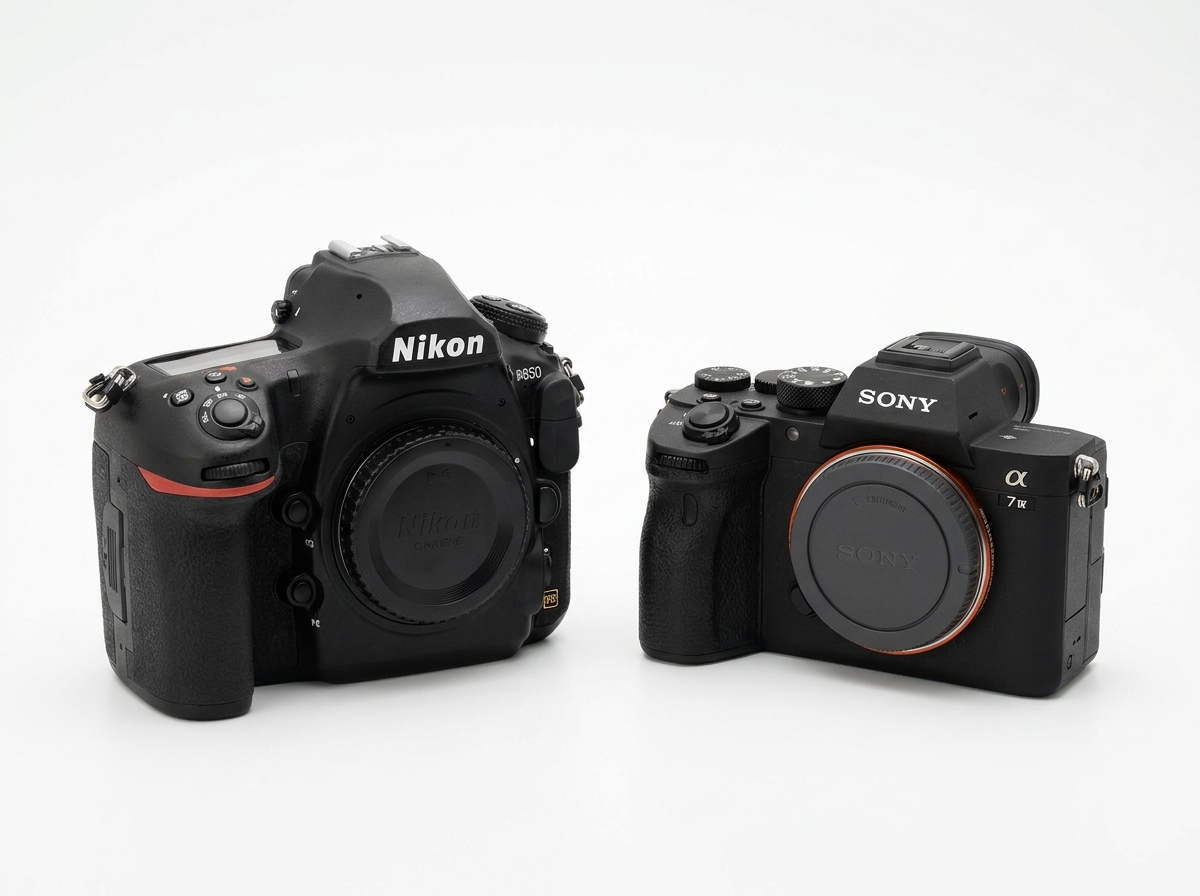
In short
- A used full-frame mirrorless like the Sony A7 II starts at 550 euros: less than a new equivalent DSLR body.
- Adapting DSLR lenses to mirrorless works, but you lose 100-300 grams of compactness and sometimes fast autofocus in video.
- For APS-C, the transition costs less: a Sony A6100 at 600 euros or a Canon R100 at 400 euros cover 90% of amateur uses.
- Selling your DSLR kit before the 2027 price drop recovers 30-40% more than waiting.
Over the past two years at the Ancona counter, I’ve lost count of how many photographers walked in with the same phrase: 'My DSLR works perfectly fine, but I want to understand if switching to mirrorless makes sense.' The short answer is yes, but not for the reasons you read on forums.
In this guide, I explain how we have managed dozens of concrete migrations: what to sell, what to keep, which camera body to choose based on the system you are coming from, and which mistakes to avoid with adapters. No theory, only what truly works when you put the new camera in your bag on Monday morning.
Why switch to mirrorless in 2026 (and when to stick with a DSLR)
In 2026, mirrorless is no longer "the future": it is the present of the photographic market. Canon stopped developing new DSLRs in 2022, Nikon in 2023, and Sony abandoned the A mount in 2021. This means two practical things: the DSLR lens park is no longer growing, and used mirrorless has become more accessible than ever. A full-frame Sony A7 II today starts at 550 euros, less than what a new entry-level DSLR cost five years ago.
That said, migration is not automatically the right choice for everyone. It is worth pausing for a moment before discarding your gear.
The real advantages that change the way you shoot
Modern mirrorless cameras offer five concrete benefits you feel every time you bring the camera to your eye:
- Electronic viewfinder with exposure preview: see the photo as it will look before you take the shot. No more chimping on the display after every click to check the histogram and white balance.
- Focus peaking and MF zoom: manual focus with vintage lenses becomes pixel-precise. Anyone using adapted primes will understand immediately.
- Eye-AF and subject tracking: autofocus locks onto the subject's eye and holds it. On portraits, it reduces rejects by 40-50% compared to an entry-level DSLR.
- Advanced video: true 4K, log profiles, reliable continuous autofocus. On DSLRs, video is almost always an added feature; on mirrorless, it is designed from the start.
- Size and weight: 100 to 300 grams less on the camera body, and native FE/RF/Z lenses often more compact than their DSLR equivalents. For those who travel or shoot street, it makes a difference after a full day.
For a more technical comparison between the two technologies, refer to our updated 2026 guide on DSLR vs mirrorless, where we go into detail on electronic shutters, battery life, and rolling shutter management.
When the DSLR is still the right choice
There are three profiles for whom the migration costs more than it benefits. We tell you this clearly because we don't want to sell you something you don't need.
- You have a massive Canon EF or Nikon F kit and you shoot landscape or static still life. If you own three L primes or three pro Nikkor lenses, the resale value doesn't even cover half the cost of their RF or Z equivalents. For stationary subjects, you don't need eye-AF.
- You shoot primarily in the studio or with flash. The EVF exposure preview turns off with flash, and the main advantage of mirrorless disappears. A Canon 5D Mark IV or a Nikon D850 remain unbeatable workhorses.
- Your DSLR has fewer than 30,000 shutter count and it's enough for you. Switching systems to chase a spec you won't use is the fastest way to lose money. Wait until the camera body reaches end of life.
For everyone else — and they are the majority — 2026 is the right window. In the sections that follow, we show you how to move without losing value.
What is your DSLR kit worth today (and what it will be worth in a year)
The used DSLR market is losing value in a predictable manner, and the numbers we see at the counter confirm this month after month. Those who sell today can still recover decent figures, while those who wait until 2027 will receive 30-40% less for the same kit. The useful window is now, not next year.
DSLR bodies: the price curve is flattening towards the lower end
Three concrete examples from our acquisitions over the last 18 months. The Canon 6D, a full-frame model from 2012, was valued at 480 euros at the end of 2024. Today, we handle it for 320-350 euros with a certified shutter count of 40,000. The Nikon D750, the benchmark for Nikon full-frame DSLRs, was priced at 700 euros 18 months ago: today it ranges between 480 and 550 euros depending on the shutter count. The Pentax K-3 II, an APS-C semi-pro, has dropped from 380 euros to 260 euros in the same period.
The pattern is clear: DSLR bodies lose an average of 30-40% of their value every 24 months. This is not a cyclical phenomenon; it is structural. Canon and Nikon declared the end of DSLR development as early as 2023-2024, and the market is digesting this news with a one-year delay. In 12 months, a 6D will be worth 220-250 euros, and a D750 350-400 euros. There is no turning back.
Lenses hold their value better than bodies
Here, the math changes. A second-generation 70-200 f/2.8, whether Canon or Nikon, loses 10-15% in value over two years. A 50mm f/1.4, a 24-70 f/2.8, and an 85mm f/1.8 behave the same way. The reason is simple: with any adapter, EF, F, or A lenses mount on mirrorless bodies of the same brand while retaining autofocus and electronic aperture control. Demand doesn't disappear; it shifts.
The strategy we recommend to customers bringing in a kit for evaluation is as follows:
- Sell the DSLR body immediately: every month of delay costs 2-3% of the residual value.
- Keep the premium lenses (f/2.8 zooms, fast primes, 300mm+ telephotos) and consider the brand's native adapter.
- Sell the kit zooms (18-55, 18-135): they are worth little and mirrorless systems have better native equivalents.
- Older dedicated flashes: same logic as the body, they depreciate quickly because new systems use updated protocols.
We always do the final calculation on paper at the counter: what goes into the trade-in today, what makes sense to keep, and what to replace. Nine times out of ten, the trade-in amount covers 50-60% of the used mirrorless camera body the customer is looking for.
Choosing the right mirrorless body based on the DSLR you are leaving behind
The smoothest transition is staying within the same ecosystem. If you come from Canon, move to Canon RF. If you come from Nikon, move to Z. The reasons are practical: familiar menus, similar ergonomics, and above all, compatibility with adapters for the DSLR lenses you already own. Changing brands while changing systems doubles the learning curve and multiplies the costs.
Coming from Canon APS-C: R100 or RP, depending on your budget
Those upgrading from an EOS 80D, 250D, or 2000D have two options. The Canon EOS R100 at 400 euros is the direct APS-C replacement: 24-megapixel sensor, native RF mount, 356 grams in weight. Ideal for users of 18-55mm kit lenses shooting vacation photos, family portraits, and home events.
If you want to take advantage of the generational leap in format as well, the Canon EOS RP at 600 euros gets you into full frame with minimal expenditure. Note: full frame RF lenses cost significantly more than EF-S. If you don't have the budget for at least an RF 35mm or 50mm, start with an EF-RF adapter and your old lenses.
Coming from Nikon DX: the Z30 is the natural transition
For those coming from a D5600, D3500, or D7200, the Nikon Z30 at 450 euros is the obvious choice. 20.9-megapixel APS-C sensor, future-proof Z mount, lightweight ergonomics. It lacks an electronic viewfinder — a deliberate choice by Nikon for the video and creator audience. If the viewfinder is a must-have for you, consider a used Z50 when it enters the catalog. The FTZ adapter allows you to use AF-S F-mount lenses with full autofocus.
Coming from Sony Alpha A-mount or Konica/Minolta: switching to E-mount
Three options in the affordable range. The Sony A6000 at 360 euros is the most cost-effective entry point into the Sony ecosystem: still decent autofocus, 11 fps burst rate, and an abundant selection of E-mount lenses on the used market. The Sony A6100 at 600 euros features next-generation eye-AF and significantly more reliable tracking, making the price difference worth it for those photographing children or animals.
If you're looking to make the jump to full frame, the Sony A7 Mark II is available for 550 euros: in-body stabilization, 24 megapixels, and a vast FE lens lineup. For guidance on choosing a brand when starting from scratch, read our Canon vs Nikon vs Sony comparison.
Coming from Olympus/Panasonic 4/3: same mount, evolved mirrorless
You are already on Micro 4/3, so your lenses are still valuable. The Olympus OM-D E-M1 mark II at 600 euros is a pro-grade camera with excellent 5-axis stabilization. For those who prioritize video, the Panasonic GH5 at 470 euros records internal 4K 10-bit, a benchmark that remains relevant today. The Panasonic Lumix G90 at 450 euros is the most balanced photo-video compromise in this price range.
Adapters for DSLR lenses on mirrorless: what actually works
The key point to grasp immediately is that "adapter" does not mean just one thing. The difference between an original Canon EF-EOS R and a 30-euro Chinese ring is the same as the difference between an L-series lens and a plastic one. Autofocus, EXIF data transmission, and stabilization depend entirely on which adapter you mount.
In our experience at the counter, 80% of clients who migrate while keeping their DSLR lenses face no serious issues. The remaining 20% almost always run into two traps: the wrong adapter or a lens too old to communicate with a modern sensor.
Native adapters: the safe choice
These are lenses produced by the same brand as the mirrorless body. They command a higher price but guarantee behavior identical to the original DSLR system.
- Canon EF-EOS R (approx. 110 euros used, 130 new): turns EF lenses into fully native RF lenses. AF and IS work without compromise, even with first-generation 70-200 f/2.8 lenses.
- Nikon FTZ II (200-250 euros used): compatible with AF-S and AF-P lenses. Older AF-D lenses without a motor lose autofocus and remain manual. Good to know before buying.
- Sony LA-EA5 (250-300 euros): brings A-mount lenses to E-mount bodies. Works well with SAM and SSM, but on older screw-drive models, AF slows down noticeably in video.
Third-party adapters: when they make sense
They are needed when you switch systems completely. The classic case is a Canon photographer moving to Sony E.
- Sigma MC-11 (130-180 euro used): connects Sigma lenses and Canon EF lenses to Sony E camera bodies. On Sigma Art lenses, AF is excellent; on less fluid Canon lenses, eye-AF tracking loses precision.
- Metabones (300-450 euro new): more expensive, generally more reliable with native Canon lenses. The T Smart Adapter V version remains the standard for those working with adapted telephoto lenses.
The practical rule is simple: test the combination before buying. With us, you can mount your adapter on the available camera bodies and verify real AF and burst performance, not just the specs declared on the box.
The hidden price: weight and balance
An adapter adds between 100 and 150 grams and shifts the center of gravity forward by 2-3 centimeters. On a 70-200 f/2.8, you won't notice: the lens already weighs a kilo and a half. On a 50mm f/1.8 pancake, however, the camera body becomes clumsy and front-heavy, and you lose the very compactness that prompted you to switch.
Consider the adapter a transitional solution, not a permanent one. On professional zooms and telephoto lenses, it may remain for years. On lightweight primes, you will eventually want to replace the optics with a native equivalent.
What to sell now, what to keep, what to replace
The practical rule we repeat every week at the counter is simple: sell the pieces that depreciate quickly, keep the lenses that hold their value, and replace only where native mirrorless offers a real advantage. There is no need to liquidate the entire kit in a weekend, but neither should you wait until 2027 hoping for a rebound that will not come.
Sell within 6 months: DSLR body, zoom kit, older dedicated flash
The DSLR body is the component that loses value the fastest. A Canon EOS 80D worth 350-400 euros today will be worth 220-250 by the end of 2027. The 18-55 or 18-135 kit zoom follows the same curve: useful as a lightweight lens, but replaceable with any native equivalent without regrets. The older dedicated flash (we are talking about the Canon 430EX II, first-generation Nikon SB-700, Sony HVL-F43AM with Minolta mount) has an increasingly narrow market because many find them cumbersome on the smaller new mirrorless body.
- Sell now: entry and mid-range APS-C DSLR bodies, kit zooms, and flashes with limited compatibility to the older system.
- Realistic recovery: 30-40% more by selling today compared to waiting 12-18 months.
- Strategy: the proceeds directly finance the new mirrorless body, reducing the net outlay.
Keep and adapt: 50/85 primes, 70-200 telephotos, macro
Premium lenses are the reason migrating to mirrorless makes sense without starting over. A 50mm f/1.4, an 85mm f/1.8, a 70-200 f/2.8, a 100mm macro: these lenses work perfectly with native adapters (EF→RF, F→Z, A→E), maintaining fast autofocus and intact optical quality. The weight increases by 100-150 grams due to the adapter, but for a professional telephoto, that's a minor detail. On a fast prime, you'll notice it more, but it remains acceptable.
The only caveat concerns continuous autofocus in video: some third-party adapters slow down during tracking. For stills, even mixed combinations work without compromise.
Replace with native: wide-angle and standard zooms
On short focal lengths and standard zooms like the 24-70 or 24-105, native mirrorless is a different category. Lenses designed for the short flange distance are smaller and 200-300 grams lighter than their DSLR equivalents, and they natively correct distortions that on DSLRs were managed via software.
A Sony FE 24-105 f/4 G, a Canon RF 24-105 f/4 L, or a Nikon Z 24-70 f/4 S cost significant amounts when new, but certified used units start at 700-900 euros and become the lens you keep mounted 80% of the time. It is worth the investment.
The realistic budget for migration: three concrete scenarios
Switching to mirrorless in 2026 costs less than you think, if you sell your DSLR kit before the 2027 crash. I’ll walk you through three cases we see weekly at our Ancona counter, with real figures from our certified used catalog. No theoretical projections: these are the prices we apply today to lab-revised camera bodies with a 2-year warranty.
Scenario 1: Family and travel enthusiast (APS-C, ~700 euros)
Start with a Canon EOS 1300D or Nikon D3300 with the 18-55mm kit. Realistically, you can resell the camera body and lens for 180-220 euros. The target is a Sony A6100 at 600 euros: 24 MP sensor, Real Time eye-detect autofocus (the same firmware as the A7 III), 11 fps. For family and travel, it is oversized for actual needs, and that is a compliment.
Final count: 600 euros for the camera body minus 200 for the DSLR trade-in, plus 100 for a used 16-50 OSS pancake lens. Net total 500 euros. Under 700 euros if you want to add a second NP-FW50 battery and a decent UHS-I SD card. Same price range, Canon alternative: an EOS M50 II, but the EF-M system is at the end of its life and we advise against entering it in 2026.
Scenario 2: enthusiast looking to step up to full frame (~€1,200–1,500)
Here, the budget changes because native FE or RF lenses also come into play. Two concrete options:
- Sony A7 Mark II at 550-580 euros: full frame 24 MP, 5-axis in-body stabilization, ergonomics still valid in 2026. Add a used Tamron 28-75 f/2.8 (550-650 euros) and you are at 1150 euros for a full frame f/2.8 kit that cost 3000 ten years ago.
- Canon EOS RP at 600 euros: full frame 26 MP, one of the lightest full frame camera bodies on the market (485 grams). Paired with a used 24-105 STM (450-500 euros), it closes at 1100 euros, with the usual Canon ergonomics that those coming from a 6D or 80D find familiar from the first shutter count.
Scenario 3: Those keeping their Canon EF or Nikon F kit (~720-900 euros)
You have two or three good EF lenses, a 50 f/1.8 STM, a 70-200 f/4 L? Don't sell them. The Canon EOS RP at 600 euros plus the original Canon EF-RF adapter (120 euros new, 80 used) brings you to 720 euros to migrate while keeping your entire lens park. Autofocus on adapted EF lenses is practically identical to native: same protocol, full-electronic communication.
Same logic applies to Nikon: a used Z5 at around 700 euros plus the FTZ II adapter at 200 euros. Total 900 euros, and all your AF-S Nikkor lenses remain 100% operational — only the older AF-D lenses without an internal focus motor lose autofocus, but that was already the case on D3500 and D5600 DSLRs.
The 5 most common mistakes we see at the counter
After ten years behind the counter, we have seen the same five mistakes repeat. They are not beginner errors: even photographers with twenty years of DSLR experience make them. Here they are, in order of frequency.
- Selling premium lenses to buy native equivalents. A customer walks in with a 24-70 f/2.8 Canon EF in excellent condition, worth 600-700 euros on the used market. They sell it and buy the native 24-70 f/2.8 RF for 1,800 euros. Result: 1,100 euros wasted to gain 80 grams and half a stop of video autofocus. The EF→RF adapter costs 100 euros and retains all original electronics. Only sell if you weren't using that lens.
- Underestimating mirrorless battery life. With a DSLR, you got 800-1000 shutter counts per charge. With a Sony A7 II, you get 350, and with a Canon R6, about 500. The electronic viewfinder always consumes power, even when you aren't shooting. Three extra batteries are the minimum for a wedding day or a trip. Include them in your budget from the start: we're talking about 150-200 euros of accessories that no one mentions at the point of purchase.
- Buying full frame without a budget for FE/RF/Z lenses. A used Sony A7 II costs 550 euros. It seems like a deal. Then you discover that the native 24-105 f/4 G costs 900 euros used, and without bright lenses, the full frame sensor loses most of its advantage. The honest calculation: body + two decent lenses means 1,500-2,000 euros in reality. Below that figure, an APS-C like the Sony A6400 or Fujifilm X-T3 gives you more quality per euro.
- Ignoring ergonomics. Mirrorless cameras are small, and for those with large hands, it's a serious problem. A Sony A7C in the hand of a photographer used to a Canon 5D Mark IV slips, causes cramps in the pinky, and forces uncomfortable grips after half an hour. Solutions: an additional battery grip (50-150 euros), or choosing larger bodies like the Canon R6 or Nikon Z6 II. Try it in your hand for ten minutes, not ten seconds.
- Jumping into mirrorless without testing it in hand. Buying online based on YouTube videos is the fastest way to regret it. The real weight, button placement, grip curve, viewfinder brightness in full sun: no review gives you that back. At the counter, in 15 minutes, you understand if that camera feels right for you.
At our Ancona workshop, a hands-on test is the rule, not the exception. Bring your DSLR lenses, we mount the adapter on the mirrorless body you are interested in, and you take real shutter counts, not simulations.
How we help you at the lab with the migration
Migrating from DSLR to mirrorless is one of those steps where a physical store makes a real difference compared to a blind online purchase. In ten years at the counter in Ancona, we have handled hundreds of transitions: each one has its own pitfalls, and almost always the customer arrives with an idea that, after thirty minutes of testing, turns out to be different from the right one for them.
Here is exactly what we do when you come to us to switch systems.
- Valuation of DSLR kits for consignment or trade-in. We open the bodies, read the certified shutter count, and inspect the shutter, sensor, and lens mounts. We tell you the exact current value and our estimate for six months from now. If you accept the trade-in, the discount is applied directly to the new camera body.
- Certified shutter count on both bodies. On the DSLR body we buy back to resell to those seeking guaranteed used gear. On the mirrorless body we sell you, so you know exactly how much it has worked before you. It is not an estimate: it is a printed report.
- In-store test of the adapter with your lenses. Bring your 24-70mm zoom or your 70-200mm and mount them on the body you are evaluating, using the correct adapter. In ten minutes, you will know if continuous autofocus holds up for your real subjects, not those of a YouTube reviewer.
- Lab revision before delivery. Every used camera body leaving our store goes through the lab: sensor cleaning, electronic viewfinder test, port and contact verification, and firmware update to the latest stable release.
- 2-year warranty on all used items. Not 6 months, not 12 out of courtesy: two full years, just like new. If a problem not caused by impact or liquids emerges within this period, we fix it.
The aspect customers most often underestimate is the physical test of the adapter. A Sigma MC-11 that works perfectly on an A7 III with a 24-70 Canon EF may lose performance on an A6400 with a first-generation 70-200 EF. It is worth making a half-day trip to Ancona before spending 1,200 euros.
If you prefer to start remotely, you can send us photos of the kit via WhatsApp at 3423623454 and we will provide a preliminary estimate within 24 hours. To call the store: 071 2916347. To write in a structured format with attachments: contact form.
Frequently Asked Questions
Should you sell your DSLR now or wait?
Used DSLR bodies lose an average of 15-20% of their value per year since 2023. Selling now, while the used DSLR market still has liquidity, recovers 30-40% more than waiting until 2027. Lenses hold their value better: for those, you can take your time.
Do my DSLR lenses lose quality with an adapter?
No, the optical quality remains identical because the optical design does not change. What may change is the autofocus speed (especially in video) and the overall size. Prime lenses and mid-range zooms perform excellently, while professional ultra-wide lenses deliver their best performance.
Is full frame mirrorless worth it, or should I stick with APS-C?
If you are coming from an APS-C DSLR and you shoot family, travel, and casual portraits, an APS-C mirrorless like the Sony A6100 at €600 or the Nikon Z30 at €450 covers 90% of your needs. The step up to full frame makes sense if you do serious portraiture, large-format landscape printing, or low-light work.
How long does a mirrorless battery really last compared to a DSLR?
A typical DSLR takes 800-1200 shutter count per charge, a mirrorless 350-500. This means you must always have two batteries in your bag. The latest mirrorless cameras like Sony A6400 or Canon RP reach 400 real shutter count, sufficient for a normal day but not for a wedding.
Does the electronic viewfinder strain your eyes?
The new-generation OLED viewfinders (over 2.3 million dots) are indistinguishable from an optical viewfinder in normal light. In low-light conditions, some users notice a slight lag, but on models such as the Sony A7 II or Olympus OM-D E-M1 II, it is practically negligible.
Can I use my DSLR flashes on a mirrorless camera from the same brand?
Yes, the hot-shoe is compatible, and dedicated Canon EX, Nikon SB, and Sony HVL flashes work in TTL on mirrorless cameras of the same brand. The only exception is some very old flashes with electronics that are no longer supported.
Is it worth buying a used or new mirrorless camera?
A certified used mirrorless with a 2-year warranty, like the ones we sell in-store, costs 30-50% less than the equivalent new model. For models released 2-4 years ago, the quality difference is zero, because the sensor and processor are the same.
Come to try your next mirrorless in Ancona
If you have any doubts about a purchase or need advice for your specific case, contact us. We offer free advice because we are photographers first, and because a customer who makes a poor purchase won't come back to photography.
Three ways to get in touch:
- Contact form — response within 24 business hours
- WhatsApp at 342 362 3454 (messages only)
- Phone: 071 291 6347 (Mon-Fri 9-13/15-18, Sat 9-13)
And if you want to see what we have in stock right now, explore the used inventory available today: every camera body is certified, comes with a 2-year warranty, and ships within 24-48 hours.
Article written by Matteo for the ReflexMania Team. Last updated: May 2026. Prices and availability refer to the time of publication.