
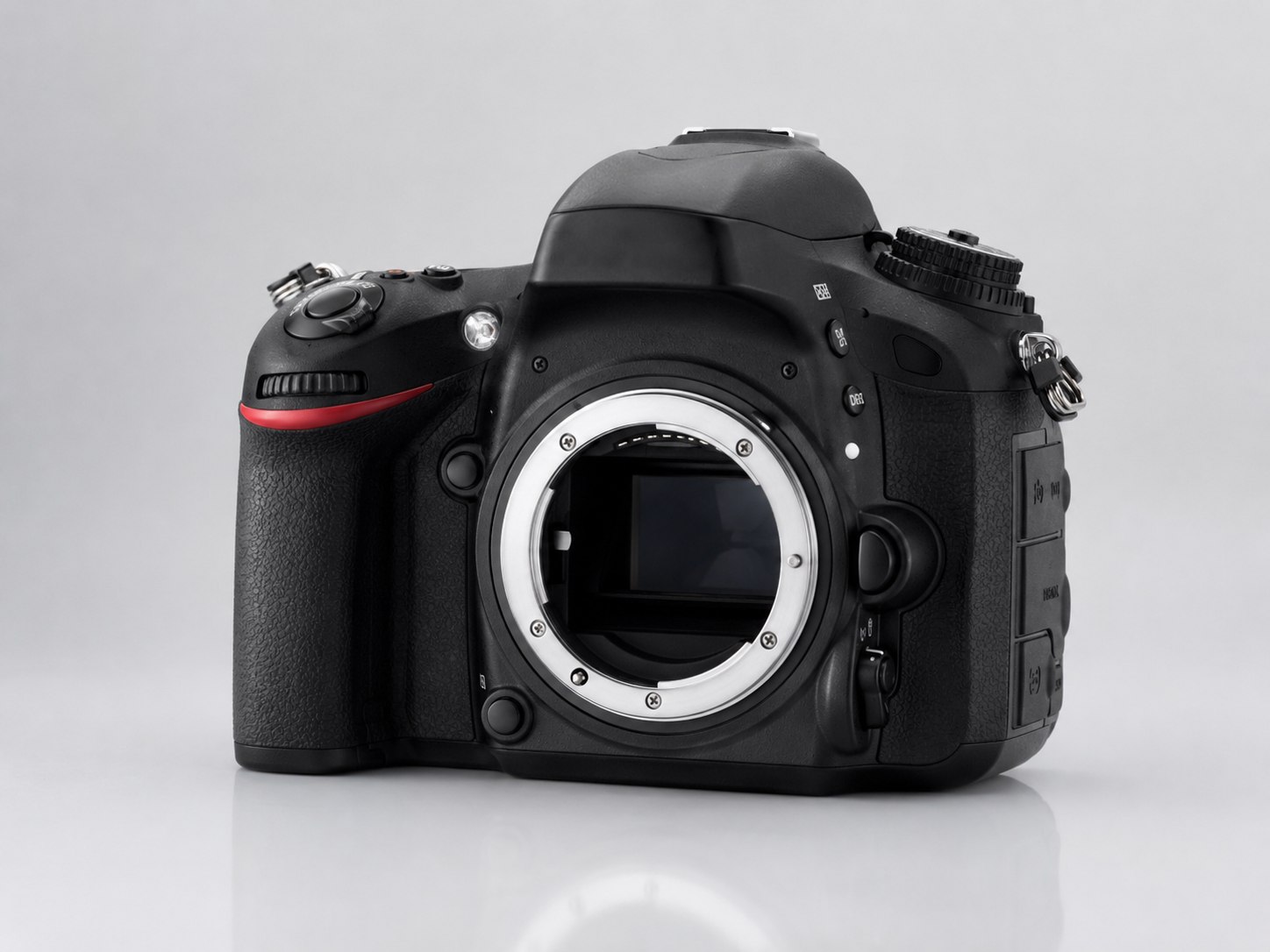
In short
- The Nikon D610 features a 24.3 MP full-frame sensor from 2013 that still handles ISO 6400 with clean files and 14 stops of dynamic range.
- On the used market, the camera body alone is priced between 400 and 600 euros, compared to its launch price of 1,900 euros: it is the most affordable Nikon full-frame with dual SD slots.
- The D610 resolved the oil spot issue on the D600's sensor: a body with a replaced shutter or under 30,000 certified shutter count is generally reliable.
- For those sticking with Nikon DSLR and already owning FX lenses, it costs less than an equivalent full-frame mirrorless like the Sony A7 Mark II or the Canon EOS RP.
The Nikon D610 is one of those camera bodies that no one mentions anymore, yet quite a few still pass through our shop. Every time, the story is the same: someone brings it in for trade-in to switch to mirrorless, while another takes it home, realizing they bought a true full-frame for less than 600 euros. In between lies the prejudice that a 2013 DSLR is outdated gear.
In this article, I explain what the D610 actually does today, where it shows its age, and where it remains competitive. It is not the right camera for everyone, but for a specific segment of photographers, it is still one of the most sensible purchases you can make on the used market. I say this as someone who opens, tests, and resells these cameras.
What is the Nikon D610 and why it exists
The D610 is the most affordable full-frame Nikon with dual SD slots you can buy today: between 400 and 600 euros for the camera body alone, compared to the 1,900 euro list price at launch in October 2013. It is not a machine built from scratch, however. It is the corrected version of a model that Nikon got wrong the year before.
The D600 issue and the birth of the D610
The 2012 D600 was supposed to be the full-frame "for everyone," but it had a specific flaw: the shutter mechanism released oil particles and debris that ended up on the sensor. Result: recurring dark spots in the top-left corners, visible especially at closed apertures against the sky or uniform walls. A cleaning wasn't enough; they came back after a few hundred shutter counts.
Less than a year later, Nikon released the D610 with a revised shutter, which eliminated the original issue. Same sensor, same ergonomics, practically the same camera: the shutter assembly changed, along with a slightly faster burst rate (6 fps instead of 5.5) and a new silent shooting mode. The D610 exists, in practice, to close the D600 chapter.
What this means for those buying used today: a D610 with an original shutter count under 30,000, or with a shutter already replaced, is generally safe. The oil spot issue is a concern specific to the D600, not this model.
What does "full-frame entry-level" mean
Here, "entry-level" needs to be read carefully, as it can be confusing. It does not mean an amateur or beginner's camera. It refers to the entry tier of the Nikon full-frame line: the lowest step to enter the 24x36 format without buying a D750 or a D810, which were significantly more expensive.
In concrete terms, "entry-level full-frame" in 2013 meant this:
- Full-frame sensor, identical in size to that of the flagship models, not an APS-C.
- Simplified body compared to the pro models: no button illumination, shutter rated for 150,000 shutter count instead of 200,000, 100% viewfinder but with a more compact pentaprism.
- Full compatibility with the Nikon FX lens lineup, including older AF-D lenses thanks to the AF motor in the camera body.
It is a serious camera with a body built to last, not a toy. The "entry" refers to its market positioning, not image quality. And that is exactly what makes it interesting today on the used market.
The sensor: 24 megapixels that still hold up today
The D610 sensor is a 24.3-megapixel full-frame CMOS introduced in 2013, and after more than ten years, it still produces files that hold up against modern cameras. Resolution hasn't changed much: most entry-level full-frame cameras today sit between 24 and 26 megapixels. What truly matters — single-pixel quality, high-ISO cleanliness, and dynamic range — remains competitive on this sensor. For prints up to 50x70 cm or for web use, 24 megapixels are more than sufficient and likely will be for a long time to come.
Dynamic range and post-production files
Dynamic range is the reason this sensor ages well. We are talking about approximately 14 stops at ISO 100, a value that placed the D610 at the top of its category at the time. In practice, this means you can recover closed shadows from a RAW file without blowing out the noise and pull down blown highlights within a certain limit.
For an intermediate photographer, this matters more than megapixels. A sky recovered by two or three stops in a backlit landscape, or the opened-up shadows of an interior, make the difference between a discarded shot and a saved one. The D610's NEF RAW file is malleable: it withstands heavy adjustments in Lightroom or Capture One before showing artifacts.
Real ISO: how far can you push it
When it comes to ISO, it is worth being concrete, as marketing tends to inflate the numbers. Here is what you get in practice:
- ISO 100-1600: virtually clean files, negligible noise. Ideal working range.
- ISO 3200-6400: noise present but controllable, detail preserved. Fully usable for reportage, weddings, and interiors.
- ISO 12800: usable in emergencies, with some noise reduction in post. Holds up even better for black and white.
- ISO 25600 and above: extended values, to be considered only as a last resort.
The honest fact is this: ISO 6400 is the practical ceiling for files you don't have to justify to anyone. A recent full-frame mirrorless camera might gain perhaps one stop in this regard, no more. For the vast majority of real-world uses, the D610 gets you the shot even in low light.
Real strengths and limitations, no marketing
The D610 does one thing exceptionally well: taking photos. Everything else — video, modern autofocus, connectivity — is secondary or absent. If you accept this design philosophy, you have a full-frame body that performs as well today as it did twelve years ago. If you expect a Swiss Army knife, look elsewhere.
The strengths that justify the purchase
The qualities that the D610 retains have no expiration date. They are design choices, not specs to chase.
- Dual SD card slots: write to two cards in parallel (automatic backup) or separate RAW and JPEG. For those shooting weddings or paid work, it's a guarantee that today's budget mirrorless cameras often don't offer.
- Partial weather sealing: seals on controls and doors. You won't take it into a thunderstorm, but a humid day or a bit of dust won't stop it.
- Real-world battery life ~900 shutter count: the EN-EL15 battery lasts a full day without recharging. An optical viewfinder doesn't drain power like an electronic screen, and you can tell.
- 100% optical viewfinder: you frame exactly what you record, with no lag and no digital noise in the dark. Those coming from film will feel right at home.
The limitations you have to live with
The D610's flaws are all tied to the age of the project. None are factory defects: they are simply things that did not exist or were not a priority in 2013.
| Limitation | What it means in practice |
|---|---|
| 39-point AF | The points are concentrated in the center. For off-center subjects, you must focus and recompose. You will struggle with sports and fast action. |
| 6 fps burst | Honest for portrait and landscape, but short for those who photograph hunting, football, or birds in flight. |
| 1080p video | No 4K, and video autofocus is slow and imprecise. It is fine for an occasional clip, not for serious videography. |
| No IBIS | Stabilization is only on the lens (VR lenses). With a non-stabilized 50mm prime, you must use faster shutter speeds when shooting handheld. |
| Fixed screen | It does not tilt. Shooting from low angles or overhead becomes uncomfortable. |
The distinction is simple: the D610 rewards those who shoot with patience and penalizes those chasing motion or looking to shoot video. Knowing where you stand tells you immediately if it's the right camera for you.
How much does a used D610 cost and what to check
In 2026, a D610 in excellent condition changes hands for between 400 and 600 euros for the camera body alone. A camera that cost 1,900 euros at launch is now available for less than a third of that price. It is the lowest price at which you can enter the Nikon full-frame DSLR segment with a dual SD card slot, and that alone explains why it continues to sell well.
Price ranges in 2026
Price is not just a number: it depends on how much the camera has worked and how it has been maintained. Here is how the market actually moves.
| Configuration | Indicative price |
|---|---|
| Body only, over 50,000 shutter count, several signs of use | 400-450 euros |
| Body only, under 30,000 shutter count, excellent condition | 500-600 euros |
| Kit with 24-85mm VR | 650-800 euros |
What makes the difference are two factors: the shutter count and the cosmetic condition. A camera body at €580 with a certified shutter count of 12,000 is worth every extra euro compared to one at €420 with 80,000 shutter count and peeling rubber seals. Be wary of prices that are too low from private sellers: they often hide a tired shutter or a sensor that has never been truly cleaned.
The shutter and shutter count
The shutter count of the D610 is reported to be approximately 150,000. This is a statistical value, not an expiration date: some shutters fail earlier, while many last well beyond this figure. The data that truly matters is the actual count, readable in the EXIF metadata of any JPEG file just taken.
Three things to check before buying:
- The certified shutter count, not just verbally declared. Below 30,000 shutter count, you still have two-thirds of the theoretical lifespan ahead of you.
- Whether the shutter has already been replaced. This happens with camera bodies sold as D600 that were returned to service for oil spots: in that case, the count resets and the camera is effectively reborn.
- Consistency between shutter count and aesthetic wear. A camera body with 8,000 shutter count but shiny buttons and a worn grip tells a story that doesn't add up.
Without a certified shutter count, you are buying blind. This is exactly the difference between a private listing and a refurbished used item: we put the number in writing for you, along with the 2-year warranty.
What we check in our lab on every D610
Every D610 that enters our store goes through the inspection bench before being listed in the catalog, and for the D610, the protocol is stricter than usual. You know the reason if you have read the previous sections: this camera body was designed to correct the oil spot defect of the D600, and our job is to verify that the correction has truly held on that specific unit, not just on paper.
The procedure always follows the same order, so we don't skip any steps. Here is what we do, step by step.
- Certified shutter count. We read the actual value from the EXIF, not the one declared by the seller. On a D610 with under 30,000 shutter count, the shutter is practically new; the shutter is rated for approximately 150,000 cycles, so we immediately know how much life is left.
- Oil spot test. We take shots at f/16-f/22 on a uniform surface and analyze the frame at 100%. If the dots in the top left corner typical of the D600 appear, we know that the camera body either has the problematic original shutter or needs a thorough cleaning. We tell you before the purchase.
- Sensor cleaning. Professional wet cleaning of the low-pass filter, not a quick blow. On a full-frame, dust is visible, and a dirty sensor turns every clear sky into a hunt for dots in post.
- AF fine tuning calibration. We verify front and back focus with the 39 points of the Multi-CAM 4800 module. If needed, we correct the calibration for the most common lenses, so the autofocus works precisely right from the start.
- Body and contacts check. Dual SD slot, dials, buttons, EN-EL15 battery compartment, mount and electrical contacts. We verify that everything responds and that there are no suspicious play.
Only after these five steps does the camera receive our 2-year warranty and go on sale. This means you are paying for a verified camera body, not a gamble bought blind from a private seller.
The same rigor applies in reverse: if you have a D610 to sell, we know exactly what it is worth and why. If you want to understand how the valuation works and which documents to keep on hand, we have written a dedicated guide on how to sell used photographic equipment without selling it for less than it's worth.
D610 vs. alternatives: DSLR or mirrorless?
The real question isn't "DSLR or mirrorless", but "do I already have Nikon FX lenses or am I starting from scratch?". If you have a drawer with a 50mm f/1.8 AF-S and a 24-85 zoom, the D610 is the most cost-effective way to mount a full-frame sensor on them. If you're starting with nothing, the calculation changes and it's worth looking outside the DSLR system as well.
Sticking with full-frame DSLRs: the comparison with the Canon 5D Mark III
In the same price range for used gear, the other most sought-after full-frame DSLR is the Canon 5D Mark III. It is a more professional camera body: 61-point autofocus versus the D610's 39 points and a burst rate of 6 fps. However, it costs more and ties you to the Canon EF mount system. If you want to understand where one truly offers better value than the other, we discussed it in detail in this article dedicated to the used 5D Mark III. The bottom line: for those already using Nikon, the D610 wins on value for money without debate.
Switching to mirrorless: Sony A7 Mark II, Canon EOS R
Used full-frame mirrorless cameras have now entered the same price range. Two examples from our catalog:
- Sony A7 Mark II — around 580 euros. Same price as the D610, but with 5-axis in-body image stabilization: a real advantage that the D610 lacks. In return: electronic viewfinder, smaller battery, and a native lens lineup to build.
- Canon EOS R — 800 euros. Newer, with a tilting screen and usable 4K video. However, it costs 200-400 euros more than the D610 body alone and requires RF lenses or an adapter.
The honest truth: if you need stabilization, video, or a compact body, a mirrorless camera makes sense even at the same price. If you photograph static subjects with the viewfinder to your eye and already own FX lenses, the D610 does the same job for less. Switching systems means selling or adapting all your lenses: factor that in before letting the latest spec sheet tempt you.
Full-frame or APS-C: Is the D610 really worth it?
Full-frame does not automatically make your photos better. It changes specific results, and for many uses, that difference is not visible. Before spending 400-600 euros on the D610, you should understand whether the large sensor truly works for you or if you are paying for something you do not use.
When full-frame really matters
The D610's FX sensor makes sense when your work involves any of these specific aspects:
- Portrait with soft background: with the same framing and aperture, the full-frame separates the subject from the background more sharply. An 85mm f/1.8 on FX delivers a bokeh that you cannot achieve on APS-C with the same focal length.
- Landscape and true wide-angle: a 24mm remains a 24mm. On APS-C, the same lens becomes a 36mm equivalent, and you lose the width needed in the mountains or in tight interiors.
- Low light: larger photosites gather more signal. At ISO 3200-6400, the D610 produces cleaner files than a same-generation APS-C, useful for concerts, church ceremonies, and interiors without flash.
When you don't need it: if you shoot sports, wildlife, or birds, the APS-C crop factor gives you extra reach for free. If you only post on social media or print up to A4 size, the quality difference between FX and DX at low ISO is practically invisible. And if all your lenses are DX, mounting them on a full-frame body forces you into crop mode, negating the advantage.
The APS-C alternative: Nikon D7200
For those who do not fall into any of the three cases above, the used Nikon D7200 is often the most rational choice. It costs less than the D610, uses the same F mount, and leverages the entire DX lens lineup, which is generally lighter and more affordable than its FX counterparts.
The practical rule I apply at the counter is simple:
- Already have FX lenses and shoot portraits, landscapes, or low light? D610.
- Starting from scratch, shooting a bit of everything, and watching your budget? D7200.
- Shooting distant moving subjects? The APS-C format gives you an advantage, D7200.
Full-frame is a tool, not a status symbol. Buying it because "that's what professionals use" is the fastest way to spend more and shoot the same.
Who I recommend the D610 to, and who I don't
The D610 is a camera for those who shoot with patience and know exactly what they want. It is not for those chasing the latest specs, but for those who put the full-frame sensor above everything else. After handling dozens of these bodies at the counter, I have a fairly precise idea of who leaves satisfied and who returns disappointed.
I buy it with my eyes closed if you fit one of these profiles:
- You already own Nikon FX lenses. A 50mm f/1.8 or a 24-70mm in your cabinet changes everything: spend 400-600 euros on the camera body and that's it.
- You shoot portraits, landscapes, still life. Subjects that are still or nearly still: the 39 central AF points won't hold you back, and the 24-megapixel full-frame sensor makes a difference in print.
- You want full-frame at the lowest possible budget. Sticking with Nikon DSLRs, there's nothing better under 600 euros with a dual SD card slot.
- You prefer the optical viewfinder. For those coming from a DSLR who don't want to give up direct viewing, without lag and without battery drain from the display.
I would not recommend it, however, in these cases:
- Capture fast-moving subjects. Sports, running kids, animals: the 39-point AF, all clustered in the center, will make you miss shots that a recent mirrorless camera would nail.
- Video matters. The D610 does 1080p and that's it, without serious continuous autofocus. Look elsewhere for video.
- Starting from scratch with no lenses. The situation changes here: if you also need to buy the optics, a full-frame mirrorless with a native kit might make more sense in the long run. I covered this in how to choose your first used mirrorless.
- You want a lightweight travel body. It's 850 grams for the body, plus the weight of FX lenses. That's a lot for a travel bag.
In short: the D610 rewards those who have already invested in Nikon and shoot static subjects. It penalizes those looking for speed, video, or lightweight gear. If you fit the first group, it is one of the best value-for-money full-frame options on our bench. If you are in the second, let me save you the disappointment: look at a mirrorless.
Frequently asked questions
Does the Nikon D610 still have the oil spot issue from the D600?
No. The D610 was designed specifically to resolve this: it features a revised shutter and an improved self-cleaning system. On camera bodies that pass through our workshop, we still check the sensor on a sample basis, but the structural defect of the D600 is not present here.
How many shutter count can a D610 take before the shutter wears out?
The shutter count is stated to be approximately 150,000. Many used camera bodies we see are between 20,000 and 60,000 shutter counts, so they still have most of their life ahead. The certified shutter count is the first thing to ask for.
Is a used D610 or a full-frame mirrorless camera the better choice in 2026?
It depends on your lens collection. If you already own Nikon FX lenses, the D610 saves you the cost of switching systems. If you are starting from scratch, a Sony A7 Mark II (with in-body stabilization) or a Canon EOS RP offer a modern mirrorless mount at similar price points.
Is the D610 suitable for video?
Only for basic needs. Records in Full HD 1080p without 4K, without log profiles, and with unreliable video autofocus. If video matters to you, this is the main limitation of this camera.
Which lenses are needed to take full advantage of the D610's full-frame?
Nikon F-mount lenses in FX format. DX lenses vignette or force a crop, reducing the sensor size. A 50mm f/1.8G or a 24-85mm are affordable and solid starting points.
Is the D610 waterproof?
It is partially weather-sealed, with seals on buttons and main joints. It withstands light rain and dust, but should not be treated as a fully sealed professional body like a D850.
How much does a used Nikon D610 cost at ReflexMania?
The typical price range for the camera body alone is €400-600, depending on shutter count and aesthetic condition. Every unit is inspected in our lab, with certified shutter count and a 2-year warranty.
Looking for a used, guaranteed Nikon D610?
If you have questions about a purchase or need advice for your specific case, contact us. We offer free advice because we are photographers first, and because a customer who makes a poor purchase does not return to photography.
Three ways to get in touch:
- Contact form — response within 24 business hours
- WhatsApp at 342 362 3454 (messages only)
- Phone: 071 291 6347 (Mon-Fri 9am-1pm/3pm-6pm, Sat 9am-1pm)
And if you want to see what we have in stock right away, explore the used gear available today: every camera is certified, comes with a 2-year warranty, and ships within 24-48 hours.
Article written by Matteo for the ReflexMania Team. Last updated: June 2026. Prices and availability as of the time of publication.