
In short
- The realistic price of used equipment is calculated by taking a certified dealer's list price and subtracting 15-25%, not based on Subito's fantasies.
- Shutter count, sensor condition, and kit completeness (box, charger, strap) impact the value by 10% to 30%.
- Private sales on Subito or eBay may yield higher returns on paper but involve risks: dubious payments, fake returns, and lost shipments.
- Trade-in or direct purchase from ReflexMania: valuation within 24h, immediate payment or discount on new used gear, zero risk of scams.
Every week at our Ancona counter, photographers arrive with a backpack full of gear they no longer use: an old Canon DSLR, two prime lenses, a flash, a few batteries. The question is always the same: "What is all this worth?" And almost always, the answer differs from what they expected, in one way or the other.
In this guide, I explain how to truly assess a used camera body or lens, what sales channels are available, what factors drive the price up or down, and why — sometimes — buying from a specialized store like ReflexMania is worth it, even if it seems like you're getting less on paper. The used photography market has precise rules: knowing them helps you sell well, while ignoring them costs you months and hundreds of euros.
What Your Gear Is Really Worth: How the Price Is Calculated
The first mistake sellers make is looking at Subito listings and using the highest price as a reference. Those listings are not sales: they are asking prices. A camera listed at 800 euros on Subito for six months is not worth 800 euros; it is worth whatever no one has been willing to pay yet.
The actual price of a used camera body or lens is determined through careful analysis, starting from a verifiable data point and applying a discount consistent with the risks inherent in a private sale.
The benchmark method: start from the price of a certified used item
Open a specialized dealer's website, search for the same model, and note the price at which it is sold with warranty. That number is your baseline: it is the price the market accepts in exchange for a machine that has been inspected, tested, and covered by a 2-year warranty.
Don't look at the highest single private listing. Check 4-5 price lists from reputable dealers and calculate the average. That is the baseline; everything else is negotiation.
The realistic range: -15% / -25% compared to the certified value
A private seller cannot expect the same price as a store. The reasons are concrete:
- No warranty: buyers assume 100% of the risk of failure.
- No inspection: no one has opened the camera body to check the shutter count, sensor, or contacts.
- No returns: if the camera arrives with a hidden defect, the buyer keeps it.
- No invoice: for a professional who wants to deduct the cost, this is a constraint.
For this reason, the realistic range falls between -15% and -25% compared to the price of a certified used item. Below -15%, you are selling at a loss; above that, it will remain unsold for months.
Concrete examples from our current price list today
Three actual cameras currently on our bench as I write this, with the calculation applied:
| Model | ReflexMania Price | Realistic Private Range |
|---|---|---|
| Sony A7 Mark II | 550-580 euros | 415-490 euros |
| Canon EOS RP | 600 euros | 450-510 euros |
| Fujifilm X-T1 | 380 euros | 285-325 euros |
A Sony A7 II that we sell for 580 euros with a 2-year warranty cannot reasonably be requested at 580 euros from a private seller. The fair price is around 450-490 euros, and if you list it at 520, you will keep it at home until Christmas.
The Fujifilm X-T1 is the most delicate case: at 380 euros with a certified shutter count, a private seller asking for 350 is underpricing it by 50-80 euros. The buyer prefers to add 30 euros and get the warranty.
The factors that make the price fluctuate: shutter count, condition, accessories
Two identical camera bodies on the shelf can differ in value by 30%. The difference is not the model: it is what lies behind it. Shutter count, sensor condition, box completeness, and signs of use move the price much more than you might think. When we assess used equipment in-store, we start with the bare body and then add or subtract based on these four parameters.
Shutter count: the key metric on DSLR and mirrorless
The shutter is a mechanical component with a finite lifespan. On DSLRs and mirrorless cameras with a mechanical shutter, the shutter count is the first piece of data we request. Typical ranges we see come through the counter:
- Under 10,000 shutter count: practically new camera, top market price.
- 10,000–50,000: normal amateur use, full or near-full value.
- 50,000–100,000: seriously used, 10-15% discount compared to the same model with fewer shutter count.
- Over 150,000: approaching the manufacturer's declared limit. Straight 20-30% discount, provided the unit is still sellable.
On mirrorless cameras that allow the use of the electronic shutter, such as the Olympus OM-D E-M1 mark II at 600 euros, the mechanical count carries less weight if the previous owner frequently shot in silent mode: the electronic shutter does not wear out. It remains a useful indicator of overall usage, but it is less definitive than on DSLRs.
Sensor condition: dust, scratches, oil spots
Dust on the sensor is normal and can be cleaned: it does not affect the price. What truly impacts the value are scratches on the AA filter and recurring oil spots typical of certain models. A scratch on the sensor is permanent damage that reduces the value by 30-40% or makes the camera body unsellable as a certified used item. Before listing, take a shutter count at f/16 against a white wall and check it on the monitor: this is the test we perform in our lab in five minutes.
Kit completeness: box, charger, cables, manuals
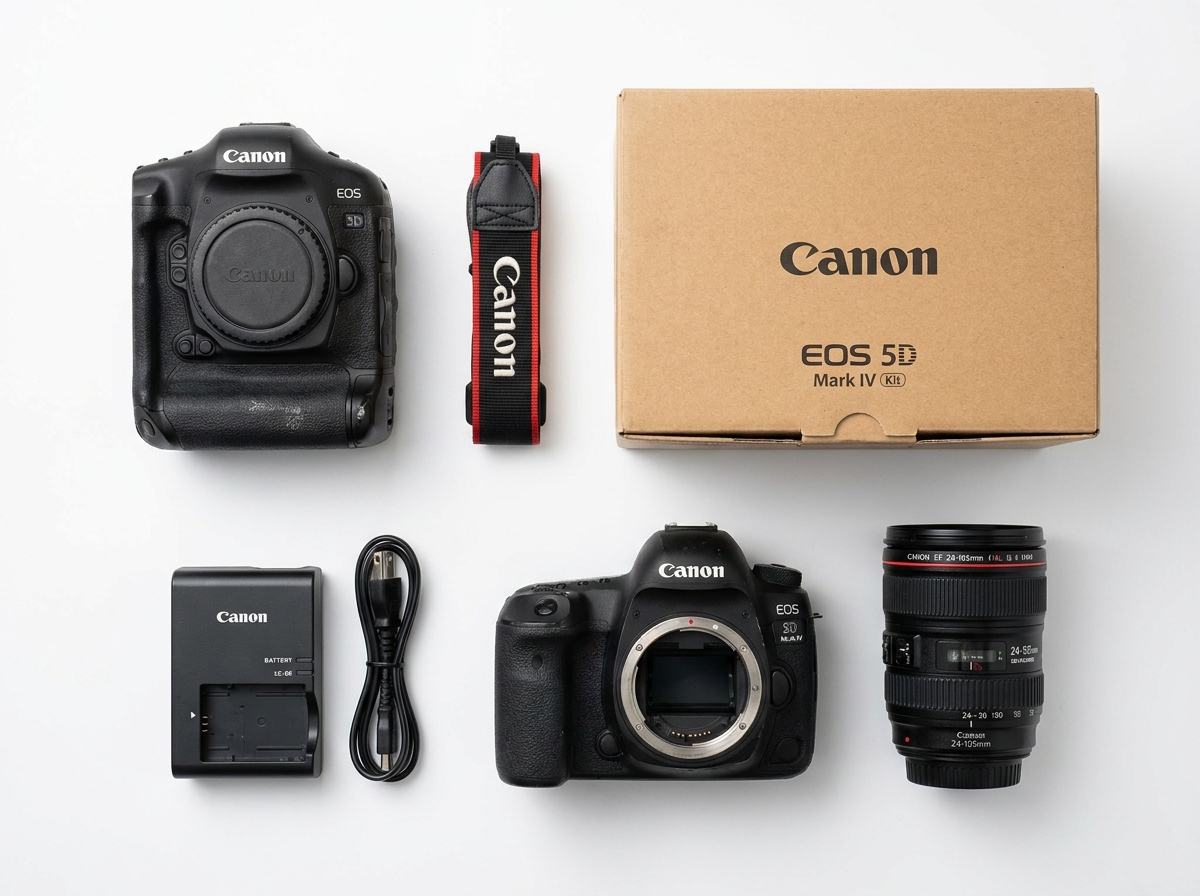
A bare body loses value. Having the original box, battery charger, battery, strap, and cables adds 10% to 15% more in value. A Panasonic GH5 at 470 euros, complete with all accessories, sells; the same bare body, without the charger, costs 50-70 euros less. The box weighs very little on its own, but it communicates care: buyers of used equipment want that signal.
Aesthetics: scratches, signs of use, rubber parts
We distinguish between cosmetic and structural issues. Scuffs on the tripod base, worn paint on buttons, slightly lifted rubber feet: all acceptable, with zero or minimal discount. The situation is different for drop dents, scratched LCD screens, deformed hot shoes, or detached or missing rubber feet. Here we are talking about a real depreciation, from 15% to 25%, because they indicate trauma and raise doubts about internal integrity.
Private sales: Subito, eBay, Facebook groups
DIY is the path that looks most profitable on paper, but it is also where I have seen the most photographers lose time, money, and patience. It is only worth it if you know exactly what you are doing and have genuine patience, not just the kind you claim to have.
How much more you earn (on paper)
Selling to a private buyer can net you 15-25% more than what a specialized store offers. It’s simple math: the retailer must cover inspection, 2-year warranty, physical space, and VAT on the margin. You don’t.
On an 800-euro camera body at a shop, you can ask for 950-1000 in private sales. On a 1500-euro lens, we're talking about a 200-300 euro difference. These figures may seem attractive, until you weigh them against everything else.
The risks: reversible bank transfers, PayPal Friends&Family, fraudulent returns
Fraud in the photo industry is creative and recurring. The three I see most often:
- "Advance" bank transfer with fake receipt: the buyer sends a screenshot of a transfer that was never initiated, you ship the item, and the transfer never arrives. For business accounts, you must wait for the actual credit, not the notification.
- PayPal Goods&Services with fraudulent return: the buyer opens a dispute claiming "item not as described", returns a different or damaged camera body, and PayPal refunds them in case of doubt. You lose both the camera and the money.
- Friends&Family to "save on fees": anyone asking for this knows that you lose all buyer protection. It is a classic red flag.
- "Lost" shipment: the package is marked as delivered by the carrier, but the buyer denies receiving it. Without insurance and a signature upon delivery, you are exposed.
On items under 300 euros, the risk is manageable. Above 1,000 euros, a single scam wipes out the margin from ten successful sales.
Timing: weeks or months, not days
The other hidden cost is time. Based on the numbers we see coming through the counter, the average timelines for private sales are as follows:
| Price range | Average selling time |
|---|---|
| Under €300 | 2-4 weeks |
| €300-800 | 1-3 months |
| €800-2000 | 2-6 months |
| Over €2000 | Even over 6 months |
Add 20-50 messages dealing with negotiation, time-wasters, and missed appointments. If your time is worth anything, the private seller's "net gain" shrinks rapidly.
When it truly makes sense: rare or high-value items for expert private buyers
Private sales are the right choice in a few specific cases. Vintage German or Russian manual lenses (Zeiss Contax, Helios, Jupiter) have a collector market that values them better than any generalist store. The same applies to cult film camera bodies, medium format backs, and out-of-production tilt-shift lenses.
For the rest — DSLRs and mirrorless cameras from the last ten years, kit zooms, common autofocus lenses — the theoretical margin rarely compensates for real risks and turnaround times.
Sell or trade-in at a specialized store: how it works at ReflexMania
Anyone walking into our store with a camera to sell almost always asks the same question: "How much will you offer?" An honest answer comes after a thorough evaluation, not a quick guess at the counter. Here is how we handle the process, from the first photo you send to the final payment.
Free valuation: how to prepare
Before bringing or shipping anything, contact us via WhatsApp or email with the following information:
- Real photos: camera body top/bottom/sides, display on, mount, front glass of every lens. No photos stolen from the manufacturer's website.
- Shutter count: read from the metadata of the last JPEG file using tools like ShutterCount or EXIFTool. On older mirrorless models, it is sometimes not exposed.
- Purchase year and receipt: a Sony A6100 bought in 2021 with a receipt is worth more than the same camera without proof of purchase.
- Included accessories: original box, battery charger, strap, caps, possible second battery. A Nikon Z30 complete with everything is worth up to 15% more than the same camera "bare".
We will respond within 24 hours with a written valuation, binding unless different actual conditions are found at pickup.
In-store pickup or insured shipping
If you live in Ancona or the surrounding area, bring everything to the counter and we’ll finalize the deal in half an hour. For those located elsewhere, we arrange the shipment via a courier insured for the agreed value. The insurance coverage is at our expense, so if the package is lost or arrives damaged, it’s not your problem. Proper packaging and the courier’s invoice/receipt are required: no padded envelopes for a camera body.
Immediate payment vs. trade-in for other used items
Here, the choice significantly affects the figures. Cash payment via immediate bank transfer: "clean" valuation. Trade-in for another used item from our catalog: on average, 10-15% more for the same camera body.
Concrete example: an Olympus PEN E-PL9 valued at 300 euros as a trade-in becomes 260-270 in cash. The difference covers the margin we would recover by reselling it. If you are changing systems, a trade-in is almost always the better option.
What we check at the lab before reselling
Before your camera hits the display, it goes through our lab. Certified shutter count test, sensor inspection with raking light for dust and scratches, shutter verification at all speeds, mount contact check, and autofocus calibration on target. If anything is off, we fix it before resale.
For this reason, we offer a real 2-year warranty on used equipment: every unit has been opened, tested, and serviced. This is also why our valuation is lower than the final selling price: laboratory work costs money, and someone has to pay for it.
What to sell and what to keep: the mistake of emptying your bag
When a photographer decides to "cash out," the temptation is to sell everything. Five minutes after selling, they realize that the 50mm lens bought ten years ago can no longer be found at the same price. Not everything in your bag should be monetized: some pieces yield very little when sold but deliver immense value when used.
Before posting the ad or bringing the bag to the store, make an honest selection. The right question is not "how much do I pay for it", but "if I sell it today, will I buy it back in six months?". If the answer is yes, leave it where it is.
High-quality prime lenses: they hold their value well, keep them
Fast prime lenses are the component that ages best in any kit. A native 50mm f/1.8 for your system is worth today what it was three years ago, barring any mount changes. A 35mm f/1.4, an 85mm f/1.8, a 100mm macro: all glass that retains its value because the market constantly seeks it out.
Selling it means settling for modest returns and then buying it back at a slightly lower price when your next camera body makes you want to get into portrait photography. Keep your prime lenses, especially if they are compatible with the system you are migrating to via an adapter.
Flashes, tripods, accessories: ridiculous prices, better to give them away or keep them
The used accessories market is disastrous. A flash you paid 350 euros for new sells for 80 if you're lucky. A mid-range tripod goes for 50. Bags, filters, remote releases, and battery chargers trade at 20-30% of the list price.
It only makes sense to get rid of it if it bothers you at home. Otherwise:
- Compatible flashes: keep them; you will eventually need one for an event or a home portrait.
- Tripods: their utility value exceeds their resale value for years.
- High-quality ND and polarizing filters: they often fit the diameter of other lenses, so do not give them up.
- Original batteries and chargers: if you switch systems, give them to a friend who has the same camera body. The gratitude is worth more than the 15 euros you would get.
When clearing makes sense: a complete system change
The exception is a complete migration, such as moving from a Canon EF DSLR to a Sony E-mount mirrorless system. Lenses, bodies, dedicated flashes, batteries: nothing is reusable on the new system. In that case, accumulating gear only incurs storage costs and depreciation risk.
Here is the practical advice: sell the entire lot to a specialized store. In our workshop, we evaluate the complete kit as a single unit, make you one offer, and we are done. Fragmenting the sale on Subito—three camera bodies, six lenses, two flashes—means two months of negotiations, delays, and open listings. Time is worth more than the 10% difference in the final price.
Common mistakes by sellers: inflated prices, poor photos, vague descriptions
Every week, photographers come into the shop who have tried selling privately for three or four months without receiving a single serious offer. Nine times out of ten, the listing has the same problem: a price out of market, poorly taken photos, and a description that says nothing technical. These are avoidable mistakes, but those who do not sell gear professionally almost always make them all at once.
Photos taken with a phone in low light on the sofa
A Fujifilm X-T3 photographed on a living room cushion, yellow light from the chandelier, reflections on the camera body, TV remote in the background. A dead listing from the start. Anyone buying used gear over 500 euros wants to see exactly what they are getting, not guess.
How to actually photograph a camera body or lens for sale:
- Neutral background: a white or grey A3 sheet of paper, a clean table, no blankets
- Diffused light from a window mid-day, never direct phone flash
- Minimum of six shutter count shots: front, back, top, bottom, lens mount, display on with information menu
- For lenses: front and rear elements in close-up, visible electrical contacts
- One photo of the serial number and one of the screen showing the certified shutter count
A phone is perfectly fine; a DSLR is not required. It just takes ten minutes of attention instead of three seconds on the sofa.
"Like new" without declared shutter count
"Like new", "barely used", "kept in excellent condition" are phrases that an experienced buyer skips over. They mean nothing. A Sony A7 III with 80,000 shutter count can be "kept in excellent condition" and still be halfway through its mechanical lifespan.
A serious listing states: certified shutter count (with a screenshot of the software reading it, EOSInfo for Canon, ShutterCount for Nikon, web services like camerashuttercount.com for Sony), year of purchase, any service interventions, and box completeness. Without this data, the listing ends up in the pile of amateur posts and serious buyers scroll past. On the broader topic of mistakes to avoid when looking at used gear from the other side of the counter, we wrote five typical mistakes made by those buying a used camera: it is worth reading even as a seller, because it explains what the other side is looking for.
Price anchored to purchase cost, not the current market
The most common mistake of all. The photographer opens the drawer, pulls out the 2020 receipt, sees 1,400 euros and lists it for 1,100. "Only three hundred euros less, it's a bargain." It is not a bargain: it is a camera body from six years ago that today on the certified market is worth 600.
The price is always calculated based on the model's current value, not the amount originally paid. Today's retail price from a certified dealer, minus 15-25% for a private sale. Everything else is emotional attachment, not economics.
Taxation and invoice: what happens when you sell to a store
Many photographers are put off by the word "invoice" and give up on selling to a shop for fear of tax complications. The reality is much simpler: if you sell a personal item that has never been used for commercial purposes, you owe nothing to the tax authorities. Only the document you sign changes, depending on who the buyer is.
Let's look at the two scenarios that concern 99% of photographers.
Private-to-private sale: no obligations
When you sell your Nikon to another private individual on Subito, eBay, or in a Facebook group, you are not conducting commercial activity. You are transferring a personal asset that you purchased for your own use. Italian regulations are clear: the occasional sale of personal goods does not constitute taxable income and does not require a VAT number.
This applies under one condition: the sale must be occasional and involve items you did not purchase with the intent to resell. If you sell two or three camera bodies a year because you are switching systems, you are fully within the law with no compliance requirements. However, if you continuously buy used equipment to resell for a profit, the Revenue Agency considers the activity habitual, triggering commercial obligations.
In practice, for the average photographer:
- No invoice to be issued
- No additional tax declaration
- No withholding on the amount received
- Keeping proof of payment received is still good practice
Sale to reseller: receipt or declaration of origin
When you sell to a store like ReflexMania, nothing changes on your end from a tax perspective: you receive the agreed price, that's it. What changes is the accounting document the store is required to issue to record the purchase.
Typically, you sign a declaration of origin with the following details:
- Your personal details and tax code
- Description of the equipment including the serial number
- Transfer amount
- Declaration that the item is your property and of legal origin
The shop uses this to track inventory in the incoming/outgoing register, as required by regulations on the trade of used goods. It is the same principle applied to jewelry stores and gold buyers, although the atmosphere in our sector is much more relaxed. For you, it is simply a document signed in three minutes, nothing more.
A practical note: the serial number on the declaration protects you as well. Should the camera appear in any anomaly report, the document proves that on date X you sold it to a registered operator. This is exactly what we do in the workshop: every camera body that comes in is registered, photographed, and cataloged. For the shop, it is an obligation; for the customer, it is a guarantee of transparency.
If you are a business owner with a VAT number and the equipment was depreciated within your company, the situation changes: in that case, the sale generates a capital gain and must be invoiced. However, this is a professional scenario, outside the scope of this guide.
Actual selling times: what to expect based on price range
Selling a used camera is not like selling a smartphone. Demand is fragmented, buyers are informed, and the time between listing and payment varies significantly depending on your asking price. In ten years behind the counter, I have observed very stable patterns: the price range determines the pace, more than the specific model.
Below are the average selling times I observe on the Italian private market, assuming a fair price and a decent listing.
| Price Range | Average Private Sale Time | Typical Number of Contacts |
|---|---|---|
| 200-450 € | 1-2 weeks | 5-15 messages |
| 500-900 € | 3-6 weeks | 3-8 qualified messages |
| 1000+ € | 2-5 months | 2-5 qualified messages |
Entry-level range (200-450 euros): fast turnover
Under €450, the market is hungry. Students, parents buying a first camera, and hobbyists who want to try mirrorless without breaking the bank. A body like the Sony A6000 at €360 or the Canon EOS R100 at €400 from a private seller sells within 7–15 days if the price is competitive and the listing photos aren’t taken with a phone in the dark.
However, be aware: in this price range, you will also encounter less serious buyers. Expect questions like "final price?" without even reading the description, and some attempts to pay via creative methods.
Mid-range (500-900 euros): more considered
Here, the buyer compares. They open 5 listings, check 3 forums, and ask for advice in the Facebook group. A Panasonic Lumix G90 at 450 euros or a Sony ZV-E10 at 500 euros sit on the borderline: the ZV-E10 attracts videomakers who also consider the FX30 and A6700, and the comparison extends the decision time.
Allow for 3-6 weeks in reality. In between, you will receive offers at -30% from people who "buy immediately in cash," negotiations that stall for days, and occasional no-shows at appointments. This is the price of doing it yourself.
High-end (1000+ euros): few buyers, slow
Above one thousand euros, the pool of buyers shrinks drastically. Anyone spending that amount expects a warranty, an invoice, and the opportunity to test the camera. A modern full-frame body like a Sony A7 IV or a Canon R6 can sit unsold for 2-5 months in the private market. I know photographers who kept a listing active from May to October before finally closing the deal.
In this price range, the gap between a private sale and a trade-in at a specialized store narrows: waiting five months to recover an extra 200 euros, while enduring ten failed negotiations, rarely pays off. In our workshop, we see exactly these camera bodies, tired of sitting on Subito.
Frequently asked questions
How much do you offer for my used camera?
It depends on the model, shutter count, condition, and kit completeness. Send us photos and details to /contact or WhatsApp: we will reply within 24 hours with a precise, free, and no-obligation valuation.
Is it better to sell on Subito or to a shop?
On Subito you may nominally get more, but you have to handle negotiations, risk scams, and wait times that can last months. With us, you get less (15-25% less) but within 24-48 hours with guaranteed payment and zero risks.
Can I trade in another used item you sell?
Yes, and it usually pays off: the trade-in valuation is 10-15% higher than a cash payment. A typical example: you bring in your Canon DSLR and get a Sony mirrorless, paying only the difference.
Do I have to come to Ancona?
No. We send a free, insured courier to your home for pickup. Once the camera arrives at our lab, we test it and confirm the valuation within 1-2 business days.
What happens if the lab finds an issue I didn't declare?
We will contact you before finalizing the evaluation. If it is a minor issue (e.g., a small mark), we will adjust the price by 20-50 euros. If it is a serious, undeclared fault and you do not accept the new price, we will ship the camera back to you at no cost.
Do you also buy individual lenses and accessories?
Yes, we appraise lenses, flashes, tripods, and accessories. For complete kits (body + 2-3 lenses), we make better offers than for individual items, as we have more resale margin in kits.
How does the shutter count affect the price?
This applies to most DSLR and mirrorless models with a mechanical shutter. Below 10,000 shutter count, there is a small premium; between 50,000 and 100,000, the value is neutral; above 150,000, depreciation begins at 15-25%. For mirrorless cameras without a mechanical shutter (Nikon Z9, Sony A9 III), the shutter count weighs much less because there is no mechanical wear.
Want a valuation for your gear? Contact us today
If you have any doubts about a purchase or need advice for your specific case, contact us. We offer free advice because we are photographers first and sellers second, and because a customer who makes a poor purchase will not return to photography.
Three ways to get in touch:
- Contact form — response within 24 business hours
- WhatsApp at 342 362 3454 (messages only)
- Phone: 071 291 6347 (Mon-Fri 9-13/15-18, Sat 9-13)
If you want to see what we have in stock right away, explore the used gear available today: every camera is certified, comes with a 2-year warranty, and ships within 24-48 hours.
Article written by Matteo for the ReflexMania Team. Last updated: May 2026. Prices and availability as of the time of publication.