
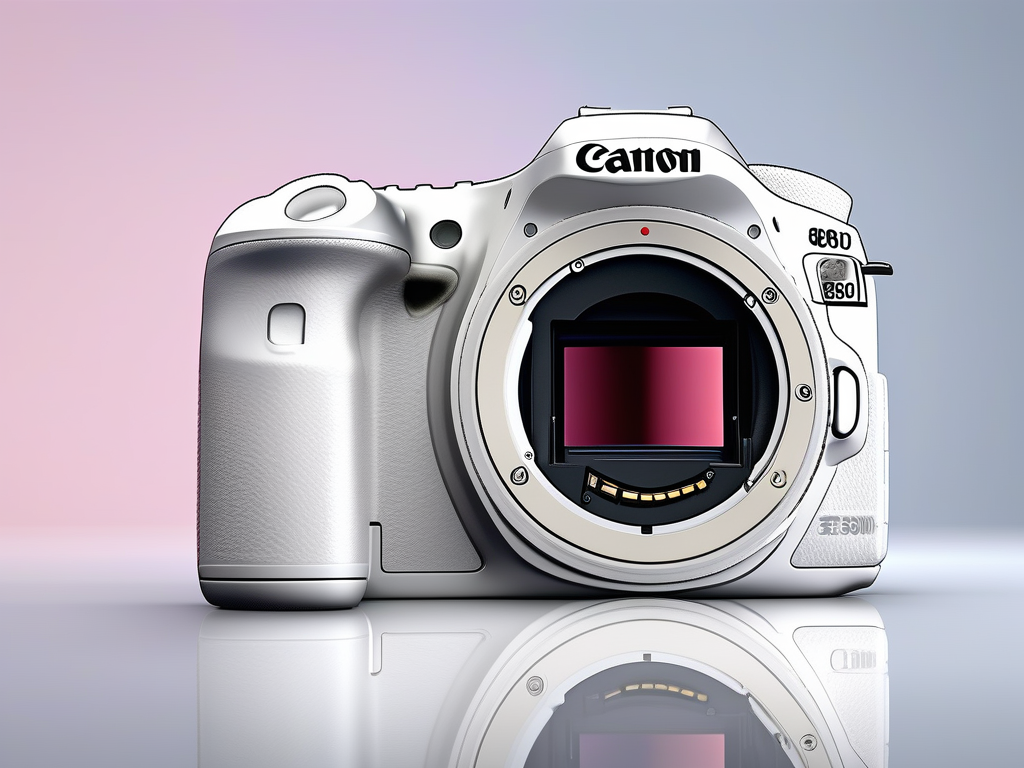
In short
- The 2016 Canon 80D combined Dual Pixel AF with a 360° flip-out touchscreen: the combination that made it one of the favorite DSLRs among vloggers before the mirrorless era.
- 24-megapixel APS-C sensor, 1080p video at 60fps (no 4K) and live view autofocus that remains fluid and reliable on faces today.
- Used today, it is found between 350 and 500 euros for the camera body only, compared to 900-1,100 euros for new at launch.
- To shoot video only in 2026, a used mirrorless like the Sony A6400 or Nikon Z50 offers 4K and more modern video autofocus for the same price: the 80D makes sense if you also want a DSLR viewfinder and affordable EF lenses.
The Canon 80D was released in 2016 and for several years was, in fact, the camera you saw framing the faces of half of Italian YouTube. Not because it was a video camera: it was an APS-C DSLR. But it featured Dual Pixel AF and a fully articulating touchscreen, and that combination did something that mirrorless cameras of the time did poorly or not at all: it kept focus on your face while you were filming yourself talking to the camera.
In this article, I look at the 80D through today's lens. What it did well back then, what still holds up in 2026, and above all, whether it makes sense to buy it used now that mirrorless cameras are affordable and shoot 4K. I tell you this from someone who has seen dozens of them pass through the counter: the answer is not straightforward in either direction.
Why the 80D became the vlogger's camera
In 2016, anyone wanting to film themselves speaking had two inconvenient options: a DSLR with poor video autofocus in live view, or a compact with a tilting screen but mediocre image quality. The Canon 80D combined both features in a single camera body, which is why thousands of creators bought it before the term "vlogger" became commonplace.
The winning combination was two technologies brought together: Dual Pixel AF and the flip-out touchscreen. Dual Pixel had already appeared on the 70D in 2013, but the 80D refined it on a 24-megapixel sensor, and it is the generation that truly took off among creators.
Dual Pixel AF explained without marketing
Dual Pixel AF is on-sensor phase detection autofocus, not relying on the separate modules used by DSLRs that look through the viewfinder. In practice, each pixel is split into two photodiodes that read the scene from slightly different angles, allowing the camera to instantly determine whether the subject is in front of or behind the focal plane.
What changes in practice when you film:
- No hunting: the autofocus does not "search" back and forth like previous DSLRs did in live view.
- Smooth transitions: if you move away or closer, the focus follows with a gradual, video-like movement, not in jerky steps.
- Silent: the autofocus is inaudible in the recorded audio, a serious issue with contrast-detect systems of that era.
For those who shoot themselves, this was it all. Focus on the eyes, talk, move, and the image stays sharp without you touching anything. Even today, on a used 80D, face AF in 1080p is fluid and reliable.
The 360° flip-out touch screen
The vari-angle screen opens sideways and rotates until it faces you. When filming yourself, you can see the framing while you speak, and this changes everything: no more recording blind, hoping to be centered.
On top of that, it’s touch-enabled, and it actually works. Tap the point where you want focus, and the Dual Pixel system locks onto it with the smooth transition mentioned above. Today, this is a standard feature, found on any smartphone. In 2016, on a Canon body costing around 900 euros new, it was rare and valuable. It’s this combination — intelligent focus plus a screen that watches you — that made the 80D the DSLR of choice for vloggers, years before mirrorless cameras did the same thing better.
What the 80D does in 2026: real specifications
Strip away the historical context, and the numbers remain. The 80D's numbers still hold up well for photography, though less so for modern video. It is a 24-megapixel APS-C sensor from 2016 that today does what you ask of it almost always, provided you know where it stops.
24 MP APS-C sensor and image quality
The 24 megapixels on an APS-C format are the balance point Canon has maintained for years, and it is no coincidence. They are sufficient for large prints and cropping with margin, without clogging cards and drives with huge files. The dynamic range, for a sensor of that era, is honest: you can recover shadows in RAW without disasters, although do not expect the margins of a more recent Sony.
Regarding ISO, the 80D is usable where it truly matters:
- ISO 100-800: clean files, no compromise.
- ISO 1600-3200: noise is present but manageable, the range you'll work in for interiors and low light.
- ISO 6400: still publishable after noise reduction, beyond this it starts to make no sense.
For portrait, landscape, events, and everyday photography, this sensor is more than sufficient in 2026. Anyone telling you that 24 megapixels from 2016 are "old" is confusing the release date with actual image quality.
Video: 1080p 60fps and the no-4K limit
This is where the real limit lies. The 80D records in Full HD 1080p up to 60 frames per second, and that's it. No 4K. In 2016, this wasn't an issue, as almost no one edited in 4K and 1080p was the standard. Today, it is the main limitation, and it needs to be stated clearly.
The 1080p of the 80D, in any case, is well done for what it is: H.264 codec, honest bitrate, pleasant Canon colors straight out of the camera. The 60fps gives you smooth 50% slow motion in a 30fps timeline. Combined with the Dual Pixel AF that tracks faces without hunting, you get fluid and reliable talking-head video.
The issue isn't the 1080p quality; it's the lack of headroom. Without 4K, you can't crop or reframe for vertical formats starting from a higher resolution. If video is your primary goal in 2026, this limitation is significant, and we address it concretely in the following sections.
Canon 80D in brief: what holds up and what is dated
| Feature | Specification | 2026 Verdict |
|---|---|---|
| Sensor | APS-C 24 MP | Still excellent for photos |
| Video | 1080p up to 60fps | Dated: no 4K |
| Video Autofocus | Dual Pixel AF | Fluid, still holds up well |
| Screen | 360° flip-out touchscreen | Perfect for talking-head vlogs |
| Viewfinder | Optical, 100% coverage | Advantage over budget mirrorless |
| Shutter | ~100,000 certified shutter count | To be verified on used units |
The real strength: affordable EF lenses
The reason I still recommend an 80D in 2026 is not the camera body: it is what you can mount on the front. Canon has produced EF and EF-S lenses for nearly thirty years, and with the market's shift to mirrorless, that lens park has crashed in price. You buy the body for little and access a huge catalog of used lenses that are worth a fraction of the new RF equivalent.
This changes the calculation. An 80D is not a camera to evaluate on its own: it is a gateway to a system that today costs very little to build.
What to mount on the 80D without breaking the bank
For most situations, three lenses are enough, all available used at prices that would have been unthinkable ten years ago:
- Canon EF-S 18-135mm — the do-it-all zoom. Covers from wide-angle to medium telephoto, ideal for those who want a single lens always mounted. Used, it is often found between 120 and 180 euros.
- Canon EF 50mm f/1.8 STM — the famous "nifty fifty". f/1.8 aperture for portraits with a soft background and shutter count in low light. Used under 90 euros, sometimes less.
- Canon EF-S 24mm f/2.8 STM — the pancake. Small, lightweight, perfect for street photography and to carry around without bulk. Used around 100 euros.
With three lenses like these, you spend less than 400 euros and cover reportage, portrait, and everyday shooting. On the new market, within the RF system, equivalent optics cost two or three times as much.
What if you switch to mirrorless?
Here is the part many overlook. EF lenses are not obsolete when you change systems: they adapt to Canon RF mirrorless bodies with a simple adapter, retaining autofocus and stabilization. The investment in glass you make today on the 80D follows you even if you buy an R100 or an RP tomorrow.
It means that buying EF lenses in 2026 is not a bet on a dying technology. It is a purchase that remains valid across two generations of cameras. I explained the real strengths and limitations of this transition in the article on whether EF lenses on RF mirrorless are still worth it in 2026: it is worth reading before building a kit.
In practice, the 80D allows you to enter a complete system at a low cost, without closing the door to the future. This, more than the camera body itself, is what makes it still a sensible choice.
80D vs. today's used mirrorless cameras
For the same budget — €350-500 for the 80D body — today you buy a used mirrorless that does things the 80D cannot. This is the most honest comparison I can give you at the counter: it all depends on what you need to do with it. If the answer is "talking head video and nothing else", the 2016 DSLR loses. But if you also want to shoot with a real viewfinder, it still holds up well.
For video-only shooters: a mirrorless is the better choice
There's no contest here. The 80D tops out at 1080p 60fps, while for just over half the price, you get 4K. Here are two examples from our catalog:
- Sony A6400 — 650 euros. True 4K, Real-time tracking autofocus for faces among the best in its class, upward-flipping screen designed specifically for vlogging.
- Nikon Z50 — 600 euros. 4K, compact APS-C body, deep grip comfortable for those coming from a DSLR who don't want to feel like they're holding a bar of soap.
Both weigh and take up less space than the 80D, and by the end of the day, you can feel the difference in your hands. If you are building your first video setup from scratch, also read our guide on how to choose your first used mirrorless: it helps you avoid the most common mistakes regarding lenses.
For those who also want photos and an optical viewfinder
The 80D holds its own remarkably well. The optical viewfinder shows the actual scene, with no lag and no battery drain from keeping it on: in bright sunlight or with fast-moving subjects, it’s a concrete advantage that an entry-level mirrorless doesn’t offer in the same way. The DSLR ergonomics, with dual dials and a full grip, remain a standard that many compact mirrorless bodies struggle to match.
The dual capability is the real reason why some still choose it: shooting with the optical viewfinder in the morning, recording talking-head video with the vari-angle screen in the afternoon, and an EF lens lineup that costs little. However, if full frame tempts you and the budget stretches, the Canon EOS RP at 600 euros offers a 24x36 sensor and mounts the same EF lenses via an adapter: a natural bridge to mirrorless without discarding your gear.
In short: video only, go mirrorless. For photo plus video with a true viewfinder and affordable lenses, the 80D still has its place.
Used 80D vs. used mirrorless cameras at a similar budget
| Model | Indicative used price | Video | Key strength |
|---|---|---|---|
| Canon 80D (body) | 350-500 € | 1080p 60fps | Optical viewfinder + EF lenses |
| Sony A6400 | 650 € | 4K 30fps | Eye-tracking AF and compactness |
| Nikon Z50 | 600 € | 4K 30fps | Ergonomics and modern Z lenses |
| Canon EOS R100 | 400 € | 4K (with crop) | Native RF mirrorless, recent release |
How much does a used Canon 80D cost and what to check
An 80D in excellent condition today starts at 350 euros for the body only. At its release in 2016, it cost between 900 and 1,100 euros: this is the natural depreciation of an APS-C DSLR that has been discontinued, not a defect of the camera body. It is precisely this price range that makes the 80D interesting, provided you know what you are looking at before paying.
Honest price range in 2026
Real used prices fluctuate within fairly precise ranges. What justifies the 100-150 euro difference is the shutter count, the presence of the lens kit, and the condition of the rubber seals and the display.
| Configuration | Honest used price |
|---|---|
| Body only | 350-500 euros |
| Kit with 18-55 STM | 450-550 euros |
| Kit with 18-135 nano USM | 500-600 euros |
A camera body over 500 euros should have a low shutter count and complete accessories. If they ask 480 euros for a body with 90,000 shutter count and no box, you are overpaying: negotiate or move on.
Shutter count and other checks
The shutter count of the 80D is listed at approximately 100,000 shutter count. It is not a hard deadline, but a body at 80,000 shutter count has already completed a significant portion of its mechanical lifespan. The count is the most critical factor affecting the price, and almost no private seller will show it to you.
Here is what you should always check, even when buying from a private seller:
- Shutter count: read it from the file metadata, not the menu. Demand a recent raw file to verify it.
- Articulated screen: test the full 360° rotation, check for play in the hinge and dead pixels on the touch.
- Sensor: shoot at f/16 against a white wall and look for dark spots. Dust can be cleaned, scratches on the filter cannot.
- Rubber seals and rear dial: peeling rubber seals and a worn rear dial indicate heavy use.
At ReflexMania, every 80D that comes in goes through our lab: we read the actual shutter count, clean the sensor, and verify the shutter, autofocus, and hinge integrity. What we tell you is the certified number, not a rough estimate. That is why we offer a 2-year warranty on used equipment.
Canon alternatives in the catalog: from DSLR to mirrorless
Those looking at the 80D today are generally choosing between two paths: sticking with the EF DSLR system, its optical viewfinder, and affordable lenses, or making the jump to the RF system and recent mirrorless cameras. Our catalog features two Canon models that cover both directions, at prices close to those of a used 80D.
The difference is not just "old versus new". It changes the type of photographer: the 80D remains the camera body for spoken video with a generous screen, while the R100 and RP cater to different needs. For a comparison with other APS-C DSLR Canon models from that era, you can find an in-depth article on the used Canon 7D Mark II, the more sporty sibling oriented towards burst shooting.
Canon EOS R100: the entry-level mirrorless
The Canon EOS R100 starts at 400 euros with us, essentially the same budget as an 80D in excellent condition. It is mirrorless, features the native RF mount, and adds 4K, but with one honest limitation: the 4K mode has a significant crop, and the autofocus loses its dedicated pixels in that mode.
Compared to the 80D, the R100's screen is fixed and non-touch, which eliminates the very advantage that made the 80D the vlogger's camera. The R100 makes sense for those who want a recent, lightweight body with a new sensor, accepting a more basic ergonomics.
Canon EOS RP: the leap to full frame
The Canon EOS RP at 600 euros is the most affordable way to enter the Canon full-frame system. The larger sensor changes the output: less noise at high ISOs, more control over background blur, and files with more headroom in post. With an EF-EOS R adapter, you can mount the same lenses you would use on the 80D, recovering the lens park we discussed earlier.
The RP is not a vlogging camera: the vari-angle screen is there, but the strength here is image quality, not video ergonomics. It is the choice for those who find APS-C too limiting and want more performance.
| Model | Price | Best for |
|---|---|---|
| Canon 80D (used) | 350-500 € | Talking vlogs, DSLR viewfinder, affordable EF lenses |
| Canon EOS R100 | 400 € | Recent body, native RF, 4K with crop |
| Canon EOS RP | 600 € | Full frame, higher resolution, adaptable EF lenses |
Who really benefits from the Canon 80D today
The Canon 80D is not a camera for everyone, and that’s fine. After ten years at the counter, I’ve learned that the right advice starts with a question: what do you actually need it for? Today, the 80D rewards a specific profile and penalizes another. Let’s see who is who.
The 80D is the right choice for you if you identify with any of the following scenarios:
- You want an optical DSLR viewfinder. Framing through the pentaprism with your eye, without electronic lag, is an experience many photographers continue to prefer. No budget mirrorless camera offers this.
- You already have EF or EF-S lenses, or you want to build a kit on a budget. The used Canon lens park is huge and undervalued: everything mounts natively, without adapters.
- You shoot family, travel, events, and some spoken video in 1080p. For this use, the 80D still performs excellently, with fluid and reliable face-detection autofocus.
It's not worth it, and I'll be clear about it, in these cases:
- You want to shoot only or mostly video. No 4K and no headroom to crop or reformat to vertical. A used Sony A6400 at 650 euros gives you real 4K, a more modern eye-detection autofocus, and a much more compact body to carry around.
- You are starting from scratch and want the lightest option possible. An entry-level mirrorless like the Canon EOS R100 at 400 euros weighs less, uses the new RF mount system, and projects you into Canon's future rather than its past.
Summary by profile:
| Profile | Recommended choice |
|---|---|
| General photography + optical viewfinder | Canon 80D |
| Video at the core of the project | Sony A6400 |
| First lightweight body, new system | Canon EOS R100 |
In short: the 80D makes sense as a complete and affordable DSLR, not as a 2026 video camera. If you are specifically looking for that combination — optical viewfinder, solid ergonomics, affordable EF lenses — it is still a smart choice. For everything else, a used mirrorless camera will take you further for the same price.
Frequently asked questions
Does the Canon 80D shoot 4K?
No. The 80D records up to Full HD 1080p at 60fps. If 4K is a requirement, it is advisable to look for a used mirrorless camera such as the Sony A6400, Nikon Z50, or Canon EOS R100.
Why is it called the vlogger's camera?
Because in 2016 it combined two rare features at that price: Dual Pixel AF, which kept focus on the face fluidly, and a fully articulating touchscreen, which allowed you to see yourself while speaking to the camera. The mirrorless cameras of the time did it worse.
How much does a used Canon 80D cost in 2026?
The body alone ranges from 350 to 500 euros depending on condition and shutter count. As a kit with an 18-55 or 18-135, the price rises to 450-600 euros. At launch, it cost 900-1,100 euros.
Can EF lenses from the 80D be used on Canon mirrorless cameras?
Yes, via the EF-RF adapter. It is one of the reasons why investing in EF lenses is not wasted: if you switch to a Canon RF mirrorless in the future, you can reuse them without any loss of autofocus quality.
Is the Canon 80D or a mirrorless camera better for video today?
If you only shoot video, a used mirrorless like the A6400 or Z50 offers 4K, greater compactness, and more advanced autofocus at a similar budget. The 80D makes sense if you also want an optical viewfinder, DSLR ergonomics, and affordable EF lenses.
How many shutter count can the 80D's shutter handle?
Canon states a lifespan of approximately 100,000 shutter count. When buying used, it is important to verify the actual count: a unit with 30,000 shutter count still has a long life ahead, while one with 90,000 should be evaluated at the right price.
Is the 80D suitable for photography only?
Yes. The 24-megapixel APS-C sensor remains more than sufficient for portrait, travel, and general photography, with good performance up to ISO 3200-6400. For photos, it is still a very current camera.
Looking for a Canon 80D or a refurbished alternative?
If you have doubts about a purchase or need advice for your specific case, write to us. We offer free advice because we are photographers first, and because a customer who buys poorly does not return to photography.
Three ways to get in touch:
- Contact form — response within 24 business hours
- WhatsApp at 342 362 3454 (messages only)
- Phone: 071 291 6347 (Mon-Fri 9-13/15-18, Sat 9-13)
And if you want to see what we have in stock right away, explore the used cameras available today: every camera is certified, comes with a 2-year warranty, and is shipped within 24-48 hours.
Article written by Matteo for the ReflexMania Team. Last updated: June 2026. Prices and availability as of the date of publication.