
In short
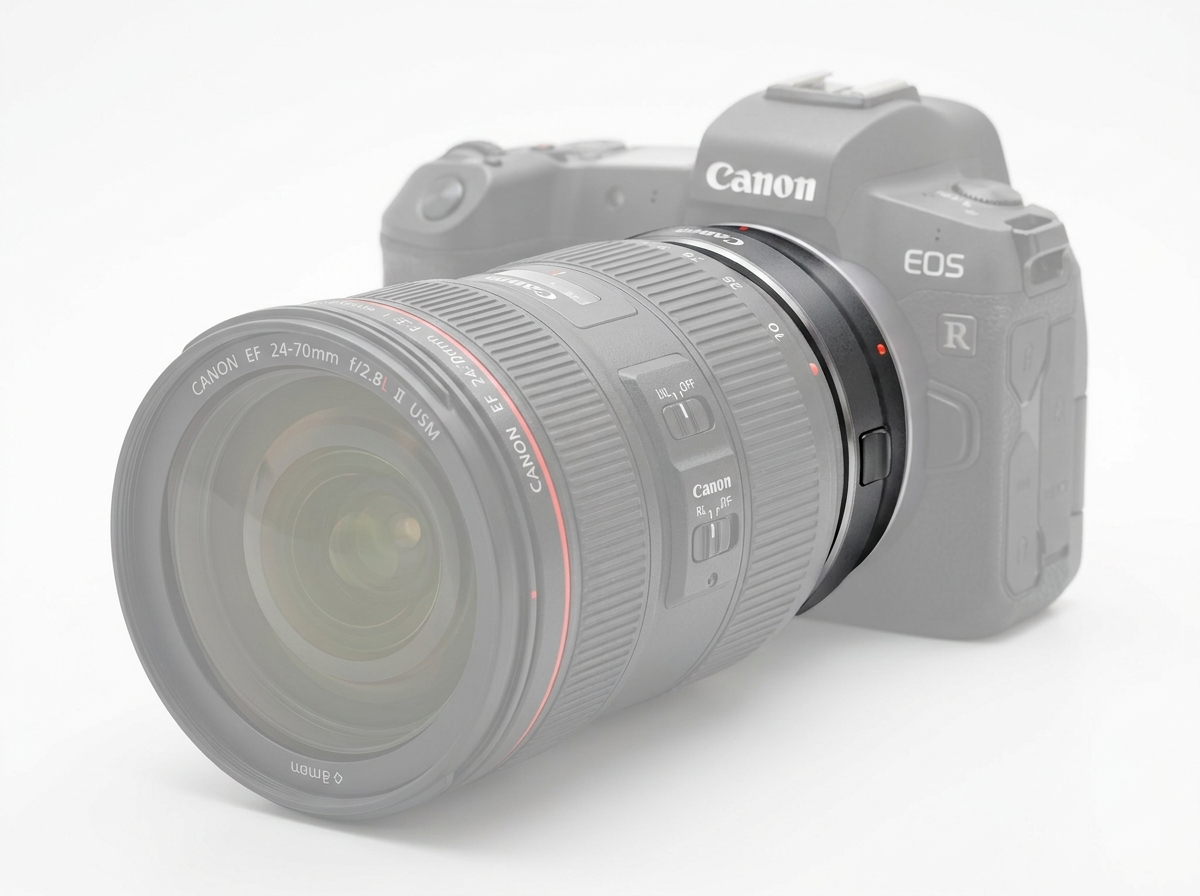
- The Canon EF-EOS R adapter maintains autofocus and stabilization: no loss of optical quality or light stop.
- A used RF camera body like the Canon EOS RP at 600 euros plus an existing EF lens park is the most economical migration available today.
- Adapted EF autofocus is reliable on static subjects, but it lags behind native RF lenses in burst shooting and continuous tracking.
- Converting makes sense if you already own 2-3 valuable EF lenses; buying new EF lenses in 2026 solely to adapt them is almost never worth it.
At the counter, the same question comes up every week: I have three Canon EF lenses from my old 5D, can I use them on an RF mirrorless? The short answer is yes, and it works much better than people expect. But as always, the devil is in the details, and a few details change the cost-effectiveness of the operation.
In this article, I explain what actually happens when you mount an EF lens on an RF body using an adapter: what you keep, what you lose, the cost involved, and in which cases it makes sense to do so rather than buying everything new in RF. No brochure theory, just what we see come through our workshop on hundreds of adapted pairings.
How the EF-EOS R adapter works: what really happens
Mount a 24-70mm EF on an RF body via an adapter and everything works: autofocus, aperture, stabilization, EXIF data. It is not a compromise, it is how Canon designed the RF system from the start. The transition from DSLR to mirrorless, which often means buying everything again, here costs the price of a ring. If you want the full picture of the DSLR-to-mirrorless transition, we covered it in the DSLR-to-mirrorless migration guide.
Why EF and RF communicate without optical compromises
The key is the flange focal distance, i.e., the distance between the mount and the sensor. On EF DSLRs, it is 44mm, because there was a mirror between the lens and the sensor. On RF mirrorless cameras, without a mirror, it drops to 20mm. Those 24mm of difference are empty physical space.
The EF-EOS R adapter simply fills those 24mm with an empty cylinder. No lenses, no corrective elements, no additional glass in the optical path. Light reaches the sensor exactly as it would on an EF DSLR.
- Sharpness: identical. The lens projects the image at the same distance for which it is designed.
- Brightness: unchanged. An EF f/2.8 remains f/2.8, with no stop loss as occurs with focal length multipliers.
- Field of view: identical. A 50mm remains a 50mm, with no crop factor introduced by the adapter.
This distinguishes the native Canon adapter from third-party adapters for "impossible" pairings, where corrective lenses are often present and degrade image quality.
Electronic contacts: autofocus, aperture, and stabilization remain active
The EF-EOS R adapter is not a passive ring. Inside, it features an electrical contact track that exactly replicates the EF mount's contacts and transfers them to the RF side. All electronic communication between the camera body and the lens passes through it.
Specifically, the adapter transmits:
- Autofocus: the lens motor receives commands from the camera body and focuses normally.
- Aperture control: you set f/8 from the camera body and the blades close as usual, including stop-down for depth of field.
- Stabilization (IS): if the EF lens has Image Stabilizer, it remains fully operational and communicates with the sensor stabilization of bodies that feature it.
- EXIF data: focal length, aperture, and lens model are recorded in the shutter count metadata.
In practice, once the adapter is mounted, the camera body recognizes the EF lens as if it were mounted directly. The difference lies not in what works, but in how well the autofocus tracks fast-moving subjects: this is the trade-off we address later, distinguishing what you retain from what you truly lose.
The four Canon adapters: which one is right for you
Canon has released four official versions of the EF-EOS R adapter, and for most photographers, the most affordable one is also the right choice. The differences do not concern image quality — which is identical across all four — but what you can do with the ring or the integrated filters.
| Version | Indicative used price | Who it's for |
|---|---|---|
| Standard | 80–110 € | The right choice for almost everyone |
| With control ring | 120–160 € | For those who want an assignable third ring (ISO, exposure) |
| Variable ND filter drop-in | 250–320 € | Video and long exposures with multiple lenses |
| Polarizer drop-in | 220–300 € | Landscape with wide-angle lenses where a front polarizer is inconvenient |
The two drop-in adapters only make sense if you use multiple EF lenses with different diameters: instead of buying a filter for every lens, you just put one in the adapter. For those shooting static photos with one or two lenses, it's an expense that doesn't pay off. The standard does exactly the same adaptation job, without any frills.
Compatibility with third-party adapters
Viltrox, Meike, and the Sigma MC-11 cost half as much as the Canon adapter, sometimes even less. They work, but with one precise limitation: autofocus is less predictable on certain lens-body combinations, especially with third-party EF lenses that are already unofficial.
The practical rule we use at the counter is simple:
- Original Canon EF lenses: a well-reviewed third-party adapter performs well. The savings are real.
- Sigma or Tamron EF lenses: the Canon adapter is better. Potential double incompatibility means AF that hesitates or fails in burst mode.
- Professional use or paid events: use the Canon adapter, period. This is not the place to save 70 euros.
The Sigma MC-11 was originally designed for Sigma lenses on Sony E, but when adapted to RF, the results are more inconsistent: we do not recommend it unless you have the opportunity to test it beforehand. When a customer brings a specific lens, we mount it on the adapter in-store and verify the AF on that combination before they spend a single euro.
What you keep and what you lose: the honest balance
With a Canon EF-EOS R adapter, an EF lens mounted on an RF body performs exactly as it did on an EOS DSLR. Same aperture, same opening, same amount of light hitting the sensor. The adapter contains no optical glass: it is a tube with electronic contacts, so it does not alter brightness or sharpness. What changes, and what we see every day at the counter, is autofocus performance in extreme conditions and the overall bulk of the system.
Image quality and brightness: zero compromises
A 50mm f/1.8 EF remains an adapted f/1.8: no light stop lost, no resolution loss. The EXIF data in the files reports the correct focal length and aperture, because the electronic contacts transmit all data to the camera body. The lens's optical image stabilization (IS) continues to function, and on RF bodies with in-body image stabilization (IBIS), the two systems work together. On this front, there is no compromise to accept.
Adaptive autofocus: where it holds up and where it falls short
This is the difference that marketing tends to gloss over. On static subjects, the adapted EF AF is flawless: portrait, landscape, still life, architecture. The focus is as precise as that of a native RF lens. The limitation emerges with continuous motion.
- Still life and portrait: no perceptible difference compared to native.
- Sports and birds in flight: the adapted AF loses some shots in continuous tracking compared to a native RF lens.
- Motor type: USM and STM lenses maintain much more solid performance than older AF micromotors, which are the first to struggle.
In practice: if you shoot people, travel, or still life, you won't notice the difference. If you make a living from sports or wildlife photography with long bursts, consider it more carefully. It's the same fundamental reasoning we address in the comparison between DSLR and mirrorless: the best technology exists, but it only matters if your actual use leverages it.
Size and balance of the camera body
The adapter adds approximately 24mm to the system length and shifts the center of gravity forward. On compact bodies like the Canon EOS RP, with a heavy EF telephoto lens attached, the balance is noticeable: the camera tends to tilt forward, and the grip works harder. With lighter optics — a 50mm or a wide-angle — the issue does not exist. It is an ergonomic factor, not an image quality one, but on long handheld sessions it makes the difference between comfort and wrist fatigue.
When converting is truly worth it: the three typical scenarios
Adapting an EF lens to an RF body makes sense when you have already invested in optics, not when you still need to buy them. The difference lies in the value of the lens park you own today, not the generic idea of "saving money". Three situations cover 90% of the cases we see at the counter.
You already own 2-3 valuable EF lenses
This is the scenario where adapting is almost the only viable option. If you own a 24-70 f/2.8, a 50 f/1.4, and a 70-200 f/2.8, you already have 3,000–4,000 euros worth of lenses that are still in excellent condition both structurally and optically. Buying the native RF equivalents means starting from scratch with a cost that easily exceeds 5,000 euros.
With an EF-EOS R adapter, those same lenses work on the mirrorless body while retaining autofocus and stabilization, without losing a stop of light. The cost is reduced to just the price of the adapter, under 150 euros for the base model.
Want to enter the RF system for less
The second case is for those starting from scratch but wanting to build a low-cost system. The used EF market has been declining for years: Canon DSLR lenses cost today a fraction of their former list price. Combining them with an affordable used RF camera body gives you a complete mirrorless kit for a limited budget.
- Canon EOS R100 — 400 euros. The most affordable entry into the RF system, ideal for those who need the bare minimum to mount EF lenses.
- Canon EOS RP — 600 euros. Compact full frame, the best price-performance compromise for those adapting high-quality EF glass.
- Canon EOS R — 800 euros. More robust in terms of ergonomics and viewfinder, suitable for those using heavy optics like the 70-200.
Used RF body, adapter, and EF lenses from the declining market: it is the most affordable migration available today in the Canon world.
When it makes NO sense: buying new EF lenses in 2026
Our advice is clear, even if it goes against the idea of selling more. Buying a new EF lens in 2026 just to adapt it to an RF body is almost never worth it. The native RF catalog now covers practically every focal length and price range, and the autofocus of native lenses remains faster and more precise for continuous tracking.
Adapting is a smart choice to make the most of lenses you already own. It is not a reason to buy glass from a generation that is being phased out. If you are spending new money, consider the RF equivalent first: the price is often similar, and the performance on mirrorless is better.
Which RF bodies to choose to start with adapted EF lenses
The right body isn't the latest one; it's the one that balances your EF lens collection with what you want to spend. If you already have EF full-frame lenses, there's little sense in starting over with an APS-C. However, if your budget is the main constraint, it makes sense to accept some limitations on autofocus and put your money where it counts: the glass you already own.
These are the three RF bodies we most often keep in stock for those adapting EF lenses, each with a precise usage profile.
Canon EOS RP: the most affordable full-frame entry
The Canon EOS RP at 600 euros is currently the most affordable way to enter the full frame RF system while keeping your EF lenses fully covered. The EF 24-105mm zoom remains a 24-105mm, with no crop. It is the right choice for portrait, landscape, and considered use.
The limitations are honest: basic autofocus and a slow burst rate. On a stationary subject or one moving calmly, you won't notice them. With sports or running children, you will.
Canon EOS R: a step up in AF and burst rate
The Canon EOS R at 800 euros features a 30-megapixel sensor and a more robust autofocus system. The difference is noticeable when using EF reportage zooms and working with tight shutter speeds, where the RP struggles. It is the camera body I recommend to those who want headroom without paying the prices of the latest RF lenses.
Canon EOS R100: Affordable APS-C, but watch out for the crop
The Canon EOS R100 at 400 euros is the lowest entry price, but it changes the game. The APS-C sensor applies a 1.6x crop: your EF 50mm works as an 80mm equivalent, and the 24mm becomes a 38mm. Goodbye true wide-angle.
It works well as a second body or as a first mirrorless for those starting from scratch, but not for those who want to fully utilize EF full frame lenses.
| Body | Price | For whom |
|---|---|---|
| EOS RP | 600 € | EF full frame, minimum budget |
| EOS R | 800 € | Reportage, more solid AF |
| EOS R100 | 400 € | Entry or second body, watch out for the crop |
If the priority is traveling light rather than sticking to the EF system, it is worth broadening your horizons: we discuss this in which mirrorless for those who travel light.
EF adapted vs. native RF: the practical comparison
Given the same lens, an adapted EF lens and its native RF equivalent produce the same image. The difference does not lie in the final picture, but in what you spend to get there and what you gain when the subject moves. It is worth examining these two factors separately, as they pull in opposite directions.
The cost factor: where the real savings lie
The savings are not on the camera body, but on the lenses. A used EF 50mm f/1.8 STM can be found for around 90 euros, while its native RF counterpart starts at approximately 180 euros new. The price gap widens for the 24-105: the used EF f/4 is priced at 350-400 euros, whereas the native RF f/4 exceeds 900 euros. Add the base adapter, which you can recover used for 80-100 euros, and the math changes significantly.
| Solution | Indicative cost |
|---|---|
| Used EF 24-105 f/4 + EF-EOS R adapter | approx. 450-480 euros |
| Native RF 24-105 f/4 | approx. 900 euros |
If you already have two or three valuable EF lenses in your cabinet, the most cost-effective migration today is a used RF body like the Canon EOS RP at 600 euros, lightweight and honest on full frame, using the adapter and the optics you already own. Zero new spending on glass.
When native is worth the extra cost
Three situations justify the price of the native RF, the others do not:
- Continuous tracking and burst: RF lenses communicate with the body's AF more frequently. For sports or a running child, a native lens locks on and tracks better than an adapted EF lens.
- Real compactness: The adapter adds 2-2.5 cm and a few hundred grams. With a native RF lens, the system remains shorter and better balanced in hand.
- Optical formulas that don't exist in EF: The RF 28-70 f/2 has no equivalent in the EF lineup. Here you are not paying for the brand, you are buying a glass that did not exist before.
For those who want a body only to get started and see if the system is right for them, the Canon EOS R at 800 euros offers a viewfinder and ergonomics a step above the RP, while remaining fully compatible with all EF lenses via adapter. Buying new EF lenses in 2026 just to adapt them, however, rarely makes sense: at that point, it is better to go native.
What we check in the lab on used camera bodies and adapters
An EF-EOS R adapter that looks perfect on the outside can still fail to focus or communicate the aperture. That is why we do not rely on aesthetics: every used adapter that passes through our bench is tested with real EF lenses mounted on an RF body, not just inspected and cleaned. The same applies to camera bodies, where the data that truly matters is the shutter count, not how shiny the coating is.
Contacts, mechanical play, and AF tests with real EF lenses
The problems with used adapters are almost always twofold: oxidized electrical contacts and mechanical play in the mount. The former causes a loss of communication between the lens and the camera body, while the latter introduces micro-misalignments that degrade focus performance. Both are invisible to the naked eye.
When an adapter comes in, this is what we do in the lab:
- Cleaning and inspection of gold contacts: we check for oxidation or wear signs that interrupt the signal.
- Play test on the mount: the adapter must lock in without any looseness or abnormal resistance, on both sides.
- AF test with real EF lenses: we mount EF lenses of different focal lengths and verify that autofocus locks and the aperture closes to the requested values.
- Stabilization check: we ensure the lens IS remains active and communicates with the camera body.
Only after these tests is an adapter put up for sale. A unit that misreads the aperture or hesitates in AF does not pass, because on an adapted EF lens, autofocus is already the most delicate aspect: we do not want to add mechanical issues to a system-level limitation.
Certified shutter count and 2-year warranty on the body
On the body, the true value lies in the shutter count. We read it directly from the internal counter and certify it, so you know the exact shutter count of the camera before you pay. The Canon EOS RP we have today for 600 euros is the perfect example of an ideal entry-level body to start with adapted EF lenses: full frame, lightweight, and with certified shutter count in hand.
Every used camera body comes with a 2-year warranty. This is not a commercial detail: photographic electronics that pass our tests and last two years are healthy electronics. It is the difference between buying from a private seller without protection and buying a refurbished used item, where the risk stays with us, not with you.
Frequently asked questions
Do I lose image quality using an EF lens on an RF body with an adapter?
No. The Canon EF-EOS R adapter does not contain optical elements, so sharpness, brightness, and rendering remain identical to the lens mounted on an EF DSLR.
Does autofocus work well with adapted EF lenses?
Yes, for portrait, landscape, and static subjects, where it is practically perfect. For sports and fast action, it remains a step below the native RF lenses, especially when used with older micro-motor lenses.
Which Canon adapter should I buy?
For most users, the standard EF-EOS R adapter is sufficient. Versions with a control ring or drop-in filter are only needed for specific requirements and cost more.
Are third-party adapters like Viltrox or Sigma MC-11 suitable?
They cost less and work with many lenses, but AF reliability varies by model. For valuable lenses, the official Canon adapter is recommended to avoid surprises.
Is it worth buying new EF lenses in 2026 to adapt them?
Almost never. The native RF lens lineup now covers almost all needs with better AF. Adapters make sense if you already own valuable EF lenses, not for new purchases.
Does the adapter work on all RF camera bodies, including APS-C models like the R100?
Yes, the adapter is compatible with all RF camera bodies. However, on APS-C bodies like the R100, keep in mind the 1.6x crop factor, which extends the effective focal lengths.
Does the EF lens stabilizer remain active once adapted?
Yes. The lens IS is transmitted and functions normally. On RF bodies with in-body stabilization, the two systems can work together.
Need help choosing a body and adapter?
If you have any doubts about a purchase or need advice for your specific case, contact us. We offer free advice because we are photographers first, and because a customer who makes a poor purchase decision will not return to photography.
Three ways to get in touch:
- Contact form — response within 24 business hours
- WhatsApp at 342 362 3454 (messages only)
- Phone: 071 291 6347 (Mon-Fri 9-13/15-18, Sat 9-13)
And if you want to see what we have in stock right away, explore the used gear available today: every camera is certified, comes with a 2-year warranty, and ships within 24-48 hours.
Article written by Matteo for the ReflexMania Team. Last updated: May 2026. Prices and availability refer to the time of publication.