
In short
- The used Canon 5D Mark IV today ranges from 900 to 1,300 euros depending on shutter count and accessories; it was 4,000 euros new in 2016.
- 30 MP sensor and files still of very high quality, but AF tracking and 4K video (with 1.64x crop and Motion JPEG codec) are outdated compared to current mirrorless cameras.
- Before buying, check the certified shutter count, the condition of the mirror box, any spots on the sensor, and AF calibration: a 5D IV with over 150,000 shutter count requires a case-by-case evaluation.
- It is worth it if you already have a set of EF lenses and shoot landscape or portrait. For video or autofocus on fast-moving subjects, a used mirrorless camera at the same price is more rational.
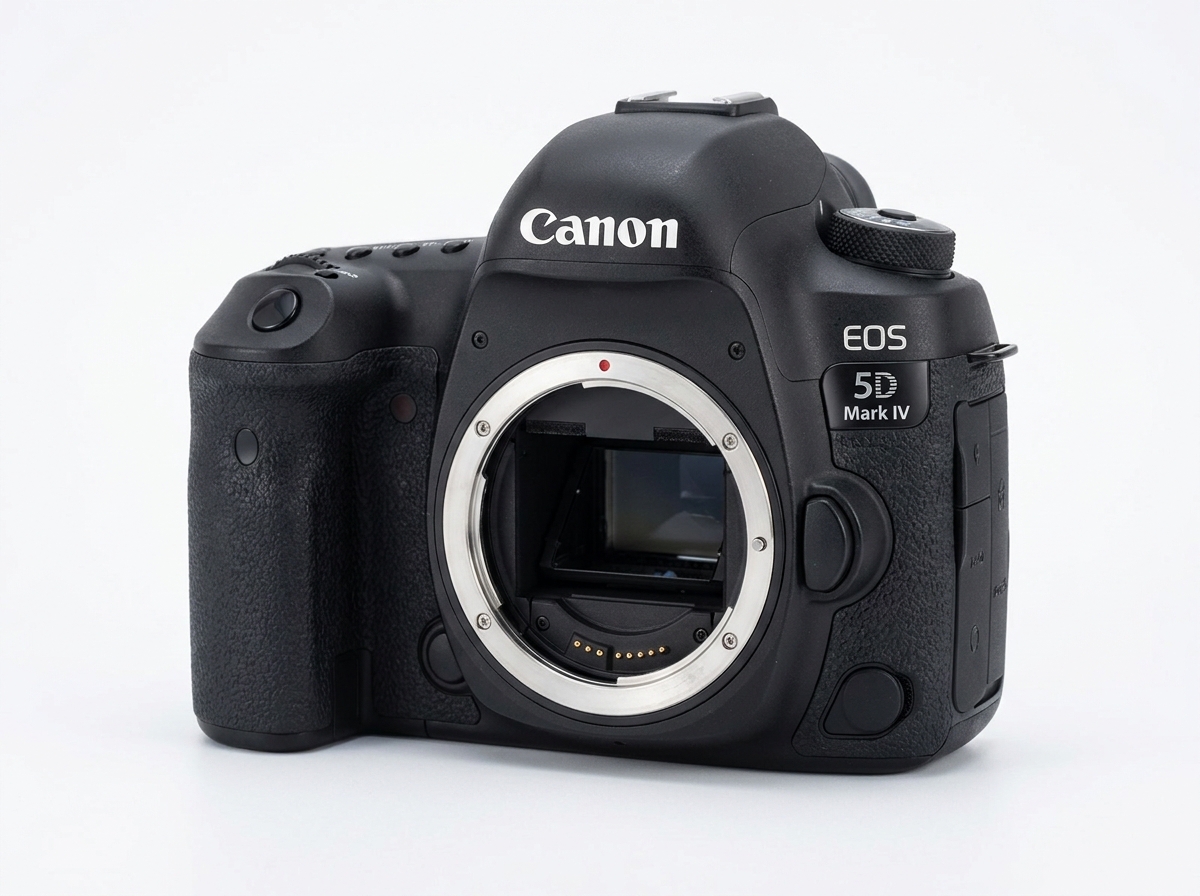
The Canon 5D Mark IV was released in September 2016 at €4,000 for the camera body alone. Ten years later, it remains one of the most sought-after full-frame DSLRs on the used market: I recognize it because two or three units arrive at our workshop every month, and the customers looking for it know exactly what they want. At the same time, every week someone asks me if it still makes sense to buy it, given the many full-frame mirrorless options available at similar price points.
The answer isn't straightforward. It depends on the lenses you already own, your photography genre, how much the lack of IBIS weighs on you, and how much value you place on the optical viewfinder. In this article, I lay out real prices, concrete limitations, checks to perform before purchase, and mirrorless alternatives at the same budget. No nostalgia, no marketing.
What the Canon 5D Mark IV still offers in 2026
The 5D Mark IV is a 2016 camera that, ten years later, continues to produce files that hold up against current camera bodies that are significantly more expensive. This is not an opinion: it is what we see when a customer brings into the shop certified shutter counts from shots taken the previous week with their 5D IV alongside those from a new €3,000 mirrorless. The difference in pure image quality, with the same lens and reasonable conditions, is minimal.
Understanding what remains competitive about this camera and what has been overtaken by the market helps decide whether it makes sense to buy it today or if it is better to look elsewhere.
The 30 MP sensor and file quality
The 30.4-megapixel full-frame CMOS sensor with Dual Pixel technology remains one of the most balanced Canon sensors ever produced. At ISO 100, it measures approximately 13.6 stops of dynamic range, a value that allows for significant shadow recovery in post without revealing banding or obvious chromatic noise.
On the resolution front, 30 MP is a real sweet spot for those who print large or crop heavily. A 50x70 cm print starts from already ample files, and a 60% crop still leaves 18 MP of usable data. The Canon RAW file is readable by any software without experimental profiles, something that is not yet guaranteed with the sensors of some recent mirrorless cameras.
Dual Pixel RAW, an interesting gimmick rather than a daily tool, allows micro-adjustments of focus in post within the depth of the pixel. Useful in specific cases, but don't expect miracles.
61-point AF and 7 fps burst
The autofocus system inherits the layout of the 1D X Mark II: 61 points, 41 of which are cross-type, with sensitivity down to -3 EV on the central point. In decent light, it is one of the most reliable DSLR AF systems ever built, especially for static subjects or predictable movement.
You can see the limitations on two fronts. Frame coverage remains concentrated in the central area, while modern mirrorless cameras cover practically the entire sensor. And tracking of fast, unpredictable subjects does not hold up against the subject detection systems of 2020 and later mirrorless cameras.
The 7 fps burst with a large JPEG buffer (approximately 110 shutter count before slowing down) remains solid for weddings, events, and dynamic portraiture. For fast sports, no, it was not its territory even in 2016.
Build and reliability
Here the 5D IV shows why it was a €4,000 camera when new:
- Magnesium alloy body: zero flex, absorbs moderate drops.
- Full weather sealing: rain, dust, and marine humidity are no problem with matching lenses.
- Certified shutter count 150,000: in the lab, we have seen units reach over 250,000 without signs of failure.
- Mature ergonomics: button layout, joystick, dual CF+SD slots, LP-E6N battery with a real-world battery life of 900-1,000 shutter counts.
It is a camera designed to last, and it actually does, a necessary condition to justify a used purchase ten years after its release.
How much does a used Canon 5D Mark IV cost today
In 2026, a used Canon 5D Mark IV costs between 900 and 1,400 euros. It was 4,000 euros at launch in 2016, so we are talking about a depreciation of about 70% in ten years. This is great news for those buying today: you are getting a professional full-frame camera body for less than a third of its original price.
The three price ranges I see coming through the counter are quite distinct:
| Range | Price | Typical features |
|---|---|---|
| Basic | 900-1.000 € | Over 150,000 shutter count, body only, several signs of use |
| Mid-range | 1.100-1.200 € | 50,000-100,000 shutter count, excellent condition, battery and charger |
| High-end | 1.250-1.400 € | Under 30,000 shutter count, complete box and accessories |
What influences the price
The shutter count is the heaviest variable, but not the only one. The 5D Mark IV has a shutter rated for 150,000 actuations: below 30,000 it is practically new, above 200,000 it is entering "shutter replacement risk" territory (350-450 euro intervention at a Canon center).
Other factors that affect the price:
- Original box and accessories: strap, compatible BG-E20 charger, manual, and CD add 80-120 euros in value compared to the camera body alone.
- Cosmetic condition: intact rubber grips, buttons without wear, and a scratch-free display. A "like new" body is worth 100-150 euros more than one with several signs of use.
- Year of production: the serial number indicates the year. 5D IV models from 2016-2017 have more years of work behind them compared to a 2020 model, even with the same shutter count.
- Canon service history: a camera with a recent service receipt and invoice is worth more, as it eliminates uncertainty.
Private seller vs specialized store
The price difference between a private seller and a specialized store is typically 150-250 euros. A 5D Mark IV that you find from a private seller for 1,000 euros costs 1,200-1,250 euros in our store. Those 200 euros cover concrete things: laboratory testing before resale, a 2-year warranty on used equipment (ours), the possibility of return within legal terms, and the trade-in valuation of your old camera body.
Buying from a private seller saves you money, but you take on all the risk: shutter count is declared but not certified, there is no protection if sensor spots are discovered after a week, and you have zero room for negotiation if the AF is miscalibrated. If you want to understand how used equipment valuation works from the seller's side, we have written a guide on how to sell used photographic equipment that also explains what a store looks for in the appraisal.
What to check before buying a used 5D Mark IV
A used 5D Mark IV can be assessed in half an hour if you know where to look. There are four areas that separate a healthy camera body from one that will give you problems within the year: actual shutter count, sensor and shutter, autofocus, and physical integrity. The price alone tells you nothing. I have seen camera bodies at 1,300 euros with 180,000 shutter count masked by accessories, and camera bodies at 950 euros kept like jewels.
Actual shutter count and wear curve
The shutter count declared by the seller must always be verified. On Canon cameras, there is no internal menu that displays it: external software is required. EOSInfo (free, Windows only) and ShutterCount (paid, Mac and Windows) read the value via USB in two seconds.
The shutter of the 5D IV is rated for 150,000 cycles. In our lab, we have seen units pass 250,000 without failure, but the wear curve differs from a 5D Mark II: the mirror box is more complex, and the cost of a shutter replacement at a Canon service center exceeds 400 euros. Below 50,000 shutter count, you are safe; between 50,000 and 150,000 is a normal working range; beyond 150,000, negotiate the price and factor it in.
Sensor, mirror box and shutter
To check for sensor dust, shoot at f/16 against a uniform white wall, ISO 100, slightly out of focus. Open the file at 100% and look for recurring dark spots: dust can be removed with a blower, while oil spots require wet cleaning.
On early production units (2016-2017 batches), we have observed oil splatter on the shutter curtain: small droplets of lubricant migrating from the mirror box. They appear as dark dots in the same positions, even after sensor cleaning. This is not a blocking defect, but be aware that they will reappear. Mirror box play is checked with the camera body powered off: gently move the mirror with a gloved finger; there should be no lateral looseness.
Autofocus and lens calibration
Enter the AF Microadjustment menu and check for any saved values. If you find corrections exceeding +/-15 across multiple lenses, something in the AF module is misaligned. Bring three lenses with different focal lengths, ideally a 50mm, an 85mm, and a telephoto lens, and perform back/front focus tests on a subject at 45 degrees. Ensure that all 61 AF points illuminate in the viewfinder and that the 41 central cross-type points lock in medium light conditions.
Weatherproofing and cosmetic wear
The grip rubber is the aesthetic weak point: it peels off after years of sweat. Replaceable for 30 euros, but it indicates intensive use. Check the tripod screw (worn thread = camera body heavily used on a tripod), the doors of the dual CF and SD slots (the plastic hinge is fragile), and the battery compartment. If you want a broader overview on how to assess a used camera body before purchase, also read our guide to checking used mirrorless cameras: many criteria are universal.
The limitations of the Canon 5D Mark IV in 2026
Ten years of mirrorless development have raised the bar in three specific areas: video, modern ergonomics, and intelligent autofocus. On the 5D Mark IV, these three fronts show their weaknesses clearly. These are not hidden flaws, but structural limitations of the 2016 design that anyone considering it today must know before signing.
4K video with 1.64x crop and Motion JPEG
The 4K on the 5D Mark IV is the most overhyped spec on the datasheet. In 2016, Canon chose a 1.64x crop on the sensor: a 24 mm full frame lens effectively becomes a 40 mm equivalent, and to shoot wide-angle you need a true 14 mm lens, which in EF costs more than the camera body.
The codec is Motion JPEG, a choice rooted in 2010 broadcast workflows. Files weigh approximately 500 Mbps, or 3.75 GB per minute: a 128 GB SD card holds half an hour of footage. No H.264, no H.265, no C-Log for grading. Dual Pixel autofocus works in 4K but features rudimentary subject tracking compared to any mirrorless camera from 2020 onwards.
Translated into practice: for video, the 5D Mark IV is the wrong choice today. Even a used Canon EOS R under €1,000 shoots 4K with a modern H.264 codec and produces much more manageable files in editing.
No IBIS, optical viewfinder, weight
It lacks in-body image stabilization. The 5D IV relies entirely on lens-based IS, and with a 50 mm f/1.4 USM without stabilization, you must increase shutter speeds or ISO. Recent mirrorless cameras compensate for up to 5-7 stops regardless of the mounted lens.
The body weighs 890 grams without a lens. With the BG-E20 battery grip, it reaches 1,430 grams, to which you must add L-series zooms that often exceed one kilogram. A wedding day with a 70-200 f/2.8 mounted weighs on the neck in a way that is no longer mandatory to endure today.
The optical viewfinder remains an advantage for those who prefer it, and it is the reason why many dedicated DSLR users are reluctant to switch. However, it is a fact: no exposure preview, no focus peaking, no live histogram in the viewfinder. You work "the old way," which is still valid for landscape photography, but much less so for fast-paced reportage.
AF subject tracking vs modern mirrorless
Here, the gap is the widest. The 61 AF points of the 5D IV were excellent in 2016, but:
- No Eye AF: no eye detection, no continuous focus on the iris while the subject moves.
- Basic subject tracking: no animal, vehicle, or bird recognition. Only classic "AI Servo" based on distance and contrast.
- AF sensitivity at -3 EV, compared to -6.5 EV for the Canon R6 and -4 EV for the Sony A7 IV. In churches or dark interiors, the difference is noticeable: the 5D IV "hunts," while the R6 locks on the first try.
For static portraits and landscapes, the system still performs exceptionally well. For sports, running children, animals, and weddings in low light, a modern mirrorless camera is a different beast.
Mirrorless alternatives at the same budget
With a budget of 900-1,300 euros, the 5D Mark IV is not the only option. Used full-frame mirrorless cameras from recent years cover the same price range and, in some cases, outperform it in autofocus, video, and weight. Here are the three alternatives we most often see at the counter when a customer is deciding whether to stick with a DSLR or switch systems.
Canon EOS RP: the most affordable Canon mirrorless
The Canon EOS RP at 600 euros is the natural choice for those coming from the Canon world who want minimal friction. 26 MP full-frame sensor, RF mount, and with a 100-150 euro EF-RF adapter you can mount all the lenses you already have without losing quality or autofocus.
There are limitations, and they need to be stated. The burst rate tops out at 5 fps, compared to 7 fps on the 5D IV. The single SD card slot is a drawback for those working at events. Autofocus on fast-moving subjects has improved over the 5D IV thanks to the enhanced Dual Pixel system, but in low-light conditions, the DSLR performs better. For portrait, landscape, and relaxed reportage, the RP at 600 euros saves you 300-700 euros compared to the 5D IV.
Sony A7 II: full-frame Sony entry on the used market
The Sony A7 Mark II between 550 and 600 euros is the most affordable entry point into the E-mount full-frame system. We have three units in stock. 24 MP sensor, 5-axis IBIS (the 5D IV has no in-body stabilization), EVF viewfinder that displays exposure in real time.
Ergonomics are divisive: the camera body is small, the first-generation Sony menus are labyrinthine, and the NP-FW50 battery has a short lifespan. If you don't have an EF lens park to preserve, it is an honest way to enter the full-frame mirrorless world. If you want more resolution and accept dated AF, the Sony A7r at 700 euros brings 36 MP to the same body.
Nikon Z5: the most balanced under 700 euros
The Nikon Z5 at 680 euros is, in my opinion, the most rational mirrorless in this price range. 24 MP sensor, IBIS, dual SD slots, serious weather-sealed construction, and Eye AF that works on humans and animals with reliability superior to the 5D IV. The EN-EL15c battery lasts twice as long as the A7 II.
The limitation is the burst rate (4.5 fps) and the 4K video with a 1.7x crop: it is not a camera for fast action. For portrait, landscape, and weddings with a documentary approach, it is the most balanced choice among the three. If you are considering the jump to the next generation, we recommend reading our Sony A7 III vs A7 IV comparison on the used market to understand how the market for more mature mirrorless cameras is moving.
- Canon EOS RP — 600 euros, EF compatibility with adapter, ideal if you are coming from Canon.
- Sony A7 II — 550-600 euros, 5-axis IBIS, entry point into the Sony system.
- Nikon Z5 — 680 euros, dual slot and robust build, the most balanced option.
Who the 5D Mark IV is truly for today
The 5D Mark IV in 2026 is not a camera for everyone, and it is honest to say so. It has a specific audience, and outside of that audience, there are more sensible choices at the same price. Let's look at the three concrete scenarios where it still makes sense, and those where it doesn't.
You already have a valuable EF lens collection
If you have three or more EF L-series lenses in your closet — think of a 24-70 f/2.8 II, a 70-200 f/2.8 IS III, and a 16-35 f/4 — you are looking at an investment of over 3,000 euros. On a 5D Mark IV, these lenses work natively, without adapters, without autofocus compromises, and without the risk of firmware incompatibilities that occasionally arise on EF-RF or EF-E mounts.
On an RF or Sony E mirrorless, the same lens lineup requires an adapter. The Canon EF-EOS R adapter works well in most cases, but I have written a dedicated in-depth article on the topic: whether mounting your EF lenses on an RF mirrorless still makes sense in 2026. Spoiler: it depends heavily on which lenses you have and how you shoot.
Do you shoot landscapes, portraits, or static reportage?
These are the genres where the 5D IV's limitations don't show. The subject is stationary or moving slowly, the 61-point central AF is more than sufficient, and the optical viewfinder has no lag and low power consumption. The sensor's 30 megapixels provide files with cropping headroom and solid dynamic range in RAW, especially at low ISO.
Canon's color management — skin tones and complexions in particular — remains a standard that many portrait photographers continue to prefer, even after trying more modern systems. For posed weddings, still life, architecture, and landscape, the 5D IV in 2026 does its job without being missed.
When it makes no sense to buy it
There are uses where spending €1,200 on a 5D IV is a decision you will regret after a month:
- Video creator: 4K with 1.64x crop and Motion JPEG codec that eats up cards and storage. Any full-frame mirrorless from the last five years performs better.
- Fast sports or bird photography: AF tracking on moving subjects is the real generational leap of mirrorless cameras. The 5D IV does not compete here.
- Dynamic reportage in low light: Clean high ISOs, deep buffer burst, eye-detect: all mirrorless territory.
In these scenarios, a used Canon R6 or a used Sony A7 IV, even if they cost 200-400 euros more, deliver much more in the long run. Paying less for the wrong tool is not saving money; it is a deferred waste.
What we do in the lab before reselling a 5D Mark IV
A 5D Mark IV that arrives at our shop doesn't end up in the display case the next day. Every camera body goes through our in-house lab and stays there until it passes all checks. Specifically for the 5D IV, after seeing hundreds of units pass through, we know exactly where to look.
The process typically takes between three and five hours of actual work, spread over two or three days, as some tests require the camera body to be at a stable room temperature after cleaning.
Here is what we check, in order:
- Reading actual shutter count: we extract the count from the EXIF of the last written file and compare it with the internal history. On the 5D IV, we have seen bodies with a reset shutter count after a motherboard replacement: the ISO-based shutter count history exposes the false data.
- 61-point AF test on three reference lenses: 50mm f/1.4, 24-70 f/2.8 II and 70-200 f/2.8 IS II. We verify that all central cross-type points lock, that fine calibration does not require more than ±5 AFMA units on a new lens, and that iTR tracking works at 7 fps without losing the subject.
- Sensor cleaning in a clean room: the 5D IV has the most delicate anti-aliasing filter in the series. We use only Visible Dust swabs and Sensor Clean liquid, never direct compressed air. After cleaning, we take a control shot at f/22 on a uniform white surface.
- Mirror box and mechanics: inspection of the mirror shutter, lubrication of the mechanism if necessary, and checking that the sub-mirror has no play. A slow sub-mirror is the most subtle defect of the 5D IV because it causes intermittent back-focus that is difficult to diagnose in-store.
- Shutter test: 200 burst shots to verify holding at 7 fps without slowdowns, checking that the shutter curtain closes uniformly at 1/8000.
- Weather sealing: visual inspection of seals on the battery door, card slots, lens mount and mode dial. On the 5D IV, the seals in the card compartment tend to harden after five or six years of use.
- CF and SD dual slot card test: sustained writing on both slots for ten minutes, verifying that no Err 02 errors occur.
- Firmware: update to the latest official Canon version (1.3.6) if not already installed.
If even one of these points fails, the camera is sent back to the workshop or removed from the catalog. The 5D IV units we sell come with a 2-year ReflexMania warranty covering the camera body and mechanics, including shutter unit replacement if it fails under 200,000 total shutter count within the warranty period.
This is not marketing: it is the reason why a certified used camera costs more than a private listing on a forum.
Frequently asked questions
Is the Canon 5D Mark IV still worth it in 2026?
Yes, but under specific conditions: already owning EF lenses, shooting landscape or portrait, and preferring the optical viewfinder. For video or tracking fast-moving subjects, a used mirrorless camera is more rational today.
How many shutter counts are too many for a used 5D Mark IV?
The shutter count is certified at 150,000 cycles, but in the lab I have seen them work well beyond 250,000. Above 150,000, it is fair to ask for a lower price and to check the condition of the mirror box and the shutter.
Is a new Canon EOS RP or a used 5D Mark IV the better choice?
It depends. The EOS RP is more modern (Eye AF, native RF, reduced weight) and costs less. The 5D IV has a better sensor, dual slots, and superior build. If you are starting from scratch, go with the RP. If you have EF lenses, go with the 5D IV.
Can I use EF lenses on a 5D Mark IV without adapters?
Yes, the 5D Mark IV is a native EF DSLR. All EF and EF-S lenses (with crop) work directly without adapters.
Is the 4K video of the 5D Mark IV still usable today?
Technically yes, but with serious limitations: 1.64x crop on the sensor, Motion JPEG codec with 500 Mbps files, no Log profile, limited 4K AF. For professional or even serious amateur video, it is the wrong choice today.
How long will Canon continue to support the 5D Mark IV?
Canon has confirmed firmware support until 2030 and spare parts availability at least until 2032. The EF ecosystem remains active thanks to compatibility with the RF mount via an adapter.
Is it worth buying a 5D Mark IV from a private seller to save money?
You save €150-250 but give up laboratory testing, warranty, and the possibility of resale or trade-in. On a camera costing over €1,000 with mechanical components under stress, carefully weigh the risk/savings ratio.
Looking for a Canon 5D Mark IV with a 2-year warranty?
If you have questions about a purchase or need advice for your specific case, contact us. We offer free advice because we are photographers first, sellers second, and because a customer who makes a poor purchase won't return to photography.
Three ways to get in touch:
- Contact form — response within 24 business hours
- WhatsApp at 342 362 3454 (messages only)
- Phone: 071 291 6347 (Mon-Fri 9-13/15-18, Sat 9-13)
And if you want to see what we have in stock right away, explore the used inventory available today: every camera is certified, comes with a 2-year warranty, and ships within 24-48 hours.
Article written by Matteo for the ReflexMania Team. Last updated: May 2026. Prices and availability refer to the time of publication.