
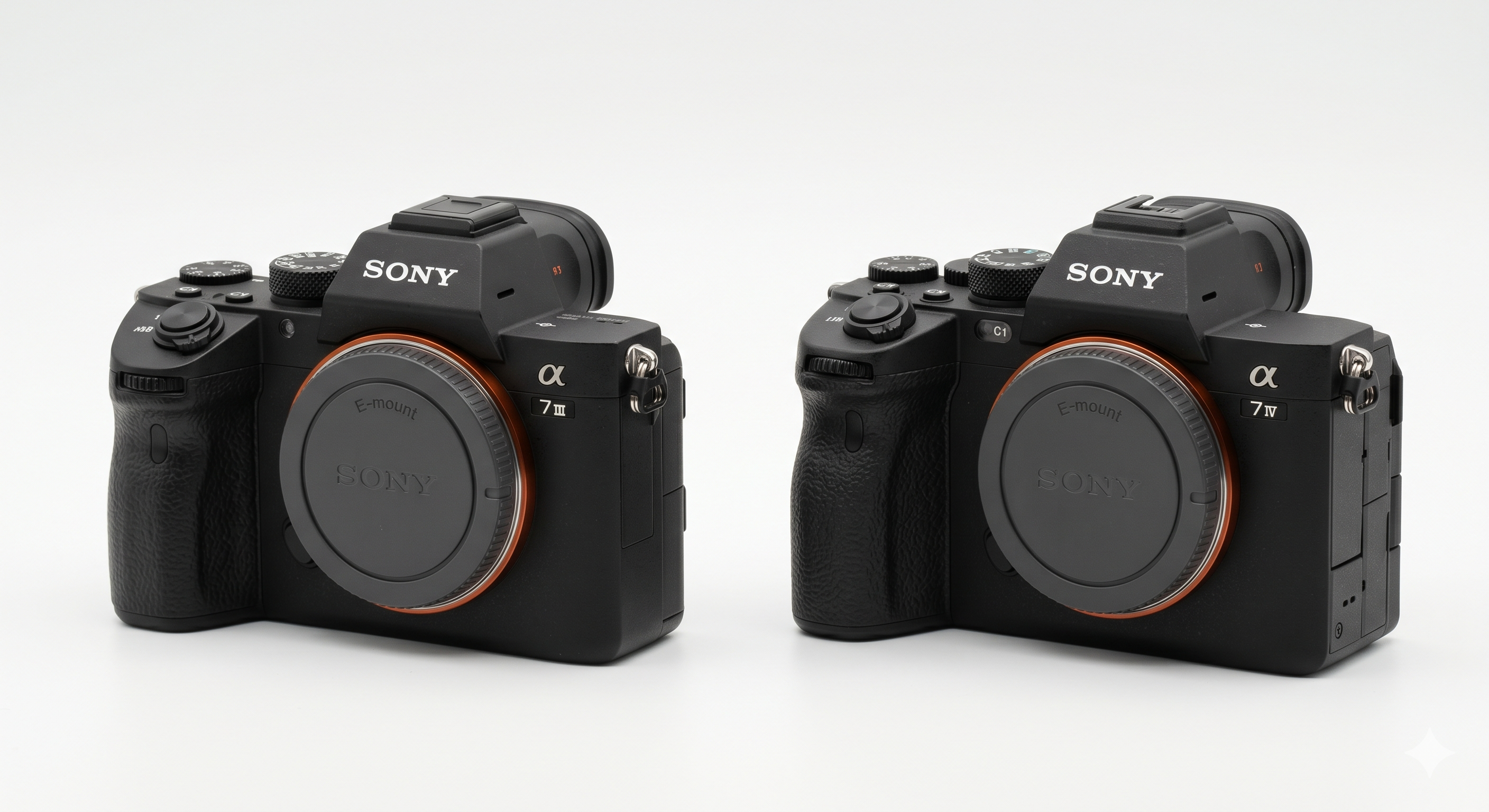
In short
- Used A7 III today starts at 950-1100 euros with low shutter count, A7 IV from 1500-1700 euros: a real difference of 500-600 euros.
- A7 IV features a new 33MP sensor, A7 III the proven 24MP from 2018: the resolution jump is the real reason to pay more.
- Real-Time Tracking autofocus with bird and car recognition is only on A7 IV, A7 III is limited to human and animal eye recognition.
- For pure photography under 20x30 prints, the A7 III remains more than sufficient; the upgrade makes sense for photo-video hybrids or heavy cropping.
It happens at the counter two or three times a week. A customer holding an A7 III they've had for four years, eyes on the A7 IV in the used gear display, asking directly: 'Matteo, is it worth it?'. The honest answer is never a simple yes or no, because it depends on what you do with the camera and how much you're willing to pay for improvements that are sometimes only visible in the lab.
In this article, I compare the two Sony models as we see them come through our workshop every month: real used prices in May 2026, the differences that truly matter when you take your shots, and the ones Sony marketing has inflated. No YouTuber-style rankings, no 'best ever' claims. Just what changes when you put your eye to the viewfinder.
A7 III and A7 IV: why the comparison makes sense today
Until a year ago, no one really compared these two cameras: the A7 IV cost 2,500 euros new, while the used A7 III was under 1,300. Today, on the used market, the gap has narrowed to a realistic 500-600 euros, making the question "is it worth spending more on the IV?" a legitimate one. It's the kind of comparison we make at the counter three times a week.
The A7 III, the workhorse of 2018
When Sony unveiled the A7 III in February 2018, it did something the market did not expect: it put a serious full-frame mirrorless camera under 2,000 euros. 24-megapixel back-illuminated sensor, dual SD card slots, NP-FZ100 battery rated for 710 certified shutter count (CIPA), and 693-point autofocus. At that price, there was no comparison with Canon and Nikon of the time.
The result is that hundreds of thousands of units have been sold worldwide. In our workshop alone, several hundred A7 III units have passed through in seven years: wedding photographers, portrait photographers, travelers, and entry-level nature photographers. It is the camera that made full-frame mirrorless accessible to the average photographer, and it is also the reason why you can easily find it used today in any condition and price range.
The A7 IV, the 2021 update that raised the bar
Sony waited three and a half years before replacing it, in October 2021. The A7 IV is not a facelift: it is a rethought camera. New 33-megapixel BSI sensor, Bionz XR processor (the same as the A1), finally redesigned menu and full touch, vari-angle articulating screen, subject recognition extended to birds and cars, 4K 60p video in Super35.
The launch price was 2,800 euros, 700 more than the III at its release. Declared positioning: "hybrid camera", meaning no longer just photographic but designed from the ground up for professionals who alternate between photo and video.
What it means in the used market today
As of May 2026, the situation is as follows:
- A7 III: 950-1100 euros with shutter count under 30,000, up to 1300 euros for like new examples under 10,000 shutter count.
- A7 IV: 1500-1700 euros for examples with 15-25,000 shutter count, 1800-1900 euros for those under 10,000.
The market has stabilized in recent months, and prices have remained steady. For those looking for a serious first Sony full-frame camera without an unlimited budget, there is also the Sony A7 Mark II starting from 550 euros: same E mount, 24MP sensor from the previous generation, excellent as a second body or as an absolute entry into the system.
Sensor and image quality: 24 vs 33 megapixels
A nine-megapixel difference may seem trivial on paper, but it is the real reason Sony positioned the A7 IV as the successor to the A7 III. The A7 IV sensor was designed from scratch in 2021, while the A7 III sensor dates back to 2018 and is the same one that equipped the first A7R before being recalibrated. In our lab, after handling dozens of units of both models, the difference is there, but it is not as significant as marketing suggests.
Resolution: when the extra 9 MP truly matter
The A7 III captures at 6000x4000 pixels, the A7 IV at 7008x4672. In print, when talking about actual paper, the difference translates as follows:
| Print format | A7 III (24MP) | A7 IV (33MP) |
|---|---|---|
| 20x30 cm | Excellent | Excellent |
| 30x45 cm | Very good | Very good |
| 50x70 cm | Good, holds up well | Extra margin useful |
| 70x100 cm | Stretched, depends on the subject | More reliable |
For Instagram, Facebook, websites, and any on-screen output, the 33 MP offer no visible advantage. The situation changes if you crop aggressively: with the A7 IV, you can crop to 60% of the frame and still maintain a 12 MP file suitable for publication anywhere. The same crop on the A7 III leaves you with approximately 9 MP, still usable but with less margin if you also need to print.
Dynamic range and high ISO
Here, Sony's marketing promises the world, but reality is more modest. Independent measurements give the A7 IV about 14.7 stops of dynamic range at base ISO, and the A7 III about 14.3. That half-stop difference is what you recover in forced shadows in Lightroom, nothing transformative. On noise at high ISOs, from 6400 upwards, in the lab we struggle to distinguish the two files blind: the A7 IV has a bit more detail in dark midtones, the A7 III delivers a slightly more uniform grain. For church weddings, concerts, indoor reportage, the two bodies perform the same way.
RAW files: size and workflow
A compressed RAW from the A7 III weighs 24-26 MB, while a compressed RAW from the A7 IV weighs 40-42 MB. That is a sixty-five percent increase, not forty as some superficial reviews claim. In the field, this means:
- SD cards: a 2000-shutter count wedding day goes from 50 GB to 84 GB
- Archive hard drive: a full season grows by about one terabyte per year
- Lightroom import: preview rendering times nearly doubled on non-recent cameras
- Cloud backup: if you pay per GB, the bill goes up
Those who shoot 500 files a week barely notice. Those who churn out high volumes notice it every day.
Autofocus: the difference you feel the most
If you hold an A7 III and an A7 IV on the same afternoon, autofocus is the first area where you truly feel the years of difference. On paper, it seems like an incremental update, but in practice, it changes the workflow for moving subjects. For static photography, posed portraits, or landscapes, the two perform almost identically.
The real leap lies in the subject recognition system. The A7 IV inherits the algorithms from the A1 and the A7S III, while the A7 III features an earlier version that, by May 2026, begins to show its seven years. It remains an excellent autofocus system for most real-world situations, not an obsolete one.
Next-Generation Real-Time Tracking
The A7 IV natively recognizes birds and cars, the A7 III does not. For those shooting avian wildlife or amateur motorsport, this is the number one reason to pay the extra 500 euros. On the A7 III, you can still track a raptor in flight, but you have to work with generic tracking and accept some missed focus on fast wingbeats.
On track cars or in rallies, the A7 IV locks onto the nose or the driver's helmet and holds focus even with aggressive panning. The A7 III relies on zone AF or lock-on with decent, not excellent, results. If your main subject is static — events, church weddings, still life, travel — you will never notice this difference.
Eye-AF: already excellent on the A7 III
For both human and animal eye recognition, both perform excellently. The A7 III was one of the cameras that made Eye-AF a standard, and seven years later, it still delivers reliable results for portraits, moving children, and dogs running on the beach.
The differences emerge in difficult light, below 5 lux or harsh backlight: the A7 IV maintains focus for longer, while the A7 III occasionally loses lock and requires refocusing. We are talking about percentages, not a vast gap. For 90% of portraits in normal conditions, the A7 III delivers the same result.
Joystick and focus points
759 points against 693, practically indistinguishable. The joystick is present on both camera bodies, positioned identically, with the same response. Those coming from an A7 II or a DSLR without a joystick will notice the leap, while those comparing the two Mark models will not feel any ergonomic difference in AF point selection.
If you are looking for a broader overview of how Sony compares to the other two major brands, we have written a dedicated guide on Canon vs Nikon vs Sony: which to choose that outlines the autofocus philosophies of the three brands.
Video: A7 IV is another planet
This is where the comparison stops being a matter of nuances. If you also use the camera for video, the A7 IV plays in a different league, and the used list price reflects that. Let's look at the real gap, not the one written on Sony's marketing slides.
Internal 4K 60p and 10-bit 4:2:2
The A7 III records 4K up to 30p in 8-bit 4:2:0, using the XAVC S codec at 100 Mbps. It is perfectly fine for standard YouTube editing or social media reels, but it breaks down quickly during color grading: posterized skies and skin tones that shift when you push the curves.
The A7 IV steps up to 4K 60p (with an APS-C crop of approximately 1.5x) and, most importantly, records internally in 10-bit 4:2:2, supporting both XAVC HS H.265 and XAVC S-I All-Intra up to 600 Mbps. If you work in S-Log3 or need to recover highlights and shadows without seeing artifacts, this feature alone justifies the 500-600 euro price difference.
Recording times and overheating
The A7 III runs for hours in 4K 30p without breaking a sweat: no 29-minute limit, sufficient passive heat dissipation. It's a camera many wedding videographers keep as a second body precisely for this. It gets warm, but it doesn't shut down.
The A7 IV features a redesigned heat sink and handles continuous 4K 30p recording well, but during extended 4K 60p Super 35 sessions, it may reach its temperature threshold, especially in summer or when recording in high-quality All-Intra. Sony provides a "high" threshold setting in the menu that raises the limit, however, under direct sunlight with a 40-50 minute clip at 60p, you will hit that limit. For shooting weddings or long interviews in 4K 30p, it remains as reliable as its predecessor.
Tilt-and-swivel display vs tilt-only display
It may seem like a minor detail, but it isn't. The A7 III features a screen that tilts on a single axis: you can adjust it up and down, but you cannot flip it forward. The A7 IV is equipped with a fully articulating vari-angle display that rotates sideways and flips out towards the subject.
If you vlog, record tutorials in self-recording, or even just shoot handheld in vertical for social media, the difference is daily. On the A7 III, you have to film blind or attach an external monitor. On the A7 IV, you flip the screen, frame yourself, and start. For a pure photographer, it makes no difference; for someone creating video content solo, it changes the workflow.
Ergonomics, menus, burst rates: what changes in hand
Hold the two cameras one after the other and the first difference you feel is in the grip: the A7 IV has a deeper grip than the A7 III, identical to that of the A7S III. For those with large hands or who use heavy lenses like the 70-200 f/2.8 GM, it means ten minutes less of cramping while shooting. The weight is similar, 658 grams versus 650, but the distribution changes.
The new touch menu of the A7 IV
If you're coming from the A7 III, you'll curse the first few days, guaranteed. The Sony A7 IV menu is completely rewritten: vertical navigation, logical grouping by function, and touch is finally responsive even inside the menu (not just for moving the AF point like on the A7 III). Objectively, it's better organized, but if you've memorized the location of thirty items over the last five years, you'll have to start over.
The display is also multi-articulated on the A7 IV, whereas the A7 III only has a vertical tilt. For those who vlog or shoot from low angles, it makes a huge difference. For those who only shoot through the viewfinder, zero.
Burst and buffer
On paper, both deliver 10 fps with the mechanical shutter. In practice, the buffer tells a more nuanced story:
- A7 III: 89 compressed RAW before slowing down, fast write speed on UHS-II SD.
- A7 IV with compressed RAW: over 1000 certified shutter count declared, effectively infinite burst in practice.
- A7 IV with lossless compressed RAW: drops to around 800 certified shutter count on CFexpress Type A, much less on SD.
- A7 IV with uncompressed RAW: the buffer fills in less than ten seconds and takes a long time to clear.
Translated: if you shoot long bursts for sports or action, the A7 IV only wins if you use compressed RAWs or invest in CFexpress. With full 33MP uncompressed files, you pay the price of resolution in the buffer as well.
Dual SD/CFexpress slots
Here, the A7 III is objectively more practical for the average photographer. It features two SD slots, one UHS-II and one UHS-I, using cards you likely already have in your drawer. The A7 IV has a hybrid SD/CFexpress Type A slot and one SD UHS-II slot. CFexpress Type A is a standard almost exclusive to Sony: a 160 GB card costs around 280 euros, compared to 60-80 euros for an equivalent SD UHS-II card, and it is virtually unavailable in physical stores if yours fails while you are on assignment. For most uses, even on the A7 IV, you will end up writing to two SD UHS-II cards and ignoring the CFexpress slot until you truly need the write speed for 4K 60p All-Intra.
Real prices on the used market in May 2026
The numbers we see passing through our warehouse and competitors' price lists these past few months tell a clear story: the gap between the two bodies has stabilized around 500-600 euros. It is not a small amount, but it is far from the chasm it was a year ago, when the A7 IV was still above 2,000 euros used.
Used A7 III: typical range and what to check
Today, an A7 III in good condition with 30,000-60,000 shutter count can be found between 950 and 1,100 euros. Below 950 euros, either the camera body is heavily marked, it has more than 100,000 shutter count, or it hides something. The shutter is rated for approximately 200,000 cycles by durability tests widely shared in the community, so even a unit with 80,000 shutter count still has a good amount of life left.
What we check at the workshop before putting it up for sale:
- Actual shutter count via internal EXIF read, not the one declared by the seller.
- Condition of the E mount contacts and bayonet retention under load with a 70-200 mounted.
- Sensor checked with raking light: the A7 III is known for attracting dust, we want to know if it just needs cleaning or if there are scratches on the filter.
- IBIS stabilizer operation on all five axes, tested with 1/8s shutter count at 50mm.
- Battery and card doors: the rubber dries out, peels off, and is the first sign of a poorly maintained camera.
Used A7 IV: typical range and availability
Used A7 IV units today start at €1,500 for bodies with 5,000-15,000 shutter count and reach €1,700 for like-new pieces with remaining Sony Italia warranty. There are significantly fewer offers compared to the A7 III: it is a 2021 model, and owners generally keep it. This keeps prices stable; I see few fluctuations from month to month.
If you see one for under €1,400, check two things: that it is the European version (not a US grey market unit without official warranty) and that the sensor does not have the well-known hot pixel defect on long exposures that affected some units from the first production series.
The calculation I do at the counter
When a customer is undecided, the advice I always give is the same: with a difference of 500-600 euros, you can buy a used 85mm f/1.8 of high quality, which changes the way you photograph much more than 9 extra megapixels. If you are coming from a Sony A7 Mark II at 565 euros and want to make a serious step up, the A7 III plus a fast lens is almost always the most sensible choice. The opposite applies to those coming from a Sony A6400 who want modern full frame with true 4K 60p video: there, the A7 IV justifies the price difference.
Which one to buy based on your actual use
Let's stop thinking in terms of spec sheets and put ourselves in the shoes of someone who will use the camera six days a week. The two Sony models serve different audiences, even though on paper they seem to overlap. Here is how we reason at the counter when someone arrives undecided between the two.
Portrait and ceremony photographer
If you shoot weddings, baptisms, studio portraits, or family reportage, the A7 III is the right choice nine times out of ten. The 24 megapixels cover any typical album print format up to 30x40, the human eye autofocus is essentially identical to that of the IV, and the files are lighter to manage when you deliver eight hundred of them after a Saturday in church.
The €500-600 difference you save on used gear translates into an 85mm f/1.8 for close-ups or a second camera body to pair with your first. For those working with a pair of bodies, two used A7 III units cost less than a single A7 IV and eliminate the issue of changing lenses under pressure.
Wildlife, sports, photo-video hybrid
The situation reverses here. Bird recognition, car tracking, and the 33-megapixel sensor of the A7 IV become concrete advantages, not brochure gimmicks. Whether you are photographing raptors in flight or kids playing soccer, the updated tracking locks in the shot in situations where the III would lose focus on the jersey instead of the face.
Heavy cropping on a distant subject still yields a 14-15 megapixel file usable even after cutting half the frame, whereas on the III you were left with barely 10 megapixels. For those who also shoot video, the internal 4K 10-bit 4:2:2 of the IV is a different world compared to the 8-bit of the III: if you edit in DaVinci or Premiere and need color flexibility, the upgrade pays for itself.
Upgrading from Sony APS-C
A classic case at the counter: a customer arrives with a Sony A6400 for 650 euros or a Sony ZV-E10 for 500 euros and wants to step up to full frame. For them, the A7 III is the logical move: same E-mount ecosystem, more serious ergonomics, and files with significantly better dynamic range, without having to relearn the menu.
The A7 IV becomes overkill if you're not doing serious video work or if you haven't already maxed out your APS-C. Spending 1600 euros to find out six months later that you only use 80% of the III's features is a mistake we see over and over. It's better to start with the III and upgrade in two years when you know exactly what you're missing.
What we check in the lab before putting them up for sale
An A7 III or A7 IV bought from a private seller on Subito might have 200,000 shutter count declared as 50,000, a buzzing IBIS, or a sensor with three dead pixels in the center. You’ll only notice six months later, when the seller has already changed their number. At our store, that camera doesn’t even make it to the display window: we stop it at the testing bench.
Certified shutter count
On Sony Alpha models, the shutter count is read from the EXIF data of an unprocessed RAW file, cross-referenced with internal diagnostic tools. On the A7 III and A7 IV, this data is locked: there are no public procedures to reset it, unlike some older Canon models.
Every camera that comes in is tested, the RAW file is downloaded, and the shutter count is read. If the seller told us 30,000 and we find 95,000, the camera is sent back or the price is adjusted. The number is listed on the product sheet, in black and white. An A7 III at €1,050 with a certified shutter count of 18,000 is a different machine from one at €950 with 80,000 shutter count, and the customer must be able to see this before paying.
Sensor, shutter, IBIS test
A full inspection at the counter includes:
- Sensor pixel mapping: shutter count with cap on, base ISO, hot pixel and dead pixel check. We tolerate a few isolated hot pixels on the edges, but we reject anything visible in the central area.
- Shutter at all speeds: from 30 seconds to 1/8000, verifying consistent exposure. A shutter curtain starting to misalign is visible first at fast speeds.
- IBIS on the bench: stabilizer tested with a known lens at progressively slower speeds. If we detect mechanical play or see drift on the axis, the camera body does not pass.
- Mount and contacts: checking for play, oxidation, and correct reading of lens data.
- Autofocus sensors and display: continuous test, touch verification, and dead pixel check on the OLED viewfinder.
Out of every ten camera bodies we evaluate, we reject an average of two. They do not end up in the catalog at a discounted price with an asterisk: they are returned to the seller.
2-year warranty: what it actually covers
The legal warranty on used items in Italy is one year. Our commercial warranty extends to two. This means that if the shutter of an A7 III fails 14 months after purchase, we will repair it for you without any additional cost, regardless of the fact that the law no longer requires us to.
We do not cover damage from drops, liquid ingress, or tampering: that is obvious. We cover everything else, including electronic components, which are often the weak point in used equipment. We have written a dedicated in-depth article on this topic in how a warranty on used gear truly makes a difference, with concrete examples of repairs we have handled.
Frequently asked questions
Is the A7 III still a valid camera in 2026?
Absolutely. The 24MP sensor is still competitive, the eye autofocus works perfectly, and the IBIS is effective. For the vast majority of photographic uses, you will never notice its limitations.
How many shutter count does the shutter of the A7 III and A7 IV last?
Durability tests widely shared in the community indicate approximately 200,000 cycles for both. In the lab, we regularly see units with over 150,000 shutter counts still functioning perfectly, but this is a statistical estimate, not a guarantee.
Can I use the same lenses on both?
Yes, they use the same Sony E mount and all FE full-frame lenses are compatible. APS-C lenses also work in crop mode, but on the A7 IV with a crop of approximately 15MP, and on the A7 III with a crop of approximately 10MP.
Is the new A7 IV menu really that much better?
Objectively, yes, it is more logical and finally features touch controls on all menu items. However, those with dozens of hours on the A7 III will curse for the first few days because everything has been moved. It’s a matter of habit; after a week, you’ll be right at home.
For weddings, is the A7 III or the A7 IV better?
Both are perfect. The A7 III is more than sufficient and leaves you with budget for a second body (essential for ceremonies). The A7 IV makes sense if you want to deliver high-quality 4K 60p video to clients as well.
What to check when buying an A7 III or A7 IV from a private seller?
Actual shutter count (using software such as Sony Alpha Shutter Count), IBIS functionality, dead pixels on the sensor, integrity of the mount contacts, and original Sony battery with reasonable cycle counts. Difficult to verify without tools, which is why certified used equipment has its place.
Want to see an A7 III or A7 IV inspected by our lab?
If you have questions about a purchase or need advice for your specific case, contact us. We offer free advice because we are photographers first, sellers second, and because a customer who makes a poor purchase won't return to photography.
Three ways to get in touch:
- Contact form — response within 24 business hours
- WhatsApp at 342 362 3454 (messages only)
- Phone: 071 291 6347 (Mon-Fri 9am-1pm/3pm-6pm, Sat 9am-1pm)
And if you want to see what we have in stock right away, explore the available used gear today: every camera is certified, comes with a 2-year warranty, and ships within 24-48 hours.
Article written by Matteo for the ReflexMania Team. Last updated: May 2026. Prices and availability refer to the time of publication.