
In short
- A new D780 costs around €1,900–2,100, while a used one in good condition ranges from €1,100 to €1,450: a €600–900 difference for the same camera body.
- The D780 shutter is rated for 200,000 shutter count: a used unit with 30,000–50,000 shutter count has used less than 25% of its expected lifespan.
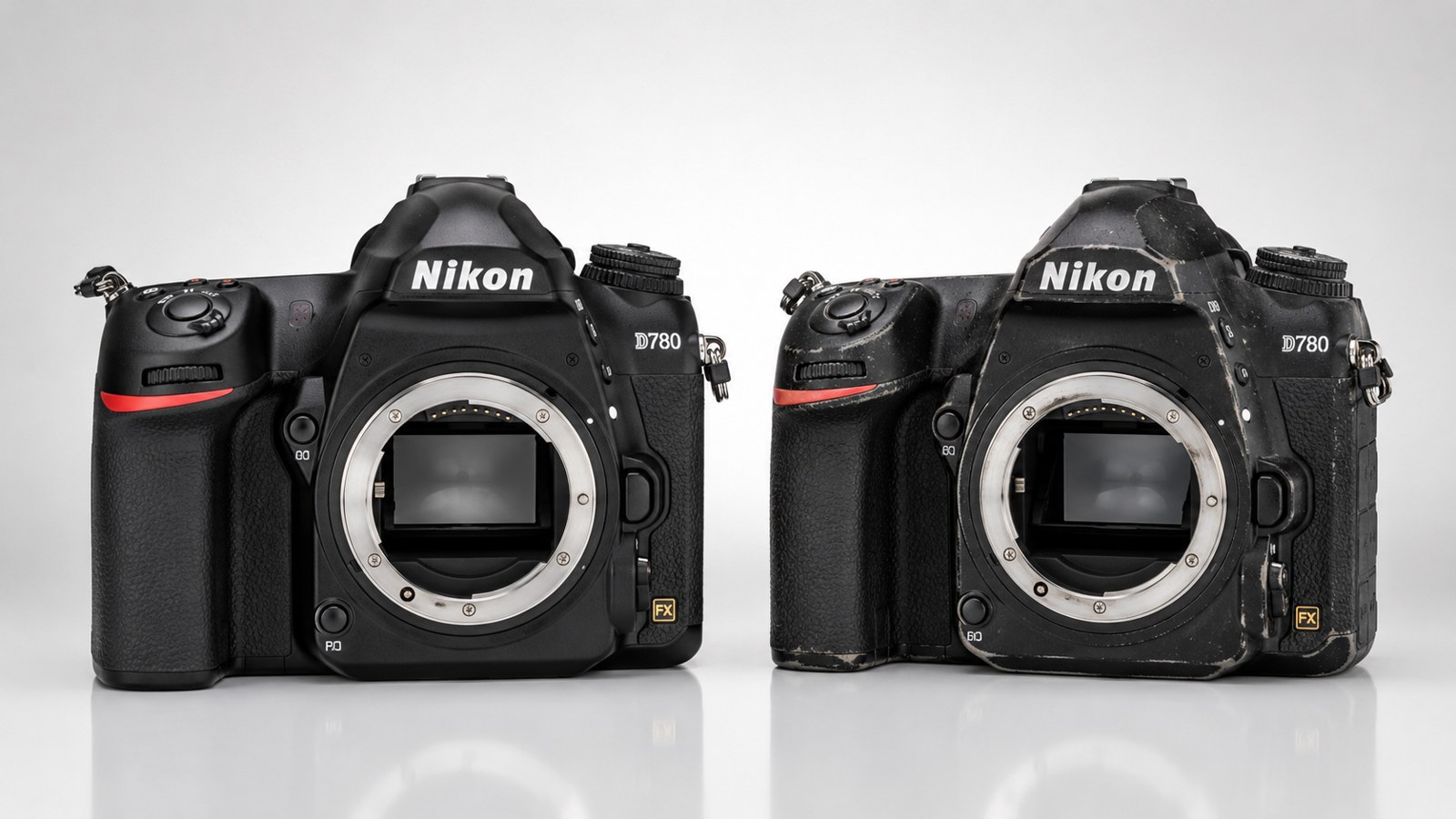
- The D780 is a full-frame DSLR from 2020 that is still on the market: whether new or used, it is the same camera; only the condition changes, not the technology.
- In the used market, the risk lies in the actual condition, not the model: certified shutter count, shutter health, and warranty shift the value proposition more than the price.
The Nikon D780 is one of those models that puts buyers in a difficult position. It is still in production, so you can buy it new, but the used market is full of examples at much lower prices. The question I hear at the counter is always the same: given this price difference, is buying a used one a bargain or a risk?
In this article, I compare the two options with concrete numbers: what the difference really costs, how many shutter counts a used D780 typically has, what to check before paying, and in which cases spending more on a new model makes sense. No theory: I tell you what we see coming through the lab.
What is the Nikon D780 and why the used-vs-new question makes sense
The D780 is one of the few full-frame DSLRs still available new in 2026. Almost all DSLRs have been discontinued: Nikon has shifted its focus to the Z mirrorless system. The D780, however, remains. This changes everything when considering used or new, because you truly have two open paths for the exact same camera body.
A full-frame DSLR still in the catalog in 2026
The D780 arrived in 2020 as the successor to the D750, one of the best-selling DSLRs of all time in the enthusiast-advanced segment. It features the 24-megapixel full-frame sensor from the Z6 and a dual autofocus system: the classic phase-detection AF in the optical viewfinder, plus on-sensor AF in live view, the same approach used in mirrorless cameras.
Essentially, you have two cameras in one. Through the optical viewfinder, you work just like on any DSLR, with the same responsiveness. In live view or for video, you get a modern AF system that tracks the subject on the sensor. Nikon keeps it in its lineup because it serves a specific audience: those with F-mount lenses, those who want the battery life of the EN-EL15 and the optical viewfinder, and those who have no intention of switching to mirrorless.
Why used is worth considering on a recent model
This is the key point. When a model has been out of production for years, buying it used means accepting outdated technology: it's the only way to own one. With the D780, that's not the case. The used camera you buy today is technically identical to the new one in the display window. Same sensor, same autofocus, same updatable firmware. Only the condition differs.
On a 2020 camera body, used is not "old technology": it is the same camera with a few fewer shutter count in its life ahead. The difference between the two options boils down to three concrete factors:
- Price: the new model costs several hundred euros more for the same technical specifications.
- Actual condition of the camera body: certified shutter count, shutter health, and signs of use on a used unit.
- Warranty: full manufacturer warranty on new units, to be assessed case by case on used ones.
And that is exactly why the used-vs-new question makes sense specifically for the D780, and much less so for a camera that is out of production. You are not choosing between old and modern. You are choosing how much to pay for the same tool, and how much security you want around the purchase. The sections that follow put numbers on each of these three factors.
The real price difference between new and used today
The price difference between a new D780 and a used one in good condition ranges from 600 to 900 euros. It's the same camera body, the same 2020 technology; the only difference is that one has been used. To determine if that savings is worth it, you need to look at the numbers, not rely on gut feelings.
How much does the D780 cost new in 2026
New, today, the D780 ranges between €1,900 and €2,100 depending on the retailer and the bundle. It is a full-frame model still on the list but nearing the end of its commercial life: it is occasionally found in clearance promotions, in which cases the price drops towards €1,800.
This is an honest point that many guides skip. When a model is discontinued, the discount on the new unit narrows the gap with the used market. If you find a new D780 below cost at €1,750 with a full Nikon Italia warranty, the advantage of buying used diminishes. It is worth checking end-of-line offers before making a decision.
What the used market asks for
In the used market, price depends on condition, not age. The same camera body changes hands at different prices depending on shutter count, aesthetic condition, and warranty coverage.
| Condition | Indicative price | Justification |
|---|---|---|
| Like new | 1.350 - 1.450 € | Low shutter count, zero signs of use, complete box and accessories |
| Excellent condition | 1.200 - 1.350 € | Minimal signs of use, perfect functionality, low shutter count |
| Several signs of use | 1.100 - 1.200 € | Visible aesthetic wear or high shutter count, sound mechanics |
The price spread within the used market — approximately 300 euros between "like new" and "several signs of use" — tells more than the average price. Two units at the same price can have different value: one with 18,000 shutter count and warranty, the other with 90,000 shutter count sold by a private seller without any guarantees. The number to look at is not how much you save off the list price, but what you are actually buying at that price.
Nikon D780: new vs used price by condition (2026)
| Condition | Indicative price | Typical shutter count | Warranty |
|---|---|---|---|
| New | 1,900-2,100 euros | 0 | 2-year manufacturer warranty |
| Like new | 1,300-1,450 euros | Under 10,000 | Depends on the seller |
| Excellent condition | 1,150-1,300 euros | 10,000-40,000 | Depends on the seller |
| Several signs of use | 1,000-1,150 euros | 40,000-80,000 | Depends on the seller |
Shutter count and shutter health: the data that really matters
A D780 with 40,000 shutter count has used less than a fifth of the shutter's rated lifespan. Yet it is the first number that scares off used buyers, as if 40,000 were a lot. It isn't, and in this section we explain why the shutter count matters, but not in the way you fear.
200,000 declared shutter count: what it means in practice
Nikon certifies the D780 shutter for 200,000 shutter count. This is a laboratory figure, obtained on a sample under controlled conditions: in practice, many shutters comfortably exceed that threshold, while some fail earlier. It should be read as an average expectation, not as a precise expiration date.
In real-world use, 200,000 shutter count is an enormous amount for anyone not working in weddings or sports. Here is what that means in years, at different rates:
| Usage profile | Shutter count/year | Years to threshold |
|---|---|---|
| Weekend amateur | 5,000 | 40 years |
| Active enthusiast | 15,000 | approx. 13 years |
| Semi-pro / events | 40,000 | 5 years |
A camera body with 30,000-50,000 shutter count offers decades of work for an advanced enthusiast. The anxiety that "used equals worn out" has no basis at these numbers. How it was treated matters far more: a D780 with 50,000 shutter count that has been serviced is worth more than one with 8,000 shutter count that was never opened and kept in a damp basement.
How to verify the shutter count before buying
The shutter count is recorded in the EXIF metadata of every file. Reading it requires nothing esoteric: take a JPEG photo with the camera and upload it to an EXIF reading tool (online or desktop), looking for the "Shutter Count" field. On Nikon, this data is reliable and cannot be reset like a car's odometer.
- Always ask for the shutter count before purchasing. A serious seller will declare it without being prompted.
- Beware of "I don't know". On a Nikon, this data is trivial to extract: if they don't provide it, they either don't know or don't want to.
- Cross-check the number with the price. A camera body with 120,000 shutter counts might be acceptable, but it must cost less.
The shutter count is just one of the parameters that affect the value of used equipment. For the full picture, see the 7 parameters that determine the value of a used camera.
What to check on a used D780 before paying
A D780 can have 40,000 shutter count and look like new, or 12,000 shutter count and hide a scratched sensor from a poorly executed cleaning. The count is only half the story: physical and optical condition matters as much as the numbers. Before pulling out your wallet, there are specific points to verify on this camera body.
- Sensor: with a B exposure and the lens detached, inspect for scratches or liquid haze under raking light. A dust spot can be blown off; a scratch remains.
- Live view autofocus: the D780 features on-sensor phase-detection AF in live view. Verify that it locks on quickly in mirrorless mode, not just through the optical viewfinder.
- Dual SD slots: insert two cards and take a shot. It happens that the second slot is ignored for years, and the issue is only discovered when a backup is needed.
- EN-EL15 battery (the EN-EL15a/b/c series is Nikon; beware of clones): check the degradation status in the menu. A tired cell is not a disaster, but it affects the price.
- Mount and rubber seals: wear marks on the mount indicate frequent lens changes; lifted or sticky seals are the first sign of a heavily used body.
The checks we perform in our lab
Every D780 that comes in goes through our workbench before hitting the display. We read the shutter count from the EXIF data, test the shutter at various speeds, verify autofocus performance through the viewfinder and in live view, and check the integrity of the weather-sealing gaskets. The sensor is thoroughly cleaned and a certified test shot is taken: no surprises on first use.
Typical defects we see on this model
The most common issue is not the shutter, but the sensor. Many D780 units arrive with dust that has never been removed or, worse, with micro-scratches from DIY cleaning using the wrong products. The second classic problem is the wear of the rubber grip, which on a heavily handled body tends to become shiny or peel off: it is a cosmetic issue, but it can be used as leverage to negotiate the price. Less common, but worth checking, are oxidized bayonet contacts on units kept in humid environments.
The same logic applies to every high-end used DSLR: if you want to understand how these factors affect the concrete valuation, we discussed it in how much is my used Nikon D850 worth, where the same checks translate into euros.
When it makes sense to buy the D780 new
Buying used saves 600-900 euros on the same camera body, but there are situations where spending that extra amount on a new one is the right choice. It is almost never a matter of performance: a new D780 and a used one take identical shutter counts. It is a matter of risk, warranty, and how much the camera works.
Here are the specific cases where I personally recommend buying new, even though used costs less.
- Intensive professional use. If you take 80,000-100,000 shutter count a year across weddings, events, and reportage, starting from a zero shutter count gives you the full lifespan of 200,000 cycles ahead. On a used camera with 40,000 shutter count, you would consume the remaining margin in just a few months of real work.
- Full Nikon Italia warranty. The new unit comes with a 2-year warranty (often extendable to 4 years with registration) covered by the manufacturer, including spare parts. For those who make a living with this tool, a camera breakdown during peak season costs more than the price difference.
- Reduced price gap due to end of series. When a retailer clears its stock and the new D780 drops below 1,700 euros, the gap with a used unit in excellent condition narrows to 300-400 euros. At that point, the margin no longer justifies the risk of uncertified used equipment.
- For those who want no worries. If the idea of checking shutter count, rubber seals, and mount keeps you up at night, the new option offers peace of mind. Sealed box, virgin sensor, no history behind it. It is a real value and should not be underestimated.
That said, I want to be clear on one point. For most photographers — advanced amateurs, second bodies, those who take a few thousand shutter counts a year — these cases do not apply. The D780 is a 2020 DSLR still in the lineup: the technology does not age from one unit to another, only the condition of use changes.
The real point is not "new versus used" in the abstract, but how much the specific used item in front of you reduces the risk. A camera body with a certified shutter count, a verified shutter, and a warranty comes close to the peace of mind of a new one at a used price. That is where the calculation changes, and it is exactly the theme of the upcoming sections.
When buying used makes sense (and how much you actually save)
A used D780 makes sense when the body is a means, not an end. If the camera is meant to take certified shutter counts and not to sit in a display case, spending €1,100–1,450 instead of €1,900–2,100 for the exact same model frees up €600–900 that can be invested where image quality is truly decided: the lens, the light, the accessories.
There are three scenarios where used gear clearly wins:
- Advanced amateur: 5,000 to 15,000 shutter count per year. A camera body with 40,000 shutter count against a 200,000 expected lifespan will serve you for years without ever approaching the shutter limit.
- Second body: you already own a Nikon and need a reliable full-frame backup for weddings, events, or travel. Paying new prices for a camera that stays in your reserve bag makes little sense.
- Those who want to reinvest the savings: the budget is fixed, and every euro not spent on the camera body becomes an euro spent on the lens.
In all three cases, the reasoning is the same: the D780 is a 2020 model still on the market. Buying it used means you don't compromise on technology; you only pay for its condition. It's a transfer of value, not a compromise.
Savings reinvested in lenses
This is the point many underestimate. In terms of final image quality, a fast prime lens matters more than the camera body. The D780 sensor is excellent, but it remains the same whether paired with a kit zoom or a 50mm f/1.8.
The €700–800 difference between new and used is no small amount: it is exactly the budget for a high-quality fast prime lens. With that amount, you enter the range of native Nikon 35mm or 85mm f/1.8 lenses, optics that change the way you work on portraits, reportage, and low-light conditions.
In practical terms: new D780 with kit zoom or used D780 plus a fast prime, for the same cost. In the vast majority of real-world uses, the second combination produces better photos. The body is the infrastructure; the lens is what the customer or you see in the final image.
If your goal is image quality rather than the camera as an object, used is not a compromise: it is the choice that takes you further with the same budget.
Used D780 or alternatives? Options at a similar budget
Used D780 bodies range from €1,100 to €1,450, but that’s not the only option at that price point. Sometimes you truly need that specific body; other times, you’re paying for capabilities you’ll never use. Before you commit, it’s worth considering two different paths: sticking with a full-frame DSLR for less, or putting that budget into a mirrorless system.
Sticking with full-frame DSLRs while spending less
If you need the full-frame sensor, the optical viewfinder, and the F-mount lenses you already own, but you don't make use of the advanced live view or the 4K video of the D780, an older DSLR covers 80% of cases at half the price. The used Nikon D610 is the classic case: same sensor format, very similar 24MP files, price starting well under one thousand euros.
What you lose compared to the D780, in concrete terms:
- Slow contrast-detection AF in live view, not on-sensor phase detection;
- No modern video capabilities and no updated connectivity;
- Shutter with lower expected lifespan and slower burst rate.
For portrait, landscape, and still life photography, where you shoot through the viewfinder and take your time, you will hardly notice the difference. In those scenarios, the D780 is a luxury, not a necessity.
Switching to mirrorless with that budget
The other option is to change direction. The Canon EOS RP at 600 euros is the most affordable full-frame mirrorless on the market: lightweight body, electronic viewfinder, on-sensor autofocus. It is an excellent entry point into the full-frame format, but it is less robust and has lower battery life than the D780, and you switch lens systems.
On the Nikon front, the Z system is the brand's future direction. However, pay attention to the format: the Nikon Z50 at 600 euros and the Nikon Z50 Mark II at 780 euros are APS-C, not full frame. They are modern, compact mirrorless camera bodies with very reliable AF, ideal if you want to lighten your kit and the smaller sensor is sufficient for you, but they do not replace the full frame of the D780.
In short: if you want full frame and mirrorless on a budget, look at the EOS RP; if you accept APS-C in exchange for compactness and recent technology, the Z50 are solid choices. If, however, Nikon full frame with F-mount lenses is your priority, the used D780 remains the most consistent choice.
Used D780 and alternatives at a similar budget
| Model | Sensor | System | When it makes sense |
|---|---|---|---|
| Used Nikon D780 | Full frame 24MP | DSLR | You want a full frame DSLR, optical viewfinder, dual SD |
| Used Nikon D610 | Full frame 24MP | DSLR | Same format for less, non-intensive use |
| Used Canon EOS RP | Full frame 26MP | Mirrorless | You want a lightweight full frame mirrorless at a low cost |
| Nikon Z50 / Z50 II | APS-C | Mirrorless Z | Investing in the future of mirrorless, accepting the smaller sensor |
Why buying certified used gear changes the math
In the used market, the real risk isn't the model, it's the specific unit. Two D780s with the same price tag can hide different realities: one with 28,000 shutter count and a healthy shutter, the other with 110,000 actuations and a count the seller doesn't know or doesn't want to disclose. Without verified data, you're buying a promise.
This is where certified used gear changes the equation. When the shutter count is measured in a lab rather than reported from memory, the price difference between new and used stops being a leap into the dark and becomes an informed choice. Saving 700 euros on a body with a known remaining lifespan is a deal. Saving them on an unknown is just a gamble.
Every D780 that comes to us goes through the same process before we list it for sale:
- Certified shutter count: reading of the actual shutter data, written on the card. Out of the 200,000 expected shutter count, you immediately know how many are left.
- Workshop inspection: shutter test, autofocus via viewfinder and live view, dual SD slot, sensor cleaning and mount check.
- 2-year warranty: the same coverage on all used equipment, not 12 months. This is the feature that truly brings used gear close to the peace of mind of new.
These three elements change the meaning of the comparison in the previous sections. A used D780 at 1,300 euros with a certified shutter count of 35,000 and a 2-year warranty is not "a cheaper D780 with risks": it is the same camera, with a wide margin of life and a safety net that the private market does not offer. The same reasoning applies to any used DSLR: we explained this also when discussing the Nikon D7200 and why it remains a sensible semi-pro APS-C, where the health of the camera body matters more than the year of release.
At the end of the day, the math is simple: you pay the used price, but with verified data and a warranty, you get peace of mind that, without certification, would cost hundreds of euros more—or leave you up all night hoping you picked the right unit.
Frequently asked questions
How many shutter count is too many for a used Nikon D780?
The shutter is rated for 200,000 shutter count. A unit with 40,000-50,000 shutter count has used less than a quarter of its expected lifespan and is still fully reliable. Above 120,000-150,000, it starts to make sense to negotiate the price, even though the shutter can still last a long time.
How much do you save by buying a used D780 instead of a new one?
In 2026, the typical gap is 600-900 euros: the new model costs around 1,900-2,100 euros, while a used one in excellent condition ranges from 1,150 to 1,450 euros. The savings are enough for a bright prime lens, which often improves photos more than the camera body itself.
Is a DSLR like the D780 still worth it in 2026, or is a mirrorless better?
It depends on usage. The D780 features an optical viewfinder, exceptional battery life, and excellent compatibility with F-mount lenses. If you are looking for a more recent and compact system, a mirrorless camera makes more sense in the long run. There is no absolute right choice: it depends on the lens park you have or intend to build.
Does the used D780 lose more value than the new one?
No: most of the depreciation occurs when transitioning from new to used. Buying a camera that is already used in good condition results in a much smaller subsequent loss of value over time compared to paying the new price.
How do I know if a used D780 has hidden issues?
Checks on the sensor, shutter, autofocus, and sealing are required. As a private individual, you cannot always perform these. When buying certified used equipment, the camera body has already been inspected in the lab, with a declared shutter count and warranty, so the risk is close to that of a new item.
Does the warranty on used equipment match that of new equipment?
The manufacturer's warranty on new items covers factory defects. On certified used equipment from ReflexMania, you get a 2-year warranty on the refurbished camera body: concrete coverage on an already inspected machine, at a used price.
Looking for a used, inspected, and guaranteed D780?
If you have doubts about a purchase or need advice for your specific case, contact us. We offer free advice because we are photographers first, and because a customer who buys poorly does not return to photography.
Three ways to get in touch:
- Contact form — response within 24 business hours
- WhatsApp at 342 362 3454 (messages only)
- Phone: 071 291 6347 (Mon-Fri 9-13/15-18, Sat 9-13)
If you want to see what we have in stock right away, explore the used gear available today: every camera is certified, comes with a 2-year warranty, and ships within 24-48 hours.
Article written by Matteo for the ReflexMania Team. Last updated: June 2026. Prices and availability refer to the time of publication.