
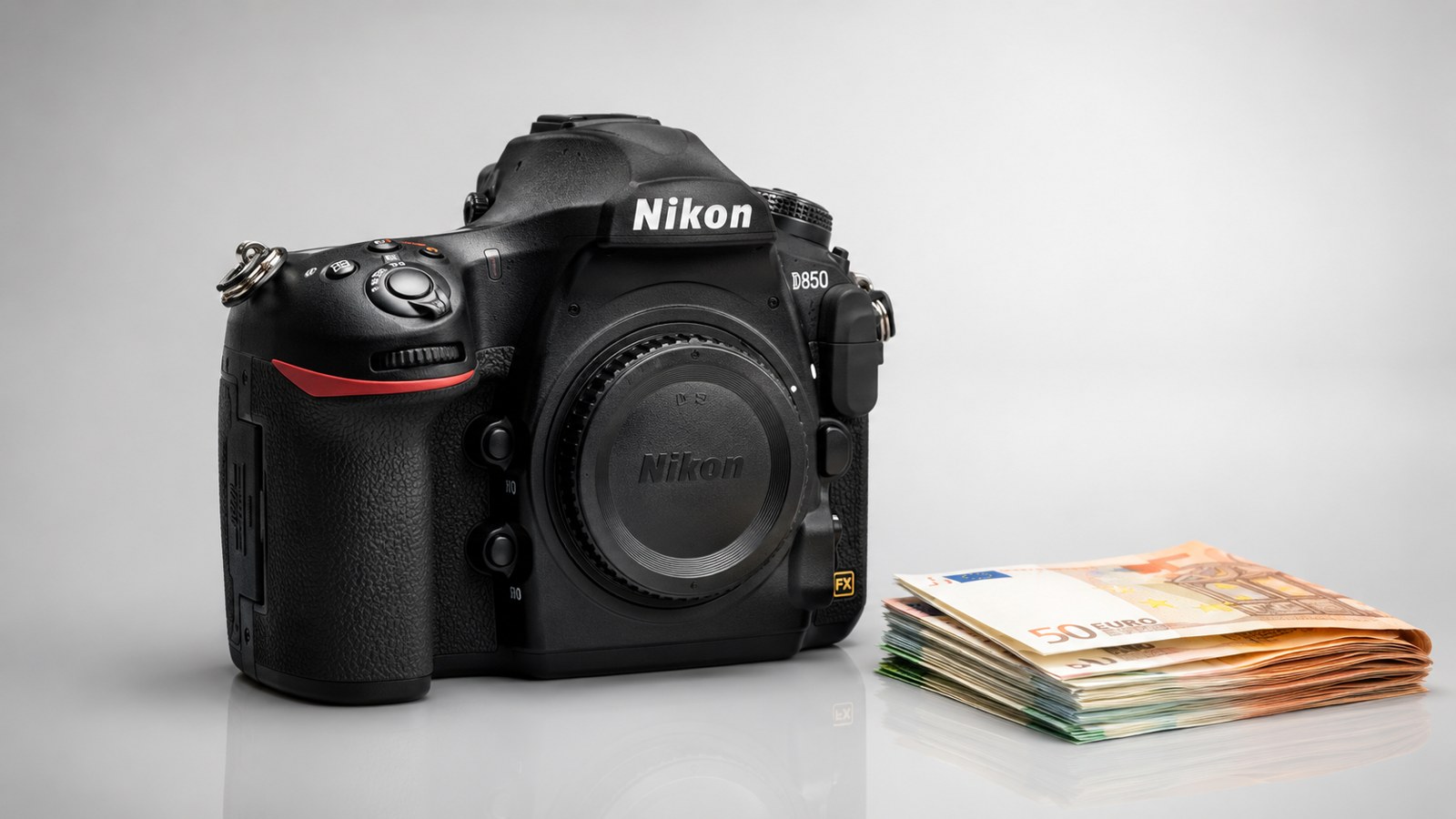
In short
- In 2026, a used Nikon D850 in excellent condition is valued between €1,200 and €1,800, depending on shutter count, included accessories, and aesthetic condition.
- Shutter count is the primary factor: below 50,000 shutter count, the value remains full; above 150,000, it drops by 20-25%.
- The original kit (charger, two EN-EL15 batteries, box, BL-5) can be worth €100-150 at the time of sale.
- The D850 holds its price better than many DSLRs because the 45.7 MP sensor still stands up to comparison with current mirrorless cameras.
The Nikon D850 is one of those cameras we often see come across the counter, and it is also one of the ones where people most often misjudge the value, in both directions. There are those who sell it for 900 euros, convinced that "it's just a DSLR now," and those who list it online for 2,200 euros because "I paid 3,500 for it." Both are wrong, for specific reasons that are worth explaining.
In this article, I tell you what a used D850 is really worth today, in 2026, and above all which factors concretely shift the price. I don't talk about feelings: I talk about shutter count, condition, included accessories, and market demand, the same parameters we use when a D850 arrives at our bench for an appraisal or a trade-in.
What is a used Nikon D850 worth in 2026: the real range
In 2026, a used Nikon D850 in good condition costs between 1,200 and 1,800 euros. The range is wide because there is no fixed price: it depends on shutter count, included accessories, aesthetic condition, and—equally important—on who is buying and who is selling. The same camera is worth different amounts depending on whether you are selling it to a friend or bringing it to a shop counter.
Before looking at yours, note the three prices associated with this model, as they are often confused with one another:
- Private sale price: the amount a seller asks for in a listing. It is the highest asking price, but the most unpredictable in terms of actual proceeds.
- Store purchase price: what you pay for a certified and warrantied unit.
- Resale price: what you receive when selling it to a store. It is always lower than the other two.
Private sale price vs. shop price
Selling to a private buyer can net you 100-200 euros more than a shop would offer. However, you pay for that margin in time and risk: listing, messages, appointments, verifying payments, and potential disputes after delivery. Selling to a shop means receiving less cash, but you close the deal in an afternoon, worry-free, with the option to use the valuation as a trade-in for another camera body. It is the same logic that applies to other top-tier DSLRs, as explained in our guide to valuing a used Canon 5D Mark IV: the price difference is real, but so is the risk.
Why the D850 has held its value
The D850 holds its value better than almost all DSLRs of its generation, and the reason is technical. The 45.7 megapixel sensor still holds up against many current mirrorless cameras in terms of detail and dynamic range. The 153-point autofocus remains fast and reliable on the optical viewfinder. For those shooting landscape, studio portrait, or still life, it is a camera that does its job today just as it did in 2017.
Active demand means stable pricing. As long as photographers seek that specific image quality without switching to mirrorless, the D850 retains its value — which is why a well-maintained example still sells well.
Shutter count: the number one factor
When a D850 comes to the counter, the first thing we check is not the rubber grip or the monitor: it is the shutter count. The shutter count tells you how much the camera has been used better than any photo in the listing. Two visually identical units can differ in value by 300 euros based solely on this data.
The D850 shutter is Nikon-certified for approximately 200,000 shutter count. It is a high number, typical of a professional DSLR, but it is a statistical average, not a guarantee: some fail at 120,000, while others exceed 300,000 without a single issue. The point is not imminent failure, but how much useful life remains and how much this weighs on the price.
The thresholds that matter: 50,000, 100,000, 200,000
Value does not decline linearly. It moves in steps, around a few precise thresholds.
| Shutter count | Impact on value |
|---|---|
| Under 50,000 | Full value. The camera is practically "new" mechanically. |
| 50,000 – 100,000 | Normal use. Slight drop, 5-10%. No cause for alarm. |
| 100,000 – 150,000 | Intensive use. 10-15% discount, the camera has worked hard. |
| Over 150,000 | Risk zone. 20-25% drop, shutter near average lifespan. |
Beyond 150,000, the shutter count becomes the most significant variable. It does not mean the camera body is a write-off; it means the buyer must budget for a potential shutter replacement, which on a D850 costs between 250 and 350 euros for parts and labor. This is why the discount is justified.
How to check the shutter count of your D850
The data is hidden in the EXIF metadata of every shutter count, but Nikon does not display it in the camera menu. It only takes a few minutes to read it.
- Tool online: take a JPEG (not an already modified RAW), upload it to a free service like MyShutterCount or Camera Shutter Count. They read the "Total Shutter Releases" field and give you the exact number.
- Software desktop: programs like ExifTool show the same value locally, without uploading anything to the network. Useful if you don't trust web tools.
A practical tip: always use a JPEG just taken, not an old photo from your phone. If you are selling, take a screenshot of the shutter count and include it in your listing. Transparency about the shutter count shortens the negotiation and makes you appear more serious. If you are buying from a private seller, ask for that number before making any moves: if they are unwilling to provide it, they likely have something to hide.
Cosmetic and functional condition: what we actually check
A camera body with visible wear can be worth just as much as a flawless one, provided the internal components are in perfect condition. This is the principle often reversed in private sales: sellers charge a premium for a pristine exterior while neglecting to have the sensor inspected. At our counter, we do the exact opposite. Aesthetics affect the price by only a few dozen euros, while mechanical and electronic condition can shift the value by hundreds.
Minor defects
The D850 is a weather-sealed body with a magnesium alloy chassis: it is built to be used, not kept in a display case. Some signs of use are expected and do not justify a significant discount.
- Signs of use on the body: scratches, worn paint on the edges, exposed brass on the flash mount. Purely cosmetic, value remains almost unchanged.
- Peeling rubber: the grip lifting slightly at the corners is the most common defect. It can be re-glued in ten minutes, costing at most 20-30 euros.
- Dust on the sensor: particles that disappear with a wet cleaning. Normal, not a structural defect.
These three points combined, on an otherwise healthy camera body, amount to a maximum difference of one hundred euros. Anyone discounting them further is exploiting your uncertainty.
Flaws that reduce value
This is where things change. These are issues that either require a major repair or make the camera unreliable for professional work. On a 45.7-megapixel body, a compromised sensor is not a minor detail: it is the heart of the camera.
- Persistent sensor spots: shadows that remain even after cleaning indicate a scratch on the sensor's protective glass or fungus. If repair is possible, it often exceeds 400-500 euros.
- Dead pixels or lines on the monitor: fixed dead pixels or an unresponsive touch LCD. The D850's rear display is tilting and expensive to replace.
- Exposure errors: inconsistent shutter counts under identical lighting conditions indicate a problem with the light meter or the shutter. A subtle defect, as it is not visible until you download the files.
- Play in the mount: a loose F mount causes loss of electrical contact with the lens. Communication errors and inaccurate AF.
A single defect from this list can reduce the value by 30-40%, or make the camera body unsellable as a guaranteed used item. That is why distinguishing a scratch from a malfunction, before negotiating the price, is the difference between a deal and a rip-off.
The bundle: how much the box, batteries, and accessories are worth
Two D850 with the same shutter count can differ by 150-200 euros solely based on what is included in the box. The camera body accounts for the bulk of the value, but the original complete kit shifts the negotiation more than most image sellers realize. Let's break down exactly how much each component weighs in the final price.
EN-EL15 batteries and chargers
The original Nikon EN-EL15 costs around 65-70 euros new. On the D850, it guarantees approximately 1,840 shutter count per charge, but a battery that is a few years old and has many cycles will see a significant drop in performance. Having two healthy original batteries, rather than 15-euro Chinese compatibles, adds real and concrete value to the sale.
The original MH-25a charger is worth 30-40 euros on its own as a replacement. When it's missing, the buyer has to buy it separately and deducts that cost from the price they offer. These are the small items that make up the kit:
- Original EN-EL15: 30-40 euros each if in good health (residual capacity above 80%)
- Original MH-25a charger: 30-40 euros
- USB cable, body cap, strap, monitor cover: 15-20 euros in total
A practical tip from a buyer's perspective: if you have a swollen battery or one that drains on its own within a few days, disclose it. A dead EN-EL15 does not reduce the value of the camera body, but a surprise during the negotiation does.
Box, manuals and MB-D18 grip
The original box with polystyrene and manuals has no practical value, but it matters psychologically. A D850 complete with its box sells faster and at a higher price than a bare unit, even in identical condition: it communicates that the camera was well cared for and that the seller has nothing to hide.
The real weight comes from the battery grip MB-D18. It is an expensive accessory, around 350 euros when new, and used in excellent condition it adds 150-200 euros to the value of the complete set. For those shooting sports, wildlife, or vertical portraits in bursts, it doubles the battery life and improves the grip: it is a piece that many buyers specifically look for.
In short, a complete and healthy kit realistically adds €100-150 to the bare camera body, and up to €200-300 if it includes an MB-D18 in good condition. Keep everything: when selling, it yields more than its nominal value.
DSLR vs mirrorless: how demand influences the price
Since 2018, the market has pushed everyone toward mirrorless, and used DSLR prices reflect this: many DSLRs have lost 40-50% in five years. The D850 is the exception. Its 45.7 MP sensor still holds up in direct comparison with 2026 full-frame mirrorless cameras, so demand remains high and the price drops slowly.
The market rule is simple: a camera body loses value when a better successor is released at the same price. Nikon has never produced a DSLR that surpasses the D850, and its spiritual mirrorless successor still costs significantly more on the used market. As long as this remains true, the price range of €1,200–1,800 holds.
Who buys a used D850 today
This is not a fallback purchase. Anyone looking for a D850 in 2026 knows exactly what they want:
- Landscape photographers who want the 45 MP and the low-ISO Nikon file, without paying for a new full-frame Z body.
- Portrait photographers who appreciate the optical viewfinder and the sensor's color rendering.
- Those who already have an F-mount kit — a 24-70 f/2.8, a 70-200, a few primes. Switching systems would mean selling everything at a loss.
- Photographers who want maximum resolution for less than an equivalent mirrorless.
This concentrated demand is the reason why the D850 does not depreciate like a Nikon D610, the most underrated entry-level full frame of that generation.
If you are considering the switch to mirrorless
If you're selling your D850 to switch systems, the key is how much you recover before reinvesting. Here are two useful references from our catalog, in different price ranges:
- A Sony A7r at 700 euros brings 36 MP full frame to a mirrorless body: useful if you want high resolution for little money, but it is a first generation model with dated autofocus and battery.
- A Nikon Z50 Mark II at 780 euros is APS-C, not full frame: excellent for lightening your kit, but it does not replace the 45 MP of the D850 in terms of files.
To be clear: neither is a resolution upgrade over the D850. If your work relies on 45 MP, selling to move to smaller bodies only makes sense if your needs have truly changed — weight, video, electronic viewfinder. Otherwise, keep the D850: today it is still one of the best DSLRs ever built, and the market recognizes it.
Valuation table: what is YOUR D850 worth
You now have all the elements: certified shutter count, aesthetic condition, and included accessories. Cross-reference them in a grid that gives you an indicative estimate in thirty seconds. Keep in mind that we are talking about the realistic resale value in 2026, what you get when selling to a private individual or receiving it as a trade-in from a store. It is not a price list: it is a compass.
The three shutter count ranges intersect with two condition levels. "Good" means intact rubber, clean monitor, flawless sensor, and perfect functionality. "Worn" means visible cosmetic defects (peeling rubber, exposed brass, a few scratches) but full functionality.
| Shutter count | Excellent condition | Several signs of use |
|---|---|---|
| Under 50,000 | 1,600 – 1,800 € | 1,400 – 1,600 € |
| 50,000 – 150,000 | 1,350 – 1,550 € | 1,200 – 1,350 € |
| Over 150,000 | 1,100 – 1,300 € | 950 – 1,100 € |
Two practical notes. First: these figures assume the complete kit (two EN-EL15 batteries, charger, box, BL-5). Without the box and with only one battery, deduct 100-150 euros from the range. Second: the D850 shutter is rated for 200,000 cycles, so even a unit with over 150,000 shutter count still has plenty of life left. It is not "at the end of its life," it is simply more used.
If your unit falls in the lower price range due to its shutter count, don't panic-sell it. The 45.7 MP sensor does not wear out with shutter count, and image quality remains identical to day one. The same logic applies to other Nikon DSLRs that hold their value: I discuss this in the analysis on the Used Nikon D7200, still the most loved semi-pro APS-C today.
Use the table as a starting point, then adjust based on the included accessories and the current market. A precise valuation, however, requires actually inspecting the camera: that is what we do in our lab, as we will see shortly.
Selling to a private individual or a shop: pros and cons
There is no single right path: it depends on how much time you have and how much risk you are willing to accept. Selling to a private buyer gets you more money in hand, while selling to a store gives you certainty and speed. Selling a D850 worth 1,200 to 1,800 euros to a stranger is not the same as selling a lens worth 200: the amount at stake also attracts people with bad intentions.
When buying from a private seller makes sense
If your D850 has a low shutter count, comes with the full kit, and is free of defects, the private market will pay more. On a unit in excellent condition, you can get 150-250 euros more than a store's valuation, which must cover inspection, warranty, and margin.
However, the full price comes with a hidden cost in time and risk. Take into account:
- Realistic timelines: listing, serial number photos, replies, negotiations. A D850 in excellent condition sells in 2-6 weeks, not in an afternoon.
- Risky payments: reversible bank transfers, PayPal "friends and family", fake receipts. At D850 price levels, scams exist and are frequent.
- Shipping: proper packaging, insurance, "arrived scratched" claims after delivery.
Buying from a private seller is worth it if you have patience, know how to present the camera, and handle the exchange in person, preferably with a hand-to-hand transaction and verified payment.
When the store or trade-in is the better option
If you need immediate liquidity or are switching to a different camera body, the shop is the rational choice. You give up some on the price, but in return you don't have to deal with listings, strangers, or payment risks. The valuation is immediate and final.
The most interesting option is trade-in. Using the D850 as a down payment on a new camera body — mirrorless or another DSLR — avoids having to pay the full amount upfront and being left with two cameras while waiting for the old one to sell. In practice, this shortens the process and locks in the price of the new one immediately.
At our store, the trade-in valuation is often more generous than a straightforward purchase, as the camera becomes part of a commercial operation rather than just resale stock. If your D850 is in good condition, this is the fastest and most hassle-free way to monetize it.
In summary: go private if you want to maximize the price and have the time; choose a shop or trade-in if you need certainty, security, and a smooth handover of the camera body without financial exposure.
How we assess a D850 at the ReflexMania lab
A D850 entering our workshop does not receive a guess-based price. It undergoes a sequence of technical checks that takes approximately forty-five minutes per unit, translating its actual condition into a defensible figure. It is the same process that allows us to offer a 2-year warranty on a used camera.
The first piece of data we check is the actual shutter count, extracted from the metadata of a recent RAW shot, not the figure declared by the seller. On a D850, these two numbers sometimes don't match, and the difference affects the valuation. From there, we move on to the real functional tests.
- Sensor test: shot at small aperture (f/16) on a uniform surface to map dust, fungus, and hot pixels on the 45.7 MP. On a full-frame Nikon, dust is easy to clean, but fungus under the sensor glass is not.
- Shutter test: extended burst to verify that the actual 7 fps are consistent and that there are no mechanical hesitations or irregular exposures at high speeds.
- Autofocus test: test of the 153-point module on subjects with variable contrast, checking front and back focus with a dedicated target. A starved AF can be corrected, but it must be declared.
- Electronic check: dual slot (SD + XQD/CFexpress), Live View stability, and endurance of the two EN-EL15 batteries under real shooting conditions.
Only after these steps do we assign a condition class and a price. A D850 with 30,000 shutter count and a clean sensor is valued at the top of its range; one with a star-rated AF and 160,000 shutter count is valued lower, and we state this clearly in the product sheet.
We apply the same protocol to every camera body that passes through our bench, not just DSLRs. It applies to an APS-C mirrorless like the Nikon Z50 Mark II at 780 euros, lightweight and ideal as a second body, to a Canon EOS R at 800 euros, Canon's first full-frame mirrorless, or to a Sony A7r at 700 euros, still a solid choice for those seeking high resolution on a limited budget.
The difference between buying from us and buying blind is right here: you know exactly what you are paying for, and if something fails within two years, we fix it.
Frequently asked questions
What is the value of a used Nikon D850 in 2026?
In good condition and with a low shutter count, a used D850 is valued between 1,200 and 1,800 euros. The exact price depends mainly on the shutter count, aesthetic condition, and included accessories.
How many shutter count can a Nikon D850 take?
The shutter of the D850 is tested by Nikon for approximately 200,000 shutter count. Many units far exceed this threshold, but in terms of valuation, the price begins to drop significantly beyond 150,000 shutter count.
How do I check the shutter count of my D850?
The data is written in the EXIF metadata of every JPEG. Just take a photo in JPEG and upload it to an online shutter count reading tool, or use dedicated desktop software that reads the 'shutter count' field.
Does a high shutter count make the D850 unsellable?
No. A high shutter count lowers the price but does not make the camera unusable: the shutter is replaceable, and many units work well even beyond 250,000 shutter count. It affects the valuation, not the immediate functionality.
Is it better to sell the D850 to a private buyer or to a shop?
From a private seller, you get more money, but it takes weeks and you take on the risk of scams and returns. From a shop, you get a bit less, but immediately and without risks, with the possibility of using it as a trade-in for another camera body.
Is the D850 still worth it compared to a mirrorless?
Yes, for those who already have F-mount lenses and are looking for 45.7 MP with battery life and robustness that few mirrorless cameras at the same price point offer. For those starting from scratch, considering the switch to mirrorless makes sense, but the D850 remains a very valid full-frame camera.
Does the original kit really increase the value?
Yes. The box, two healthy original EN-EL15 batteries, the charger, and the manuals can add 100-150 euros. The original MB-D18 battery grip, if present, is worth another 150-200.
Want an accurate valuation of your Nikon D850?
If you have questions about a purchase or need advice for your specific case, contact us. We offer free advice because we are photographers first and sellers second, and because a customer who makes a poor purchase will not return to photography.
Three ways to get in touch:
- Contact form — response within 24 business hours
- WhatsApp at 342 362 3454 (messages only)
- Phone: 071 291 6347 (Mon-Fri 9-13/15-18, Sat 9-13)
And if you want to see what we have in stock right away, explore the used inventory available today: every camera is certified, comes with a 2-year warranty, and ships within 24-48 hours.
Article written by Matteo for the ReflexMania Team. Last updated: June 2026. Prices and availability as of the date of publication.