
In short
- The used Sony A7 III today ranges between 850 and 1,100 euros: it was 2,300 euros new in 2018, a 55-60% depreciation that makes it the full-frame with the best performance/price ratio on the used market.
- 24MP sensor, dual SD slots, 693-point autofocus and NP-FZ100 battery for 710 shutter count: specs still competitive against new camera bodies under 1,500 euros in 2026.
- The weak point is the shutter: over 200,000 certified shutter count of rated life, but on reportage examples it reaches end of life. The certified shutter count always matters.
- If you don't need full-frame, a Sony A6400 at 650 euros or a Canon EOS RP at 600 euros save 300-400 euros without compromises for those who don't print large or work in low light.
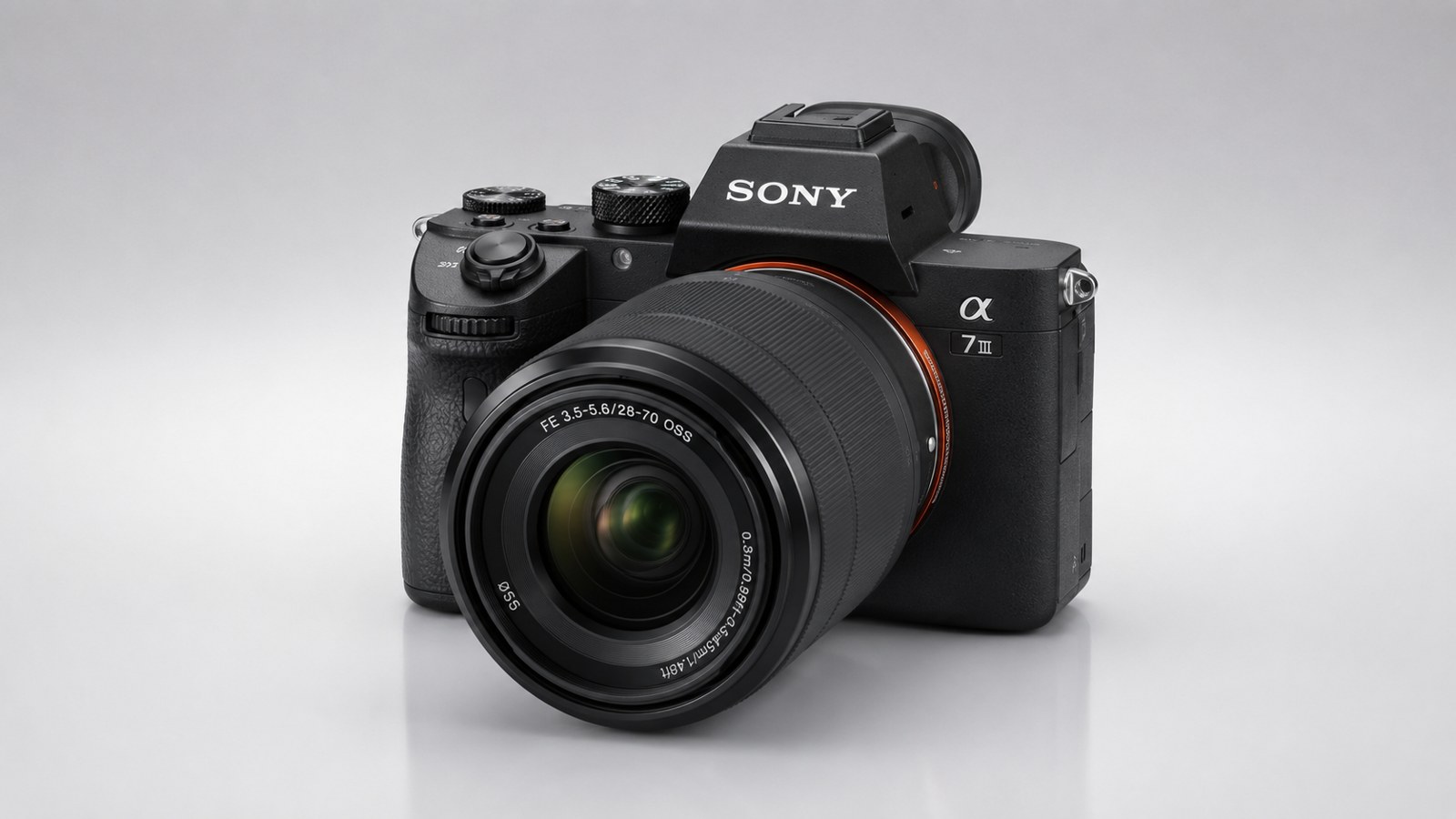
The Sony A7 III is the camera I have recommended most often at the counter over the past ten years. Released in 2018 at €2,300 for the camera body only, it sold numbers no full-frame mirrorless had ever achieved in that price range, and it remains one of the most requested machines among the used gear arriving at our workshop. The reason is simple: it has aged well, and the used market has made it accessible.
In this article, I look at whether it still makes sense to buy it used in 2026. Real prices, what to check before paying, where it starts to show its age, and when it’s better to spend less on another camera. No brochure hype: just what I see come across the counter every week.
Why the A7 III sold so well
In 2018, the A7 III did something rare: it took the specifications of top-tier camera bodies and put them into the base model, at a list price of €2,300. Sony called it "entry-level full-frame," but the technical sheet told a different story. It is this gap between positioning and content that made it the best-selling mirrorless of its generation, and that keeps it alive in the used market today.
To understand why a 2018 camera body still holds its own against new full-frame models under €1,500 in 2026, just look at what it offered compared to its direct competitors at the time.
The package that changed the mid-range
The strength of the A7 III wasn't a single headline number, but the combination. At that price, no other full-frame camera offered this list of features in 2018.
- 24MP back-illuminated sensor: balanced resolution, manageable files, excellent low-light performance.
- Native ISO up to 51200: genuinely usable, not just on paper. At 12800, noise remains under control for standard prints.
- 10 fps with AF/AE tracking: sports-body burst rate on a body sold as a base model.
- 693-point phase detection autofocus: 93% frame coverage, a density rivals reserved for models costing over 3,000 euros.
The result is that those who bought an A7 III didn't feel the need to step up to a higher tier. For weddings, reportage, portrait, and landscape photography, it was more than enough. That "enough" is the reason why we find so many of them on the used market today: they were sold by the thousands.
Dual slots and NP-FZ100 battery
Two less conspicuous details made it a choice for professionals as well. The first is the dual SD slots: for a wedding photographer, redundancy is not a luxury, it is the difference between an unexpected event and a disaster. Being able to write the same file to two cards in real time eliminates the risk of losing work due to a corrupted card.
The second is the NP-FZ100 battery, delivering approximately 710 real-world shutter counts per charge. Those coming from first-generation A7s remember the nightmare of NP-FW50 batteries dying by mid-morning, requiring three or four batteries in rotation. The FZ100 ended that era: a single charge covers a normal day of work. It is a change that seems boring on paper but has practically shifted entire groups of users from competitors to Sony.
How much does a used A7 III cost in 2026
Today, a used Sony A7 III ranges from 850 to 1,100 euros, depending on condition, certified shutter count, and included accessories. This price makes it the full-frame camera with the best performance-to-price ratio on the used market, and not by chance: it is the point where seven years of depreciation have finally stabilized.
The depreciation that works in your favor
In 2018, the A7 III launched at around €2,300 for the body only. Today it is worth €850-1,100: a 55-60% loss in seven years. It may seem like a lot, but this is exactly the dynamic that works in your favor as a buyer. A full-frame camera loses value rapidly in the first three to four years, after which the curve flattens out.
The A7 III has passed that phase. Most of the depreciation has already occurred: someone buying it today for 950 euros will resell it in two years for 750-800, not 400. It is the difference between buying a camera body still in free fall and one that has already found its market floor. For those who want a full-frame without seeing it lose half its value in two seasons, this is the right time in the cycle.
Private seller vs certified store
The price gap between private sellers and dealers is 150-250 euros. A private unit can be found for 800-850 euros, while the same certified body sits at 1.000-1.100. The right question is not "why does it cost more", but "what am I buying with that difference".
- Certified shutter count: read from internal data, not declared verbally. On a body with a 200,000 shutter count, knowing whether you are at 30,000 or 150,000 changes everything.
- Inspected sensor: no scratches, no DIY cleaning spots, tested stabilization.
- Real warranty: 2-year warranty on used equipment, not the "it worked when I shipped it" of a private seller.
Buying from a private seller can be a great deal, but you are relying on a stranger's word for a camera body that may have endured intense reportage work. Certification is not a markup: it is the cost of avoiding the discovery of a worn-out shutter three months after purchase.
If you want to understand where the A7 III stands compared to other used full-frame models in the same price range, we have compared the main models in the article on the best used full-frame under €2,000.
Shutter count: the data that really matters
Sony states a shutter life of over 200,000 shutter count for the A7 III. This is a high figure, among the best in its category in 2018, but it is a statistical estimate based on a sample, not a guarantee that your specific unit will last that long. For a used camera, the metric that matters is not the theoretical lifespan: it is how many shutter count the camera in front of you has already logged.
200,000 declared shutter count: what it means in practice
The same number means different things depending on who has handled the camera. An amateur who photographs travel and family takes between 5,000 and 10,000 shutter count per year. At this pace, an A7 III takes twenty years to approach the stated threshold: the shutter will never be your problem; the battery and rubber seals will fail first.
A wedding photographer operates on a different level. In rapid succession, between the ceremony and the reception, they exceed 50,000 shutter counts per year. A four-year-old A7 III from a previous reportage assignment can arrive at the shop with 180,000-220,000 shutter counts: technically, it has reached the end of the shutter's useful life.
- Under 20,000 shutter count: practically new, shutter with decades of life ahead.
- 20,000-60,000 shutter count: normal use, healthy condition, no concerns.
- 60,000-120,000 shutter count: has worked, still reliable but value it lower.
- Over 150,000 shutter count: ex-professional, budget for shutter replacement.
Replacing the shutter on an A7 III costs 250-350 euros for parts and labor. On a camera paid for at 900 euros, it is not a catastrophe, but it is an expense that must be factored into the negotiation price.
How we verify the shutter count in our lab
A photo of the serial number in a listing tells you nothing about actual wear. In our lab, we read the shutter count directly from the body's metadata, report it in writing on the product sheet, and certify it. Then we run the shutter: a 10 fps burst test to ensure it doesn't miss beats, a check for shutter lag, and a visual inspection of the shutter blades for signs of wear or bending.
It is the difference between buying a number stated by a private seller and buying a measured data point. A certified shutter count tells you exactly where the camera body stands in its lifespan, allowing you to pay the right price instead of discovering later that the shutter had already exceeded its threshold.
Where the A7 III starts to show its age
The A7 III is not perfect, and by 2026 some limitations are visible. These are not flaws that disqualify it, but things to know before signing the purchase. Anyone selling it to you as "still current in every respect" is oversimplifying.
4K Video without frills
The A7 III records 4K at 30p in 8-bit internally. For taking photos and occasional clips, it is more than sufficient: the file is clean, and the color holds up well in post. But if in 2026 you make video as a job, you will hit the first walls here.
- No internal 10-bit: you have less headroom in grading, especially for skin tones and skies. You are limited to 8-bit recording.
- No 4K 60p: 4K slow motion is not available. You can only achieve slow motion in Full HD at 120 fps.
- Visible rolling shutter: vertical lines tilt during fast pans or handheld shots.
Translated: for a photographer who shoots some incidental video, the A7 III is perfectly fine. For those selling video services or editing color-critical material, more suitable bodies exist in 2026. It is a real limitation, not marketing.
Display and menus of the old generation
The screen is a 922,000-dot LCD, tiltable but not fully articulating. By 2018 standards, this was standard; today, next to a 1.44-million-dot display, the difference in resolution and sharpness in the live view is noticeable.
Touch operation is the most common frustration at the counter. It works for moving the focus point and little else: you cannot navigate menus by touching, you must use the dial and buttons. Those coming from a smartphone or a recent mirrorless camera find it clunky.
Then there is the pre-restyling Sony menu: long, deep, with items scattered without immediate logic. Sony reorganized it starting from the A7 IV, but on the A7 III you are stuck with the old one. You get used to it, but the learning curve is real.
Do not underestimate the viewfinder either: the 2.36-million-dot EVF does its job, but it lacks the definition and fluidity of more recent viewfinders. In difficult lighting conditions, the difference is noticeable. These are all minor daily frictions: none of them ruin a shutter count, but taken together, they reveal the true age of the camera body.
Full-frame alternatives to consider
The A7 III is not the only sensible full-frame option under €1,100. Depending on what you are looking for — resolution, lightweight design, or a strict budget — another camera body might make more sense. Let’s put them on the bench without taking sides: some of these are in our display case right now.
Canon EOS RP, the most affordable full-frame
The Canon EOS RP at 600 euros is the most affordable way to put a full-frame sensor in your backpack. It weighs about 485 grams, compared to the 650 grams of the A7 III: you notice the difference, especially while traveling. The 26MP sensor performs excellently in good light, and the RF mount, although still young, already offers accessible fast lenses.
There are compromises, and they must be stated: single SD slot, less aggressive autofocus on moving subjects, and a less capacious battery. For portrait, travel, and family use, it is a best buy. For sports, reportage, or high-speed bursts, the A7 III remains a couple of generations ahead.
Staying in the Sony ecosystem with the A7 II or the A7r
If you are already in the E-mount system, two paths cost less than the III:
- Sony A7 Mark II — from 550 euros. In-body stabilization already included, same mount, solid camera body. Give up the 693-point autofocus, the NP-FZ100 battery, and the dual card slots. For those who shoot at a relaxed pace, it saves 300 euros.
- Sony A7r — 700 euros. The first high-resolution generation: the 36MP sensor delivers detail for landscape and large-format printing. In exchange, you pay for dated autofocus and a slow burst rate. A choice for static subjects, not action.
These are previous-generation bodies: neither can match the A7 III in low light or subject tracking. But for those who know what they are looking for, the performance-to-price ratio is interesting.
Full-frame DSLRs, still an option
If mirrorless is not a dogma, the used DSLR market offers solid full-frame bodies for less money. A Canon 5D Mark III or a Nikon D610 cost today figures that make you think, with an optical viewfinder and a huge lens park. We detailed the case in this in-depth look at the Canon 5D Mark III.
The price of the DSLR is ergonomics and infinite battery life; the price of convenience is bulk, no focus peaking, and immature video. If you come from film or love the optical viewfinder, it is worth the detour before signing up for the A7 III.
Do you really need full-frame?
Before signing for an A7 III, pause on an uncomfortable question: do you really need the full-frame sensor, or are you just buying a label? Between the camera body and a single decent lens, you are already over 1,200 euros. For many intermediate photographers, that budget is wasted, because the advantage of a large sensor is only visible in two specific situations: large prints and low light. Outside of that, a well-chosen APS-C does the same job and leaves you 300-400 euros in your pocket.
When APS-C Is More Than Enough
The Sony A6400 we have for 650 euros features the same autofocus system as the A7 III — Real-Time Tracking and Eye AF — with 425 phase-detection points: the eye tracking locks onto your subject and doesn't let go. The sensor is 24MP like the A7 III, just smaller. If you don't print larger than 50x70 and don't routinely work above ISO 6400, you won't see the difference in a photo viewed on screen or printed in A3.
Below, two even more affordable alternatives for those just starting out:
- Sony A6100 — 550 euro: same 24MP sensor and excellent autofocus, viewfinder and burst rate slightly reduced compared to the A6400. For everyday photography, you won't notice the difference.
- Sony A6000 — 360 euro: we have two units. It's from 2014, but the value for money remains unbeatable for those who want to learn without breaking the bank.
The same logic applies outside the Sony ecosystem: the Nikon D7200, because it is still the most loved semi-pro APS-C camera today, demonstrates that the smaller format is not a compromise for beginners.
The hidden cost: full-frame lenses
The body is just the beginning. This is where the trap we see at the counter every week hides: buying the A7 III thinking you've spent 950 euros, only to discover the price list of FE lenses.
| Lens | Indicative used price range |
|---|---|
| Sony FE 28-70 kit | 200-300 euros |
| Sony FE 50mm f/1.8 | 150-200 euros |
| Sony FE 24-105 f/4 G | 700-900 euros |
On the APS-C E-mount system, equivalent lenses regularly cost 30-40% less. If your total budget is €1,000, an A6400 with two decent lenses will let you shoot better than an A7 III with just one cheap zoom. Buy the system, not the body.
What to check before buying it used
An A7 III listed at €850 is not automatically a bargain, and one at €1,050 is not automatically overpriced. The difference comes down to three details that, in just five minutes, separate a healthy unit from one that will give you trouble within a year. Here is the order in which we check them at our counter.
Sensor, shutter and contacts
The sensor should be inspected in backlight, with the lens removed and the shutter opened in cleaning mode. Dust can be blown off and is not an issue. Scratches on the low-pass filter, however, are permanent and will be visible on a 24MP full-frame sensor at small apertures, such as f/11 against a uniform sky. A unit with sensor scratches is not worth much, regardless of the asking price.
The shutter count is the most critical piece of data. The A7 III declares over 200,000 shutter actuations, but an ex-reportage unit may have already burned through 180,000. It is not a hidden defect; it is approaching end-of-life. Insist on the certified shutter count, not just verbal assurances.
- Sensor: acceptable dust, no scratches on the filter. Check at f/11 against a light surface.
- Shutter count: under 50,000 is a young example, over 150,000 negotiate the price or walk away.
- Contacts: greenish oxidation on the NP-FZ100 battery pins or SD card contacts indicates moisture and poor storage. It's the sign that escapes buyers in a hurry.
Oxidized contacts are the detail that almost no private buyer checks. A battery compartment showing traces of verdigris tells you more about where that camera has been than a thousand test shots.
Our 2-year warranty
At ReflexMania, every A7 III goes through our lab before hitting the display. We count the shutter count from the system file; we do not estimate it. We inspect the sensor, shutter, contact integrity, and the operation of both SD card slots, because on a camera designed with dual slots, a dead slot changes everything for professionals.
We then provide 2-year warranty on all used equipment. On a full-frame body costing 900 euros, this is not a commercial detail: it is the difference between spending that amount and being able to sleep, and spending it hoping the shutter holds up. From a private seller, if the shutter fails at 200,000 shutter count, the problem is yours. From us, for two years, it is ours.
Verdict: best buy or nostalgia?
The A7 III in 2026 remains a best buy, but not for everyone. It is the camera I recommend when someone wants to enter the full-frame world with a budget between 850 and 1,100 euros and intends to shoot seriously for the next three or four years. It is not nostalgia: it is the full-frame body with the best performance-to-price ratio that passes through our bench, and I say this after having reviewed dozens in the lab.
It becomes the wrong choice in two specific cases. First: those who buy based on specs rather than actual use, only to end up shooting JPEGs at 1/200s in the evening from a phone already in their pocket. Second: those looking for a low-cost backup who are tempted by an ex-reportage unit with a certified shutter count of 230,000 for 800 euros, ignoring that the shutter is at the end of its life.
Here is how I position it relative to the three profiles we see most often:
- True best buy — portrait photographers, event shooters, couples covering weddings with a second camera body, and those who print or frequently work at ISO 3200 or higher. Here, the 24MP resolution, dual card slots, and 693-point autofocus justify every euro spent.
- Smart compromise — those looking for a Sony full-frame on a tighter budget should consider the Sony A7 Mark II at 550 euros: it features the same 24MP sensor, but with autofocus and battery life from a previous generation. You save 300 euros by accepting a slower workflow.
- Look elsewhere — those entering the full-frame market without brand loyalty and prioritizing portability will find in the Canon EOS RP at 600 euros a smaller and more affordable camera body, provided they accept less aggressive autofocus and a slower burst rate.
If full-frame interests you but you're not convinced you need it, read our analysis of the used Nikon D610 before spending: an entry-level full-frame DSLR that costs even less for the same sensor. The A7 III is worth its 900 euros only when fast autofocus and compact dimensions truly make a difference in your shooting style.
Frequently asked questions
Is the Sony A7 III still a good camera in 2026?
Yes, for photography it remains competitive: the 24MP sensor, 693-point autofocus, and dual SD card slots hold up against many new camera bodies under €1,500. It shows its age mainly in video, where it lacks internal 10-bit recording and 4K 60p.
How much does a used Sony A7 III cost today?
It ranges between 850 and 1,100 euros depending on condition and shutter count. It was 2,300 euros for the camera body only at its launch in 2018: a 55-60% depreciation that makes it one of the best value-for-money full-frame options on the used market.
How many shutter count can the A7 III's shutter handle?
Sony states a lifespan of approximately 200,000 shutter count. An amateur takes 5,000-10,000 per year, so a well-maintained unit has a long life. The situation changes for ex-reportage cameras with 50,000 shutter count annually: the certified shutter count is the decisive factor.
Is a used Sony A7 III better than a new entry-level full-frame?
For the same budget, a used A7 III offers superior autofocus, burst rate, and ergonomics compared to many new entry-level models. A new camera provides full warranty and zero wear, but with a certified camera body and a 2-year warranty, the risk of buying used is eliminated.
Do I really need full-frame, or is APS-C enough?
If you don't print larger than A3 and don't frequently work at high ISOs, a Sony A6400 at 650 euros shares the same autofocus system and saves 300-400 euros. Full-frame is advantageous for low light, bokeh, and large prints.
Are A7 III lenses expensive?
FE full-frame lenses cost more than their APS-C equivalents. The body is just the beginning of the budget: anyone buying an A7 III should budget for at least one high-quality fast lens to make the most of the sensor.
Is it worth buying the A7 III from a private seller or a store?
Buying from a private seller saves 150-250 euros, but you get no warranty or certified shutter count. Buying from a certified store costs a bit more, but you get a tested sensor, a real shutter count, and a warranty, which is essential for a camera body worth almost 1,000 euros.
Looking for a Sony A7 III or a controlled alternative from our lab?
If you have doubts about a purchase or need advice for your specific case, contact us. We offer free advice because we are photographers first, sellers second, and because a customer who makes a poor purchase won't return to photography.
Three ways to get in touch:
- Contact form — response within 24 business hours
- WhatsApp at 342 362 3454 (messages only)
- Phone: 071 291 6347 (Mon-Fri 9-13/15-18, Sat 9-13)
And if you want to see what we have in stock right away, explore the used inventory available today: every camera is certified, comes with a 2-year warranty, and ships within 24-48 hours.
Article written by Matteo for the ReflexMania Team. Last updated: June 2026. Prices and availability refer to the time of publication.