
In short
- The OM-1 new cost 2,199 euros in 2022, today on the used market it is found between 1,100 and 1,400 euros depending on the shutter count and the kit.
- The 20 MP stacked sensor with 1,053 cross-type AF points is the real leap compared to the E-M1 Mark III: 50 fps burst with continuous AF-C.
- The declared 8-stop stabilization (7 stops on the body alone) in practice holds 1/4 second handheld on medium focal lengths, not 5 seconds.
- Body + two PRO zooms weigh 1.75 kg against 2.8 kg of an equivalent full frame f/2.8: this is the reason for purchase, not pure image quality.
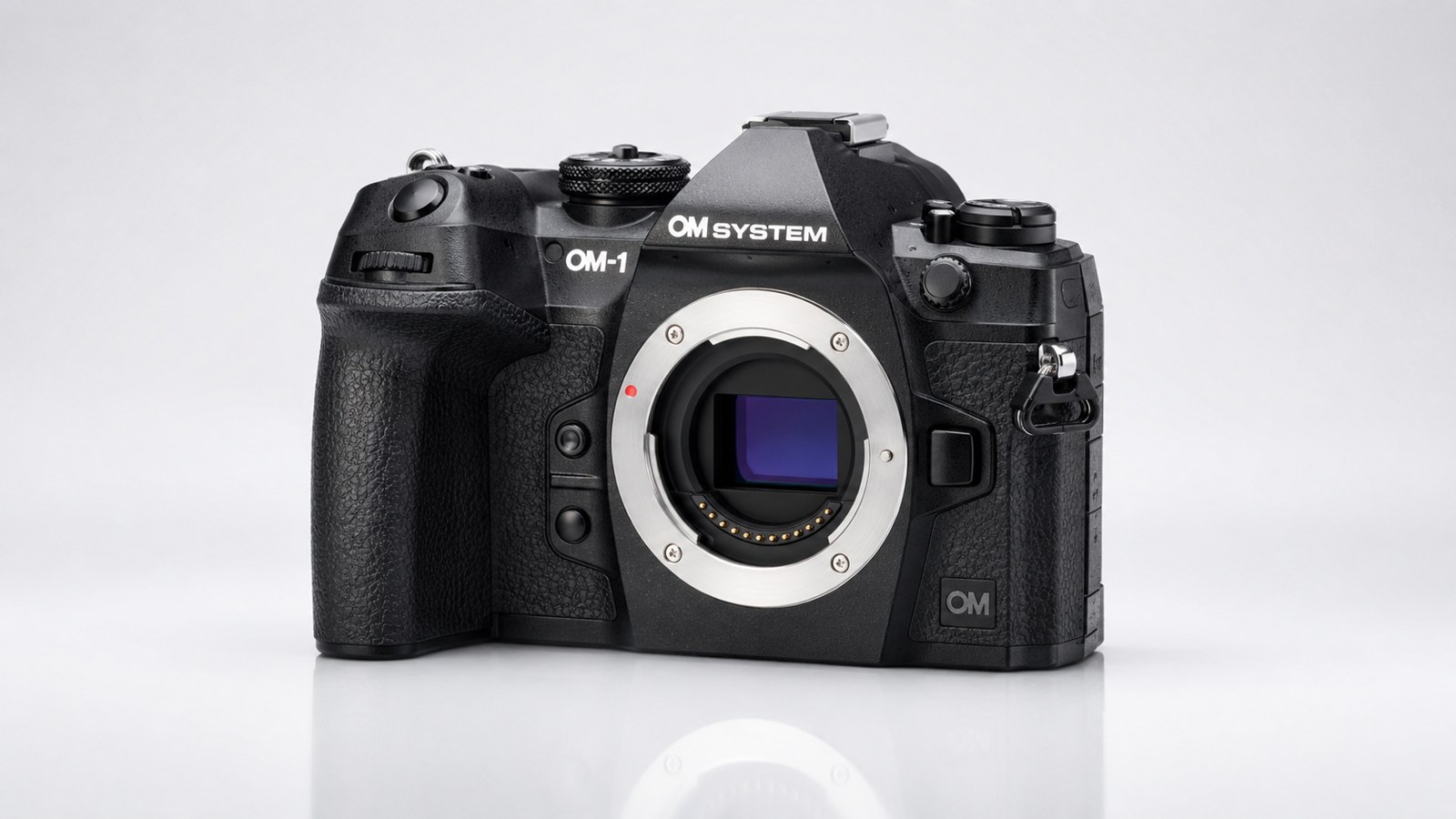
At the counter, I often see the same scene: someone arrives with a 4-kilo backpack on their shoulders, sets everything down, and asks if there's a way to halve that weight without dropping two categories in terms of final results. Nine times out of ten, we end up talking about Micro Four Thirds, and since the OM-1 exists, the conversation has become much shorter. It is the first body in the system that doesn't ask for apologies for the sensor format: if anything, it asks for them regarding the list price, which in 2022 was €2,199 for the body only.
This article lays out the concrete reasons why a used OM-1 makes sense today, and just as honestly, the cases where it doesn't. I wrote the section on technical checks with private buyers in mind: these are the same things we inspect in our lab before putting a camera body on the shelf, and they are also the details nobody checks when a deal seems too good to be true.
Why the OM-1 is not your typical micro 4/3
Up to the E-M1 Mark III, every high-end Olympus camera body demanded a compromise on autofocus. The body was beautiful, the stabilization was excellent, but tracking on fast-moving subjects remained a step below the competition. With the OM-1, that step disappears, and not because of firmware or marketing: the sensor changes, the processor changes, the AF system changes. It is the first true architectural leap of the micro 4/3 system after years of incremental updates.
The stacked sensor: where it makes a difference and where it doesn't
The sensor is still 20 MP, exactly like the previous generation. What changes is the stacked BSI structure, which reads the frame much faster. In everyday use, this means three concrete things:
- Nearly no rolling shutter in electronic shutter: helicopter blades and light poles in panning no longer bend as in previous generations.
- 50 fps burst with continuous AF-C, which becomes 120 fps with AF locked on the first frame.
- About one stop of noise gain at high sensitivities: ISO 3200 on the OM-1 is usable where you worked at 1600 on the E-M1 Mark III. The two stops of improvement announced at launch are not found in independent tests.
That said, 20 MP are still 20 MP. If you print at 70 cm on the side or crop by 50% to straighten frames, you are looking at the wrong camera body: the resolution has not increased by a single pixel.
Autofocus with 1,053 cross-type points
It is the first OM/Olympus camera body featuring cross-type phase detection across the entire sensor surface, not just in the center. Cross-type means the system reads contrast on both vertical and horizontal lines, so it does not lose track of a subject with details in only one direction.
Subject recognition covers birds, animals, vehicles, trains, and airplanes. The use case where the difference is most pronounced is a bird in flight against an open sky or against branches: the E-M1 Mark III would regularly lose it, while the OM-1 locks on and tracks it. Wildlife photographers know that this was exactly the reason many had stayed with Canon or Nikon.
What Micro 4/3 will never do
The sensor remains four times smaller than a full frame, and no processor can fix that. Two consequences to keep in mind before spending:
- Noise: compared to a full-frame camera of the same generation, the gap remains at about two stops. The stacked sensor recovers ground compared to previous micro 4/3 models, but not compared to larger formats.
- Bokeh: a 25mm f/1.2 on micro 4/3 gives the background of a 50mm f/2.4 on full frame. An excellent lens, but those looking for portraits with a completely dissolved background need a different system.
Micro 4/3 remains the right format for those who carry everything on their shoulder — the same reasoning that applies to much more affordable camera bodies, as we explain in the article on the used Olympus OM-D E-M10 Mark IV for travel.
How much does a used OM-1 cost today and how has the curve moved
The OM-1 was released in March 2022 with a list price of €2,199 for the body only. Today, just over four years later, a used example in excellent condition ranges between €1,100 and €1,400. This represents a loss of approximately 40%, which is a surprisingly flat curve for a flagship mirrorless camera four years after its launch. A Canon EOS R5, released in July 2020, has lost a significantly higher percentage of its list price.
The three price ranges you see around
The shutter count is the variable that most affects the price, but not in a linear way. The mechanical shutter of the OM-1 is rated for 400,000 cycles: a body with 60,000 shutter count has used up 15% of its declared lifespan; it is not old.
| Shutter count range | Typical price | What you're buying |
|---|---|---|
| Under 30,000 | €1,300–1,400 | Amateur use, often just the kit, seals untouched |
| 30,000–80,000 | €1,150–1,300 | The best value range: minimal real wear |
| Over 80,000 | €1,000–1,150 | Often ex-burst naturalist, needs careful inspection |
The mid-range is where it makes sense to stay. Paying 200 euros more to drop from 50,000 to 20,000 shutter count means buying theoretical margin on a shutter that will never reach end-of-life in your hands. The case is different beyond 80,000: there, the number signals intense professional use, and you should check the seals and the sensor condition, not the counter itself.
Regarding the included accessories, pay close attention to their actual value. A new HLD-10 grip costs around 300 euros, while on the used market it is worth 150-180. Additional BLX-1 batteries are worth 60-70 euros each if they are original and have a low cycle count, but are practically worthless if they are generic compatibles. A listing at 1,500 euros with a grip and three batteries is not a deal compared to a bare camera body at 1,250: you are paying nearly full price for accessories.
The impact of the OM-1 Mark II on the market
Usually, the release of a successor causes the predecessor's price to drop by 20-25% within six months. With the Mark II in January 2024, this did not happen, and the reason is simple: the upgrade is marginal. Declared stabilization of 8.5 stops instead of 8, doubled buffer, extended focus stacking, and a tweaked menu interface. The sensor, processor, and AF system remain the same.
The result is that the Mark I has held its value, and the used Mark II is currently priced between €1,500 and €1,700. That €400 difference buys a larger buffer and half a stop of declared IBIS. Those who do not take 100 consecutive shutter counts will never recoup that cost. For 90% of buyers, the Mark I remains the rational choice.
The 8 stops of stabilization: what they really mean
The 8-stop figure appears in every OM-1 spec sheet, but it only applies in a specific configuration: body paired with a Sync IS-compatible lens, where the lens stabilizer works in coordination with the sensor stabilizer. The body alone, with a non-stabilized lens, declares 7 stops. The one-stop difference is not marginal in marketing, but in real-world use it matters far less than the gap between lab data and what you actually get standing up, after three hours of walking, in the wind.
Theoretical calculation says: the reciprocal rule on a 25mm (50mm equivalent) means 1/50 s as the safety shutter speed. Eight stops below 1/50 is approximately 5 seconds. No one holds 5 seconds hand-held with usable results. The data is measured on a bench according to CIPA protocol, with the camera body on a support that simulates standardized shake and without the background noise of a real photographer: breathing, heartbeat, micro-oscillations of the legs.
The test you can do yourself
Simple protocol, ten minutes of work. Mount a 25mm lens, set 1/4 second at base ISO, choose a stationary and well-detailed subject (a wall with text, a bookshelf), take 20 shutter count in standing position without support. Then check every file at 100% in view.
- 1/4 second: expect 15-18 sharp shutter counts out of 20. This is where stabilization really works well.
- 1/2 second: drops to 10-13 out of 20. Still usable if you can afford the burst.
- 1 second: 4-6 out of 20, with a strong reliance on luck.
- 2 seconds and beyond: some people publish it, but it's statistics, not technique.
The practical number to keep in mind is therefore 1/4 second at medium focal lengths, not 5 seconds. This is still an excellent result: it represents 4 real stops gained compared to the reciprocal rule, and no competing full-frame system does better consistently.
When stabilization is useless
Stabilization compensates for camera movement, not world movement. Three cases where the number on the card becomes irrelevant:
- Moving subjects: a person walking at 1/4 second is a blur. You need subject-appropriate shutter speeds, not photographer-friendly ones, and that's where ISO and aperture come into play.
- Walking video: IBIS absorbs vibrations, not footsteps. Electronic IS mode helps but applies a crop to the frame. For clean walking shots, you still need a gimbal.
- High-magnification macro: beyond 1:1, the focal plane is millimetric, and the forward-backward movement of the torso — naturally produced by breathing — is not corrected by any sensor shift. You need a tripod or a micro-rail there.
With long focal lengths, the math changes again: with a 300mm (600mm equivalent), the theoretical safety shutter count starts at 1/600 s, and even gaining 4 real stops, you end up around 1/40. Useful, but it won't save you from a moving bird.
The computational features that justify the purchase
This is the part you won't get with any other system at the same price point. The computational features of the OM-1 are not aesthetic filters: they replace physical accessories that would cost hundreds of euros and that you would have to carry in your bag. None of them require a tripod, screw-in filters, or post-production software.
Live ND up to ND64 and High Res handheld
The Live ND simulates a neutral density filter up to 6 stops, combining multiple exposures in camera. In the field, this means going from 1/125 to half a second on a waterfall in full daylight, without screwing anything on. The practical advantage is the preview: the viewfinder shows the motion blur effect of the water before the shutter count, something that never happens with a physical ND.
There is a limit. The Live ND works on exposure, not on the actual light entering the lens: if the aperture is already at f/16 and you are shooting into backlight, beyond a certain point the noise increases. With ND32 and ND64, it is advisable to keep ISO at 200 and accept that true long exposures still require twilight.
Handheld High Res Shot produces a 50 MP file by combining 16 shutter count with micro-shifts of the sensor. It truly works, but within precise limits:
- Works: architecture, interiors, windless landscapes, still life, reproduction of paintings and documents.
- Works with difficulty: landscapes with leaves or tall grass — moving areas remain resolved at 20 effective MP with checkerboard artifacts.
- Does not work: moving water, fast clouds, any person or animal, focal lengths over 100 mm handheld.
The tripod version reaches 80 MP, but at that point you're carrying the tripod and the sense of a lightweight system is lost.
Pro Capture and focus stacking
Pro Capture is the feature that alone justifies the cost for bird photographers. With a half-press of the shutter button, the camera body records up to 70 frames in the buffer; when you press fully, it also saves those preceding frames. The heron's takeoff, which you would always miss by 0.3 seconds, remains in the file. In Pro Capture SH2 mode, AF-C continues to operate at 50 fps, so the retroactive frames are in focus, not just present.
In-camera focus stacking merges up to 15 shutter counts and returns the combined JPEG along with the individual RAW files. In field macro — insects at dawn, mushrooms in the undergrowth — it lets you immediately see if the covered depth is sufficient, instead of finding out at home. Bracketing goes up to 999 shutter counts if you prefer to merge in Helicon Focus.
What to check before buying a used one
On an OM-1, the controls that matter are not the standard ones. The shutter count weighs less than usual, while two items you would ignore on other camera bodies — weather sealing and IBIS condition — become decisive. Here is what we look at, in order.
Shutter count and shutter
The declared 400,000 shutter count changes the negotiation logic compared to a DSLR, where 60,000 shutter count on a 150,000-rated shutter is already half its lifespan. We have written about this topic in when a used Nikon D780 is worth it compared to a new one, and the reasoning on the shutter count/threshold ratio applies identically here.
The count is read from the service menu, not the user menu: it is a key sequence with the camera body powered off that a private seller often does not know. If the seller cannot tell you the shutter count, it is not bad faith, but it is data you are missing. Have them show it on screen or demand a certified reading.
Another factor matters more: the IBIS cycles. The stabilizer unit suspends the sensor on actuators, and on bodies heavily used for burst shooting or transported roughly in a backpack, it can develop play. The symptom is an irregular hum at startup or micro-shake at shutter speeds where it shouldn't occur.
IP53 Tropicalization: Certification Expires
IP53 certification applies to the intact camera body as it left the factory. A single drop, a compressed seal, or a port cap screw reinstalled incorrectly can compromise the seal — even if the body looks perfect. To be verified:
- Battery door seal: it must be elastic, not shiny or flattened.
- Card door and connector door: crisp closure, no lateral play.
- Mount: the black seal must be checked for cuts or crushed sections.
- Body screws: stripped heads or chipped paint indicate previous opening.
BLX-1 Battery and Cycles
The OM-1 has dropped the BLH-1 used in the E-M1 for the new BLX-1: they are not interchangeable, and anyone coming from a previous Olympus camera body cannot reuse anything. The health status is readable from the menu, in a dedicated section, with a three-level indication.
A new original BLX-1 costs 90-100 euros. The stated battery life is approximately 520 certified shutter counts (CIPA), but in real-world use — with the viewfinder on intermittently and bursts — you can easily exceed 1,000. If the included battery is at its lowest level, deduct 100 euros from the price and treat it as a consumable item.
What we do in the lab on an OM body
A tropicalized camera body that has worked in the rain looks identical to one kept in a bag. The difference is inside, and it is not visible in a listing photo. That is why a service matters more on an OM-1 than on a studio camera: the IP53 certification is only valid as long as the seals are intact, and no private seller will ever tell you that the body took on saltwater two summers ago.
Every OM-1 that enters the shop goes through the workbench before being listed. The process is always the same, regardless of how it arrives:
- Certified shutter count — we extract the actual counter from the firmware, not the declared one. We list it in the product sheet because on a 50 fps body the count rises quickly and changes the value.
- IBIS bench test — sequence of shots at 1/4 and 1/8 second at medium focal length, no tripod, frame-by-frame sharpness comparison. A stabilized sensor that has taken a hit produces constant micro-shake, always in the same direction. It is the most subtle defect in used micro 4/3.
- Sensor cleaning — OM's SSWF system is among the most effective on the market, but it does not remove fatty deposits. We clean with a wet method and recheck at f/16 on a white background.
- AF target test — focus target at controlled distance, verification on all cross-type points, not just the center. On a stacked sensor, peripheral back-focus is only noticeable this way.
- Seal inspection — inspection of the battery door, card slots, mounts, and port caps. A dry or crushed seal means degraded weather sealing, and we report it.
- BLX-1 battery test — full charge cycle and degradation state reading. A tired BLX-1 is a 90-100 euro replacement, better to know beforehand.
What fails our checks does not make it to the list. If an OM-1 arrives with compromised seals, we sell it declaring that weather sealing is not guaranteed, or we keep it for parts. We are not interested in placing it with someone who will use it in the mountains under snow.
We apply a 2-year warranty to all used equipment. This is not a commercial detail; it is the reason our workshop exists. A camera that comes back after eight months costs us, so checking it thoroughly beforehand benefits both of us. With a private seller, a defect that emerges after three weeks is solely your problem.
When the OM-1 is not the right choice
Selling an OM-1 to someone who won't use it for what it does best is the fastest way to end up with a dissatisfied customer in six months. The camera body costs €1,100–1,400 on the used market, and there are at least three types of photographers for whom that money would work much harder spent elsewhere. We see them come through the counter every week.
If you shoot portraits and interiors
Here, Micro 4/3 is at a disadvantage, and no computational feature can compensate for it. On a 45mm f/1.8, the depth of field is equivalent to a 90mm f/3.6 on full frame: the bokeh is there, but it is not what the customer expects when looking at a portrait. In indoor environments, you lose two useful stops in terms of noise, and this is noticeable from ISO 3200 upwards.
With the same budget, you get the camera body and the lenses. A Canon EOS RP starts at 550 euros: a 26 MP full-frame, compact, and the 50mm f/1.8 RF costs just over 200 euros new. A Sony A7 Mark II is in the 500-513 euro range and features 5-axis IBIS, backed by the entire used Sony FE lens lineup. You have 600 euros left for a truly fast lens. If the appeal of the mechanics matters as much as the image quality, it is also worth reading what a used Nikon D700 can still do at similar price points.
If your only concern is the weight of your backpack
The OM-1 weighs 599 grams with battery and card. A Sony A6400 (403 g) or a Nikon Z50 Mark II (550 g) are in the same weight class and cost about half as much. If you buy a 1,200 euro body just to avoid carrying a DSLR, you are paying for Pro Capture, Live ND, High Res handheld, and IP53 weather sealing: features you will never use if you do not shoot nature or mountain photography.
| Model | Price | Why it makes sense |
|---|---|---|
| Sony A6400 | €646-680 | Eye-tracking AF among the best in its class |
| Nikon Z50 Mark II | €702 | DSLR-like ergonomics, lightweight Z DX lenses |
| Fujifilm X-T30 II | €820 | Film simulations and dedicated dials |
If you are entering the system now
The body is the economical part. A used 12-40mm f/2.8 PRO and a 40-150mm f/2.8 PRO cost together as much as an OM-1, and without those lenses the stacked sensor remains underutilized. With a total of 1,200 euros, it is better to buy a simpler Micro 4/3 body and two used PRO lenses: you will shoot better, immediately. Buy the OM-1 later, when the lenses are already there and the bottleneck becomes the body.
Used OM-1 vs. lower-budget alternatives
| Body | ReflexMania Price | Body Weight | Key Strength | For Whom |
|---|---|---|---|---|
| OM System OM-1 | €1,100-1,400 | 599 g | IP53 weather sealing, 50 fps, computational photography | Nature, trekking, macro |
| Sony A6400 | €646-680 | 403 g | Excellent AF, extensive E-mount system | Travel, video, general use |
| Nikon Z50 Mark II | €702 | 550 g | Ergonomics and excellent JPEG files | Those coming from Nikon DSLRs |
| Fujifilm X-T30 II | €820 | 378 g | Film simulations, analog controls | Street and reportage |
| Canon EOS RP | €550-600 | 485 g | Full frame at an APS-C price | Portrait, interiors, low light |
The three situations where the used OM-1 is unbeatable
If you buy an OM-1 for studio portraits or tripod-based landscape photography, you have wasted 1,200 euros. But there are three genres where Micro 4/3 matches full frame: it beats it, and it beats it on the aspect that truly matters when you walk for eight hours with a backpack on your shoulders.
Nature: the crop factor that works for you
The 300mm f/4 PRO mounts on the OM-1 and gives you a framing equivalent to a 600mm. It weighs 1.270 grams. With the MC-14 multiplier, you reach 840mm equivalent while staying under 1.5 kg total lens weight.
On full frame, the 600mm f/4 weighs over 3 kg and costs as much as a used compact car. Even stepping down in range, a 200-600 Sony weighs 2,115 grams and forces you to f/6.3 at the long end. Here, the format is not an accepted compromise: it is the technically best choice for those who photograph birds and wildlife handheld.
Trekking and travel in harsh conditions
The calculation that makes the most sense is this one, and it concerns what you carry to cover 24 to 300mm equivalents.
| Setup | Weight |
|---|---|
| OM-1 + 12-40 f/2.8 PRO + 40-150 f/2.8 PRO | approx. 1,750 g |
| Full frame + 24-70 f/2.8 + 70-200 f/2.8 | approx. 2,800 g |
A one-kilogram difference isn't noticeable on day one. It becomes apparent on day three, on the uneven terrain, when you decide whether to take the camera out or leave it in the backpack. The IP53 certification and the declared operation down to -10 degrees are not marketing numbers: the OM-1 is one of the few camera bodies you can use in heavy rain without a second thought.
Field macro
In macro, Micro 4/3 has a structural advantage, not a compromise. At the same aperture and framing, the smaller sensor gives you approximately twice the depth of field of a full frame. On an insect at 1:1 magnification, this means having the eye and part of the thorax in focus instead of just the eye.
- In-camera focus stacking: the OM-1 captures the sequence and composites the final file within the camera body, without a computer or a micro-focusing rail.
- 60mm macro: 185 grams, 120mm equivalent, sufficient working distance to avoid startling the subject.
- Usable stabilization: at high magnification ratios, IBIS helps with framing, not freezing motion — but framing at 1:1 handheld is already a lot.
The common denominator of the three situations is that you are shooting away from home, standing up, without a tripod. That is where the used OM-1, priced at €1,100–1,400, delivers a performance that no full-frame camera can match at the same budget.
Frequently asked questions
How many shutter count is too many for a used OM-1?
The mechanical shutter is rated for 400,000 cycles, so a body with 80,000 shutter count still has 80% of its life ahead. The condition of the IBIS and seals matters more: a body with 30,000 shutter count used at the beach and never cleaned is in worse shape than one with 90,000 shutter count that has been well maintained.
Is it worth waiting to buy a used OM-1 Mark II?
The 2024 Mark II adds half a stop of declared stabilization, a larger buffer, and improved focus stacking. On the used market, it costs about 400 euros more. Unless the buffer is your real bottleneck, you are better off spending that difference on a lens.
Is the OM-1 suitable for video?
It records 4K DCI 60p with the OM-Log400 profile and has no 30-minute limit. It is suitable for documentary and wildlife use. However, if video is your main line of work, the Panasonic or Sony ecosystem offers more mature tools: the Panasonic GH4 that we have at 320 euros remains a good secondary video body even today.
Are Olympus and Panasonic lenses interchangeable?
Yes, the Micro Four Thirds mount is shared. The only practical limitation concerns stabilization: the Sync IS that delivers the claimed 8 stops works only with compatible OM System and Olympus lenses. With a stabilized Panasonic lens, the two systems do not communicate, leaving you with IBIS only.
Does the IP53 weather sealing apply to a used camera body?
The certification applies to an intact camera body that has never been opened. If the body has been dropped or subjected to service, the seal is no longer guaranteed by anyone. For this reason, on a used tropicalized body, the maintenance history matters more than on others: we always check the seals and doors before putting a body on the shelf.
Is a used OM-1 better than a new APS-C at the same price?
It depends on what you shoot. For wildlife, trekking, and macro, the used OM-1 is a clear winner: weight, weather sealing, and computational features have no equivalent. For portraits, interiors, and general use, a recent APS-C body in the 700-800 euro range delivers the same results at a lower cost.
How much does a replacement BLX-1 battery cost?
The original costs around 90-100 euros. Compatible ones cost a third as much, but not all of them correctly communicate the charge status to the camera. On a camera body used in the mountains or in cold conditions, it is advisable to have at least one original spare battery.
Looking for a used OM-1 or want to get your camera valued?
If you have questions about a purchase or need advice for your specific case, contact us. We offer free advice because we are photographers first, and because a customer who makes a poor purchase decision does not return to photography.
Three ways to get in touch:
- Contact form — response within 24 business hours
- WhatsApp at 342 362 3454 (messages only)
- Phone: 071 291 6347 (Mon-Fri 9-13/15-18, Sat 9-13)
If you want to see what we have in stock right away, explore the used gear available today: every camera is certified, comes with a 2-year warranty, and ships within 24-48 hours.
Article written by Matteo for the ReflexMania Team. Last updated: July 2026. Prices and availability refer to the time of publication.