
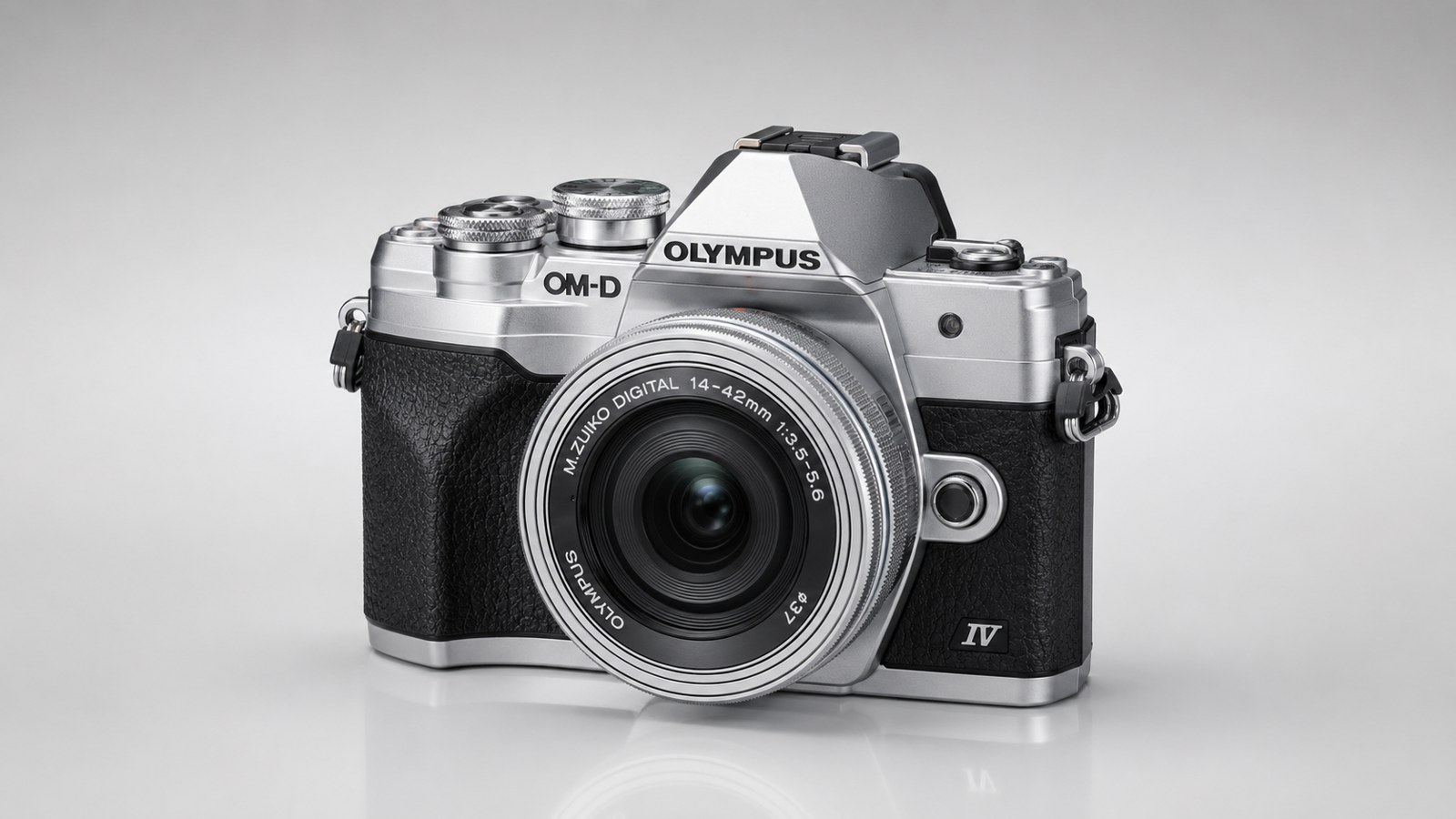
In short
- The E-M10 Mark IV weighs 383 g with the camera body and fits in a jacket pocket: it is one of the most compact mirrorless options for traveling light.
- The 20 MP Micro 4/3 sensor with 4.5 stop IBIS stabilization holds up well handheld down to 1/4 second with short lenses.
- The Micro 4/3 system offers tiny lenses: a 17mm f/1.8 weighs 120 g, unthinkable on full frame.
- Above 1600 ISO the small sensor shows its limits: for evening or dark interiors an APS-C performs better.
The Olympus OM-D E-M10 Mark IV is one of those cameras that customers underestimate when looking at the spec sheet, but never let go of after their first trip. It doesn't have the largest sensor, the fastest burst rate, or 4K video without heavy crop. But once you pick it up, tuck it into your backpack with two lenses, you forget it's there until you need it. For those who walk all day while shooting, this matters more than two stops of dynamic range.
In this article, I look at it for what it truly is: a serious compact for travel and street photography, not an all-rounder. Let's see where it shines, where the Micro 4/3 sensor makes itself felt, which lenses make sense in a travel kit, and which used alternatives at the same price are worth considering before you decide. By the end, you'll know if it's the right camera for you or if you should look elsewhere.
Why a used E-M10 Mark IV for travel and street
The first thing you notice when you pick up an E-M10 Mark IV is what you don't feel: the weight. The camera body is 383 grams, less than a half-liter water bottle. In a year at the counter, I've seen many people return from a trip with their DSLR left in the hotel because it was too bulky. With a camera like this, the excuse disappears: you carry it because it doesn't weigh anything.
It's not just about the body. It's the core concept: a camera that truly delivers, every day, without requiring you to plan around it. It's the same logic that makes a compact like the used Sony RX100 a worthwhile choice, but here you get interchangeable lenses and a genuine electronic viewfinder.
The weight that makes a difference by the end of the day
With the 14-42 pancake kit, you stay under 700 grams, everything included. Compare that to an APS-C DSLR mounted on an 18-135: you're looking at around 1.5 kg, often more. On an eight-hour hiking day, that extra kilogram is felt on your neck and shoulders.
- E-M10 Mark IV + 14-42 pancake: under 700 g, fits in a spacious jacket pocket or a handbag.
- APS-C DSLR + versatile zoom: 1.4-1.6 kg, requires a dedicated backpack.
The difference is not academic. It is the machine that leaves the house versus the one that stays in the closet.
Discretion: the camera that doesn't scare the subject
For street photography, a small body is a concrete advantage, not an aesthetic one. A large DSLR pointed in someone's face changes the scene: people stiffen, turn away, and stop doing what they were doing. A compact body passes as a tourist camera and lets you work.
This is complemented by the electronic shutter, which is completely silent. In a market, a church, or on public transport, you can take shutter count without the mechanical "clack" that draws attention. It is the kind of silence that lets you capture the true expression, before the subject realizes they are in the frame.
True compactness: weight, size, and what fits in your pocket
A Panasonic Lumix DMC-G100 with its pancake lens truly fits in the inner pocket of a jacket. This is not a brochure cliché: these are measurable numbers, and they are the main reason why this camera ends up in a travel backpack instead of staying at home.
Body and kit: the real numbers
The camera body measures 121x84x49 mm and weighs 383 grams with battery and card. For a practical reference: it is smaller than many high-end smartphones once you put them in a case. It comes with the kit lens, the 14-42 mm EZ pancake, and with the lens retracted, the thickness remains under 4 cm.
- Camera body: 121x84x49 mm, 383 g
- 14-42 EZ retracted: lens protrusion under 4 cm
- Total footprint: fits in a jacket pocket or a small crossbody bag
This changes habits. A camera you always carry with you takes more shutter count than a higher-end DSLR left in the closet because it "weighs too much to take out".
The advantage lies in the system, not the camera body
This is the point many people get wrong. Compact full-frame cameras exist today, but a small body is useless if you mount a 900-gram 24-70 f/2.8 on it. The real weight is in the lenses, and on full frame, lenses remain large due to the laws of physics.
The Micro 4/3 flips the script. The smaller sensor allows for tiny lenses: a 17mm f/1.8 weighs just 120 grams and fits in the palm of your hand. On full frame, an equivalent focal length and aperture weigh three or four times as much. It is the complete system — body plus two or three lenses — that fits in a bag that won't break your shoulder after eight hours of hiking.
And the best part is that those compact lenses are shared across the entire Micro 4/3 system. The same lens you mount on the E-M10 can be moved to a Panasonic body without adapters. If you want a second, more robust body oriented towards 4K video, you can look at a Panasonic GH4, which we have for 320 euros: it mounts the same Micro 4/3 lenses, so you invest in lenses once and use them on both.
The message is simple: don't buy the E-M10 Mark IV just because the camera body is light. Buy the idea of going out with a complete system that weighs less than a single full-frame lens.
IBIS Stabilization 4.5 Stops: What It Really Means
Olympus claims 4.5 stops of in-body stabilization. In practical terms: you can slow down your shutter speed by about four and a half stops compared to shooting without IBIS, while keeping the image sharp. But "claimed stops" and "real stops in your hand" are two different things, and the difference depends on you.
The number is generated in a lab, under ideal conditions and with a steady operator. In the real world, what matters is the focal length you mount, the coffee you've had, and how much you breathe before pressing the shutter. With a short lens, the margin is wide; with a telephoto, stabilization works harder and the 4.5 stops thin out.
What you can do handheld
With a 25mm f/1.8 and a steady hand, you can take sharp shots at 1/4 second, consistently. This is the concrete advantage of this IBIS: photograph a dark interior, a church, or an evening shop window without pulling out the tripod.
Here is what you can realistically expect with short lenses (17-25mm):
- 1/15s: almost guaranteed, even without support.
- 1/4s: feasible with good technique, elbows tucked in, breath held.
- 1 second: possible but it's a lottery, expect few certified shutter count successes out of many.
At longer focal lengths, lower your expectations: with a 45mm, stay cautious around 1/15s.
What stabilization does NOT fix
This is where marketing falls apart. IBIS counters camera shake, i.e., the tremor of your hands. It does not freeze the subject. If the person in front of you is walking, they will appear blurred at 1/4 second, whether you have 4.5 or 8 stops of stabilization.
For night street photography, the math is simple: you need to freeze motion, so you require a fast shutter speed, such as 1/125s. To achieve 1/125s in low light, you must raise the ISO, not slow down the shutter. Image stabilization helps with static scenes, not with moving subjects.
Practical rule: if the subject is stationary, use IBIS and keep ISO low. If the subject is moving, forget about the rated stops and think about shutter speed and ISO as you would on a camera without stabilization.
20 MP Micro 4/3 Sensor: Pros and Cons for Travel and Street
The Micro 4/3 sensor in the E-M10 Mark IV is smaller than an APS-C: it measures 17.4 × 13 mm compared to approximately 23.5 × 15.6 mm in a Sony or Fuji. This is the premise that explains both its strengths and its limitations. It is not a flaw to hide nor a detail to downplay: it is a design choice that pays off in compactness and comes at a cost in difficult lighting conditions.
It looks great in daylight
Whether in full sun or in the shade on a bright day, the 20 MP of this sensor is more than enough. Prints up to 40×30 cm are sharp, and there is room to crop a detail without degrading the image. For those who photograph while traveling, this is the most common scenario: walking during the day, shooting with abundant light, and staying under 400 ISO for the majority of the shutter count.
In these conditions, the difference compared to a larger sensor is almost imperceptible on screen or in print. Olympus colors, especially on skin tones and sky blues, are among the most pleasing to use without post-production. For daytime street photography and holiday landscapes, you won't be missing anything.
Where the small sensor bills you
Above 1600 ISO, noise becomes evident and dynamic range shrinks: you recover less detail from the shadows compared to an APS-C. In a dark interior, a venue in the evening, or a poorly lit street, you are forced to raise the ISO, and the image loses clarity faster.
There is also the bokeh quality: at the same aperture, a small sensor produces a less soft and creamy background. An f/1.8 on Micro 4/3 blurs like an f/3.5 approximately in full frame equivalence. It is good for isolating a subject, less so for portraits with a strong separation.
If you frequently take shutter count in low light or seek a pronounced bokeh, consider an APS-C. The Sony A6100 we have at 550 euros features a 24 MP sensor that handles high ISOs better and performs effortlessly in the evening. It is not as compact as the Olympus, but if your best photos are taken when the light fades, those 550 euros offer better value.
Autofocus, burst mode and silent shutter for street photography
On the move, the autofocus has one job: lock onto a subject walking toward you and hold it. The E-M10 Mark IV does this without hesitation. Ask it to track a cyclist rounding a corner or a child running diagonally, and the story changes. It is a camera designed to capture the moment, not to chase fast action, and it should be used with that in mind.
Contrast AF: fast but not for action
The system features 121 contrast-detection points, with no on-sensor phase-detection pixels. It is fast and precise on stationary or predictably moving subjects: it locks onto a shop window, a face on the street, or an architectural detail in a fraction of a second. On a medium format, the depth of field is deep, so focus is very forgiving even at f/1.8.
Limitations emerge with continuous tracking. A subject approaching rapidly or changing direction causes the contrast to "pump," that micro back-and-forth typical of phase-less systems. For sports, running dogs, or children on bikes, you need a different camera. For street photography, where you shoot subjects at a constant distance, it is not a real issue.
A practical tip from someone who uses it on the street:
- Single AF + center zone for deliberate shooting: focus, recompose, take the shot.
- Hyperfocal with the 17mm: stop down to f/8, set the distance to 2-3 meters and you are always in focus without waiting for the AF.
- Touch-to-shoot on the screen: tap the point, it focuses and takes the shot in one gesture, very convenient from low angles or at waist level.
Silent shutter: the true ally of street photography
This is where the camera truly shines. Silent mode uses the electronic shutter to capture images without any noise: no mechanical click, no vibration. No one notices you are taking photos, and on the street, this changes everything. People remain natural, they do not stiffen up, and they do not turn their heads toward the sound.
Keep one rule in mind: the electronic shutter reads the sensor row by row, so with fast-moving subjects or under LED lighting you may encounter distortions (rolling shutter) or horizontal banding. For street photography on foot, you will never notice it. If you photograph moving cars or specific artificial lights, switch back to the mechanical shutter.
Added to the 383 grams of the camera body and the 120-gram 17mm f/1.8 lens, the silent shutter makes the E-M10 Mark IV one of the most discreet cameras you can carry around all day without drawing attention.
The right lenses for the Micro 4/3 travel kit
The real advantage of the E-M10 Mark IV is not the 383 g camera body: it is the lens lineup. On Micro 4/3, a fast prime lens weighs as little as a bottle cap and costs less than a full-frame equivalent. For travel and street photography, this changes everything: you can fit two lenses in your pocket instead of just one in your bag.
The all-rounder and the lightweight primes
The kit starts with the 14-42 EZ, the retractable pancake zoom: when powered off, it is 22 mm high and weighs 93 g. It covers the 28-84 mm equivalent and is the "go out without thinking" lens. However, for street photography, fast primes do a different job. The 17mm f/1.8 (34 mm eq.) weighs 120 g and delivers a soft background that the kit zoom cannot achieve. The 25mm f/1.8 (50 mm eq.) is the quintessential portrait-reportage focal length, always under 140 g.
- 14-42 EZ — 93 g, the whole kit fits in your pocket at maximum aperture
- 17mm f/1.8 — 120 g, the standard street focal length, fast
- 25mm f/1.8 — lightweight, 50 mm equivalent for portraits and interiors
A travel zoom without lens changes
If you don't want to change lenses on the go, you have two options. The 12-40 f/2.8 Pro is weather-sealed, bright, and consistent: 382 g, the choice if image quality matters and rain is no obstacle. The 14-150 represents a different philosophy: 285 g to cover from wide-angle to 300 mm equivalent, one single lens for an entire trip. You lose one stop of light, but you never have to swap glass.
A detail we often mention at the counter: the Micro 4/3 mount is shared between Olympus and Panasonic. A lens bought today for the E-M10 mounts without adapters on a Panasonic body as well. If you ever want to add a second body more oriented towards video, a used Panasonic GH4 at 320 euros uses the exact same lens lineup. It is the kind of investment you do not throw away when you change cameras.
Practical advice: start with the 14-42 EZ plus a 17mm or 25mm f/1.8. Two pieces, just under half a kilo, and you've covered 90% of travel shots. Add Pro zooms only when you know you really need them.
Recommended Micro 4/3 lenses for travel
| Lens | 35mm Equivalent | Weight | Ideal Use |
|---|---|---|---|
| 14-42 EZ pancake | 28-84mm | 93 g | Pocketable all-rounder |
| 17mm f/1.8 | 34mm | 120 g | Street and reportage |
| 25mm f/1.8 | 50mm | 137 g | Portrait and environmental |
| 12-40 f/2.8 Pro | 24-80mm | 382 g | Fast travel zoom |
Used alternatives at the same price: when it makes sense to look elsewhere
The E-M10 Mark IV is an honest camera, but it is not the only sensible choice in that price range. If Micro 4/3 convinces you for its compactness but you have doubts about low-light performance, or if full frame tempts you, it is worth putting on the table what we have in stock at similar prices. The rule remains the same: you pay for the larger sensor in the weight and bulk of the lenses, not just in the price of the camera body.
If you need more low-light performance: APS-C
The APS-C sensor has a surface area approximately 1.6 times that of Micro 4/3. In practice, you gain a solid stop of noise reduction above 1600 ISO, without giving up a pocketable body. For dark interiors, concerts, or evening street photography, it’s the difference between a usable file and one you’d throw away.
| Model | Price | Key Strength |
|---|---|---|
| Nikon Z50 | 470 € | Deep grip, the most comfortable to hold |
| Sony ZV-E10 | 500 € | Video-oriented, flip-out screen, excellent for vlogging |
| Sony A6100 | 550 € | Autofocus with eye-AF among the best in its class |
| Fujifilm X-T30 II | 820 € | Physical dials and film simulations, color rendering straight out of JPEG |
If your budget is tight, the Canon EOS R100 at €400 is the most affordable APS-C mirrorless camera we stock: 24 MP sensor, minimal body, a solid choice to get started without overspending.
If you are looking for a compact entry-level full frame
The reasoning changes here. A used Canon EOS RP goes for around €550-600: a full-frame sensor in a small body, a bargain on paper. But full-frame RF lenses are much larger and heavier than Micro 4/3 primes: a travel kit in a shoulder bag adds weight quickly. It only makes sense if you aim for portraits and strong bokeh, not for lightness.
The same applies to those coming from compact DSLRs: we discuss this in the article on the used Canon EOS 200D, another valid option for those who want an APS-C sensor without spending much.
E-M10 Mark IV compared with used alternatives in stock
| Model | Sensor | Body weight | Key strength | Indicative used price |
|---|---|---|---|---|
| Olympus E-M10 Mark IV | Micro 4/3 20 MP | 383 g | System compactness + IBIS | approx. 400-500 euros |
| Sony A6100 | APS-C 24 MP | 396 g | AF and high ISO performance | 550 euros |
| Sony ZV-E10 | APS-C 24 MP | 343 g | Video and vlogging | 500 euros |
| Fujifilm X-T30 II | APS-C 26 MP | 383 g | Colors and physical dials | 820 euros |
| Nikon Z50 | APS-C 21 MP | 397 g | Ergonomics and viewfinder | 470 euros |
| Canon EOS RP | Full frame 26 MP | 485 g | Large sensor, bokeh | 550-600 euros |
What to check when buying a used E-M10 Mark IV
An E-M10 Mark IV relies on two components that wear out faster than the rest: the mechanical shutter and the IBIS unit. These are also the two that the eye cannot see on the bench, which is exactly why they must be tested before payment. The body is compact and the mechanics are delicate: a camera that has been dropped or infiltrated with sand during travel may have issues that only manifest after weeks.
Critical points to check
Before finalizing the purchase, check these points in order. None of them require laboratory equipment, but all of them require attention.
- Shutter count. The shutter of the E-M10 Mark IV is rated for approximately 100,000 actuations. A unit with fewer than 20,000 shutter count has plenty of life left; above 60,000, the price should drop accordingly.
- IBIS operation. Take a shot at 1/4 second handheld with a short lens: if the photos are blurry even while standing still, the stabilization is not working. Also listen for any abnormal humming noises when turning on the camera.
- Sensor cleaning. Photograph a white wall at f/16: dark spots are dust on the sensor. On Micro 4/3, the ultrasonic anti-dust filter is effective, but a neglected body may still have some.
- BLS-50 battery life. It is the same series used for years on these bodies. A tired BLS-50 delivers fewer than 200 shutter count per charge: ask how long it has been in use and consider a second battery.
- Rubber seals and touch display. Check that the rubber seals do not peel off and that the articulating monitor responds to touch across its entire surface.
If you want to understand the true value of a used item before negotiating, you can find our pricing logic in our guide to valuing a used DSLR: this logic applies to any camera body, including mirrorless models.
What we do in our workshop
Every E-M10 Mark IV that enters ReflexMania goes through our inspection bench before hitting the display. We count the actual shutter count and declare it in the listing, test the IBIS on a tripod by comparing stabilized and unstabilized bursts, verify the shutter at all speeds, and clean the sensor. We check the battery, contacts, and monitor integrity. Only then is the camera body put up for sale, with 2-year warranty on all used gear. That’s the difference between buying blind from a private seller and buying something someone has already opened and verified for you.
Frequently asked questions
Is the Olympus E-M10 Mark IV suitable for street photography?
Yes, it is one of the best choices: small and discreet camera body, silent electronic shutter, and lightweight prime lenses like the 17mm f/1.8. The subject doesn't notice the camera, and for street photography, that matters more than a huge sensor.
Is the Micro 4/3 sensor too small in 2026?
It depends on usage. In daylight, 20 MP are sufficient for prints and crops. The limitation becomes apparent above ISO 1600 and in dynamic range, where an APS-C sensor performs better. For travel and daytime street photography, it is not a real issue.
How long does the battery of the E-M10 Mark IV last?
Approximately 360 shutter count per charge with the BLS-50, CIPA standard. When traveling, it is advisable to carry a second battery: it is inexpensive, weighs 40 g, and eliminates end-of-day anxiety.
Is the E-M10 Mark IV better than a used Sony A6100?
The Olympus wins on the compactness of the complete system and in-body stabilization. The Sony A6100 performs better at high ISOs and has a more responsive autofocus. If you often shoot in low light or track moving subjects, look at the Sony.
Does the 4.5-stop stabilization really make a difference?
Yes, but for camera shake, not for moving subjects. With a 25mm lens, you can shoot handheld up to 1/4 second on static scenes. To freeze walking people, you still need a fast shutter speed and higher ISO.
How many shutter counts are too many on a used E-M10 Mark IV?
The mechanical shutter is rated for approximately 100,000 cycles. A camera with 20,000-40,000 certified shutter count is well within its lifespan. How it has been treated matters more than the number: we verify this in our lab before putting it up for sale.
Does a used E-M10 Mark IV come with a warranty?
At ReflexMania, used equipment comes with a 2-year warranty. Every camera body goes through the lab: IBIS, shutter, sensor, and battery tests, with the certified shutter count declared in the listing.
Looking for a used, inspected and guaranteed E-M10 Mark IV?
If you have questions about a purchase or need advice for your specific case, contact us. We offer free advice because we are photographers first, and because a customer who makes a poor purchase will not return to photography.
Three ways to get in touch:
- Contact form — response within 24 business hours
- WhatsApp at 342 362 3454 (messages only)
- Phone: 071 291 6347 (Mon-Fri 9-13/15-18, Sat 9-13)
If you want to see what we have in stock right away, explore the used inventory available today: every camera is certified, comes with a 2-year warranty, and ships within 24-48 hours.
Article written by Matteo for the ReflexMania Team. Last updated: July 2026. Prices and availability refer to the time of publication.