
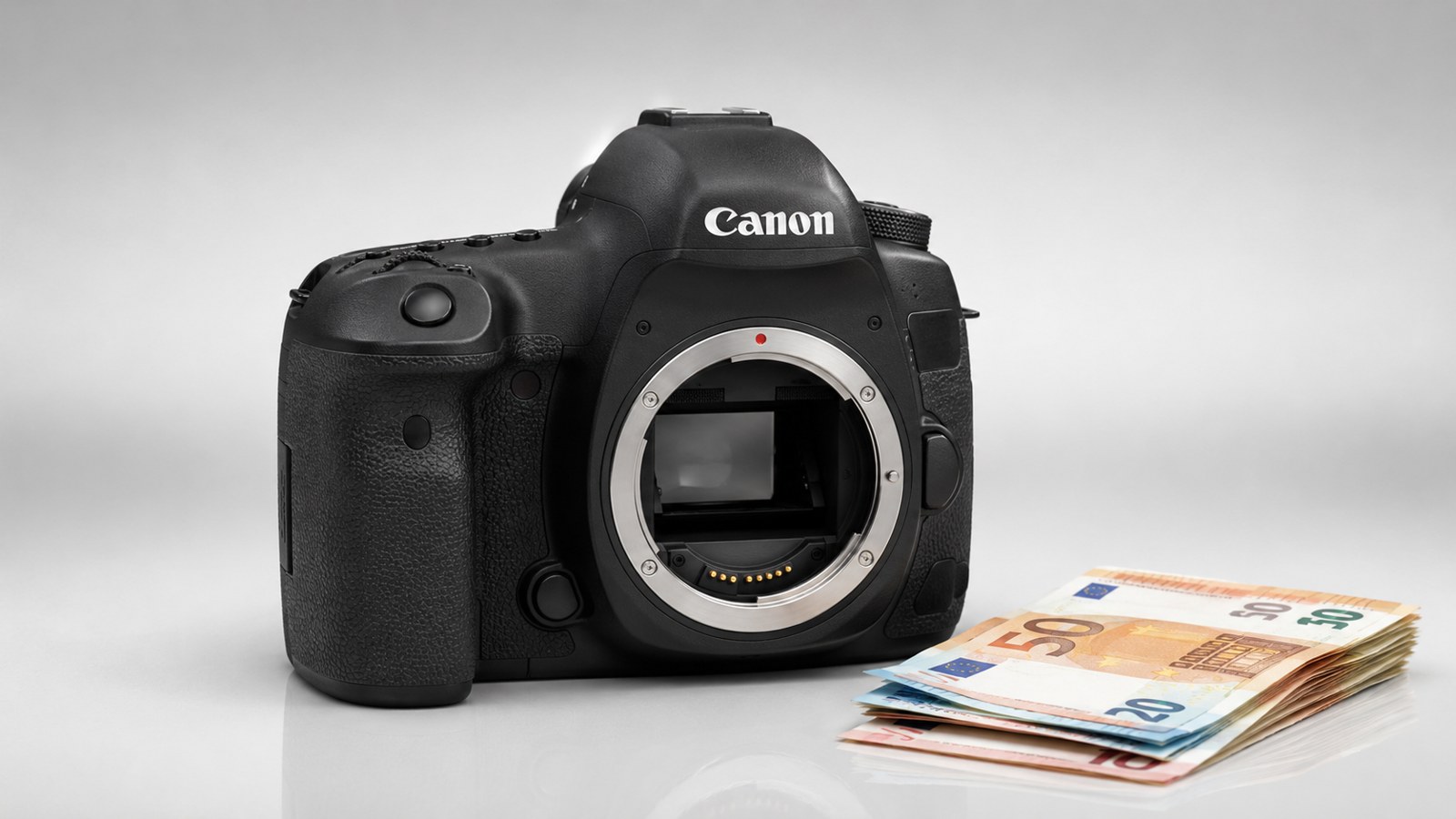
In short
- In 2026, a used 5D Mark IV typically trades between €750 and €1,250 on the private market, depending on shutter count and included accessories; a shop offering trade-in usually values it 15-25% lower, as they add inspection and warranty.
- The shutter is rated for 150,000 cycles: below 50,000 shutter count, the low count is a price advantage; between 50,000 and 120,000, it has little impact; above 150,000, it becomes the primary negotiation point.
- The defects that reduce value the most are not scratches: a sensor with fixed spots, detached rubber seals, an LCD with dead pixels, and CF cards with bent pins result in discounts ranging from €40 to €250.
- The box, two original batteries, and the purchase invoice are worth €80-120 combined towards the final price: without them, negotiations always start lower.
At least twice a week, someone walks into the shop with a 5D Mark IV in their bag and the same question: what is it worth? Usually, they have already checked three online listings, seen prices ranging from 700 to 1,400 euros, and don't understand why the same camera costs double just 40 kilometers away. It's not a matter of chance: those prices describe different cameras, with different histories, sold through different channels.
In this article, I explain how we assess a 5D Mark IV when it arrives at our counter: what we check first, how much the shutter count truly matters, which defects lower the price by hundreds of euros, and which ones matter less than you might think. This is useful whether you want to sell or if you want to understand whether the camera body you are about to buy is priced fairly.
Today's market price: where to start
In 2026, a used Canon EOS 5D Mark IV in good condition ranges between 750 and 1,250 euros in the private market. The spread is wide because it covers two very different machines: the body alone with 130,000 shutter count and some lifted rubber sits at the lower end, while the complete kit with box, two original batteries, and 25,000 shutter count sits at the upper end. If a listing falls outside this range, there is usually a reason: either the seller has miscalculated, or the camera has an issue that is not disclosed.
| Condition | Private (2026) | Trade-in Valuation |
|---|---|---|
| Like new, under 20,000 shutter count, complete kit | 1,150 - 1,250 € | 900 - 1,000 € |
| Excellent condition, 30,000 - 70,000 shutter count, partial accessories | 950 - 1,100 € | 750 - 870 € |
| Good condition, 80,000 - 150,000 shutter count, several signs of use | 800 - 950 € | 620 - 750 € |
| Body only, over 150,000 shutter count or defects | 750 - 830 € | 550 - 650 € |
That 15-25% difference between the two columns is not pure margin. It covers the laboratory inspection, the 2-year warranty, and the risk of the camera being returned. We will return to this point later, when discussing sales channels.
Asking price and actual selling price are not the same thing
Online listings show what people ask for, not what they actually receive. On the 5D Mark IV, the gap between asking and selling price averages 10-15%. Sellers listing at €1,100 typically close at €950-980 after two weeks and three negotiations. If you base your valuation solely on window prices, you start with an expectation off by about €120.
To read the real market, you need three indicators that nobody looks at:
- Listing duration. A camera body listed for 45 days is priced at least 10% above market value; it is not uncommon to find it still there after three months.
- Quickly removed listings. Those that disappear within 3-5 days indicate where the true closing price lies. Track a dozen for a couple of weeks and you will see the threshold emerge on its own.
- Relistings. The same listing republished with identical photos and a price reduced by 100 euros tells you exactly how far above market the seller was.
Why the 5D Mark IV has held its value better than other DSLRs
The 30-megapixel full-frame sensor and Dual Pixel AF produce files that, in 2026, still hold up for any portrait, wedding, or still life work. This is not nostalgia: it is because after 2016, the increase in useful resolution has stalled, and a 30 MP file prints at 60x90 without debate. Those who print and deliver have never had a technical reason to switch.
Let's be honest, though. The drop in value in the Canon DSLR world hasn't hit the 5D Mark IV body; it has hit the EF lenses. A 24-70 f/2.8 L II or a 70-200 f/2.8 L IS II can be bought today for prices that were unthinkable five years ago, because those switching to the RF system are selling them off in bulk. The result is paradoxical and benefits the photographer: the body holds its value, while the lenses you need cost little. If you are considering whether to sell it or keep it, we discussed this in more detail in the analysis of the used 5D Mark IV in 2026.
Shutter count: how much does it really matter
In ten negotiations for a 5D Mark IV, eight start with the same question: "What is the shutter count?" It is the first thing everyone asks, yet it rarely makes the difference in the final price. The count matters, but it matters far less than the used market believes, and it matters differently depending on the price range in which the camera falls.
150,000 declared shutter count: what it means in practice
Canon rates the shutter of the 5D Mark IV for 150,000 cycles. That number is a statistical average from a test batch, not a deadline written on the calendar. In our lab, we have seen camera bodies from former wedding photographers exceed 250,000 shutter counts without a hitch, while bodies from hobbyists fail at 60,000 with the shutter sticking halfway through its stroke.
Replacing the shutter on a 5D Mark IV at a reputable service center costs between 350 and 450 euros, including parts and labor. This is the figure that matters in negotiations, not the count itself: on a camera with 180,000 shutter count, you are not buying a certain problem, but a risk worth a fraction of those 400 euros. Asking for a 400-euro discount on a working camera is off the market; asking for 100-150 is legitimate.
How to read the shutter count without trusting the seller
A count declared verbally or written in the listing is worth nothing. Verification is required, and for the 5D Mark IV there are two options:
- Reading from the body via USB: This is the reliable method. Software like ShutterCount queries the camera connected to the computer and returns the count recorded by the firmware. You need the body in hand, or the seller connecting it in front of you via video call.
- Why free online tools are not enough: Canon does not write the count into the EXIF of a JPEG, so services that analyze a file downloaded from the listing return zero or an error. This is where half of the misunderstandings we see at the counter come from.
If the seller is unable to connect the camera and display the reading, treat the count as unknown and evaluate the camera based on the highest plausible range of shutter count. This is the same criterion we apply to high-value DSLRs, as we explain in how much is a used Nikon D850 worth.
Shutter count ranges that affect the price
| Shutter count range | Price impact | Note |
|---|---|---|
| Under 20,000 | +100 / +150 euros | Collector's body or lightly used: a real premium applies |
| 20,000 - 50,000 | +50 euros | Selling point, not a multiplier |
| 50,000 - 120,000 | None | Normal usage range: the difference between 60,000 and 110,000 is not reflected in the price |
| 120,000 - 150,000 | -50 / -100 euros | Risk discounting begins |
| Over 150,000 | -100 / -200 euros | Shutter discount: buyers factor in the cost of replacement |
The mid-range is where sellers are often surprised. A 5D Mark IV with 65,000 shutter count and one with 110,000, in identical condition, sell for the same price. Anyone demanding 200 euros more because it "only has 65,000 shutter count" will be left with their listing online for months.
Condition: The flaws that truly cost you
A scratch on the bottom plate of a 5D Mark IV doesn't shift the price by ten euros. A bent pin in the CF slot shifts it by two hundred. The valuation logic doesn't follow aesthetics: it follows the cost of the repair and the risk that the defect returns. At the counter, we explain this every week to those who arrive convinced the camera body is "like new" because it has no signs of use, and to those who apologize for a dent that counts for nothing.
Sensor: dust, fixed spots and scratches on the filter
Dust on the sensor is normal on a body that has mounted multiple lenses. A cleaning costs between 30 and 50 euros and disappears from the negotiation. The real problem is recurring oily spots, typical of intensively used bodies: they return after a few hundred shutter counts because the lubricant of the mechanism migrates. Those are worth an 80-120 euro discount, because they require a deep cleaning and do not guarantee the result over time.
The test takes thirty seconds: set the lens to f/16 or f/22, focus to infinity, take a shot of a white wall or the sky, then increase the contrast in post-processing. Dust appears as blurred dark dots. A scratch on the low-pass filter appears as a sharp line, always in the same position, and cannot be removed by any cleaning. A scratched filter on a 5D Mark IV means sensor group replacement: it goes beyond 400 euros, and the camera should be evaluated as a body for parts.
Body, rubber seals and card slots
The rubber grips on the 5D Mark IV tend to detach from the handle and connector bay after a few years, especially on camera bodies left in cars during summer. Whether sticky or missing, expect to pay 40-60 euros for parts and labor. A loose tripod thread is more serious: it indicates that the body has been used on poorly tightened plates or has suffered a drop while mounted on a tripod.
The most underestimated flaw remains the CF slot with bent pins. It happens when inserting the card at an angle, and sellers often don't know about it because they only use the SD slot. Two bent pins mean the card won't mount, or worse, corrupted writes. Repair costs over 200 euros. Always check it with a flashlight before closing a deal.
| Defect | Price impact | Repairable? |
|---|---|---|
| Dust on sensor | 30-50 € | Yes, cleaning |
| Recurring oil spots | 80-120 € | Partially |
| Scratch on AA filter | over 400 € | No |
| Detached rubber feet | 40-60 € | Yes |
| Bent CF pins | 150-250 € | Yes, expensive |
| Dead LCD pixels | 60-100 € | Replacement only |
LCD, touch and viewfinder
A single dead pixel on the rear LCD does not compromise usability but reduces the value by 60-80 euros, as the next buyer will use it in negotiation. Delamination, which is the separation between the glass and the panel creating milky haze at the edges, carries a heavier penalty: up to 100 euros. The touch screen of the 5D Mark IV must be tested zone by zone, not just in the center: it often stops responding in the lower section, where it is touched most frequently for AF point selection.
Dust in the viewfinder is a non-issue. It does not affect the image files, it does not indicate neglect, and anyone using it to lower the price is bluffing. It carries zero value in depreciation.
Autofocus and micro-adjustments
Systematic front or back focus is more intimidating than it needs to be. The test is performed on a target tilted at 45 degrees, at maximum aperture, on a tripod, using the same lens and taking five shutter count shots. If the error is constant and in the same direction, the micro-adjustment integrated into the camera body corrects it in five minutes at no cost.
Another red flag: if the error changes direction from one shutter count to the next, or if it appears with only one lens and disappears with others, the issue lies with the lens or the AF module. In the latter case, it requires service calibration, costing 120-180 euros. Before negotiating the price of a camera body, test it with at least two different lenses.
Accessories, boxes, and documents: what they are worth in euros
At the counter, the same scene plays out: a customer walks in with a 5D Mark IV, the original box packed with everything, and expects €150 more than the appraisal. The reality is that the accessories only move the price when they are items the buyer would actually use. Everything else is sentimental clutter, and the market treats it as such.
What adds value: original batteries, battery grip, invoice
The original Canon LP-E6N is the accessory that makes the biggest difference relative to its cost. A second original battery in good condition adds 30-40 euros to the negotiation, because a new one costs over 70 and the buyer knows it. However, note: original means branded Canon with the hologram, not "branded compatible". Compatible batteries are worth nothing in valuation, and on some, the 5D Mark IV does not read the remaining charge percentage in the battery info menu.
The battery grip BG-E20 adds 80-120 euros if it is the original Canon unit and not a clone. It is an accessory that portrait or sports photographers actively seek out, giving it its own independent market. The 40-euro clones, however, are a risk: oxidizing contacts and loose housings. In our valuation, we count them as zero.
The purchase invoice is the single most important document, yet very few sellers still have one. It proves the camera's origin—whether it is a domestic or imported unit—and is practically essential for selling to a shop: without proof of provenance, the negotiation always becomes more complicated.
| Accessory | Real value impact on price |
|---|---|
| Extra original LP-E6N | +30-40 € |
| Original BG-E20 battery grip | +80-120 € |
| Purchase invoice | +30-50 € and faster negotiation |
| Complete box with all contents | +20-30 € |
What doesn't affect the price as much as you think
It needs to be said clearly, because there are listings asking for 100 euros more for gear that isn't worth it:
- Empty box only: if it doesn't contain the original charger or battery, it's worth 10-15 euros. It's for shipping, not for adding value.
- Paper manuals: zero. The PDF is on the Canon website, for free.
- Unused original strap: zero. Anyone buying a 5D Mark IV already has their own strap and won't use the one with the giant logo.
- Old CF cards: a 16 GB CF card at 60 MB/s can't handle the burst buffer. Counting it as value is wishful thinking; the buyer will just toss it in a drawer.
- Generic UV filters: no value, and they often degrade images in backlit conditions.
In a nutshell: batteries, grips, and memory cards hold their value. Cardboard, plastic, and standard accessories do not.
Provenance and warranty: the factor nobody checks
Two 5D Mark IV with the same shutter count and the same aesthetic condition can differ in value by 150 euros. Not because of something you can see by opening the battery door, but because of how that camera body entered Italy and what life it had before appearing in the listing. It is the only price factor that almost no private buyer checks, and the only one we always verify before making an offer.
These are the adjustments we apply during valuation, assuming all other factors remain equal:
| Condition | Price Impact |
|---|---|
| Extra-EU import without Italian or European invoice | -100 to -150 euros |
| Declared ex-rental, documented maintenance | -50 to -100 euros |
| Untraceable repair (no service record) | -100 to -200 euros |
| Worn, covered, or illegible serial number | no offer |
Grey import and Canon Italy support
A camera body purchased outside the European Union functions exactly like any other. The difference emerges on the day of a malfunction: without a purchase receipt from an EU retailer, the Canon service center works on a quote, even for a camera that is technically still covered. On a 5D Mark IV, a shutter repair starts at around 350 euros, and on a body worth 900 euros, the difference between a covered repair and a paid one weighs as much as a third of the price.
You can tell from the paperwork, not the camera body. Look for an invoice or receipt from an Italian or European retailer, the manual in the correct language, and a charger with a European plug, not an adapter. If the seller says "I bought it online, it was much cheaper" and can't find the invoice, you're looking at an import. It's not illegal goods, but it's worth less and should be priced lower.
Ex-rental and intensive professional use
A former rental body is not automatically a bad buy. Rental companies perform scheduled sensor cleaning, replace rubber parts when they peel off, and send cameras to service before a defect becomes a complaint: maintenance is almost always above the average of an amateur body kept in a bag for eight years. The profile changes, however, on three fronts: high shutter counts (typically above 80,000), worn edges and mount, and inventory stickers that leave adhesive residue under the display.
The real issue is transparency. Ask the seller if the camera body was part of a fleet and whether it has undergone any repairs: a precise answer backed by a service record is worth more than a camera described as "always well kept" without a shred of documentation.
Where to sell it: private sale, trade-in, or consignment
The same €1,000 market value translates into three different figures depending on how you sell. The difference between the best and worst channels for a 5D Mark IV in excellent condition ranges between €150 and €250, but the timelines and who bears the risk if something goes wrong also change.
| Channel | Payout on a value of €1,000 | Typical timelines | Who bears the risk |
|---|---|---|---|
| Private (listing) | €900-1,000 | 3-5 weeks | You, until payment is received |
| Trade-in in store | €750-850 | Same day | The store |
| Consignment | €800-880 (15-20% commission) | 1-3 months, payout upon sale | The store, but you pay for the wait |
Consignment makes sense in one specific case: kits worth over €1,500, where the retained percentage weighs less than the trade-in differential. On a single camera body worth €900, the commission eats up almost all the advantage, and in the meantime, the camera is sitting idle elsewhere.
Private sale: higher returns, more effort
On a well-presented 5D Mark IV with genuine photos and a declared shutter count, the sale typically closes within 3-5 weeks. Without a declared shutter count, the timeframe doubles, as every inquiry starts with the same question.
- Negotiation: expect a 50-100 euro discount off the listed price. Buyers of used gear always negotiate.
- Payments: accept only certified bank transfers or cash in hand. Fake PayPal receipts and payment links sent via chat are the most common scam in this price range.
- Shipping: insure for the actual value and photograph the packaging. Shipping a 900 euro camera body without insurance is a risk you bear.
- After: there is no warranty between private parties, but if the buyer disputes a defect you did not disclose, the dispute will still arise.
In-store trade-in: when the numbers truly add up
Trade-in makes sense if you are already making a purchase. If the 5D Mark IV is only needed to raise cash, the private seller pays more, so it is better to wait.
Concrete numbers: with a trade-in valuation of 800 euros, a Canon EOS RP from our stock (520-600 euros, the most cost-effective way to enter the RF system using EF lenses via an adapter) leaves you with approximately 200 euros in your pocket. A Canon EOS R at 800 euros, with a more robust body and a better viewfinder, is a fair trade.
In either case, you don't write ads, you don't ship anything, and you're done in an afternoon. The 150-200 euro premium over private sales is the price of that simplicity.
If you're selling to switch to mirrorless: what you're actually buying
Suppose you get 1,000 euros from a private sale. That’s the average amount for a 5D Mark IV in excellent condition with a complete kit. The real question isn’t how much you cash in, but what you end up with the next day. Because the budget alone doesn’t tell you anything: what matters is what remains compatible with the lenses you already own.
What you get with the proceeds from your 5D Mark IV
With the proceeds from a private sale, you fall into the range where used full-frame mirrorless cameras are already solid. Here is what we have in stock today within that price bracket:
| Model | Price | What changes for you |
|---|---|---|
| Canon EOS R | 800 euros | With the EF-RF adapter, you can use all your EF lenses without any loss of image quality or autofocus performance |
| Canon EOS RP | from 520 to 600 euros | Same lens compatibility, lighter camera body, leaving you with 400 euros in your pocket |
| Sony A7 Mark II | 570 euros | Entry into the Sony full-frame system with in-body image stabilization, but you are switching systems from scratch |
| Sony A7r | 700 euros | High resolution for still life and landscape photography, but slow autofocus on moving subjects |
The difference that matters is in the third column, not the price. Switching to the Canon system, the EF-RF adapter costs 80-130 euros used and preserves your entire lens park. Switching to Sony, EF-E adapters exist (Sigma MC-11, Metabones), but continuous autofocus loses precision, and in practice, EF lenses are resold: if you have three decent lenses, that's another 1,500 euros to put back on the table before returning to the starting point.
The EOS RP at €520 is the option we most often recommend to those who want to try mirrorless without spending their entire budget. Having nine units in stock means you can choose the shutter count. If you are aiming for a more recent body, it is worth reading whether it is worth waiting for the R6 Mark II price to drop instead of settling for now.
When it is not worth selling
There are three situations where upgrading will cost you money and quality:
- You have bright EF L-series lenses. A 24-70 f/2.8 II and a 70-200 f/2.8 IS III on the native body already perform at their best. The adapter works, but it adds 24 mm of flange distance and an extra point of mechanical play on lenses weighing over a kilogram.
- You work in difficult conditions. The optical viewfinder does not turn off, has no lag, and does not drain the battery: the 5D Mark IV declares 900 shutter count per charge in viewfinder mode (CIPA data), while an EOS R declares 370. In the cold, the gap widens even further.
- You have a consolidated workflow for weddings or printing. Changing systems means redoing color profiles, menu habits, and field tests. Six months of friction for a file the client cannot distinguish.
If you identify with any of these points, €1,000 is better spent on a lens you are missing than on a body that takes the same photos.
What we do in the lab when a 5D Mark IV comes in
A 5D Mark IV that comes to the counter doesn't get a price in five minutes. It goes to the lab, where we spend between 45 and 90 minutes checking it before quoting a figure to the customer. That's why we sometimes ask you to leave it and call you back in the afternoon: the visual assessment, done at the counter while the customer waits, is the one that leads to the most disputes afterwards.
The inspection checklist, point by point
The process is always the same, in the same order, and every point ends up on the label that the customer then finds in the product sheet.
- Certified shutter count: we extract the count from the firmware, not from the files. The value we publish is the one read, not the one declared by the person who brought us the camera.
- Sensor test: shot on a uniform background at f/16 and f/22, inspection at 200%. We distinguish dust — which we remove — from fixed spots and hot pixels, which remain and affect the price.
- Autofocus on all points: the 61 points of the module must be tested one by one on a target with known contrast, not just the central one. The peripheral points are the first to fail on heavily used bodies.
- Shutter at high speeds: burst at 1/4000 and 1/8000 checking exposure uniformity. A slowing curtain appears as a dark band on one side of the frame, before the count says anything.
- Card slots: CF and SD, inspection of the pins with a lens. A single bent pin in the CF slot is a repair, not a detail.
- Batteries: charge cycles and residual capacity of every LP-E6N that arrives with the body. Those below threshold we replace ourselves.
- Seals and rubber parts: doors, bayonet mount, grip coatings. We re-glue or replace detached rubber parts.
- Cleaning: sensor, viewfinder, bayonet contacts and body.
Why our price is lower than a private listing
We always say the same thing, with the numbers up front: what we offer is not the market price of the camera body, but the market price minus what we put into it. And that includes specific items.
| Item | What it entails |
|---|---|
| Workshop inspection | 45-90 minutes of bench time on every camera body |
| Spare parts | Rubber seals, replaced battery, doors |
| 2-year warranty | Provision set aside on every unit sold |
| Inventory | A 5D Mark IV stays in stock for weeks, not hours |
The customer makes the decision with these figures in hand. If they have the time and inclination to manage a listing, a private seller will offer more. However, if a trade-in is needed to take home a body immediately — for example, a Canon EOS R, which we keep at 800 euros and represents the most direct step towards the RF mount while staying within the Canon ecosystem — the calculation changes, as the discount on the valuation is applied to the purchase.
Frequently asked questions
What is the current value of a used Canon 5D Mark IV in excellent condition?
In 2026, a camera body in good condition with 80,000-150,000 shutter count sells between private parties for around 800-950 euros. In a trade-in at a store, the valuation drops to 620-750 euros, because it covers servicing, potential parts, and warranty.
At what shutter count should the price be reduced?
The market psychological threshold is 150,000 shutter count, the value declared by Canon for the shutter. Once that figure is exceeded, the buyer almost always requests a discount equal to a portion of the shutter replacement cost, even if the camera body functions perfectly.
How do I check the shutter count of my 5D Mark IV?
The data is not in the camera's menu: it is read by connecting the camera body to a computer using dedicated software such as ShutterCount, or by having it certified in-store. Online services that analyze a JPEG downloaded from the listing do not find it, and a verbally declared count is worth nothing to a discerning buyer.
Does the original box increase the value?
On its own, hardly. It really carries weight when it comes with the purchase invoice, original batteries, and complete accessories: in that case, the package is worth 80-120 euros more than the camera body alone.
Is it worth selling the 5D Mark IV to switch to a mirrorless?
It’s worth it if you truly need eye AF, silence, and modern video files. If you work with bright EF lenses and your workflow is already set, the switch will cost you more than the trade-in value: first calculate how much you’ll have left after replacing adapters, batteries, and memory cards.
Does ReflexMania buy camera bodies with defects?
Yes, but the valuation changes. A sensor with fixed spots, a CF slot with bent pins, or misaligned AF translates into an intervention cost that we disclose to the customer before making the offer, so the figure is verifiable.
How long does it take to receive a valuation?
If you send us the model, shutter count, and three photos of the camera body, we will reply with a price range within one business day. We confirm the final figure only after the laboratory inspection, because real defects are only visible when handling the camera.
Want to know what your 5D Mark IV is worth? Ask us for a valuation
If you have any doubts about a purchase or need advice for your specific case, contact us. We offer free advice because we are photographers first, and because a customer who makes a poor purchase won't return to photography.
Three ways to get in touch:
- Contact form — response within 24 business hours
- WhatsApp at 342 362 3454 (messages only)
- Phone: 071 291 6347 (Mon-Fri 9am-1pm/3pm-6pm, Sat 9am-1pm)
If you want to see what we have in stock right away, explore the used gear available today: every camera is certified, comes with a 2-year warranty, and ships within 24-48 hours.
Article written by Matteo for the ReflexMania Team. Last updated: September 2026. Prices and availability refer to the time of publication.