
In short
- The RX100 series ranges from the Mark I (2012) to the Mark VII (2019): same 1-inch sensor, but zoom, autofocus, and viewfinder change significantly between versions.
- Used prices start at around 250-300 euros for a Mark I/II and reach 700-900 euros for a Mark VII: the price jump is not always justified for real-world use.
- The historical weak point is the retractable lens: dust on the sensor and zoom mechanism jams are the two defects to check first.
- If you are willing to change lenses, a used APS-C mirrorless like the Sony A6100 or Nikon Z30 offers more quality for the same cost: the RX100 wins only on portability.
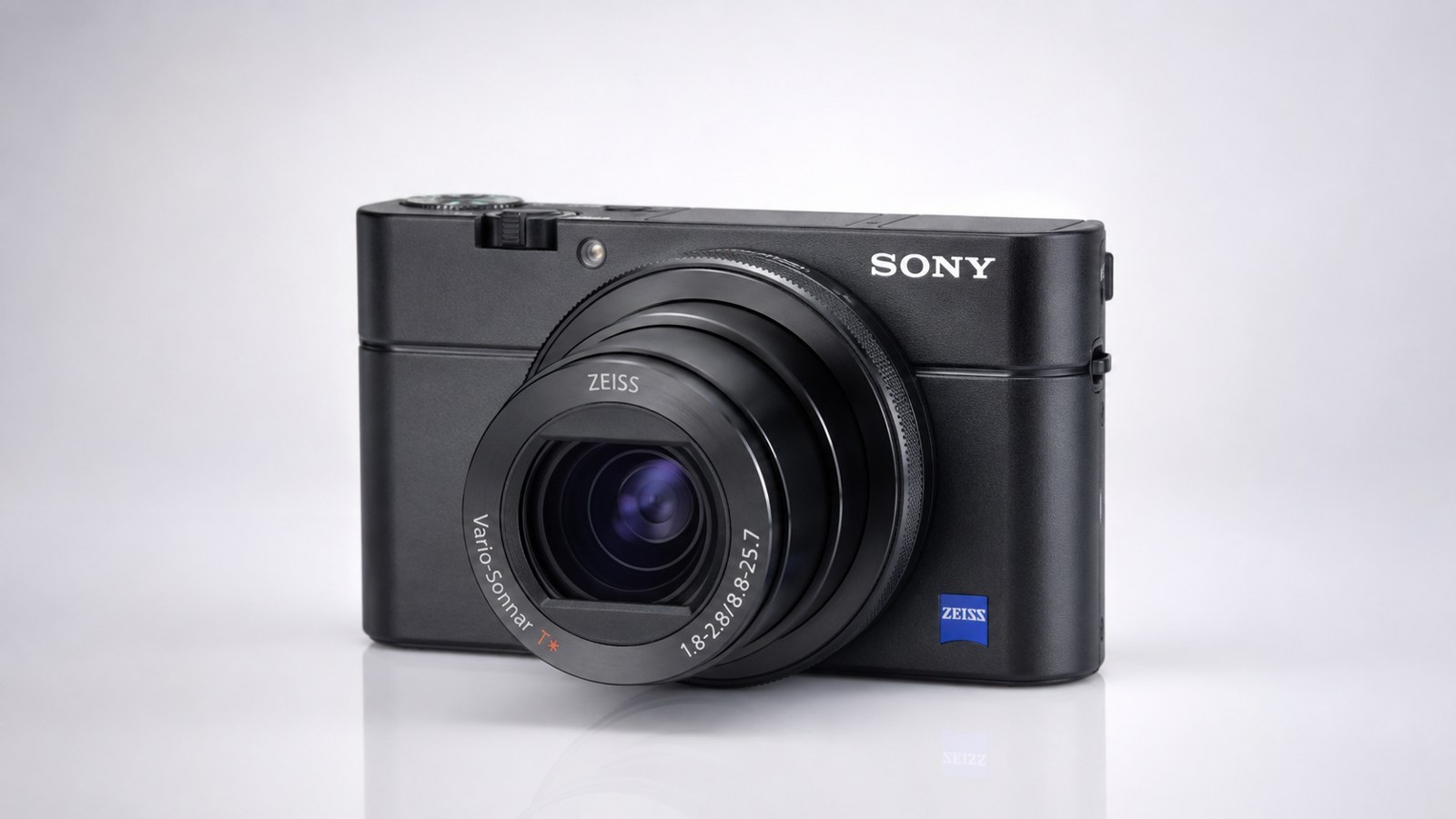
The RX100 is the camera I have most often recommended to those who told me, 'I want something better than a phone but that fits in my pocket.' In ten years at the counter, I have seen every version pass through, from the first one in 2012 to the Mark VII, and I have learned that the right choice is almost never the latest release. It is a compact with a 1-inch sensor, a format that sits halfway between a smartphone sensor and an APS-C mirrorless sensor.
In this article, we sort out the seven versions, see what they are worth today on the used market, and most importantly, what to check before paying. Because the RX100 has a recurring manufacturing defect, and if you don't know where to look, you risk taking home a problem that is expensive to repair. At the end, we also understand who it is really worth it for and who should look elsewhere.
What is the Sony RX100 and why it set the standard
In 2012, Sony packed a 1-inch sensor into a camera body that fit in a jeans pocket. Before that, to get that sensor size, you had to carry a DSLR or a mirrorless with a lens. The RX100 effectively created a category: the premium compact. From then on, Canon with the G7 X and Panasonic with the LX100 followed the same pattern.
The point is not that it took better shutter counts than a DSLR. It didn't. The point is that it took far better shutter counts than anything you could fit in your pocket, and that was enough to change the habits of those who no longer wanted to go out with a camera bag.
The 1-inch sensor: what really changes
The RX100 sensor measures 13.2 x 8.8 mm. To understand what this means, let's compare it with other formats you know:
- Smartphone: the main sensor is around 7-9 mm in diagonal. The thumb has about four times the surface area.
- 1 inch (RX100): 116 mm² of area. The real leap compared to a phone.
- APS-C (Sony A6100, Nikon Z30): approximately 370 mm², more than three times the size of a 1-inch sensor.
In practice, this translates into two concrete things. The dynamic range is wider than that of a smartphone: you recover highlights in a sky or shadows in an interior much better. And high sensitivity holds up: up to ISO 800-1600, images remain clean; above 3200, noise becomes visible and it is best to stop. Do not expect the results of an APS-C at high ISOs: the sensor is in between, it does not perform miracles.
Genuinely pocketable: the real reason to choose it
The RX100 isn't bought for absolute image quality. It's bought because you always have it with you. Weighing around 240-300 grams depending on the version, the lens retracts flush with the camera body, and you can slip it into a jacket without a second thought.
This is its raison d'être, and also the yardstick by which to judge it. The best camera is the one you have with you when you need it. An A6100 with a 16-50 doesn't fit in your pocket, but the RX100 does. If you are looking for maximum performance and are willing to carry a lens, you are looking at the wrong tool. If you want honest quality in an object you forget you are wearing, the RX100 does exactly that.
The seven versions: which RX100 to buy used
Seven models in seven years, from the same pocketable camera body and with the same 1-inch sensor. What changes — and what determines the price on the used market — is the surrounding package: lens, viewfinder, autofocus, and video. Before checking the price lists, it is worth understanding where the real leaps are, because not all versions are worth the difference they ask for.
Mark I, II and III: the entry-level tier of the used market
The Mark I (2012) and Mark II share the same 28-100mm equivalent f/1.8-4.9 lens: bright at the wide end, dark at the far end of the zoom. The Mark II adds a tilting screen and a back-illuminated sensor that performs slightly better at high ISOs. The real leap comes with the Mark III (2014): a pop-up electronic viewfinder and a 24-70mm f/1.8-2.8 lens, shorter but much brighter. For those shooting landscape, travel, and portraits without chasing action, the Mark III remains the most balanced choice in the affordable used market.
Mark IV and V: autofocus and 4K video
Here the series becomes a serious machine. The Mark IV introduces 4K video and the electronic shutter up to 1/32000. The Mark V — and the subsequent VA revision — brings hybrid autofocus with 315 phase-detection points and a burst rate of 24 frames per second. This is the point where the RX100 stops being just a travel compact and handles running children, animals, and amateur sports.
- Mark IV: first 4K, sharper viewfinder, fast electronic shutter.
- Mark V / VA: reactive hybrid AF, 24 fps burst. For many, it's the sweet spot of the used market.
Mark VI and VII: the 24-200mm long zoom
With the Mark VI, the philosophy changes. The lens becomes a 24-200mm f/2.8-4.5: much more versatile, but darker and less suitable for low light or strong background blur. The Mark VII (2019) keeps the same zoom and adds autofocus derived from Sony professional camera bodies, with real-time tracking of human and animal eyes, plus a microphone input. It is truly useful for those who film or photograph moving subjects at a distance. If you just need an all-rounder for travel, the extra cost compared to the Mark V is rarely justified in real-world use.
How much does a used RX100 cost today
The used market for the RX100 series is more stable than you might think: these cameras hold their value because the 1-inch sensor has not aged. A Mark I from 2012 still produces perfectly usable photos in 2026. This keeps the prices of the early versions above 250 euros, and those of the latest models close to their original retail price.
Here are the actual price ranges we see come through the counter, for a working camera complete with battery and charger:
| Version | Year | Used Price 2026 | Justification |
|---|---|---|---|
| Mark I / II | 2012-2013 | 250-350 € | 1-inch sensor, pure portability |
| Mark III | 2014 | 380-480 € | Pop-up viewfinder, 24-70mm f/1.8-2.8 zoom |
| Mark IV / V | 2015-2016 | 450-600 € | 4K video, faster autofocus |
| Mark VI | 2018 | 550-700 € | 24-200mm zoom, touch screen |
| Mark VII | 2019 | 700-900 € | Eye-AF autofocus, microphone jack |
Where the price is justified and where it isn't
The Mark VII costs three times as much as the Mark III, but it does not take photos three times better. The sensor is the same 1-inch, 20-megapixel unit. What you pay for in the higher-end versions is the eye-detection autofocus and the long 24-200mm zoom, not the basic image quality.
The "always buy the latest" argument doesn't hold up here. If you shoot landscape, portrait, and street photography at normal distances, the Mark III at 400 euros gives you the same file as the Mark VII with a brighter lens at f/1.8. The Mark VII only makes sense if you truly need the long telephoto reach or autofocus for moving children and animals.
The most honest price jump is from the Mark I to the Mark III: an extra 150 euros buys you the viewfinder and a better lens. Beyond that, you pay for specific features, and if you don't use them, you're wasting 300 euros.
What to check before buying
The RX100 is a dense, well-built camera, but it harbors a recurring point of failure. Before looking at aesthetics or accessories, focus on one thing only: the retractable lens. That is where 90% of the wrong used purchases in this series happen.
The retractable lens: the number one flaw
The optical group retracts completely into the camera body when you turn the machine off. This is the secret to its portability, but also its Achilles' heel. The zoom mechanism consists of tiny plastic and metal parts, which can jam over time or after a drop.
The classic symptom is the E:62:10 message on the display, with the lens stuck halfway or not moving at all. Sometimes it starts with a grinding gear noise. How to test it in two minutes:
- Turn the camera on and off five or six times in a row, listening to ensure the zoom retracts smoothly every time.
- Move through the entire focal range, from wide-angle to maximum extension, back and forth, checking for any stuttering or hesitation.
- Observe whether the internal aperture blades move uniformly, without tilting.
If you find any of these defects, walk away. Repairing the optical unit costs between 180 and 250 euros in parts and labor, figures that on a Mark I or II exceed the camera's value itself. This is why you see so many RX100 sold for 80 euros "for parts".
Dust on the sensor and other quick checks
The 1-inch sensor is sealed, but not immune. Dust settles in the internal lens and ends up on the sensor precisely due to the continuous movement of the zoom. You cannot clean it yourself: it is not a bayonet mount, it is a closed system.
The test is immediate. Set f/8, frame a clear sky or a uniform white wall, and take a shot. Dust spots appear as blurred dark shadows, more visible at a closed aperture. A few grains are tolerable; a constellation is not.
Complete with quick checks on the rest of the camera body:
- Lens ring: it must rotate smoothly, without jumps or dead zones. It is the most used control and the first to wear out.
- NP-BX1 battery: ask how many cycles it has been in use. A tired battery gives 120 shutter count instead of the declared 240, and is cheap to replace.
- Flaps: the battery-card compartment and the micro-USB one tend to loosen. Check that they close and latch properly.
What we do at our workshop on every RX100
Checking a used compact is not the same as checking a DSLR. With the RX100, the risk lies not in the mirror or the shutter, but in the retractable lens group and the 1-inch sensor sealed behind it. That is why every RX100 entering the shop goes through the lab bench before being placed in the display window, following a checklist specifically designed for this series.
The zoom mechanism is the first thing we check. We extend the lens across its entire focal range, from wide-angle to maximum extension, and verify that the motor operates smoothly, without stuttering, delays, or abnormal gear noises. An RX100 that hesitates during extension or displays an "E:62:10" error is a camera we are about to reject, not sell.
Here is what we specifically check on every unit:
- Full zoom under load: range from 24 to 70 mm equivalent (or up to 200 mm on Mark VI and VII) repeated multiple times, with the camera cold and after a few minutes of use.
- White screen sensor test: shutter count on a uniform surface at closed aperture to reveal dust or spots. On the RX100, dust gets into the retractable mechanism and does not clean as easily as on a mirrorless.
- Actual shutter count: we read the effective shutter count, we do not trust the value declared by the seller. A camera with 8,000 shutter counts and one with 60,000 have different value.
- Control ring and buttons: the ring around the lens wears out with intensive use, we verify that it responds on all steps.
- Pop-up viewfinder (from Mark III onwards): lifting mechanism and glass retention, the most fragile point of that group.
- Battery and charging: NP-BX1 retention test and verification that USB charging works on the body.
What passes this check comes with a 2-year warranty, the same two years we offer on all used gear. It’s not a commercial gesture: it’s the result of knowing exactly what condition the camera is in, because we opened, tested, and certified it ourselves. On a ten-year-old compact with a delicate retractable lens, this is the difference between a worry-free purchase and a surprise after a month.
RX100 or a used mirrorless? The honest comparison
For the same price, an APS-C mirrorless with a lens delivers better image quality than any RX100. The sensor is four times larger, and the dedicated optics don't have to fit into a pocketable body. But that's exactly the point: the RX100 fits in your pocket, a mirrorless with a lens doesn't. The choice isn't between good and bad, it's between two different ways of carrying a camera.
If portability is everything: the RX100 remains the choice
There are use cases where the RX100 has no rivals and no APS-C camera truly replaces it. If you fall into one of these categories, the decision is made.
- Light travel: when bulk is the main constraint and you don't want a dedicated photography backpack.
- Second camera: you already have a serious DSLR or mirrorless and need something to keep on you at all times.
- Discreet street: a compact doesn't intimidate anyone, an APS-C body with zoom does.
In all other cases, it is worth considering the alternative.
If you can change lenses: APS-C alternatives
If you accept a camera body that doesn't fit in your pocket, you get a much larger sensor for the same money. Three models in our catalog cover this range well:
| Model | Used price | Key strength |
|---|---|---|
| Nikon Z30 | 450 euros | The most compact of the three, designed for video and vlogging without a viewfinder |
| Canon EOS R100 | 400 euros | The most affordable, an excellent entry point into the Canon RF system |
| Sony A6100 | 550 euros | Eye-tracking autofocus among the best in its class |
Note the comparison: a Sony A6100 at 550 euros costs the same as a used RX100 Mark III-IV, but features an APS-C sensor and interchangeable lens. If your goal is to grow, the A6100 opens up an entire system; the RX100 remains what it is. On the Sony APS-C path, we have written a dedicated in-depth article on the used Sony A6000, useful for understanding the strengths and limitations of the family. The RX100 wins only when pocketability matters more than everything else.
Who the RX100 is for and who it isn't
The RX100 makes sense when pocketability is the number one constraint, not a detail. If the camera needs to fit in a jacket and be with you at all times, few compacts can compete with a 1-inch sensor. But if you accept a small bag, there is almost always a more capable alternative for the same price.
Here is how we see it at the counter, by reader profile:
- Light traveler: the ideal candidate. A used Mark III or IV covers wide-angle and short telephoto without adding weight, and fits anywhere.
- DSLR or mirrorless photographer: works well as a second camera "always in your pocket." It doesn't replace your kit; it complements it for moments when you wouldn't carry anything else.
- Absolute beginner: be careful. Spending 600-700 euros to learn on a compact with a fixed lens makes less sense than an entry-level mirrorless with an interchangeable lens.
- Those seeking maximum image quality: this is not the right camera. A 1-inch sensor is still one inch, no matter how well it is utilized.
Vloggers and video: pay attention to the right version
Here, the error is costly. The screen that flips 180° upwards, which is essential for self-recording, appears from the Mark III onwards: the Mark I and II lack it. But for vlogging, the screen alone is not enough; what matters is a video autofocus that keeps the face in focus without hesitation, and that becomes truly reliable with the Mark VA, VI, and VII thanks to eye-detection. On the Mark III, IV, and V, you have the flip screen but slower video tracking.
If the goal is to speak on camera, don't save money by buying a Mark III thinking "it does video anyway". It does video, but with an autofocus less ready to keep you in focus while you move. Better to step up to the correct version or change category altogether.
When it makes sense to move up a category
If your budget exceeds 700 euros and cost is truly not a constraint, a used mirrorless camera outperforms the RX100 across the board. At that price point, you enter the used full-frame market: a Sony A7 Mark II, which we keep around 500-550 euros, offers a significantly larger sensor, in-body stabilization, and interchangeable lenses. The difference in low-light performance and portraits is undeniable.
If you want to see how far this reasoning goes, we have explored the topic in depth in the comparison of the used Sony A7 III. The rule remains simple: the RX100 wins only when fitting in your pocket is the priority. In all other cases, for the same price, you get more camera.
Frequently asked questions
Which used Sony RX100 is worth buying in 2026?
For most people, the Mark III is the best compromise: it features the 24-70mm f/1.8-2.8 lens and a pop-up viewfinder, and is priced between 380 and 470 euros. Those looking for fast autofocus and 4K should consider the Mark V, while the Mark VI and VII only make sense if you need zoom up to 200mm.
Is the Sony RX100 better than a high-end smartphone?
The RX100's 1-inch sensor is approximately four times larger than that of a flagship smartphone, giving it a clear advantage in challenging conditions: backlighting, low light, and true optical zoom. In bright daylight, the difference narrows, but the real benefits remain the genuine zoom and manual controls.
What is the most common defect of the used RX100?
The retractable lens mechanism. With use, it may jam or trigger the E:62 error, and repair costs often equal the price of a low-end used camera body. It must always be tested by turning the camera on and off multiple times and exercising the full zoom range.
Is it worth spending more on the RX100 VII compared to previous versions?
Only if you truly need the latest generation of autofocus with Eye-AF, the 24-200mm zoom, or the microphone input for videos. For travel and everyday photography, a Mark III or V costs half as much and, in practice, produces very similar photos.
Is the RX100 suitable for vlogging?
Only some versions. The screen that flips upward comes from the Mark III, but to shoot solo you also need reliable video autofocus: the most suitable are the Mark VA, the VI, and the VII. The Mark I and II do not have a front screen, while the III, IV, and V have a flip display but slower video tracking.
Is a used RX100 better than a used APS-C mirrorless at the same price?
It depends on usage. If the priority is always having a discreet camera in your pocket, the RX100 has no rivals. If you are willing to carry a bag and change lenses, a used Sony A6100 or Nikon Z30 offer superior quality and a system that grows over time.
How many shutter count can an RX100 last?
The shutter is rated for tens of thousands of shutter count, but on the RX100 the critical component is not that: it is the moving optical group. A camera with a low shutter count but kept in a pocket without a case can be more worn out than one with a high count but well treated.
Looking for a Sony RX100 or a certified used compact?
If you have doubts about a purchase or need advice for your specific case, contact us. We offer free advice because we are photographers first, and because a customer who buys the wrong gear stops shooting.
Three ways to get in touch:
- Contact form — response within 24 business hours
- WhatsApp at 342 362 3454 (messages only)
- Phone: 071 291 6347 (Mon-Fri 9-13/15-18, Sat 9-13)
And if you want to see what we have in stock right away, explore the used gear available today: every camera is certified, comes with a 2-year warranty, and ships within 24-48 hours.
Article written by Matteo for the ReflexMania Team. Last updated: July 2026. Prices and availability refer to the time of publication.