
In short
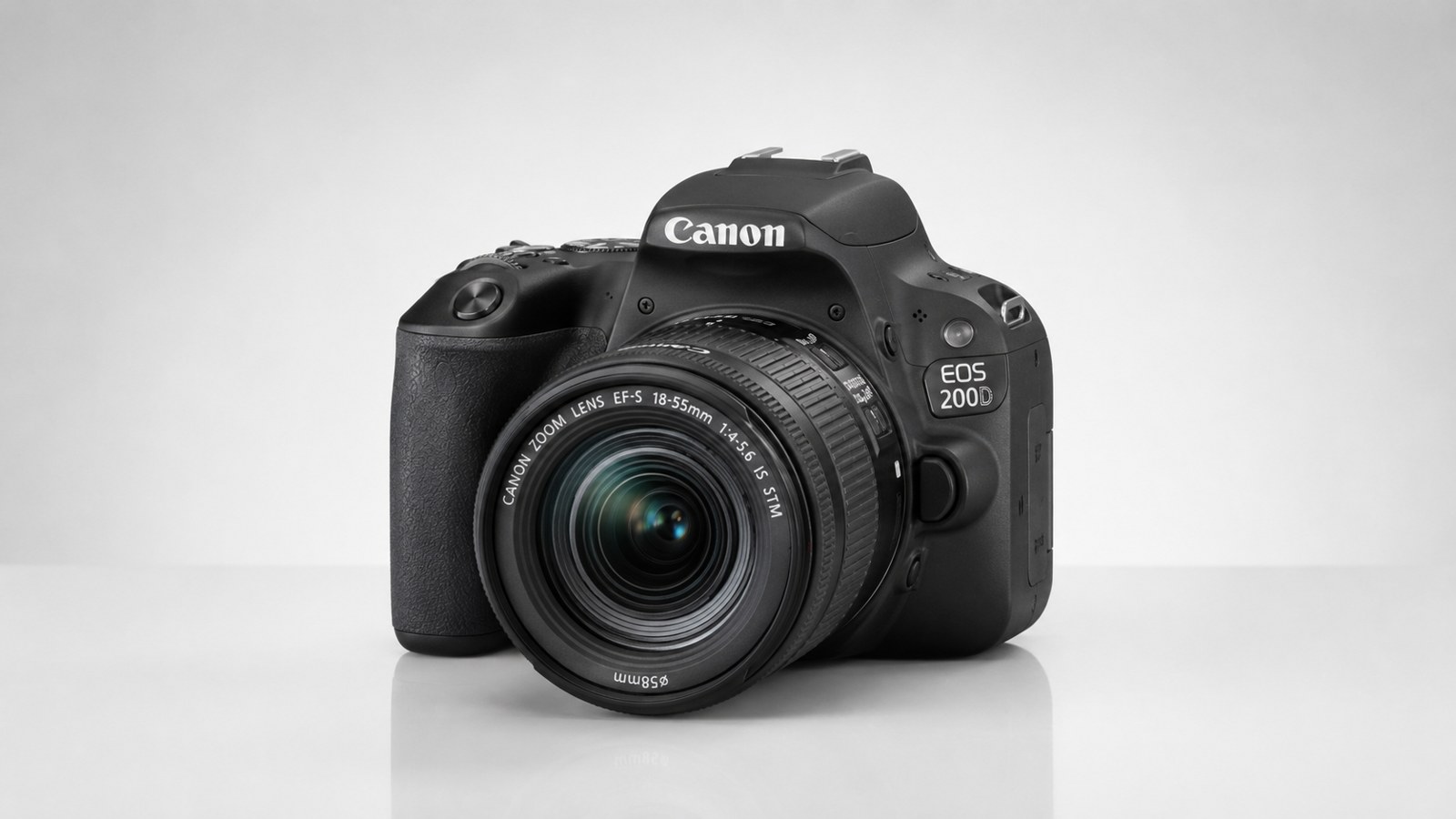
- The Canon EOS 200D features a 24.2 MP APS-C sensor, DIGIC 7 processor, and a vari-angle touchscreen: weighing 453 g, it is one of the lightest DSLRs ever produced by Canon.
- In Live View, it utilizes Dual Pixel CMOS AF, the same fluid autofocus that makes video and screen-based shooting significantly more reliable than previous entry-level models.
- Used, it is currently priced between 250 and 350 euros with the 18-55 STM lens; below 200 euros, valid alternatives in stock are the Canon 1300D and Canon 600D.
- Before purchasing, verify the shutter count (the shutter is rated for 100,000 cycles), the condition of the mirror and sensor, and ensure it is the Dual Pixel version, not the older 100D.
The Canon EOS 200D is the camera I most often recommend to those entering the world of DSLRs who don't want to carry a brick around. It is small, lightweight, and features a guided interface that explains what each setting does: for a beginner, this makes a huge difference compared to a body designed for those who already know where to put their hands.
In this article, we take a close look: what it actually mounts, where it excels and where it shows its limits, what it costs today on the used market, and what to check before paying for it. If, after reading, you realize you need something else, we point you to concrete alternatives we have in the shop at lower prices.
What is the Canon EOS 200D and who it was designed for
The Canon EOS 200D is the DSLR I recommend to those who truly want to learn, not to those looking for the cheapest camera body available. Weighing 453 grams, it is among the lightest DSLRs Canon has ever put into production: pick it up and it doesn't feel like a brick like the DSLRs from ten years ago. It features a 24.2 MP APS-C sensor and the DIGIC 7 processor, the same foundation as its bigger siblings of that era.
A clarification on the name, as it often causes confusion at the counter. The 200D in Europe is the same camera that is called the Rebel SL2 in the United States. It is the direct successor to the Canon 100D, the brand's first "mini-DSLR," released four years earlier. If you see a listing that mixes them up, ask for the exact model number: the 100D does not have Dual Pixel CMOS AF, the 200D does, and in Live View it is a completely different camera.
Positioning in the Canon range
In Canon's lineup from those years, the 200D occupies a specific tier: above pure entry-level models, below bodies with dual dials and a pentaprism. Here is where it stands.
- Below: the Canon 1300D, more basic, without a tilting screen and with slow autofocus in Live View.
- The 200D: tilting touchscreen, Dual Pixel AF, ultra-compact body. The "serious" entry point.
- Above: the Canon 800D and 77D, with a larger viewfinder, more AF points, and a second control ring for those working in manual.
To be blunt: the 200D is designed for beginners who want a camera that won't frustrate them, not for those who already shoot raw handheld and seek semi-pro ergonomics.
The guided interface for beginners
This is the real reason why I hand it to a beginner. The 200D has a guided mode that explains on-screen what each parameter does. When you adjust the aperture, an icon shows you the background blurring or sharpening; when you change the shutter speed, you see the motion frozen or blurred.
It may seem like a brochure detail, but it changes the learning curve. Those buying their first DSLR often give up because they don't understand the exposure triangle. Here, the camera explains it to you while you take shutter counts, without opening the manual. Then you disable it all and switch to the classic interface when you're ready.
The specs that really matter
The technical specifications of the Canon EOS 200D are honest, but not all numbers carry the same weight. At the counter, when someone picks it up, I explain that three items matter more than the others: the sensor, Live View autofocus, and the weight. The rest is just context.
Sensor, processor and image quality
It features a 24.2-megapixel APS-C sensor paired with the DIGIC 7 processor. This is the same resolution base you find on much more expensive bodies from the same period: it is more than enough for prints up to 50x70 and for web use. Low-ISO performance is clean, and Canon's color is warm—exactly what you like right away without touching anything in post.
Be realistic about high ISO settings. Up to 3200, you can use it without a second thought; at 6400, noise is visible but remains manageable for non-professional use. Beyond that, the file becomes soft: the extended values listed in the specs exist to fill a line in the brochure, not for actual processing.
Dual Pixel CMOS AF: the real leap
This is the difference that justifies the 200D over previous entry-level models. In Live View and video, it uses Dual Pixel CMOS AF: on-screen autofocus locks onto the subject smoothly and continuously, without the back-and-forth "hunting" typical of older models. For those who film or shoot using the articulated display, it makes all the difference.
However, do not mistake it for an action camera. The optical viewfinder retains a 9-point autofocus system, with only a single central cross-type point. It is perfectly suitable for portraits, landscapes, and family shots; for sports or children running around in the viewfinder, it is modest. The strength lies on the screen, not in the eyepiece.
Articulating screen, weight and battery life
The vari-angle touchscreen flips and rotates fully: convenient for low-angle and high-angle shots, as well as selfies. Touch operation also controls focus, allowing you to place the focus point exactly where you want it with a single tap.
- Weight: 453 g with the bare camera body, among the lightest DSLRs ever made by Canon
- Battery: LP-E17, approximately 650 shutter count per charge in the optical viewfinder (less in Live View)
- Shutter: rated for 100,000 cycles
Weight is not a detail for nerds. A lightweight camera is one you actually carry with you, and a DSLR that stays at home doesn't take photos. For a beginner, this is the specification that most impacts the final result.
Real strengths and limitations in the field
The 200D does something previous Canon entry-level models did poorly: it focuses well even when shooting live view, meaning you compose using the screen instead of the viewfinder. This is thanks to Dual Pixel CMOS AF, the same system that provides smooth autofocus in video. This changes the real-world user experience, especially for those coming from smartphones who instinctively compose on the screen.
Where the 200D is still excellent
At 453 grams, the body is among the lightest DSLRs Canon has ever produced: you can carry it all day without noticing. The tilting touchscreen lets you shoot from low angles, high angles, and take selfies without contorting yourself.
- Daytime photos: the 24.2 MP APS-C sensor with DIGIC 7 delivers clean files and reliable Canon colors up to ISO 1600-3200 without much hassle.
- 1080p video: Dual Pixel AF tracks the subject with smooth transitions, something older models like the 1300D and 100D cannot do.
- Lenses: it accepts the entire EF and EF-S lens lineup, which is affordable and widely available on the used market. You can get the 50mm f/1.8 STM for less than 100 euros.
Limitations to know before buying
The typical compromises of a 2017 entry-level DSLR remain, and they must be stated clearly:
- 9 AF points in the viewfinder: few and concentrated in the center. Limiting for moving subjects framed through the viewfinder.
- No 4K: video tops out at Full HD. If you really need 4K, this camera body is not for you.
- 5 fps burst: sufficient for everyday use, short for sports or animals in action.
- No in-body stabilization: you rely on the lens stabilization. With a non-stabilized prime, handheld shooting in low light is difficult.
When does it make sense to go for a mirrorless instead? If you need full-frame AF with eye recognition, faster burst rates, or 4K video, the right camera body is not an entry-level DSLR from this generation. In that case, the question becomes a different one: how much do you want to spend and what do you really need? If, however, you stay loyal to the DSLR but want to move up a category, we discuss it in our in-depth article on the used Canon 90D, the last major APS-C DSLR from the brand.
Canon EOS 200D vs. entry-level alternatives
The 200D is not the cheapest Canon DSLR on the used market: it costs 50-150 euros more than models like the 1300D or the 600D. The right question is not "how much do I save", but "what do I lose if I go for a cheaper price". In this price range, three things make the difference: the Dual Pixel CMOS AF, the vari-angle touchscreen, and the DIGIC 7 processor. Let's see when that premium is worth it.
200D vs Canon 1300D and 600D
These are the two entry-level Canon bodies we keep under 200 euros, and both feature the older 18 MP sensor with a DIGIC 4 processor. Neither has Dual Pixel: in Live View and video, autofocus struggles, "pumping" before locking onto the subject. Here is the straight comparison:
| Model | Used Price | Why it's a good buy |
|---|---|---|
| Canon 1300D | 190 € | The absolute minimum to start at a very low cost, featuring an optical viewfinder and classic Canon controls. |
| Canon 600D | 200 € | It has the articulating screen that the 1300D lacks, offering a more complete body for those who want full manual controls. |
The 200D is worth the premium if you care about smooth video, reliable on-screen autofocus, and touch: you are paying for the Dual Pixel, not the body. If you only shoot through the viewfinder, in RAW, at static subjects, the 1300D does 90% of the job at half the price. In that case, the honest advice is to save.
200D vs Nikon D5600 and D3300
Those not tied to a specific brand also look at Nikon. The Nikon D3300 at 220 euros features the same 24 MP sensor without an anti-aliasing filter and offers excellent RAW performance for its class, but lacks touch controls and has a slow Live View. The D5600 adds a tilting touchscreen and connectivity, bringing the user experience very close to that of the 200D.
The real dividing line remains the Live View: no entry-level Nikon DSLR can match the Dual Pixel Canon. However, if you shoot through the viewfinder and optimize the RAW, the difference between the two worlds almost disappears. We compared prices and pitfalls of the used D5600 in a dedicated in-depth article, useful if you are also considering the Nikon side.
Canon EOS 200D and entry-level alternatives compared
| Model | Sensor | AF Live View | Key Strength | Indicative Used Price |
|---|---|---|---|---|
| Canon EOS 200D | 24.2 MP APS-C | Dual Pixel CMOS AF | Compact, vari-angle touchscreen | €250-350 |
| Canon 1300D | 18 MP APS-C | Contrast (slow) | Lowest price, simple | €190-200 |
| Canon 600D | 18 MP APS-C | Contrast (slow) | Vari-angle screen, robust | €200 |
| Canon 650D | 18 MP APS-C | Hybrid CMOS AF | First Canon touchscreen, video | €220 |
| Nikon D3300 | 24.2 MP APS-C | Contrast (slow) | Excellent performance, lightweight | €220 |
What to check before buying a used 200D
A 200D might have a shutter count of 3,000 or 90,000: externally they are identical, and the price is often the same too. The difference is made by you, with ten minutes of checks before handing over your money. Here is what I look for when a 200D arrives on the counter.
Shutter count and shutter condition
The shutter of the 200D is rated for 100,000 cycles. It is not an insurmountable limit — many camera bodies go beyond it — but it is the reference point for understanding how much life is left. On an entry-level DSLR, usually purchased by weekend photographers, 15,000–25,000 shutter count is the norm. Above 50,000 on this type of body, we are talking about intensive use: not a defect, but the price must reflect it.
The count is not visible from the Canon menu. You need software that reads the data from the EXIF of a recent RAW shutter (EOSInfo, ShutterCount online). If the seller cannot tell you the number and does not allow you to verify it, that is already a red flag.
Sensor, mirror and contacts
Three quick checks, in this order:
- Sensor: take a shutter count at f/16 against a uniform white wall. Fixed dark spots that remain in the same position are dust (cleanable) or, more rarely, mold in the optical path (not easily cleanable).
- Mirror: check that it is clean and securely mounted, with no play. A mirror that vibrates or remains raised is a serious mechanical issue.
- EF/EF-S Contacts: the gold pins on the mount must be clean and not oxidized. Dirty contacts cause communication errors with the lens.
Quick focus test: mount the lens, switch to Live View, and check the Dual Pixel CMOS AF. It should lock on quickly and smoothly. Slow AF or "pumping" in Live View on this body is abnormal.
Accessories, battery and warranty
The 200D uses the LP-E17 battery. Original Canon batteries hold up well; cheap compatibles tend to swell or die halfway through the day after a few years. Ask which battery is included and its condition. Check that the charger and strap are present: small costs that add up if they are missing.
The real point, however, is who is selling you the camera body. From a private seller, you buy it "as is": if the shutter fails after a week, the problem is yours. These are the same checks we perform on every camera body before putting it on display — the same logic applies to much more expensive machines, as we explain in the guide to valuing a used Canon 5D Mark IV. Buying from a seller who certifies shutter count and provides a warranty means shifting that risk to the one who knows the machine.
Current price and in-stock alternatives
A Canon EOS 200D in excellent condition with an 18-55 STM lens currently ranges from 250 to 350 euros. This is the right price for a DSLR released in 2017 featuring Dual Pixel CMOS AF and a vari-angle touch screen. Below that threshold, the risk changes nature: it is no longer about a good deal on shutter count, but about understanding what is not being told to you.
Price range of the used 200D
The 250-350 euro price range depends almost entirely on three factors: the actual shutter count (rated for 100,000 cycles), cosmetic condition, and the presence of the 18-55 STM kit. A body only drops to 220-250 euros, but for a beginner, the lens is needed immediately, so the kit remains the sensible choice.
When you see a 200D listed for €180–200, pause for a moment. At that price, something is usually missing: a non-original charger, a shutter count over 40,000, peeling rubber grips, or — it happens — it is actually an older 100D sold as a 200D. A low price is rarely a gift. More often, it is a problem you will pay for later.
If your budget is tighter: Canon models in stock
If the 250 euros are not available, we have specific Canon alternatives that we run through our workshop. You give up the Dual Pixel and the tilting touch screen, but you stick with solid bodies to learn. Here is what we have today:
| Model | Price | Why it makes sense |
|---|---|---|
| Canon 550D | 150 € | The most affordable in stock, perfect for starting with the essentials. |
| Canon 1300D | 190-200 € | 18 MP sensor and built-in Wi-Fi. Two units available. |
| Canon 600D | 200 € | Articulating screen and sturdy body. Three units: the easiest to find ready to ship. |
| Canon 650D | 220 € | The first Canon with a touch screen and Hybrid CMOS AF: the bridge to the 200D. |
My honest advice: if you can stretch to 220 euros, the 650D already gives you a taste of touch operation and Live View autofocus. If you are strictly aiming for 150 euros, the 550D does its job without pretense and leaves you with budget for a better lens later.
Canon entry-level in stock today at ReflexMania
| Model | Price | Availability | Ideal for |
|---|---|---|---|
| Canon 550D | 150 € | 1 unit | Lowest budget, 1080p video |
| Canon 600D | 200 € | 3 units | Articulating screen, beginners |
| Canon 650D | 220 € | 1 unit | Touch and hybrid autofocus |
| Canon 1300D | 190-200 € | 2 units | Absolute entry-level, essential |
Which lenses to start with
The 18-55 STM kit lens that comes with the 200D is a better lens than its reputation as a "bonus lens" might suggest. It covers wide-angle and short telephoto, features image stabilization, and uses the STM motor, which ensures smooth and silent autofocus in Live View with Dual Pixel. For the first few months, you don't need anything else: use it, figure out which focal lengths you actually use, and only then buy a second lens.
The 18-55 STM kit and the 50mm f/1.8 STM
The first right purchase after the kit is the Canon 50mm f/1.8 STM, the classic "nifty fifty". Used, you can find it between 60 and 90 euros, and it is the expense that changes your photos the most for the minimum outlay. The f/1.8 aperture gives you the blurred background that the kit zoom cannot achieve and lets you shoot indoors without raising the ISOs too much.
It is an EF lens, not EF-S, so it was designed for full frame but is perfectly compatible with the 200D. On the APS-C sensor, the 1.6x crop factor makes it equivalent to an 80mm: a portrait focal length, excellent for faces and details, a bit tight for interiors and landscapes. The STM motor works well with Dual Pixel AF even in video.
- 18-55 STM — the all-rounder you already have: keep it for travel, groups, and landscapes.
- 50mm f/1.8 STM (€60-90 used) — portraits and low light: the second lens for everyone.
What to avoid at the beginning
Two categories will only cost you money. The first is budget superzooms like the 18-200 or 18-270 in the lower price range: on paper they cover everything, but in practice they are soft at the edges and slow when wide open, and on a light body like the 200D they negate its advantage.
The second are older third-party lenses from the 2000s, certain Sigma and Tamron models pre-redesign: they may cause communication errors or fail to fully utilize Dual Pixel in Live View. If you are considering a third-party lens, look for recent models and verify the declared compatibility, rather than grabbing the first deal for 40 euros on the used market.
What we do in our lab
Every Canon EOS 200D that arrives at our store does not go on the shelf the same day. It first goes through our in-house lab in Ancona, where a technician opens the camera body, tests it, and certifies it. This is the difference between buying from a private seller on a listing and buying a camera that someone has actually checked before selling it.
On the 200D, the most critical point is the shutter. Canon rates it for 100,000 cycles, but the number on paper means nothing if you don't know how many shutter count you've reached. That's why we connect every camera body and read the actual shutter count from the firmware, then we state it clearly in the product sheet. If a 200D has 12,000 shutter count, you'll see it listed; if it has 80,000, you'll see that too, and we adjust the price accordingly.
Here is what we check on every unit before putting it up for sale:
- Certified shutter count: read from the firmware, not estimated by eye, and reported in the listing.
- Sensor cleaning: removal of dust, which is almost always present on used DSLRs, verified at closed aperture on a uniform background.
- Focus test: performed both through the optical viewfinder and in Live View, to confirm that the Dual Pixel CMOS AF works as smoothly as it should.
- Mirror and shutter: check that the movement is clean, without delays or abnormal noises that anticipate a failure.
- Articulating touchscreen: verification of the hinge and touch response across the entire surface.
- Battery and contacts: retention test of the LP-E17 and cleaning of the contacts between the camera body and the lens.
Those buying an entry-level model like the 200D are often purchasing their first serious camera body and may not have the tools to perform these checks themselves. This is precisely where the laboratory work matters most: you are not buying a box, you are buying a machine that starts from a known baseline.
On all used equipment, we apply a 2-year warranty, not the three months typical of the private used market. This means that if something fails after six months, you won't be left holding a paperweight: the camera body goes back to our lab and we fix it. For a DSLR that accompanies you through your first years of learning, having real coverage removes a worry that otherwise weighs on every shutter count.
Frequently asked questions
Is the Canon EOS 200D still a good choice in 2026?
Yes, for a beginner who wants to learn with a lightweight DSLR and a guided interface. The 24 MP sensor and Dual Pixel AF in Live View remain more than adequate for photos and 1080p video. However, if you are aiming for 4K video or advanced tracking autofocus, consider a mirrorless camera.
How many shutter count can a Canon EOS 200D take?
The shutter is reported to have approximately 100,000 cycles. For an entry-level camera body, a used unit with between 5,000 and 30,000 certified shutter counts is entirely normal and leaves ample margin. Beyond 50,000, it is not a problem in itself, but it is a factor to consider in the price.
What is the difference between Canon EOS 200D and 100D?
The 200D features a 24 MP sensor compared to the 18 MP of the 100D, the DIGIC 7 processor, a tilting touchscreen (fixed on the 100D), and above all Dual Pixel CMOS AF, which makes Live View autofocus much faster and smoother.
How much does a used Canon EOS 200D cost?
Today it is priced between 250 and 350 euros with the 18-55 STM kit lens, depending on condition, shutter count, and warranty. Below 200 euros, it generally drops to previous models such as the Canon 1300D or 600D.
Canon EOS 200D or a used mirrorless?
It depends on your usage. To learn with a limited budget and affordable lenses, the 200D is excellent. If you are interested in modern video, the electronic viewfinder, and extreme compactness, a used mirrorless camera in the same price range might make more sense, but it often costs more.
Which lens to buy to start with the 200D?
Start with the 18-55 STM kit, then add the Canon 50mm f/1.8 STM: it costs just a few dozen euros on the used market, opens to f/1.8 for bokeh, and teaches you to compose with a fixed focal length. It is the first upgrade I almost always recommend.
Should you buy a used 200D from a private seller or a store?
Buying from a private seller saves you some money, but you have no guarantees about the actual condition of the sensor, shutter, and battery. In a store, you pay a bit more but get a serviced body, a certified shutter count, and a warranty that covers hidden defects.
Looking for a compact DSLR to get started? Let's talk
If you have doubts about a purchase or need advice for your specific case, contact us. We offer free advice because we are photographers first, and because a customer who makes a bad purchase won't come back to photography.
Three ways to get in touch:
- Contact form — response within 24 business hours
- WhatsApp at 342 362 3454 (messages only)
- Phone: 071 291 6347 (Mon-Fri 9-13/15-18, Sat 9-13)
If you want to see what we have in stock right away, explore the available used gear today: every camera body is certified, comes with a 2-year warranty, and ships within 24-48 hours.
Article written by Matteo for the ReflexMania Team. Last updated: July 2026. Prices and availability refer to the time of publication.