
In short
- In 2026, a used D850 in excellent condition costs between 1,300 and 1,900 euros: less than half of the 3,500 euro list price in 2017.
- The 45.7 MP sensor and the certified shutter count of 200,000 shutter counts remain competitive: a camera with 80,000 shutter counts has more than half its life ahead.
- The real risks of used gear are a shutter at the end of its life, peeling rubber seals, and dust on the sensor, not the age of the camera body.
- If you are looking only for lightness or modern video, a used full frame mirrorless under 1,000 euros may make more sense than the D850.
The Nikon D850 was released in 2017 and, even today at the counter, it is one of the DSLRs customers ask for by name. It is no coincidence: 45.7 megapixels, a burst rate of 7 fps, autofocus inherited from the D5, and a build quality that withstands years of serious work. In 2026, however, the question is no longer “is it a good camera” — it is — but “does it make sense to spend that money on the used market now, with mirrorless cameras costing less and less”.
In this article, I tell you what a used D850 really costs today, how many shutter counts you can accept without issues, what we check in our lab before putting one up for sale, and in which cases a cheaper or lighter alternative is the right choice. No brochure enthusiasm: just what we see coming through the shop.
What is the D850 and why is it still talked about in 2026
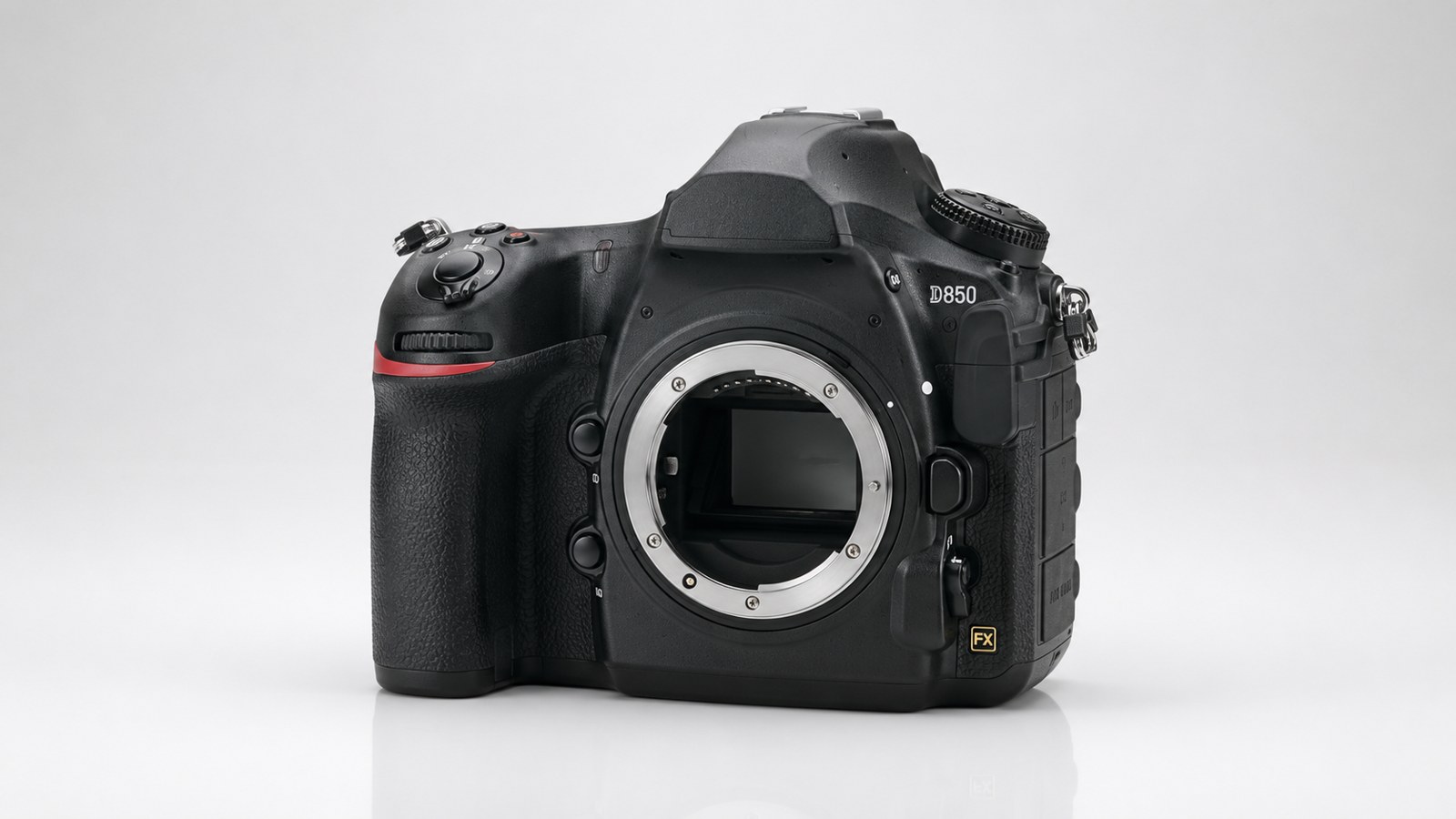
The D850 was released in 2017 with a list price of 3,500 euros and in 2026 it continues to come through the counter regularly. Not out of nostalgia: it is the high-resolution full-frame DSLR that Nikon has never truly replaced in its segment. A 45.7-megapixel sensor without a low-pass filter, built for those who print large or crop heavily, still holds its own against current camera bodies that are significantly more expensive.
The reason for the buzz is simple: today it can be found used for less than half of its original price, while most of its specifications remain aligned with what a landscape, portrait, or still life photographer demands in 2026.
The specs that still matter today
Not all the numbers on the spec sheet carry the same weight when you're actually working. Here's what matters and what is mostly just brochure talk.
- 45.7 MP without low-pass filter: genuinely useful if you print larger than A2 or crop heavily. It makes no difference for an Instagram file.
- Base ISO 64: this matters. It gives you darkroom-level dynamic range and allows long exposures without ND filters in full daylight. Few camera bodies have this.
- Certified shutter count of 200,000 cycles: a concrete industrial threshold, not marketing. It is the foundation of used value, and we will discuss it further later.
- Dual XQD + SD slots: real-time backup. XQD is fast but expensive, so factor it into your budget.
- 100% optical viewfinder: no lag, no battery drain. For many, this is an advantage, not a limitation.
What NOT to expect from a 2017 DSLR
The D850 is a serious camera, but buying it with 2026 mirrorless expectations leads to avoidable disappointments. Let's be clear before you buy.
- The autofocus is excellent in the center, but the 153 points do not reach the edges of the frame like a modern mirrorless does.
- The video is 4K with minimal crop in full frame, but without IBIS stabilization on the body: you feel it when shooting handheld.
- No animal eye-AF and no advanced subject recognition. Eye detection AF does not exist here.
If these limitations weigh on your workflow, the D850 is not the right camera for you, and we are happy to say so. If, however, you shoot in a considered manner, they remain secondary details compared to that sensor.
How much does a used Nikon D850 cost in 2026
In 2026, a D850 in excellent condition costs between €1,300 and €1,900. For a camera that launched in 2017 with a list price of €3,500, we are talking about less than half. The price has not collapsed because the D850 is obsolete: it has dropped because the used market has been flooded with units, while the 45.7 MP sensor remains one of the best ever mounted on a DSLR.
Price ranges by condition and shutter count
The price range depends primarily on two factors: cosmetic condition and shutter count. A camera with fewer than 50,000 shutter counts, intact rubber seals, and a complete box sits at the top end. One with 120,000 shutter counts and several signs of use sits at the bottom, but it still makes sense if the price reflects that.
| Condition | Indicative shutter count | Price |
|---|---|---|
| Like new, complete | under 30,000 | €1,800 – €1,900 |
| Excellent condition | 50,000 – 90,000 | €1,500 – €1,700 |
| Several signs of use, functional | 100,000 – 130,000 | €1,300 – €1,450 |
Why private seller prices are misleading
You find listings at €1,100 and it looks like a deal. Often, it isn't. That below-threshold price almost always hides something: a shutter count of 250,000 beyond the certified limit, a sensor needing a deep clean, peeling rubber seals, or a finicky card slot. The private seller won't tell you, because in many cases, they don't even know.
The real difference lies between the stated price and the actual cost. A professional sensor cleaning costs money, and a shutter replacement on a D850 easily exceeds several hundred euros. If you add those jobs to the initial 1,100 euros, you end up with the same figure as a certified camera, but without a warranty and without knowing what you have bought. If you want to understand how the market reasons about valuations, we discuss it in detail in how much is my used Nikon D850 worth.
With us, the price includes the certified shutter count, sensor inspection, and a 2-year warranty. You pay a bit more than a private listing, but you know exactly what you are bringing home.
Shutter count: how many is too many
The shutter count is the first thing anyone buying a used D850 wants to know, and almost always for the wrong reason. Fear of a high number leads buyers to discard excellent cameras and accept inflated prices for "low-mileage" bodies that may have peeling rubber seals or mold on the lenses. The shutter is one of the few components you can measure with an objective data point: learn how to read it and put it in context.
How to read the actual shutter count
The shutter count is written in the EXIF metadata of every RAW or JPEG file, even if Nikon does not display it in the menu. To read it, you only need a recent, unmodified shot and a tool that opens the complete shooting data. The most reliable ones:
- Web services for shutter count: upload a freshly taken JPEG, and they return the count.
- ExifTool: free software that reads the "Shutter Count" field without ambiguity.
- Dedicated Nikon desktop apps: same EXIF field reading.
The rule is simple: do not trust the number declared in the listing; ask for an original RAW file and verify it yourself. An honest seller will provide it within five minutes. If they hesitate or only send screenshots of the display, they usually have something to hide. Also, be wary of a shutter that has already been replaced: in that case, the shutter count resets, and a body that appears "young" may have a history of intensive use.
200,000 certified shutter count: what it means in practice
Nikon certifies the shutter of the D850 for 200,000 cycles. This is not a limit beyond which the camera dies: it is the threshold within which Nikon statistically guarantees operation. Many shutters comfortably exceed this number, while some fail earlier. It is a mechanical component and should be treated as such.
This changes how you view used gear. A D850 with 80,000 shutter count has passed its break-in period and has more than half of its certified life ahead. At 120,000 shutter count, you are still talking about a camera with plenty of margin, not a scrap. And when the shutter truly reaches the end of its life, it gets replaced: it is a known repair with a predictable cost, not the end of the camera body.
The correct reading is proportional to the price. A camera body at €1,400 with 130,000 shutter count may make more sense than one at €1,800 with 30,000, if the former is flawless on sensor and rubber seals. The number matters, but it is only one of the parameters, not the verdict.
What we check in the lab before selling it
A D850 that comes into the shop doesn't go on display the same day. It first goes to the inspection bench, where we verify the previous seller's claims and examine the areas where these cameras actually wear out. The shutter count, which we discuss in the section on shutter counts, is just the first number. The rest is visible to the eye and under a lamp.
The 5 typical weak points of a used D850
After years of working with the D850, we know exactly where to look. These are not design flaws; they are the areas where heavy use leaves its mark. Here is what we check on every unit that comes in.
- Sensor dust. Test at f/16 on a uniform surface. Particles are immediately visible. If they do not come off with wet cleaning, it is stuck dust or, rarely, a scratch on the AA filter.
- Peeling grip rubber. On heavily used camera bodies, the rubber on the grip side detaches at the corners due to sweat and heat. It can be reattached, but it must be reported.
- AF-ON button wear. Users of back-button focus press this button thousands of times. We verify that the travel is still crisp and not spongy.
- XQD slot. The D850 has one XQD slot and one SD slot. We check the contacts and test writing and reading with a real XQD card, not just an empty test.
- Viewfinder and mirror drift. Pentaprism cleaning, mirror alignment, absence of oil on the shutter blades. A halo in the viewfinder is not an optical defect, but it must be mentioned.
What we find ends up in the camera's data sheet. No surprises at pickup.
Why the 2-year warranty changes the calculation
This is the concrete difference compared to a private purchase. Replacing a D850 shutter at the end of its life costs between 250 and 350 euros for parts and labor. On a camera paid for at 1,500 euros, it is a significant risk.
With our 2-year warranty, that risk is no longer yours. If the shutter fails, we handle it. That is why we inspect every camera before selling: any defect we miss comes back to us at our expense. We have more to gain from a thorough check than you do. Buying a D850 from a private seller for 200 euros less may seem like a deal, until the first out-of-budget repair arrives.
D850 DSLR or switch to mirrorless?
This is the real question of 2026, even more so than the shutter count or the price. The D850 is a DSLR, and in the meantime the market has shifted to mirrorless. Before signing the check, it is worth understanding what you are buying and what you are giving up.
What you gain and what you lose with mirrorless
A modern full-frame mirrorless camera offers three real advantages: less weight, real-time exposure preview in the viewfinder, and more aggressive eye-detection autofocus. These are concrete benefits, especially for portrait work and for those who shoot a lot of video.
However, the D850 still holds positions that should not be underestimated. Here is the honest assessment:
- Optical viewfinder: zero lag, zero smearing in low light, battery life that lasts twice as long. In the field, during a reportage day, it is still an advantage.
- F-mount lens lineup: enormous and now affordable on the used market. A high-quality 50mm or 85mm Nikkor can be found at prices you could only dream of on the mirrorless system.
- Ergonomics and build quality: bulky body, full grip, serious weather sealing. Those with large hands or who work outdoors will notice the difference.
What you lose is the weight (the D850 is a brick) and mirror-up autofocus for video. If those two points are your priority, the DSLR is not the right choice.
Used full frame alternatives under €1,000
If you want full frame but don't have €1,500 to spend on a D850, two used mirrorless bodies do the job for a fraction of the price. No illusions: they don't have the 45.7 MP or the autofocus of the D850.
The Sony A7 Mark II at around 535 euros is the first full-frame camera with 5-axis in-body stabilization: 24 MP, excellent for those starting from scratch who want to mount adapted lenses. The Canon EOS RP at around 587 euros is lightweight (under 500 grams), 26 MP, a clean entry into the RF system if you want to grow.
These are "I want full frame and that's it" machines, not replacements for the D850. If you're thinking within the Sony ecosystem and wondering if it's worth stepping up, we discuss it in this comparison between the A7 III and A7 IV on the used market.
Direct alternatives to the D850 in 2026
The D850 is not the only option for those seeking high megapixel counts at a used price. Before finalizing the purchase, it is worth considering two different directions: the long-standing full-frame DSLR rival and the Nikon mirrorless system, which many evaluate while holding a D850.
Canon 5D Mark IV: the DSLR rival
This is the most honest comparison, as we are talking about the same category: full-frame DSLRs released in the same period. The 5D Mark IV features a 30.4 MP sensor, less than the 45.7 MP of the D850. In prints up to 50x70, you won't see the difference; when cropping heavily or printing large, the D850 has more headroom.
For autofocus, the D850 still holds the edge for portraits and action, thanks to its 153-point system. The 5D Mark IV offers the advantage of Dual Pixel in live view and video, making it more immediate to use. In the used market, prices for these two bodies often overlap, so the choice depends more on the lens lineup you already own than on the camera body itself. If you have been shooting with EF lenses for years, sticking with Canon will save you thousands of euros in glass. We analyzed this case in detail in our article on the used Canon 5D Mark IV in 2026.
Staying in the Nikon ecosystem: the Z system
If you're considering mirrorless but don't want to abandon your F-mount lenses, the FTZ adapter mounts Nikon DSLR lenses on Z bodies without losing quality. The key point to understand: entry-level bodies in the system are APS-C, not full frame like the D850.
- Nikon Z50 (470 euro): the most affordable way to enter the Z system. Lightweight camera body, ideal for those who want to try Nikon mirrorless without selling their entire gear.
- Nikon Z50 Mark II (780 euro): same formula, with updated autofocus and processor, more convincing in video and subject tracking.
These are different cameras from the D850, not a replacement for it: smaller sensor, fewer megapixels, different depth of field at the same framing. They make sense as a lightweight second body or as a gradual entry into the Z system, not as a substitute for a high-resolution full-frame. If you truly need full-frame in Nikon mirrorless, the discussion shifts to Z6 or Z7 series bodies, with a different budget.
Nikon D850 and its alternatives compared
| Model | Type | Resolution | 2026 Used Price Range |
|---|---|---|---|
| Nikon D850 | Full frame DSLR | 45.7 MP | €1,300 - €1,900 |
| Canon 5D Mark IV | Full frame DSLR | 30.4 MP | €1,100 - €1,500 |
| Sony A7 II | Full frame mirrorless | 24.3 MP | €520 - €550 |
| Canon EOS RP | Full frame mirrorless | 26.2 MP | €550 - €600 |
Who should buy the D850 today (and who shouldn't)
The D850 is not a camera for everyone, and that is fine. It was designed for a specific type of work: high resolution, generous files, and a body that takes a beating. If you fit that profile, in 2026 you can get it for less than half the 2017 list price. If you do not, you risk paying for capabilities you will never use.
The D850 is right for you if...
The 45.7 megapixels and robustness pay off when the final file matters more than the weight in your backpack. Here are the specific cases where we recommend it without hesitation:
- Landscape and architecture: the 45.7 MP give you cropping margin and detail for prints of 70x100 cm and larger. The sensor's dynamic range handles deep shadows and heavy skies in the same shot.
- Portrait and studio: high resolution means freedom to recompose in post and retouch skin without losing micro-detail. In the studio, the weight of the body is irrelevant; you work on a tripod or handheld with flash.
- Those who already have F-mount lenses: if you own a Nikkor lens kit — a 24-70 f/2.8, an 85 f/1.8, a 105 macro — the D850 mounts them natively, without adapters and without compromises on autofocus. You start from scratch only if you change systems.
- Those who print large or sell files: agencies, archives, art reproduction. Here, megapixels are a requirement, not a whim.
Look elsewhere if...
Being honest here leads to happier customers than a forced sale. In these cases, the D850 is either too much camera or simply the wrong one:
- Looking for lightweight gear: the camera body weighs over 900 grams without a lens. For travel or street photography, it's a weight you'll feel by the end of the day.
- Want modern video: the D850 delivers honest 4K, but lacks in-body stabilization and its video autofocus shows its age today.
- Need advanced eye-AF: the D850's AF is excellent for a DSLR, but the real-time eye recognition found in recent mirrorless cameras is a different world.
- Have a budget under €1,000: the D850 doesn't fit here, and forcing it doesn't make sense.
In this case, an APS-C mirrorless like the Sony a6600, which we have at 800 euros, offers in-body stabilization, eye-AF, and a body weighing around 500 grams. It doesn't shoot at 45 MP, but for those seeking lightweight performance and modern autofocus, it is the most sensible choice. Buying a D850 only to complain about its weight is the worst way to spend that money.
Frequently Asked Questions
How many shutter count can a Nikon D850 handle before it breaks?
The shutter is certified by Nikon for 200,000 cycles. Many units exceed this threshold without issues, and in the event of failure, the shutter is replaceable at a typical cost of €250-350. A camera with 80,000 certified shutter count therefore has more than half of its estimated lifespan ahead of it.
Is a used D850 still worth it in 2026, or is a mirrorless better?
It depends on the use. For landscape, portrait, and large prints, the 45.7 MP and the robustness of the D850 remain competitive. If, however, you are looking for lightweight design, advanced eye-AF, or modern video with in-sensor stabilization, a recent full-frame mirrorless is more suitable.
How much does a used Nikon D850 cost today?
In 2026, a D850 in excellent condition with a low shutter count can be found for between 1,500 and 1,700 euros. Prices drop to around 1,300 euros for units with more wear and rise to 1,900 euros for like-new cameras with a complete set of accessories.
How do I know the actual shutter count of a D850?
The shutter count is recorded in the metadata of every file and can be read using free tools by loading a recently taken JPEG. Do not trust the number stated verbally: always ask for a recent photo to verify, or buy from a seller who provides a certified shutter count.
Is the D850 suitable for video?
It records in 4K UHD with good image quality, but it is a 2017 camera: it lacks in-body image stabilization and its video autofocus is inferior to that of current mirrorless models. For video-priority use, there are more modern options in the same price range.
Can I use my old Nikon lenses on the D850?
Yes, the D850 uses the Nikon F mount and accepts most AF-S and AF-D lenses, including second-hand options at very low prices. This is one of the concrete advantages of the DSLR system: a vast lens lineup that is now affordable on the used market.
Is it worth buying a D850 from a private seller to save money?
Private listings at €1,100 often hide shutters nearing end-of-life or sensors requiring cleaning, costs that emerge after the purchase. Buying from a dealer with certified shutter count verification and warranty shifts the risk from the buyer to the store.
Looking for a checked and guaranteed Nikon D850?
If you have questions about a purchase or need advice for your specific case, contact us. We offer free advice because we are photographers first, and because a customer who makes a poor purchase will not return to photography.
Three ways to get in touch:
- Contact form — response within 24 business hours
- WhatsApp at 342 362 3454 (messages only)
- Phone: 071 291 6347 (Mon-Fri 9-13/15-18, Sat 9-13)
If you want to see what we have in stock right away, explore the used cameras available today: every camera body is certified, comes with a 2-year warranty, and is shipped within 24-48 hours.
Article written by Matteo for the ReflexMania Team. Last updated: June 2026. Prices and availability refer to the time of publication.