
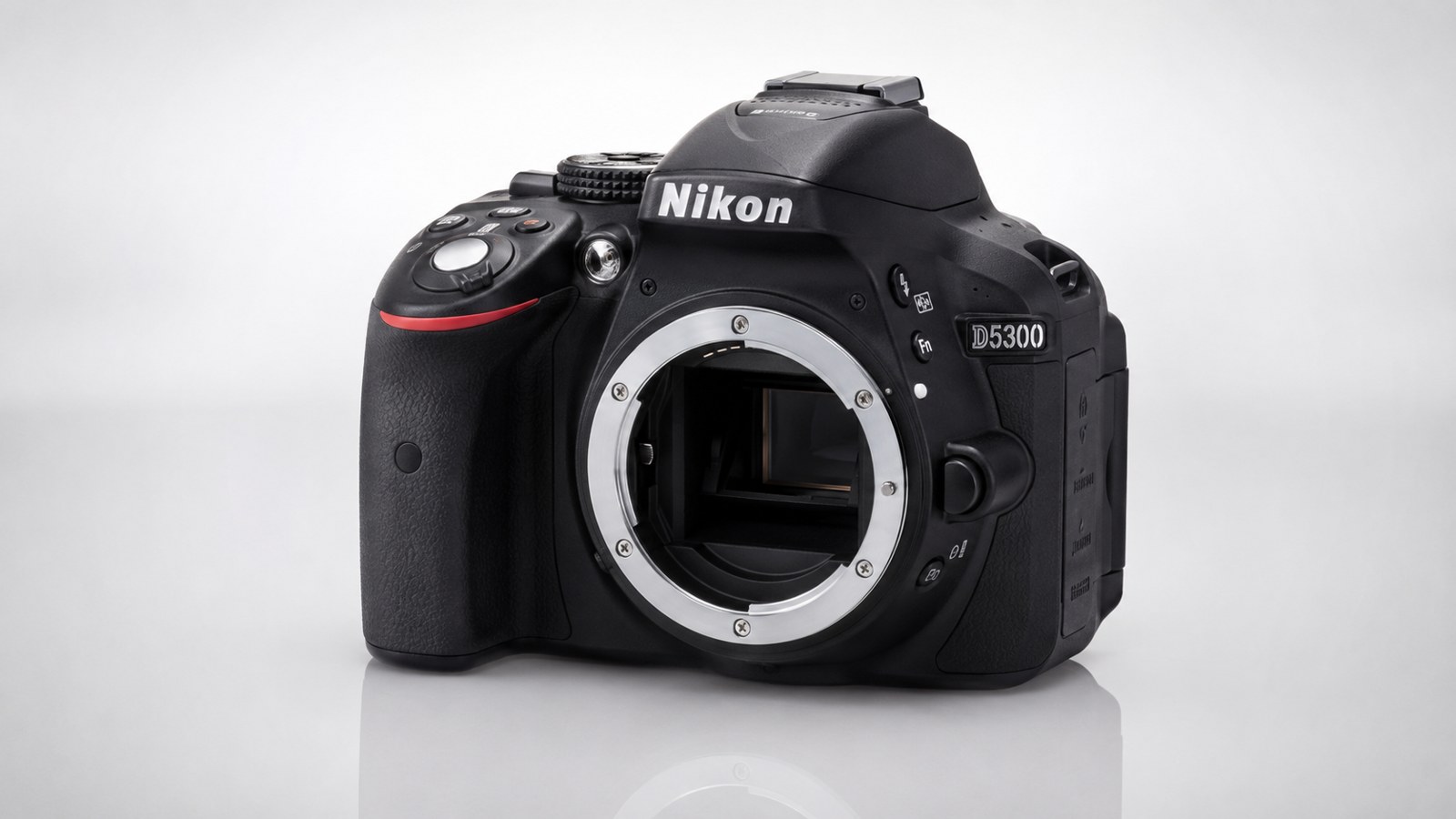
In short
- A used Nikon D5300 in good condition is worth between 220 and 320 euros today with the 18-55 lens, depending on shutter count and condition.
- 24-megapixel APS-C sensor without anti-aliasing filter: same sensor as the D3300, but with an articulating screen and GPS.
- Actual weak points: peeling rubber grips, screen with mechanical play; below 30,000 shutter count, the shutter is reliable.
- If you don't need the articulating screen and GPS, a Nikon D3300 at 220 euros does almost the same job for less money.
The Nikon D5300 is one of those models we see constantly on our bench: people entering the DSLR world, parents looking for something serious for their kids' photos, and students in their first photography course. It dates back to 2013, but the 24-megapixel APS-C sensor it features is still more than sufficient for beginners today, and it costs little on the used market. The challenge is figuring out how little is actually fair, and what distinguishes a healthy unit from a tired one.
In this article, I tell you what to check before buying one, what it should really cost in 2026, and which typical defects of this model we find in our hands when it arrives at the workshop. I also tell you when it makes no sense to buy it, because sometimes an older or simpler model solves the same problem by spending less.
Why the Nikon D5300 is still a good DSLR to start with
In 2026, a D5300 still does almost everything needed for those learning: clean raw, direct controls, and an F-mount lens lineup covering thirty years of production. It is not a modern camera, but its sensor holds its own against many current APS-C models. The reason we still recommend it at the counter is simple: spend 250-300 euros and you get more resolution than you will truly use in the first two years.
The 24-megapixel sensor without anti-aliasing filter
The D5300 features a 24.2-megapixel APS-C sensor, producing files of 6000×4000 pixels. The key difference compared to many entry-level models is the absence of an anti-aliasing filter in front of the sensor.
That filter is designed to prevent moiré, i.e., the wavy patterns that appear on finely woven fabrics or regular surfaces. Removing it comes with a cost and a benefit:
- Real advantage: sharper edges and more perceived detail, especially in landscapes, architecture, and still life. With the same lens, the rendering is more incisive compared to an entry-level model in the same price range that still mounts an AA filter in front of the sensor.
- Theoretical cost: moiré risk. In everyday photography, you rarely encounter it — it happens on tight-striped jackets or mosquito nets, and it is corrected in a few seconds in raw.
Translated: in 99% of shutter counts you gain detail and pay nothing. However, the Nikon D3300 at 220 euros mounts the same 24MP sensor without AA filter and delivers the same detail in the files. You prefer the D5300 for the tilting screen, GPS, and more complete autofocus, not for image rendering.
What NOT to expect: video, burst autofocus, extreme low light
Honesty is key here, otherwise you're buying it for the wrong reasons. The D5300 features a 39-point autofocus system that works perfectly for portraits, travel, still life, and subjects that aren't moving fast. It is not a sports camera body: it struggles with your son's soccer games or birds in flight, and the 5 fps burst mode fills up quickly.
The video records 1080p at up to 60 frames per second, but continuous autofocus during recording is slow and unreliable: to shoot consistently, you must focus manually. In low-light conditions, the sensor performs well up to ISO 3200; beyond that, image quality degrades. If you are looking for high-speed burst shooting and modern video capabilities, this is not the right camera body, and in the following sections we will see when it makes sense to spend your budget elsewhere.
How much does a used Nikon D5300 cost in 2026
Today, a used Nikon D5300 in excellent condition with an 18-55mm lens ranges from 220 to 320 euros. The spread may seem wide, but it is entirely explained by three variables: the shutter count, the presence of the lens, and the condition of the original accessories. Below 220 euros, you will find heavily used bodies or those without a box; above 320 euros, you are paying for a like-new example with a low shutter count and the full set of accessories.
Body only, body + 18-55, full kit: the three tiers
To help you navigate the used market, here are the typical configurations and what to expect from each.
| Configuration | Price range | What's included |
|---|---|---|
| Body only | 180-240 € | Camera body, battery, charger. No lens. |
| Body + 18-55 VR | 220-320 € | The best-selling configuration, ready to use. |
| Complete kit | 300-380 € | 18-55 + box, strap, second battery or bag. |
What makes the price fluctuate: shutter count, rubber seals, original accessories
The most critical factor is the shutter count. Below 30,000, the shutter is in good shape and the camera body commands a premium price; above 80,000, the price drops, even though the D5300 can easily handle much more. Peeling rubber grips and minor mechanical play in the tilting screen do not affect usability but reduce the value by 20-30 euros. The box and the second original battery are worth more than they might seem on the used market.
To gauge whether a price is in line with the market, keep in mind the reference points for the entry-level Nikon camera bodies we have in our catalog:
- Nikon D3300 at €220: same 24MP sensor, no tilting screen or GPS. If you don't need those two features, spend less for the same image quality.
- Nikon D5100 at €200: 16MP sensor from a previous generation, but already with a tilting screen.
- Nikon D3100 at €150: the entry-level option, 14MP, for those who want to start with minimal spending.
The same reasoning regarding shutter count and condition applies to any DSLR: if you want to see how an estimate is built, read how we assess the average price of a used Nikon, where we explain the method on the professional D850 body.
Used Nikon D5300: indicative price ranges in 2026
| Configuration | Condition | Indicative shutter count | Indicative price |
|---|---|---|---|
| Body only | Good | under 30,000 | 180 - 230 euros |
| Body + 18-55 VR | Good | under 30,000 | 240 - 300 euros |
| Body + 18-55 VR | Like new | under 10,000 | 300 - 340 euros |
| Kit with signs of use | Fair | over 50,000 | 150 - 200 euros |
What to check before buying a used D5300
The D5300 is a robust camera, but three things make the difference between a good purchase and a regret: the shutter count, the sensor condition, and typical body defects. These are checks we perform routinely at the counter, and you can do them yourself, in-store or during a test, in just a few minutes.
Shutter count: where to find it and what counts as high
Every JPEG or RAW file coming out of the D5300 has the number of times the shutter has operated written in its EXIF metadata. There is no need to disassemble anything: just take a photo and read the data with a site like camerashuttercount.com or with an EXIF reading program. If the seller does not show it to you, ask for it before negotiating.
The D5300 shutter is rated for approximately 100,000 certified shutter counts, but this is a statistical average, not an expiration date. Here is how to interpret these thresholds in practice:
- Under 30,000 shutter count: a reliable camera, it still has plenty of life ahead.
- Between 30,000 and 60,000: normal usage, no cause for alarm if the rest is in order.
- Over 80,000: it is not broken, but price it accordingly. A shutter near its rated life can fail without warning.
Sensor, shutter and mirror: quick bench tests
The 24-megapixel sensor without an anti-aliasing filter is precise, but dust and oil spots are immediately visible against a clear sky. Run this five-minute test:
- Mount a lens and stop down the aperture to f/16 or f/22.
- Take a shot of a uniform white background (a sheet of paper, a wall) slightly out of focus.
- Open the photo at 100% and look for dark spots or recurring halos.
A few specks can be cleaned; fixed and oily spots indicate that the sensor needs servicing. Then listen to the shutter: it must have a crisp and regular action. A mirror that remains raised or a dull noise are signs not to be ignored.
Typical defects of the model: rubber seals and articulating screen
On this camera body, we always see the same two weak points. The first is the rubber coating on the grip, which peels off at the edges over time: it is a cosmetic issue that can be re-glued, but it signals a heavily used camera. The second is the hinge of the articulating screen: move it on all axes and check for excessive play or creaking. A loose panel is a genuine mechanical defect, not a minor detail.
For a general checklist applicable to any digital camera body, also check out our list of 12 checks when buying a used mirrorless: many points apply equally to a DSLR like the D5300.
D5300 vs D3300, D5100 and D90: which one to choose
The D5300 is not the only sensible Nikon DSLR under 300 euros. Our catalog features three alternatives that solve the same problem — learning to photograph with a reliable body — for less. The difference lies in what you are willing to compromise on.
D5300 vs D3300: you pay for the tilting screen and GPS
They are twin machines in terms of sensor: both feature 24-megapixel APS-C sensors without an anti-aliasing filter, the same F mount, and identical image quality in the files. The Nikon D3300 at 220 euros delivers the exact same detail as the D5300. The difference lies entirely in the camera body.
What you get with the D5300 compared to the D3300:
- Tilt screen: useful for low-angle, high-angle shots, or video. On the D3300, it is fixed.
- Built-in GPS: geolocates the shutter count. Handy when traveling, useless for most people.
- Slightly larger viewfinder and more AF points: 39 vs 11. Noticeable when tracking a moving subject.
The practical truth: if you shoot landscapes, portraits, and everyday life through the viewfinder, the D3300 saves you money without compromising anything essential. The tilting screen is justified if you shoot video or frequently take shots at awkward angles.
D5100 and D90: the most affordable options and their trade-offs
We step down a generation here. The Nikon D5100 at 200 euros features a 16-megapixel sensor: smaller files, excellent performance up to ISO 3200, but less cropping headroom compared to the 24MP of the D5300. It still has a tilting screen, making it a solid compromise for those looking to spend less.
The Nikon D90, still at 200 euros, is an older camera body but with a more "serious" grip: dual command dials and a top display, like on high-end DSLRs. In return, it has 12 megapixels and a dated autofocus in live view.
| Model | Price | Sensor | Key Strength |
|---|---|---|---|
| D3300 | 220 € | 24MP | Same quality as D5300, lower cost |
| D5100 | 200 € | 16MP | Affordable tilting screen |
| D90 | 200 € | 12MP | Ergonomics of a higher-end body |
For those starting out today who want headroom for prints and crops, the D5300 or the D3300 remain the most forward-thinking choice. The D5100 and D90 make sense if your budget is tight or if you are looking for a second body.
D5300 and Nikon alternatives compared
| Model | Megapixels | Screen | Key Strength | Typical Used Price |
|---|---|---|---|---|
| Nikon D5300 | 24 | Articulating + GPS | Articulating screen, GPS, no AA filter | 220 - 320 euros |
| Nikon D3300 | 24 | Fixed | Same sensor, lower cost | approx. 220 euros |
| Nikon D5100 | 16 | Articulating | Good low light performance, affordable | approx. 200 euros |
| Nikon D90 | 12 | Fixed | Robust body, AF motor | approx. 200 euros |
Nikon or Canon to get started: how not to get stuck on the choice
The Nikon vs. Canon dilemma stops more beginners than the number of shutter counts they achieve in their first month. The practical truth is less dramatic: at the entry level, the difference between a Nikon DSLR and a Canon DSLR of the same tier is noticeable only to those with twenty years of experience, not to those learning manual exposure. On JPEG files at low ISO in good light, photos from a D5300 and a Canon 600D are difficult to distinguish in a blind test.
The lens and the body ecosystem matter more
The body is the part that ages first and matters least. A good lens stays with you for two or three cameras, improves every shutter count, and holds its value over time. A 35mm f/1.8 on a D5300 takes better photos than an 18-55 kit lens mounted on a more expensive body.
Before choosing a brand, check what you already have at home:
- Already own lenses for a system? Stick with it. A Nikkor DX zoom or a Canon EF-S lens you inherit is worth more than any paper comparison.
- Starting from scratch? Choose based on the camera body that convinces you and the price, not the logo. Both used lens parks are deep and affordable.
- Planning to switch to mirrorless in two years? Know that you will eventually move to a different mount. In that case, the DSLR body matters even less.
Equivalent Canon entry-level models in our catalog
If you're still undecided after seeing the D5300, these are the comparable Canon camera bodies we keep in stock, fully serviced and with a 2-year warranty. They are the honest alternatives for those starting from scratch.
- Canon 1100D at 160 euros: 12-megapixel sensor, the most affordable option. It does its job for learning, but it is a step below the D5300 in detail and screen quality.
- Canon 1300D at 190 euros: 18 megapixels and built-in Wi-Fi, the direct Canon equivalent of a D3300.
- Canon 600D at 200 euros: features a tilting screen like the D5300 and handles video well. It is the Canon that most closely resembles it in use.
The practical advice remains this: the D5300 at 24 megapixels without an AA filter renders more detail than all three. But if your budget is 160 euros, a Canon 1100D that works today is worth more than a D5300 you buy in six months.
Which lenses to pair with the D5300
The D5300 is only as good as the lens you put in front of it. The camera body captures 24 megapixels without an anti-aliasing filter, but if there is mediocre glass in front, you will never see that detail. There is also a technical constraint to be aware of: the D5300 does not have an internal focus motor, so it only autofocuses with AF-S or AF-P lenses (motor in the barrel). Older screw-drive AF-D lenses remain manual focus only.
The 18-55 kit lens: how far it goes
The kit lens, the Nikkor 18-55mm f/3.5-5.6 VR, is better than its reputation suggests. It is sharp in the center even at f/5.6, the VR stabilizer gives you two or three stops in static situations, and it covers the most used range: landscape at 18mm, environmental portrait at 55mm.
The limitations are real and must be stated:
- Variable aperture: at 55mm you start at f/5.6, resulting in low light performance and limited bokeh.
- Struggles in the dark: indoors without flash, you'll be forced to use high ISOs or slow shutter speeds.
- Plastic build: the plastic mount handles normal use but won't withstand impacts.
It’s perfect for learning how to compose and read the light. But when you want to separate the subject from the background or shoot in the evening, you’ll hit a wall.
The first lens to add: the 35mm f/1.8 DX
If you add just one lens to the D5300, make it the Nikkor AF-S DX 35mm f/1.8G. Used, it costs between 120 and 150 euros, features the AF-S motor for reliable autofocus, and on a DX sensor delivers a field of view close to a 50mm on full frame: the most natural focal length there is.
What actually changes compared to the kit:
| Aspect | 18-55 at 35mm | 35mm f/1.8 |
|---|---|---|
| Maximum aperture | approx. f/4.5 | f/1.8 |
| Light gathering | reference | approx. 6 times more |
| Background blur | barely noticeable | soft and clean |
With f/1.8, you can shoot handheld in the evening, isolate portraits from the background, and keep ISOs low. This is the step that makes you say, "Now I understand why people get so passionate." What to avoid at this stage: superzooms like the 18-200 or 18-300, which are convenient but soft at the extremes, and cheap third-party prime lenses without a motor, which will not autofocus on the D5300.
When the D5300 is not the right choice
The D5300 is a good DSLR for learning, but it is not the answer to everything. There are uses where it will let you down, and others where you would pay for features you do not need. Better to know before spending 300 euros, not after.
If you need serious video or autofocus for sports
In the video, the D5300 shows its age. It records in Full HD 1080p at 60 fps, but it lacks 4K, has no headphone output, and focuses slowly in Live View with a visible "pumping" effect. It is suitable for a few family clips. For a YouTube channel or professional video work, no: any recent entry-level mirrorless camera provides reliable continuous autofocus and 4K.
For fast action, the limit is the 39-point autofocus, designed for predictable subjects. Here is where the D5300 struggles:
- Sports and running children: continuous shooting loses focus frames during tracking.
- Birds in flight photography: 5 fps and limited tracking are not sufficient.
- Low-light reportage: above 6400 ISO, noise becomes significant.
If your primary use case is one of these three, the D5300 is not a good investment: look for a camera body with a more aggressive autofocus system, even if it means spending more.
The growth path: when to consider an upgrade
Many stick with the D5300 for years, and that’s perfectly fine: as long as the camera does what you need, upgrading is just an expense. An upgrade makes sense when you start to feel a concrete and recurring limitation, not just because you want a new camera body.
The typical signal is the dual requirement: full frame for performance in difficult light plus autofocus from a serious body. This is the moment to look at something like the Nikon D780, which combines a DSLR optical viewfinder with modern 4K video. If you are at that stage, we discussed it openly in this comparison between used and new D780, with the numbers to back it up.
The beauty of the Nikon F mount is that the lenses you buy today for the D5300 remain valid on your next camera body. Growth is gradual and without wasting anything: start with what you need now, and change bodies only when you truly feel the limit.
What we do at the lab before selling a used DSLR
A D5300 that enters our shop doesn't hit the shelf the next day. It first goes through our workshop, where we dismantle the most widespread prejudice about used gear: that it's a black box you just have to trust. On a camera body that has already worked for another photographer, the shutter count and the condition of the shutter mechanism count as much as the aesthetics, often even more.
We read the shutter count from the EXIF data using dedicated software, not by guesswork. On a D5300 with under 30,000 shutter count, the shutter is still in its early life, and we state this in writing on the data sheet. If a camera body reaches 60,000 or 80,000 shutter count, we don't hide it: the price changes, not the transparency. We prefer to lose twenty euros on the price tag than to sell you a camera described better than it actually is.
Here is what we check on every camera body, including the D5300:
- Certified shutter count: read from the EXIF and written on the product sheet, so you know where you stand.
- Sensor cleaning: inspection with raking light and wet cleaning when necessary. On an APS-C DSLR, dust is immediately visible at closed apertures (f/11, f/16), so we start with a clean sensor.
- Shutter test: bursts at various speeds to check if the curtains operate smoothly, without hesitations or abnormal noises.
- Articulating screen: on the D5300, this is a known weak point, so we check the mechanical play of the hinge and the integrity of the flat cable.
- Rubber and coatings: we verify that they are not peeling off, a typical defect of this model after a few years.
- Mount and contacts: bayonet with no play and clean electrical contacts, because that is where the communication with the lens takes place.
We provide a 2-year warranty on all used equipment. It is not a marketing badge: it is the reason our inspection process is rigorous. If I sell you a camera that breaks down within six months, that camera comes back to me and I lose twice as much. Our interest in checking it thoroughly aligns with your interest in buying with peace of mind.
It's the difference between a D5300 bought from a private seller without any guarantees and one that has passed through our bench: you pay a little more, but you know exactly what you're bringing home and you have a 2-year warranty network at your feet.
Frequently asked questions
How much does a used Nikon D5300 cost in 2026?
In excellent condition and with the 18-55mm lens, a used Nikon D5300 is worth between 240 and 300 euros. The camera body alone drops to 180-230 euros. Units with over 50,000 shutter count or several signs of use fall below 200 euros.
How many shutter count can the shutter of a D5300 handle?
The declared nominal lifespan is approximately 100,000 shutter counts, but many units go well beyond that. Below 30,000 shutter counts, the camera is effectively young. It is still the first piece of data to check before buying.
Which is better, the used Nikon D5300 or the D3300?
They feature the same 24-megapixel sensor and produce nearly identical files. The D5300 adds a tilting screen, GPS, and Wi-Fi. If you don't need these features, the D3300 does the same job for less.
Is the Nikon D5300 suitable for video?
Records in Full HD at up to 60 frames per second with good quality, but the video autofocus is not reliable for moving subjects. It is fine for occasional use, but for serious video work, it is advisable to look elsewhere.
What is the first lens to buy after the 18-55mm kit?
The Nikon 35mm f/1.8 DX. It is affordable even used, opens up a lot of light, and delivers a bokeh that the 18-55 cannot. It is the most sensible quality upgrade for this body.
What are the typical defects of a used Nikon D5300?
The most common issues are the rubber coating pieces that tend to peel off and possible mechanical play in the hinge of the articulating screen. Neither affects the shutter count, but both impact the value.
Is it still worth buying a DSLR in 2026 instead of a mirrorless?
To start out and spend little, yes. A used D5300 gives you a serious APS-C sensor at one-third the price of a new mirrorless. Mirrorless makes sense when you grow and need more modern video or autofocus.
Looking for a Nikon D5300 or another DSLR to get started?
If you have doubts about a purchase or need advice for your specific case, contact us. We offer free advice because we are photographers first, and because a customer who makes a poor purchase does not return to photography.
Three ways to get in touch:
- Contact form — response within 24 business hours
- WhatsApp at 342 362 3454 (messages only)
- Phone: 071 291 6347 (Mon-Fri 9-13/15-18, Sat 9-13)
If you want to see what's currently in our catalog, explore the available used gear today: every camera is certified, comes with a 2-year warranty, and ships within 24-48 hours.
Article written by Matteo for the ReflexMania Team. Last updated: July 2026. Prices and availability as of the date of publication.