
In short
- On a mirrorless, the most important factor is not aesthetics but the shutter count: under 30,000 you are safe, over 150,000 it is a case-by-case evaluation.
- The exposed sensor is the weak point: dust, scratches, and fungus are not visible in the seller's photos but ruin every shutter count.
- Battery and electronic shutter must be tested: a battery at 2,000 cycles holds 200 shutter counts instead of 400, and the mechanical shutter has a finite lifespan.
- Every used mirrorless we sell undergoes 12 laboratory checks and comes with a 2-year warranty: this is the difference between a certified purchase and a gamble between private parties.
Over the last ten years, I have opened, tested, and serviced thousands of cameras. I recognize mirrorless bodies by touch: I know where to look, what to listen for when pressing the shutter button, which models hide pitfalls, and which age well. Most issues on a used camera are not visible in the listing photo, nor even after turning it on for two minutes from the seller.
This article is the checklist we actually use at the counter, reduced to 12 concrete points. It’s not theory: it’s what you check before pulling out your money, whether you’re buying from a private seller or evaluating a store. By the end, you’ll know how to distinguish a healthy used camera from one that will give you problems in six months.
Before you touch it: what to ask and what to bring
Buying used gear is decided over the phone, not in person. When you meet the seller with the camera already in hand, you are in the worst possible state of mind to say no: you have invested time, perhaps driven for miles, and you tend to overlook issues. The right questions must be asked beforehand, when walking away costs only a message.
This section sets the mindset. We cover the 12 technical checks later, but without the proper preparation, you risk performing them incorrectly or being unable to perform them at all.
The right questions to ask the seller before the meeting
Five questions filter out 80% of problematic cameras before you leave your house:
- What is the shutter count? If the seller cannot answer or says "a few", that is a red flag. On a mirrorless camera, this data is readable from the metadata: anyone who knows the camera is aware of this. Below 30,000 you are safe; above 150,000, evaluate case by case.
- Why are you selling it? "Moving to full frame" or "I have two identical bodies" are reasonable answers. "I had a problem but it works now" warrants further investigation.
- How have you used it? Studio photography and professional 4K video consume the camera differently. Heavy use for recording generates more heat and ages the sensor faster.
- Have there been any repairs? A replaced shutter is not a defect, but it changes the actual shutter count. You need to know this.
- Do you have a receipt or invoice? It is required for the remaining warranty and, simply put, to rule out that the camera is stolen.
If you want a broader overview of how to think before purchasing, we discussed it in how to choose your first used mirrorless.
What to bring for an on-site test
Showing up empty-handed means trusting the seller's shutter count and battery. Don't do it. Bring your own gear so you can verify variables they can't falsify.
- A fast, empty SD card, to test burst writing and slots without relying on yours.
- A lens you know well: if autofocus lags with a lens you know is perfect, the problem is the camera body.
- Your charged battery, if compatible, to isolate the health of the accumulator from the rest.
- A microfiber cloth, to clean and then inspect the display and viewfinder.
Lighting matters too. To inspect the sensor, you need a uniform, bright background and a light source: a shutter count at f/16 aimed at a white wall will reveal dust and scratches that are invisible in dim light. Look for a well-lit environment, not a dark parking lot.
Checks 1-4: shutter count, shutter mechanism and mechanical wear
The aesthetics of a mirrorless body can be deceiving. A glossy, scratch-free camera may have 180,000 shutter count behind it, while one with several signs of use has only 8,000. The data that matters is the shutter count, and it is the first thing we check when a camera arrives on our bench.
1. Shutter count: how to read it and what it really means
The shutter count is derived from the EXIF metadata of the last file captured. On Sony and Canon, a dedicated tool is required because the data is not exposed in the JPEG: for Canon, we use software such as EOSInfo or ShutterCount; for Sony, tools that read the value via USB. On Nikon, the count is often readable directly in the EXIF fields using a viewer like ExifTool.
The thresholds we use as a practical reference:
| Shutter count | Reading |
|---|---|
| Under 30,000 | Young camera, no concerns |
| 30,000–100,000 | Normal use, evaluate the price |
| 100,000–150,000 | Check case by case |
| Over 150,000 | Shutter potentially at end of life |
The myth to dispel is that a low shutter count is always better. A camera sitting in a drawer for five years has different issues: dried lubricants, stiff seals, and a battery degraded from disuse. A Canon EOS RP at 600 euros with a certified shutter count of 15,000, used regularly, is worth more than one with 2,000 shutter counts forgotten in a closet.
2. The mechanical shutter: lifespan and sound
Manufacturers declare lifespans: 150,000–200,000 on entry-level models, 300,000 and above on pro bodies. These are statistical estimates, not warranties. Some shutters fail at 80,000, while others exceed the stated limit without a hint of trouble. Your ear helps: the shutter count must be crisp and regular. Double clicks, delays, or irregular metallic sounds indicate wear in the spring or the first curtain.
3-4. Electronic shutter and curtain: practical tests
The electronic shutter reduces mechanical wear but introduces its own limitations. Shoot a fast-moving subject: if vertical lines tilt, it's rolling shutter, common on many sensors but something to be aware of. Photograph under LED or fluorescent lights: dark horizontal bands (banding) are inherent to the electronic shutter, not a defect of the camera body.
The Sony A7 Mark II at 550 euros is an excellent choice for those entering the full-frame world. We always test both shutters before listing it in our catalog. Every mirrorless camera we sell undergoes our 12-point laboratory inspection: the shutter count is the first check, but it is only the beginning.
Shutter count thresholds by mirrorless category
| Category | Safe shutter count | To be assessed | Typical shutter life |
|---|---|---|---|
| Entry-level (Sony A6000, Canon R100) | < 20.000 | 40.000-80.000 | ~100.000-150.000 |
| Mid-range (Sony A6400, Nikon Z50) | < 30.000 | 60.000-120.000 | ~150.000-200.000 |
| Full-frame (Canon RP, Sony A7 II) | < 40.000 | 80.000-150.000 | ~200.000 |
| Pro/video (Panasonic GH5, Fujifilm X-T2) | < 50.000 | 100.000-200.000 | ~200.000-300.000 |
Checks 5-7: the sensor, the most delicate point
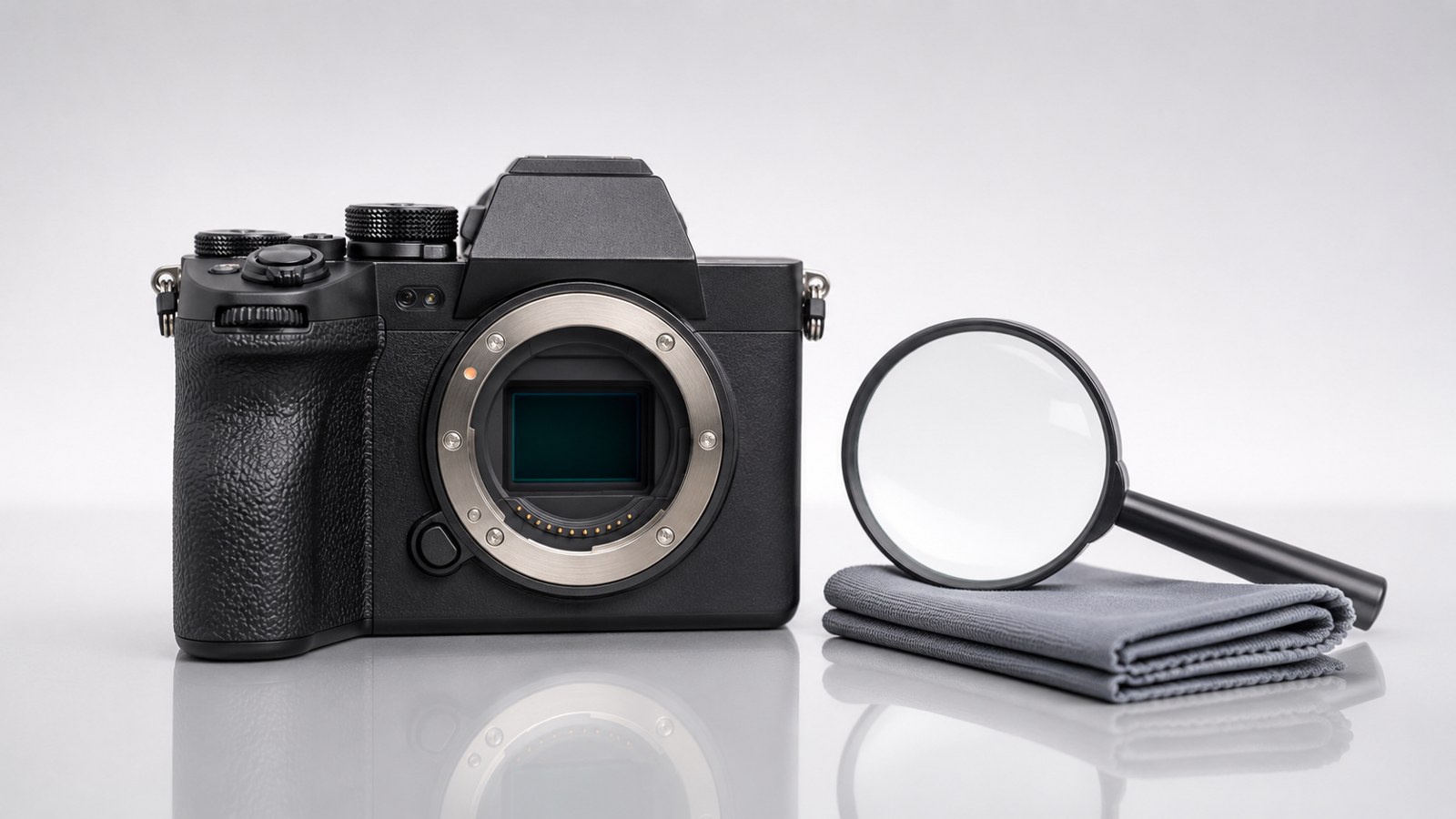
On a DSLR, the sensor sits behind the mirror: you only see it when you take a shutter count. On a mirrorless, it is exposed every time you change the lens. This changes everything. Dust, scratches, and fungus do not appear in the seller's photos, but they ruin every single shutter count you will take afterwards. These three checks are worth more than the aesthetics of the camera body.
5. Dust and spots on the sensor: the f/16 sky test
Frame a bright, uniform surface — the sky, a white wall, a sheet of paper — and stop down to f/16 or f/22. Take a shot, then zoom in to 100% on the screen. At such small apertures, every speck of dust becomes a well-defined dark spot. This is the fastest and most reliable test available.
The good news: dust can be removed. A professional wet cleaning service costs little and eliminates the issue. Do not use a dust spot as an excuse to reject a good camera body, but use it to negotiate the price if the seller has never had it cleaned.
6. Scratches, fungus, and permanent damage
This is where the substance changes. A scratch on the sensor's protective glass or the low-pass filter cannot be cleaned: it remains permanently, visible in every shutter count. Fungus is worse. It originates from humidity and storage in enclosed environments, has a branching shape, and expands over time. A diffuse, hazy halo, finally, often indicates a failed cleaning attempt using incorrect products.
- Dust: round, distinct spots, removable, no impact on value.
- Scratch: distinct line always in the same position, permanent, reduces value.
- Fungus: branching structure that grows, permanent, to be avoided.
A Sony A7r at 700 euros, with its 36 megapixels, reveals any sensor flaw without mercy: on such a high-resolution machine, a scratch becomes immediately evident. It is worth checking it carefully.
7. Hot pixels and dead pixels
Put the cap on, set a low ISO, and take a long exposure of 15-30 seconds. Zoom in: hot pixels appear as fixed colored dots, always in the same position. Most are mappable via firmware — many bodies, including the Fujifilm X-T2 at 550 euros, have a pixel mapping function in the menu that neutralizes them in seconds. True dead pixels, which are always black, are rarer and not always correctable. In our lab, we perform routine mapping and flag any unrecoverable residual pixels.
Sensor issues: removable or permanent?
| Defect | Fixable? | Impact on value |
|---|---|---|
| Dust on sensor | Yes, lab cleaning | None, manageable |
| Single hot pixels | Often, firmware remapping | Low |
| Scratch on sensor glass | No | High, reject or heavy discount |
| Fungus / moisture haze | No (or costly replacement) | High, not recommended |
8-9 Checks: viewfinder, display and articulating screen
The EVF and rear screen are the two interfaces you actually use to view the camera, and they are also two components that sellers rarely show in listing photos. A dead pixel in the viewfinder or a loose hinge won't appear in the spec sheet, but you'll spot them on the first shutter count. It takes five minutes and the right lighting to find them.
8. Electronic Viewfinder (EVF): resolution, contrast, proximity sensor
Point the camera at a uniform white wall, raise the ISO, and look through the viewfinder: dead pixels appear as fixed black dots, while stuck pixels show up as dots that are always lit. On an OLED with several million points, one or two defective pixels are tolerable, but a cluster of dead pixels is not.
Then check the automatic EVF/LCD switching. Bring your eye to the viewfinder: the proximity sensor must turn off the rear screen and turn on the viewfinder instantly. If the transition is uncertain or the screen remains on, the sensor is dirty or defective. Also ensure that the contrast is uniform and that there are no darker areas at the edges.
- Dead pixels: white wall + high ISO, look for fixed dots.
- Proximity sensor: move your eye closer and farther away, the switching must be immediate.
- Uniformity: no yellowed or darker areas at the edges.
9. Tilting and touch display: the failing hinge
The vari-angle display is the first point of failure on vlogging cameras, as it is opened and closed dozens of times a day. Open the screen, rotate it through all positions, and check for mechanical play: if it wobbles, creaks, or does not stay in the chosen angle, the hinge is worn. This is a defect that cannot be repaired cheaply.
For the touch, methodically tap the entire surface — corners included — while selecting the focus point. An unresponsive area is a symptom not to be underestimated. This check is doubly important on cameras designed for video, such as the Nikon Z30 at 450 euros, an excellent vlogging compact without a viewfinder but with a highly stressed articulating screen. On the Canon EOS R100 at 400 euros, an entry-level model with a fixed screen, the hinge is not an issue: fewer moving parts, fewer things to break.
Those coming to mirrorless from a compact DSLR will recognize the same wear patterns I discussed regarding the used Canon 80D, the vlogger's camera before mirrorless: the articulating screen is convenient, but it is also the first component to show signs of intensive use.
Checks 10-11: autofocus, stabilization, and battery
These two checks are performed only in the field, never by reading the technical specifications. The autofocus and stabilization of a mirrorless camera depend on electronics and actuators that wear out, and the battery is almost always the first component to fail on a camera of a certain age. These are the two areas where the seller, even in good faith, may not know what they are handing you.
10. Autofocus and stabilization: testing them in the field
Autofocus requires two concrete tests. Enable continuous Eye-AF and frame a person (or even a photo on a screen) moving back and forth: the focus box must lock onto the eye and stay there, without jumping at every half-step. Then test tracking on a subject crossing the frame. A healthy AF tracks fluidly, while a worn or misaligned one "pumps" as it searches for focus.
The IBIS situation is more nuanced, as the stated figures should be taken with a grain of salt. When Panasonic writes "5 stop," it refers to laboratory conditions: a stationary subject, a short focal length, and a cooperative photographer. In practice, two or three real stops are already an excellent result. The true test is done like this: standard focal length (50mm equivalent), a 1/10s shutter count at hand, and check at 100% on the screen if the photo is sharp.
A good test case is the Panasonic GH5, which we have for 470 euros: the IBIS Dual I.S. of this camera body is among the most effective of its generation, and it is precisely on such machines that it is worth verifying that the actuators have no play. If you hear a light clicking sound when you turn it off, it is normal: it is the stabilizer locking.
11. The battery: cycles, battery life, and authenticity
The battery of a mirrorless camera works harder than that of a DSLR, as it continuously powers the sensor and viewfinder. For this reason, real-world battery life is often half of the stated capacity and degrades quickly. Many camera bodies display the cycle count or health status in the menu (or via the manufacturer's software): always check it.
- Shutter count under 200: battery is practically healthy, no issues.
- Shutter count 200-500: reduced battery life, factor it in but it is manageable.
- Shutter count over 800: holds 200 shutter count instead of 400, needs replacement.
- Non-original compatible: risk of swelling. A swollen battery no longer fits in the compartment: discard it.
Always include a new original battery in your budget: depending on the model, it costs 50-80 euros and significantly changes the user experience. If the seller provides only one already tired battery, it is not a disaster, but it is a cost to deduct from the price.
Check 12: ports, connectors, firmware and accessories
The final check is the one almost nobody performs, and the one that costs you the most if you skip it. The doors and electrical contacts of a mirrorless camera oxidize, the SD slot wears out, and the mount develops play. These are issues you won't see in the seller's photos but that will halt your workflow at the first file transfer or the first lens change.
12. Connectors, SD slots and mount
Open the port door and inspect the USB-C, HDMI, and microphone jack contacts with a flashlight. Look for green oxidation or bent pins. Insert a known-good SD card and take a test shot: if the camera fails to read it or throws intermittent errors, the slot is faulty and replacement will cost you.
Mount and unmount the lens on the bayonet two or three times. It should click into place firmly, with no lateral play when the lens is attached. A slight shine on the gold contacts is normal; dark spots or deep scratches are not. Clean the lens contacts with a dry cloth before finalizing the purchase.
- Port contacts: no green oxidation, no bent pins.
- SD slot: reads and writes without errors, lock lever is secure.
- Mount: clean engagement, zero play, clean contacts.
Firmware, serial number and included accessories
Go to the menu and check the firmware version: it must be the manufacturer's official version and updatable from the website. A camera stuck on an old firmware often means fewer AF features compared to the updated model. A Nikon Z50 Mark II at 780 euros, for example, still receives updates that improve tracking: verify that the seller has not installed modified or regional firmware.
Note down the serial number and compare it with the one on the box and the certificate. A scratched or mismatched serial number is a theft red flag: during an inspection, the camera body may be seized. For accessories, here is what truly affects the price:
| Item | Price impact |
|---|---|
| Original battery + charge | High — an original one is worth 50-80 euros |
| Box, manuals, traceable serial number | Medium — useful for warranty and resale |
| Body and eyepiece caps | Low — convenient but replaceable for a few euros |
An Canon EOS R at 800 euros, complete with original box and battery, is worth 30-40 euros more than the body alone: you are paying for the peace of mind of a documented kit. If the box and accessories are missing, use them to negotiate, not as a reason to discard a healthy camera.
Private seller or certified store: what really changes
The difference between buying from a private seller and a certified store isn't the price: it's what happens when, two months later, the shutter starts making a strange noise. Between private parties, that problem is yours. With a certified camera, it's ours. On a mirrorless, where the sensor is exposed and electronics matter more than mechanics, this safety net weighs more than on an old DSLR.
What we do in our workshop before putting it up for sale
Every used mirrorless camera that enters our store is not displayed until it has passed the 12 checks described in this article. It is not a formality: it is the reason we can offer a 2-year warranty on a second-hand camera.
In short, before listing it for sale, we verify:
- Certified shutter count: read from EXIF data and stated on the card, not estimated by eye.
- Shutter and mechanical wear: mechanical and electronic, with noise and lag tests.
- Sensor: inspection for dust, scratches, fungus, and hot pixels, with professional cleaning.
- Viewfinder, display, and hinge: dead EVF pixels, proximity sensor, and articulating screen integrity.
- Autofocus, stabilization, and battery: eye-AF tests, IBIS where present, and real charge cycles.
- Ports, mount, firmware, and accessories: connectors, SD slots, and registered serial number for warranty and anti-theft.
The Canon EOS RP at 600 euros that you find in today's catalog has passed through this bench: certified shutter count, clean sensor, warranty included. The same applies to the Sony A7 Mark II at 550 euros, a full-frame camera with in-sensor stabilization that, at that price and certified, is hard to beat.
When buying from a private seller makes sense — and when it doesn't
To be honest: buying from a private seller makes sense. If you can read a shutter count, spot fungus on the sensor, and the price is significantly below market value, buying from a private individual is a rational choice. I would do the same.
Everything changes in two cases. If you are a beginner and lack the tools for the checks we described, you are taking a gamble: the warranty is worth the price difference. And if the camera is expensive, an out-of-warranty electronic failure can cost as much as half the body.
To help you navigate the models and current market prices, check out our ranking of the best used mirrorless cameras under 1000 euros: it provides a benchmark before you decide where to buy.
Frequently asked questions
How many shutter count are too many for a used mirrorless?
It depends on the category. On an entry-level model like the Sony A6000 or Canon R100, you are safe below 20,000 shutter count; above 80,000, you should start evaluating. A full-frame model like the Canon EOS RP or Sony A7 II holds up well up to 150,000. How it was used matters more than the raw number: 50,000 landscape shots cause less wear than 50,000 in sports burst mode.
How do I know the shutter count of a mirrorless camera?
The shutter count is often recorded in the EXIF data of the last photo and can be read using brand-specific tools. On Nikon and Pentax, it is almost always readable; on Canon and Sony, dedicated software or opening the file is required. We certify it for every camera body for sale, so you know the actual data and not the declared one.
Is dust on the sensor a serious problem?
No, dust is removed through professional lab cleaning and is normal on any used equipment. The real issue is scratches on the sensor glass and fungus from poor storage: those cannot be removed and ruin every shutter count. Always take a test shot at f/16 on a uniform surface to distinguish them.
Should I worry about the battery on a used mirrorless camera?
Yes, more so than on a DSLR. Mirrorless cameras consume a lot of power because they continuously power the sensor and viewfinder, and a battery with 2,000 cycles may give you 200 shutter count instead of 400. Check the cycles in the menu or with a tool, and budget 50-80 euros for a new original battery if needed.
Is it better to buy from a private seller or a shop?
Buying from a private seller can save you money if you are an expert and know how to perform these 12 checks, but you have no warranty if something fails after a week. From a certified store like ReflexMania, you pay a bit more but get a inspected camera body, certified shutter count, and a 2-year warranty. For expensive cameras or if you are a beginner, the difference is well worth it.
Are the declared '5 stops of stabilization' real?
They are laboratory values; in practice, they matter less. Five theoretical stops would allow you to shoot handheld at 1/4 second, but this depends on your technique, the lens, and the subject. Test the stabilization in the field by taking a shot at 1/10s: if it comes out sharp, the IBIS really works.
What do I check to be sure it hasn't been stolen?
Verify that the serial number on the camera body matches the one on the box and the receipt, and that it has not been tampered with or erased. Always ask for proof of purchase. An honest seller has no problem showing it; anyone who refuses is a red flag.
Looking for a used mirrorless camera that is already checked and guaranteed?
If you have doubts about a purchase or need advice for your specific case, contact us. We offer free advice because we are photographers first, sellers second, and because a customer who buys poorly stops shooting.
Three ways to get in touch:
- Contact form — response within 24 business hours
- WhatsApp at 342 362 3454 (messages only)
- Phone: 071 291 6347 (Mon-Fri 9-13/15-18, Sat 9-13)
If you want to see what we have in stock right away, explore the used equipment available today: every camera is certified, comes with a 2-year warranty, and is shipped within 24-48 hours.
Article written by Matteo for the ReflexMania Team. Last updated: June 2026. Prices and availability as of the time of publication.