
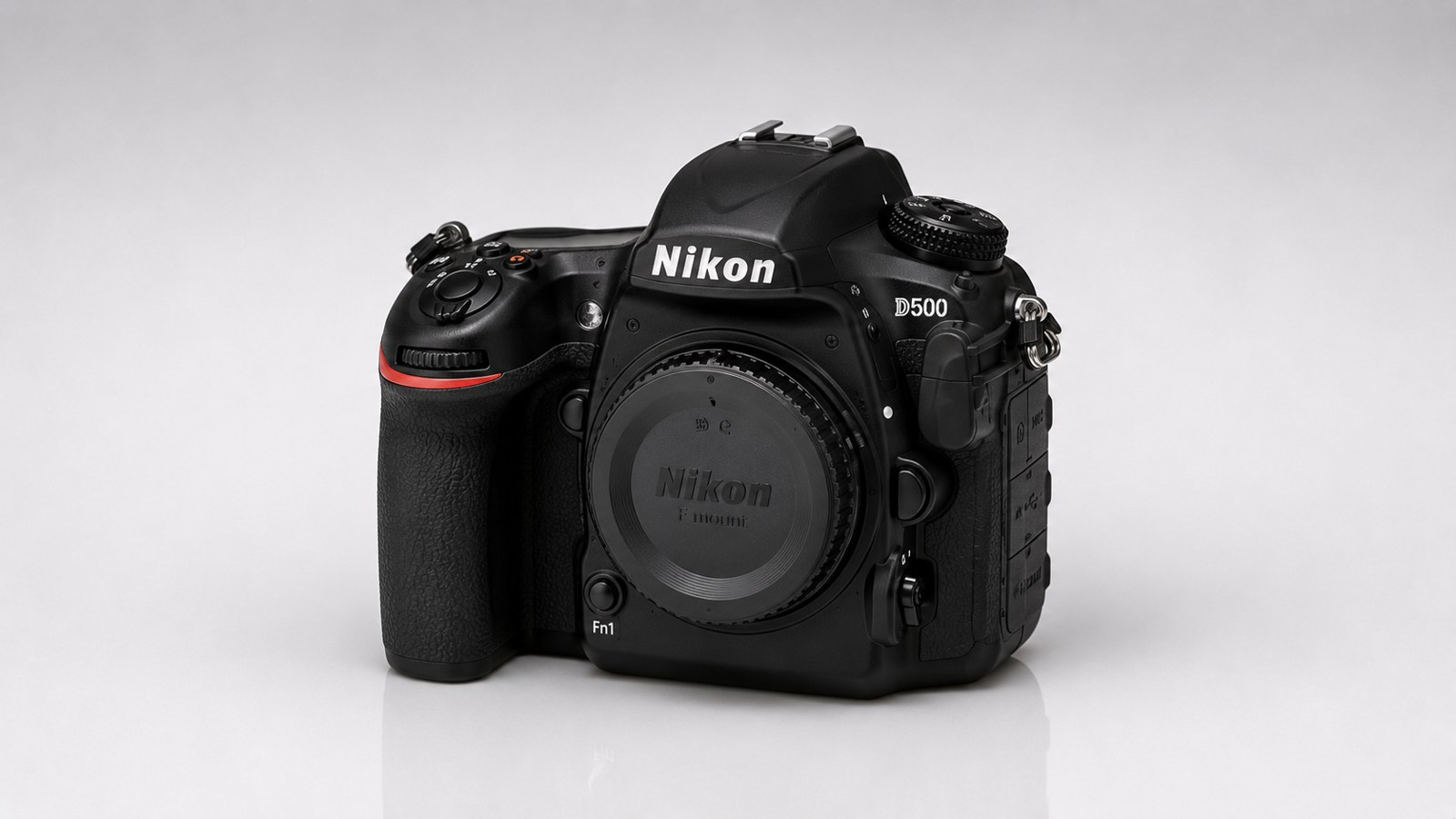
In summary
- The Nikon D500 features the 153-point Multi-CAM 20K AF system derived from the D5, a 10 fps burst rate, and a 200-RAW buffer: figures that remain competitive for sports and wildlife in 2026.
- The 1.5x crop factor turns a 300mm lens into a 450mm equivalent: for wildlife photography, this is a reach advantage that full-frame systems pay for with longer and more expensive lenses.
- The shutter is rated for 200,000 shutter count: on a used camera body, it is normal to find 40,000-80,000, so the actual certified shutter count must always be verified before purchase.
- Mirrorless alternatives like the Nikon Z50 II (€780), Sony a6600 (€800), or Sony A6400 (€650) offer modern eye-detection AF, but lack the buffer capacity and action-oriented ergonomics of the D500.
At the counter, the question comes up almost every week from those shooting soccer, athletics, or birds in flight: does the Nikon D500 still make sense in 2026, with the market now fully shifted to mirrorless? It is a DSLR released in 2016, yet it continues to appear on the wish lists of action shooters. Not out of nostalgia, but because it did one specific thing better than almost everything else: tracking fast subjects with a long burst rate and an autofocus system taken straight from the flagship D5.
In this article, I look at the D500 from the perspective of someone who resells and services it: what it still does well, where mirrorless has surpassed it, what to check on a used unit, and which concrete alternatives we have in stock today. The goal is not to sell you the D500 at all costs, but to tell you if it is the right camera for your way of shooting.
What made the Nikon D500 an action beast
In 2016, Nikon took the brain of its D5 flagship and put it into an APS-C body that cost a third of the price. That is the essence of the D500: top-tier sports performance in a more compact format, with the extra reach of the cropped sensor. Ten years later, the numbers still hold up at the counter.
Multi-CAM 20K autofocus with 153 points
The AF module is the same as the D5: 153 focus points, of which 99 are cross-type, with 15 points sensitive down to f/8. The frame coverage is extensive, nearly edge-to-edge horizontally, something that did not happen on a full frame with the same module.
In practice, this means you can place the AF point on an off-center subject without having to recompose. 3D tracking locks onto a bird in flight or a player cutting across the field and holds focus, even when they change direction. It is not the eye-detection found in today's mirrorless cameras — we cover that later — but for subjects moving in a predictable manner, it remains fast and reliable.
10 fps and 200 RAW buffer
The burst rate is 10 frames per second. However, the number to watch is the buffer: 200 shutter count in 14-bit RAW before the camera slows down. In 2026, this figure puts many mid-range APS-C mirrorless cameras at a disadvantage.
What 10 fps really means:
| Burst duration | Shutter count produced | Does the buffer hold? |
|---|---|---|
| 2 seconds | 20 RAW | Yes, comfortably |
| 10 seconds | 100 RAW | Yes |
| 20 seconds | 200 RAW | At the limit |
With a fast XQD card, the buffer clears while you continue shooting, so in practice you rarely saturate it. This changes the way you work: start a burst before the action and hold it for the entire sequence — the dive, the final sprint, the raptor's landing — without ever lifting your finger for fear of filling the memory. It is the difference between hoping for the right shot and bringing it home.
The 1.5x crop advantage for sports and wildlife
With the D500, a 300mm lens frames like a 450mm on full frame. It’s not a software trick: the 20.9-megapixel APS-C sensor crops the center of the lens’s circle of coverage, and that crop gives you reach. For those shooting birds, football, or motorsport, it’s the main reason an APS-C DSLR remains relevant in 2026.
300mm that become 450mm equivalent
The 1.5x crop factor multiplies the actual focal length of every lens mounted. It is the most cost-effective way to reach far distances without buying huge telephoto lenses. Here is what you mount on the D500 and how it frames compared to a full frame:
| Actual lens | Equivalent angle on D500 | Required on full frame for the same framing |
|---|---|---|
| 200mm | 300mm | a 300mm |
| 300mm | 450mm | a 450mm (effectively a 400-500mm) |
| 500mm | 750mm | a 500mm + extender or a 600mm |
The difference shows up in your wallet. A 300mm f/4 is lighter and costs a fraction of a 500mm f/4, yet on the D500 it covers the same field of view. For amateur wildlife photography, it is often the only way to reach the subject without spending as much as a used camera body.
Pixel density and post-crop
The 20.9 megapixels on an APS-C sensor provide a high pixel density: more detail on distant subjects at the same focal length, and more room to crop in post without dropping below useful dimensions for web or medium prints. On a bird filling half the frame, this margin makes the difference between a usable photo and one to be deleted.
The downside emerges at high ISO settings. Smaller, more densely packed pixels gather less light individually, so beyond 3200-6400 ISO, noise increases sooner than on a full-frame camera of the same generation. In bright sunlight, you won't notice; at sunset or under stadium floodlights, the full-frame sensor regains the advantage. The D500 performs well up to those limits, but don't expect miracles when the light fades: that's where the free reach of the crop factor comes at the cost of image cleanliness.
Where the 2026 outperformed the D500
The D500 still does everything it did in 2016, but in the meantime, mirrorless cameras have raised the bar in two specific areas: intelligent autofocus and video. No firmware update can change that; these are architectural limitations of the camera body. It is worth knowing about them before spending, as they can change the decision for certain uses.
Eye and subject detection AF
The 153-point Multi-CAM 20K system tracks a moving subject perfectly along the horizontal plane, but it doesn't know what it's looking at. You select the AF point, and it keeps focus on that specific area. A recent mirrorless camera recognizes a person's or animal's eye and locks onto it, maintaining focus even as the subject turns their head or moves across the frame.
The difference is noticeable in specific situations:
- Wide-aperture portraits: with an 85mm f/1.4, the depth of field is razor-thin; the eye-AF locks onto the eyelash where you might risk focusing on the cheekbone.
- Animals moving toward you: a running dog, an approaching bird. The D500 tracks the mass, the mirrorless locks the eye.
- Subject behind obstacles: branches, nets, crowds. Subject recognition re-acquires the target after obstruction.
For classic action wildlife, such as a bird in flight against a clear sky, the D500 still holds its own. It is in portraiture and close subjects that the lack of eye-detection truly makes a difference.
Video and live view: the weak points
If you film even occasionally, the D500 shows its age here. Three things to keep in mind:
- Pushed 4K Crop: 4K UHD uses an additional crop on the sensor, approximately 2.25x compared to full frame. Your wide-angle lens becomes a normal lens, and recovering a wide field of view in video is complicated.
- Slow AF in live view: without on-sensor phase detection autofocus, focus in live view and video hunts and pumps, far from the responsiveness of a mirrorless.
- No IBIS: no in-body image stabilization. Handheld video relies solely on the lens stabilizer, when available.
Add the optical viewfinder: you frame the actual scene, not the exposure preview. In a studio or with flash, it makes no difference, but for video, the monitor remains the only option, and without performant phase-detection autofocus, it is a compromise.
The D500 is a body designed for shooting action with the viewfinder at your eye. If your work involves serious video or moving portraits, these limitations matter more than any burst rate advantage.
What to check when buying a used D500
The D500 was built to be used heavily. Those who bought it shot sports, birds in flight, and motorcycles on the track: 10 fps bursts filled multiple times a day. This means that a used unit has almost always worked hard, and the checks must be calibrated for an action camera, not a weekend DSLR.
Shutter count and shutter life
Nikon rates the D500's shutter for 200,000 shutter count. This is a high figure, typical of semi-professional camera bodies, but on this model it should be read with attention: those who used it at 10 fps accumulated numbers quickly. On a used camera body, it is normal to find 40,000-80,000 shutter count. It is not a problem; it is half its lifespan or less.
The count is read from the EXIF data of a JPEG file taken at the time, using tools such as a metadata reader or an online service that extracts the "shutter count". Be wary of anyone who does not provide it to you.
- Under 50,000 shutter count: lightly used body by D500 standards, excellent remaining lifespan.
- 50,000-120,000 shutter count: normal, honest usage, still plenty of life left.
- Over 150,000 shutter count: close to the declared limit, must be priced significantly lower or only considered if the price is aggressive.
Pay attention to the AF-ON button as well: users of back-button focus press it thousands of times. A button that responds irregularly or feels "sunken" is a sign of intense action use.
XQD/SD cards and wear from intensive use
The D500 features dual slots: one XQD and one SD UHS-II. XQD cards are fast and essential for clearing the 200 RAW buffer, but they are expensive: a decent card starts at 60-80 euros. Check if the camera body is sold with the XQD included, as it is sometimes missing and needs to be budgeted for.
On a body that has seen field use, check these specific points:
- Rubber grips: often peel at the corners due to sweat and heat. Aesthetic issue, but indicates heavy use.
- Slot contacts: insert and remove a card; it must fit without play and be read immediately.
- Sensor: take a shot at f/16 against a white wall and look for dark dust spots; they are normal, but many indicate poor maintenance.
- Dials and joystick: the rear AF selector is the most stressed component; it must move in all directions without hesitation.
A D500 may have worked hard and still be perfect, or look new while hiding a tired shutter. The difference lies in the actual shutter count, not the camera body.
D500 vs today's used APS-C mirrorless
Those considering the switch from the D500 to an APS-C mirrorless are looking for two things: modern eye-AF and less weight around the neck after a day in the field. You get both, but you give up the 200-RAW buffer and pro-body ergonomics. Let’s see what really changes, body by body, on the models we keep in stock.
Nikon Z50 II and Z50: staying in the Nikon family
The Nikon Z50 Mark II at 780 euros is the most natural step up: eye-detection for people and animals, Expeed 7 processor derived from high-end bodies, and 4K video without the heavy crop of the D500. Compared to a DSLR, you gain exposure preview in the viewfinder and save about half a kilogram in your bag.
What you leave on the table, however, matters. The burst rate holds up well, but the buffer fills up sooner, and you don't get the action grip with dual dials and a dedicated joystick. The Nikon Z50 at 470 euros costs less, but the first generation lacks the advanced eye-AF of the Mark II: it's a good travel body, not one for the sidelines. For those who shoot video and vlogs, there's the Nikon Z30 at 450 euros, without a viewfinder: off-topic for sports, excellent for content.
Sony a6600, A6400 and A6100 for action
Sony plays the Real-time Tracking card, the AF that locks onto the subject and keeps tracking it even if it changes pose. The Sony a6600 at 800 euros adds the NP-FZ100 battery with all-day battery life and in-body stabilization, which the D500 lacks. The Sony A6400 at 650 euros features the same AF but a smaller battery; the Sony A6100 at 550 euros is the entry-level option, with a less refined viewfinder.
- Buffer: none of these can handle the 200 consecutive RAW shots of the D500.
- Telephoto lenses: the E-mount lineup for wildlife has grown but remains more expensive than used F-mount telephotos.
- Ergonomics: small camera bodies, less comfortable with a 300mm f/4 mounted for hours.
If the bug is the modern full frame, before spending read our in-depth guide on the used Canon EOS R6 Mark II: it helps you understand if the upgrade is worth the cost. For tighter budgets, finally, the Canon EOS R100 at 400 euros is an honest entry-level mirrorless, but don't expect sports-grade performance from it.
D500 vs. other used Nikon DSLRs
The D500 is not the only Nikon DSLR that still makes sense to buy used in 2026. The key is understanding what you are truly looking for: burst rate and buffer for action, or resolution and dynamic range for landscape and portrait. These are two different jobs, and the D500 excels at only one of them.
D500 or D7200: which Nikon APS-C
The used D7200 costs less and remains an honest all-rounder, but it doesn't play in the same league as the action. The gap lies in the engine, not the megapixels: both sit around 20-24 MP, but the D500 inherits the 153-point AF and a 200-RAW buffer that the D7200 doesn't even dream of.
| Feature | D500 | D7200 |
|---|---|---|
| AF Points | 153 (Multi-CAM 20K) | 51 (Multi-CAM 3500 II) |
| Burst Rate | 10 fps | 6 fps |
| RAW Buffer | ~200 shutter count | ~18 shutter count |
If you photograph running children, birds in flight, or team sports, that 200-shutter buffer changes your day: you keep shooting while the D7200 is already stuck writing to the card. But if your work is portrait, travel, street, and occasional wildlife, the D7200 gives you 90% of the result while saving several hundred euros. We discuss this in more depth in the article dedicated to the used Nikon D7200: for many, it is more camera than they need.
When to step up to the full-frame D850
The D850 is the other extreme. Its 45.7 MP full frame serves those who print large, crop heavily, or live off landscape and still life, where dynamic range and detail matter more than burst speed. It is not an action camera designed like the D500, although it holds up well.
The logic is simple: the D500 gives you reach and speed on a smaller sensor, while the D850 offers resolution and dynamic range on a large sensor. Buying a D850 to shoot night football is paying for shutter count you won't use; buying a D500 to print two-meter landscapes is giving up the detail you need. Choose the camera body based on the subject, not the longer spec sheet.
Who the D500 is for in 2026 (and who it isn't)
The D500 is not a camera for everyone, and that is fine. It was designed for a specific task — freezing action with a deep buffer and an AF system that does not let go — and it remains valid for that task even today. The problem arises when it is purchased for reasons other than those for which it was created.
The ideal profile for the D500
If you identify with this list, the used D500 is still one of the smartest choices on the market:
- Sports and wildlife photographers who shoot in long bursts and need a buffer that handles 200 RAW files without stuttering.
- Those who already own F-mount lenses, especially telephoto lenses like a 300mm f/4 or a 200-500mm, and want to take advantage of the 1.5x crop without having to buy everything again.
- Those who prefer the optical viewfinder: zero lag, zero perceived blackout, the real scene right in front of your eye when the bird takes off.
- Those who work in harsh conditions and want serious weather sealing and a body that weighs just right to balance a telephoto lens.
For this profile, spending 700-800 euros on a D500 with a low shutter count makes more sense than spending 1,500 euros on an equivalent mirrorless for action performance.
When to walk away
There are three situations where I would advise against the D500, even though we would be happy to sell it to you:
- If you shoot a lot of video. The 4K with additional crop and the lack of in-body image stabilization make it less suitable for video. A recent mirrorless camera will offer you much more.
- If you are starting from scratch without lenses. Building an F-mount kit today makes less sense than entering the Z system directly: all new Nikon lenses are aimed at that mount.
- If you want eye-AF on the subject. The D500 focuses very well, but it does not recognize the eye like a camera body from 2020 onwards does. For portrait and street photography, this difference is noticeable.
If your goal is image quality and resolution rather than burst speed, consider a full-frame body: the used Nikon D850 remains a more versatile DSLR for landscape, portrait, and large-format printing, while retaining excellent AF inherited from the same family as the D500.
In short: the D500 rewards those who know exactly why they want it. If your usage is mixed or video-oriented, mirrorless is the right path.
What we check at the ReflexMania workshop
A used D500 does not go on sale until it has passed the bench. In the previous section, you saw what to check yourself before buying: here I explain what we do, with the tool in hand and the camera body open, before putting it on the shelf with a 2-year warranty.
The shutter count is the first piece of data we extract, and we certify it in writing. We do not rely on the previous seller: we read the actual shutter value and record it on the product sheet. On a camera body listed with 200,000 shutter count, knowing whether you are looking at 45,000 or 130,000 cycles changes the price and changes how long it will last.
Next, the autofocus is tested. The 153-point Multi-CAM 20K module is the heart of this camera: if it fails to focus, the 200-RAW buffer is useless. We verify the calibration on the central and peripheral points, and check the AF-ON button, which on these camera bodies works the most and shows signs of wear first.
- Certified shutter count: actual shutter value, documented in the report, not estimated.
- Shutter test: 10 fps burst under supervision, verification of fast shutter speeds, no lag or sticking.
- AF test: accuracy across 153 points, calibration, AF-ON button and joystick check.
- Sensor cleaning: dust removal on the 20.9 MP APS-C sensor, with a control shot at closed aperture.
- Body inspection: rubber seals, XQD and SD slot retention, display, optical viewfinder, gaskets.
- Battery test: original EN-EL15 under real load, to estimate remaining effective battery life.
When needed, we replace the shutter. It is an intervention we perform in-house; we do not send it out. If a D500 arrives with 160,000 shutter count but it makes sense to restore it, we install a new unit and the counter resets. In that case, we state this clearly on the product page.
The difference between buying a D500 from a private seller and buying a refurbished one is all here: you know exactly what you have in your hands, you know the certified shutter count, and if anything fails within two years, we fix it. In the used action camera market, where camera bodies have often worked hard, this is not a formality: it is the difference between a deal and a gamble.
Frequently asked questions
Is the Nikon D500 still a good choice for sports in 2026?
Yes, if you already have F-mount lenses and prefer an optical viewfinder, long burst rates, and a deep buffer. The 153-point AF still tracks fast subjects well; it lacks the eye-detection of modern mirrorless cameras, but it remains very solid for traditional action.
How many shutter count does the D500 shutter last?
It is listed at 200,000 shutter count. On a used camera, it is common to find between 40,000 and 80,000. The actual count must always be verified: an action camera body can accumulate many in a short time, so the number matters more than the age.
Is the Nikon D500 better than an APS-C mirrorless like the Z50 II?
It depends on usage. The Z50 II offers eye-AF, better video, and less weight. The D500 wins on buffer, action ergonomics, and the affordable F-mount lens lineup. Those shooting long bursts of sports or wildlife often still prefer the D500.
Is the APS-C sensor of the D500 suitable for wildlife?
Yes, and it is one of its strengths. The 1.5x crop extends the reach: a 300mm lens performs like a 450mm equivalent, so you get more subject in the frame without buying huge and expensive telephoto lenses.
What memory cards does the Nikon D500 use?
It has dual slots: one XQD and one SD UHS-II. XQD cards are fast but more expensive and less common. Factor the cost of the cards into your budget, especially if you make use of the 10 fps burst mode.
Does the D500 record useful video?
It records in 4K UHD but with a significant additional crop and slow AF in live view. It is suitable for occasional clips, but it is not the right choice if video is a central part of your work: in that case, a mirrorless is preferable.
Why buy a used D500 from ReflexMania instead of from a private seller?
Why every camera body goes through the lab: we verify the certified shutter count, shutter, autofocus, and sensor, and provide a 2-year warranty. On an action camera, which has often worked hard, knowing the actual condition before purchase makes the difference.
Looking for a Nikon D500 or an alternative for sports and wildlife?
If you have doubts about a purchase or need advice for your specific case, contact us. We offer free advice because we are photographers first and sellers second, and because a customer who makes a bad purchase won't come back to photography.
Three ways to get in touch:
- Contact form — response within 24 business hours
- WhatsApp at 342 362 3454 (messages only)
- Phone: 071 291 6347 (Mon-Fri 9-13/15-18, Sat 9-13)
And if you want to see what we have in stock right away, explore the used gear available today: every camera is certified, comes with a 2-year warranty, and ships within 24-48 hours.
Article written by Matteo for the ReflexMania Team. Last updated: July 2026. Prices and availability refer to the time of publication.