
In short
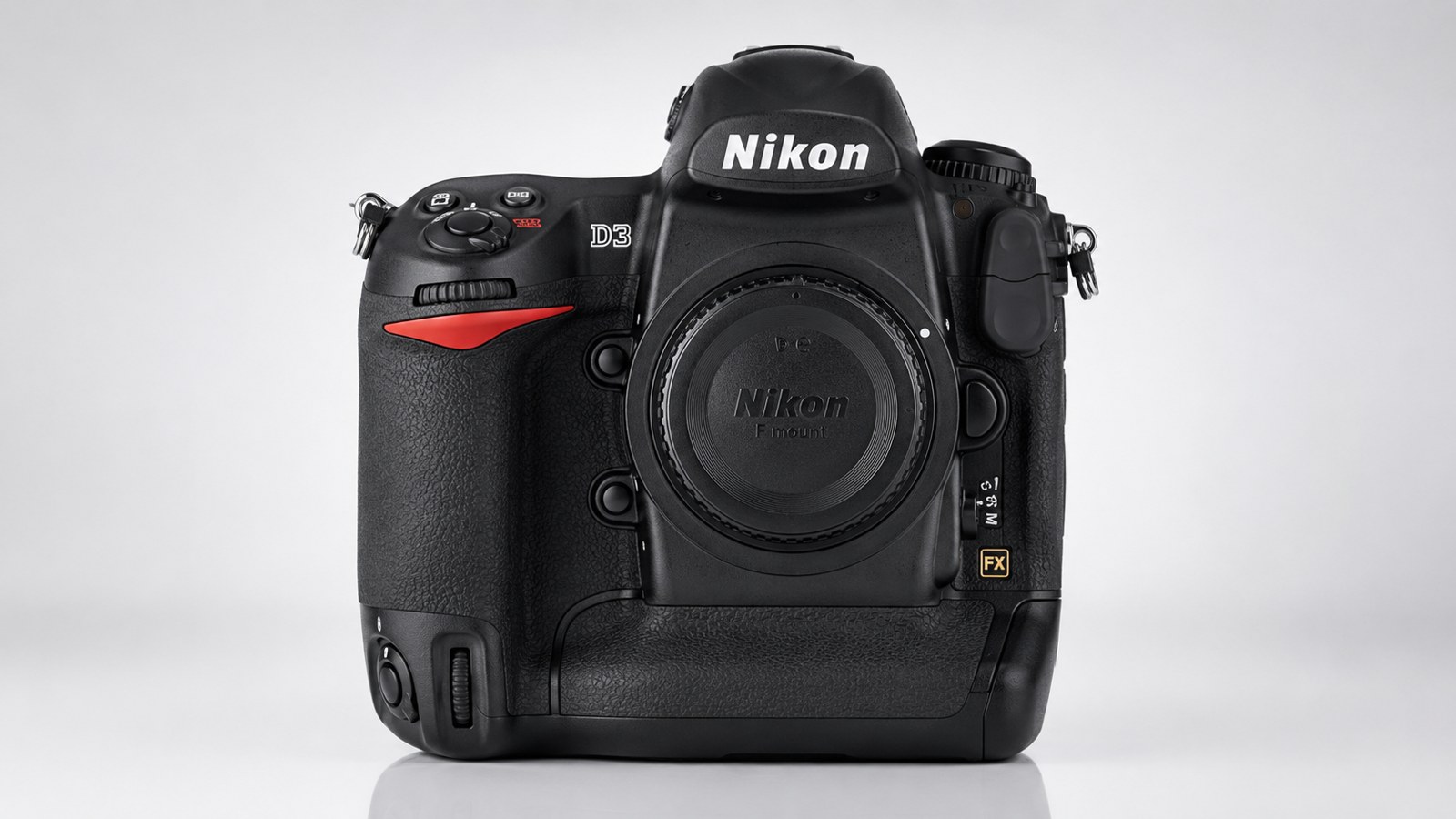
- The Nikon D3 (2007) is Nikon's first full-frame DSLR: 12MP FX, native ISO up to 6400, magnesium alloy body designed for 300,000 shutter count.
- The D3s (2009) raises native ISO to 12800 (102400 in boost), features a cleaned sensor, and adds 720p video: in 2026, it is the preferred version for high-ISO performance.
- 12 megapixels are few today for heavy crops or prints larger than 50x70, but they are more than sufficient for web, reportage, and prints up to A3.
- The real risk with used gear is the shutter count and contact oxidation: on these ex-professional bodies, the certified shutter count is the first thing to verify.
The Nikon D3 was the camera that turned the table upside down in 2007. Before it, Nikon full frame did not exist, and sports and reportage photographers worked on APS-H or APS-C sensors, accepting compromises on noise and field of view. With the D3, and then the D3s in 2009, Nikon put an FX sensor with 12 megapixels in the hands of professionals, capable of shooting in lighting conditions that until then had been simply forbidden. Today, those two camera bodies can be found used at prices that were unthinkable fifteen years ago.
The real question is not whether the D3 was an important camera: it was, without a doubt. The question is whether it still makes sense to buy one in 2026, with that 12MP sensor and a body that weighs more than a kilo and a half. In this article, I explain what these cameras were, where they still hold up perfectly, where age starts to show, and how to inspect a used unit before spending money.
What are the Nikon D3 and D3s, and why they made history
In 2007, Nikon was still shooting everything on APS-C sensors, while Canon had been selling full-frame cameras for three years. The D3 closed that gap in one stroke, and it did so by focusing on an unexpected area: high ISOs. Not resolution, not the number of megapixels. Signal cleanliness at high ISOs, where reporters and sports photographers truly live.
2007: Nikon enters the full frame
The D3 is the first Nikon DSLR with an FX sensor, meaning full frame 24x36 mm, at 12 megapixels. It may seem low today, but the choice was deliberate: larger pixels gather more light, resulting in less noise. Nikon called it the hunt for useful ISOs, and the result was a native ISO up to 6400, pushable to 25600 in boost, when other professional DSLRs were already struggling at 3200.
The camera body was built for heavy-duty work: magnesium alloy chassis, weather sealing, certified shutter count of 300,000, 51-point autofocus and a burst rate of 9 frames per second. It was the camera of news agencies and field reporters, not of studio portrait photographers. This still matters today when you are looking for a used one, because almost every unit out there has worked hard.
The 2009 D3s: evolution, not revolution
Two years after the D3s, it doesn't reinvent the wheel; it refines. Same camera body, same resolution, same autofocus. The core changes: a redesigned sensor with native ISO doubled to 12800 and extended up to 102400. In practice, this means more than a full stop of additional noise reduction at high ISOs—the difference that lets you capture the shot in a gym or a dark church.
The other two concrete additions of the D3s:
- Sensor cleaning: ultrasonic sensor cleaning system, absent on the D3. On a body that changes lenses all day long, it is not a minor detail.
- 720p video: the D3 does not record video, the D3s does, in Motion JPEG format. Primitive by today's standards, but it marks Nikon's first step into motion.
For this reason, if you are considering used gear in 2026 and your budget allows, the D3s is the version to prefer: it offers the same strengths as the D3, with the high-ISO performance that has made these camera bodies legendary.
The specs that still matter today
In 2007, the D3 raised the bar on one key parameter: signal cleanliness at high ISOs. Nearly twenty years later, much of that spec sheet still holds up, provided you know what to look for and what to ignore. Three aspects truly matter: resolution, autofocus system with burst rate, and body construction.
12 megapixels: few on paper, sufficient in reality
Twelve megapixels may seem modest next to the 45MP of a Z8. But the right question isn't "how many pixels," it's "what do you need them for." For web use, reportage, or printing up to A3 size (30x42 cm), 12MP is more than enough. The file remains clean, manageable, and fast to edit, even on non-recent computers.
The limit is reached when aggressive crops or prints larger than 50x70 are required. If you crop half the frame or print large from a close distance, the pixels run out. Those doing high-resolution still life, gallery landscape work, or jobs with heavy cropping should look elsewhere. For everything else, 12MP FX quality is worth more than 24MP from a tired small sensor.
Autofocus and burst: from 9 to 11 frames per second
The Multi-CAM 3500FX module, featuring 51 points (15 of which are cross-type), was designed for sports and photojournalism. In 2026, it lacks the eye-detection tracking found in mirrorless cameras, but for subjects with predictable movement — a match, a runner, a bird in flight against a clear sky — it locks onto and maintains focus with a responsiveness that still surprises.
The burst rate is 9 frames per second in full-frame FX and increases to 11 fps when using the DX crop. Numbers that many newer DSLRs cannot reach. The deep buffer and responsive shutter make these camera bodies still honest action tools.
Build and reliability: born to work
There is no comparison with the consumer tier here. These are the features that justify the weight:
- Magnesium alloy body with dust and moisture sealing.
- Certified shutter count of 300,000, twice that of an entry-level DSLR.
- 100% optical viewfinder: frame exactly what you record.
- Dual CompactFlash slots for real-time backup or overflow.
It is the difference between a camera designed for a weekend and one built to work every day. It is also the reason why, in the used market, the true indicator of health is not the year but the certified shutter count.
D3 or D3s: which one to choose used
If your budget covers both, the choice is simple: the D3s. Not because the D3 is outdated, but because the D3s takes the same base and improves its only weak point where these cameras are truly tested, namely low-light performance. The rest — autofocus, burst rate, build quality, viewfinder — is practically identical, so the comparison comes down to high ISOs and a secondary detail: video.
The difference that matters: high ISOs
The D3 reaches 6400 native ISO, while the D3s doubles this to 12800, with boost up to 25600 and an extreme Hi-3 at 102400. On paper, it is a doubling; in practice, it is a change of profession. The D3s gains approximately one and a half stops of real cleanliness thanks to a revised sensor, not just a more aggressive firmware.
In a church wedding, where you have a candle and a large window, or in indoor sports under mercury lights, the D3 asks for a flash or a tripod. The D3s lets you work handheld at 6400 ISO with noise that, at 12 megapixels, remains perfectly printable in A3. If you frequently shoot in these conditions, the difference alone justifies the higher price.
Video, almost a detail
The D3s adds 720p recording, and on this point, let's be clear: it's primitive video. No continuous autofocus, jello effect on rapid movements, short clips, and internal microphone audio to forget. It was Nikon's first foray into video on a pro body, with all the limitations of 2009.
Don't buy a D3s for video. If you need video, any entry-level mirrorless camera today outperforms it. Consider the 720p for what it is: an occasional extra, not a reason to buy. The D3s is chosen for high-ISO photos, period.
Nikon D3 vs D3s: the differences that matter
| Feature | Nikon D3 (2007) | Nikon D3s (2009) |
|---|---|---|
| Sensor | FX CMOS 12.1 MP | FX CMOS 12.1 MP (redesigned) |
| Native ISO | 200 - 6400 | 200 - 12800 |
| Extended ISO | 100 - 25600 (Hi-2) | 100 - 102400 (Hi-3) |
| Burst rate | 9 fps (11 in DX) | 9 fps (11 in DX) |
| Video | Not available | HD 720p 24p (M-JPEG) |
| Sensor cleaning | No | Yes (sensor cleaning) |
| Certified shutter count | 300,000 shutter count | 300,000 shutter count |
The limitations to consider in 2026
These cameras were built to be used, not to sit in a display case. However, a body designed in 2007-2009 carries design choices that weigh on you today, literally and not just figuratively. Before buying a D3 or a D3s, it is worth knowing where they show their age, so you avoid finding out after the bank transfer.
Weight and size: over 1.2 kg for the body alone
The D3 and D3s camera body weighs approximately 1,240 grams empty, excluding battery and card. The battery grip is integrated into the magnesium alloy casting: you cannot remove it, nor can you lighten it. Mount a 24-70 f/2.8 and you are looking at roughly 2.3 kg around your neck for an entire day.
For sports or wildlife reportage, this weight is an advantage: it balances long lenses, absorbs vibrations, and keeps the camera steady. For those seeking travel or street lightness, this is the wrong path. If weight is your primary criterion, a full frame mirrorless like the Sony A7 Mark II (from 500 euros, about half the weight and in-body stabilization) solves the problem at its root. We discuss this in detail in our guide to the used Sony A7 first series.
No modern conveniences
On these camera bodies, you won't find the features we take for granted today. Here is the situation:
- Slow and unresponsive live view: usable on a tripod, frustrating when shooting handheld.
- Fixed screen: no articulation, no low-angle or overhead shooting.
- No connectivity: no WiFi, no Bluetooth, transfer only via cable or CF card reader.
- Video absent or primitive: the D3 does not record, the D3s tops out at 720p, good for emergency B-roll and little else.
If the tilting screen, 4K video, or live view autofocus are part of your workflow, no D3 will provide them. In that case, a Canon EOS RP (from 550 euros, 26MP, 4K video, and tilting touchscreen) is a more suitable camera for 2026, even though it lacks the robustness and burst rate of a professional body. These are two different philosophies: the D3s is a specialized work tool, not a modern all-rounder.
How much does a used D3 or D3s cost and what to check
In 2026, a Nikon D3 in excellent condition is found between 350 and 500 euros, while the D3s starts at 550 and reaches 750 euros depending on shutter count and body condition. These are prices for ex-professional bodies: these cameras have worked, often extensively, and the price alone does not indicate how much useful life remains. Before looking at the aesthetics, look at the numbers.
The shutter count is everything
The D3 and D3s are designed for 300,000 certified shutter count on the shutter. It is not an insurmountable limit — many units go beyond it — but it is the reference point to understand where you stand. A body passed through the hands of a sports or reportage photographer may have accumulated 200,000 shutter count in a few years of 9 fps bursts.
The shutter count can be read from the EXIF metadata of a recent RAW file, using tools such as an online EXIF reader or dedicated software. Here is how to get started:
- Under 50,000 shutter count: rare on these bodies, practically like new. Be wary if the price is too low.
- 50,000–150,000: normal use, ample remaining lifespan. The ideal range.
- 150,000–250,000: well-used but healthy body, price should reflect this accordingly.
- Over 250,000: close to the design limit. Only consider if the seller has already replaced the shutter, with receipt.
If the seller cannot provide the shutter count or refuses to send you a RAW file, consider the purchase a risk. On an ex-professional camera body, the certified shutter count is the primary data point, not a minor detail.
Contacts, viewfinder, batteries and CF slot
Beyond the shutter count, four practical points make the difference between a bargain and a hidden cost on these machines.
- Mount contacts and hot shoe: check for oxidation or green corrosion. Dirty contacts cause communication errors with the lens that can look like serious faults.
- Prism and viewfinder: look inside against the light. Mold, haze, or heavy dust in the pentaprism is expensive to fix.
- EN-EL4a batteries: often tired after fifteen years. A battery at end of life is normal, budget for it: it affects the price, not the value of the camera body.
- CompactFlash slot: check that the internal pins are straight. A bent pin from a poorly inserted card blocks one of the two slots.
If you prefer a less demanding Nikon full frame to handle, also read our guide on the used Nikon D700, which shares much of the D3's soul in a more manageable body.
Checklist before buying a used D3 or D3s
| What to check | Why it matters | Reference value |
|---|---|---|
| Shutter count | These are ex-professional bodies, often heavily used | Under 150,000 is excellent, around 300,000 is end of life |
| Contacts and CF slot | Oxidation and bent pins prevent card insertion | No oxidation, straight pins |
| EN-EL4a batteries | Often tired after 15 years | At least a good recharge cycle |
| Sensor and viewfinder | Dust and mold on the prism | Clean sensor, clear viewfinder |
What we do in our lab on a body like this
A D3 or D3s that comes to us doesn't go on display the same day. It first goes to the workshop bench, where we stop trusting what the seller claims and start measuring. On a body built for 300,000 shutter counts and often used by a professional, the difference between "looks fine" and "is fine" is made only by the tool.
The first step is reading the shutter count from the internal EXIF data, not from the counter that resets with a firmware update. A D3s with 40,000 certified shutter counts is one thing; the same camera at 250,000 is another. Both may function, but the price and remaining lifespan are two different worlds. The certified number is included in the product sheet, so you know exactly what you are buying before you pay.
Here is what we check on every camera body before certifying it:
- Shutter: Actual shutter count and burst test to verify there are no slow curtains or irregular exposures at high shutter speeds.
- Sensor: Wet cleaning and shot on a white background at f/16 to detect dust and fixed spots, typical of cameras used outdoors for years.
- Contacts and connectors: Inspection of the mount, pins, and CF slot for oxidation, the most insidious issue on camera bodies that have operated in humid environments.
- Autofocus: Focus verification on the 51 points with a reference lens, to rule out front or back focus.
- Battery: Load test of the EN-EL4a, because on these cameras the original battery can be over ten years old and hold only a few shutter counts.
If something fails, we either fix it or the camera is not listed for sale. We are not interested in selling a body that comes back after two weeks.
On all used equipment, including ex-professional bodies, we provide a 2-year warranty. This is no small detail on a camera that already has a history: it means we take on the risk of the shutter or contacts, rather than passing it on to you. This is the part of the work you don't see in the listing photo, but it's what distinguishes a certified used item from a private sale.
Who it's really for and which alternatives to consider
The D3s still makes sense today, but for a specific type of photographer. If you identify with the first group, it’s a bargain. If you identify with the second, you’re about to pay for ruggedness and high ISO performance you won’t use, giving up features you need every day.
It's worth it if you're looking for a robust camera body for reportage and sports
This camera is for those who work with their hands more than with menus. If you shoot reportage, weddings in dark environments, concerts, or indoor sports, the native ISO 6400-12800 performance remains clean, and the magnesium alloy body withstands impacts that an entry-level mirrorless cannot handle. The D3s rewards those who love physical controls: dedicated dials, dual CF slots, battle-ready ergonomics.
If 12 megapixels are enough for you — and they truly are for web, A3 prints, and quick delivery — you have no technical reason to spend twice as much on a modern camera body. You buy it for the handling and low-light performance, not for the numbers.
Look elsewhere if you need lightweight bodies, video capabilities, or high resolution
If you walk all day, shoot video, or crop heavily in post-production, the D3s works against you: it weighs over a kilogram, video is limited to 720p, and the 12MP sensor leaves no room for cropping. In these cases, consider:
- Nikon D610 — full frame DSLR with 24MP, offering significantly more resolution for the same or nearly the same price. It is the most underrated entry-level FX camera on the market: we have written about it in this dedicated guide.
- Sony A7r Mark II at 800 euros — 42MP full frame mirrorless with in-sensor stabilization and 4K video. The leap in resolution and lightness compared to the D3s is enormous.
- Nikon Z50 at 470 euros — a lightweight and modern APS-C mirrorless, excellent for those entering the Z system now who want current autofocus and video capabilities.
- Nikon Z30 at 450 euros — designed for video and vlogging, compact and without a viewfinder: the philosophical opposite of the D3s, for those who prioritize movement over still photography.
In short: the D3s is a specialized tool. If your work is what it was built for, it ages beautifully. If you need an all-rounder, one of these bodies will give you more freedom with less weight.
Frequently asked questions
Are 12 megapixels still enough in 2026?
For most uses, yes. With 12 megapixels, you can comfortably print up to A3 size and publish anywhere on the web. You only need more megapixels if you crop images heavily or print larger than 50x70. For reportage, sports, weddings, and everyday use, they are not a real limitation.
Which is better used: the Nikon D3 or the D3s?
If the budget allows, go for the D3s. The main difference is high ISO performance: the D3s starts at a native ISO of 12800, compared to the D3's 6400, resulting in cleaner files in low-light situations. It also adds sensor cleaning. The 720p video, however, is not a valid reason to choose it.
How many shutter count can a D3 or D3s handle before breaking?
The shutter is certified for 300,000 shutter count, a value typical of the professional class. In practice, many units go even beyond that, but it is normal for a former professional camera body to have already covered a good part of its lifespan. This is why the shutter count is the first thing to check in a used camera.
Does the D3s shoot good video?
No, and it should not be bought for that purpose. The video is 720p HD in M-JPEG from 2009, with pronounced rolling shutter and manual focus. If you are looking for a camera for filming, any recent mirrorless model significantly outperforms it.
Is the D3 or D3s too heavy for amateur use?
The body weighs over 1.2 kg on its own, with an integrated vertical grip that cannot be removed. With a professional lens mounted, you easily exceed 2 kg. It is a camera designed to work all day with robustness as the top priority, not for lightness. Those who want to travel light should look at a full-frame mirrorless.
Is it still worth buying a D3s, or is a more recent full-frame model better?
It depends on what you are looking for. The D3s still makes sense if you love physical controls, work at high ISOs, and want an indestructible camera body. If, however, you need more megapixels, modern video capabilities, or lighter weight, consider a used Nikon D610 or a full-frame mirrorless like the Sony A7 II, which can be found at interesting prices today.
Looking for a serviced and guaranteed D3s? Let's talk
If you have doubts about a purchase or need advice for your specific case, contact us. We provide free advice because we are photographers first and sellers second, and because a customer who makes a poor purchase will not return to photography.
Three ways to get in touch:
- Contact form — response within 24 business hours
- WhatsApp at 342 362 3454 (messages only)
- Phone: 071 291 6347 (Mon-Fri 9-13/15-18, Sat 9-13)
And if you want to see what we have in stock right away, explore the used gear available today: every camera is certified, comes with a 2-year warranty, and ships within 24-48 hours.
Article written by Matteo for the ReflexMania Team. Last updated: July 2026. Prices and availability refer to the time of publication.