
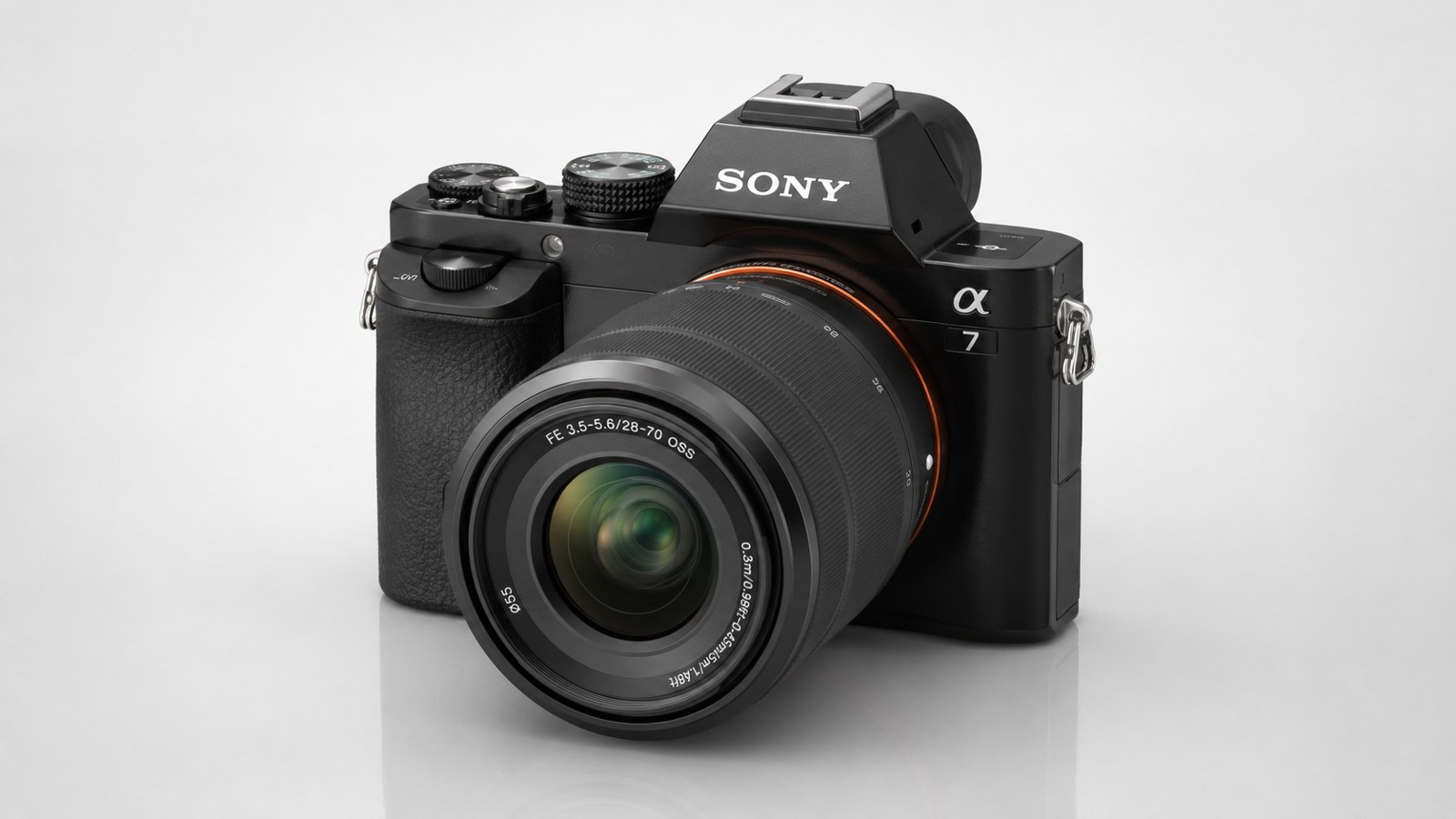
In summary
- The Sony A7 first series (2013, 24MP full frame sensor) is today the most affordable way to enter the full frame mirrorless world, often under 450 euros used.
- The real limitations are slow contrast autofocus by 2026 standards, a 2.4M dot EVF, lack of in-body stabilization, and a noisy shutter.
- The full frame E mount opens up to a huge lens park, but high-quality native FE lenses often cost more than the camera body itself.
- Those looking for modern autofocus and IBIS stabilization should consider the used Sony A7 Mark II (from 500 euros) instead of the first series.
The first-generation Sony A7 is the camera that made full-frame mirrorless accessible in 2013. Ten years later, it has also become the most affordable way to put a 24x36 sensor behind a compact body: we see quite a few of them come through the counter, and the question is always the same. Is it still worth it, or is it a museum piece that forces you to accept hard-to-digest compromises?
In this article, I look at it from a photographer's perspective, not from a brochure. What it truly does well, where it drives you crazy, which shutter counts and defects to check before buying, and in which cases it makes more sense to spend an extra hundred euros on a newer model. No forced enthusiasm: just what to expect when you take it out of your bag.
What is the Sony A7 first series and why is it so cheap
Today, a Sony A7 first series in good condition starts at around 400-450 euros used. It is the lowest entry price available for a modern full-frame sensor on a mirrorless body. Behind that figure lies a 2013 machine that has aged well in some aspects and poorly in others, and it is worth understanding which ones before signing.
The model that opened the full frame mirrorless market
In October 2013, Sony introduced the A7 and A7R together. They were the first full-frame mirrorless cameras designed for a broad audience, not a niche. The A7 features a 24-megapixel Exmor sensor, while the A7R has a 36-megapixel sensor without a low-pass filter. Until then, fitting a 24x36 mm sensor into such a compact body was the domain of prototypes or cameras costing several thousand euros.
The conceptual leap was precisely this: the same sensor format as professional DSLRs, but without a mirror, without a pentaprism, in a body weighing 474 grams. With the E mount, Sony opened a new full-frame bayonet starting almost from scratch. The A7 is the camera that forced Canon and Nikon to catch up, something they only did five years later with Z and EOS R.
Why it's under €450 today
The price has dropped for a simple reason: after the first series, five generations have arrived. A7 II, A7 III, A7 IV, plus the R and S lines. Each leap added in-body stabilization, faster autofocus, and better viewfinders. The first series has ended up at the bottom of the chain, and the used market prices it accordingly.
A low price is not, however, synonymous with a scam. The 24-megapixel sensor from 2013 still holds up today in terms of dynamic range and low-ISO performance, and in that regard, the camera body does not show its age. What has aged is the surrounding technology: electronics, autofocus, and control ergonomics. This distinction matters.
- What you pay little for and it remains valid: the 24 MP full frame sensor, image quality at low ISO, the editable raw file.
- What you pay little for because it is outdated: autofocus, electronic viewfinder, lack of in-body stabilization, slow burst rate.
Those who understand this difference make the right purchase. Those expecting an A7 III at one-third of the price will be disappointed on the first day of use.
The sensor: where the first-generation A7 still holds up today
Take autofocus out of the equation and the first-generation A7 is still intimidating. The 24-megapixel Exmor sensor from 2013 produces files that, at low ISO, hold their own against much newer and much more expensive camera bodies. It is here, in the raw data, that the camera does not show its thirteen years.
Dynamic range and base ISO performance
At ISO 100, the sensor offers genuine exposure latitude, not just brochure claims. You can underexpose by 2-3 stops to protect the highlights and recover the shadows in RAW without blowing out the noise. For landscapes with a heavy sky or portraits in controlled light, this is exactly what you need.
In practice, this means 24MP files that withstand heavy editing: pulled curves, shadows lifted by several stops, and recovered white balances. The color rendition on skin tones is soft and credible, without the plasticity that sometimes emerges on denser sensors. The advantage is felt in three concrete situations:
- Landscape at dawn or dusk: recover the burnt sky and ground shadows from the same shutter count.
- Indoor portrait with window light: smooth transitions, natural skin tones, no banding in gradients.
- Still life and reproduction: fine detail and faithful color, where slow autofocus is not an issue.
Performance at high ISO
Honesty is required here, as this is where the first series begins to show its age. The sensor is clean and usable up to ISO 3200, still acceptable at 6400 with minimal noise reduction in post. Beyond that, the file degrades quickly and detail drops: ISO 12800 and above exist on the dial, but keep them for emergencies, not for image quality.
Context is key. A 2013 full-frame sensor at ISO 6400 delivers performance that was considered high-end at the time, but 2026 expectations have risen: users coming from a recent mirrorless camera will find the noise more intrusive than they remember. If you frequently shoot in dim interiors, concerts, or flash-free events, this is a limitation to weigh seriously before purchasing.
The bottom line is simple: the A7 first generation rewards those who work in controlled or manageable light and leverage the dynamic range at base ISO. Anyone shooting above 6400 ISO will find newer cameras — even used ones — much more comfortable.
Real limitations: autofocus, EVF, stabilization, shutter
Here, age shows. The sensor holds up, but the rest of the body doesn't: the 2013 A7 was designed when mirrorless autofocus was taking its first steps, and every compromise from that era is still inside this camera. Anyone buying it needs to know this beforehand, not discover it at the first event with moving subjects.
Slow autofocus by 2026 standards
The A7 features a first-generation hybrid AF system, combining contrast detection with scattered phase detection. On stationary subjects — posed portraits, landscapes, still life — it does its job. As soon as the subject moves, it struggles: running children, animals, and amateur sports put it under strain. In low light, it hunts and sometimes fails to lock focus.
Above all, don't expect the reliable eye-AF we take for granted today, even on an A6400. Here, you have to find the eye yourself, using single focus and a bit of patience. It's a camera for deliberate work, not for bursts.
No in-body stabilization
The first A7 does not have IBIS. Period. Any compensation for micro-shake depends on the stabilized lens or a tripod. With the few FE OSS lenses available, you can manage, but if you mount an unstabilized fast 50mm lens and shoot handheld below 1/60s, you will start to collect blurry shots.
It is exactly the practical difference with the Sony A7 Mark II (from 500 euros, 2 pieces in catalog): the Mark II introduces 5-axis in-body image stabilization, which gives you three or four real stops with any lens, even adapted manual focus lenses. For those who shoot handheld indoors or at dusk, those extra 100 euros change the way you work.
EVF, ergonomics and noisy shutter
The 2.4-million-dot viewfinder was good in 2013, but today it is merely sufficient: modest definition and a refresh rate that struggles in low light. The grip is narrow — with a 24-70 f/4 attached, the camera feels front-heavy, and with a 70-200, the grip becomes uncomfortable for extended use.
Then there's the shutter. The mechanical shutter on the first A7 is noisy and has a noticeable vibration upon release, making it audible in weddings or theaters. It lacks a silent electronic shutter, so in situations where discretion is required, this is an objective limitation, not a nitpick.
Lenses: The True Hidden Cost of the E Mount
You pay 400 euros for the camera body, then the real bill arrives. A photographic system is not just the body: it is the body plus the lenses you mount on it. And on the E mount full frame, quality lenses almost always cost more than the A7 first generation body you just bought on sale.
Native FE lenses: few affordable, many expensive
Used A7 bodies are often found with the Sony FE 28-70mm f/3.5-5.6 kit lens. It is an honest but modest lens: good for getting started, lacking in brightness, and soft at the edges when wide open. It is not the lens that makes you say, "This is why I bought a full-frame camera."
Jumping up in quality requires prime lenses, and that’s where prices shift gears. Here’s what you actually pay for used gear in excellent condition:
| Lens | Indicative used price | Note |
|---|---|---|
| Sony FE 50mm f/1.8 | 150-200 euros | The budget entry-level option, optical but slow autofocus |
| Samyang/Rokinon 35mm f/2.8 FE | 180-250 euros | Compact, more than valid rendering |
| Tamron 28-75mm f/2.8 | 450-550 euros | The do-it-all zoom, costs as much as a body |
| Sigma 35mm f/1.4 DG DN Art | 550-650 euros | Professional quality, beyond the price of the A7 |
Do the real math: an A7 at €420 with a Tamron 28-75 becomes a system costing nearly €900. It is still a bargain for a full frame f/2.8, but it is no longer the "€400 full frame" promised in the ad title.
Adapting old manual lenses
This is where the A7 first series plays its best card. The short flange distance of the E mount — the minimum distance between the flange and the sensor — allows adapting almost any existing DSLR lens, with mechanical adapters costing 20-40 euros.
- M42 screw mount: Helios 44-2 58mm f/2, Takumar 55mm f/1.8, often under 60 euros.
- Canon FD: prime lenses from the '70s-'80s with excellent build quality, low demand.
- Leica M and Contax/Yashica: legendary glass, varying prices.
You lose autofocus and automation: focus manually using the EVF's focus peaking. But on a full frame, those lenses deliver their full character, and the cost to build your kit drops significantly. It's the low-cost path for those with the patience to learn how to shoot with their hands.
Used A7 first series or A7 Mark II: which one to choose
In most cases, the extra 100 euros for the Mark II are the best money spent in the entire purchase. The first series starts at around 380-400 euros used, while we currently have the Sony A7 Mark II from 500 euros. That difference buys two things that change the daily user experience: in-body image stabilization and a less temperamental autofocus.
What really changes between the two generations
The 24MP base sensor is the same, so image quality at low ISOs is practically identical. The Mark II does not take "prettier" photos in full light conditions. Everything else around the sensor changes.
| Aspect | A7 first series | A7 Mark II |
|---|---|---|
| Stabilization | Absent | 5-axis IBIS on sensor |
| Autofocus | Slow, contrast-detection | Hybrid, faster lock-on |
| Grip | Minimal | Deep grip, better balance with heavy lenses |
| Shutter | Noisy and vibrating | More damped and discreet |
The 5-axis IBIS is the most significant feature. It allows you to use affordable manual lenses, adapted from old DSLR kits, gaining three or four stops of handheld stabilization. On the first series, those same lenses remain shaky below 1/60.
When the first series still makes sense
It is not always a rejection. There are specific cases where paying for the Mark II is a waste of money:
- Strict budget under 450 euros: if those 100 euros make the difference between buying or not buying, the first series still puts a full frame in your hands.
- Tripod use: landscape, architecture, still life. On a tripod, IBIS is not needed and slow autofocus is not an issue.
- Already stabilized lenses: if you mount FE optics with OSS, part of the stabilization is already in the lens.
If you shoot portraits, events, or handheld street photography, the autofocus and IBIS of the Mark II solve real problems. And those aiming for higher resolution can look at the Sony A7r Mark II at 800 euros, featuring a 42MP sensor and the same stabilized body. If your budget allows for the latest generation of autofocus, it is worth reading our in-depth guide on the used Sony A7 III, which remains the best-selling balance point in the range.
What to check before buying a used A7
The low price of a first-generation A7 hides a trap: many units out there have worked hard. They were €1,500 cameras in 2013, often in the hands of heavy shooters. Before signing, three checks separate a bargain from a scrap.
Shutter count, sensor and typical weak points
The first thing is the shutter count. The A7's shutter is rated for approximately 200,000 shutter count, but this is a statistical value, not a guarantee. A camera with 40,000 shutter count still has plenty of life left; one with 150,000 should be priced lower, knowing that the shutter is an expensive replacement part, almost as costly as the camera body.
Then the sensor. The 24MP full frame Exmor lacks stabilization, so it remains exposed: check for dust and spots with a shutter count at f/16 against a white wall. Also verify the absence of scratches on the sensor glass, as DIY cleaning on these sensors has ruined quite a few.
- Shutter count: under 50,000 is excellent; over 150,000 warrants a price negotiation.
- Sensor: take a test shot at f/16 on a white background to check for dust and fungal spots.
- EVF and screen: look for dead lines or spots; the flat cable of the flip-out screen wears out.
- Contacts and E mount: green oxidation on the pins indicates moisture and communication issues with lenses.
A known issue: the A7 first generation suffers from "star-eating," an aggressive noise reduction on long exposures that erases faint stars. This is not a defect of the used unit, but a design flaw, yet anyone shooting night skies needs to be aware of it.
NP-FW50 batteries and limited battery life
The A7 uses NP-FW50 batteries and delivers approximately 300 certified shutter counts per charge. That is low: on a real shooting day, you will need at least three batteries. Check that the included ones are not swollen and that they hold their charge, as used original NP-FW50 batteries often have significant cycles on them. Compatible batteries are cheap, but verify that the camera body recognizes them without errors.
What we do at the ReflexMania workshop
Every A7 that comes through our doors goes through our technical bench: we read the actual shutter count, test the sensor, autofocus, and shutter durability, and check the EVF and batteries. The certified shutter count is listed in the product sheet, not estimated by eye. And we offer a 2-year warranty on all used gear, so the weak points mentioned above become our problem, not yours.
Used full-frame alternatives in the same price range
The first-generation A7 is not the only gateway to affordable full frame. If the slow autofocus and lack of stabilization hold you back, the used market offers more modern or cheaper camera bodies, each with a different compromise. It is worth knowing them before signing the purchase.
Full frame mirrorless: Canon EOS RP and EOS R
If you stay in the mirrorless world but want 2019 autofocus instead of 2013, Canon has two concrete candidates in our catalog.
The Canon EOS RP, which we stock from 550 euros, is the most direct alternative to the A7. It features a 26MP full frame sensor, reliable Dual Pixel autofocus with eye-AF, and focus acquisition that locks onto the subject where the A7 hesitates. It is lightweight and accepts native RF lenses or EF lenses via adapter. The limitations are a slightly lower dynamic range and a modest buffer, but for portrait and travel photography, it offers a different level of responsiveness.
The Canon EOS R, starting at 760 euros, moves up a category: 30MP, a sharper electronic viewfinder, and a sturdier camera body. It costs almost twice as much as an A7, so it only makes sense if autofocus and build quality matter more than the absolute lowest price.
| Model | Price from | Key strength |
|---|---|---|
| Sony A7 (2013) | ~450 € | Lowest price, FE lens lineup |
| Canon EOS RP | 550 € | Modern Eye-AF, lightweight |
| Canon EOS R | 760 € | 30MP sensor, robust body |
Full frame DSLR: the even more affordable route
If you don't need a mirrorless camera, you can go even lower in price with a used full-frame DSLR. The Canon 6D, Canon 5D Mark III, and Nikon D700 offer an optical viewfinder, proven ergonomics, and high-quality files at prices often lower than the A7. In return, you give up effective live-view and exposure preview in the viewfinder.
It is the right path for those coming from a DSLR who do not want to relearn everything. We have dedicated a specific in-depth article to the used Canon 6D as the most affordable entry-level full frame, including prices and what to check.
Affordable used full-frame cameras compared
| Model | Type | Key Strength | Indicative Used Price |
|---|---|---|---|
| Sony A7 | Mirrorless | Cheapest full frame | under 450 euros |
| Canon EOS RP | Mirrorless | Modern AF with eye-AF | 550-600 euros |
| Canon EOS R | Mirrorless | Sturdier EVF and body | 760-800 euros |
| Sony A7r Mark II | Mirrorless | 42MP and IBIS | 800 euros |
Frequently asked questions
Is the Sony A7 first series still a good camera in 2026?
Yes, for those looking for the most affordable full-frame camera who mainly shoot static subjects, landscapes, or portraits in controlled light. The 24MP sensor still holds up well in terms of dynamic range and RAW rendering. However, it shows its age in autofocus, viewfinder, and lack of stabilization.
How much does a used first-generation Sony A7 cost?
On the used market, the first A7 is generally found for under 450 euros. It is the most affordable full-frame mirrorless camera available. The Sony A7 Mark II, which adds stabilization and improved autofocus, starts at around 500 euros in our catalog.
Does the Sony A7 first series have in-body image stabilization?
No. The first series does not have IBIS: stabilization relies entirely on the lens or the use of a tripod. 5-axis in-body stabilization is only available starting with the Sony A7 Mark II, which is the main reason many choose the second generation.
Which lenses can I mount on the Sony A7?
It accepts all Sony FE lenses with full-frame E mount, as well as APS-C crop lenses. Thanks to the short flange distance, you can economically adapt old manual M42, Canon FD, or Leica M lenses. Be aware of the cost: high-quality native FE lenses often exceed the price of the camera body.
Which is better: the Sony A7 or the used Canon EOS RP?
It depends on your priorities. The A7 costs less and is full frame like the RP, but the Canon EOS RP has a much more modern autofocus system with reliable eye-AF and is more recent. If you shoot moving subjects or fast portraits, the extra 100-150 euros for the RP are well spent.
How many shutter count can a Sony A7 first generation take?
The shutter is reported to have approximately 200,000 actuations. When buying used, it is always advisable to verify the actual shutter count: an A7 with 30,000 shutter count still has a lot of life ahead, while one close to 180,000 should be evaluated with caution. This is one of the checks we perform in the lab before sale.
Does the Sony A7 battery drain quickly?
Yes, it is one of the practical limitations. The NP-FW50 battery provides approximately 300 certified shutter counts CIPA, a low value compared to current standards. For a full day of shooting, you need at least two or three healthy batteries. In the used market, it is important to check that they are not swollen and that they hold their charge.
Looking for a used, guaranteed Sony full frame? Let's talk
If you have questions about a purchase or need advice for your specific case, contact us. We offer free advice because we are photographers first and sellers second, and because a customer who makes a bad purchase won't come back to photography.
Three ways to get in touch:
- Contact form — response within 24 business hours
- WhatsApp at 342 362 3454 (messages only)
- Phone: 071 291 6347 (Mon-Fri 9-13/15-18, Sat 9-13)
If you want to see what we have in stock right away, explore the used gear available today: every camera is certified, comes with a 2-year warranty, and ships within 24-48 hours.
Article written by Matteo for the ReflexMania Team. Last updated: July 2026. Prices and availability refer to the time of publication.