
In short
- A used Nikon D5600 in excellent condition today is found between 300 and 420 euros for the camera body only, and between 400 and 520 euros with the 18-55mm lens.
- 24 MP APS-C sensor without anti-aliasing filter and no in-body stabilization: stabilization depends on the VR lens.
- Key points to check are the shutter count (under 30,000 is excellent), rubber seals that may come off, and a responsive touch screen.
- It lacks a front command dial and an internal AF motor: older AF-D lenses do not focus automatically.
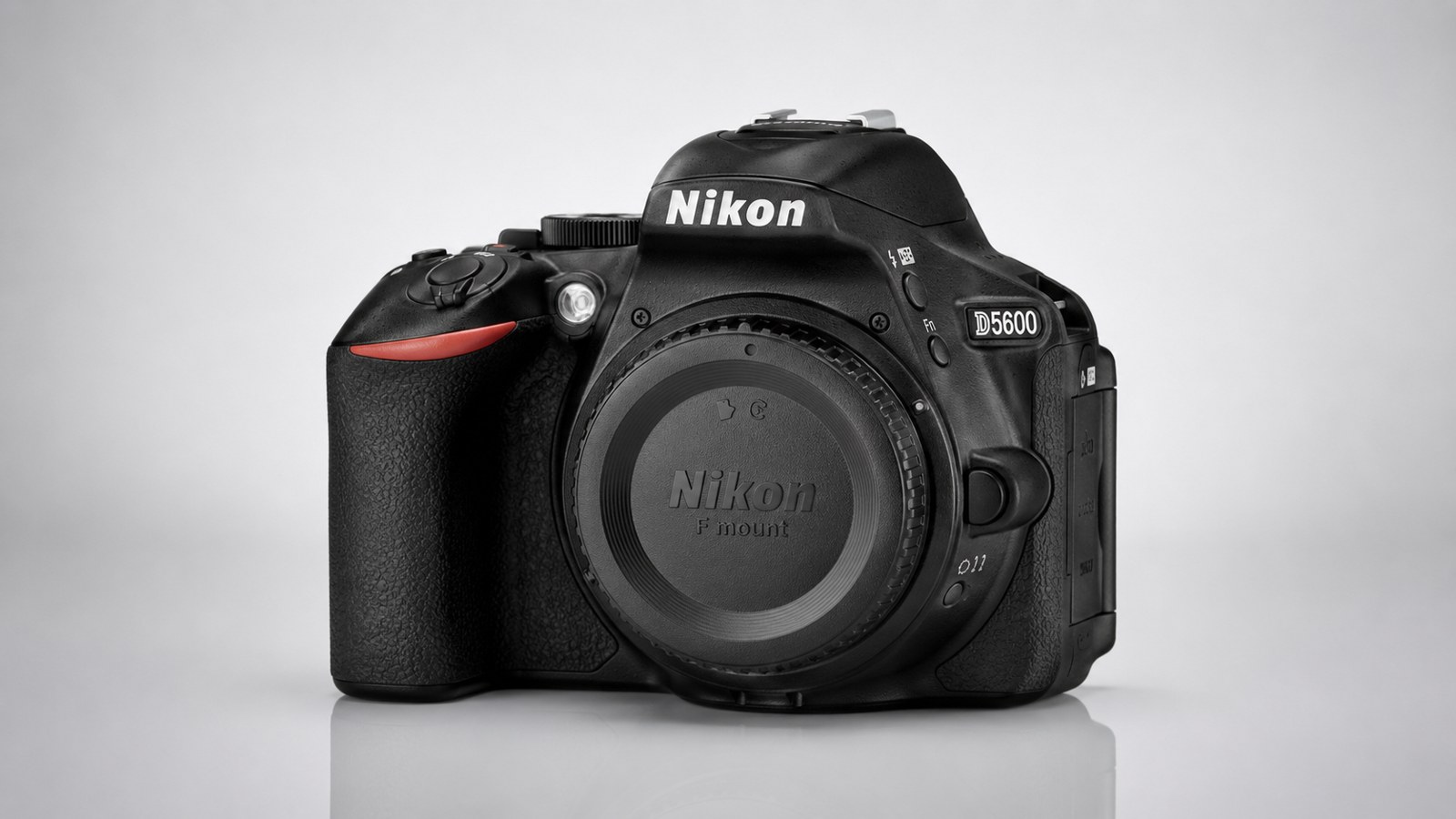
The Nikon D5600 is the latest DSLR in the D5000 series, released at the end of 2016 and never truly replaced: Nikon closed the chapter on entry-level DSLRs to push their Z mirrorless line. This means that used is the only sensible way to buy it today, and the market is full of them because many owners used them briefly before switching to smartphones or mirrorless. We see quite a few come through the counter, often with fewer than 20,000 shutter count and in excellent condition.
In this article, I explain what a used D5600 really costs in 2026, how it differs from its siblings, the D5300 and D3100, and, above all, what to check before paying. The goal is not to convince you to buy it: for certain uses, a D5300 for less money does the same job, and I say that clearly.
What is the Nikon D5600 and who it is really for
The Nikon D5600 is the APS-C DSLR we buy when someone wants to stop shooting in automatic mode but doesn't have €1,500 to spend on a pro body. It is the latest addition to the D5000 series, released in 2016, and features a 24-megapixel sensor without an anti-aliasing filter. In practical terms: clean and sharp detail, provided you mount a lens up to the task.
Positioning in the Nikon range
To understand what you have in your hands, you need to place it within the Nikon DX scale. It sits one step above the D3000-series and one step below the D7000-series, and this makes a significant difference to the experience at the counter.
- D3000-series (D3300, D3500): designed for those starting from scratch, with on-screen guides and controls reduced to the minimum.
- D5000-series (up to the D5600): tilting touch screen, bracketing, remote control via Snapbridge, more control without being intimidating.
- D7000-series (D7200, D7500): dual command dials, weather-sealed body, internal AF motor. Gear for those who already know what they are doing.
The D5600 sits in the middle: simple enough not to intimidate, yet complete enough to help you grow. The price of this compromise is paid on two fronts we will discuss later: it lacks a front command dial and an autofocus motor in the camera body.
Who it makes sense for today
In our experience at the counter, the D5600 suits a specific type of photographer. It is not for everyone, and it is important to state this clearly before spending money.
It makes sense if you identify with any of these situations:
- You want to learn to work in manual mode — shutter speeds, apertures, ISO — on a lightweight body that won't tire you out on the go.
- You shoot family portraits, kids, and outings: the tilting touchscreen helps in awkward angles.
- You're looking for 24 megapixels of real quality for under 500 euros, lens included.
It makes no sense, however, if video truly matters to you. The D5600 tops out at Full HD at 60 frames per second: no 4K. Those aiming to shoot modern video today look elsewhere, typically towards a mirrorless. And if your ultimate goal is fast reportage with a double dial under your fingers, it is worth considering a used D7200 directly. For everyone else in between, this camera still does an honest job.
How much does a used Nikon D5600 cost in 2026
A Nikon D5600 in excellent condition currently changes hands for between 300 and 420 euros as a body only. In a kit with the 18-55mm VR lens, the price range rises to 400-520 euros. These are figures we see confirmed every week at the counter, with fluctuations that almost always depend on three factors: shutter count, accessories, and cosmetic condition.
Body-only and kit prices
These extremes are not random. A camera body at €300 is almost always a unit with over 40,000 shutter count, rubber seals starting to lift, and possibly no box. A camera body at €420 typically has under 20,000 shutter count, complete accessories, and a touch screen without haze.
The same logic applies to kits. The 18-55mm VR AF-P is a budget lens, but new it still costs around 200 euros: used and in good condition, it adds a real 80-100 euros to the value of the camera body. If they offer you a kit for 400 euros with a high-shutter-count body, you are paying almost everything for the lens.
What raises and what lowers the value
Here are the factors that truly impact the price, ranked by weight:
- Shutter count: this is the number one item. Below 30,000 shutter count, the camera is considered young and holds a high price. Over 50,000, you enter the discount territory.
- Original box and charger: the box counts for little functionally, but an original Nikon charger (not the 8-euro Chinese ones) is worth 20-30 euros and reassures you that the camera has been treated well.
- Additional batteries: the EN-EL14a is the battery for this camera body. A second healthy battery adds 15-25 euros and saves you from being left without power halfway through the day.
- Grip rubber wear: on the D5x00, the grip rubber tends to peel off due to sweat. It is not a fault, but a camera body with loose grip rubber easily drops by 30-40 euros.
If you are considering the smaller sibling to save money, we have analyzed prices and checks in the article dedicated to the used Nikon D5300. The price difference is real, but not always justified: we discuss this further in the comparison.
Price ranges for used Nikon D5600 (2026)
| Configuration | Condition | Typical shutter count | Indicative price |
|---|---|---|---|
| Body only | Excellent condition | 30,000-60,000 | 300-360 euros |
| Body only | Like new | under 15,000 | 380-420 euros |
| Kit 18-55 VR | Excellent condition | 20,000-50,000 | 400-460 euros |
| Kit 18-55 VR | Like new | under 10,000 | 480-520 euros |
The specs that matter (and the ones marketing inflates)
The D5600's technical specifications look generous, but only three factors truly change the photos you take home: resolution, stabilization, and high-ISO performance. The rest is fluff that marketing tends to exaggerate. Let's see what to expect in practice, without brochure-style hype.
24 megapixels: when they matter and when they don't
The 24 MP APS-C sensor without an anti-aliasing filter is sharp, that is true. The absence of the AA filter brings out more fine detail, which is useful if you print large or crop heavily during editing. But that detail only emerges if you have a lens up to the task in front of it.
With the 18-55mm kit lens, the difference between 24 and 20 megapixels remains theoretical: the lens is the bottleneck, not the sensor. If you shoot in JPEG and share on social media, you will never see those extra pixels. They become concrete if you work in RAW with a good prime, such as a 35mm or a 50mm.
Stabilization: it's in the lens, not the body
This is where the most common misconception at the counter arises. The D5600 does not have in-body stabilization: no IBIS. Stabilization depends entirely on the lens, specifically those with the VR (Vibration Reduction) designation.
What this means in practice:
- With an 18-55mm VR or an 18-140mm VR, you are covered for handheld shooting in low light.
- With a cheap fixed lens without VR, such as the 50mm f/1.8, you can only rely on fast shutter speeds and a steady hand.
- Switching from one camera body to another does not "carry over" the stabilization: it travels with the lens.
ISO and video: what to really expect
Regarding noise, the D5600 performs well for an entry-level APS-C camera. In practice, ISOs remain clean up to 3200, and are usable with some noise reduction up to 6400. Beyond that, quality drops quickly: the extended ISOs listed are spec sheet numbers, not indicators of real-world usability.
As shown in the video, the difference is clear: the D5600 records only in Full HD 1080p, no 4K. For photos and occasional clips, it is perfectly fine. If your primary goal is to shoot 4K video, this is not the right camera body, and no used market offer will change the sensor: look elsewhere.
What to check before buying it used
A healthy D5600 handles years of use without issues, but in the used market, three defects are more common than others. They are all verifiable in a few minutes, if you know where to look. Here is what we check before putting a camera body up for sale, and what you should ask a private seller.
Shutter count
The D5600's shutter count is reported at approximately 100,000 cycles. This is not a hard limit: many camera bodies exceed this figure comfortably, while others fail earlier. Below 30,000 shutter count, you are in excellent condition territory, with almost the entire mechanical lifespan ahead of you.
The number is written in the EXIF metadata of every photo. Just take a JPEG and upload it to an online EXIF reader, or open it with software like ExifTool. However, it matters less than you might think: a shutter with 45,000 certified shutter counts that has been serviced and is functioning properly is worth more than one with 8,000 on a poorly maintained camera body. The count is a clue, not a verdict.
Rubber parts, touch screen and sensor
The typical flaw of this generation is the peeling of the grip rubber. The adhesive fails due to sweat and heat, causing the rubber to lift at the edges. This is an aesthetic and grip issue, not an electronic one, and can be fixed with specialized adhesive, but it must be reflected in the price.
The tilting touchscreen must be tested in every position: rotate it, touch every corner, and verify that touch response works everywhere. The flat cables in the hinges wear out. On the sensor, check the dust map: dust particles can be cleaned, but a scratch on the filter cannot.
Quick tests to run in 5 minutes
Before paying, perform these checks in sequence:
- Uniform sky or wall: shoot at f/16 towards a light surface. Enlarge the image on your PC: dark spots are dust, fixed red or white dots are hot pixels.
- Autofocus: focus on a high-contrast subject and then on a flat one. It must lock on quickly, without hunting back and forth.
- Buttons and dial: test every button, the rear command dial, and the mode selector. No dead travel.
- SD slot: insert a card, take a shot, and read it back. The latch must hold and the contacts must write without errors.
Five minutes like this tell you more than half an hour of talk about the camera body's condition.
The limits of lenses: watch out for the AF motor
The Nikon D5600 does not have a focus motor in the camera body. This detail, which no spec sheet highlights in bold, determines which lenses will autofocus and which will not. Larger bodies (D7500, D500) do have the motor; entry-level models in the D3000 and D5000 series do not. It is a cost-saving choice, not a defect, but it changes the rules when buying used lenses at a low price.
AF-S, AF-P and AF-D: what focuses
The practical rule is simple: only lenses with a built-in motor can autofocus. In Nikon terminology, these are the AF-S (ultrasonic motor) and AF-P (stepping motor, more recent) designations. AF-D and older AF lenses without a designation rely on the camera body's motor: on the D5600, that motor does not exist, so they become manual focus only.
The problem is that used AF-D lenses cost little and seem like a bargain. A 50mm f/1.8 AF-D can be found for 80 euros, but on the D5600 you would use it manually, without autofocus. How to recognize them before buying:
- AF-S or AF-P printed on the barrel or in the name: autofocus guaranteed.
- AF-D or just AF: they have a small cut slot (the "screw") on the mount, which remains disconnected on the D5600 body. Manual focus only.
- Lenses with the G designation and AF-S motor remain compatible: the G letter only indicates the absence of the aperture ring.
Recommended lenses to get started
For those starting out, three lenses cover almost everything without compatibility issues or excessive cost. These are the lenses we most often see paired with this camera body.
| Lens | Use | Note |
|---|---|---|
| Nikon AF-P 18-55mm VR | All-rounder, travel | Silent AF-P with VR stabilization, the ideal kit lens for the body |
| Nikon AF-S 35mm f/1.8G DX | Environmental portrait, interiors | Fast, lightweight, "normal" perspective on APS-C |
| Nikon AF-S 50mm f/1.8G | Portrait, bokeh | AF-S motor: be careful not to buy the AF-D version |
With a used body plus one of these three, you stay under 550 euros and get a complete kit to grow with. The one precaution always applies: before buying a used lens, check the marking. On this body, it’s the difference between autofocus and manual focus.
D5600, D5300 or D3100: which one is worth it
Before spending on a D5600, it is worth looking at what sits next to it on the used shelf. They are all Nikon APS-C DSLRs with the same F mount, but the technical gap between them is smaller than the price suggests. In many cases, the smaller sibling does the same job and leaves you with money for a better lens.
What really changes between the three models
The D5600 and D5300 are almost twins: same 24 MP sensor, same 39-point autofocus, same tilting screen. The real differences are the touch interface and Bluetooth SnapBridge connectivity, which on the D5300 becomes WiFi plus integrated GPS. If you download photos from your computer and compose using the viewfinder, you will never use that touch feature. The D5100 drops to 16 MP and 11 AF points, the D3100 to 14 MP: both remain excellent for learning, but the generational leap is noticeable in high ISO performance and burst rate.
| Model | MP | AF Points | Notes |
|---|---|---|---|
| D5600 | 24 | 39 | Touch + SnapBridge |
| D5300 | 24 | 39 | WiFi + GPS, no touch |
| D5100 | 16 | 11 | Solid for beginners |
| D3100 | 14 | 11 | Basic entry-level |
When spending less makes sense
If you don't need touch controls or wireless transfer, a used D5300 does the same job as the D5600 for less: read our guide to the used D5300 to understand what to check. The Nikon D5100 at 200 euros remains a solid foundation for beginners, while the Nikon D3100 at 150 euros only makes sense as a minimum budget option or a second body.
A special case is the Nikon D90 at 200 euros: it has an internal AF motor, so it autofocuses even with older AF-D lenses that remain manual on the D5600. Fewer megapixels, but a concrete advantage if you already have dated optics in your drawer.
Nikon D5600 vs D5300 vs D3100 at a glance
| Feature | D5600 | D5300 | D3100 |
|---|---|---|---|
| Sensor | 24 MP APS-C | 24 MP APS-C | 14 MP APS-C |
| AF Points | 39 | 39 | 11 |
| Articulating Touch Screen | Yes | No (articulating) | No (fixed) |
| Connectivity | Bluetooth SnapBridge | Wi-Fi + GPS | None |
| Video | Full HD 60p | Full HD 60p | Full HD 24p |
| Indicative Used Price | 300-420 EUR | 220-300 EUR | 150 EUR |
Is an APS-C DSLR still worth it in 2026?
Yes, but it depends on what you're looking for. The right question isn't "DSLR or mirrorless," it's "what do I need to learn and how much do I want to spend." A used D5600 at 300-420 euros for the camera body alone still does everything needed for someone building their photographic eye. The problem isn't the body, it's the excuse: no one stopped taking good photos because the sensor was APS-C.
DSLR vs mirrorless for beginners
The practical difference you truly feel is the viewfinder. The D5600 has an optical viewfinder: you look through the lens, see the real scene, with no lag and no battery drain. Nikon Z mirrorless cameras have an electronic viewfinder, which shows you the exposure preview but drains the battery much faster.
The D5600 on a single charge comfortably reaches 800-900 shutter count. An entry-level Z model does half that. For beginners, this is a concrete advantage: fewer worries, fewer backup batteries, more time shooting.
- Choose the DSLR if you want to spend little, learn the fundamentals, and affordable lenses that are already widespread on the used market are enough for you.
- Look at the Z if you put video at the center, want more compact bodies, or are already thinking about a system to keep for ten years.
To learn, today, the D5600 remains one of the most sensible choices overall. It costs little and does not impose real limits until you know exactly why you would need something else.
When to go for a used full frame
There is one case where APS-C truly feels limiting: when you frequently work in low light or seek that soft background blur. In those situations, a larger sensor makes a difference that no software trick can fully recover.
The surprise is the price. A used entry-level full-frame Nikon costs today little more than a D5600 in kit. If you already know that your genre is portrait or evening reportage, jumping straight to full frame may make sense. We discussed this in detail in this in-depth guide to the Nikon D610, the most underrated entry-level full frame that passes through our counter.
For everyone else — landscape, travel, family photography, first steps — the D5600's APS-C sensor in 2026 is still the right answer, not a compromise.
What we do in our workshop
Every Nikon D5600 that arrives at our store is not put on display until it passes through the inspection bench. It is not a five-minute aesthetic check: it is the same procedure we apply to a 1,500 euro camera body, because a broken entry-level model wastes time and trust exactly like a professional one.
The first step is reading the actual shutter count, the one recorded in the shutter's EXIF data, not the one declared by whoever sold us the camera. On a D5600 with a shutter rated for approximately 100,000 shutter count, knowing whether we are at 12,000 or 60,000 changes everything: remaining lifespan, price, and what we write on the tag.
Here is what goes through our hands before you see it online:
- Certified shutter count: the actual number read from the shutter, clearly stated in the product sheet. No visual estimates.
- Sensor cleaning: dedicated swab for APS-C DX format, with final verification at closed aperture (f/16) against a white background to detect dust and spots invisible at f/5.6.
- Shutter and mirror check: burst shooting at various speeds to rule out irregular exposures or mirror slap.
- Touchscreen and hinge test: we verify the responsiveness of the articulating touchscreen and the hinge integrity, a point that tends to loosen with use on this model.
- Grip rubber and coatings: we reattach or report on the grip rubber that tends to lift, a typical defect of the D5000 series.
- Focus test: we mount an AF-S or AF-P lens and verify that autofocus works cleanly on all points.
We are honest about what we find. If a camera body has a cosmetic defect or a rubber part that needs replacing, we state it and apply a discount; we don't hide it behind a well-lit photo. We prefer a customer who knows exactly what they are buying to a sale that is later disputed.
Every D5600 leaves our workshop with a 2-year warranty, the same coverage we provide on all certified used equipment. Not a month of goodwill: a full two years, because if we have performed the service correctly, we can stand behind it. That is the difference between buying from a private seller on a listing and buying a camera that someone, before you, has opened, measured, and tested.
Frequently Asked Questions
How much does a used Nikon D5600 cost in 2026?
Body only ranges from 300 to 420 euros depending on condition and shutter count; with the 18-55 VR lens, the price rises to 400-520 euros. Below 280 euros for a body only, be wary or carefully check the shutter and sensor.
How many shutter count can the D5600's shutter handle?
The shutter is reported to have approximately 100,000 cycles. A unit with fewer than 30,000 certified shutter count is practically new and still has its full lifespan ahead. Even at 60,000 certified shutter count, if healthy, it remains a reliable camera.
Does the Nikon D5600 have stabilization?
No, it does not have in-body stabilization. Stabilization depends on the lens: you need a lens with the VR designation, such as the 18-55 VR kit. With prime lenses without VR, you must rely on faster shutter speeds.
Which lenses autofocus on the D5600?
Only AF-S and AF-P lenses, because the camera body does not have an internal autofocus motor. Used, budget AF-D lenses operate in manual focus only. Always check the designation before buying a second-hand lens.
Which is better: the Nikon D5600 or the used D5300?
They are very similar in image quality. The D5600 adds a tilting touchscreen and SnapBridge Bluetooth, but costs 80-120 euros more. If you don't need the touchscreen and wireless transfer, the used D5300 is the smartest choice.
Does the D5600 record video in 4K?
No, it tops out at Full HD 1080p at 60 fps. If video is your priority and you are looking for 4K, this is not the right camera: it is better to look at a more recent mirrorless.
Is it still worth buying an APS-C DSLR in 2026?
For learning photography and amateur use, yes, the value for money of used equipment is excellent. If you aim for performance in low light and strong bokeh, consider a used entry-level full-frame body such as the Nikon D610.
Looking for a used and refurbished Nikon D5600?
If you have questions about a purchase or need advice for your specific case, contact us. We offer free advice because we are photographers first, sellers second, and because a customer who makes a poor purchase decision will not return to photography.
Three ways to get in touch:
- Contact form — response within 24 business hours
- WhatsApp at 342 362 3454 (messages only)
- Phone: 071 291 6347 (Mon-Fri 9-13/15-18, Sat 9-13)
And if you want to see what we have in stock right now, explore the available used gear today: every camera is certified, comes with a 2-year warranty, and ships within 24-48 hours.
Article written by Matteo for the ReflexMania Team. Last updated: July 2026. Prices and availability as of the date of publication.