
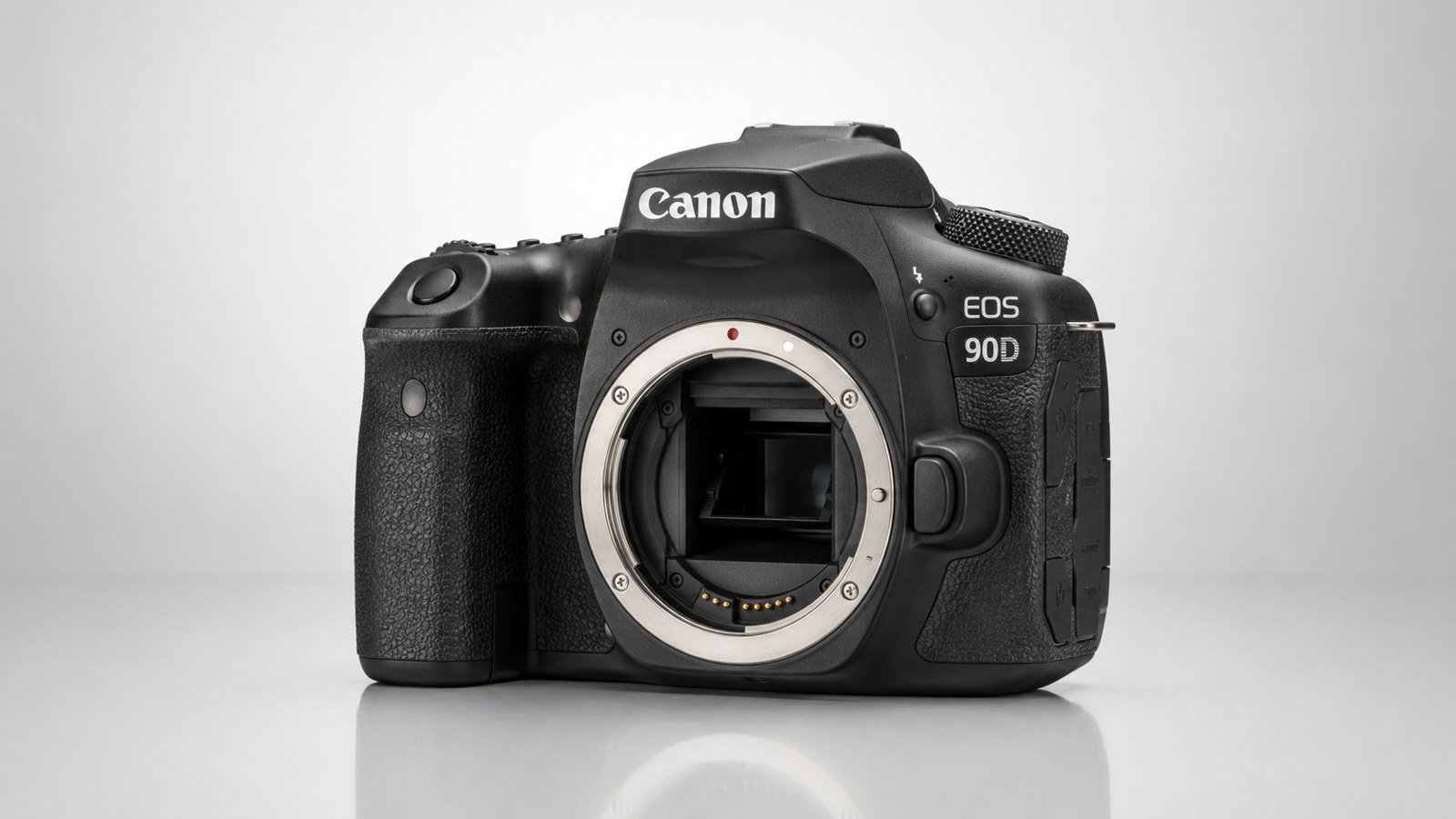
In short
- The 2019 Canon 90D is Canon's last serious APS-C DSLR: 32.5 MP, the densest APS-C sensor ever mounted on an EOS, 10 fps and 4K UHD without crop.
- On the used market today, the camera body alone is found between 650 and 850 euros, often with 15,000-40,000 shutter count on a shutter rated for 120,000 cycles.
- It makes sense for those who already have EF/EF-S lenses and want reach in nature and sports photography without switching to mirrorless; for those starting from scratch in 2026, the Canon R7 is the more forward-looking choice.
- The main risk on the used market is the actual shutter count and the condition of the shutter: we certify both in our lab before sale.
The Canon 90D arrived in 2019, when almost everyone had written off DSLRs. Canon did the opposite: it packed the densest APS-C sensor ever seen on an EOS, 32.5 megapixels, into a body designed to last. It remains the company's last high-end APS-C DSLR, and probably will be forever.
This article aims to clarify one thing: is buying a used 90D today a smart choice or a nostalgic purchase? Let's look at what it truly does well, where it shows its age, what it costs on the used market, and who it suits best compared to alternative DSLR and mirrorless options. No sugarcoating, because a 90D bought for the wrong reasons will just sit in a drawer.
What is the Canon 90D and why is it a boundary model
The Canon 90D was released in August 2019, when Canon had already launched the EOS R and was betting everything on the RF mirrorless system. Yet it chose to push the APS-C format to the limit on this camera body: 32.5 megapixels. This is no small detail: it is the last serious APS-C DSLR Canon has built, and it will likely remain so.
We call it a "borderline model" because it sits exactly on the line between two eras. It has the soul of a DSLR — optical viewfinder, mechanical shutter rated for 120,000 cycles, semi-pro body ergonomics — but it was born when that world was already closing. Buying it today on the used market means buying the last chapter of a historic series, not a transitional model.
The successor to the 60D-70D-80D line
The xxD series has been Canon's "serious yet accessible" tier for years, sitting above the entry-level models and below the full-frame ones. The 90D brings this lineage to a close:
- Canon 60D (2010) — 18 MP, the camera that brought DSLR video to many enthusiasts.
- Canon 70D (2013) — 20 MP, debut of Dual Pixel AF in live view.
- Canon 80D (2016) — 24 MP, 45-point cross-type AF, the standard of the category.
- Canon 90D (2019) — 32.5 MP and 10 fps, the last and most advanced.
The step up from the 80D is concrete: from 24 to 32.5 MP, from 7 to 10 fps, and crop-free 4K UHD, which the 80D lacked. If you have a Canon 60D — currently available from us for 210 euros, still an honest machine for learning — the 90D is two generations ahead in resolution, burst rate, and video, while using the same EF-S lenses.
Born contrarian
Why did Canon launch a DSLR in 2019 while pushing the RF system? Because the EF and EF-S lens park was still massive, and millions of photographers were not ready to buy everything again. The 90D was designed for those who wanted a quality upgrade while staying within their existing kit, without adapters or new expenses.
This makes it a rational choice even today, but with a clear expiration date: Canon has not developed any APS-C DSLRs since this model. It is the last of its kind, and it should be evaluated with the understanding that the future of the system lies elsewhere.
The 32.5 MP sensor: what changes in practice
The 90D features the densest APS-C sensor ever seen on an EOS: 32.5 megapixels on a surface of 22.3 × 14.9 mm. To understand what this means, consider a comparison. A 30 MP full frame camera like the EOS 5D Mark IV distributes those pixels over an area 2.6 times larger. The 90D packs them all into the APS-C format. The result is an extremely high pixel density, which cuts in two opposite directions.
Reach and crop: the advantage for nature and sports
More pixels on the subject means more detail when the subject is far away. With a telephoto lens like the 100-400mm, the APS-C 1.6x crop factor brings the field of view to a 160-640mm equivalent. The 90D adds density: you can crop a portion of the frame in post and retain enough pixels for a decent print or post.
In practice, those who photograph birds, wildlife, or sports from the stands gain an advantage. A heron at 30 meters captures the texture of the feathers clearly, where a 24 MP camera would start to blur the fine details. This is why many nature photographers kept the 90D even after switching to mirrorless: as a low-cost reach body, it still does its job.
The downside: noise at high ISO and demanding lenses
More megapixels are never free. Individual photosites are smaller, gather less light, and this is evident in two specific areas:
- Noise beyond ISO 3200. Up to ISO 1600, the output is clean. From ISO 3200 upwards, noise becomes visibly apparent, and beyond ISO 6400, it is advisable to work in RAW and accept some reduction in post-processing. For dark interiors or night shots without flash, this is the most concrete limitation of the camera body.
- Lenses put to the test. 32.5 MP reveal every weakness of the lens. The 18-55mm kit lens or an old, budget 75-300mm lacks the resolving power to fully utilize the sensor: mount Canon's densest camera body and you will see soft images at the edges.
The practical consequence is simple: the 90D performs best with high-quality lenses, such as a 17-55mm f/2.8 EF-S or a sharp prime. If you plan to use it only with the kit lens, you are likely utilizing only half of the sensor's potential. It is better to know this before buying and to evaluate whether your budget should truly go toward the camera body or a better lens.
Autofocus, burst rate, and video: where the 90D remains competitive
The 90D features two autofocus systems coexisting within the same camera body, and knowing when to use one over the other makes the difference between sharp shutter counts and wasted frames. The optical viewfinder utilizes a 45-point module, while the screen in live view engages the Dual Pixel system. These are two distinct approaches with non-overlapping strengths.
45 cross-type points and Dual Pixel in live view
All 45 phase-detection AF points in the viewfinder are cross-type, which is the real advantage: they read contrast both vertically and horizontally, so they lock onto tricky lines like a fence or the edge of a wing with ease. It is a fast and responsive system for single subjects, but subject recognition is limited compared to a mirrorless: no eye tracking in the viewfinder, no persistent tracking across the entire frame.
In live view, everything changes. The Dual Pixel system covers most of the frame, focusing with precision without the hunting typical of pure contrast detection, and offers on-screen face and eye detection. For static portraits and video, it is more reliable than the viewfinder; for fast action and burst shooting, the optical viewfinder remains more immediate.
10 fps and 4K without crop: honest numbers
The 10 frames per second are real, not a marketing peak, and you can maintain them for a few seconds before the buffer fills up. Here is what to expect in practice:
- Burst: 10 fps with the mechanical shutter. With 32.5 MP RAW files, the buffer fills up quickly; on a fast UHS-II card, you recover much sooner.
- 4K UHD 30p Video: no crop, so you utilize the full angle of your lenses. This is the 90D's strong suit compared to many previous DSLRs.
- Rolling shutter: present in 4K and noticeable during fast pans or when subjects cross the frame. It is not a body designed for cinematic motion shots.
The meaning of these figures is clear. For nature, amateur sports, and wildlife photography, the 90D holds up well: solid burst rate, APS-C reach, and clean 4K video for non-professional content. Ask it for tracking performance from a latest-generation mirrorless or high-motion video without artifacts, and it shows its age.
Canon 90D: key specifications at a glance
| Feature | Value | What it means in practice |
|---|---|---|
| Sensor | APS-C 32.5 MP | The densest ever mounted on an EOS: maximum detail and crop |
| Burst | 10 fps with AF | Sufficient for amateur sports and nature |
| Viewfinder AF | 45 cross-type points | Wide coverage, reliable in good light |
| Video | 4K UHD 30p without crop | Full angle, rare on APS-C DSLRs |
| Shutter | 120,000 certified shutter count | Body designed to last for years |
| Battery | LP-E6N, ~1,300 shutter count | DSLR-grade battery life, superior to mirrorless |
How much does a used Canon 90D cost today
In 2026, a Canon 90D body only is priced between 650 and 850 euros. This is a solid price for a DSLR released in 2019, and there is a reason: Canon has not produced anything similar in the APS-C DSLR segment since, so the used market lacks a direct successor that would drive down its value. Sellers of the 90D do not sell at a loss, and buyers know exactly what they are getting.
Price ranges for body and kit
The difference between body and kit matters, because the included lens has real market value. Here are the price ranges we see on the counter today.
| Configuration | Used Price Range 2026 | Notes |
|---|---|---|
| Body only | 650 - 850 € | Price depends on shutter count and condition. |
| Kit with EF-S 18-135mm IS USM | 850 - 1.050 € | The new lens is worth about 450 €: in the kit, you pay much less for it. |
Under €650 for a body alone? Raise your eyebrows: either the shutter count is high, accessories are missing, or something is off. Over €850, expect a like-new camera with a low shutter count and a complete kit.
How shutter count and condition affect the price
The shutter count of the 90D is reported at 120,000. In the used market, we typically find units between 15,000 and 40,000, meaning cameras with plenty of life left. However, the actual count is the variable that most impacts the price, and it does not always match the figure declared by a private seller.
- Under 20,000 shutter count: justifies the upper end of the price range. Body is practically broken in.
- Between 20,000 and 50,000: normal range, full market price.
- Over 80,000: value drops, and the mechanical condition of the shutter must be evaluated, not just the number.
Worn tires, dials, and joysticks also count, as do a clean sensor and the presence of the original box, charger, and LP-E6N battery. If you want to understand the method for arriving at a fair price, we have explained it step by step in the guide to valuing a used Canon: the logic is the same for the 90D as well.
Who it's really for (and who it's not)
The Canon 90D is not a camera for everyone, and it is right to say so before recommending it. It is a body designed for those who already have one foot in the Canon DSLR ecosystem and want to get the most out of that lens park for years to come. Outside of that profile, it often makes sense to look elsewhere.
The ideal profile for the 90D
If you have a drawer full of EF and EF-S lenses, the 90D is probably the last body where you can use them without compromises. No adapters, no vignetting, no slowed-down autofocus: your lenses work exactly as they were designed. This applies to a Canon 70-300 telephoto, a 50mm f/1.8, or a 17-55 f/2.8 that would otherwise sit idle.
The second profile is for those who live on reach. A dense APS-C sensor paired with a telephoto lens means getting closer to the subject without spending 3,000 euros on optics. Here is who it truly makes sense for:
- Naturalist and birdwatcher: the 1.6x crop turns a 400mm into a 640mm equivalent, with enough detail to crop further.
- Those who follow sports and photo hunting: 10 fps and a shutter rated for 120,000 cycles handle continuous bursts without wear anxiety.
- Those who refuse to give up the optical viewfinder: a battery that lasts a full day, zero lag, zero blackout. For many photographers, it is still the natural way to frame.
When it is the wrong choice
We are a Canon store, but bad advice doesn't lead to happy customers. If you are in any of these situations, the 90D is not the right answer.
- Start from scratch in 2026: without EF/EF-S lenses to recycle, you are investing in a system that Canon no longer evolves. The Canon R7, its spiritual successor, offers the same dense APS-C sensor with a future ahead.
- You mainly shoot video: uncropped 4K is good, but Dual Pixel in a DSLR lags behind the continuous tracking of a dedicated mirrorless.
- You seek lightness: 701 grams of camera body plus DSLR lenses do not fit into a minimal travel bag. If weight is a constraint, the 90D works against you.
In short: the 90D is a bargain for those who choose it with full knowledge, not a fallback for those unsure where to start.
Used 90D vs. alternatives: older DSLRs and mirrorless
The 90D doesn't stand alone in the Canon catalog. Below it are APS-C DSLRs that cost a third of the price, and above it is the mirrorless model that inherited its sensor. Before signing the check, it's worth understanding whether you really need the 90D or if you're paying for specs you won't use.
If your budget is tight: older Canon DSLRs
If you are just starting out and are not yet sure how much you will shoot, spending 700 euros on a camera body makes little sense. Previous Canon DSLRs do exactly the same educational job: they mount the same EF-S lenses, have the same controls, and teach you shutter speeds and apertures in the same way.
| Model | Price | For whom |
|---|---|---|
| Canon 600D | 200 € | First absolute DSLR, tilting screen to learn |
| Canon 650D | 220 € | Like the 600D but with touchscreen and first-generation hybrid CMOS AF |
| Canon 60D | 210 € | Sturdier body, dual dials, for those who want xxD controls |
These are older camera bodies, of course: no 4K, slow burst rate, and high ISOs that degrade quickly. But for portraits, travel, and landscape photography in good light, the difference with the 32.5 MP sensor is only visible at 100% on the monitor. If you get the hang of it, the 90D is waiting for you, and you can take your EF-S lenses with you.
Looking to the future: the Canon R7 mirrorless
The Canon R7 is the spiritual successor to the 90D: the same high-resolution APS-C concept, housed in a mirrorless camera body. The subject and eye tracking autofocus is from another era compared to the 45 points in the optical viewfinder, and the shutter speed rises well beyond 10 fps. For those starting from scratch in 2026, it is the most forward-thinking choice.
The downside: your EF-S lenses on the R7 require an adapter, and there are still few native RF-S lenses available. It’s the same “mature used vs. new generation” reasoning we apply in this comparison of the Nikon D780: if you already have an EF/EF-S lens kit, the 90D saves you hundreds of euros immediately; if you still need to build your kit, investing in mirrorless avoids buying twice.
90D vs. alternatives on the used market
| Model | Type | Indicative used price | For whom |
|---|---|---|---|
| Canon 90D | DSLR APS-C 32.5 MP | 650-850 € body | For those who want reach and robustness with EF-S lenses |
| Canon 60D | DSLR APS-C 18 MP | approx. 210 € | For beginners with a minimal budget |
| Canon 650D | DSLR APS-C 18 MP | approx. 220 € | For those who want a touchscreen and lightness at a low cost |
| Canon R7 | Mirrorless APS-C 32.5 MP | 900-1.100 € body | For those looking to the future and wanting modern AF tracking |
The pitfalls of used gear: what to check on a 90D
A 90D can be three years old or one month old: you can't tell from the outside. What determines how much life it has left is the shutter count, and on this model, it's the first piece of data you must demand. Before looking at the body's exterior or aesthetics, ask for the shutter count and how it was obtained.
Shutter and certified shutter count
Canon rates the 90D shutter for 120,000 cycles. This is a reference value, not a hard limit: many shutters exceed the threshold without issues, while others fail earlier. However, on a body that frequently operates at 10 fps — sports, nature, wildlife photography — shutter counts accumulate quickly, and 120,000 can be reached within a couple of years of intensive use.
The problem with private-party used gear is that almost no one knows the shutter count. Canon does not display it in the camera menu, unlike Nikon and Pentax. You need to connect the camera body via USB to dedicated software (EOSInfo, ShutterCount) that reads the counter from the camera, and the average seller has never done this. Here is what you should check:
- Real shutter count: demand the number, not "I've barely used it".
- Shutter: shoot in burst mode and listen for a regular rhythm, without stutters or slowdowns.
- Sensor: take a photo at f/16 against a white wall to reveal dust and scratches.
- Dual Pixel AF: test autofocus in live view and video, not just through the viewfinder.
- Ergonomics: check the joystick and rear dial, the controls that wear out first.
- Batteries: original LP-E6N batteries degrade; check their health in the menu.
If these checks seem like a lot, it is because they are. This is the same reason we wrote a guide to used DSLRs under 500 euros: in the used market, the condition of the specific unit matters more than the model.
What we do in our workshop
Every 90D that comes to us undergoes a review before being put up for sale. We certify the shutter count read from the metadata, test the sensor for dust and scratches, verify the AF both through the viewfinder and in Dual Pixel, and check the condition of the batteries. We apply a 2-year warranty to all used items. This means the shutter count you see in the listing is not just the seller's word: it is a measured data point.
Frequently Asked Questions
Is the Canon 90D still a good choice in 2026?
Yes, if you already have EF or EF-S lenses and are looking for a robust body with an optical viewfinder for nature, sports, or general use. Its 32.5 MP and 10 fps still hold up well. If you are starting from scratch, consider the mirrorless Canon R7, which shares the same sensor but features a more modern AF system.
How many shutter count does the Canon 90D shutter last?
Canon states a shutter count of 120,000. In practice, many units far exceed this limit. A used 90D with 30,000-40,000 certified shutter count has most of its useful life ahead of it. The problem is that private sellers often do not know the actual count: we certify it in our laboratory.
Which is better: the used Canon 90D or the Canon R7?
It depends on the lenses. The 90D natively uses EF/EF-S lenses and costs less; the R7 mounts RF lenses and has significantly superior subject-tracking AF. If you already have an EF-S lens kit, the 90D is more cost-effective. If you are building from scratch and want a long-term investment, the R7 is the more forward-looking choice.
Are the 32.5 megapixels of the 90D too many for APS-C?
There are many, and they require good optics to be fully exploited: a cheap kit lens cannot resolve all that detail. At high ISOs, above 3200, the small pixels show more noise compared to less dense sensors. However, with quality lenses and good light, the detail is remarkable.
Is the Canon 90D good for video?
For amateur and semi-pro use, yes: it records 4K UHD at 30p without crop and features Dual Pixel for smooth autofocus during video. It lacks in-body image stabilization, so a stabilized lens or a tripod is required. For serious video with advanced AF, a recent mirrorless camera performs better.
How much does a reliable used Canon 90D cost?
In the 2026 used market, the camera body alone is priced between 650 and 850 euros, depending on the shutter count and condition. A kit with an 18-135mm lens costs an additional 150-250 euros. Be wary of prices that are too low from private sellers: they often hide a high shutter count or undeclared shutter problems.
What is the difference between the Canon 90D and the older 60D or 650D?
A huge generational leap: the 90D has nearly twice the megapixels, a faster burst rate, 4K, improved AF, and a full touchscreen. The 60D and 650D remain excellent for getting started at just over 200 euros, but they are DSLRs from 2010-2012. The 90D is a current camera body that closes an era.
Looking for a used and certified Canon 90D?
If you have doubts about a purchase or need advice for your specific case, contact us. We offer free advice because we are photographers first, and because a customer who buys poorly does not return to photography.
Three ways to get in touch:
- Contact form — response within 24 business hours
- WhatsApp at 342 362 3454 (messages only)
- Phone: 071 291 6347 (Mon-Fri 9-13/15-18, Sat 9-13)
And if you want to see what we have in stock right away, explore the used inventory available today: every camera is certified, comes with a 2-year warranty, and ships within 24-48 hours.
Article written by Matteo for the ReflexMania Team. Last updated: July 2026. Prices and availability as of the time of publication.