
In short
- For street photography, discretion matters more than megapixels: an APS-C body under 500 grams with a 35mm equivalent lens goes unnoticed where a DSLR does not.
- Used Sony APS-C 6000 series and Nikon Z30/Z50 range from 360 to 800 euros, featuring eye-detection autofocus that locks onto a moving subject in less than 0.1 seconds.
- Compact full frame makes sense especially for night street photography: used Sony A7 II or Canon EOS RP (520-600 euros) handle ISO 6400 with manageable noise.
- The silent electronic shutter often matters more than the sensor: shooting without the mechanical click changes how people react on the street.
The first time I tried street photography with a DSLR and a 24-70, I realized within two minutes what was wrong: everyone was watching me. The bulky body, the protruding black barrel, the shutter click. Street photography lives on unscripted moments, and a bulky camera kills them before you even take a shot. Since then, when someone at the counter asks me for street gear, I always start with one question: how inconspicuous do you want to be?
In this article, I discuss what truly makes a camera suitable for street photography: weight, dimensions, silence, autofocus responsiveness, and low-light performance. No magazine-style rankings, no "best overall" claims. I show you specific models we have used and certified, with real prices, and I also tell you when a body that looks perfect on paper becomes dead weight on the street.
What a street camera really needs
The right camera for the street is the one people don't notice. In ten years at the counter, I've seen photographers return discouraged from a day of street photography with a full-frame DSLR and a 24-70: technically perfect shutter counts, but every shot posed, because the subject had spotted the lens from twenty meters away. The problem wasn't the photographer. It was the wrong gear for the context.
Discretion first
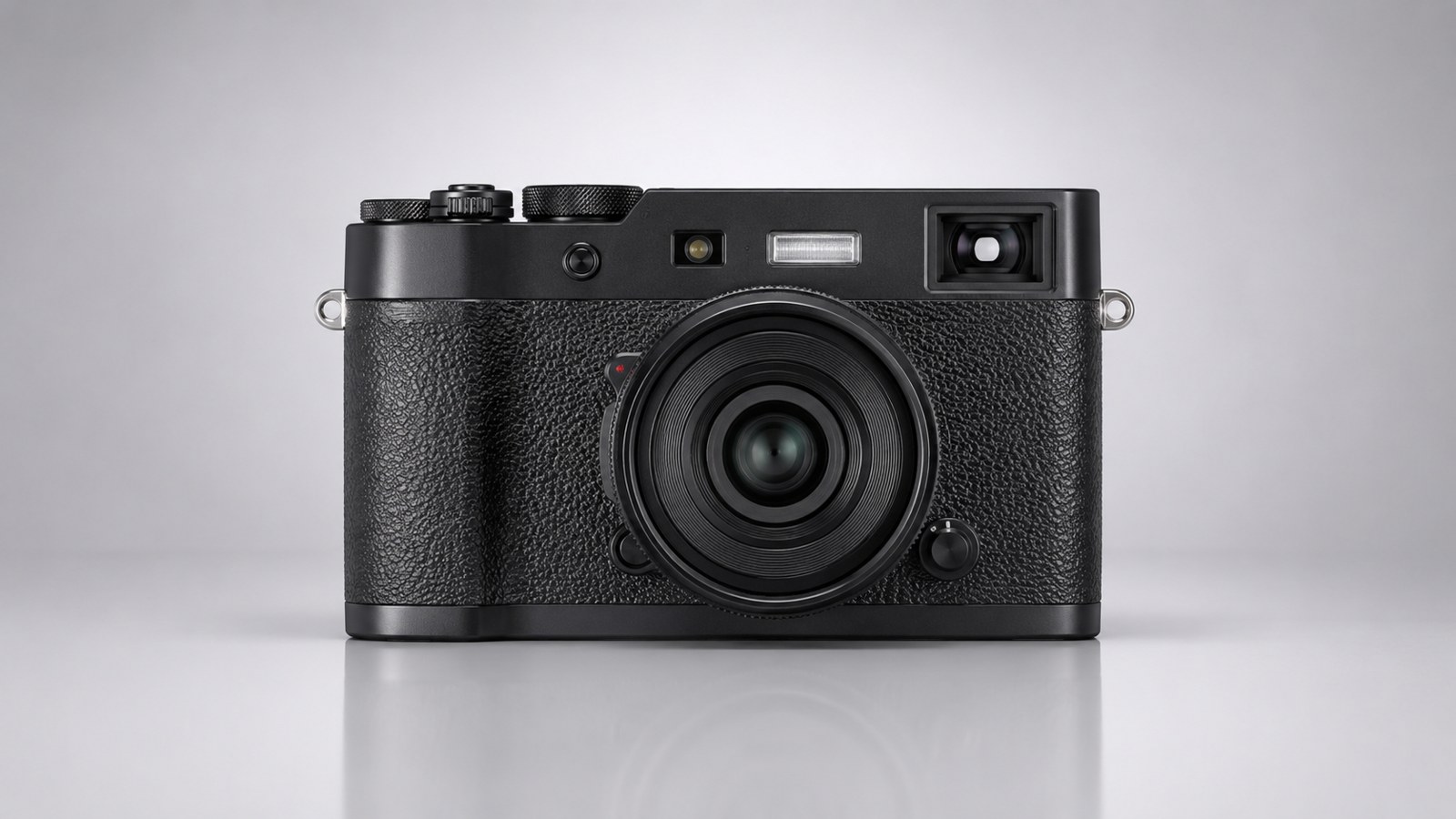
A small, dark body changes the behavior of the person in front of you. A black APS-C mirrorless with a 35mm equivalent lens is mistaken for a tourist's camera, and no one notices a tourist. A DSLR with a lens hood and a protruding zoom lens communicates "working professional," and people stiffen or turn away. Street photography lives on unfiltered gestures: a laugh, a glance, a step. All of this vanishes the exact moment the subject realizes they are being photographed. Going unnoticed is not an aesthetic issue; it is the technical condition for obtaining true shutter counts.
Weight and size: the 8-hour limit
A real day of street photography means six to eight hours on your feet, walking. Here, weight stops being a spec sheet detail and becomes the factor that determines how many photos you bring home. The rule I give to anyone coming into the shop is simple.
- Under 500-600 grams (body + lens): you can wear it around your neck or hold it in your hand all day and forget it's there.
- Between 600 grams and 1 kg: it lasts half a day, then you start leaving it in your bag "to rest".
- Over 1 kg: you give up by midday. And the best camera is always the one you have with you, not the one in your bag.
What DOESN'T matter as much as you think
Marketing pushes megapixels, 20 fps burst rates, and 4K video. For street photography, these are almost irrelevant. You can easily make a 30x45 print with 24 megapixels, and online you use a fraction of that. A 20 fps burst is not for those who anticipate the moment: it is for those who hope to catch it by chance. What matters is responsiveness: how quickly the camera turns on, focuses, and takes the shot between the moment you see the scene and the moment you press the button. Those fractions of a second make the difference between the shot and the regret.
Silence: Why the Electronic Shutter Changes Everything
On the street, the noise you make matters as much as the image you capture. A mechanical shutter produces a click clearly audible from three meters away, and that click is the signal that tells the subject "I just took your photo." The electronic shutter eliminates that signal: the sensor reads the exposure without any moving parts, and no one notices the shutter count.
The silent shutter and people's reaction
The difference is not aesthetic, it is methodological. With silence, you can work at close range, repeat the shutter count two or three times to capture the right expression, and the scene remains intact. The person does not stiffen, does not turn their head, and does not ask what you are doing.
Almost all Sony APS-C 6000 series cameras offer a completely silent shutter mode from the menu. The Sony a6600 at 800 euros is the most complete in the series: in-body image stabilization and an extended battery that lasts a full day of street photography. The Sony A6400 at 650 euros does the same job without internal stabilization, but with the same ultra-fast autofocus: for those who shoot during the day, it is the most sensible price cut.
The downside: rolling shutter and artificial lights
The electronic shutter isn't free. The sensor reads the lines from top to bottom in a handful of milliseconds, and this creates two concrete problems you will actually encounter in the field:
- Distortion of fast-moving subjects. A cyclist, a car, or a rapidly moving arm appears skewed or "tilted" because each row is captured at a different instant. This is the rolling shutter effect.
- Flicker under LED and neon lights. Artificial lights pulse at 50 or 100 Hz. The electronic shutter reads them mid-cycle, producing light and dark horizontal bands across the image, typical of shop windows and evening signage.
The practical rule is simple: use the silent shutter when the subject is stationary or moving slowly and the light is natural; use the mechanical shutter when framing rapid movement or working under artificial lighting. On Sony 6000 series camera bodies, the switch is a menu option, so you don't have to compromise on anything: change the mode based on the scene. Learning when to use one versus the other is worth more than any sensor specification.
APS-C compacts: the ideal compromise for street photography
This is the sweet spot for street photography. An APS-C body under 500 grams features a sensor large enough for 40 cm prints and clean files up to ISO 3200, yet remains as compact as a point-and-shoot. On the street, you feel the difference: no one gets suspicious of a camera that looks like a tourist's. It's the same reason why a 35mm equivalent goes unnoticed where a 24-70 does not.
Sony 6000 series: compact and extremely fast autofocus
The Sony 6000 series remains the benchmark for size and responsiveness. The real difference between models is the autofocus, not image quality: the 24-megapixel sensor is essentially the same.
- Sony A6000 at €360: Sony A6000 — Phase-detection AF is still fast; eye-AF is available only in single-shot mode (AF-S) and does not track moving subjects. More than sufficient for daytime zone-focus street photography.
- Sony A6100 at €550: Sony A6100 — Features modern eye-AF, locking onto the eye in less than a tenth of a second. The useful step up from the A6000.
- Sony A6400 at €650: Sony A6400 — Same AF as the A6100 but with better build quality and a sharper viewfinder. The choice for serious street photography.
- Sony a6600 at €800: Sony a6600 — Adds in-body image stabilization and a larger battery. Only makes sense if you shoot for long periods or in fading light.
In practice, under €600, the A6400 is the best compromise. I only recommend the a6600 to those who truly make use of IBIS and battery life.
Nikon Z30 and Z50: ergonomics and grip
Nikon APS-C cameras win on handling. The grip is more pronounced than on Sony models, and for those with long fingers, this makes a significant difference. The Nikon Z30 at €450 is the lightest and lacks a viewfinder, designed for those who frame using the monitor. The Nikon Z50 at €470 adds a viewfinder, which is essential in bright sunlight. The Nikon Z50 Mark II at €780 features the latest generation AF with subject recognition, the real reason to spend more. The Z DX lens lineup is still young but growing.
Canon EOS R100: the affordable entry point
The Canon EOS R100 at 400 euros is the most affordable mirrorless camera body in our catalog. No in-body stabilization, basic AF, simple viewfinder: but it is honest. For those who want to find out if street photography is for them without investing too much, it is a sensible starting point. We have 4 units available.
When a compact full frame makes sense
Full frame on the street is not an automatic upgrade: it is a choice you pay for in weight and money, and it only makes sense in two specific scenarios. The first is low light, where the larger sensor handles high ISOs with manageable noise. The second is pronounced bokeh, when you want to isolate a face from the chaos of the sidewalk. For everything else, a compact APS-C does the same job with half the bulk.
Sony A7 II and Canon EOS RP: full frame without the weight
These are the two most compact full-frame bodies we keep in our catalog, and the difference compared to a full-frame DSLR is noticeable in your bag. The Sony A7 Mark II starts at 520 euros: it features a 5-axis in-body image stabilizer, which is invaluable when shooting at slow shutter speeds in the evening without a tripod. The Canon EOS RP ranges between 550 and 600 euros and is the lightest among modern full-frame models, with an ergonomics that accommodates larger hands.
What you get with these camera bodies:
- Higher usable ISO: in the same scene, you gain a couple of stops over an APS-C before annoying noise appears.
- Softer bokeh: the large sensor separates the subject from the background with a distinction that better tells the story of the scene on the street.
- More flexible files: in post, you recover burned shadows from an underpass or a backlit shop window.
The real cost of full frame: lenses
This is the honesty that saves you from disappointment. The camera body is compact, but full-frame lenses are not. A 35mm f/1.8 for Sony A7 or a 35mm f/1.8 RF for the EOS RP weighs and takes up significantly more space than the APS-C equivalent, and once mounted, the advantage of the lightweight body diminishes.
The complete system you carry in your pocket weighs as much as an APS-C with its 35mm equivalent, sometimes more. If absolute discretion is the priority, the compact full frame is not the right choice: it is the right choice when the gain in low light matters more than the weight. Evaluate the camera body and the lens together, never the body alone on the spec sheet.
In practice: grab an A7 II or an EOS RP if you do a lot of night street photography or want candid portraits with a soft background. For daytime shooting around the city center, an APS-C body serves you better and is less tiring to carry.
Micro 4/3 and Fujifilm: alternatives not to be overlooked
Sony and Nikon do not hold a monopoly on street photography. Micro 4/3 and Fujifilm offer camera bodies and lenses designed exactly for those who walk all day with the camera around their neck. But beware: not all bodies in these ranges are suitable for the street. Two examples from our catalog demonstrate this well, as they are both excellent devices that, however, show a precise limitation on the street.
Panasonic GH5: tiny lenses, not-so-tiny body
The real strength of the Micro 4/3 system lies in its lenses. The 2x crop factor allows for short and lightweight lenses: a 17mm f/1.8 (34mm equivalent) fits in the palm of your hand and weighs just over 100 grams. For street photography, where you want a discreet 35mm equivalent, it is a godsend.
The Panasonic GH5, which we have at 470 euros, only makes use of this advantage to a limited extent. It is a camera body designed for video: robust, weather-sealed, with a generous grip and a weight that is noticeable. Mount a pancake lens on it and you have an unbalanced combination. For pure street photography, there are smaller and lighter M4/3 bodies.
Who is the GH5 really for? Those who do street and video together: urban reportage, neighborhood documentary, photo-video hybrid. In that case, the body oriented toward video becomes an asset, not a dead weight. If, however, you only take street photos, your budget will go further elsewhere.
Fujifilm X-H1: great image quality, but heavy
Fujifilm is almost synonymous with street photography: dial-based ergonomics, JPEG color rendering that many use straight out of camera without editing, and a retro aesthetic that puts the subject at ease. The issue is the model.
The Fujifilm X-H1, at 650 euros, is the largest and heaviest body in the entire X range. It had a semi-professional vocation: in-body image stabilization, robust build, substantial grip. All qualities that, on the street, work against the discretion you are looking for.
Don't get me wrong: the sensor performance is excellent and the stabilization is useful in the evening. But if your priority is to go unnoticed, the Fuji range offers much more compact bodies, ideal for traveling light.
| Model | Price | Best for |
|---|---|---|
| Panasonic GH5 | 470 € | Hybrid photo-video, tiny M4/3 lenses |
| Fujifilm X-H1 | 650 € | For those wanting Fuji rendering and stabilization, accepting the weight |
Bottom line: both are good cameras, but for pure street photography, they are choices to make with eyes wide open. You buy the system for its lenses, not for these two specific bodies.
The right lenses: 35mm and 50mm equivalents
On the street, the lens matters more than the body. A small, fast prime mounts on any APS-C compact and disappears in your hand; a large 24-70 zoom turns the same camera into an object people notice from twenty meters away. For street photography, you need two numbers: 35mm and 50mm equivalents. Everything else is an exception.
Why a prime lens beats a zoom on the street
A 35mm equivalent prime lens often weighs less than 150 grams, opens to f/1.8 or f/2, and has no barrel that extends when focusing. A standard zoom lens offers convenience, but at the cost of weight, size, and brightness: most 16-50mm kits stop at f/3.5-5.6, making them unusable as light fades.
There is a less obvious advantage. A prime lens removes the choice of focal length, so you compose with your feet. You move closer, change the angle, and anticipate the scene instead of zooming from a distance. It is annoying for the first few days, then it becomes the reason you take better shots. On the street, reaction speed matters more than theoretical versatility.
35 or 50? How to choose your focal length
The two focal lengths tell the story of the street differently. The 35mm equivalent includes the context: the subject and the place where it is located. The 50mm equivalent isolates, compresses the background slightly, and works for the candid portrait taken at close range.
| Focal Length | Render | When |
|---|---|---|
| 35mm eq. | Wide scene, context | Crowded streets, markets, urban architecture |
| 50mm eq. | Isolated subject, soft background | Candid portrait, detail, raking light |
If you're starting from scratch, begin with the 35mm equivalent. It forgives compositional errors, works well in tight spaces, and gets you used to being inside the scene rather than photographing it from the outside. Add the 50mm later, once you know what you're looking for. If you're interested in going longer, you can find our reasoning on long focal lengths in our guide on how to choose your first telephoto lens, but for street photography, you rarely need it.
Night street and low light
At night, the city changes its rules. Illuminated shop windows, streetlights, and signs create strong contrasts, but the light drops sharply as soon as you step out of a streetlight's cone. Here, a light and silent camera is no longer enough: you need a sensor that can handle high ISOs without breaking down the image. This is the only street scenario where full frame truly gains ground over APS-C.
How much ISO do you need in the city at night
On a streetlight-lit sidewalk, using a 35mm equivalent f/2 and a shutter speed sufficient to freeze a passerby, you will end up between ISO 3200 and 6400. At these values, a good APS-C still holds up: the Sony a6600 (800 euros, dual-capacity battery for long evenings) produces cleanable files up to 6400 without issues.
The full-frame advantage is roughly one real stop: where APS-C tops out at 6400, the Sony A7 Mark II (€520-570) and the Canon EOS RP (€550-600) handle 12800 with finer noise that is easier to recover. It is not the difference between day and night, but in a dark alley, that stop is the difference between a usable shutter count and one to be discarded.
- Shop windows and signage: ISO 1600-3200, any APS-C works perfectly.
- Streets with sparse streetlights: ISO 6400, APS-C holds up, full frame breathes.
- Nearly dark corners: ISO 12800, here the compact full frame makes the difference.
Stabilization: helps but does not stop movement
When a manufacturer claims "5 stops of stabilization," they mean the camera body is steady in your hands, not the subject. The IBIS in the A7 Mark II and a6600 allows you to shoot a sign or an empty street at 1/15 second without blur. But a person walking at 1/15 becomes a streak, with or without a stabilizer.
On the street at night, shutter speed is what matters, not stabilization. To freeze a passerby, you need at least 1/125, and at that point, stabilization is irrelevant: the sensor and aperture are what count. IBIS remains valuable for static scenes and for recovering one stop when raising the ISO makes you nervous. If you want to push further with slow shutter speeds and urban lights, we discuss it in the night photography guide.
Autofocus and responsiveness: capturing the moment
You never get the same shot twice on the street. The person gesturing, the reflection in the shop window, the dog crossing: you have a fraction of a second, and a slow autofocus will eat it up. That is why, after discretion and silence, AF responsiveness is the third criterion I truly look for in a street camera body.
Eye-AF and tracking: old and new generations
The generational leap here is tangible, not just marketing fluff. The Sony A6000 at 360 euros features a 2014 phase-detection system: it locks onto the central subject well, but continuous tracking struggles, and eye-detection on moving faces loses focus. It works perfectly for predictable subjects, but less so for those moving towards you.
The Sony A6400 at 650 euros changes the game: its Real-time Eye AF locks onto an eye and tracks it as the subject walks, turns their head, or moves in and out of the frame. The Nikon Z50 Mark II at 780 euros brings the same approach to the Nikon lineup, featuring more advanced subject recognition and excellent low-light performance.
| Body | Price | Street Performance |
|---|---|---|
| Sony A6000 | 360 € | Fast central AF, ideal for zone focusing |
| Sony A6400 | 650 € | Eye-AF that tracks moving subjects |
| Nikon Z50 Mark II | 780 € | Modern tracking, excellent in low light |
Zone focusing: the technique that eliminates the problem
There is a way to make AF speed irrelevant: don't use it. Zone focusing is the classic technique for photojournalists. You set manual focus, stop down to f/8, adjust the distance to the hyperfocal, and everything between approximately 2 meters and infinity will be sharp. At that point, just press the shutter: zero lag, zero hunting.
It works on any camera body, including the A6000. It is the same logic regarding pre-focusing that applies to fast-moving subjects in sports photography: those who anticipate the scene do not chase focus; they already have it ready.
What we check in the lab and which one we would choose
A street camera body lives on rapid shutter counts, a stressed shutter, and batteries drained to the last drop. That is why, before listing a mirrorless suitable for street, the lab looks exactly where the street leaves its mark: the certified shutter count, the shutter's health, and the sensor's cleanliness.
Checks on used gear for street photography
Street photography is an intensive but low-intrusion use case: high shutter counts with minimal dust ingress from lens changes in extreme environments. Here is what we inspect on every camera body before sale.
- Certified shutter count: we read the actual counter from the internal EXIF data, not the verbally declared one. An APS-C body with fewer than 20,000 shutter counts still has almost its entire lifespan ahead of it.
- Shutter condition: we verify mechanical timings and electronic integrity. For those shooting silently, the electronic shutter is the real engine, and it must be tested on moving subjects to rule out abnormal rolling shutter.
- Clean sensor: test shot on a uniform background at f/11 to detect dust and spots. If necessary, laboratory cleaning before listing the product.
- Batteries: we measure the residual capacity. Small APS-C bodies have modest batteries, and in the field this means carrying two: we tell you this beforehand, not afterwards.
Every camera body comes with a 2-year warranty. This is not a marketing detail: it means that if the shutter fails at the 30,000th shutter count, the problem is ours, not yours.
Our pick for your budget
Three tiers, three honest answers. No body here is wrong for street: it only changes how far you push it.
| Budget | Camera body | Why |
|---|---|---|
| Under €400 | Sony A6000 — €360 | Compact, lightweight, and its AF is still reliable after 11 years. The best entry point into street photography I know. |
| Around €400-450 | Canon EOS R100 — €400 / Nikon Z30 — €450 | Recent sensors, modern ergonomics. The Z30 is tiny and silent, perfect for staying unnoticed. |
| Over €600 | Sony A6400 — €650 | Eye-detection that locks onto a moving subject in under 0.1 seconds. For those who never want to miss the moment. |
If you could only buy one, and your budget allows it, I would choose the A6400: the autofocus makes a real difference exactly where street photography is most challenging. But starting out today with an A6000 for 360 euros is not a mistake at all.
Frequently asked questions
Is APS-C or full frame better for street photography?
For most street photographers, APS-C is the right choice: smaller, more discreet, and lighter camera bodies and lenses to carry all day. A compact full-frame, such as the Sony A7 II or the Canon EOS RP (520-600 euros used), is particularly worthwhile if you often shoot at night or want a pronounced bokeh. But remember that its lenses remain large and heavy.
How heavy should a camera be for street photography?
Ideally, keep the total weight of the camera body and lens under 500-600 grams. A day of street photography means 6-8 hours on your feet and on the move: beyond one kilogram, you tend to leave the camera in your backpack, and an unshot photo is worth nothing. The APS-C Sony 6000 series with a pancake prime lens comfortably fits within this weight budget.
Which lens is needed to start street photography?
A 35mm equivalent prime is the classic starting point: small, bright, and versatile for urban scenes with context. On APS-C, it corresponds to a 23-24mm actual focal length; on full frame, to a 35mm. A street zoom is bulky and slows down composition: it is better to use a single prime and move with your feet.
Is the silent shutter really important on the street?
Often more than the sensor. The mechanical shutter betrays the photo and alters people's reactions; the silent electronic shutter allows working up close without interrupting the scene. The only limitation is the rolling shutter: with very fast subjects or under LED lights, it is advisable to return to the mechanical shutter.
Does IBIS stabilization help in street photography?
It helps with handheld shooting at slow shutter speeds, but it does not freeze moving subjects. Image stabilization compensates for camera shake, not the motion of a walking person: to freeze motion, you need an adequate shutter speed, at least 1/125s. Do not buy a camera body solely for IBIS, thinking it will solve subject motion blur.
How much does a good used street camera cost?
Starting at 360 euros for a Sony A6000 or 400 for a Canon EOS R100, these camera bodies are already more than sufficient for learning. Around 550-650 euros, you find APS-C models with modern autofocus, such as the Sony A6400. Above that, with the A6600 or Nikon Z50 II (780-800 euros), you add IBIS, a larger battery, and last-generation tracking.
Is it worth buying a used camera for street photography?
Yes, it is one of the most sensible choices. Street photography does not stress the camera body as much as sports or professional video, so a used body in excellent condition lasts for years. The important thing is that it is certified: here, every camera goes through the lab with a certified shutter count, sensor and shutter check, and a 2-year warranty.
Find your street compact with us
If you have questions about a purchase or need advice for your specific case, contact us. We offer free advice because we are photographers first, and because a customer who makes a poor purchase will not return to photography.
Three ways to get in touch:
- Contact form — response within 24 business hours
- WhatsApp at 342 362 3454 (messages only)
- Phone: 071 291 6347 (Mon-Fri 9-13/15-18, Sat 9-13)
If you want to see what we have in stock right away, explore the used gear available today: every camera is certified, comes with a 2-year warranty, and ships within 24-48 hours.
Article written by Matteo for the ReflexMania Team. Last updated: June 2026. Prices and availability as of the date of publication.