
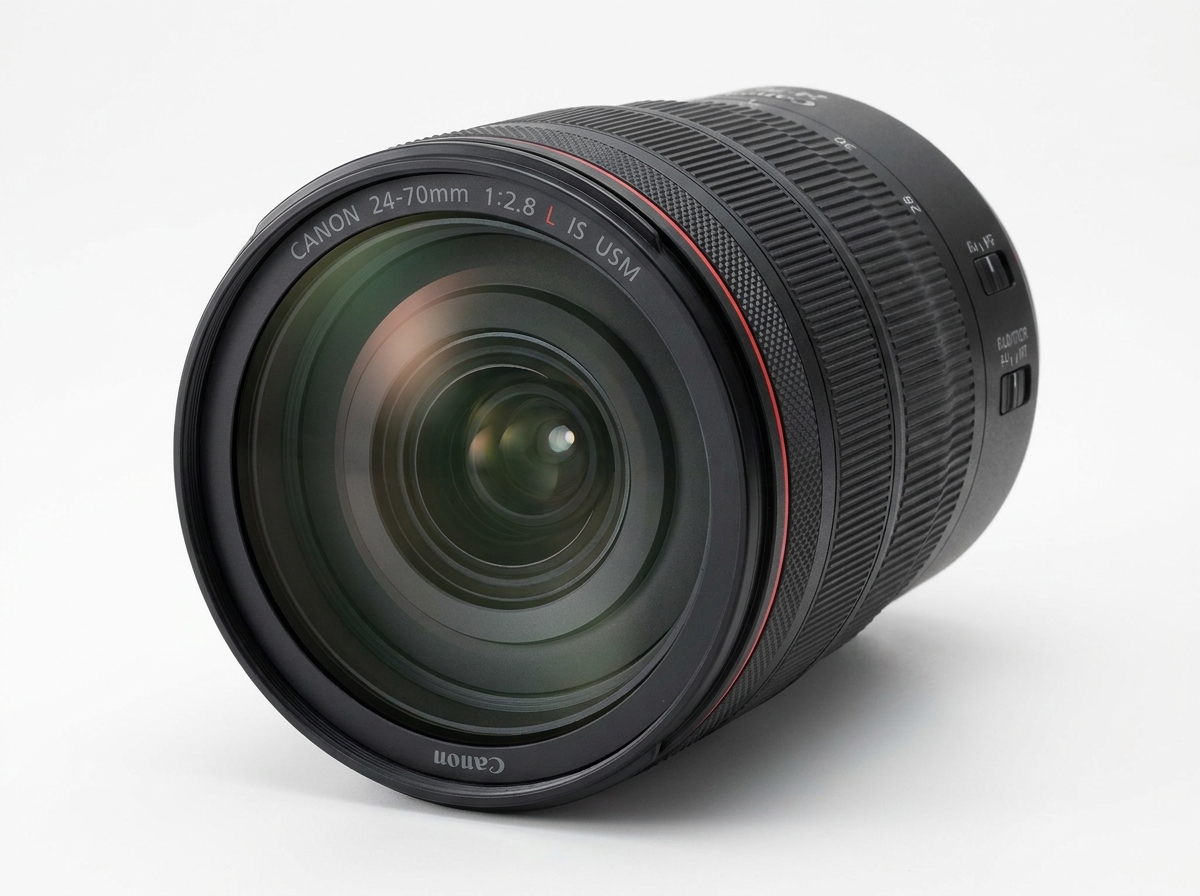
In short
- A used 24-70mm f/2.8 costs €700-1,300 compared to €1,800-2,500 for new, but weighs 800-900 g and is not always necessary.
- The f/4 version weighs 400-500 g, costs half as much, and is often the right choice for those who do not work indoors or at night.
- Defects to check for on a used 24-70 are helicoid play, zoom creep, and fungus on the internal lenses, not just front element scratches.
- On mirrorless cameras, native versions (Sony GM, Nikon S, Canon RF, Sigma DG DN) clearly outperform adapted DSLR lenses in terms of AF and size.
The 24-70mm is the lens I mount first when I don't know what I'll be shooting. It covers the wide angle for landscapes, the 50mm for reportage, and the 70mm for half-length portraits, all without changing lenses. That's why we've called it 'the do-it-all' at the counter for ten years: nine out of ten customers who come in for their first serious zoom end up looking at this one.
Here is what actually changes between versions, when an f/2.8 is worth the price and weight, and when an f/4 will make you happier. Most importantly, here is what to check before buying one used. No marketing jargon: just what we see on the bench and in the lab.
Why the 24-70mm is the quintessential standard zoom
If you could only carry one lens in your bag for a wedding, a trip, or a day of city reportage, it would be a 24-70mm. Not because it is the best at anything, but because it is discreet in almost everything. It covers the wide angle needed for a tight interior and reaches the right focal length for a half-body portrait without you having to change lenses. It is the walking lens by definition: you mount it in the morning and don't take it off until evening.
That is why we call it the "standard". The 24-70mm range covers the focal lengths that the human eye perceives as natural, without the exaggerated distortion of a super-wide-angle or the compression of a telephoto. This is why it alone covers approximately 80% of the shutter count for most photographers in real-world use.
What the 24-70mm focal length actually covers
Every end of the range has a specific role. Moving along the zoom changes the type of photo you are taking, not just the framing.
- 24mm — landscape, architecture, tight interiors, group photos where you need to include everyone without backing up against a wall.
- 35-50mm — the heart of reportage and street photography: the focal length that tells a scene with the proportions the eye expects.
- 70mm — environmental portrait, where the subject separates from the background but remains within the context.
That said, it is a lens that stops where it needs to. At 70mm, you do not have a true telephoto: for photographing a show from the back of the hall or an animal at a distance, you will find it short. And it is not a macro lens: the minimum focus distance allows for some close-up details, but not the 1:1 ratio of a true macro. Those who buy a 24-70 expecting it to also serve as a telephoto or macro will be disappointed, but they are asking the lens to do something that is not its job.
Full frame, APS-C and equivalence
All of the above applies to full frame, the format for which the 24-70 is designed. On an APS-C body, the situation changes, and this is where confusion often arises.
The APS-C sensor is smaller, so it crops the image: the crop factor (1.5x Sony/Nikon, 1.6x Canon) turns a 24-70 into an equivalent 36-105mm approximately. The problem is evident — you lose all the wide-angle. At 36mm equivalent, you can no longer shoot wide landscapes or tight interiors, and the main advantage of the standard zoom disappears.
That is why, on APS-C, the true standard lies in other lenses, such as the 16-50mm or 17-50mm, which deliver an equivalent range close to the 24-75mm. If you have an APS-C camera body, that is where you should look: mounting a 24-70 full-frame lens on APS-C only makes sense if you already own the lens and plan to switch to full frame.
f/2.8 vs f/4: the choice that truly matters
This is where the purchase decision is made, more so than on the brand or lens generation. Between a 24-70 f/2.8 and an f/4, there is a 400-gram difference on the strap and nearly a thousand euros on the receipt. The right question is not "which is better," but "do I really need the extra stop, or am I paying for a number?" For most daytime uses, the honest answer is no.
What really gives you the extra stop
One stop means one thing: at the same exposure, you either halve the shutter speed or halve the ISO. At f/2.8 you shoot at 1/100 where with f/4 you would be at 1/50, or you stay at ISO 1600 instead of going up to 3200. It may seem like little when written down, but indoors, at church weddings, concerts, and evening reportages, that margin is the difference between a clean photo and a blurry one.
The point is that today that margin matters less than it did ten years ago. In-body stabilization recovers three or four stops on stationary subjects, and modern sensors handle ISO 6400 with manageable noise. If you shoot landscape, travel, daytime street, or outdoor portraits, an f/4 aperture comfortably covers 80% of the work. The bokeh of an f/2.8 at 70mm is slightly softer, but on a standard zoom it is never the real reason to buy the lens: for bokeh, get a prime.
Weight and size: 900 g is no joke
This is the item people underestimate in the shop and curse on the road. Here are the real numbers, mount excluded:
| Version | Typical weight | Used price |
|---|---|---|
| 24-70mm f/2.8 | 800-900 g | 700-1.300 € |
| 24-70mm f/4 | 400-500 g | 350-600 € |
On a day of handheld reportage, 900 grams attached to the camera body are felt after three hours, not after ten minutes. When traveling, what goes into the backpack and what stays at home also changes. Many photographers buy the f/2.8 for the security of "having it" and then always mount the f/4 because that is the one they are willing to take out of the house.
Pragmatic advice: if you don't regularly work in difficult light, start with the f/4 and keep the money you save for a better body or a fast prime. The f/2.8 makes sense when low light is your daily bread, not when it happens twice a year.
Mount versions: Sony, Canon, Nikon and Sigma
The same 24-70mm changes its character depending on the mount. On mirrorless, native optics almost always outperform those adapted from DSLR in terms of autofocus, size, and edge performance. However, prices vary significantly, and here the used market rewards those who know the third-party alternatives.
Sony FE: GM, GM II and the Tamron 28-75 alternative
Sony has three paths. The first-generation 24-70 GM can be found used for around 1,000–1,100 euros: excellent optics, but it weighs 886 g and its autofocus is a generation behind the GM II (lighter at 695 g, rarely under 1,700 used). For most photographers, the smart choice is the Tamron 28-75 G2, around 650–750 euros used: you lose 4mm on the wide end, gain 300 g less weight, and save a thousand euros. It mounts well on everything, from a Sony A7 Mark II at 550 euros to a Sony A7r at 700 euros, where the 36 megapixels still demand decent glass.
Canon RF and Nikon Z: native vs. adapted
On Canon RF and Nikon Z, the adapter issue matters. If you already have an EF or F-mount f/2.8 lens kit, the adapter costs 100-150 euros and autofocus remains excellent: it makes sense for those migrating gradually. We have written a dedicated guide to migrating from DSLR to mirrorless on this transition. For those starting from scratch on an accessible body like the Canon EOS RP at 600 euros or the Nikon Z5 at 680 euros, it is worth aiming for native f/4 versions: the RF 24-105 f/4 and the Z 24-70 f/4 S are around 600-800 euros used and weigh less than half of the f/2.8 lenses.
Sigma and Tamron: the smart way to save
The Sigma 24-70 DG DN Art is available in E-mount and L-mount versions, used for around 700-800 euros. Its optical performance is just a step below native lenses and often outperforms first-generation GMs. What you lose, honestly:
- Top-tier autofocus: excellent for stills, one step below native systems in continuous video tracking.
- Weather sealing: present but less robust than on flagship models; I wouldn't use it in heavy rain without protection.
- Firmware: less frequent updates compared to major manufacturers.
For 90% of uses, you won't notice the difference. For the remaining 10% — weddings in the rain, paid video work — the native advantage pays for itself.
Which camera bodies does a 24-70mm fit (and which ones we have in stock)
A 24-70mm performs best on full frame, because that is where the 24-70 range truly remains 24-70. On an APS-C camera body, the zoom works, but the sensor crops the edges, resulting in a 36-105mm equivalent: you lose the wide angle exactly where it is needed. That is why the first consideration should not be "which zoom," but "on which body am I mounting it."
Entry-level full frame: where the body + zoom combo begins
If you want to step into full frame without spending €2,000 on the body alone, the used market offers a concrete solution. These are the most sensible bodies to pair with a 24-70, with actual prices currently available in our shop:
| Camera body | Price | Why it makes sense |
|---|---|---|
| Sony A7 Mark II | 550 euros | The most affordable stabilized full-frame in our lineup, E mount with a wide selection of used zooms |
| Canon EOS RP | 600 euros | Lightweight, modern RF mount, ideal for those starting from scratch with Canon |
| Nikon Z5 | 680 euros | Dual card slots, excellent viewfinder, in-body stabilization. The most complete option in this price range |
| Sony A7r | 700 euros | High resolution for printing or cropping, same E mount as the A7 II |
| Canon EOS R | 800 euros | A step up from the RP in build quality and viewfinder, still RF mount |
With one of these bodies plus a used 24-70, you can cover events, travel, and environmental portraits without changing lenses. The A7 II at €550 with a native 24-70 f/4 stays under €1,000 in total: hard to beat in full frame.
What if you have an APS-C?
On the Sony a6600 (€800) or the Nikon Z50 Mark II (€780), a full-frame 24-70mm lens will mount, but it is the wrong choice. The zoom is large, weighs twice as much as the camera body, and throws the balance forward. Most importantly, on the crop sensor it becomes a 36-105mm: goodbye wide angle.
On these camera bodies, a standard zoom designed for APS-C, such as a 16-50 or 18-50, makes more sense. It provides a field of view equivalent to a true 24-70, costs less, and weighs half as much. Keep the 24-70 full frame for when you switch to a full-frame sensor, not before.
What to check before buying a used 24-70mm
On a 24-70mm, front element scratches are the least of your worries. This is a complex zoom: 15-18 moving lenses, an extending barrel, and gears that have ground through kilometers after ten years of reportage. The real defects are internal and can be tested in a minute, if you know where to look.
Zoom creep, helicoid play and barrel distortion
Hold the lens vertically with the mount facing up and observe: if the barrel extends on its own due to gravity, you have zoom creep. On an extending 24-70, this indicates that the internal friction mechanism is worn out. It is annoying for macro or tilted tripod setups, rarely blocking, but it is a point of negotiation.
Then take the zoom ring and move it slightly back and forth: mechanical play on the barrel extended to 70mm indicates helical play. A few tenths of a millimeter is physiological after years of use; obvious wobble with clicking is another matter. That is expensive to rectify.
Internal lenses: fungus, separation and dust
With a 15+ lens zoom, the likelihood of finding something inside is higher than with a prime. Not everything is serious. Distinguish:
- Internal dust — almost always harmless. Scattered specks do not affect image quality and are normal on used equipment. Do not pay for them as a defect, but do not accept them as "perfect".
- Fungus — whitish cobwebs on the glass. They grow in humidity, spread, and eat into the coatings. Avoid, period.
- Cement separation — iridescent halos at the edges of cemented lens groups. Irreversible, worsens with heat. Reject.
Shine a flashlight obliquely through the lenses at full aperture while zooming: fungus and separation will immediately stand out, while dust remains harmless.
AF and electronic contacts
Focus at 24, 35, 50, and 70mm on a high-contrast subject. The AF must lock on decisively at every focal length, without hunting back and forth. On DSLR bodies adapted to mirrorless, check the contacts: if they are oxidized or darkened, the AF will drop intermittently and the EXIF will lose aperture data.
You can perform these checks in-store if they allow you to test the equipment. As a private buyer, you often cannot, which is where the warranty on used gear makes the difference: it specifically covers internal defects that are not visible to the naked eye.
When the 24-70mm is NOT the right choice
The 24-70 is a zoom that does everything decently, and precisely for this reason it does nothing excellently. There are at least two types of photographers to whom I advise keeping their money in their pocket or spending it elsewhere: those who live off portrait work and those who truly want to travel light. If you identify with either of the two, an 800-gram 24-70 f/2.8 is the wrong compromise.
If you mainly shoot portraits
At 70mm f/2.8, the 24-70 gives you an honest half-body shot, but the background blur remains flat compared to a fast prime. A used 85mm f/1.8 or 50mm f/1.8 operates on a completely different level: two and a half stops more light, subject-background separation that the zoom cannot achieve, and softer bokeh on background light points.
The best part is that they cost less. A used 50mm f/1.8 is often found for under 200 euros, while an 85mm f/1.8 sits around 300-400. If portraits make up 70% of your shutter count, get the prime first and keep a budget zoom kit for the rest. I covered this in detail in the guide to best used portrait lenses: the numbers speak for themselves.
If you travel light
A 24-70 f/2.8 plus a full-frame camera body puts 1.5 kg around your neck, which you feel after two hours of walking. For those shooting landscape and street during the day, the f/2.8 aperture is rarely needed, and that weight becomes a hindrance.
Sensible alternatives, in order of compactness:
- 24-105 f/4 — more range, half a kilo lighter, covers from wide-angle to short telephoto. The quintessential travel choice.
- Pancake or compact prime — a 40mm or 35mm pancake fits in your pocket. It forces you to move, but reduces your system to something you always carry.
- Standard zoom f/4 — if you really want a zoom, the f/4 version of the same 24-70 weighs 400-500 g and costs half as much.
The rule I repeat at the counter: buy the lens for what you do 80% of the time, not for the rare case. If that rare case is an indoor wedding or a concert, then yes, the f/2.8 makes sense. Otherwise, you're paying in weight and price for a stop you won't use.
How much you really save by buying used
A used 24-70mm f/2.8 in good condition costs between 700 and 1,300 euros, compared to the 1,800-2,500 retail price for a new one. The price range may seem huge, but it must be read carefully: it depends on the mount, the generation, and how sought-after the model is. A Sigma 24-70 f/2.8 DG DN starts at a lower price than a Sony GM, even when used.
One point few consider: new gear isn't always worth the full price. When a manufacturer releases the II version of a lens, the I version drops by 20-30% at retail, and at that point the gap with used gear narrows. Before signing for a used unit at €1,250, check what the new previous generation costs on promotion.
The three price ranges
I have divided the scenario into three real categories. Used prices refer to tested units, not to warehouse stock without warranty.
| Category | New | Used | Savings |
|---|---|---|---|
| f/2.8 native (Sony GM, Nikon S, Canon RF, Sony GM II) | 1.800-2.500 € | 900-1.300 € | 35-50% |
| f/4 native (pro kit, Sony FE, Canon RF f/4) | 900-1.300 € | 450-700 € | 40-50% |
| Third-party f/2.8 (Sigma DG DN, Tamron) | 900-1.200 € | 600-850 € | 25-35% |
The price range where used gear offers the best value is the native f/2.8 tier: here, the absolute savings often exceed €1,000, and these lenses age well because they are already at their optical limit. Third-party lenses offer lower percentage savings, simply because the new price is already low: sometimes it is worth buying a new Sigma with full warranty.
The same logic applies to lenses: buying a tested previous generation often beats the latest model at full price. I covered this in the comparison Sony A7 III vs A7 IV: is the jump worth it on the used market, where the price difference says more than the spec sheets.
Here, every zoom in these ranges goes through our lab before being added to the catalog: the used price you see includes the test, so it’s not a blind gamble.
What we do in our lab for every zoom
A standard zoom has more moving parts than any prime, and every moving part is a potential point of failure. That is why a 24-70mm that comes into the shop does not undergo the same inspection as a 50mm f/1.8: we open it, disassemble the accessible parts, and test it at all focal lengths, not just at 24 and 70.
Here are the steps we take on every standard zoom before putting it on display:
- Helical test at all focal lengths. We extend and retract the barrel dozens of times, checking for lateral play, irregular shutter count, or hard spots. A play you don't feel at 24mm becomes evident at 70mm with the lens fully extended.
- Zoom creep test. We point the lens downwards and upwards: if the barrel drops or rises on its own under its own weight, we flag it. On an 800 g lens, this is a defect that worsens over time, not a minor detail.
- Inspection of internal elements in backlight. Using a flashlight at an angle, we look for fungus, delamination, and loose dust in the internal groups, where a quick front check never reaches.
- AF test across the full range. We verify that autofocus locks and holds at both 24mm and 70mm, because a tired motor often fails only at one end of the range.
- Optical centering check. We take certified shutter count shots on a frontal plane at f/2.8 and f/4 and compare the corners: if one side remains soft while the other is sharp, the element is misaligned and the lens does not pass.
If a defect is recoverable, we fix it in our workshop; if not, the lens does not go on sale. It is a filter that costs us time but prevents returns and unhappy customers. On a complex mechanical object like a 24-70mm, this work carries more weight than on a camera body: you will use the lens for years on different bodies, and a play ignored today becomes a 200-euro repair in two seasons.
Every zoom we sell comes with a 2-year warranty, because after these tests we know exactly what we are putting in your hands. If you want to understand why the warranty on used gear truly makes a difference and is not just a formula written on the tag, we have discussed it here: why the warranty on used gear makes a difference.
Frequently Asked Questions
Is a 24-70mm f/2.8 worth it, or should you buy two prime lenses?
It depends on usage. If you constantly change framing at events and weddings, the zoom wins on practicality. If you seek maximum quality and bokeh for portrait or considered reportage, two primes like a 35mm f/1.8 and an 85mm f/1.8 cost less and deliver more.
Can I use a 24-70mm full frame lens on an APS-C camera?
Yes, but it becomes a ~36-105mm equivalent: you lose all the wide-angle capability at 24mm, which is often the reason you buy it. On APS-C, a dedicated standard zoom like a 16-50 or 17-50 makes more sense.
How many shutter counts does a used lens have? How do I assess its wear?
Lenses do not count shutter counts like camera bodies. Wear is assessed based on mechanical play in the helicoid, zoom smoothness, lens condition, and autofocus precision. These are exactly the tests we perform in the laboratory before putting them up for sale.
Is a third-party 24-70mm lens like Sigma or Tamron reliable on the used market?
Yes. The latest Sigma DG DN Art and Tamron G2 series lenses offer optical quality close to native lenses at a lower price. You give up a slight amount of top-tier AF speed and sometimes full weather sealing, but for most uses, you won’t notice.
The zoom 'drops on its own' when I point it downward: is this a serious defect?
It is called zoom creep and is a sign of wear on the helicoid. On a heavily used lens, it is common and does not always compromise the photos, but it is a point to negotiate the price. It is worth checking it before purchase.
Is it worth adapting an old 24-70mm for DSLR to my mirrorless?
To save money, it may make sense if you already have the lens or find it at a low price. However, for a purchase from scratch, native versions perform better in autofocus and size. Evaluate on a case-by-case basis.
How heavy is a 24-70mm f/2.8 really on a shooting day?
Between 800 and 900 grams for the lens alone, plus the camera body. You can feel it during a full day of handheld shooting. If you walk a lot or travel light, an f/4 lens weighing 400-500 grams changes the experience.
Looking for a used 24-70mm? Let's talk
If you have doubts about a purchase or need advice for your specific case, contact us. We provide free advice because we are photographers first, and because a customer who makes a poor purchase will not return to photography.
Three ways to get in touch:
- Contact form — response within 24 business hours
- WhatsApp at 342 362 3454 (messages only)
- Phone: 071 291 6347 (Mon-Fri 9-13/15-18, Sat 9-13)
And if you want to see what we have in stock right now, explore the available used gear today: every camera is certified, comes with a 2-year warranty, and ships within 24-48 hours.
Article written by Matteo for the ReflexMania Team. Last updated: May 2026. Prices and availability refer to the time of publication.