
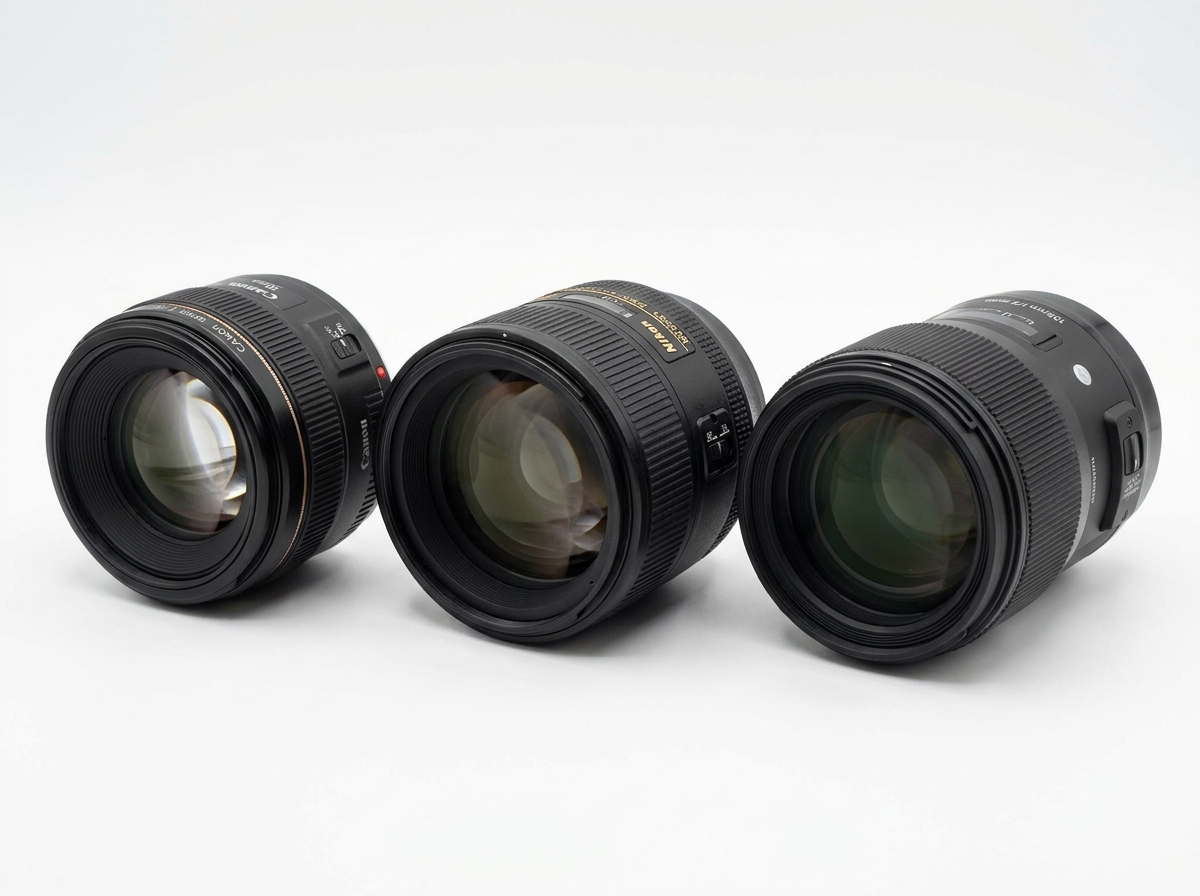
In short
- The three classic focal lengths for portrait are 85mm, 50mm, and 135mm on full frame; on APS-C they scale to approximately 56mm, 35mm, and 90mm equivalents.
- A used 85mm f/1.8 under 400 euros almost always outperforms a new 85mm f/1.4 costing 1,500 euros for those who do not shoot in a studio.
- For used lenses, the critical checks are oily iris, decentering, electronic diaphragm cables, and AF motor: three minutes of testing saves 200 euros in repairs.
- Adapted vintage lenses work well for stylized portraits but lose autofocus: they only make sense if you accept 100% manual focus.
Every week, the same scene unfolds at the counter. Someone walks in with their new mirrorless camera, the 18-50mm kit zoom, and asks for the right lens to take portraits of their children or partner. The kit zoom isn't wrong; it's simply designed for something else: portraiture requires a long focal length and a wide aperture, two things the basic zoom does not offer.
In this guide, I explain what I look for when a customer asks for advice on a portrait lens, what I check in the lab before reselling a used lens, and which body-lens combinations truly work without spending professional-grade money. No generic Top 10 rankings: concrete choices with clear reasoning.
What we really look for in a portrait lens
A good portrait lens does three things: it separates the subject from the background, renders skin tones credibly, and focuses where you tell it to without losing the shot. Everything else — the price, the red ring on the barrel, the number of aspherical elements in the optical design — comes second. Before looking at specific models, it’s worth understanding what we’re actually buying when we spend between €200 and €1,500 on a prime lens.
Focal length: why you're buying compression, not zoom
A long focal length does not bring you closer to the subject; it compresses the planes. It is a difference that changes everything. A 50mm lens at two meters from the face renders the nose and cheekbones with more pronounced proportions; the same face shot with a 135mm lens at five meters appears flatter, with compressed features and a background that seems glued behind the head.
That compression is why medium-telephoto lenses flatter faces. Not because they "blur more," but because they correct the perspective distortion that wide-angle lenses accentuate. If you shoot at 1.5 meters with a 35mm, the subject's nose becomes the protagonist. With an 85mm at the same framing, you are three meters away and the facial geometry returns to natural.
Aperture: the blur is a tool, not a goal
F/1.4 always looks better than f/1.8, until you actually use it. At full aperture on an 85mm, the depth of field at two meters is about 5 centimeters: eye in focus, ear already soft. If you miss the focus by a few centimeters, the shot is a waste.
Here is when each aperture makes sense:
- f/1.4: stylized portrait, close-up, stationary subject, difficult lighting conditions. Costs three times as much, weighs twice as much, and performs well only when stopped down to at least f/2.
- f/1.8: the sweet spot for 90% of portrait photographers. Sufficient bokeh, manageable weight, fair price, and excellent sharpness already at maximum aperture on modern models.
- f/2.8: zoom for reportage and weddings. Sufficient bokeh to isolate subjects at long focal lengths (135mm, 200mm), with much greater versatility.
Bokeh, micro-contrast, transitions: what to look for
Specifications don't tell you how a lens renders. Two 85mm f/1.8 lenses from the same generation can produce very different files. When we evaluate a lens in the lab, we look at the shape of the out-of-focus point lights (the bokeh "bubbles" should be round, not lemon-shaped towards the edges), how focus transitions into blur (a harsh transition creates the classic "cartoon" effect), and the micro-contrast on skin lit at an angle.
These are characteristics you only see when opening RAW files at 100%. That’s why, when it comes to used gear, reviews from people who have actually printed and retouched the files matter far more than manufacturers’ MTF charts.
The three classic focal lengths: 85mm, 50mm, 135mm
In full-frame portrait photography, three focal lengths have withstood fifty years of technical evolution: 85mm, 50mm, and 135mm. This is not nostalgia; it is geometry. These focal lengths produce facial proportions and background separation that our eyes perceive as "natural" or "cinematic." On APS-C, the values scale according to the crop factor: approximately 56mm, 35mm, and 90mm equivalents become the new references.
85mm: the standard for half-length portraits
The 85mm is considered the king of portrait photography for two measurable reasons. The first is the working distance: to frame a half-body shot, you stand about 2.5-3 meters from the subject, close enough to direct them verbally, yet far enough not to invade their space. The second is the rendering of facial proportions. At this focal length, the nose, cheekbones, and ears remain in the ratio that the brain recognizes as faithful, without the elongation seen at 35mm or the excessive compression of long telephoto lenses.
Moderate compression helps separate the subject from the background even at f/2.8, and becomes dramatic at f/1.8. For beginners, an 85mm f/1.8 is the choice that offers the best value for money in the entire photographic system.
50mm: the everyday and environmental lens
The 50mm does a different job: contextualized portraiture. Include part of the environment — the window, the brick wall, the bar counter — and tell who the person is, not just what their face looks like. The working distance drops to 1.5-2 meters for a half-body shot, with greater engagement between photographer and subject.
On APS-C, the 50mm becomes a 75mm equivalent and its role changes: it turns into an almost pure portrait lens, losing its environmental versatility. This is why anyone with an APS-C camera body and a 50mm f/1.8 lens in their drawer already has, in fact, a decent portrait lens without even realizing it.
135mm: for close-up purists
The 135mm is the focal length for tight close-ups and extreme compression. The working distance increases to 4-5 meters for a half-body shot, the background flattens, and the bokeh melts in a way no shorter focal length can replicate.
The limitations are equally evident:
- Required space: In homes or small studios less than 5 meters deep, you cannot frame even a full-body shot.
- Communication: At a distance of 5 meters, directing the subject means raising your voice or using an assistant.
- Weight and price: Bright 135mm f/1.8 lenses are large, over one kilogram, and cost twice as much as an 85mm with the same aperture.
It’s a lens for those who already know what they want. As a second, specialized lens, not as a first purchase.
Maximum aperture: how much f/1.4 do you really need
The difference between f/1.4 and f/1.8 is one stop of light. The price is three times higher, the weight is almost double, and the practical performance difference is often imperceptible. It is only worth it if you know exactly why you need it.
f/1.4: you pay triple for one stop of light
A new 85mm f/1.4 lens costs 1,500 euros, weighs 950–1,100 grams, and at full aperture has a depth of field of just a few centimeters at portrait distance. If you focus on the right eye, the left one is already soft. If the subject moves half a step, you’ve missed the shot.
The f/1.4 autofocus performs in difficult conditions: less tolerance for front/back focus, higher demand on the motor. On recent mirrorless bodies with eye-AF, the situation improves significantly, but on used DSLRs, the rejection rate at full aperture often exceeds 30%. In a studio with flash, where you stop down to f/5.6-f/8 to keep the entire face in focus, the maximum aperture becomes irrelevant.
It makes sense to pay for the f/1.4 in three real-world cases:
- Church wedding reportage using ambient light, where every extra stop keeps ISOs under 6400.
- Editorial portrait with extreme bokeh as an intentional stylistic choice.
- Professional work where the client pays for the specific rendering of a Sigma Art or a G Master.
f/1.8: the value for money that makes sense in 90% of cases
A used 85mm f/1.8 costs between 250 and 400 euros depending on the mount, weighs 350-400 grams, and at full aperture produces a bokeh already more than sufficient to separate the subject from the background. The visual difference compared to an f/1.4 at the same distance is noticeable on a calibrated monitor, not on social media.
For those who shoot portraits as a side job, for family, or for personal projects, the f/1.8 is the right choice. The Nikon 85mm f/1.8G, the Canon EF 85mm f/1.8 USM, and the Sony FE 85mm f/1.8 are all honest lenses that go for between 280 and 400 euros on the used market and do the job without visible compromises.
f/2.8 zoom: when it makes sense compared to a prime
The 70-200 f/2.8 is a different tool. It is not a substitute for a fast prime, it is another machine. It weighs 1.400-1.500 grams, costs between 700 and 1,300 euros on the used market, and makes sense when you need to cover the church ceremony, the reception, or a corporate reportage where you cannot change lenses every two minutes.
At f/2.8 and 200mm, the depth of field is similar to an 85mm f/1.4 at medium distance, so the bokeh is there. What you lose is the light in dark interiors and the weight around your neck after eight hours. For pure posed portraiture, a prime f/1.8 remains lighter, sharper in the center, and costs less than half the price.
System and mount: choose the lens your body can handle
The mount of your camera body determines 70% of the lenses you can realistically afford. Buying a fantastic 85mm for a standard your system does not natively mount means paying for an adapter, losing fast AF, and accepting compromises. Before choosing the lens, look at what you have in hand.
Sony E-mount: the richest ecosystem in the used market
Sony has won the used lens park war, and the Sony A7 Mark II at 550 euros is the proof: a 5-axis stabilized full frame with access to the entire native FE catalog, plus working adapters for Canon EF, Minolta A, and Leica M. For portrait, this means a Samyang AF 85mm f/1.4 FE around 400-500 euros, or a Sony FE 85mm f/1.8 at around 450 euros on the used market.
On APS-C, the Sony A6000 at 360 euros remains the smartest foundation for those starting from scratch. With a Sigma 56mm f/1.4 DC DN (84mm equivalent), you build a compact portrait kit under 700 euros total that produces cover-worthy files. The camera body's limitation is the viewfinder, not the image quality.
Canon RF and EF: two tracks, two strategies
The Canon EOS RP at 600 euros is a native full-frame RF camera, but the used RF lens lineup is still expensive. The real strategy is the original Canon EF-RF adapter (around 100 euros): it opens access to the entire history of EF lenses, including gems like the 85mm f/1.8 USM, on the market since 1992 and available used for under 300 euros. It works at full speed, with no loss of stops and native AF.
If you still have an EF DSLR (5D Mark II, 6D, 80D), you can mount the same lenses directly. We have written a dedicated comparison on how to navigate between systems: Canon vs Nikon vs Sony: which to choose.
Fuji X and Micro Four Thirds: APS-C and 4/3 for portrait
On smaller sensors, focal lengths are scaled. Quick summary:
- Fujifilm APS-C (crop 1.5x): the 56mm f/1.2 gives an 85mm equivalent on full frame. The Fujifilm X-T1 at 380 euros, paired with a used 56mm f/1.2, produces portraits that compete with full-frame setups costing 2,000 euros.
- Micro 4/3 (crop 2x): the 45mm f/1.8 is equivalent to 90mm. The Olympus OM-D E-M1 mark II at 600 euros plus this 45mm lens keeps the total under 800 euros and weighs less than 1 kg.
The downside of crop is bokeh: at equivalent focal length and aperture, the background blur is less pronounced. For many types of portrait—environmental, lifestyle, reportage—it's a non-issue. For tight beauty on full frame f/1.4, it still makes a difference.
Adapted vintage: period bokeh at a low price
A €60 Helios 44-2 produces a swirly bokeh that no modern lens can replicate. This is why adapted vintage glass remains relevant: recognizable optical character at a fraction of the cost. But you pay for it in workflow, not in euros.
Helios 44, Takumar 55mm, Pentacon 135mm: classics under 100 euros
Three Soviet and German lenses that have been circulating in flea markets for decades and still hold their own on modern sensors.
- Helios 44-2 58mm f/2 (40-80 euro, M42 mount): "swirly" bokeh at the edges when the background has point lights. Soft rendering at f/2, low contrast. Equivalent to approximately 87mm on APS-C, perfect portrait length.
- Super Takumar 55mm f/1.8 (60-100 euro, M42 mount): thoriated glass slightly yellow in older versions, excellent sharpness already at f/2.8, warm color rendering that many seek out specifically in post-production.
- Pentacon 135mm f/2.8 (50-90 euro, M42 mount): the "bokeh monster" with 15 blades. Heavy (650 grams), but on full frame mirrorless you build a 135mm f/2.8 with dense bokeh for less than 100 euro total.
The Jupiter-9 85mm f/2 and Carl Zeiss Jena Pancolar 50mm f/1.8 also fall into this price range, but they are becoming increasingly difficult to find in decent condition.
Adapters: budget vs focus confirmation
The M42 to Sony E or Canon RF mechanical adapter costs 15-25 euros on Amazon and does its job: it keeps the glass at the correct distance from the sensor. Same price range for Nikon Z and Fuji X.
The chip-enabled adapter that sends focus confirmation and EXIF data to the camera body costs 60-90 euros. It is truly only necessary if your camera lacks focus peaking or fast live view magnification. On Sony A7 III, Fuji X-T3, and any mirrorless from the last six years, peaking is precise and the basic adapter is sufficient. Spend 80 euros only if you use a DSLR with an optical viewfinder, where focus confirmation becomes the only reliable reference.
Real limitations: no AF, stop-down light meter
Adapted vintage lenses are 100% manual focus. No eye-AF, no tracking, no on-the-fly recovery if the subject moves. It works for controlled posed portraits, but not for running children.
The light meter operates in stop-down mode: close the aperture and the camera measures the actual light. On mirrorless cameras, this is transparent; on DSLRs, the viewfinder becomes dark at f/8 or f/11. Add the lack of stabilization (unless the body has IBIS) and you understand why these lenses only make sense if you accept a slower workflow. When you do, they deliver a rendering that a €500 Sony 85mm f/1.8, perfect in every way, simply doesn't have.
What to check on a used lens before paying
Three minutes of bench testing can save you from 200-euro repairs. Used lenses have specific, recurring defects that are recognizable without any tools. If you buy from a private seller and don't know what to look for, you're paying blind. For the big picture on the used market, check out our article on 5 mistakes to avoid when buying a used camera; here, we go straight to the lenses.
Oil iris and diaphragm blades
Oil fouling is the number one defect on fast prime lenses that are 10–20 years old. It is the lubricant for the aperture blades that migrates onto the diaphragm surface, making it slow or stuck. Here is how you recognize it:
- Detach the lens from the camera body and look from the mount side.
- Press the diaphragm lock lever (on Canon EF it is mechanical, on Nikon AI-S there is the slide).
- The blades must close and reopen instantly, crisply.
- If you see shiny streaks on the blades or a gummy movement, it is oily.
On 50mm f/1.4 lenses from the 90s and vintage 100mm macro lenses, it is almost epidemic. Repair costs 80-150 euros at a lab. It is not the end of the world, but it must affect the price.
Decentration and edge sharpness
Decentration occurs when a lens group shifts off the optical axis, usually after a drop. Quick test: smooth wall, 2 meters distance, lens at full aperture, focus in the center. Download and zoom to 100% on the four corners. If one corner is noticeably softer than the other three, there is decentration. A physiological difference between the center and the edges is normal, but asymmetry between the corners is not.
AF system: buzzing, slowness, hunting
On screw-drive motors (Nikon AF-D, Pentax K), a mechanical humming sound is normal; it is the camera body moving the lens elements. On internal USM, SWM, and STM motors, operation must be silent and linear. Warning signs:
- Infinite hunting even in good light with a high-contrast subject — motor or encoder failure.
- Erratic shutter releases and plastic grinding noises — worn gears.
- AF engaging only after 2-3 half-presses — faulty contacts or flat cable.
Wires and electronic contacts
On mirrorless lenses, dirty contacts cause firmware errors that look like serious faults. "Lens error", erratic exposure, EXIF missing aperture data. Before assuming it's broken, clean the gold contacts with a soft eraser or a microfiber cloth. A third of the "faults" brought to us are this. On models with an internal flexible film bayonet, however, a crack in the flat cable is terminal and can only be identified by opening the body: keep this in mind if the price is too low without an apparent reason.
Real budgets: what to get for €200, €400, and €800
The three price thresholds I see come across the counter every week are these: 200, 400, and 800 euros. Under 200, you enter the world of the first bright prime lens. At 400, you take home an 85mm f/1.8 that does 90% of the work of a 1,500-euro f/1.4. At 800, you start buying optics that, ten years ago, were gear for professional wedding photographers.
Under 200 euros: the first bright prime
The 50mm f/1.8 is the universal choice at this budget, regardless of the mount. It is lightweight, affordable, opens to f/1.8, and teaches you to compose with a fixed focal length.
- Canon EF 50mm f/1.8 STM — 100-130 euros used. Silent STM motor, decent AF, plastic build but honest glass.
- Nikon AF-S 50mm f/1.8G — 130-160 euros. More solid than the Canon, excellent center sharpness even at f/2.
- Sony FE 50mm f/1.8 — 150-180 euros. Slightly slow and noisy AF, but performs very well on Sony full-frame sensors.
- Fujifilm XF 50mm f/2 WR — 250 euros used (above the threshold, but worth noting). Weather-sealed, very fast AF, 75mm equivalent on APS-C: essentially a mini portrait lens.
On APS-C, the 50mm becomes a 75-80mm equivalent: already a true portrait focal length, not a standard one.
300-400 euros: the 85mm f/1.8 that changes everything
This is where the quality leap becomes clear. The 85mm f/1.8 is the classic portrait focal length on full frame, and at this price, you can find excellent versions.
- Canon EF 85mm f/1.8 USM — 280-350 euros. Dated 1992 but the glass is still valid, fast USM AF, lightweight (425g).
- Nikon AF-S 85mm f/1.8G — 350-420 euros. Probably the best value for money in the Nikon portrait lens catalog.
- Sony FE 85mm f/1.8 — 400-480 euros. Native E-mount, fast and silent AF, featherweight (370g).
- Fujifilm XF 56mm f/1.2 R (first version) — 450-550 euros. 85mm equivalent on APS-C, one of the most loved optics in the X system.
Compared to the 50mm kit lens, the difference is evident: correct perspective compression, softer bokeh, and subject-background separation that the 50mm cannot achieve at the same apertures.
600-800 euros: second-hand professional lenses
At this price point, you can find lenses that cost twice or three times as much new. Three concrete directions:
- Sigma 85mm f/1.4 Art (for Canon EF, Nikon F, Sony E) — 600-750 euros used. It weighs a brick (1.130g) but the f/1.4 performance is legendary.
- Canon EF 85mm f/1.4L IS USM — 800-950 euros used. Stabilized, weather-sealed, one of the best portrait lenses ever produced by Canon.
- Nikon AF-S 105mm f/1.4E ED — 800-1.000 euros. Slightly longer focal length, bokeh that made history.
At this budget, the advice remains valid: a used second-generation f/1.4 is better than a new first-generation f/1.4. Modern lenses have made a real leap in the last seven to eight years, especially in the correction of chromatic aberration at full aperture.
Body + Lens Pairings: Complete Kits Under €1,000
The beauty of portrait photography on the used market is that you don't need to blow past €1,000 to bring home a kit that truly delivers. Here are four real combinations, built on the camera bodies we have in stock today and the lenses we see passing through the counter most frequently. Each kit has a distinct character: choose the one that matches how you shoot, not the one with the longest spec sheet.
Sony A6000 + 50mm f/1.8 OSS: APS-C portrait for a total of 600 euros
The Sony A6000 at 360 euros plus a used 50mm f/1.8 OSS around 220-240 euros brings the kit to approximately 600 euros. The equivalent focal length is 75mm, slightly shorter than the classic 85mm but perfect for half-body and environmental portraits. The system weighs less than 600 grams in total, the autofocus is fast on stationary faces, and the OSS on the lens helps when you drop below 1/60. For those starting today, it is the best value for money in the used mirrorless market.
Sony A7 II + Samyang 85mm f/1.4 manual: full frame at 850 euros
The Sony A7 Mark II starts at 550 euros in our stock. Add a used Samyang 85mm f/1.4 for around 280-300 euros and you are under 850 euros with a full frame kit and a true f/1.4 lens. The compromise is manual focus: the A7 II's focus peaking makes it manageable, but if you photograph children or dynamic events, this kit is not for you. For posed portraits in a controlled environment, the performance at full aperture is remarkable.
Canon EOS RP + RF 50mm f/1.8 STM: compact full frame for 800 euros
The Canon EOS RP at 600 euros plus a used RF 50mm f/1.8 STM for around 180-200 euros makes for an extremely lightweight full-frame kit, under 700 grams. It is the kit we recommend to those coming from smartphones who want a full-frame sensor without having to learn how to use heavy lenses. The AF eye-detection is reliable, the Canon file already looks pleasing on skin tones, and the RF 50 has a soft yet sharp rendering in the right spots.
Used Fujifilm X-T1 + 56mm f/1.2: The Fuji 'Film' Look
The Fujifilm X-T1 at 380 euros, paired with a used XF 56mm f/1.2 (worth 520-580 euros on the market), brings the kit total to just over 900 euros. 85mm equivalent focal length, true f/1.2 aperture, and Fuji film simulations directly in JPEG. This is the kit for those who want Fuji color without going through Lightroom: shoot, export, deliver.
If you prefer a more modern APS-C with more aggressive face AF tracking, the Sony A6100 at 600 euros is the natural choice; if your budget is truly tight, the Canon EOS R100 at 400 euros plus an EF 50mm f/1.8 STM with an EF-RF adapter (around 200 euros for the pair) is the most affordable portrait kit on the list.
What we do in our lab before reselling a lens to you
Every lens that enters the shop is tested at the bench before it makes it to the display. This is not marketing; it is how we ensure we never sell an 85mm with a stuck aperture or a 135mm that is decentered by half a millimeter. Three fixed steps, plus specific interventions on individual units when necessary.
Collimator and resolution chart tests
The collimator is an optical instrument that projects a target at virtual infinity. We use it to verify two things: that the lens focuses where it claims to focus, and that it does so uniformly across the entire frame. A decentering of a few tenths of a millimeter is not visible at f/8 on a home wall, but at f/1.8 on a face two meters away, it produces a blurred side that the customer discovers after the first shoot.
After collimation, we mount the lens on the camera body and take certified shutter count shots of a standard resolution chart at various apertures. We compare sharpness in the center and at the four corners. If one edge shows asymmetric degradation compared to the opposite side, the lens is sent back to the lab for recentration or listed as "soft background use only" with a revised price.
Internal lens and aperture cleaning when needed
We do not disassemble every lens that comes in. It would be pointless and would introduce risks. We intervene when we find:
- Visible fungus between the lenses: UV treatment and cleaning, or disposal if the root has damaged the anti-reflective coating.
- Greasy aperture: the blades do not close in time at f/1.4 and f/2, resulting in shutter counts that are overexposed by one stop. Disassembly and degreasing.
- Blocked electronic iris on Canon EF and Sony FE: often it is the internal flat cable. Replacement when the part is available.
- Loose dust behind the rear lens: cleaning if it visibly interferes, otherwise declared in the listing.
When a repair would cost more than the residual value of the optical system, the lens is added to stock as is at a reduced price with an explicit technical note. No surprises.
2-year warranty also on lenses
On camera bodies, a 2-year warranty is now quite common in the professional used market. For lenses, it remains an exception: most dealers limit it to 6 or 12 months. We apply the same 24 months to our lens inventory as well.
What is specifically covered: autofocus motor failure, stuck aperture, electronic contacts losing communication with the camera body, zoom or focus rings becoming stiff or slow beyond tolerance. What is not covered: impacts, water ingress, unauthorized disassembly. The warranty is activated with the invoice and follows the lens even if you resell it to a friend within 24 months.
Frequently asked questions
Is a 50mm f/1.8 or an 85mm f/1.8 better as a first portrait lens?
It depends on the space where you take your shots. Indoors or in an apartment, the 50mm is more manageable because it allows you to stay 1.5-2 meters from the subject. Outdoors or in a studio, the 85mm provides better compression and separation. If you have to choose only one and you mostly shoot in enclosed spaces, get the 50mm; if you have large rooms or work outside, go for the 85mm.
Is an 85mm f/1.4 really worth twice the price of an f/1.8?
For those who don't live off portrait work, no. The difference between f/1.4 and f/1.8 is one stop of light and a slightly shallower depth of field. In practical terms, at f/1.4 the focal plane is often so thin that you focus on one eye and the other is already soft. Most professional portraits published in magazines are taken between f/2 and f/2.8.
Can I use an adapted vintage lens for portraits?
Yes, but only if you accept manual focus and stop-down metering. Lenses like the Helios 44-2 58mm f/2 or the Takumar 55mm f/1.8 cost 50-80 euros and have a characteristic rendering for portraiture. They work well on mirrorless where focus peaking helps you focus at full aperture. On DSLRs without assistance, it is frustrating.
On APS-C, which focal length is equivalent to an 85mm full frame?
On APS-C sensors from Canon, Nikon, Sony, and Fuji, the crop factor is 1.5x (1.6x on Canon). Therefore, a lens that provides a field of view similar to an 85mm full-frame lens is approximately a 56mm. This is why Fujifilm produces a 56mm f/1.2, considered the portrait reference of the X system. On Micro Four Thirds, the crop factor is 2x, so a 42-45mm corresponds to an 85mm full-frame lens.
Is it worth buying a 70-200mm f/2.8 zoom instead of an 85mm prime?
For pure portrait work, no, it is a waste of weight and budget. The 70-200 makes sense if you shoot ceremonies, events, sports, or if you need to change framing quickly without moving. For posed or family portraits, an 85mm f/1.8 prime weighs one-third as much, costs half as much, and performs equally well or better at the same aperture.
How can I test a lens before buying it from a private seller?
Bring a camera with the same mount or ask the seller to take certified shutter count. Verify autofocus on a stationary and moving subject. Take a shot of a wall or a newspaper at close range at full aperture to check if it is decentered (one side will be visibly softer than the other). Open and close the aperture against the light to see if the blades are clean or oily. In three minutes you will know if the lens is healthy.
Do the used lenses you sell come with a warranty?
Yes, 24 months on all lenses sold by ReflexMania, including vintage ones. Before entering stock, every lens goes through our lab for sharpness, centering, aperture functionality, autofocus, and internal cleaning when necessary. If we find an irreparable defect in the lab, the lens is not put up for sale.
Need advice before choosing your portrait lens?
If you have any doubts about a purchase or need advice for your specific case, contact us. We offer free advice because we are photographers first, and because a customer who buys the wrong gear stops shooting.
Three ways to get in touch:
- Contact form — response within 24 business hours
- WhatsApp at 342 362 3454 (messages only)
- Phone: 071 291 6347 (Mon-Fri 9-13/15-18, Sat 9-13)
If you want to see what we have in stock right away, explore the used gear available today: every camera is certified, comes with a 2-year warranty, and ships within 24-48 hours.
Article written by Matteo for the ReflexMania Team. Last updated: May 2026. Prices and availability as of the date of publication.