
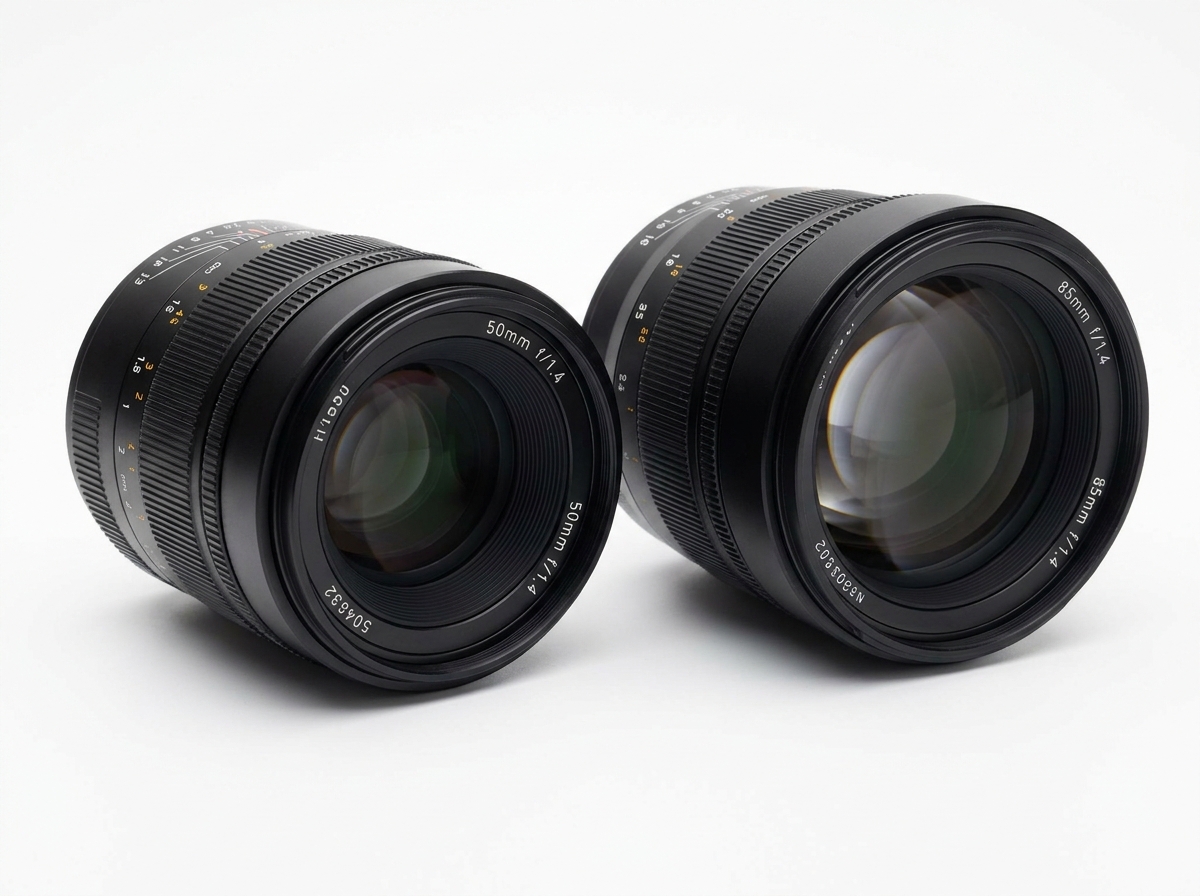
In short
- The 50mm is more versatile and costs less: with f/1.8, prices start at 100-150 euros new or 70-100 used.
- The 85mm compresses planes and separates the subject better: it requires a minimum distance of 2-3 meters from the subject.
- On APS-C, the 50mm becomes a 75-80mm equivalent, already close to a classic portrait focal length.
- For medium indoor portraits (3x4 meters), the 50mm wins; for outdoors and half-body shots, the 85mm is unbeatable.
When a customer walks into the shop and asks which lens to buy for portraits, the answer is never immediate. It depends on where you shoot, what camera body you have in hand, and how much you are willing to move between yourself and the subject. The 50mm and the 85mm are the two classics of portraiture, but they cater to different needs and are not interchangeable, as is sometimes read on forums.
In this article, I compare the two focal lengths from a practical standpoint: what truly changes during a shoot, how much distance is required, how they perform on full frame and APS-C, and what they cost today on the used market. The goal is to give you a tool to make an informed choice, not a list of specifications already available everywhere.
What really changes between 50mm and 85mm in portrait photography
The difference between these two focal lengths is not a matter of "a few more or fewer millimeters." They are two tools that work differently: what enters the frame changes, the way planes overlap changes, and even the physical distance you need to keep from the subject changes. Understanding these three aspects prevents you from buying a lens you don't know where to use.
Field of view and framing
On full frame, the 50mm covers a field of view of approximately 47°, while the 85mm stops at around 28°. In practical terms: at 2 meters from the subject, a 50mm captures a generous full-body shot; with an 85mm, you are already at a tight half-body framing. If you want the same framing with both, you need to change your position.
| Desired framing | Distance with 50mm | Distance with 85mm |
|---|---|---|
| Close-up (head and shoulders) | 1.2 meters | 2 meters |
| Half body | 1.8 meters | 3 meters |
| Full body | 3 meters | 5 meters |
Perspective compression: what it means in practice
It is often said that "the 85mm compresses more." In reality, compression depends on distance, not on the focal length itself. The point is that with the 85mm you are forced to stand further away to achieve the same framing, and that greater distance flattens the planes.
The effect on the face is evident: with a 50mm at 1.2 meters, the nose appears slightly more prominent than the ears, the cheekbones widen, and the face gains depth but loses harmony. With an 85mm at 2 meters, the face "flattens" in the right way, and the proportions remain true to how we see them in person at conversational distance. This is why fashion portrait photographers work from 85mm and up.
Below 50mm — think 35mm — the effect is accentuated in the opposite direction, making faces appear "stretched". This is why the 35mm is a great lens for reportage but a compromise for tight portraits.
Working distance to the subject
This is where a factor that is often underestimated comes into play: the physical space you have. With the 85mm, a half-body shot requires 3 meters between you and the subject, plus the space behind you to move around. In a living room that is 4 meters wide, you are already at the limit of the wall.
There is also a relational aspect. At 1.2 meters with the 50mm, you can talk to the subject in a normal voice, give directions, and joke around. At 3 meters with the 85mm, you have to raise your voice or use hand gestures. For those who photograph children or shy people, this distance becomes an advantage: the subject forgets about the camera. For those who do intimate portraits with a friend, it becomes a nuisance.
If you want to dive deeper into specific models to look for on the used market for portrait photography, I have dedicated a guide to the best portrait lenses on the used market, including prices and mounts.
The 50mm: the Swiss Army knife of portrait photography
If I had to recommend a single focal length for someone starting out in portrait photography, it would be the 50mm. Not because it is the absolute best, but because it allows you to make fewer mistakes and work in more situations. It is affordable, lightweight, fits in your bag without being noticeable, and forces you to move around — which is beneficial for anyone learning the craft.
Versatility: environmental portrait and half-body
The 50mm offers a field of view that closely matches our central vision. This means that in portraiture, it includes a piece of the environment around the subject without fully isolating them. It is the right focal length when you want to tell who the person is and where they are: the craftsman in their workshop, the musician in the rehearsal room, the child in the kitchen with their grandmother.
On a full frame like the Canon EOS RP (currently available at our store for 600 euros with 3 units in stock), a 50mm lens keeps you between 1.5 and 2.5 meters from the subject for a half-body shot. It is a conversational distance, not a distant observation. People react differently: they laugh more, relax sooner, and look you in the eyes.
Performance in tight spaces
In a three-by-four-meter room — the vast majority of Italian living rooms — an 85mm lens barely allows for a tight close-up. With a 50mm, you get the half-body shot and even the full-body shot by stepping back against the wall. The same logic applies to small studios under 20 square meters, where the 85mm forces you to crop your compositions.
Even outdoors, in narrow alleys or in the middle of a crowd, the 50mm allows you to react. The Nikon Z5 at 680 euros with a 50mm f/1.8 Z is a portrait kit under 1,200 euros that handles any scenario you put in front of it.
How much it costs: new, used, and the famous nifty fifty
This is one of the reasons why the 50mm is the rational first choice. Typical used prices on the main mounts:
- 50mm f/1.8 STM, FE, Z, X: 70-150 EUR used, 130-250 EUR new
- 50mm f/1.4 (Canon EF, Nikon F, Sigma Art): 250-450 EUR used
- 50mm f/1.2 native mirrorless (RF, Z, L): 1,000-1,800 EUR used, rare below
The "nifty fifty" — the affordable f/1.8 from every brand — offers the best value for money in all of photography. For 100 euros, you get a lens that does 90% of the work of an f/1.4 that costs four times as much. In our workshop, we check the mount alignment and aperture blade play on every used 50mm lens we receive: these are budget lenses, and even a slight drop can shift the axis without it being visible to the naked eye.
The 85mm: The classic portrait lens, when you have the space
The 85mm is the focal length portrait photographers keep mounted by default, and it’s not a pose for snobby photographers. There is a precise technical reason: for the same framing on the face, the 85mm forces you to stand 2-3 meters from the subject instead of 1.2-1.5 meters as with the 50mm. This extra distance changes everything, from the rendering of facial features to the comfort of the person posing in front.
In the studio or for serious outdoor portraits, if you have the space, this is the choice that makes the fewest mistakes. On full-frame bodies like the Sony A7 Mark II (€550-580) or the Sony A7r (€700), an 85mm f/1.8 works at its native focal length, with no crop factor compromises.
Subject separation and blur
At f/1.8, the 85mm produces a visibly creamier bokeh than the 50mm at the same aperture. The reason is geometric: a longer focal length means a shallower depth of field at the same focus distance. The background loses detail sooner, and the edges of lights become clean circles, not cut diamonds.
In practice, if you photograph a subject at three meters with a background at seven meters, with the 50mm you can still see the leaves of the tree behind. With the 85mm they are patches of color. For a portrait isolated from the context, that is exactly what you want.
Feature rendering
At the typical working distance of an 85mm lens, the nose, forehead, and cheekbones are rendered in their true proportions. No exaggerated nose, no widened forehead, no short-range fisheye effect. This is why wedding photographers use the 85mm for close-ups of the couple and the 50mm when they need to include the environment or small groups.
It performs so well that many advertisers shoot products and cosmetics at 85 to 135mm: the clean rendering of the front plane avoids heavy retouching in post.
When the 85mm is wrong
Three scenarios where you should leave it at home:
- Indoors under 4x4 meters: the minimum focusing distance is 80-85 cm, but framing a half-body shot requires 2.5 meters. In an average living room, it's not feasible.
- Events and reportage: too long to capture the moment. By the time you realize something is happening, you have to back up and you've already missed the shot.
- Group portraits of 3+ people: to frame four people side by side, you end up at 6-7 meters. Communicating with them at that distance is frustrating for everyone.
The 85mm rewards those with time and space. If you work fast or in tight quarters, the 50mm remains the more honest choice.
50mm and 85mm on APS-C: everything changes
The APS-C sensor doesn't just crop the frame: it fundamentally changes the lens's identity. A 50mm lens mounted on a Sony A6400 no longer behaves like a 50mm. It becomes something else, and that something else is often exactly what you need for portraiture.
The crop factor is 1.5x on Sony, Nikon, and Fujifilm, and 1.6x on Canon. This means a 50mm lens "sees" like a 75mm on Sony or an 80mm on Canon. An 85mm becomes a 127-136mm equivalent. Portrait proportions change accordingly, as does the distance you need to maintain from the subject.
The 50mm on APS-C becomes a ready-made portrait
75-80mm equivalent: you are already in the territory of classic portraiture, the kind you buy as an 85mm on full frame. With a used 50mm f/1.8 for 100 euros, you mount the ideal portrait lens on your APS-C camera body. The working distance for a half-body shot is 1.5-2 meters, manageable in any living room.
With a Sony A6100 at 550-600 euros and a used Sony 50mm f/1.8 OSS lens for around 180 euros, you get a complete portrait kit for under 800 euros. The image quality is clean, the autofocus is fast, and the lens stabilization helps in fading light.
The 85mm on APS-C: the risk of having to step back too far
An 85mm lens on APS-C becomes a 127-136mm equivalent. For a close-up, you are forced to stand 3-4 meters from the subject; for a half-body shot, 5-6 meters. You simply won't fit in a 4x4 meter room. It works outdoors, in large studios, or in parks.
Moreover, interactions with the subject become complicated: at 5 meters, you cannot give directions in a low voice; you must shout or keep moving. For environmental or indoor lifestyle portraits, the 85mm on APS-C is simply the wrong lens.
What lens do I mount on a Sony A6400 or Fujifilm X-T2 for portrait
Here are the combinations we recommend at the counter, divided by mount:
- Sony E (A6400, Sony a6600, A6100): Sony 50mm f/1.8 OSS used, 150-200 euros. Lightweight, stabilized, excellent face autofocus.
- Fujifilm X (Fujifilm X-T2): Fujinon 56mm f/1.2 if you have the budget (700-900 used), otherwise the 50mm f/2 WR at around 350 euros. The 56mm, equivalent to 85mm, is the definitive APS-C portrait lens.
- Canon EF-M and RF-S: here, the 50mm f/1.8 STM with an adapter remains the most sensible budget choice under 150 euros.
If you are still choosing the camera body, take a look at the comparison between Canon, Nikon and Sony to understand where it makes more sense to invest before thinking about lenses.
Blur and bokeh: 50 f/1.8 vs 85 f/1.8 in a real-world comparison
Open the same aperture on two different focal lengths and you get two different photos. This is what confuses people the most when buying their first portrait lens: the idea that f/1.8 is f/1.8 regardless. It isn't, and the difference is visible to the naked eye even in the first tests in the store.
The practical formula: focal length and distance matter more than aperture
The blur behind the subject depends on three variables: aperture, focal length, and focus distance. At the same f/1.8, an 85mm produces roughly twice the blur of a 50mm, because focal length enters the depth of field calculation quadratically. Put simply: if you frame the same close-up with a 50mm at 1.2 meters and an 85mm at 2 meters, the background behind the subject's head melts away much more with the 85mm.
I often test it at the counter with customers who are undecided. Same model, same light, same aperture, two consecutive shutter counts: the difference is evident even on a 3-inch display.
When a 50 f/1.4 beats an 85 f/1.8
There is a specific scenario where the brightest 50mm beats the 85 f/1.8: full-body or American shot portraits in tight spaces. To frame a full-body subject with an 85mm, you need at least 5-6 meters of distance, which you simply don't have in an average living room. With a 50 f/1.4 at 2.5 meters, however, you capture the entire figure while maintaining a clean bokeh.
The same applies to environmental portraits: you want to see the context around the subject, a bookshelf, a window. The 85mm crops out everything, while the 50mm lets the scene breathe. Here, the wider aperture of f/1.4 compensates for the shorter focal length, and the background result is comparable.
What to look for beyond the numbers
The amount of bokeh is only half the story. The other half is quality, and here the two types of lens behave differently:
- Bokeh shape: out-of-focus highlights turn into circles only in the center. At the edges, they take on a lemon or cat-eye shape, more pronounced on budget 50mm lenses than on 85mm ones.
- Transition between in-focus zones: the 85mm separates the focal plane more softly, while the 50mm does so more sharply. For skin and hair, the 85mm is generally more flattering.
- Color rendering and contrast: 85mm lenses have traditionally offered a warmer rendition with higher micro-contrast, a quality that translates into more three-dimensional faces.
In the workshop, when we test a used 85mm, we always check the bokeh on a series of lights at 5 meters: if we see marked onion ring or double contours, we report it in the data sheet.
Budget and availability on the used market: how much to really spend
The used market for these two focal lengths is one of the healthiest around. These lenses have been produced in millions of units for decades, so you'll always find good availability and stable prices. The real difference comes down to the condition and who is selling you the lens.
Used 50mm: from 70 euros to over 1,500 euros
The 50mm f/1.8 is the most democratic lens on the market. Here is the actual price range in the used market, based on what we see coming through our workshop every week:
- Yongnuo 50mm f/1.8 (50-80 euro): budget copy of the Canon, slow and noisy AF but optically decent. Good for those starting out who don't want to invest much.
- Canon EF 50mm f/1.8 STM (70-110 euro): the most common used lens by far. Silent STM motor, sharp rendering from f/2.8 onwards. On a Canon DSLR, it's a no-brainer purchase.
- Sony FE 50mm f/1.8 (130-180 euro): native for Sony full-frame mirrorless. AF is slightly slow but the optics are more than honest for the price.
- Nikon AF-S 50mm f/1.8G (130-170 euro): solid, fast AF, consistent rendering across the entire frame.
- Sigma 50mm f/1.4 Art (450-650 euro): the real quality leap. Surgical sharpness even wide open, significant weight and size. For those doing serious portrait work.
- Canon RF 50mm f/1.2 L (1.500-2.000 euro used): professional territory. You see it on sets, not in amateur bags.
Used 85mm: from 200 euros to 1,500 euros
The 85mm starts from a higher tier. There is no equivalent to the 50 1.8 at 70 euros, and the reason is mechanical: a longer focal length requires larger optical groups.
- Samyang 85mm f/1.4 manual (200-280 euros): manual focus, no AF. Surprisingly good optics if you know how to focus by hand. Perfect for video.
- Canon EF 85mm f/1.8 USM (270-380 euros): the workhorse of the 85mm lenses. Fast AF, lightweight, creamy rendering. We often recommend it.
- Sony FE 85mm f/1.8 (450-580 euros): excellent weight/quality compromise on the E-mount system. No frills, just results.
- Nikon AF-S 85mm f/1.8G (380-480 euros): a historical choice for Nikon portrait photographers, still very much relevant today.
- 85mm f/1.4 lenses from all manufacturers (900-1,500 euros): Sigma Art, Sony GM, Canon L. They weigh twice as much, cost three times as much, and you only see the difference if you zoom in to 100% or if you are looking for that specific bokeh rendering.
What we check at our lab before selling a lens
Every lens that enters our store undergoes three fixed steps. We perform bench tests at various apertures to verify sharpness in the center and at the edges, check internal cleanliness with a raking light (looking for dust, fungus, or element separation), and calibrate the AF on a reference camera body when we detect back or front focus. If a lens fails any of these steps, we either fix it or we do not put it up for sale.
My advice based on your use case
After five sections of theory, we get to the point: what you are actually buying. I summarize the scenarios I see most often at the counter, along with the answer I give when a customer asks me directly, "But what should I get?"
Indoor or small space portraits: 50mm without a doubt
If you shoot in an average apartment, with 3-4 meters of usable space between you and the subject, the 85mm becomes unmanageable. You end up pressed against the wall to frame a medium shot, and an American shot is practically impossible. The 50mm on full frame gives you the freedom to work at 1.5-2 meters, where communication with the subject remains natural.
A Canon EOS RP at 600 euros, paired with the 50mm f/1.8 STM (approximately 130 euros new), gives you a full-frame portrait kit for under 750 euros. For a parent who wants to photograph their children in the living room, it is a combination that has no rivals in terms of quality, price, and space required.
Outdoor portrait: 85mm if you have it
Parks, squares, garden weddings, sports events on the sidelines: this is where the 85mm shines. A working distance of 3-4 meters is no problem, and the compression separates the subject from the background in a way the 50mm never will. Faces that pop from the scene with creamy bokeh, distant backgrounds that turn into soft patches of color.
On a Nikon Z5 at 680 euros paired with an 85mm f/1.8 (used Nikkor Z models range from 450 to 550 euros), you get a serious portrait setup for under 1200 euros. The same applies to those choosing the Sony E mount with the Sony A7 Mark II at 550-580 euros: the used Samyang 85 f/1.4 is found around 350 euros.
One lens for everything: 50mm
If your budget allows for only one lens and you need a lens that handles portraits as well as street photography, family reportage, details, and wide group shots, the 50mm is the undisputed choice. The 85mm is specialized: trying to photograph a table of eight people in a dining room with an 85mm is frustrating. Versatility beats specialization when you have to choose just one.
Already have a 50mm: is it worth getting the 85mm too?
It depends on how much portrait work you actually do. If it's your main line of business or the genre you love most, yes: the 85mm adds a rendering that the 50mm cannot replicate, especially on tight close-ups. If, however, you shoot portraits only two or three times a year, I would invest those 400-500 euros better elsewhere — a serious tripod, a decent flash, or a more modern camera body. If you are still evaluating the right system to build on, read reflex vs mirrorless: which to choose in 2026 first: it also changes the choice of available lenses.
Frequently asked questions
If I can only buy one, should I choose the 50mm or the 85mm?
50mm. Use it for portraits, travel, indoor shooting, or street photography. The 85mm is more specialized and makes sense as a second lens, not a first one.
Is the budget 50mm f/1.8 lens suitable for professional portrait photography?
Yes, the new generation f/1.8 lenses (Canon RF 50 1.8 STM, Sony FE 50 1.8, Nikon Z 50 1.8 S) hold their own against their bigger siblings in terms of sharpness. The bokeh rendering, AF speed, and half-stop of brightness differ. They are perfectly fine to start with.
For a Sony A6400 or A6600, is it better to choose the 50mm Sony FE or a native APS-C lens?
For portraits, the Sony FE 50 1.8 is perfect (around 200 euros used). It becomes a 75mm equivalent and works as a classic portrait lens. Alternatively, the Sigma 56mm f/1.4 DC DN on E-mount is the best choice overall: 84mm equivalent, excellent optical quality.
Is the 85mm f/1.4 worth the price difference compared to the f/1.8?
If you do portrait photography as a profession or as a serious passion, yes, because the bokeh at f/1.4 has superior quality and subject separation is more pronounced. If you are in your early years or shoot infrequently, starting with an f/1.8 and investing the 600-800 euro difference in a good flash or lighting is much more productive.
What focal length is needed for a group portrait?
Neither 50 nor 85. For a group of 3-6 people, you need a 35mm on full frame (or 24mm on APS-C). The 50mm is only suitable for tight couples or portraits of 2 people.
Does the 50mm distort the face?
Up close, yes, it accentuates the nose and forehead. For a tight close-up, 50mm is not the correct focal length: either step back and crop to a half-body shot, or mount an 85mm. For full-body or three-quarter portraits, the 50mm does not distort at all.
Is it worth it to buy a vintage manual 50mm or 85mm lens to save money?
Only if you enjoy manual focus and know what you are doing. Vintage lenses (Helios 44, Pentax-M, Nikkor AI) cost 50-100 euros and have a characteristic rendering, but they are frustrating with moving subjects. For a start, I always recommend a modern used AF lens.
Want to try a 50mm or 85mm before choosing?
If you have any doubts about a purchase or need advice for your specific case, contact us. We offer free advice because we are photographers first and sellers second, and because a customer who makes a bad purchase won't come back to photography.
Three ways to get in touch:
- Contact form — response within 24 business hours
- WhatsApp at 342 362 3454 (messages only)
- Phone: 071 291 6347 (Mon-Fri 9-13/15-18, Sat 9-13)
And if you want to see immediately what we have in stock, explore the used items available today: every camera is certified, comes with a 2-year warranty, and is shipped within 24-48 hours.
Article written by Matteo for the ReflexMania Team. Last updated: May 2026. Prices and availability refer to the time of publication.