
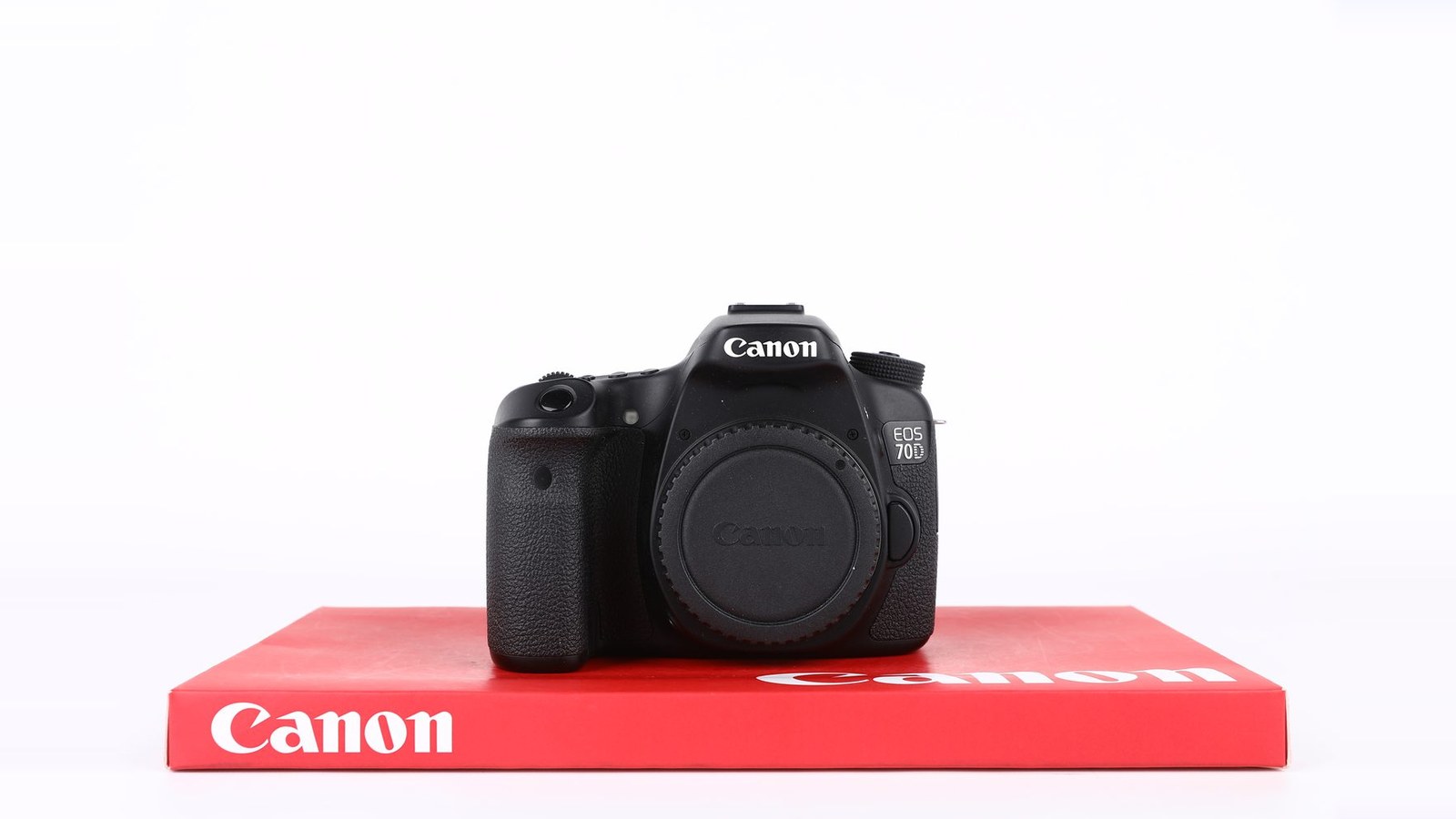
In short
- The Canon 70D was released in 2013 and debuted with Dual Pixel CMOS AF. In Full HD video at 30p with STM lenses, autofocus remains fluid and reliable.
- No 4K, no headphone jack, and clips are limited to 29:59. It is still suitable for YouTube in 1080p, but for commissioned work in 2026, it is at its limit.
- For sports, it shoots at 7 fps with 19 cross-type AF points, but stops after approximately 16 RAW frames. It is sufficient for amateur daytime football, but not for indoor basketball at ISO 6400.
- Used, it costs 300-400 euros for the camera body only. A Canon EOS R100 at 363 euros records in 4K but is slower in bursts: the choice depends on what you are actually shooting.
Looking for a used Canon 70D? The used Canon 70D page shows current availability and prices, with certified shutter count and a 2-year warranty. See also all used Canon cameras.
At the counter, the 70D comes back often, almost always for two reasons. Either it's brought in by someone switching to a mirrorless and leaving the camera body and EF lenses as a trade-in, or it's requested by someone with a 350 euro budget who wants a DSLR to film their child's games or start making videos. In 2013, it was the first Canon with Dual Pixel AF and changed the way video was shot with a DSLR. Thirteen years later, that advantage is no longer exclusive, but it hasn't disappeared either.
In this article, we put it to the test in the two areas where it is still sought after: video and sports. We look at what it does well, where it shows its age with hard numbers, and what to check on a used unit. Then we honestly explain when it makes sense to buy it and when it is worth spending a little more on something else.
The Canon 70D seen through 2026 eyes
The Canon 70D was introduced in July 2013. It sat midway between the 700D, designed for beginners, and the 7D, the flagship APS-C model for sports. It inherited the 19-point AF system from the 7D and the articulating touch screen from the 700D. Today, those specs should be evaluated based on their practical value in real-world work, not on how they appeared in the brochure back then.
The specs that really matter
| Item | Data | What it means today |
|---|---|---|
| Sensor | APS-C 20.2 MP, Digic 5+ | Sufficient for A3 prints and moderate cropping |
| ISO | 100-12800, extended 25600 | 25600 is an extended value, not native: practically not to be used |
| Autofocus (viewfinder) | 19 points, all cross-type | Coverage concentrated in the center of the frame |
| Burst | 7 fps | Still a respectable value for an APS-C |
| Display | 3 inches, articulating and touch | Essential for video and low-angle framing |
| Connectivity | Built-in Wi-Fi | Transfer to smartphone without adapters |
| Card | Single SD slot | No real-time backup |
| Shutter | 100,000 certified shutter count | This is a design specification, not a durability guarantee |
| Weight | 755 g with battery and card | Heavier than any current APS-C mirrorless |
A single slot is the most underestimated limitation. For a wedding or an event that cannot be repeated, a corrupted card means losing the work. For amateur use, it is not an issue. However, this must be kept in mind before taking on paid assignments.
Why Dual Pixel AF Made History
The principle is simple. Each pixel on the sensor is split into two photodiodes that read light separately. By comparing the two signals, the camera determines whether the subject is in focus and which direction the lens needs to move. This is phase detection, the same method used by the viewfinder, but performed directly on the sensor.
Before the 70D, Canon DSLRs in live view relied primarily on contrast detection for autofocus. The lens would move back and forth until it found the point of maximum sharpness, and in video, that search was fully visible. With Dual Pixel, the lens immediately knows which direction to go, resulting in a smooth focus transition rather than a jerky one.
However, it needs to be put in perspective. In 2013, it was a genuine novelty; today, it is standard: every Canon mirrorless in the lineup has it, including the entry-level R100. Recent versions add eye and subject recognition, which the 70D lacks. Its AF in live view is fast and precise, but the subject must be selected and tracked manually. It is the same reasoning applied to the Canon 5D first series: it matters little if a camera made history, what matters is what it still does well today.
In video: where the 70D still holds up
In Full HD, with the right lenses, it’s still enough for those shooting for YouTube, family events, and social media.
Full HD up to 30p, ALL-I or IPB
Records in H.264 within MOV files, at these frame rates:
| Resolution | Frame rate | Practical use |
|---|---|---|
| 1920×1080 | 24p, 25p, 30p | YouTube, interviews, family events |
| 1280×720 | 50p, 60p | Light 50% slow motion in post-production |
You choose the compression, and the difference is most noticeable in post-production:
- ALL-I, approx. 90 Mbps: each frame is compressed independently. It takes up about 680 MB per minute, but plays back more smoothly on the timeline and holds up better during color correction.
- IPB, approx. 30 Mbps: takes up one-third of the space. Suitable for long takes that go online without major post-production work.
For a 1080p YouTube channel, a fixed-camera vlog, or your children's dance recital, the image quality remains clean with decent lighting. The audience will not see the difference compared to a recent entry-level mirrorless camera in Full HD.
Autofocus in video: an STM lens is required
Dual Pixel AF performs best when the lens motor supports it. With STM lenses, focus transitions are smooth and nearly silent: EF-S 18-55 IS STM, EF-S 24 mm f/2.8 STM, EF-S 10-18 IS STM, EF 40 mm f/2.8 STM. These are also the most affordable lenses to find used.
With older micromotor lenses, such as the EF 50mm f/1.8 II or the EF-S 18-55 IS II, the AF operates in steps. Additionally, the internal microphone picks up the motor noise. The 3.5mm jack input solves the audio issue: an external microphone on the hot shoe hears the motor much less, and the levels can be adjusted manually.
The most reliable method is to touch the subject on the screen: focus shifts there with a natural transition. Face tracking exists, but it is slow compared to today's standards. If the speaker turns in profile, the camera loses focus and takes a moment to reacquire it.
The articulating screen is still a real advantage
The 3-inch screen opens sideways and rotates, and it is touch-enabled. You use it constantly when shooting video:
- low-angle shots, with the camera a few centimeters from the ground;
- self-framing for vlogs and tutorials, with the screen flipped towards you;
- low tripod or camera raised above the crowd at a concert or a recital.
Many recent entry-level models cost the same but lack these features. The Canon EOS R100 at 363 euros records in 4K, but the screen is fixed and not touch-enabled. If you film yourself, you cannot see the framing on the R100 while recording. On the 70D, you can.
In video: the limits that cannot be bypassed
The 70D records up to Full HD at 30p, and no firmware or accessory changes that. Here is the other half of the equation: limitations that cannot be resolved with an adapter. Before buying it for professional video work, all of these must be taken into account.
No 4K and no 60p in Full HD
In 1080p, the 70D reaches 30, 25, or 24 frames per second. For a personal channel, that’s fine, but delivering client work in 1080p30 in 2026 is a choice that needs justification. Many clients request 4K to allow for reframing in post-production. With the 70D, that margin doesn’t exist.
The slow-motion capability is the other weak point. 60fps is only available at 720p, and when slowed down in the timeline, it looks too soft for a product that needs to appear professional. If you frequently use slow motion in commercials or sports videos, this camera is not for you.
Audio, clips and HDMI output
These are the limitations that weigh heaviest on working professionals, because they become apparent on set, not in the technical specifications:
- No headphone output. The 3.5 mm microphone input is present, but audio can only be monitored via the on-screen level indicator. You won't hear cable noise or a lavalier mic rubbing against a shirt until post-production, when it's too late to reshoot.
- 29:59 clip limit. Conferences, ceremonies, and long interviews must be split. If you get distracted, you lose the witness's statement or the most important answer.
- Unclean HDMI output. The output includes on-screen interface overlays. Removing them requires Magic Lantern, an unofficial firmware I wouldn't install on a camera that needs to deliver a paid job. If you want to use an external recorder, the 70D wasn't designed for that.
Each of these can be bypassed with a separate audio recorder, a second camera body, or a timer. However, every solution adds another item to manage during an event that cannot be repeated.
Moiré, rolling shutter and no in-sensor stabilization
On fine patterns, moiré is visible: thin-striped jackets, herringbone fabrics, brick facades shot from a distance. In video, you'll notice moving colored bands that cannot be cleanly removed in post. Better to know this before shooting a wedding with the groom in a pinstripe suit.
The rolling shutter effect is also noticeable. In a fast pan or when shooting from a car window, vertical lines bend and poles appear slanted. With slow camera movements, the issue almost disappears.
Finally, the sensor is not stabilized. For handheld shooting, you need a lens with IS or a gimbal; otherwise, every step ends up in the frame. With an unstabilized fast prime, such as a 50mm f/1.8, you can only work on a tripod or monopod.
In sports: Are 7 fps and 19 points enough?
Yes for Sunday amateur football, no for indoor basketball. It’s not just the burst rate that decides. Autofocus, buffer, and available light all work together, and their limitations add up precisely when the action speeds up.
AI Servo Autofocus with 19 cross-type points
All 19 AF points on the 70D are cross-type. With f/2.8 lenses, the center point becomes dual cross-type and is more sensitive. The issue is coverage: the points are clustered in the center, leaving the edges of the frame uncovered. If a striker runs toward the goal or a sprinter is on the straight, focus holds well in AI Servo with zone selection. With subjects that change direction suddenly, such as a dunk under the rim or a burst of speed in basketball, it misses more often than a mirrorless with subject recognition.
Burst mode and buffer in practice
The 7 fps hold for about 16 RAW or about 65 JPEG on a fast UHS-I card. Then the camera slows down while emptying the buffer. A goal action lasts 2-3 seconds and you cover it in RAW. However, if the counter-attack starts immediately after, the buffer is still full and you miss the decisive frames. The practical advice:
- Fine JPEG for full matches and tournaments, where not getting stuck is what matters.
- RAW only for important matches, with short bursts of 4-5 frames.
- Fast card always, because with a slow card the buffer takes much longer to clear.
Gym lighting is the real obstacle
The 2013 sensor is clean up to 1600-3200 ISO. At 6400, noise is evident and noise reduction smears details in knitted fabrics and faces. To freeze basketball and volleyball, you need at least 1/800 of a second, and in a municipal gym you only get there with an f/2.8 lens. A 70-300 f/4-5.6 at 300 mm is two stops more closed. You end up at 12800 ISO and above, or you accept motion blur. For outdoor daytime sports, there are no problems, even with a budget zoom.
What defines a sports camera
The 7D Mark II, the older sibling released in 2014, shoots at 10 fps and features 65 cross-type points covering a much larger portion of the frame. Today's mirrorless cameras add subject tracking across almost the entire frame, which truly increases the percentage of sharp shots. The 70D remains suitable for the enthusiast who follows their son's team or the local team on Sundays. For those working as accredited field photographers, it is the wrong tool.
What to check on a used 70D
A 2013 70D has years of real use behind it, and the weak points are almost always the same: shutter, screen hinge, rear controls. This is the order in which we inspect them when one comes to the counter.
Shutter count
Canon rates the 70D shutter for 100,000 cycles. This is a statistical average, not an expiration date: we have seen shutters fail earlier and last well beyond that. The issue is that the counter does not appear in the menu. To read it, you need software connected via USB, or a lab that can read and certify it.
| Shutter count | How to interpret them |
|---|---|
| Under 30,000 | Young unit, shutter with plenty of life left |
| 30,000–50,000 | Normal use by an enthusiast |
| 50,000–80,000 | Sensible purchase, but the price must reflect this |
| Over 80,000 | Close to or beyond the declared 100,000, typical of sports use: budget for a replacement |
If the seller does not know the number or answers "a few," consider it missing data, not good news.
Articulated display, hinge, and flat cable
Open the screen and rotate it in all positions: facing the subject, at 90 degrees, and closed with the glass inside. Check if the image flickers, turns black, or skips for a moment. These are the first signs of a flat cable that, after thousands of openings, has started to fail inside the hinge. Then touch the screen at the corners, the center, and the lower icon strip: the touch must respond across the entire surface.
Sensor, dials, SD slots, and video test
- Sensor: take a shot at f/16 against a uniform sky and zoom in to 100%. Sharp dots are dust, while blurred spots can be oil residue or traces of poor cleaning.
- Rear dial and multi-controller: the 70D does not have a joystick; the directional buttons are located inside the dial. If they are worn out, they lose their click, and moving the AF point becomes a matter of chance.
- SD slot: use a torch to check that the pins are not bent. A bent pin causes intermittent write errors, which are the hardest to diagnose.
- Video and audio: record a clip of at least 15 minutes with a microphone connected to the 3.5 mm jack. Listen for any hiss or interruptions and verify that the overheating icon does not appear.
- Firmware: check the version in the menu and compare it with the latest one published on the Canon website.
What we do in our workshop
For every 70D that comes into ReflexMania, we read the shutter count with dedicated tools and report it on the product page. We clean the sensor and test the autofocus on a target to rule out systematic front or back focus. We perform a video test with an external microphone and open the hinge in all positions. Then we cover it with a 2-year warranty like any other used item, even though it is a DSLR from 2013.
What it's worth today and when it's not worth it
A Canon 70D in good condition is worth between 300 and 400 euros today for the camera body only, and asking for more only makes sense if a lens is included in the package. The price mainly depends on three things: the shutter count, the condition, and what is in the box. The model was released in 2013 and there are many units around, so there is no reason to accept a high price for a poorly maintained camera.
The right price for a used 70D
- 300-330 euro: camera body with more than 50,000 shutter count, visible signs of use, compatible battery instead of the original one.
- 340-400 euro: camera body under 30,000 shutter count, original Canon battery and charger, no defects on the doors or the articulated display.
- Over 400 euro: only if a STM lens is included, for example the 18-55 STM or the 18-135 STM.
- Under 250 euro: be wary if the seller does not declare the shutter count. There is often a reason, and you find out later.
The original battery matters more than you might think. Cheap compatibles last shorter and some provide inaccurate charge readings. Budget 40-50 euros if you need to replace it.
When the 70D makes sense
Spending 350 euros is reasonable if you identify with at least one of these cases:
- you already have EF or EF-S lenses and don't want to change systems;
- you need the articulating screen to frame yourself or shoot at awkward angles;
- you shoot in 1080p for YouTube, family videos, or social media;
- you photograph outdoor sports with daylight and subjects that aren't too fast.
Here, the 70D performs well, and the budget saved can be invested in a better lens, which has a greater impact on the final image than the body.
When it's not the case
If a customer asks for 4K video, the 70D is not an option: there is no way around this limitation. The same applies to those who photograph indoor sports every week, because gyms and arenas quickly put the sensor and buffer under strain. If you start from scratch, without lenses, the advantage of staying on the EF system disappears.
In these cases, it is worth spending up to 200 euros more on a newer mirrorless camera: the options, divided by need, are in the section below. We made the same assessment for another camera from those years, still in high demand, in the article about the Sony A6000 used in 2026.
The alternatives that make the most sense today
None of the cameras below is superior to the 70D in every aspect. Each one addresses a specific limitation while introducing another. We have categorized them by use case, with prices from our current catalog.
If you already have Canon EF lenses
With the EF-EOS R adapter, EF lenses work on Canon mirrorless cameras without losing autofocus and stabilization. Keep the optics you have, just change the camera body.
- Canon EOS R100, from 363 euros: records in 4K, but with a 1.55x crop and contrast autofocus. You only get Dual Pixel in 1080p. It has a slower burst rate than the 70D and a fixed screen, so for vlogging it is a step back.
- Canon EOS RP, 570-600 euros: it is the most affordable way to switch to full frame using the same lenses. Here too, the 4K has a heavy crop and the burst rate is slow. It makes sense for photography, not for video or sports.
- Canon EOS R, 760-800 euros: 8 fps, articulating screen and headphone input. However, the 4K has a crop of about 1.7x, and with an EF wide-angle lens you lose the wide framing.
If video is the priority
- Canon EOS R50 V, 540-550 euro: designed for video, featuring 4K and subject-recognition autofocus. It lacks a viewfinder: in bright sunlight, you have only the screen as a reference.
- Fujifilm X-T3, 800 euro: records internally in 4K 60p at 10-bit and shoots at 11 fps with the mechanical shutter. For those alternating between video and sports, it is the most complete choice. The price to pay is the system change: EF lenses remain in the drawer.
- Sony A7s Mark II, 800 euro: 12-megapixel full frame, built for shooting in low light. It makes sense for churches, concerts, and night shoots, and little else. The NP-FW50 battery has a short lifespan, so plan on at least three. Video autofocus is far from Dual Pixel.
If sport is the priority
The Sony A6100 at 550 euros shoots at 11 fps, features real-time tracking, and records in 4K. In this list, it offers the best price-to-autofocus ratio. In soccer and athletics, it tracks the subject much better than the 19 points of the 70D. There are two compromises: the sensor is not stabilized and the grip is small. With a long telephoto lens, after a while during a match, your hand will feel the strain.
If you can reach 800 euros, the Fujifilm X-T3 remains the most balanced option: same 11 fps and a weather-sealed body. If you want to stick with Canon and can spend more, the natural step is the one we covered in the article about the used Canon EOS R7.
Frequently asked questions
Does the Canon 70D record in 4K?
No. The maximum is Full HD 1080p at up to 30 frames per second, while 60p is only available at 720p. For 4K, you need more recent models such as the Canon EOS R100, the R50 V, or the Fujifilm X-T3.
Is the Dual Pixel AF on the 70D the same as on Canon mirrorless cameras?
The principle is the same, but the 70D lacks the eye and subject recognition of later generations. Focus transitions are fluid and precise, but face tracking in motion is slow and loses the subject more easily.
Can the 70D be used for shooting football or basketball?
Outdoor soccer during the day, yes, with good results at 7 fps. Indoor basketball is more difficult, because high ISOs are required where the 2013 sensor loses detail, and an f/2.8 lens that costs more than the camera body.
How many shutter counts can a 70D handle before failing?
Canon rates the shutter for 100,000 cycles. This is a statistical average: we have seen units exceed 150,000 and others fail earlier. When buying used, it matters to know the exact certified shutter count, not estimate it from the camera's appearance.
Do my EF-S lenses work on a Canon mirrorless?
Yes, with the Canon EF-EOS R adapter they work on all Canon R series bodies while retaining autofocus. On full-frame models like the RP or the R, EF-S lenses trigger the automatic crop and the resolution drops.
Which is better: a used Canon 70D or a Canon EOS R100?
It depends on the use. The 70D has an articulating screen, a faster burst rate, and an optical viewfinder. The R100 records in 4K, weighs much less, and is more recent. For sports and 1080p video, the 70D still holds up; for 4K and lightweight portability, the R100 wins.
Do you have a 70D to evaluate or are you looking for the right camera for video and sports?
If you have doubts about a purchase or need advice for your specific case, contact us. We offer free advice because we are photographers first, and because a customer who makes a bad purchase does not return to photography.
Three ways to get in touch:
- Contact form — response within 24 business hours
- WhatsApp at 342 362 3454 (messages only)
- Phone: 071 291 6347 (Mon-Fri 9-13/15-18, Sat 9-13)
If you want to see what we have in stock right away, explore the used gear available today: every camera is certified, comes with a 2-year warranty, and ships within 24-48 hours.
Article written by Matteo for the ReflexMania Team. Last updated: October 2026. Prices and availability refer to the time of publication.