
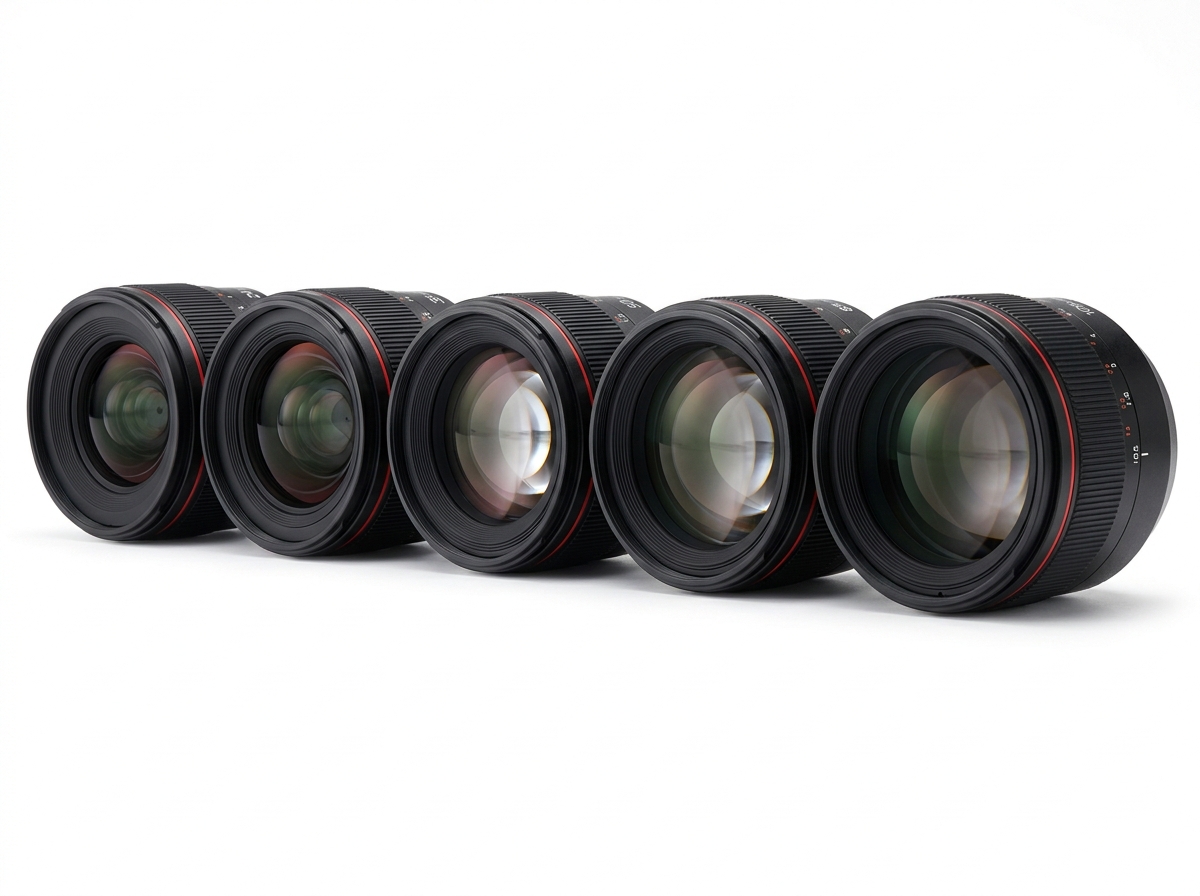
In short
- Under 500 euros, you can find prime lenses that outperform any kit zoom in sharpness, from the 50mm f/1.8 to Sigma Art.
- The three most versatile focal lengths remain 35mm, 50mm, and 85mm: with these three, you cover 85% of real-world situations.
- Manual focus lenses from Samyang and Voigtländer offer pro-grade optical quality for 200-400 euros each on the used market.
- Before buying a used lens, check for fungus, element separation, mount play, and AF functionality: three minutes that prevent returns.
Over the past ten years at the ReflexMania counter, I have seen the same scene repeat hundreds of times: a photographer walks in with their 18-55mm kit zoom and asks why their photos lack the look they see online. The answer is almost always the same: you need a prime lens. A 50mm f/1.8 for 150 euros makes more of a difference than a 1000 euro camera body upgrade.
In this article, we list ten prime lenses currently available on the used market for under 500 euros, with real prices and concrete indications on what to expect. These are all lenses we have tested in our lab over the years: no theory, only models that work and that we actually sell.
Why switching to a prime lens changes everything
The first time you mount a 50mm f/1.8 on a body used to the kit zoom, your first thought is simple: "something is missing here". Then you take the first snapshot on the fly indoors, without flash, and you realize that the "something" missing is the compromise. Prime lenses don't have the versatility of zooms, but they compensate with three concrete advantages that no 18-55 can offer: more light, more sharpness, less weight in your backpack.
The leap is not theoretical. It is measurable from the very first shutter count, and even untrained eyes notice it when viewing the photos on the screen.
Maximum aperture: what f/1.8 means in practice
A standard kit zoom opens to f/3.5-5.6. A budget prime opens to f/1.8. The difference is not cosmetic: f/1.8 gathers about four times more light than f/3.5 and over ten times more light than f/5.6 at 55mm. In real-world scenarios:
- Dinner at a restaurant: with f/1.8, you can take shots at ISO 1600 and 1/60s while keeping the camera steady. With f/5.6, you would have to raise the ISO to 12800 or use a flash. The difference in file quality is huge.
- Concert, theater, wedding in a church: f/1.8 allows shutter speeds of 1/125s without pushing the ISO beyond the sensor's usable limit.
- Portrait with blurred background: at f/1.8 with a 50mm lens two meters from the subject, the background becomes a soft chromatic blur that isolates the face. With f/5.6, the background remains recognizable and distracting.
Shallow depth of field is a tool, not an effect. Learning to manage it at f/1.8, f/2, and f/2.8 is what separates a catalog photo from a thoughtfully composed one.
Superior sharpness at the same price
Here, the math is ruthless. A new Canon EF 50mm f/1.8 STM costs 130 euros, while the used version goes for 80-100. A used 18-55 kit sits around 100-150 euros. For the same price, the prime wins at every aperture.
The 50 f/1.8 is already sharp in the center at maximum aperture and becomes excellent from f/2.8 onwards. The 18-55 kit, even at its best aperture (f/8 at mid-range focal lengths), does not reach the edge sharpness that the prime lens achieves at f/4. The reason is structural: a prime lens has 6-7 elements to optimize for a single focal length, while a zoom has 12-15 elements to make work across three different focal lengths. The compromise is inevitable.
Keep in mind that prime lenses are lighter (a 50mm f/1.8 weighs around 160 grams, while an 18-55mm kit lens weighs between 200 and 300 grams), and you'll understand why so many people stop putting their kit zoom back on once they've tried their first prime.
The 50mm f/1.8: The Essential First Purchase
If I had to recommend a single lens to pair with a camera body, it would always be a 50mm f/1.8. It costs less than a dinner for two, weighs 150-200 grams, and opens two and a half stops wider than any kit zoom. It is found everywhere on the used market because everyone buys it, and many resell it after discovering that 50mm on full frame is not a wide angle. For those who keep it, it becomes the most used lens in the kit.
The practical advantage is twofold: at f/1.8 you can shoot at 1/125s ISO 800 where an f/4 zoom would require ISO 3200, and the rendering at full aperture on a modern sensor separates the subject from the background in a way no 18-55 kit can replicate. After ten years in the lab, we assure you it is the lens we see change hands the most: it often enters and leaves our workbench three or four times before finding its final owner.
Canon EF 50mm f/1.8 STM: 90-130 euro used
Outstanding build quality, a well-deserved nickname. The STM motor has eliminated the annoying noise of the old II, and AF is precise even on entry-level bodies. Center sharpness is already good at f/1.8 and becomes excellent from f/2.8 onwards. The edges require stopping down to f/4 to match. On EOS R, R6 or R8 it mounts with an EF-EOS R adapter and works perfectly, including fast AF. At 100 euros, it is simply the lens with the best value for money in the photographic market.
Nikon AF-S 50mm f/1.8G: 130-180 euro used
The G version offers a significantly superior optical performance compared to the old D from 2002: less chromatic aberration, better micro-contrast, and rounder bokeh thanks to the seven rounded blades. The SWM motor is silent and fast on all modern DX and FX camera bodies. On Z system, the FTZ II adapter is required: the combination works perfectly, but consider whether it is more worthwhile to go directly for the Nikkor Z 40mm f/2, which is smaller and native, and can be found used for around 200 euros.
Sony FE 50mm f/1.8: 150-200 euro used
Optical performance is good, especially when stopped down to f/2.8, but AF is the weak point: slow, noisy, and sometimes hesitant in backlight. On newer bodies with AI tracking it works better, but it remains inferior to the Sigma 45mm f/2.8 DG DN or the Samyang 45mm f/1.8 AF. For those starting with a Sony A7 Mark II that we keep at 580 euros, it is still the most affordable choice to access full frame with a bright aperture.
The same logic applies to those starting with a Canon EOS RP: a full-frame body at 600 euros plus a used 50 STM at 100 euros, and you are operational for under 700 euros total with image quality that cost three times as much ten years ago.
The 35mm: the quintessential reportage lens
The 35mm is the focal length that most closely matches how the eye frames a scene when you enter a room. It doesn't compress like the 85mm, nor does it distort like the 24mm: it restores the proportions with which you remember that moment. For this reason, it is the historic lens of reportage, from Cartier-Bresson onwards, and today it remains the first choice for those doing street photography, documentary-style weddings, and travel.
On full frame, the 35mm immerses you in the scene: you have to get closer to the subject, and this changes how people react. On APS-C, the angle becomes equivalent to a 50mm and loses its "environmental" character, but it remains a versatile lens.
Used Sigma 35mm f/1.4 Art: 400-480 euros
The Art is the lens that rewrote the category in 2012. At f/1.4 it is already sharp in the center, at f/2 it is crisp even at the edges, and the microcontrast holds its own against optics with double the list price. On the used market, it is available in Canon EF, Nikon F, and native Sony E mounts, around 400-450 euros for well-kept examples.
It weighs 665 grams and you feel it around your neck after a few hours. It's the compromise to accept: if you're looking for lightness, look elsewhere; if you're looking for optical performance, you'll hardly find better in this class. In our workshop, we always check for decentering because on these Art lenses it's a defect that happens: one calibration screw out of place and the left and right edges are never in focus together.
Nikon AF-S 35mm f/1.8G DX: 130-180 euro
Only for Nikon APS-C camera bodies (D3500, D5600, D7500). On these sensors, the equivalent focal length is approximately 52mm, making it effectively a standard lens. It is affordable because it is designed for the entry-level market, but the optical performance is solid: sharp from f/2.8, with fast AF thanks to the SWM motor. It weighs 200 grams, featherlight.
Do not mount it on full-frame bodies: heavy vignetting occurs because the image circle does not cover the entire sensor.
Sony Zeiss FE 35mm f/2.8 ZA: 350-450 euros
The ideal companion for a Sony A6100 or a Sony A6400 for those looking for a tiny travel kit, even though on APS-C it becomes a 52mm equivalent. It weighs 120 grams, features T* Zeiss coating, and delivers very clean color rendering.
The f/2.8 aperture limits bokeh and low-light performance. If you're looking for creamy blur, this isn't the right lens: get a Sigma 30mm f/1.4 DC DN. If you prioritize compactness and optical quality for shooting light, it's unbeatable.
The 85mm for portraits: separation and bokeh
The 85mm is the focal length that separates the subject from the background like no other. Perspective compression flattens facial features in a flattering way, the shallow depth of field isolates the person, and the working distance (approximately 2-3 meters for a half-body shot) allows the model to breathe without invading their personal space. For portraiture, it is the lens that makes the difference between "a photo of a person" and "a portrait".
On the used market, this is a lucky category: 85mm lenses suffer little from intensive use because portrait photographers typically shoot in studios or controlled conditions, not in the rain or sand. You can find examples with 20,000 shutter counts that look like new.
Canon EF 85mm f/1.8 USM: 280-350 euros
Canon's historical benchmark for portraiture. Weighing 425 grams, it focuses with a fast and quiet USM motor, holding f/1.8 with acceptable sharpness in the center and excellent performance from f/2.8 onwards. The bokeh features the typical eight blades that create slightly polygonal circles in out-of-focus highlights, while the transition from sharp to soft on faces remains smooth.
The real strength: it remains fully relevant on mirrorless systems today. With a €100 EF-EOS R adapter, you can mount it on a Canon EOS RP and achieve reliable AF, functional eye-detection, and image quality that many €1500 RF zooms fail to match. For those already invested in the Canon system, it is the smartest purchase under €400.
Samyang 85mm f/1.4 manual: €180-250
Manual focus, no electronic contacts, no stabilization. On paper it seems like a compromise, in practice it is one of the most underrated lenses on the market. The 9-element design renders a clean bokeh, sharpness at f/2 is already pro-grade, and chromatic aberration stays under control where other 85mm lenses at the same price point collapse.
Available in Sony E, Nikon F, Canon EF, and Fuji X mounts. Mounted on a Sony A7 Mark II, it leverages the body's focus peaking to achieve precise focus even at f/1.4: once you get the hang of it, it's faster than it looks. Ideal for posed portraits, where you have the time to compose. Not recommended for moving children or events.
For an extended comparison of the 85mm lenses available on the used market, we have dedicated a complete article to how to choose the best used portrait lens, with practical examples of performance comparisons.
A note from the bench: the Canon EF 85 f/1.8 has a known minor defect of purple chromatic aberration on high-contrast edges at full aperture. It is correctable in a second with Lightroom and is not a reason to reject it. The Samyang does not have this issue but has slight barrel distortion, which is negligible in portrait photography.
Fixed wide-angle lenses: 24mm and 28mm for landscape and interiors
Below 35mm, the used market thins out considerably, but those looking for a bright fixed wide-angle lens will find two options worth considering. The 24mm and 28mm cover two different needs: the former is the lens for Milky Way and wide landscapes, while the latter is the cut for indoor reportage and urban architecture. They are not everyday lenses like a 35 or a 50, but when needed, no kit zoom can replace them.
Samyang 24mm f/1.4 manual: 280-380 euro
The Samyang 24mm f/1.4 is the lens that made astrophotography accessible to those who don't want to spend €1,500 on a Sigma Art. Real f/1.4 aperture, controlled coma at the edges even at full aperture, robust build. On the used market, it ranges from €280 to €380 depending on the mount: Canon EF and Nikon F versions cost less, while Sony E versions are slightly more expensive due to mirrorless demand.
Manual focus at 24mm is not the problem many fear. With a depth of field at f/8 ranging from two meters to infinity, you just need to set the hyperfocal distance and forget about focusing for the entire landscape. For the Milky Way, work at infinity with focus peaking active: five seconds and you're done. The only precaution is to verify that the actual infinity point corresponds to the reference on the ring, as on some units it is slightly off-center.
Nikon AF-S 28mm f/1.8G: 380-480 euro
The 28mm f/1.8G is one of Nikon's most underrated primes. Silent and fast AF thanks to the SWM motor, barrel distortion kept under 2%, and vignetting that disappears at f/2.8. On the used market, it ranges from 380 to 480 euros in excellent condition. Weighing 330 grams, it remains balanced even on mirrorless bodies via the FTZ adapter.
It is the ideal focal length for shooting tight interiors: real estate, restaurants, church weddings. At f/1.8, it performs well even in low ambient light without needing to raise the ISOs too much. The Nikon Z5 we have for 680 euros, paired with this 28mm via FTZ, becomes a compact reportage kit under 1,100 euros in total, featuring a stabilized full-frame sensor.
When buying the 28mm, always check two things: the oiling of the aperture blades (common in poorly stored units) and the play in the bayonet mount, because on this small lens, even two-tenths of a millimeter translates into perceptible micro-shake at wide apertures.
APS-C dedicated primes: small lenses for small bodies
Mounting a full-frame lens on an APS-C body is a waste of glass, weight, and money. Manufacturers have understood the issue and for years have offered dedicated primes for the smaller format: compact dimensions, optical designs optimized for the smaller image circle, and more accessible prices. On a body like the Sony ZV-E10 or the Nikon Z30, a native APS-C prime weighs half as much as a full-frame lens and often costs a third of the price.
The advantage is not just ergonomic. The optical design calculated for APS-C concentrates quality where it matters, without having to correct aberrations at the edges of a larger circle that the sensor will never use. Result: edge sharpness often superior to that of an adapted full-frame lens, at the same price.
Sigma 30mm f/1.4 DC DN Contemporary: 280-350 euros
It is the prime lens we most often recommend to those buying an entry-level APS-C mirrorless camera who want an immediate quality boost. Available for Sony E APS-C, Fuji X, and Canon EF-M, it weighs 265 grams and features an f/1.4 aperture that, on current compact cameras, delivers performance equivalent to a 45mm f/2 on full frame: a natural field of view, excellent for environmental portraits, street photography, and video.
The optical performance is Art line quality at a Contemporary price. Excellent sharpness at f/1.4 in the center, closing to f/2.8 at the edges. On a Sony ZV-E10 or Sony A6100, it becomes the perfect setup for those who want a single versatile lens that does everything well. The only limitation is the lack of stabilization and weather sealing.
Fuji XF 35mm f/2 R WR: 380-450 euro
If you're in the Fuji system, this is the prime lens you only take off the camera body to clean it. Weather-sealed (WR stands for Weather Resistant), with a silent and fast linear motor AF, and a physical aperture ring with clicks every third of a stop. It weighs 170 grams and has a 53mm equivalent on APS-C: the classic all-rounder.
Compared to its sibling, the XF 35mm f/1.4 R, the f/2 loses a bit of character in the bokeh but gains on three decisive fronts: AF three times faster, halved dimensions, and weather sealing. For daily use, travel, and reportage, the f/2 wins.
- Sigma 30mm f/1.4 DC DN — 280-350 euros — Sony E, Fuji X, Canon EF-M. Best value for money in the category.
- Fuji XF 35mm f/2 R WR — 380-450 euros — Weather-sealed, fast AF, compact. The first prime to get for Fuji owners.
- Sony E 35mm f/1.8 OSS — 350-420 euros — Stabilized, ideal for handheld video on bodies without IBIS like the ZV-E10.
- Viltrox 23mm/33mm/56mm f/1.4 — 200-280 euros each — The low-cost trilogy for Sony E and Fuji X, surprising for the price.
A practical tip: if you have an APS-C body without stabilization, consider the Sony E 35mm f/1.8 OSS instead of the Sigma. You lose half a stop of aperture, but gain 4 stops of stabilization, which is worth far more than a nominal f/1.4 when shooting handheld.
Vintage M42 and Pentax-K: quality for 50-150 euros
Seventies and eighties lenses are the best-kept secret of digital photography. With an adapter costing 15-25 euros, you can mount Soviet, Japanese, and German glass on any modern mirrorless camera. The color rendition differs from that of current lenses: less clinical, more three-dimensional, with a microcontrast that many chase in post without ever truly achieving it.
The only compromise is manual focus. On mirrorless cameras with focus peaking and 10x magnification, it becomes fast even for those who have never done it before. On a Sony A7 Mark II for 550 euros, you get full frame + 5-axis in-body stabilization: every vintage lens becomes stabilized, even a Helios from the Sixties. On an Olympus PEN E-PL9 for 300 euros, the 2x crop doubles the equivalent focal length: a 58mm becomes a 116mm, ideal for tight portraits.
Helios 44-2 58mm f/2: 50-90 euro
The most copied and most debated Soviet lens of all time. The famous swirly bokeh — blur that swirls around the subject — stems from the Biotar optical design replicated by KMZ. It performs best when you have foliage or point lights behind the subject, at a distance of 2-3 meters, with the aperture wide open at f/2.
What to check when buying one:
- Aperture blades: must not be oily; the aperture must close with a decisive snap.
- Focus ring: slightly damped, never stiff nor completely free.
- Lenses: minor surface scratches do not affect performance, but fungus and delamination do.
1960s "zebra" versions are worth twice as much as 1970s black ones in the same condition. Optically identical.
SMC Takumar 50mm f/1.4: 120-180 euros
For many, the best 50mm ever produced under 200 euros, whether vintage or modern. Brass and aluminum construction, a long and smooth focus ring, and eight aperture blades that create a round bokeh even when stopped down to f/2.8. Pentax's 1971 SMC (Super-Multi-Coated) treatment was light years ahead of its contemporaries.
Pay attention to one detail: some versions produced between the late 1960s and the first half of the 1970s feature a rear element made of thorium glass, which yellows over time. This can be corrected with UV exposure for a few days, but if you prefer to avoid the issue, look for more recent examples, identifiable by the SMC marking on the front ring instead of Super-Takumar.
Add a quality M42 adapter (Fotodiox, K&F Concept) and you're ready to go. Avoid the 8-euro adapters: excessive play, misaligned infinity, lens hood unscrewing the lens.
What to check before buying a used lens
A used lens can last forty years or die after three months. The difference is made by five minutes of checks before the purchase. Below, I explain what we do at the counter and what you can do if you buy from a private seller.
The 5 things we do in our workshop
Every lens that enters ReflexMania goes through the workbench before it reaches the display. It is not a visual check: it is a repeatable procedure that we apply identically to an 80-euro 50mm and a Sigma Art 600.
- Optical collimator test. We verify the alignment of the lens groups by projecting a reticle. If the optics are decentered — a group has shifted by a few tenths of a millimeter after an impact — the test exposes it. Decentering = sharp left side, soft right side. A defect invisible to the naked eye, devastating in print.
- AF verification on standard target. We mount the lens on the system's reference camera body and take certified shutter count shots on a 45° tilted target. We measure front and back focus. If the AF is off by 3-4 cm at f/1.4, the lens goes into calibration before it leaves.
- Lens-by-lens inspection with raking light. LED light aimed tangentially at the surfaces, lens by lens, including internal ones through the barrel. We look for fungus, haze, delamination (that iridescence similar to a soap bubble between two cemented elements), and coating scratches.
- Cleaning electronic contacts. The gold contacts on the mount oxidize. Two passes with a microfiber cloth and isopropyl alcohol are enough to eliminate intermittent communication errors that look like electronic faults but are not.
- Aperture test at all stops. Sequential shutter count from f/1.4 to f/22 in B mode with closure time counting. Oily aperture blades are the most common defect on poorly stored lenses: the aperture closes late or stays open, and all shots come out overexposed.
This is why we offer a 2-year warranty on used equipment: we know exactly what we are selling.
What you can check as a private individual
If you buy from a private seller, you won't have a collimator on hand, but you can perform three basic checks anywhere, even at a bar table.
- Raking light with your phone's torch. Shine the light at a grazing angle through the front element while looking from the rear, then vice versa. Fungus appears as white cobwebs or star-shaped spots. Delamination shows up as an iridescent patch on the edges of the internal elements. Fine dust is not an issue, cobwebs are.
- Rotation of the focus and zoom rings. They must be smooth and uniform, with no stuttering or hard spots. If you feel "grittiness" or irregular resistance, there is dust in the mechanisms or dried grease inside. Repair costs 80-150 euros.
- Shutter count at all apertures in A mode. Frame a white wall and take certified shutter counts from f/1.8 to f/16. The photos must show consistent exposure. If f/8 and f/11 come out brighter than the others, the aperture blades are oily.
Three minutes that save you from wasting 300 euros. If you want to equip yourself with some basic tools for your checks, in our article on essential photography accessories under 50 euros you will find an LED torch, microfiber cloths, and a blower bulb at negligible costs.
Which camera body to pair with these lenses
Having three 50mm f/1.8 lenses on display is of little use if the camera body has a different mount. Before choosing a prime lens, decide on the system, then select the used entry-level camera body that brings you into the ecosystem with the smallest budget. Here are the bodies we most recommend at the counter for those starting from scratch or switching systems.
Full frame under 700 euros
Used full-frame bodies under €700 were unthinkable five years ago. Today, three models open the door for those who want to get the most out of f/1.8 primes, maximizing sharpness, bokeh, and high-ISO performance.
- Sony A7 Mark II — 580 euro. E mount full frame, 5-axis in-body stabilization. Compatible with the entire FE lens lineup: the Sony FE 50mm f/1.8 and the FE 35mm f/2.8 ZA mentioned above mount natively. AF is dated for moving subjects, but it performs flawlessly for portrait and landscape without compromises.
- Canon EOS RP — 600 euro. RF mount, but with the EF-EOS R adapter (approx. 100 euro new) it mounts the entire EF lens lineup natively, including the 50mm f/1.8 STM and the 85mm f/1.8 USM. 26 megapixels, lightweight body. The best choice for those who already own EF lenses from the DSLR era.
- Nikon Z5 — 680 euro. Z mount, 5-axis stabilization, 24 megapixels. With the FTZ adapter it mounts all AF-S F lenses like the 50mm f/1.8G and the 85mm f/1.8G. The most robust body of the three, weather-sealed.
APS-C for compact primes
If the goal is lightness and Sigma DC DN or Samyang lenses weighing 200-300 grams, APS-C remains the most sensible choice. Weigh the complete system, not just the body.
- Canon EOS R100 — 400 euros. The lowest price to enter a current mirrorless system. RF mount, fits all RF and RF-S lenses.
- Nikon Z30 — 450 euros. No viewfinder, designed for video and creators. With the Sigma 30mm f/1.4 DC DN it becomes a pocketable street camera.
- Sony ZV-E10 — 500 euros. APS-C E mount, excellent for 4K video and vlogging. Compatible with all Sony E primes (35mm f/1.8 OSS) and Sigma DC DN lenses.
- Sony A6100 — 600 euros. Same mount as the ZV-E10 but with an EVF viewfinder and photographic dials. We prefer it for those who shoot photos 90% of the time.
- Nikon Z50 Mark II — 780 euros. The price goes up, but it brings last-generation AF inherited from the Z full-frame models. The investment makes sense if you plan to keep it for five years.
All these camera bodies leave our lab with a certified shutter count, a tested sensor, and a 2-year warranty. If you are undecided between two systems, visit our store: trying them in hand with the prime lens you are interested in will resolve your doubts in ten minutes.
Frequently asked questions
Is it really worth buying a used prime lens instead of a new zoom?
Yes, almost always. A used 50mm f/1.8 for 130 euros has superior optical performance to a new 18-55 zoom for 250 euros at all apertures, plus 4 stops more light. The only real limitation is the fixed focal length: you have to move with your feet.
Do vintage M42 lenses really work on modern mirrorless cameras?
Yes, with a 20-40 euro mechanical mount adapter. You lose autofocus and automatic aperture control, but you gain lenses with characteristic rendering for 80-150 euros. They mount perfectly on Sony A7 II or Olympus PEN E-PL9.
Are manual Samyang lenses worth their price?
For those who accept manual focus, yes. The optical performance of the Samyang 85mm f/1.4 is comparable to lenses three times more expensive. It is suitable for posed portraits, landscape, and astrophotography. Avoid it for sports or fast-paced reportage.
How long does a used lens last?
If well maintained, decades. The mechanical glass and metal lenses from the 70s that we sell in our workshop are 40-50 years old and still work. Modern lenses with electronics have weak points in the AF motors and contacts, but with normal use they easily last 15-20 years.
Can I use Canon EF lenses on Canon mirrorless EOS R?
Yes, with the official Canon EF-EOS R adapter (around 100 euros new, 50-70 used). Autofocus works at the same speed, in many cases even better than the original DSLR body thanks to the Dual Pixel AF of the EOS R sensors.
Which prime lens do you recommend to get started if I just bought my first mirrorless?
The 50mm f/1.8 native to your system. It is inexpensive (130-200 euros used), lightweight, offers excellent image quality, and forces you to think about composition instead of zooming. After six months, you will know for yourself whether you need an additional 35mm or 85mm lens.
Does ReflexMania inspect used lenses before selling them?
Yes, every lens goes through our in-house lab in Ancona. We check for fungus with raking light, centering on the collimator, AF performance on a test target, aperture blades at all apertures, and mount play. All used items come with a 2-year warranty.
Find your prime lens with us
If you have doubts about a purchase or need advice for your specific case, contact us. We offer free advice because we are photographers first, sellers second, and because a customer who makes a poor purchase does not return to photography.
Three ways to get in touch:
- Contact form — response within 24 business hours
- WhatsApp at 342 362 3454 (messages only)
- Phone: 071 291 6347 (Mon-Fri 9-13/15-18, Sat 9-13)
And if you want to see what we have in stock right now, explore the used inventory available today: every camera body is certified, comes with a 2-year warranty, and ships within 24-48 hours.
Article written by Matteo for the ReflexMania Team. Last updated: May 2026. Prices and availability refer to the time of publication.