
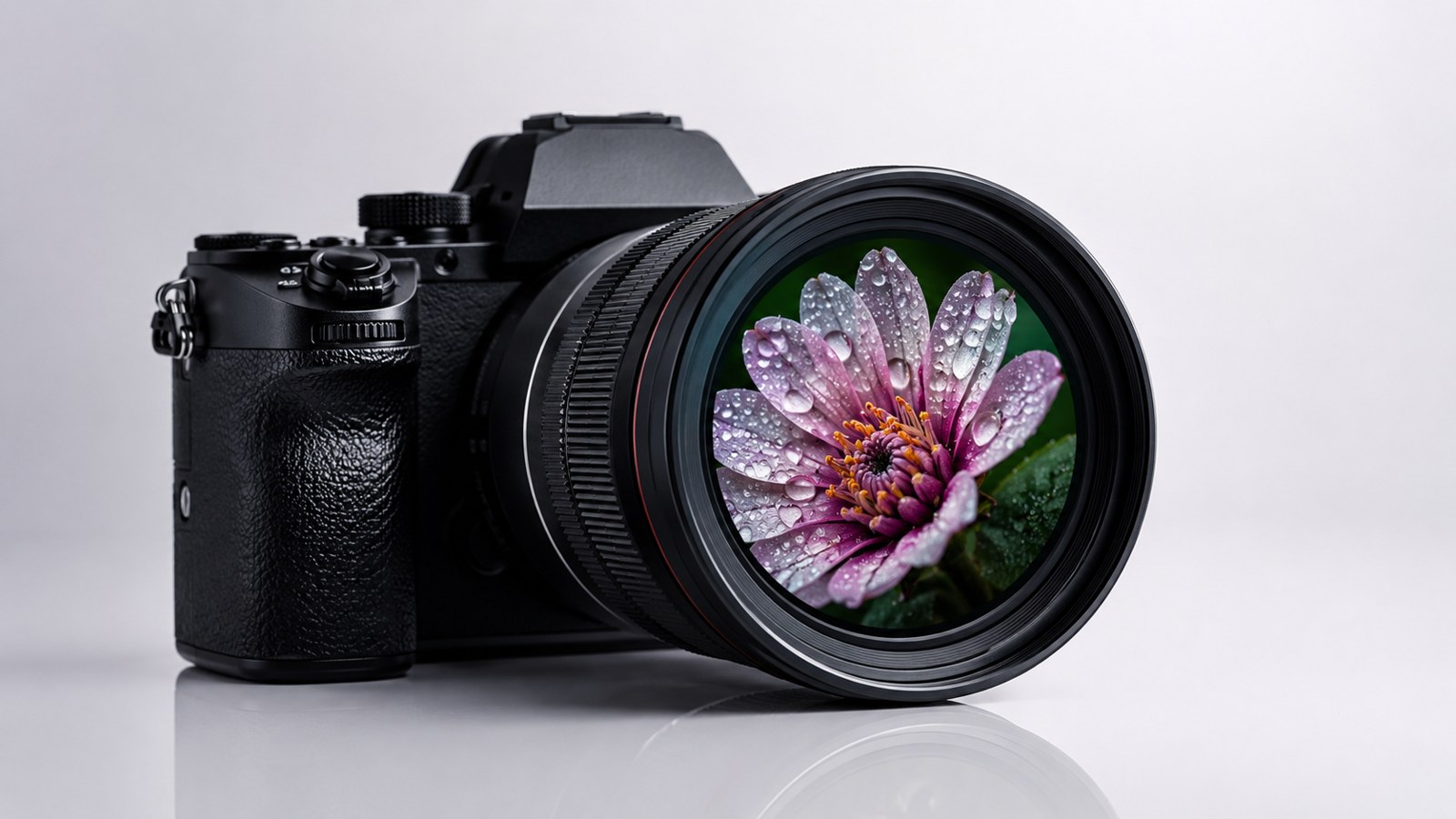
In short
- A true macro lens reaches a 1:1 reproduction ratio; below this value it is only "close-up", not real macro.
- Extension tubes (30-60 euros used) and close-up lenses turn a 50mm into a near-macro without spending hundreds of euros.
- Used Tamron 90mm and Sigma 105mm often cost between 200 and 350 euros and outperform many newer native macro lenses in image quality.
- Working distance matters more than megapixels: with a 60mm you are 5-6 cm from the subject, with a 100mm you are 14-15 cm away and do not scare insects.
At the counter, the request "I want to do macro but without spending a fortune" comes up at least once a week. Almost always, the same confusion lies behind it: people assume you absolutely need the latest native macro lens costing 700 euros, when the used market offers lenses that do the same job for a third of the price. And often, before even considering a lens, a 40-euro accessory would suffice.
In this article, we separate marketing from practice. We look at what makes a lens truly macro, which affordable alternatives actually work, and which used models we recommend after seeing hundreds pass through our workshop. The goal is to help you spend the right amount on what you actually photograph, not on what's printed on the box.
What makes a lens truly "macro" (and what doesn't)
The word "macro" is printed on dozens of lenses that are not macro. On many kit zooms, you find it stamped next to a little flower, but when you try to fill the sensor with a ladybug, you realize the subject remains small. The issue is not optical quality: it is the reproduction ratio. A lens is truly macro only when it reaches 1:1, period. Everything else is close-up, useful but different.
The 1:1 reproduction ratio explained without technical jargon
The reproduction ratio indicates how large the subject is projected onto the sensor compared to its actual size. At 1:1, a 10 mm object occupies exactly 10 mm of the sensor. On a full-frame sensor with a 36 mm side, this means an insect slightly over three centimeters long fills the frame from edge to edge.
Below that value, magnification drops quickly. Here's what changes in practice:
- 1:1 — a fly's eye fills half the frame. True macro.
- 1:2 — the subject is rendered at half its actual size. Good for flowers and details, not for a fly's eye.
- 1:4 — one quarter of the actual size. This is a "close-up", nothing more.
On an APS-C sensor, the situation is even more favorable: the 1.5x crop factor (1.6x on Canon) means that the same 1:1 magnification fills a smaller frame, resulting in greater apparent enlargement. I will return to this point later.
When "macro" on the box doesn't mean macro
Marketing uses "macro" because it sells. Many zooms — think 18-55 or 18-200 — list a "macro function" that translates to 1:3 or 1:4 in the technical specs. It’s honest on paper, but the term remains misleading for those who don’t read the numbers. Before you trust it, check two items:
- The declared maximum magnification ratio. If it doesn't say 1:1, it's not macro.
- The minimum focusing distance, i.e., how close you can get while keeping the subject in focus. The shorter it is, the closer you can get to the subject.
One without the other is misleading. A long focal length with a generous minimum focusing distance can still achieve 1:1, while a zoom that lets you get within a few centimeters often stops at 1:2 due to optical design limitations. When evaluating a used lens, always start with these two lines on the spec sheet: they tell you in three seconds whether you have a true macro or a close-up in disguise.
Affordable alternatives to true macro: what actually works
You don't need to spend 300 euros to get close to a flower or an insect. If you already have a 50mm or a 35mm lens in your bag, you can turn it into a near-macro setup for 30-60 euros. You won't reach a 1:1 magnification ratio, but 1:2 or 1:3 is achievable, and for many subjects, that's more than enough. The key is understanding what you are buying and where you compromise, because every budget solution comes with a hidden cost.
Extension tubes: the most honest solution under 60 euros
An extension tube is an empty ring that you place between the camera body and the lens. By moving the lens away from the sensor, you reduce the minimum focusing distance and increase magnification. No additional glass is added: the optical performance remains that of your lens, and this is the true advantage over close-up filters.
The price to pay is light. The more you extend, the more stops you lose: with a 36mm set on a 50mm lens, you can lose up to 1.5-2 stops. In macro, you are working at closed apertures and on a tripod anyway, so it is often not a drama. The distinction that matters is another one:
- Manual extension tubes (10-25 euros): no electrical contacts. You lose autofocus and aperture control from the camera body. On many recent lenses without an aperture ring, the glass stays fully open, making it unmanageable.
- Extension tubes with electrical contacts (40-60 euros used): retain aperture and automatic exposure, and sometimes AF. For macro, you will rarely use AF, but aperture control from the body is almost indispensable on modern lenses.
Practical advice: go for the ones with contacts, unless you mount older lenses with a physical aperture ring.
Close-up lenses and reverse rings: limitations and when they make sense
Close-up lenses are screw-on filters featuring a magnifying lens, ranging from +1 to +10 diopters. They are very affordable, typically costing 15-30 euros, and do not sacrifice light. The issue is degradation: you lose sharpness visibly at the edges, and the higher the diopter, the worse it gets. Double-element (achromat) versions cost more but perform significantly better.
The reverse ring is the zero-budget solution: you mount the lens backwards, usually a 50mm, and achieve magnifications greater than 1:1. It is extremely inconvenient: no automation, exposed lens, and focusing only by moving the camera body back and forth. It works, it is almost a stylistic exercise, but you will not use it in the field.
If your goal is simply to buy a good fast prime lens for conversion, check out the top 10 used prime lenses under €500: an honest 50mm is the ideal base for tubes and reverse rings.
Used macro lenses worth your money
If I had to name just one macro lens to buy used without overthinking it, my finger always lands on the same range: third-party 90-105mm lenses. These are optics designed twenty years ago for film, built when "macro" truly meant 1:1, and they still perform excellently on modern sensors. They are inexpensive because they were sold in massive quantities, not because they are of low value.
The classic 90-105mm: Tamron 90 and Sigma 105
The Tamron SP 90mm f/2.8 Macro and the Sigma 105mm f/2.8 Macro EX have been the quality-price benchmark for at least two generations. Used, you will almost always find them between 200 and 350 euros, depending on the version (older non-stabilized or more recent with VC/OS) and mount. At that price, they outperform many newer native mirrorless macros in image quality, which cost three times as much, because the macro optical design has been mature for a long time and there is little to gain by reinventing it.
- Tamron SP 90mm f/2.8 — 200-300 euros used. The "nickname" is 90mm Bokeh for the soft out-of-focus. The older version without stabilizer costs less and optically loses nothing on a tripod.
- Sigma 105mm f/2.8 EX — 250-350 euros used. More contrast and a few millimeters of extra working distance. The OS version adds stabilization useful for handheld shooting, but raises the price.
Practical advice: if you mostly shoot on a tripod, get the older, non-stabilized version and save 80-100 euros. Stabilization in 1:1 macro is far less useful than marketing suggests, as you are working with controlled shutter speeds and apertures anyway.
Budget macro 50-60mm: shorter, closer to the subject
50-60mm macro lenses (Canon EF-S 60mm, Nikon 60mm, various Sigma 50-70mm) are often found used for under 200 euros and also achieve 1:1 magnification. The compromise is not optical quality, which is excellent, but working distance: at full scale, you are 5-6 cm from the front element, almost on top of the subject.
They are perfect for still life, coins, jewelry, products on a table, or document reproduction: the subject is stationary, and you don't need to get close to it. For insects and flowers in the wind, however, those few centimeters become a concrete issue of shadows and movement. If you are interested in a broader discussion on used prime lenses to pair with your body, I covered it in the best 10 used prime lenses under €500.
Working distance: why focal length matters more than megapixels
The question we always get at the counter is "how many megapixels do you need for macro". Almost never is that the right one. Two different macro lenses both reach a 1:1 ratio, fill the sensor with the same subject, and produce the same amount of detail. What changes, and changes everything, is how far you are from the subject while shooting. This measurement is called working distance: the space between the front glass and the insect, flower, or droplet you are photographing.
With a 24-megapixel sensor, you already capture more detail than any A3 print can show. The jump from 24 to 45 megapixels won't change your life when shooting a beetle. Focal length, however, decides whether that beetle stays still or flies away before the shutter count.
60mm vs 100mm: same 1:1, different experience
At the same maximum magnification, working distance increases with focal length. Here are the actual figures at a 1:1 ratio, generally applicable to any brand:
| Macro focal length | Working distance at 1:1 | Typical use |
|---|---|---|
| 60mm | 5-6 cm | Still life, coins, jewelry, stationary objects |
| 90-100mm | 14-15 cm | Insects, flowers in wind, portrait |
| 150-180mm | 25-30 cm | Shy butterflies and dragonflies |
Five centimeters may seem like little, and they truly are. At that distance, the lens casts its shadow on the subject, the lens hood nearly touches the petal, and the insect perceives the movement. With a 100mm, you gain a good ten centimeters: the camera body's shadow stays out of the frame, lighting improves, and the animal doesn't flee.
The 60mm is not to be discarded; it was simply designed for something else. For those photographing stationary objects on a table, the short focal length is more manageable, weighs less, and costs less used. But if the goal is nature — which is what 90% of people asking for a macro have in mind — a medium focal length around 100mm is the choice that saves you from frustration. Before looking at the technical specifications, decide what you photograph: working distance matters more than any spec.
Which used camera body to mount a budget macro lens on
Macro is the most democratic photographic genre in terms of camera body. You don't need a 20 fps flagship: the shot is slow, often taken on a tripod and in manual mode, with a stationary subject. The lens and technique matter much more. Any used body in our catalog, whether APS-C or full frame, does its job without real compromises.
APS-C: the crop factor works in your favor
In macro, the smaller sensor is an ally, not a limitation. The crop factor crops the center of the image projected by the lens, so at the same 1:1 ratio, the subject fills a larger portion of the frame. The same glass that would give you a "distant" flower on full frame brings it closer to the edge on APS-C: greater apparent magnification, at zero cost.
Moreover, the greater depth of field at the same aperture helps, as in macro photography the focus tolerance is only a few millimeters. Used camera bodies worth considering to start with:
- Nikon Z50 at 600 euros: compact APS-C mirrorless, clean viewfinder and convenient focus peaking for the manual focus typical of macro.
- Fujifilm X-T2 at 550 euros: dedicated physical dials, useful for working in manual without entering the menus, and generous files in detail.
Both are fitted with a Tamron 90mm or a Sigma 105mm — native or via an adapter depending on the mount — and the effective magnification you see in the viewfinder is higher than that of the same lens on full frame.
Used full frame for those who want more separation
Full frame isn't about zooming in further; it's about separating the subject from the background more effectively and keeping high ISOs clean when working in low light without flash. If you're after that creamy background and three-dimensional separation, full frame makes sense.
- Sony A7 Mark II from 520 to 570 euros: in-body stabilization helps with handheld shooting, and with an adapter ring you can mount virtually any vintage manual macro lens for a few euros.
- Canon EOS RP at 600 euros: lightweight full frame, and the short flange distance of the RF mount accepts EF lenses and old M42 with the right adapters, perfect for reviving dated macro lenses.
The Sony A7 Mark II is particularly one of the most popular platforms for adapted macro lenses: short flange distance, stabilization, and a huge range of adapters. You don't spend on the camera body what you want to invest in the glass.
Adapted vintage macro lenses: the real deal for tinkerers
An Olympus OM 50mm f/3.5 macro can be found for between 60 and 90 euros, and an adapter ring costs 20-30 euros. For less than 120 euros, you get a lens that performs like many native 600-euro macros. The market for discontinued DSLRs has flooded the used market with mountains of excellent manual lenses: Olympus OM, Nikon AI/AI-S, Vivitar Series 1, Pentax Takumar. They all mount on mirrorless cameras, because the short flange distance of Sony E, Micro 4/3, and Canon RF leaves room for the adapter without compromising infinity focus.
Adapter rings and manual focus
You lose nothing by giving up autofocus, because in 1:1 macro, AF is useless anyway: the depth of field is only a few millimeters, and you work by moving the camera body back and forth, not the focus ring. Manual focus is the standard for anyone doing serious macro, whether vintage or native.
The focus peaking and on-screen magnification of mirrorless cameras make manual focus more precise than the optical viewfinder of an old DSLR. And here vintage shines in focus stacking: fluid focus ring, no electronics getting in the way, repeatable shutter counts on a tripod. A Panasonic GH5 at 470 euros has post-focus and in-camera focus stacking, which with a manual lens become an assembly line. The same patient tripod approach applies to the sky: we discuss it in astrophotography with used cameras.
When vintage is not worth it
If you photograph live insects or events, look elsewhere. Without autofocus and electrical contacts, you will lose moving subjects and lack EXIF data for the aperture. For those seeking speed, a used Tamron 90mm or Sigma 105mm AF (€200-350) is the right choice.
Vintage makes sense in these cases:
- Worth it: still life, flowers, products, jewelry, tripod focus stacking, budget under 150 euros.
- Not worth it: handheld macro, moving insects, those who don't want to learn manual focus, those who need stabilization paired with AF.
On a Sony A6100 at 550 euros, vintage lenses perform excellently for studio work, but if you spend half your time chasing bees on flowers, spend those 550 euros by reserving 300 for an autofocus macro lens. The right tool depends on what you photograph, not on how beautiful the lens looks on paper.
What we check in the lab on a used macro lens
A macro lens operates at distances where every millimeter of mechanical play becomes visible. That is why our inspection of a used macro lens is stricter than that of a standard lens: we look for defects you would not notice at infinity, but which will ruin your shot at 1:1.
We run a full sequence of checks on every unit before listing it:
- Helical: we perform a full excursion from the minimum focus distance to infinity, checking if the ring moves smoothly. Hard spots or sticking areas indicate dried grease or internal dirt.
- Aperture blades: we stop down to all values, checking the opening speed and looking for oil stains on the blades. On a macro lens, exposure often works at f/11-f/16, so a slow aperture is immediately noticeable.
- Internal elements: in backlight, we look for fungus, haze, and delamination between the cemented elements.
- Electrical contacts and AF: we verify communication with the camera body, EXIF transmission, and focus acquisition, even though you will likely use many macro lenses in manual focus anyway.
Typical defects of used macro lenses
Three issues come up more often than others, and it’s worth understanding what they really mean before buying from a private seller.
| Defect | What it means for the buyer |
|---|---|
| Greasy aperture | The blades close late or stick. This leads to incorrect exposures and, over time, oil ends up on the lens elements. It is repairable, but the cleaning cost is often close to the value of the lens. |
| Loose helicoid | The ring has play and the barrel "wobbles". At 1:1, the focal plane shifts on its own: with focus stacking, it becomes unmanageable. It requires professional lab adjustment; from a private seller, it is a gamble. |
| Lens separation | The cement between two elements detaches, creating iridescent halos at the edges. It cannot be repaired economically: the lens should be discarded, regardless of the price. |
When we find any of these three issues, we make a case-by-case decision: aperture and helicoid problems are covered by the revision, while separation removes the unit from the catalog. This is the difference between buying a certified macro lens and taking a blind gamble, hoping the oil hasn't yet reached the glass.
Frequently asked questions
What is the difference between a "macro" lens and a "close-up" lens?
A true macro lens achieves a 1:1 reproduction ratio, meaning the subject is projected onto the sensor at life size. "Close-up" lenses or zooms with macro function often stop at 1:3 or 1:4, thus magnifying much less.
Do extension tubes degrade image quality?
No, extension tubes do not contain lenses: they simply move the optics further away from the sensor. The quality remains that of the lens you mount. You lose a bit of light and infinity focus, but sharpness does not degrade.
Which is better: a 60mm or a 100mm macro lens?
Both can achieve 1:1. The difference is the working distance: with a 60mm you are 5-6 cm from the subject, with a 100mm 14-15 cm. For live insects the 100mm is preferable because it does not scare them; for still life and products the 60mm is perfectly fine and costs less.
Can I do macro photography with a used APS-C mirrorless?
Yes, and the crop factor works in your favor: an APS-C increases the apparent magnification compared to a full frame with the same lens. A used camera body like the Sony A6400 or Nikon Z50 is a more than adequate base for macro.
Is an adapted vintage macro lens worth it?
For those with patience, yes: manual macro lenses can be found for 40-120 euros that perform very well, because in macro photography focus is almost always done manually. The disadvantage is the lack of autofocus and electrical contacts. If you are looking for speed, a used AF macro lens is better.
How much should I spend to start serious macro photography?
If you already have a camera body, 40-70 euros of extension tubes are a great way to start. For consistent and comfortable results, a used native macro lens in the 200-350 euro range is an investment that stands the test of time.
What should I check before buying a used macro lens?
Check that the focus ring has no play, that the aperture blades are not oily, that there is no fungus or lens element separation, and that the electrical contacts work. These are the defects we see most often at the bench.
Looking for a used, inspected, and guaranteed macro lens?
If you have doubts about a purchase or need advice for your specific case, write to us. We offer free advice because we are photographers first, and because a customer who buys poorly does not come back to photography.
Three ways to get in touch:
- Contact form — response within 24 business hours
- WhatsApp at 342 362 3454 (messages only)
- Phone: 071 291 6347 (Mon-Fri 9-13/15-18, Sat 9-13)
If you want to see what we have in stock right away, explore the used gear available today: every camera is certified, comes with a 2-year warranty, and ships within 24-48 hours.
Article written by Matteo for the ReflexMania Team. Last updated: June 2026. Prices and availability refer to the time of publication.