
In short
- The 2021 Sigma 18-50 f/2.8 DC DN Contemporary weighs 290 g and measures 74.5 mm. On APS-C, it is equivalent to a 27-75 mm f/2.8, about the size of a kit lens.
- Available for Sony E and L-Mount since 2021, for Fujifilm X since 2022, and for Canon RF since 2024. The older EX DC versions for DSLR are a different lens and do not fit mirrorless bodies well.
- It is not stabilized. On bodies without IBIS, such as the Sony A6000, Fujifilm X-T3, X-T30 II, and Canon EOS R100, you must rely solely on fast shutter speeds.
- On the used market, it is found between €330 and €420, compared to around €1,000–1,400 for a new Sony E 16-55 f/2.8 G or Fujifilm XF 16-55 f/2.8.
At the counter, the Sigma 18-50 f/2.8 DC DN almost always comes with the same story. The customer has used the kit lens for two years, discovered that their APS-C body quickly hits 6400 ISO indoors and at night, and is looking for something brighter. However, they don't want to carry 650 grams of professional zoom in front of the camera. The Sigma solves exactly this: constant f/2.8, 290 grams, and the footprint of a 35mm prime.
The name, however, is misleading when it comes to used gear. Under the 18-50 f/2.8 designation, Sigma has sold at least four different lenses over twenty years, first for DSLRs and then for mirrorless cameras, and today the DC DN exists in four mounts with non-identical behaviors. In this guide, we show you how to identify the versions, what changes between Sony E, Fujifilm X, Canon RF, and L-Mount, which camera bodies it makes sense to mount it on, and what we check in the lab before putting one up for sale.
Why an 18-50 f/2.8 zoom makes sense on APS-C
Indoors and at night, the kit's limitation isn't the focal length but the light. The f/2.8 zoom solves exactly this, even if its bokeh performance delivers less than marketing might suggest.
27-75 mm equivalent: the everyday focal length
On Sony E, Fujifilm X and L-Mount APS-C, the crop factor is 1.5x: the 18-50 becomes a 27-75 mm. On Canon RF, the crop is 1.6x, reaching approximately 29-80 mm. It follows the same logic as the 24-70 on full frame, which we discuss in our guide to used 24-70 standard zooms, with a slightly less wide angle.
- 18 mm (27 mm eq.): interiors, narrow city streets, landscapes without exaggerating the perspective.
- 24-35 mm (36-52 mm eq.): reportage, group dinners, group photos at normal distance.
- 50 mm (75 mm eq.): half-length portraits, details, faces without distortions.
Those who photograph while traveling and with family will find this range sufficient for the vast majority of their shutter count. It lacks a true wide-angle for architecture and a telephoto for sports. For everything else, there is no need to change the lens.
f/2.8 on APS-C: what you gain and what you don't
In stock f/2.8 remains f/2.8, on any sensor. The comparison with an 18-55 f/3.5-5.6 kit is therefore measured in real stops, and the difference grows as you zoom in.
| Focal length | Kit 18-55 | Sigma 18-50 | Gain |
|---|---|---|---|
| 18 mm | f/3.5 | f/2.8 | approx. 2/3 of a stop |
| 50 mm | f/5-5.6 | f/2.8 | 1.7 to 2 stops |
Two stops mean going from ISO 3200 to ISO 800 at the same shutter speed, or from 1/30 to 1/125 second at the same ISO. In a poorly lit kitchen, it’s the difference between a blurry child and a sharp one. In low light, this advantage is visible in every photo.
As for the bokeh, however, expectations should be tempered. In terms of depth of field, f/2.8 on APS-C is equivalent to approximately f/4.2 on full frame (f/4.5 on Canon). At 50 mm, the background separates, but remains recognizable. A 50 mm f/1.8 prime on the same body opens up by about 1.3 stops more, and the background melts away much more significantly.
When a product listing touts “creamy bokeh” for this lens, it pays to be skeptical. The 18-50 f/2.8 is a fast zoom designed for low light, not a portrait lens. If you primarily want a blurred background, you’ll spend less and get more by pairing a fast prime with your kit.
The versions: from DSLRs to DC DN Contemporary
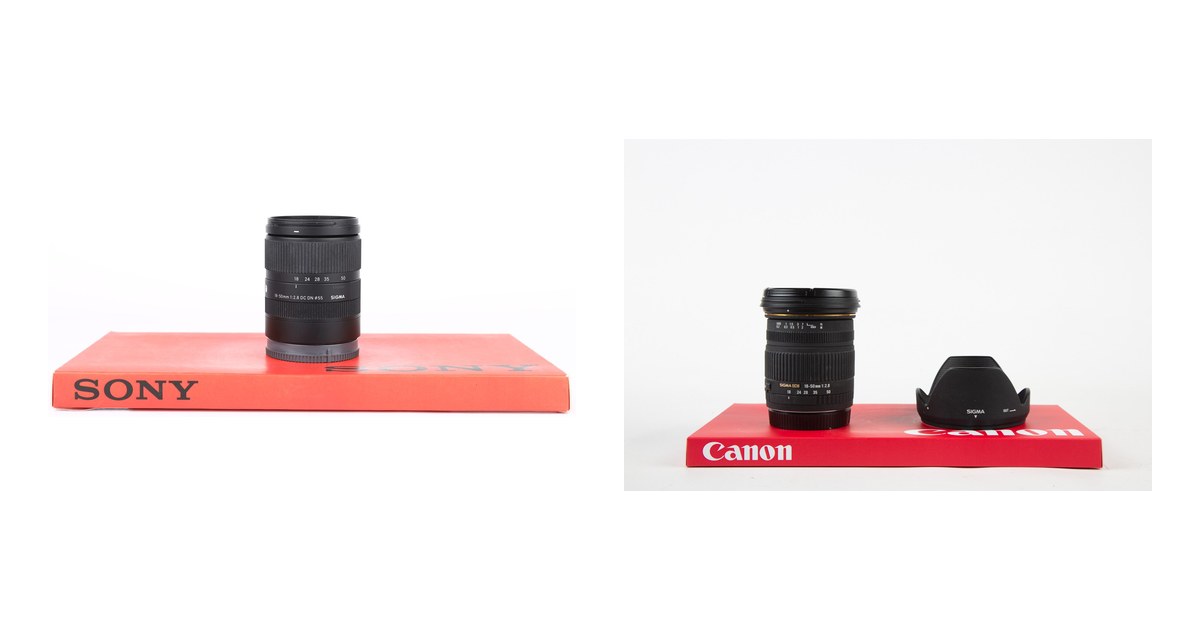
Under the name "Sigma 18-50 f/2.8", at least four versions have been released over twenty years, plus a close relative starting at 17 mm. Only the latest one was designed for mirrorless cameras. Private sellers often confuse them because the focal length and aperture remained the same. To distinguish them, just look at the code on the front ring and the finish of the barrel.
| Version | Period | System | How to identify it |
|---|---|---|---|
| 18-50 f/2.8 EX DC | early 2000s | DSLR APS-C | Gold ring, EX marking, no Macro or HSM designation |
| 18-50 f/2.8 EX DC Macro | mid-2000s | DSLR APS-C | "Macro" text on the ring |
| 18-50 f/2.8 EX DC Macro HSM | late 2000s | DSLR APS-C | HSM designation and autofocus motor in the lens |
| 17-50 f/2.8 EX DC OS HSM | 2010 | DSLR APS-C | Starts at 17 mm, OS designation, stabilizer switch |
| 18-50 f/2.8 DC DN Contemporary | from 2021 | Mirrorless APS-C | DC DN designation, "C" badge on the barrel, 290 g |
Old EX DC lenses for DSLRs
They are available for Canon EF, Nikon F, Pentax K, and Sigma SA mounts and weigh between 445 and 565 g: the highest weight belongs to the stabilized 17-50. The former do not have HSM. On Nikon, they focus using the body's motor, so on a D3500 or a D5600 they remain manual. On the used market, they cost between 80 and 150 euros. The 18-50 EX DC were designed when APS-C DSLRs had 6-12 megapixels. Autofocus is slower and more prone to errors than that of a modern zoom, especially at f/2.8 and at the minimum focusing distance.
The 2021 DC DN Contemporary
It is a new project, not an update: 13 elements in 10 groups, stepping motor, mount seal and 55 mm filter. In wide-angle it focuses down to 12.1 cm with a 1:2.8 ratio. It is not a true macro, but it is enough for a plate at a restaurant or a product detail. The stepping motor is silent and tracks subjects well even in video. Those using a mirrorless should only consider this version: it does not mount on DSLRs, and older versions work poorly on mirrorless.
Why not adapt the old version to mirrorless
With the EF-EOS R adapter or the Sigma MC-11 on Sony E, the EX DC lenses work again, but only partially:
- Autofocus: slow, with frequent "hunting" and often unreliable tracking. The EX DC lenses are not among the officially supported lenses for the MC-11, which is designed for the Contemporary, Art, and Sports series in Canon EF or Sigma SA mount.
- Weight: lens plus adapter exceed 550 g, nearly double the 290 g of the DC DN.
- Sharpness: on a 24-26 MP sensor, the edges at f/2.8 appear soft. On a 6 MP DSLR, this flaw was not visible.
Adapting only makes sense if you already own the lens and use it occasionally. Buying one specifically to mount on a mirrorless is not worth it. Between the price of the older version and the adapter, the difference compared to a used DC DN is very small.
DC DN mounts: Sony E, L-Mount, Fujifilm X and Canon RF
The optical group is identical across all four mounts, so sharpness remains consistent when paired with the same camera body. What varies is the release year, how the lens communicates with the camera, and the number of units available on the used market. This matters more than the spec sheet when looking for a good deal.
| Mount | Available from | Typical APS-C bodies | Used market prevalence |
|---|---|---|---|
| Sony E | 2021 | A6000, A6100, A6400, A6600, ZV-E10 | High |
| L-Mount | 2021 | Leica CL, TL, TL2 | Low |
| Fujifilm X | 2022 | X-T30 II, X-S10, X-T4, X-S20, X-T5 | Medium |
| Canon RF | 2024 | R100, R50, R50 V, R10, R7 | Growing |
Sony E: the most common version on the used market
It is the one we see most often at the counter, because it arrived first and fits a very wide range of APS-C camera bodies. Eye-AF works the same as with Sony lenses. Real-time tracking, however, depends on the body: it is available on the A6100, A6400, and A6600, but not on the A6000. Distortion and vignetting corrections are applied in-camera. If you mount it on a full-frame Sony camera, the body automatically switches to APS-C mode, provided that the crop setting is set to "Auto" in the menu.
Fujifilm X: from 2022, without the aperture ring
You can feel the difference in your hands. The aperture does not have a ring on the lens and is set using the command dial on the camera body. Those coming from Fujinon XF lenses, accustomed to keeping the aperture under their left thumb, may find it uncomfortable at first. The subject detection on the X-T5 and X-S20 works reliably. The lens firmware is updated from the camera body via an SD card, without any accessories: before putting a unit up for sale, we check that it is on the latest version.
Canon RF: Since 2024, among the first third-party zooms for RF APS-C
Canon opened the RF mount to Sigma, starting with APS-C lenses, and the 18-50 was among the first to arrive. On RF-S bodies, it fills a real gap: Canon does not have an f/2.8 standard zoom for RF-S, and the native alternatives are variable-aperture zooms like the RF-S 18-45 f/4.5-6.3 and the RF-S 18-150 f/3.5-6.3. On the R100, R50, and R10, the lack of stabilization remains an issue. On the R7, which features in-body image stabilization, the pairing becomes much more comfortable.
L-Mount: a niche, but with a note
APS-C L-Mount camera bodies are few: Leica CL, TL and TL2, all discontinued. On full frame models like Sigma fp and Panasonic S5, it works in crop mode. On the used market, it is rare and pricing is less transparent, because too few units circulate to establish a reliable average. If you find one, compare it with the price of the Sony E version. A markup justified only by rarity makes no sense: the lens is the same.
Which camera bodies to pair it with: combinations that work
With the Sigma 18-50, the kit cost is determined almost entirely by the camera body, as the used lens price fluctuates within a narrow range of €330 to €420. Below you will find the five APS-C bodies currently in our catalog, with the total kit cost calculated based on actual prices. Before looking at the numbers, keep one thing in mind: none of these bodies feature in-body image stabilization. At 50 mm (75 mm equivalent), it is advisable to stay above 1/125 s to ensure sharp handheld photos.
| Camera body | Body price | Kit with used Sigma | Key strength |
|---|---|---|---|
| Sony A6000 | 360 € | 690-780 € | The most affordable fast kit |
| Fujifilm X-T3 | 800 € | 1.130-1.220 € | Physical dials and weather-sealed body |
| Fujifilm X-T30 II | 820 € | 1.150-1.240 € | Same Fuji image quality in a smaller body |
| Canon EOS R100 | 360-400 € | 690-820 € | The most affordable entry into RF |
| Canon EOS R50 V | 540 € | 870-960 € | Body designed for video |
Sony A6000: the most affordable bright kit
A Sony A6000 at 360 euros with a used 18-50 lens costs less than 800 euros in total. The Sigma weighs less than the camera body, and the combined weight stays under 640 g. The limitations are those of a 2014 camera body: no IBIS and a viewfinder that today seems dated. For those who want to learn with an f/2.8 lens without spending too much, it remains the most sensible combination.
Fujifilm X-T3 and X-T30 II: Fuji performance without the €1,000 XF lenses
A Fujifilm X-T3 at 800 euros with the Sigma costs roughly the same as a new Fujinon XF 16-55 f/2.8 alone. On top of that, the Sigma weighs less than half of the first version of the Fuji zoom: 290 g versus 655 g. The Fujifilm X-T30 II at 820 euros offers the same sensor in a more compact body, which pairs better with the lens dimensions. The real compromise is the aperture ring, which we discussed above: if you shoot on Fuji specifically for that gesture, the Sigma will feel restrictive.
Canon EOS R100 and R50 V: the real upgrade for RF-S
Owners of the Canon EOS R100, currently priced at 360 euros, typically pair it with the RF-S 18-45 f/4.5-6.3. The Sigma lens offers 1.3 stops of advantage at 18 mm and over 2 stops on the long end. Indoors, in the evening, this makes the difference between ISO 6400 and ISO 1600. Regarding the Canon EOS R50 V at 540 euros, designed for video, there are two key points to know:
- the AF motor is quiet but not silent, and with the internal microphone in quiet environments it can be heard;
- without IBIS, the digital stabilization for video crops the frame, so the 18 mm end up a bit tighter.
On full frame: when mounting it is a mistake
The Sigma 18-50 f/2.8 DC DN covers only the area of an APS-C sensor. On a full-frame camera body, it does not just vignette: the camera switches to crop mode and discards more than half of the pixels. Mounting it on a full-frame body results in a larger, heavier APS-C camera, priced like a full-frame one.
Sony A7, A7 III and Canon EOS RP in crop
Here are the facts. On Sony camera bodies, the APS-C crop is automatically activated with E-mount lenses, or it can be manually set in the menu. On Canon RF, an APS-C lens forces the 1.6x crop, and it cannot be disabled.
| Camera body | Native resolution | With the Sigma 18-50 | Price on ReflexMania |
|---|---|---|---|
| Sony A7 | 24 MP | approx. 10 MP | 350 euros |
| Sony A7 Mark III | 24 MP | approx. 10 MP | 920 euros |
| Canon EOS RP | 26 MP | approx. 10 MP | 600 euros |
The Canon EOS R, with its 30 MP, drops to approximately 11-12 MP. The viewfinder displays only the cropped portion, so you frame with less detail than the camera body can offer. Furthermore, you lose the advantage for which a full frame was chosen: the bokeh and high ISO performance revert to those of an APS-C sensor.
The typical case we see at the counter is this: a Sony A7 for 350 euros plus a used Sigma 18-50 for 350-400 euros. That's a total of 700-750 euros for a 10 MP camera that weighs about 474 g for the camera body with battery, compared to the 344 g of a Sony A6000. In practice, it's a worse APS-C than what you could have bought for the same money.
On an A7 III at 920 euros, the mistake weighs even more. You paid for a modern full-frame sensor and you are using it at 40%.
It only makes sense to mount it in two cases:
- As a temporary solution, for those who already have an APS-C body with the Sigma and have just acquired a full frame, while waiting for the right zoom.
- As an emergency backup body, when 10 MP are sufficient and the file will not be printed or cropped.
In all other cases, that 350-400 euro budget goes towards a full-frame zoom. On Sony E, there is the Sigma 28-70 f/2.8 DG DN Contemporary at 470 g and the Tamron 28-75 f/2.8 Di III RXD. If the budget is tight, there is the FE 28-70 f/3.5-5.6 OSS kit. On Canon RF, the budget reference is the RF 24-105 f/4-7.1 STM. The same reasoning applies that we made for the Nikon 24-120 f/4 on full frame: the lens must cover the sensor you paid for. If a customer asks us for this combination, we advise them to change the lens.
What to check on a used Sigma 18-50
On this lens, defects are almost always the same, as they depend on its construction and how owners use it. It is small, so it always travels in a backpack. The lens hood is often left at home, and the zoom mechanism moves up and down thousands of times. For general checks on a used lens, you can find everything in our definitive guide to buying used. Here we focus on what is typical of the 18-50.
Extending barrel and internal dust
Turning the ring towards 50 mm extends the barrel by approximately 2 cm. With the barrel fully extended, hold the front section between two fingers and move it side to side: a barely perceptible amount of play is normal, but if you feel a click or a step, the barrel is worn. The ring must rotate smoothly throughout its entire range. If it stiffens at a specific point or scratches, there is dirt or wear inside that will worsen.
Then turn on your phone's flashlight and look through the lens, both from the front and from the mount. An extending zoom draws in air, so almost every lens has a few specks of dust, which won't show up in photos. The real issue is other signs:
- Mold: branching filaments, like small cobwebs, usually on the edges of the lenses. It spreads and can damage the anti-reflective coating.
- Haze: the lens appears milky under raking light and contrast drops in backlight.
- Front element: carefully check for fine scratches left by cleaning with a t-shirt. These are typical of users who did not use a lens hood.
- Mount: deep grooves or oxidized contacts indicate frequent mounting and lack of care.
Focus and firmware
Mount the lens on your camera body and test the AF at 18, 35, and 50 mm, both on a close subject and at infinity. The motor should be fast and nearly silent. An irregular hum or an AF that pumps back and forth in good light is not normal. Also test in video, as that is where motor issues are most noticeable.
In the body menu, where the camera allows it, check the lens firmware version and compare it with the latest one published by Sigma. With an outdated firmware, some AF functions or in-camera corrections may not work properly on newer bodies. In almost all cases, this can be resolved by updating it, but it is better to know before paying.
What we do in our workshop
Before listing an 18-50, we test it at the bench on a sharpness target at 18, 35, and 50 mm, always at f/2.8. We compare the four corners of the image: if one side is soft and the other is not, the lens is decentered and we do not sell it. Then we clean it, check the electronic contacts, and update the firmware. This lens also comes with a 2-year warranty, like all our used equipment.
Alternatives: when other options make sense
At the counter, we recommend a lens other than the Sigma 18-50 in three specific cases. In one of these, the alternative costs roughly the same as the Sigma.
| Lens | Weight | Stabilized | Indicative Price |
|---|---|---|---|
| Sigma 18-50 f/2.8 DC DN | 290 g | No | 330-420 € used |
| Tamron 17-70 f/2.8 Di III-A VC RXD | 525 g | Yes | 500-600 € used |
| Fujifilm XF 18-55 f/2.8-4 R LM OIS | 310 g | Yes | 300-400 € used |
| Sony E 16-55 f/2.8 G / Fujifilm XF 16-55 f/2.8 | 494-655 g | No | 1.000-1.400 € new |
Tamron 17-70 f/2.8: if you shoot video without IBIS
The Tamron weighs almost twice as much as the Sigma and is another bulky item in your bag. However, on a Sony A6000, a Fujifilm X-T3, or an X-T30 II, optical stabilization makes a difference: it is the only one you have. In handheld video, the image stops shaking with every step, and in stills, you can drop to 1/15 s on stationary subjects without raising the ISO. Plus, it reaches 70 mm, which is approximately 105 mm equivalent, useful for half-length portraits. If you shoot a lot with a body that lacks IBIS, you will gladly carry these extra 235 g.
Fujifilm XF 18-55 f/2.8-4: the alternative many underestimate
For those who shoot, Fujifilm is often the most sensible choice. On the used market, it costs the same as the Sigma and features OIS, an aperture ring, and a metal barrel, so it feels just like other Fuji lenses. The trade-off is the aperture: at 55 mm it stops down to f/4, one stop less than the Sigma. For landscape, travel, and daytime street photography, that stop matters little. It only becomes important if you frequently work indoors with moving subjects, where stabilization doesn't help because the subject is moving, not the camera.
Sony 16-55 G and Fujinon 16-55 f/2.8: only if you really need them
With these two zooms, you gain 2 mm of wide-angle reach, weather sealing, and better edge sharpness even at maximum aperture. In return, you pay two to three times as much and carry 494 g with the Sony, 655 g with the first version of the Fujinon. Neither lens is stabilized. They are labeled "professional," but one must ask: professional for what use? For a wedding in the rain or large prints that are scrutinized right down to the corners, yes. For holidays and family portraits, the difference compared to the Sigma is only visible in tests. However, if you are considering switching to full frame, the situation changes, and you can find the details in our used market guide for 24-70 mm standard zooms.
Frequently asked questions
Is the Sigma 18-50 f/2.8 DC DN stabilized?
No. On bodies with IBIS, such as the Sony A6600, Fujifilm X-T4, X-S10, X-S20, and X-T5, or the Canon EOS R7, stabilization is provided by the sensor. On the A6000, A6400, X-T3, X-T30 II, and Canon R100, you must stay above 1/125 s at 50 mm to get sharp handheld photos.
Can I use the old EX DC version for DSLR on a mirrorless camera?
It is possible with an adapter, but autofocus is slow and unreliable, the weight doubles, and edge performance on modern sensors is inferior. It is only worth it if the lens is already in your collection: buying it specifically to adapt it makes no sense.
Does it work on Sony or Canon full frame?
Yes, but in APS-C crop mode. Both the Sony A7 III and the Canon EOS RP drop to approximately 10 MP. As a stable solution, it is a waste of the full-frame sensor.
Sigma 18-50 or Fujifilm XF 18-55 on Fuji?
The Sigma is brighter at 50 mm and more compact. The Fujinon has stabilization, an aperture ring, and a metal build at a similar used price. On a camera body without IBIS, such as the X-T30 II or X-T3, we often recommend the Fujinon.
How much does a used Sigma 18-50 f/2.8 DC DN in excellent condition cost?
Between 330 and 420 euros, depending on the mount and condition. The Canon RF version, being newer and less widespread, tends to fall in the upper end of the range.
Is it weather-sealed?
It features a gasket on the mount against dust and splashes, not full weather sealing like the Sony G or Fujinon WR lenses. In real rain, additional protection is required.
Looking for a Sigma 18-50 or the right APS-C camera body to mount it on?
If you have questions about a purchase or need advice for your specific case, contact us. We offer free advice because we are photographers first, sellers second, and because a customer who makes a poor purchase won't return to photography.
Three ways to get in touch:
- Contact form — response within 24 business hours
- WhatsApp at 342 362 3454 (messages only)
- Phone: 071 291 6347 (Mon-Fri 9am-1pm/3pm-6pm, Sat 9am-1pm)
And if you want to see what we have in stock right away, explore the used gear available today: every camera is certified, comes with a 2-year warranty, and ships within 24-48 hours.
Article written by Matteo for the ReflexMania Team. Last updated: November 2026. Prices and availability refer to the time of publication.