
In short
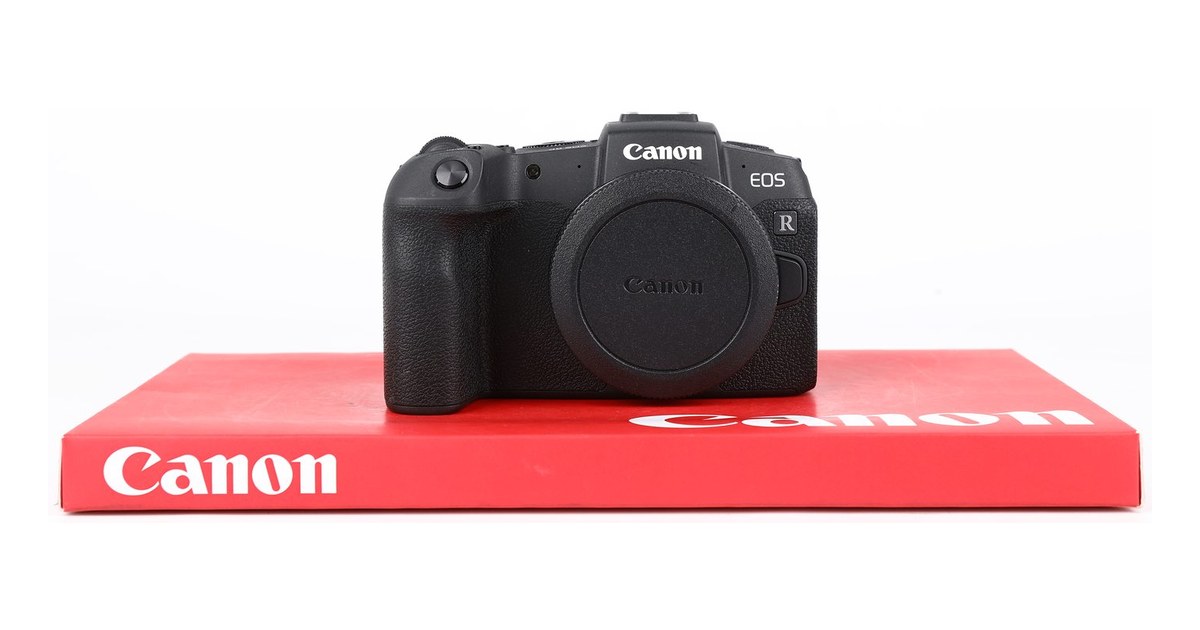
- The Canon EOS RP was released in 2019 at around 1,600 euros for the camera body only: today it costs 600 euros with us, including laboratory inspection and a 2-year warranty.
- It is not the cheapest full-frame mirrorless camera on the market: a Sony A7 costs 350 euros. However, it is the most affordable model featuring modern eye autofocus and a lens system that is still in production.
- The real limitations are four: an LP-E17 battery with a CIPA rating of approximately 250 shutter count, 4K video with a 1.6x crop without Dual Pixel AF, no in-body image stabilization, and a single SD card slot.
- Weighing 485 g and equipped with Dual Pixel AF, it is suitable for portrait, travel, and street photography. It is not suitable for sports, serious 4K video, or shooting 800 photos per event.
Looking for a used Canon EOS RP? The used Canon EOS RP page shows current availability and prices, with certified shutter count and a 2-year warranty. See also all used Canon cameras.
At the counter, the question comes up at least once a week: what is the most affordable full-frame camera I can buy today without regretting it in a year? For those looking for a Canon mirrorless, the answer is usually the EOS RP. Dozens have passed through our workshop, and today we have three in stock for 600 euros. In 2019, that price could barely buy a mid-range APS-C body.
Here we check whether the label of the most affordable full-frame camera holds up, what the RP can do and where it falls short, which lenses make sense, and what to look for in a used unit. It is not the right camera for everyone: in some cases it is worth spending less, in others more.
Canon EOS RP: what it is and why it costs 600 euros today
The Canon EOS RP was released in February 2019 as an entry point into the RF system: a compact body for those who wanted full frame without the weight of a 5D.
The price has dropped for three reasons. Canon has discontinued the model, and the EOS R8 has taken its place as the lightweight full-frame option in the lineup. Those who upgraded to the R8 have then resold their RP. The used market is currently saturated, and the price is determined by competition among sellers.
The specs that really matter
The 26.2 MP sensor is derived from the EOS 6D Mark II and works with the DIGIC 8 processor. The camera body weighs 485 g with battery and card. These are the key items in the technical specifications, as they change how you use it:
- 26.2 MP: enough headroom for cropping, with files that a standard laptop opens without strain.
- Native ISO 100-40,000: extended values go beyond this, but this is the range to consider.
- Dual Pixel AF with eye recognition: the feature that sets the RP apart from older, cheaper full-frame mirrorless cameras.
- 2.36 million dot OLED viewfinder: check exposure and white balance before taking the shot.
- Tilting touchscreen: essential for low-angle framing and moving the AF point with your finger.
- USB-C charging: with a USB Power Delivery adapter, the battery charges inside the camera, so you don't need to carry a charger (Canon specifies the PD-E1).
From the 2019 price list to today's price
For those buying now, this is the most useful data point on the entire spec sheet: in just under eight years, the RP has lost over 60% of its list price.
| Item | Value |
|---|---|
| Launch price (February 2019) | approx. €1,600 |
| Current price at ReflexMania | €600, including service and 2-year warranty |
| Depreciation already paid by others | approx. €1,000, over 60% |
The bulk of the depreciation has already been paid by the first owner. A camera loses value primarily in the first two or three years, after which the price drops much more slowly. Someone buying an RP today and reselling it in two years will lose only a small fraction of what the original owner lost when purchasing it new in 2019.
However, a low price tells you nothing about the condition of the individual unit. You can only distinguish a bargain from a problem by inspecting the camera.
Is it really the most affordable full frame mirrorless?
No, it isn't. Today in our catalog, a Sony A7 costs 350 euros and a Sony A7 Mark II starts at 500 euros. The Canon EOS RP at 600 euros sits in between. So the right question is another one: what do those 100-250 euros of difference buy you.
| Model | Our Price | Megapixels | In-Body Stabilization | Battery |
|---|---|---|---|---|
| Sony A7 | 350 € | 24.3 | No | NP-FW50 |
| Sony A7 Mark II | 500-520 € | 24.3 | Yes, 5-axis | NP-FW50 |
| Canon EOS RP | 600 € | 26.2 | No | LP-E17 |
| Canon EOS R | 690-800 € | 30.3 | No | LP-E6N |
| Nikon Z6 | 850 € | 24.5 | Yes, 5-axis | EN-EL15b |
Sony A7 and A7 II: lower cost, but at what compromise
The first-generation A7 dates back to 2013, and you can feel it in hand. Autofocus is slow in low light, and eye recognition is first-generation: it works only in single AF mode while holding a button. The menus are scattered. Used native Sony FE lenses cost on average more than budget Canon RF lenses, so the savings on the body are often lost on the first lens.
The A7 Mark II is a different story. The 5-axis in-body stabilization works with any lens mounted, even an adapted Pentax Takumar or Leica R. If you want to use vintage manual lenses, you are better off getting the A7 II for 500 euros than the RP. With a 50mm manual lens at 1/15 second, the difference is immediately visible. However, if you shoot portraits with autofocus and want a system with lenses still in the current lineup, stick with the RP.
EOS R and Nikon Z6: when it makes sense to spend €100-250 more
The Canon EOS R, priced between 690 and 800 euros, resolves two specific issues of the RP and adds a few megapixels:
- LP-E6N Battery: the same as mid-range Canon DSLRs, with significantly higher battery life. If you come from a 6D or a 5D, you already have the spares in your bag.
- Controls and body: top display and a more robust body. It handles heavy lenses better.
- 30.3 MP: more room for cropping, though barely noticeable in prints under 50x70.
We discussed this in detail in the article on the used Canon EOS R. If you shoot weddings or long days, the extra 90-200 euros are worth it. If you shoot on weekends while traveling, they are not.
The Nikon Z6 at 850 euros is the choice for those who also shoot video. It features in-body image stabilization and records 4K across the full sensor width, without crop. For those shooting serious clips, the extra 250 euros are fully recovered. For those shooting only stills with autofocus lenses, the RP remains the most sensible entry point.
What the RP does well in real-world use
The strengths that truly matter are not the most prominent ones on the spec sheet: they become apparent after a month of shutter counts.
- 26.2 MP sensor between 3,200 and 6,400 ISO: clean files indoors and at night. Noise remains fine and can be removed in Lightroom without smearing details.
- Articulating touchscreen: for low angles, ground-level details, and tripods near walls. No need to lie down, and you won't be shooting blind.
- 6,240 x 4,160 pixel files: a 40x60 cm print outputs at approximately 260 dpi. Sufficient for home walls and even for a small exhibition.
Dual Pixel AF and eye recognition
With a 50 mm or an 85 mm at f/1.8, the AF locks onto the pupil and tracks it even when the subject turns their head. It works even when the depth of field is only a few centimeters. For portraits, church ceremonies, and children playing in the living room, the percentage of sharp shots in AF servo mode is high. The limitation is the burst rate: in servo mode, the RP captures at approximately 4 frames per second. A running dog or a futsal match are not its forte.
Canon claims autofocus down to -5 EV, but only with an f/1.2 lens. In low light, an f/4 zoom will cause the AF to hesitate, as it would on any camera body. The relevant comparison is with the first Sony A7 from 2013. Its first-generation hybrid AF struggles to track a moving face and lacks comparable eye recognition. For those who photograph people, the difference is immediately apparent in practice.
Weight and dimensions: the real selling point
The RP weighs 485 g with battery and card. A 6D Mark II, from which the sensor is derived, reaches 765 g, and a 5D Mark III reaches 950 g. With an RF 35 mm f/1.8 Macro IS STM, weighing about 305 g, the kit stays under 800 g. It weighs less than the 5D Mark III camera body alone.
This is the reason we hear most often from those who arrive with a full-frame DSLR. They are not looking for better specifications, but for a camera that can truly be taken on a trip or to dinner instead of staying at the hotel. The RP fits in a small crossbody bag along with a second lens. The downside is the short grip: with large hands, the pinky finger sticks out. That is why Canon sells the EG-E1 extension separately.
The limits to know before buying it
The RP costs 600 euros partly because Canon removed certain features, and it is better to know what they are before paying. None of these limitations make it a bad camera. Their impact depends on what you photograph.
| Limitation | The data | Matters for |
|---|---|---|
| Battery | LP-E17, approx. 250 shutter count CIPA | Weddings, events, travel without power outlets |
| 4K Video | 25p, 1.6x crop, contrast AF | Those shooting video with the camera |
| Burst | 5 fps, 4 fps with continuous AF | Sports, animals, running children |
| Stabilization | Not on the sensor | Those using non-stabilized EF or vintage lenses |
| Slot | Single SD | Those working on commission |
| Shutter | Max 1/4000 s | f/1.8 portraits in full sun, requires an ND filter |
| Flash sync | 1/180 s | Outdoor fill flash without HSS |
Battery: 250 certified shutter count, what actually happens
The 1,040 mAh LP-E17 is the same battery used in mid-range Canon APS-C cameras, and the approximately 250 certified shutter count CIPA rating is a pessimistic value. In real-world use, relying on the viewfinder and avoiding checking every photo on the screen, you can expect 350-450 certified shutter count. For a day of travel, you need two batteries; for a wedding with 800 photos, you need 3-4.
On-camera charging via USB-C is a partial solution. It works with a USB Power Delivery charger and only when the camera is off: it's convenient in the evening at a hotel or in the car, but it's not useful during a job.
Video: 4K is available on paper
The RP's 4K is 25p, with a 1.6x crop and contrast autofocus, without Dual Pixel. A 24 mm lens becomes approximately a 38 mm, and the AF pumps back and forth as soon as the subject moves. Full HD at 50p, however, uses the full width of the sensor with Dual Pixel AF, and is the format to use. It's fine for family videos or a reel. Those who shoot video seriously should look at a body designed for it, like the Canon R50 V.
No in-body image stabilization
With stabilized RF lenses, such as the RF 24-105 mm f/4-7.1 IS STM or the RF 35 mm f/1.8 Macro IS STM, the issue is greatly reduced indoors and at dusk. However, with an adapted EF 50 mm f/1.8 or a manual vintage lens, every shutter count below 1/100 s risks micromotion on the 26 MP sensor.
If the plan is to use older lenses, the comparison above applies: the Sony A7 Mark II at 500-520 euros stabilizes any adapted lens via in-body stabilization. In return, you give up modern eye AF, and its NP-FW50 battery lasts no longer than the LP-E17.
The right lenses for a used RP
On an RP, the lens determines the result more than the body. The 26.2 MP sensor performs best with a bright, lightweight lens, and only a few are needed here. Within the RF system, three make sense on an entry-level body without in-body stabilization.
- RF 50 mm f/1.8 STM: it is the first lens to buy. It is very small and at f/1.8 it utilizes eye AF in portraits. It is not stabilized, so indoors with low light you need to use fast shutter speeds.
- RF 35 mm f/1.8 Macro IS STM: for us, it is the most complete pairing. The 35 mm is the right angle for travel and street, and the optical stabilization compensates for what the camera body lacks. Additionally, it reaches a 1:2 macro ratio.
- RF 24-105 mm f/4-7.1 IS STM: it is the lightweight, stabilized do-it-all zoom. However, at f/7.1 on the long end, you lose the bokeh and low-light performance, which are precisely the reasons for switching to full frame.
A word on balance. An adapted EF 24-70mm f/2.8L weighs over 900 g including the lens and adapter, nearly double the 485 g of the RP. The grip is small, and after an hour at a wedding, your wrist will notice. Heavy lenses work on this body, but they are not comfortable.
Coming from a Canon DSLR: the EF-EOS R adapter
The EF-EOS R adapter contains no lenses. It simply compensates for the distance between the two mounts, adding approximately 24 mm in length and 110 g in weight. EF lenses mounted this way retain autofocus and optical quality, and with Dual Pixel AF they often focus better than on the original DSLR. EF-S lenses also work, but the camera automatically switches to the 1.6x crop.
If you have a 6D and some EF lenses, the RP is the most affordable step into mirrorless. The sensor comes from the same family and the lenses remain the same. If you are still considering a DSLR, find the details in the article about the used Canon 6D.
Realistic overall budget
A camera body alone is not enough to start shooting. A fair budget to get started includes:
- the Canon EOS RP at 600 euros, serviced and with a 2-year warranty;
- a bright fixed RF lens, the 50 mm or the 35 mm;
- two spare LP-E17 batteries, essential with a battery life of approximately 250 shutter count.
With these three items, the total cost ranges between 900 and 1,100 euros, depending on the lens and its condition. If you already own EF lenses, the cost drops to around 750 euros, covering only the adapter and batteries. If your budget is limited to 600 euros and you do not have lenses, it is better to wait and save the remaining amount rather than buying the camera body and pairing it with a lens chosen solely because it is cheap.
What to check on a used Canon RP
On a used RP, serious defects are rare and can be spotted in ten minutes if you know where to look. The issues we most often find at the counter involve the exposed sensor, the screen hinge, and the bottom door. Shutter count matters less than you might think, but it needs to be interpreted correctly.
Shutter count: how to read it on an RP
The RP's shutter count can be read precisely from the EXIF data of a file taken at that moment, for example using ExifTool. It is a verifiable number, not an estimate. If the seller does not provide it, ask for an original photo, without transfers via WhatsApp or social media that strip metadata. For a body produced between 2019 and 2021, these are the benchmarks we use:
- under 10,000 shutter count: light amateur use, almost always a travel body that has sat in a closet for most of its life;
- 10,000 to 30,000: normal mileage for 5-7 years of enthusiast use;
- over 50,000: has worked hard, and the price must reflect that.
In our listings, the shutter count is always certified. The three Canon EOS RP in our catalog each display their specific count, read from the file.
Exposed sensor and tilting screen: the two weak points
When the lens is removed, the RP's sensor is exposed: there is no mirror in front to protect it, as there is on DSLRs. With the updated firmware, there is a menu option that closes the shutter when the camera is powered off. Check that this option is present and enabled, as many users leave it disabled. Here is what to verify before paying:
- sensor filter: with a raking light, look for scratches and haze, which are different from dust and cannot be removed by cleaning;
- screen: open, rotate, and close it to the end of its travel in all positions, checking if the image flickers or turns off. This is a sign of a fatigued flat cable;
- RF mount contacts: they must not be oxidized or bent, and the lens must mount without play;
- bottom door: on the RP, the battery and SD card are in the same compartment, so the latch works with every change. Check that it clicks properly and that the hinge is not cracked;
- USB-C port: connect a cable and verify that it charges and that the computer recognizes it.
What we do in our workshop
Every RP that comes through us undergoes the same inspection before being put up for sale:
- sensor test at closed aperture on a uniform background, revealing dust and spots invisible at f/2.8, followed by cleaning if necessary;
- autofocus test with an RF lens and the EF-EOS R adapter, to check communication on both systems;
- verification of the mount contacts, the screen in all positions, the doors, and the USB-C port;
- firmware update to the latest available version;
- battery test with a measured session of shutter count, because a tired LP-E17 further reduces an endurance that is already the limit of this camera body.
After the inspection, the camera comes with a 2-year warranty. This means the buyer does not have to perform the check, and the risk of the purchase does not remain their responsibility.
Who the RP is for, and who it isn't
At the counter, we recommend the RP without hesitation to four types of photographers and advise against it for just as many. It’s best to figure out which group you belong to before looking at the price.
- It makes sense for those moving from a Canon APS-C to full frame, for portrait photographers with a limited budget, for those who travel light, and for those who already have EF lenses to mount with an adapter.
- It does not make sense for those photographing sports, shooting 4K video for work, or covering weddings and long events. It also does not make sense for those who simply need to spend as little as possible.
When it makes sense to spend less
If full frame does not meet a specific need, 600 euros is too much. The Canon EOS R100 costs between 350 and 400 euros with us. It features a 24 MP APS-C sensor and the same RF mount, so the lenses you buy today remain useful even if you switch to full frame in the future. The Sony A6000 at 360 euros is older, but remains compact and benefits from a very extensive E-mount lens selection on the used market.
If you prioritize autonomy and robustness, and are willing to carry a bit more weight, a full-frame DSLR is the better choice. A Canon 5D Mark III lasts a full day on a single battery, features dual card slots, and has a body built to withstand rain. We discussed this in detail in our article on the used Canon 5D Mark III.
When it makes sense to spend more
For video, the RP is the wrong choice at any price. The Canon EOS R50 V at 540 euros costs less and is designed for filming: 4K derived from the full width of the sensor up to 30p and Dual Pixel AF active during recording. The price to pay is the absence of a viewfinder. Those who want full frame even in video have the Nikon Z6 at 850 euros, seen in the comparison above.
For events and heavy use, the right step is the Canon EOS R, priced between 690 and 800 euros, especially due to the LP-E6N battery and the top display.
The criterion is simple: if you already know that your limit will be the battery or the burst rate, the RP is not for you. You would end up reselling it within a year and paying twice the difference that today seems like a saving.
Frequently asked questions
Is the Canon EOS RP still a good camera in 2026?
Yes, for portrait, travel, and street photography. The 26 MP sensor and Dual Pixel AF with eye recognition remain competitive. It becomes a limitation for sports, 4K video, and long sessions due to battery life and burst speed.
Is a used Canon RP or a Canon EOS R better?
The EOS R costs 90 to 200 euros more and offers a larger LP-E6N battery, a better display, 30 MP, and a more robust camera body. If you shoot events or use the camera every day, the R is the right choice. If you are looking for lightness and want to spend less, the RP is enough.
Can I use my Canon EF lenses on the RP?
Yes, with the EF-EOS R adapter, autofocus and image quality remain unchanged. Stabilized lenses retain their IS. With heavy lenses like a 70-200 f/2.8, the small camera body becomes unbalanced.
How many shutter counts are too many for a used RP?
Canon does not declare an official shutter life for the RP. For a 2019-2021 camera body, up to 30,000 shutter count remains within normal usage. More important than the number is the condition of the sensor and the mount, which we verify in the laboratory on every unit.
How many batteries are needed with the Canon RP?
For a day out, you need at least two. For a wedding or a long event, three or four. USB-C charging helps while traveling but does not replace backup batteries.
Is the RP suitable for video?
For Full HD up to 50p, yes, with Dual Pixel AF across the entire sensor. The 4K has a 1.6x crop and contrast autofocus, making it unsuitable for serious use. For video, consider the Canon R50 V or the Nikon Z6.
Want to see a refurbished Canon EOS RP up close?
If you have any doubts about a purchase or need advice for your specific case, contact us. We offer free advice because we are photographers first, and because a customer who makes a poor purchase does not return to photography.
Three ways to get in touch:
- Contact form — response within 24 business hours
- WhatsApp at 342 362 3454 (messages only)
- Phone: 071 291 6347 (Mon-Fri 9-13/15-18, Sat 9-13)
And if you want to see what we have in stock right away, explore the used items available today: every camera is certified, comes with a 2-year warranty, and is shipped within 24-48 hours.
Article written by Matteo for the ReflexMania Team. Last updated: November 2026. Prices and availability as of the time of publication.