
In summary
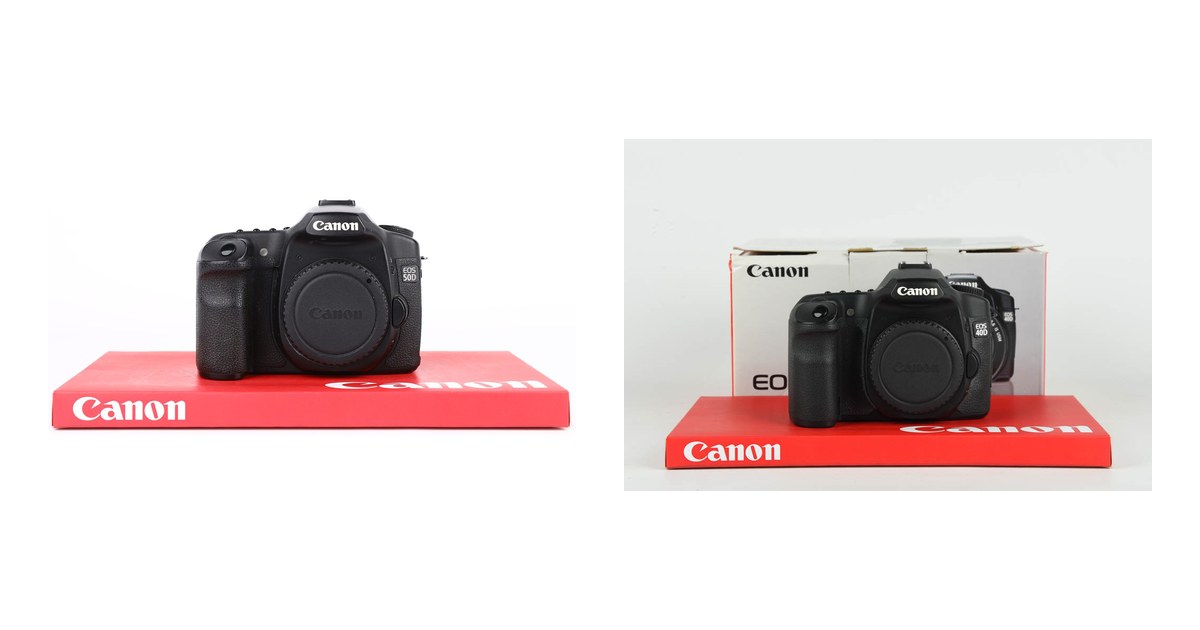
- A used Canon 40D body only is currently found for around 70-120 euros, while a 50D costs around 110-180 euros: they cost as much as a good second-hand EF-S zoom.
- Magnesium alloy body, approximately 740 grams, 6.3-6.5 fps burst rate and shutter tested for 100,000 cycles: the mechanical part still holds up against today's entry-level models.
- The real limitation is the sensor: 10.1 MP on the 40D and 15.1 MP on the 50D, with clean files up to ISO 800-1600 and no video function on either.
- With 350-600 euros you can move to a Canon EOS R100 or an EOS RP with an EF adapter: those who already own Canon lenses gain more by spending there than on a 50D.
Looking for a used Canon 50D? The used Canon 50D page shows current availability and prices, with certified shutter count and a 2-year warranty. See also all used Canon cameras.
The 40D and 50D regularly come to us via trade-in, almost always with an EF-S 17-85 or a 70-300 attached and the grip rubber worn down by the thumb. Those who bring them in have often used them for ten or fifteen years and ask if it is worth keeping them. Those looking for them want to know if a 150-euro semi-pro beats a new entry-level model. A clarification on the dates: the 40D was introduced in August 2007, the 50D in August 2008, so “from 2008” applies to both only in a broad sense.
Here is what remains valid about these two camera bodies in 2026 and what is outdated, what we check in the lab before putting them back on sale, how much to pay for them, and when it makes sense to spend the same amount, or slightly more, on something else. The verdict in brief: they make sense as a second body, as a camera to learn manual mode with in-house EF lenses, or for those who enjoy slow photography, not as a primary camera for professionals.
What the 40D and 50D were, and what they are today
In 2007 and 2008, the 40D and 50D were the Canon to buy when the 400D or 450D started feeling limiting and the full-frame 5D was too expensive. Canon marketed them as "semi-pro." However, one must ask: semi-pro compared to what? Compared to the xxxD models of the same era, "semi-pro" meant four specific things:
- Direct controls: dedicated buttons on the top plate for ISO, AF mode, burst, and white balance, without navigating through menus.
- Top display to read parameters with the rear screen turned off.
- Rear dial in addition to the front one: shutter speed and aperture are adjusted with two different fingers.
- Magnesium alloy body, whereas the xxxD models were made of plastic.
Today, many €500 mirrorless cameras feature two dials and a joystick for moving the AF point. However, top displays and magnesium bodies remain rare in that price range.
| Canon EOS 40D | Canon EOS 50D | |
|---|---|---|
| Release | 2007 | 2008 |
| APS-C Sensor | 10.1 MP | 15.1 MP |
| Processor | DIGIC III | DIGIC 4 |
| Burst Rate | 6.5 fps | 6.3 fps |
| AF Points | 9, all cross-type | 9, all cross-type |
| 3-inch Screen | 230,000 dots | 920,000 dots |
| AF Micro-adjustment | No | Yes |
| HDMI Output | No | Yes |
| Video | No | No |
40D: the first xxD with live view
At launch, the 40D cost over 1,000 euros for the camera body alone. Today, it can be found used for about a tenth of that price. It featured a 10.1 MP sensor with the DIGIC III, shot at 6.5 fps, and had 9 cross-type AF points, a serious specification for this class at the time.
It was the first xxD with live view, but it took some getting used to. There was no contrast-detect autofocus. To focus, the camera would lower the mirror, causing the image to disappear momentarily. It was designed for studio work and tripods, using manual focus on the magnified image, not for handheld shooting. The 230,000-dot screen is sufficient for checking composition, but not for verifying focus.
50D: more pixels, better screen, same camera body
One year after the 50D, it retained the 40D's camera body but changed almost everything else. It moved to 15.1 MP with the DIGIC 4 and a 920,000-dot screen, the most noticeable improvement in daily use. It also added AF micro-adjustment, allowing you to correct front and back focus lens by lens. HDMI output and support for faster-writing CF UDMA cards were also introduced.
The extra pixels came at a cost. Fitting 15.1 MP onto a 2008 APS-C sensor meant smaller photodiodes, and consequently more noise per pixel. Looking at files at 100%, the 50D was criticized for years for being noisier than the 40D at high ISOs. However, when comparing prints of the same size, the difference is greatly reduced.
Where it still holds up: body, ergonomics, and burst rate
If you pick up a 40D after handling a Canon EOS R100, the difference is noticeable before you even turn it on. The 40D features a magnesium alloy body weighing approximately 740 grams, while the R100 has a plastic chassis. Canon has added seals around the battery and card doors, but this is not full weather sealing. A truly sealed body has seals on every button, every dial, and the mount: here, it withstands light rain and dust, not a downpour.
- Pentaprism optical viewfinder: covers 95% of the frame with a 0.95x magnification. It is larger and brighter than that of any xxxD, which uses a pentamirror.
- Dual dials and top display: shutter speed and aperture each have their own dial, and parameters can be read from the top without turning on the rear screen.
- Central cross-type AF: all 9 points are cross-type. The central point gains precision with f/2.8 or faster lenses: with a 50mm f/1.8 or a 17-55mm f/2.8, it is the point to use.
- Battery life: the 40D achieves approximately 800 CIPA shutter count with the BP-511A, while the 50D delivers slightly less. Many entry-level mirrorless cameras declare 230-370.
Direct controls vs. menus
The top plate features three buttons, each with dual functions: AF and shooting mode, white balance and metering, and ISO and flash compensation. Press the button, turn the main or rear dial, and you're done. The ISO is displayed directly in the viewfinder, the rest on the top LCD, and you never need to enter the menus. On an R100, half of these adjustments are made via the on-screen quick menu.
For those learning manual mode, it is a practical advantage, not nostalgia. You change one parameter at a time, take a shot, and see the effect immediately; within a few weeks, the gestures become automatic. This is the same reason we still recommend a used Nikon D7200 to those looking for a semi-pro body: ergonomics do not age like sensors.
Burst and buffer in practice
The 40D shoots at 6.5 fps, the 50D at 6.3. For youth football, amateur cycling, or slowly moving animals, this is sufficient. However, with fast sports and unpredictable subjects, the 9 AF points become the limiting factor before the burst rate.
The real bottleneck is the buffer. In RAW, the 40D stops after approximately 17 shutter count and the 50D after approximately 16: less than three seconds of continuous burst. Then the camera shoots only at the speed at which it writes to the card, and with an old and slow CF, the wait time increases significantly.
- Shoot in short bursts of 3-5 frames; do not hold the button down.
- If the action is prolonged, switch to JPEG, which has a much larger buffer.
- On the 50D, use a CF UDMA card: it is supported, and it is advisable to purchase it together with the camera body.
Where they show their age
A 50D at ISO 3200 in an indoor arena produces files that are barely usable, often only after converting them to black and white. The camera body still holds up, but the sensor does not. And it is the sensor that determines what ends up in the archive.
Sensor and ISO: The limit that cannot be bypassed
The 40D delivers clean files up to ISO 800, while the 50D handles up to ISO 1600. Beyond that, chromatic noise eats into fine details. Noise reduction in Lightroom results in plastic-looking skin and matted hair. A church wedding without flash, shot at 1/125 and f/2.8, often requires ISO 3200: with these two cameras, you are at the limit of usability.
Even at base ISO, the dynamic range remains lower than that of any current 24 MP APS-C camera. If you shoot into backlight and lift the shadows by two stops, noise and banding appear. In full light, the situation changes: a 15 MP file from the 50D handles a 30x45 print well. The 10 MP file from the 40D manages it too, but with less detail if the print is viewed up close.
The rest of the list is short, but it carries weight:
- No video, neither on the 40D nor on the 50D.
- 9 AF points clustered in the center: a subject on the side third forces you to focus and recompose.
- Slow live view, comfortable only on a tripod.
- No Wi-Fi and no articulating screen.
The most honest comparison is with the Canon EOS R100, which we currently have for between 350 and 400 euros. It offers 24 MP, Dual Pixel AF with eye recognition, and 4K video. In return, it features a plastic body, a single dial, and an electronic viewfinder instead of an optical one. On the file, it wins; in hand, the 50D wins.
Compact Flash and batteries: the hidden costs
Both use Compact Flash cards, a format the market has abandoned: new CF cards are available in few capacities, cost more than an SD card of the same size, and no recent laptop has the slot, so a reader must be purchased separately.
Most original BP-511A batteries still in circulation are over ten years old and no longer deliver the battery life they had when new. Compatible batteries range from good to poor, often with identical labeling: a new one from a reputable manufacturer is the better choice. The full breakdown of accessory costs is in the pricing section below.
40D or 50D: which one to choose
In most cases, the 50D is the better choice. It costs 40-60 euros more, but that money pays for two features you use on every shoot: the screen and autofocus micro-adjustment. The 40D only makes sense in a few specific cases, and almost always only if it costs less than 100 euros.
Who is the 50D best for?
The 920,000-dot screen is the difference you notice immediately. On the 40D's 230,000-dot screen, magnification helps check the framing, but not whether the eyes are in focus. On the 50D, with magnification at maximum, a slightly out-of-focus portrait at f/2 is already visible on the spot, while you can still retake it.
AF microadjustment matters with fast lenses. A used EF 50mm f/1.8 or EF-S 17-55mm f/2.8 may exhibit slight front or back focus. At f/1.8, at portrait distance, the depth of field is only a few centimeters, making the error visible. The 50D corrects this from the menu, lens by lens. With the 40D, the only option is to send the camera body and lens to service.
Then there is the crop. The 15.1 MP leave approximately 7.5 MP even after cropping half of the image, compared to the 5 MP remaining on the 40D. For those shooting sports or wildlife with a 70-200mm, these are pixels that matter.
When the 40D is enough
There are three situations where the price difference cannot be recovered:
- Landscape at ISO 100 on a tripod: work calmly at medium apertures, and check sharpness on the computer.
- Studio with flash: shoot at ISO 100-200 between f/8 and f/11, with a depth of field that hides small focusing errors.
- First body for a student: to learn manual mode for less than 100 euros, dials and viewfinder matter more than the screen.
The 40D also features larger pixels, 5.7 microns compared to 4.7: as mentioned above, the advantage in noise performance is fully visible at 100% zoom but almost disappears in print. The concrete benefit is another: 10 MP files are lighter and easier to manage on an older computer.
Those also considering consumer models from the same era find 15.1 MP and Full HD video on the 500D, and 18 MP, video, and a tilting screen on the 600D. In return, they give up the magnesium alloy body, the second control dial, and a viewfinder as large as those on the xxD series. If video is a priority, that is the choice, and we have explained it in Canon 600D e 500D usate: valgono ancora qualcosa nel 2026. If you need a camera for photography only, to be used with fast lenses, the 50D remains the best compromise.
What we check in the lab on a 40D or 50D
On these two camera bodies, the most expensive failure is almost always the CF slot, not the shutter. When a 40D or a 50D comes in as a trade-in, we run it through the bench before deciding whether to put it back up for sale. The sequence of checks is always the same, and anyone buying from a private seller can repeat most of it on their own.
The CF slot: check this first
Open the door and look inside with a flashlight, keeping the light at a low angle. The pins must be straight, aligned, and at the same height. A single card inserted at an angle, even just once, can bend one: at that point, the camera will either throw a card error or fail to turn on at all. Replacing the CF block often costs as much as the entire camera body or more. On a 40D worth 70-120 euros, the repair is almost never worth it. If even a single pin is bent, walk away.
Shutter, certified shutter count and field test
Canon specifies a lifespan of 100,000 cycles for both models. This is a design average, not an expiration date: we have seen shutters stop at 60,000 shutter counts and others work well beyond 150,000. The count does not appear in the EXIF data, so it is read by connecting the camera body via USB to dedicated software. In our workshop, we read it this way and report it on the product sheet. Then we move on to the practical test:
- Burst of 30-40 shutter count: the cadence must remain consistent from start to finish, without slowdowns or irregular intervals.
- Shutter count at 1/8000 on a uniform surface, such as a white wall or the sky: if dark bands appear or one side is brighter, the curtains are worn.
- All shutter speeds, from the longest up to 1/8000, to ensure each is distinct from the previous one.
- Err 99 and Err 20: Err 20 indicates a mechanical issue with the shutter or mirror. Err 99 is a generic error, often related to contacts with the lens. If these appear during the test, the camera body should not be purchased.
Ask a private seller for the certified shutter count, a photo taken at 1/8000 on a light wall, and a video of the burst mode. If they refuse all three, you already have your answer. Also check the mode dial and the joystick, which wear out with use and lose their clicks, and the top display, which may have missing lines or a backlight that is already fading.
Seals, sensor and battery
Over the years, the rubber grip tends to swell or peel off. It is a low-cost replacement, so it is not a reason to reject the camera, but it is a good argument for negotiating the price. The sensor should be checked with a shutter count at f/16 on a light surface. Both have automatic filter cleaning, but it is much less effective than that of recent mirrorless cameras, and it does not remove oil or moisture spots. The BP-511A battery should be tested at full charge by taking a few shots. An old battery may show a full charge at startup and then shut down after a hundred shutter counts.
2026 Prices and When They Still Make Sense
A Canon 40D body only today costs 70-120 euros, while a 50D goes for 110-180 euros. Adding an 18-55 or a 17-85 to the package increases the price by 40-80 euros. If you are paying more than 130 euros for a 40D body or 200 euros for a 50D body, you are paying for the seller's nostalgia, not the camera. At that point, it is better to keep your money and look elsewhere.
The real budget, accessories included
The body price is not the entry price. A typical bill for a 50D at 150 euros:
- 32 GB CompactFlash: 20-30 euros
- CF USB reader: 10-15 euros
- New compatible BP-511A battery from a well-known manufacturer: 20-25 euros
- Strap, if the original is missing: approx. 10 euros
You end up at €210–230: this is the figure to compare against alternatives, not the €150 in the listing. On a 40D paid for at €90, the same €60–80 in accessories is worth almost as much as the camera body.
The best case: you already have EF lenses
If you already have an EF-S 17-55 f/2.8, an EF 70-200 f/4, or a 50 f/1.8, a 50D will still deliver good photos for just over 200 euros in total. The lenses do most of the work, while the camera body provides direct controls and an optical viewfinder. If you are starting from scratch, you will need to add at least one lens, which changes the cost significantly.
Uses I recommend it for without reservation:
- Second camera body for those already shooting with Canon EF and EF-S lenses.
- Camera to learn manual mode, with dials and a top display instead of menus.
- Studio work with flash, where you shoot at ISO 100 and the sensor is never stressed.
- Gift for a beginner, with a price that won't hurt if the camera gets dropped.
Where I don't recommend them: video, which is completely absent on both; events in churches or dimly lit venues; and sports or unpredictable subjects, where a modern AF with subject tracking is required.
If you value the optical viewfinder and tactile controls, a 50D for 200 euros still makes sense. If only the final file matters, there are better options under 400 euros: the R100 and A6000 offer 24 MP and cleaner files at high ISOs, and we compare them below.
Alternatives for the same budget or slightly more
Who looks at a 50D for 180 euros with a minimum of accessories quickly arrives near 250 euros. At that point, the right comparison is not with other DSLRs of the same era. It must be made with used mirrorless cameras that are 100-550 euros higher and that have six to fifteen years of development more on sensors and autofocus.
| Model | Today's price at our store | Key strength | Best for |
|---|---|---|---|
| Canon EOS R100 | 350-400 euros | 24 MP, Dual Pixel AF, uses EF-S lenses without crop | Those who already have EF-S lenses and want to spend little |
| Sony A6000 | 360 euros | 179 phase-detection AF points, 11 fps | Those starting from scratch, without Canon lenses |
| Canon EOS RP | 600 euros | 26 MP full frame, Dual Pixel AF | Those with EF full frame lenses |
| Canon EOS R | 690-800 euros | 30 MP, top display, more robust body | Those coming from a xxD who don't want to give up on controls |
Sticking with Canon EF Lenses
With the EF-EOS R adapter, which must be budgeted for separately, EF and EF-S lenses work on RF mounts without practical limitations. Dual Pixel AF focuses across almost the entire frame, not just the 9 central points, and microadjustment is not required. A fast zoom that was off by a few centimeters on the 50D focuses precisely where it should on the mirrorless. There is one limitation to be aware of: on the RP and the R, EF-S lenses work only in crop mode. On the RP, you drop to approximately 10 MP, the resolution of a 40D. If your lens kit consists of 18-55 and 55-250, the coherent choice is the R100. Full frame makes sense only if you already own EF lenses such as a 50 mm f/1.8 or a 24-105. Lens-by-lens details are in the article on Canon EF lenses on RF mirrorless in 2026.
Starting from scratch without lenses
The advantage of the 50D lies entirely in the EF lens lineup, which can be found at low prices. If you don't have anything in your bag, that advantage disappears. An A6000 at 360 euros costs 100-200 euros more than a 50D with a zoom, but it has 24 MP and 179 AF points distributed across most of the frame. It shoots at 11 fps, almost double that of the 50D. In return, you give up the optical viewfinder and the full grip of a magnesium body.
The rule we apply at the counter is simple. If the 50D is for a specific purpose, such as a second camera body, studio work with flashes, or learning manual mode, buy it now. However, if you need your main camera for the next five years, wait two or three months. Setting aside an extra 150-400 euros gets you an R100 or, if you have EF full-frame lenses, an RP, and the difference is visible in every shutter count above ISO 1600.
Frequently asked questions
Should you avoid a Canon 50D with a certified shutter count over 100,000?
No, the 100,000 cycles are an average declared by Canon, not a deadline: many reach 150,000 and beyond. What matters more is how it performs in burst mode and whether there are Err 20 or Err 99 errors. However, all else being equal, a camera with a lower certified shutter count should cost a bit more.
Do the 40D and 50D support EF-S lenses?
Yes, both accept EF and EF-S without limitations. The 17-55 f/2.8 IS, the 15-85, and the 10-22 remain excellent choices on these camera bodies.
Can I shoot video with the Canon 50D?
No. Neither the 40D nor the 50D records video: the first Canon xxD with video was the 60D, released in 2010. If you need video even just occasionally, look elsewhere.
Which is better: a used Canon 50D or a 600D?
The 600D has 18 MP, Full HD video, and a tilting screen, while the 50D features a more robust camera body, a larger viewfinder, and direct controls. For those who shoot in manual mode and do not use video, the 50D is more pleasant to use. For those looking for an all-rounder, the 600D is more comprehensive.
Are Compact Flash cards still available?
Yes, but the selection is limited and a good 32 GB CF card costs more than an equivalent SD card. You also need a dedicated CF reader, as recent computers do not have the slot. SD-to-CF adapters work, with variable performance.
Does it make sense to buy a 50D as a first DSLR in 2026?
It only makes sense with a budget under 250 euros all-inclusive and if you want to learn manual exposure. With 350-400 euros, a mirrorless like the Canon EOS R100 gives you better files and a much easier-to-use autofocus.
Do you have a 40D or a 50D to evaluate, or are you looking for a camera body for your EF lenses?
If you have any doubts about a purchase or need advice for your specific case, contact us. We offer free advice because we are photographers first and sellers second, and because a customer who buys the wrong gear stops taking photos.
Three ways to get in touch:
- Contact form — response within 24 business hours
- WhatsApp at 342 362 3454 (messages only)
- Phone: 071 291 6347 (Mon-Fri 9-13/15-18, Sat 9-13)
And if you want to see what we have in stock right now, explore the available used gear today: every camera is certified, comes with a 2-year warranty, and ships within 24-48 hours.
Article written by Matteo for the ReflexMania Team. Last updated: November 2026. Prices and availability refer to the time of publication.