
In short
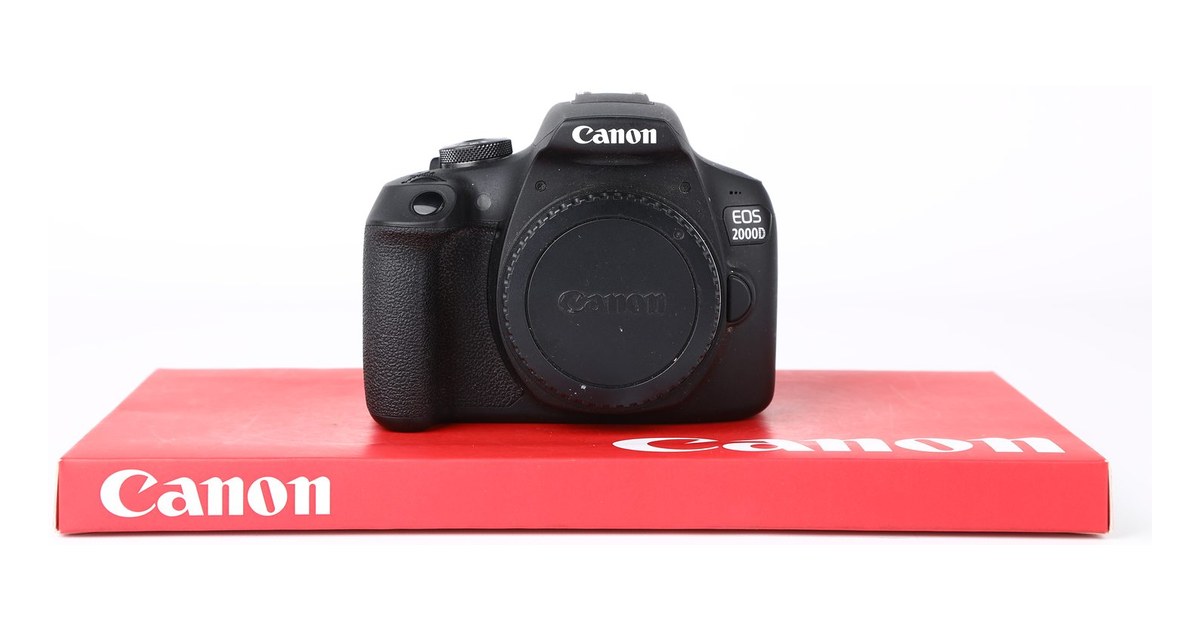
- The Canon 2000D (2018) is the 1300D with a 24 MP sensor: 9-point autofocus, 3 frames per second, Full HD video at 30p, fixed non-touch screen.
- It is the last Canon in the lowest price range, not the most recent entry-level DSLR: the 250D (2019) and the 850D (2020) were released later and sit one step above.
- Used with the 18-55, it is found for 250-320 euros. A 4000D costs about 200 euros, a 100D 220: the extra 50-100 euros buy mostly megapixels.
- It is worth it if you want 24 MP with a simple body and find a kit with the stabilized 18-55. If you shoot video or moving portraits, a used 750D is a better investment.
Looking for a used Canon 2000D? The used Canon 2000D page shows current availability and prices, with certified shutter count and a 2-year warranty. See also all used Canon cameras.
At the counter, the 2000D almost always arrives in the same way: bought new at a shopping center in 2019 or 2020, used for two vacations and a baptism, then left sitting in a drawer with 4,000-8,000 shutter count. It is a camera that sold in huge numbers, and those looking for a used unit often start with a specific idea: it was released in 2018, so it is more modern than the 150-euro Canons. The date is correct. The rest of the story is different.
In this article, I take the 2000D apart piece by piece: what actually changes compared to the 4000D, its twin released on the same day, and compared to older Canon models that cost less today. I also tell you at what price it makes sense to buy it and what to check before paying. By the end, you will have a clear criterion: when the 2000D is the right choice and when it is worth spending 50 euros less, or 100 more.
What the Canon 2000D really is: a 1300D with a new sensor
If you place a 2000D and a 1300D side by side on the workbench, it is hard to tell them apart without reading the model designation. Canon introduced it in February 2018 alongside the 4000D. In the United States it is called the Rebel T7, in Japan the Kiss X90, and in some Asian markets the EOS 1500D. It is worth knowing this, because in import listings the same camera body appears under different names. The substance is simple: the body is the same as the 2016 1300D, but it houses a newer sensor.
What it inherited and what is new
There is only one truly new item. Everything else comes from the 1300D, component by component:
- New: the 24.1 MP APS-C sensor, replacing the 18 MP one. It is from the same generation as the 750D, but lacks the on-sensor phase detection autofocus pixels used by the 750D in live view.
- Carried over: the DIGIC 4+ processor.
- Carried over: the 9-point autofocus system, with only the central cross-type point.
- Carried over: the pentamirror viewfinder with 95% coverage. The 5% of the edge you don't see in the viewfinder is included in the final image.
- Carried over: the LP-E10 battery, the same one used in the 1100D and 1300D.
- Carried over: Wi-Fi and NFC. Some retailers list these as new features, but they were already present on the 1300D.
So if you already have a 1300D and want to move to the 2000D, you're only buying 6 more megapixels. Everything else is already there: the focusing method, the speed, and the spare batteries in the drawer.
Why “Newer” Doesn’t Mean “More Modern”
The 2000D is often described as "Canon's latest entry-level DSLR". This needs clarification. It is the most recent release in the lowest tier, the four-digit series. The 250D arrived in 2019 and the 850D in 2020, and both sit a step above. Since the 2000D and the 4000D, Canon has not released any DSLRs at that level: the line ends here, with no successor.
The release date, then, tells you nothing about the age of the technology. The DIGIC 4+ is an evolution of the DIGIC 4, released in 2008 with the 50D. The 9-point AF system with a central cross-type sensor is the same as the 550D from 2010. In practice, the 2000D from 2018 performs like a DSLR from eight years prior, with an updated sensor. It is not necessarily a flaw: it is proven technology and simple to use. But if you read "recent model" in the listing, know that "recent" applies to the sensor and little else.
Reading the spec sheet at the counter: what matters in practice
On paper, the 2000D looks like a complete DSLR. In practice, what's missing matters more: autofocus struggles with slow-moving subjects, and video is little more than an add-on. Here is how the numbers translate once the camera leaves the box.
| Specification | Declared value | What it means in practice |
|---|---|---|
| Sensor | 24.1 MP APS-C | Crop factor, but with the 18-55 the advantage is only noticeable beyond A3 size |
| ISO | 100-6400 (12800 extended) | Clean up to 1600, usable at 3200, 12800 is for emergencies |
| Autofocus | 9 points, only the central one is cross-type | Reliable with stationary subjects |
| Burst rate | 3 fps | Not suitable for sports or action |
| Battery | 500 certified shutter count CIPA | 600-700 real shutter count using little live view |
Sensor and image quality
The 24 MP are useful in three cases: cropping a detail from a travel photo, photographing landscapes rich in detail, and printing large. In all three, the difference compared to an 18 MP sensor exists, but remains small. On a file viewed on screen or printed in A4, no one will see it.
The real limitation is the kit lens. The EF-S 18-55, at the edges and wide open, cannot fully utilize all the pixels of the sensor. With a 50 mm f/1.8 or a high-quality prime lens, the 24 MP are visible. With the kit lens alone, much less.
Autofocus and burst rate: the real limit
The central point is cross-shaped and locks on well even indoors. The other eight are linear: in low light they hesitate and sometimes focus on the background. Think of a birthday party in the living room in the evening, with a child running towards the cake. In AI Servo, the camera lags behind the subject, and at 3 frames per second, you save one or two out of five shots.
If you photograph stationary subjects, such as posed portraits, architecture, and landscapes, this is not an issue. The method that works is to use only the center focus point, focus, and then recompose the frame.
Video and live view
In live view, the 2000D focuses using contrast detection, lacking the Dual Pixel system found in newer Canon models. The result is slow focusing that hunts back and forth before locking on. The screen is not touch-enabled, so you cannot tap to select the focus point.
The video reaches 1080p at 30 fps, without a continuous autofocus to rely on. The most common 18-55 lens versions found in kits, the III and the IS II, lack an STM motor: every focus correction ends up in the internal microphone's audio. It's fine for a few memory clips. Anyone who wants to shoot video seriously needs to look at a different camera.
Canon 2000D vs 4000D: two twins that are not the same
The 4000D is the Canon we are most often asked about as an alternative to the 2000D. They were released together and look very similar from the outside, but there is a 50-100 euro difference between the two. They share the same 9-point autofocus, the same 3 fps burst rate, the same LP-E10 battery, and the same Full HD video. What changes are the parts you touch and look at every day.
| Canon 2000D | Canon 4000D | |
|---|---|---|
| Sensor | 24 MP | 18 MP |
| Screen | 3 inches, 920,000 dots | 2.7 inches, 230,000 dots |
| Mount | Metal | Plastic |
| Connections | Wi-Fi and NFC | Wi-Fi only |
| Used price | €250-320 with the 18-55 | approx. €200 |
The differences you can see in use
The most practical difference is the screen, even before megapixels. At 230,000 dots, the 4000D shows you a shutter count that always appears sharp, even when it isn't. Zoom in to check the eyes in a portrait and you only see pixels. Often, you only discover a blur or a focus error at home, on the computer. The 2000D's screen is not an absolute reference, but it immediately tells you if the shutter count needs to be retaken.
The plastic mount is far less of a concern than it might seem, at least with the 18-55. A lens weighing around 200 grams puts little stress on the mount, and the plastic holds up to years of mounting and unmounting. Things change with a lens like the EF 70-300 IS II, which weighs over 700 grams. If you hold the camera by the grip, all that weight ends up on the mount. Over time, the plastic can develop play, and that is where the metal of the 2000D makes a difference. If you are considering a telephoto lens, this matters more than the extra 6 megapixels.
The body plastics are thinner and the card door is more fragile. It's not a dealbreaker, but at the workshop, these are the first points we check when a 4000D comes in.
When the 4000D is enough
For a precise profile, the 4000D is the most sensible purchase:
- you only use the 18-55 and have no intention of buying heavy lenses;
- you print at most 20x30, where 18 or 24 MP are indistinguishable;
- you view photos on your smartphone or computer, not on the camera's display;
- you want to spend as little as possible to get an optical viewfinder and manual controls.
In this case, you save 50-100 euros without losing anything substantial. Today we have a Canon 4000D in the shop for 200 euros, serviced like all our used equipment. However, if you already have a telephoto lens in mind, or want to check from the screen whether the shutter count was successful, the extra cost of the 2000D is well spent.
The older Canon models that cost less and sometimes do more
The phrase we hear most often at the counter is “I’ll take the 2000D because it’s the newest.” However, when placed next to Canon models from a few years prior, the advantage narrows down to two points: 24 megapixels instead of 18 and integrated Wi-Fi. In terms of burst rate, screen, and autofocus in live view, the 100D and the 600D keep up or perform better, and they cost less.
| Model | Year | Megapixels | Burst | Video | Screen | Price |
|---|---|---|---|---|---|---|
| Canon 2000D | 2018 | 24 | 3 fps | 1080p | 3", fixed | 250-320 € (market, with 18-55) |
| Canon 100D | 2013 | 18 | 4 fps | 1080p | 3", touch | 220 € |
| Canon 600D | 2011 | 18 | 3.7 fps | 1080p | 3", tilting | 200 € |
| Canon 1100D | 2011 | 12 | 3 fps | 720p | 2.7", fixed | 160 € |
| Canon 550D | 2010 | 18 | 3.7 fps | 1080p | 3", fixed | 150 € |
Canon 100D: the smallest and the most complete
The Canon 100D is from 2013, today you can find it here for 220 euros and it weighs 407 grams with battery and card. It features a 3-inch touch screen, shoots at 4 frames per second, and above all has hybrid AF on the sensor in live view. It focuses faster than the contrast system of the 2000D and maintains continuous focus in videos, slow but usable. Those who shoot often or use the camera away from their face will find a more modern body, even though it was released five years earlier. One thing to know: the LP-E12 battery is small, so it is advisable to have a second one.
Canon 600D: the articulating screen
The Canon 600D at 200 euros features the same 9-point AF layout as the 2000D, an 18 MP sensor, and a 3-inch vari-angle screen. For low-angle shots, flowers, portraits of children at their eye level, and video on a tripod, it offers a convenience that the 2000D does not provide at any price. It uses the LP-E8 battery, and caution is required here: many cheap compatible batteries declare a capacity they do not have or are not recognized by the camera body. It is better to choose an original or a reputable brand.
1100D and 550D: the bare minimum
Under 200 euros, you compromise on specific features. The Canon 1100D at 160 euros has 12 MP, video only at 720p, and a 2.7-inch screen. It is sufficient for those who print 10x15 and view photos on their phone, and it uses the same LP-E10 battery as the 2000D. The Canon 550D at 150 euros is from 2010, but it has 18 MP, Full HD, and the same 3-inch screen as the 600D, though fixed: it remains an honest option for getting started. If your budget is this, in the article about the used Canon 700D, we explain how to navigate the 150-euro range.
In the end, the math is simple: the 2000D wins on megapixels and Wi-Fi for transferring photos to your smartphone. If you don't really need either of those, saving enough on one of these four to buy a better lens than the 18-55 is a smart move.
How much does it cost used and at what price is it really worth it
A used Canon 2000D in good condition sells today for between 250 and 320 euros with the 18-55, and between 200 and 240 euros for the camera body only. The price range is wide for two reasons: the shutter count and which lens is included in the box. The latter weighs more than it might seem in listings.
| Configuration | Realistic price | Note |
|---|---|---|
| Body only | 200-240 euros | Makes sense if you already have EF or EF-S lenses |
| With EF-S 18-55 III | 250-280 euros | Non-stabilized lens |
| With EF-S 18-55 IS II or IS STM | 280-320 euros | The kit to look for |
The 18-55 in the kit: check the designation
Many 2000D units were sold with the EF-S 18-55 III, the version without image stabilization. Used, it is worth 30-40 euros less than the IS II, but listings often simply describe it as the "original Canon 18-55". Before making an offer, ask for a photo of the front ring, where the full model designation is printed.
- EF-S 18-55mm III: no IS marking, no selector on the side. Not stabilized.
- EF-S 18-55mm IS II: IS II label on the ring and a «STABILIZER» selector next to the AF/MF one.
- EF-S 18-55mm IS STM: STM motor, quieter autofocus. It is the best of the three, even for video.
In practice, the difference becomes apparent in low light. At 55 mm on APS-C, without stabilization, below 1/60 second a portion of hand-held shutter count results in motion blur: at home in the evening, in a church, at sunset. Canon claims approximately 4 stops for IS. At the counter, we count 2-3 reliable stops, which are sufficient to deliver sharp photos at 1/15 where the III forces you to increase ISO. Remember that the stabilizer stops your shake, not that of the subject.
The threshold beyond which to look elsewhere
Above €300, the 2000D with the 18-55 III no longer makes sense. With that budget, or slightly more, you can find a used Canon 750D: same 24 MP sensor, but autofocus and screen in a different league, as we see further down. We analyzed it in the article on the used Canon 750D and its hybrid AF.
An honest note about our catalog: we currently do not have a revised 2000D in stock. There is a Canon 4000D for 200 euros, the 18 MP twin we mentioned above. If you specifically want the 2000D, request a notification: when one arrives in our workshop, we will let you know, with the certified shutter count and the lens serial number already verified.
What to check before buying a used 2000D
A used 2000D rarely breaks down suddenly. Almost always, the issues were already present at the time of sale, and no one looked for them. The six checks below take less than fifteen minutes to perform, even at a private seller's home, using an SD card and your smartphone.
The 6-point checklist
- Shutter count. Canon does not declare the shutter lifespan for this class, so count how much it has been used. Under 20,000 shutter count, the camera is young. The count cannot be read from the JPG: you need to connect it via USB to a dedicated program. Ask the seller to turn it off and on again before reading, because Canon DSLRs update the counter when powered off.
- Dust on the sensor. Shoot at f/16 and ISO 100 towards a uniform sky or a white wall, with manual focus left out of focus. Zoom in to the maximum on the display and scroll the edges. A few gray dots can be cleaned. Large spots or oil smudges indicate a neglected or poorly cleaned sensor.
- SD card door and battery compartment. These are the weak points of entry-level plastics. Open and close both several times: they must click shut with a clean snap, without play. A cracked hinge closes poorly and lets dust in.
- Mount and contacts. Look at the gold contacts of the camera body and lens with a raking light: no green oxidation, no deep scratches. Mount the lens, change the aperture and focus several times. If a "Communication Error" appears, the problem is there.
- LP-E10 battery. Check if it is an original Canon or a compatible one. Compatible ones cost little, but often last less and the charge indicator is wrong. Ask how long it lasts: a battery that discharges after a hundred shutter count should be counted as an expense.
- Wi-Fi and Camera Connect. Install the Canon Camera Connect app, pair the camera and transfer a photo. If the connection does not start or keeps dropping, you have lost one of the few reasons to choose the 2000D instead of an older Canon.
If the seller won't let you do at least the first two points, walk away. An honest private seller has no reason to hide the shutter count or an f/16 test shot.
What we do in our workshop
For entry-level DSLRs that come to us, we perform the same checks, but using bench tools. We test the shutter and measure autofocus with reference lenses. We clean the sensor and verify the result with a control shot. The shutter count is read from the camera's memory and certified in the product sheet. Every camera leaves with a 2-year warranty: if something we checked fails after purchase, it is our problem.
When the 2000D is not the right choice
At the counter, before selling a 2000D, we always ask what you plan to photograph. In three cases, the answer leads us to recommend a different camera, even if it costs more or is from a different brand.
If you shoot video or capture moving subjects
The 2000D's limitation isn't the megapixels, but everything surrounding the sensor. For just 100-150 euros more than a 2000D in kit, you can get two cameras that address its weak points.
- Canon EOS 750D: same 24 MP sensor, but 19-point all-cross AF, 5 frames per second, articulating touchscreen, and hybrid autofocus in live view. For family videos and moving kids, the difference is immediately noticeable.
- Canon EOS R100: mirrorless with Dual Pixel AF and face/eye detection for people in photos. It keeps focus on a child running in the garden, whereas the 2000D loses the subject. 4K is available, but it is cropped, and autofocus switches to contrast detection in that mode: Full HD remains the format to use.
If you are considering the switch to mirrorless, you can find all the details in the article about the used Canon EOS R100. The EF-S lenses you already own can be mounted using the EF-EOS R adapter.
If you want 24 MP at the lowest price
If you choose the 2000D solely for the 24 MP, you can get them for less. The Nikon D3200 we have at 200 euros features 24 MP, 11-point AF, and 4 frames per second: on paper, it offers slightly more than the 2000D and costs 50-120 euros less. If you need a tilting screen, the Nikon D5100 is available at the same price: the megapixel count drops to 16, but this makes no difference for prints up to A4 size.
Before switching to Nikon, however, keep three things in mind:
- Mount system: Canon lenses you already have in your drawer won't mount.
- No autofocus motor in the body: AF works only with AF-S lenses. Older AF-D autofocus lenses do not focus on their own.
- No built-in Wi-Fi: On the D3200, it is added via the WU-1a adapter, which is a separate purchase.
The profile for which the 2000D is the right choice
The 2000D is the right purchase if you identify with all three of these points:
- You are just starting out and photographing travel, family, and landscapes, i.e., stationary or nearly stationary subjects.
- You prefer looking through an optical viewfinder rather than a screen, and a simple body with few menus is sufficient for you.
- You want to transfer photos to your smartphone wirelessly and stay with Canon, preferably with the 18-55 IS II included in the kit.
If even one of these conditions does not apply to you, one of the alternatives above will serve you better for the same price or slightly more.
Frequently asked questions
Is the Canon 2000D a good DSLR for beginners?
Yes, if you mainly photograph stationary subjects, travel, and family. It has 24 MP, an optical viewfinder, and Wi-Fi transfer to your smartphone. The 9-point autofocus and 3 frames per second make it weak for sports, running children, and video.
What is the difference between the Canon 2000D and the 4000D?
They were released on the same day, but the 2000D features a 24 MP sensor instead of 18, a 3-inch screen with 920,000 dots instead of 2.7 inches and 230,000, a metal mount instead of plastic, and NFC. Autofocus, burst rate, and battery are identical.
What is the value of a used Canon 2000D in 2026?
With the 18-55 lens, the price ranges from 250 to 320 euros; the body alone ranges from 200 to 240 euros. The price depends heavily on the shutter count and the type of lens in the kit. The non-stabilized 18-55 III is worth 30-40 euros less than the IS II.
Which is better: a Canon 2000D or a used 750D?
The 750D costs 80-120 euros more. In return, you get 19-point autofocus with all cross-type sensors, 5 frames per second, a vari-angle touchscreen, and the DIGIC 6 processor. Both cameras feature a 24 MP sensor. For moving subjects and video, the 750D is worth the difference.
How many shutter count can the 2000D withstand?
Canon does not declare an official lifespan for this range. In our experience, Canon entry-level models easily reach 50,000-100,000 shutter count. A used 2000D typically has between 3,000 and 15,000 shutter count, so the problem is rarely the shutter.
Is the Canon 2000D good for video?
For occasional use only. It records in Full HD at 30 fps, but lacks Dual Pixel AF and a tilting screen, and in live view, focusing is slow and the lens motor is audible. For video, a 750D, a 100D, or a mirrorless camera is recommended.
Looking for a refurbished entry-level Canon DSLR? Let's talk
If you have questions about a purchase or need advice for your specific case, contact us. We offer free advice because we are photographers first, and because a customer who makes a poor purchase will not return to photography.
Three ways to get in touch:
- Contact form — response within 24 business hours
- WhatsApp at 342 362 3454 (messages only)
- Phone: 071 291 6347 (Mon-Fri 9-13/15-18, Sat 9-13)
And if you want to see what we have in stock right now, explore the used equipment available today: every camera is certified, comes with a 2-year warranty, and ships within 24-48 hours.
Article written by Matteo for the ReflexMania Team. Last updated: November 2026. Prices and availability as of the date of publication.