
In short
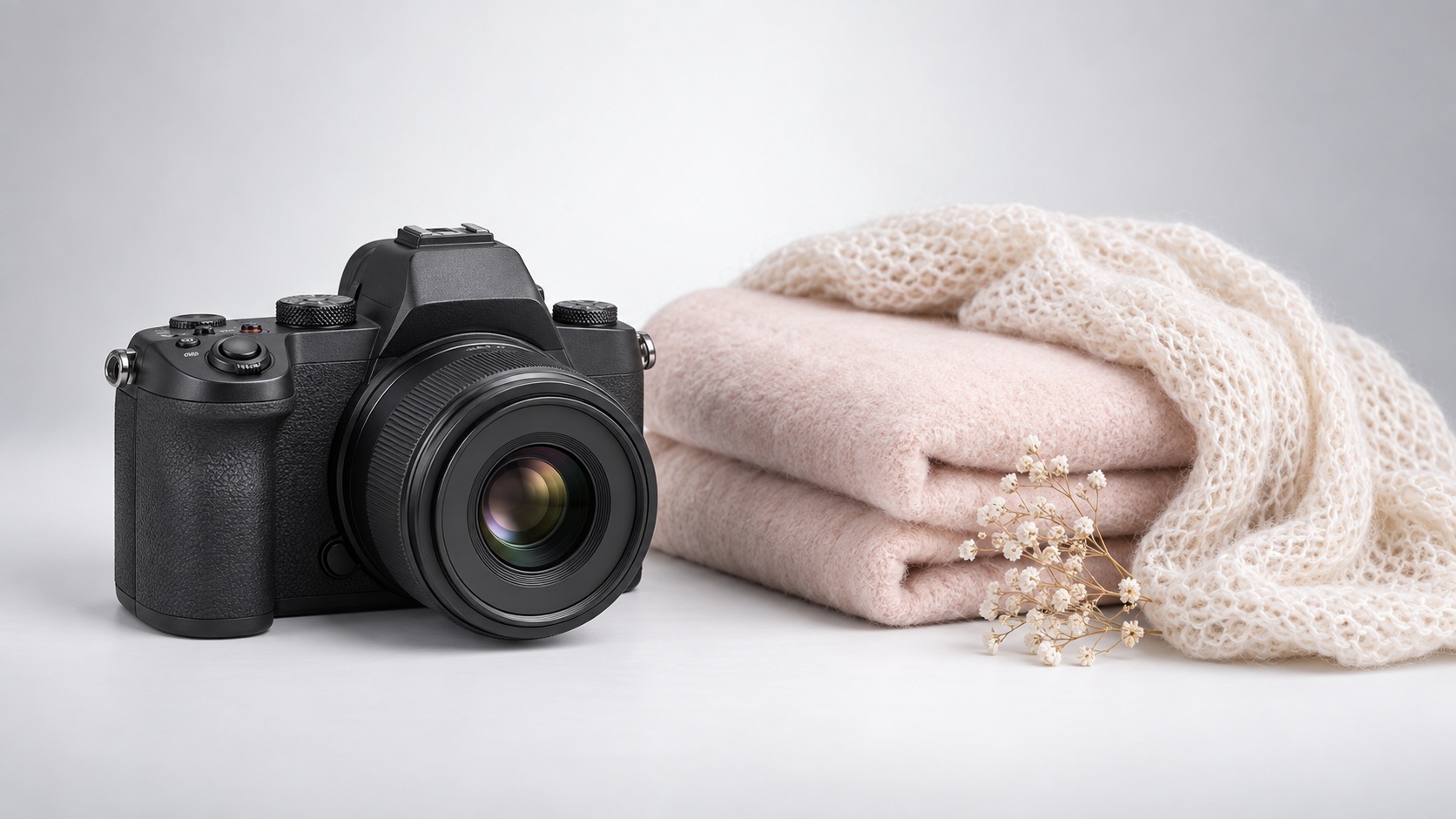
- Camera body, lens and lighting for newborn photos cost around 550 euros: used Canon EOS R100 from 340 euros, used RF 50mm f/1.8 STM for about 170 euros, reflector panel and white backdrop for about 40 euros. The set (backdrops, cushion, heater) adds 60-170 euros.
- The session should be done between the 5th and 14th day of life, in a room at 26-28 °C: the newborn sleeps almost all day and can be positioned without stiffening up.
- With a sleeping newborn, Eye AF doesn't lock onto anything because the eyes are closed. The silent shutter matters more, which the Sony A7 III (700 euros) has and the Sony A7 II doesn't.
- At 80 cm, with a 50mm on full frame, f/1.8 leaves about 3 cm of depth of field. To keep nose and ears in focus, you need f/4, which reaches about 6 cm.
At least once a month, someone walks into the shop with a newborn kit list: a studio flash with three softboxes, a backdrop with stand, a 100mm macro lens, baskets, hats, and a 180-euro posing pouf. Usually, it's a first-time parent or a photographer looking to add newborn sessions to their services. The total often exceeds 2,000 euros. Half of that gear ends up gathering dust in the basement after the third session.
A well-executed newborn portrait requires few things, and almost none are expensive: a window, a silent camera body, a fast lens capable of close focusing, and a warm room. In this article, we outline what is truly essential, what can be postponed, and what is not worth buying. For each price range, we list the cameras currently available in our workshop. However, before the equipment, the child's safety comes first.
Before setup: safety, timing, and temperature
A newborn session succeeds or fails before you mount the lens. Three things matter: the calendar, the thermometer, and what you decide not to attempt. Get one wrong, and the day goes off track, and no gear choice can recover it.
The 5-14 day window
Between the 5th and 14th day of life, a newborn sleeps 16–18 hours a day, and sleeps deeply. During that period, they are soft, allow themselves to be positioned without stiffening, and still tend to curl up in the position they had in the womb. After 3 weeks, sleep becomes lighter: a noise or a change in position is enough to wake them, and the session stretches out between awakenings and crying. Even within the right window, plan for 2–3 hours in total, including breaks for feeding and diaper changes. The rhythm is set by the child, not the schedule.
Warm room and hands always close by
Newborns are photographed naked or nearly so, and they lose heat much faster than adults. That is why the room temperature must be kept at 26-28 °C, verified with a thermometer rather than by feel. You are dressed and constantly moving, so you will feel warm long before the room is actually warm enough. Some rules are non-negotiable:
- The child should sit on the floor or a low pouf. Never on tables, high beds, or surfaces where they might slip.
- A second adult, usually a parent, is always required, with a hand a few centimeters from the child while you take the shots.
- Wash hands before every contact, keep nails short, and wear no rings or bracelets.
- Avoid accessories with small parts, buttons, or detachable pieces near the face.
When you look through the viewfinder, you only see what is within the frame, and you may not notice a foot slipping out of the edge. That is why the second person is not just extra help: without them, the shot cannot be taken.
Catalog poses are photo montages
In the photos you see on Pinterest, the newborn rests their chin on their hands, or sleeps swaddled and hanging from a branch. None of these images are shot that way. They are composites: two or more shutter count frames where an assistant's hand supports the head or body, then merged in post-production to remove the support. The photographers who create them have years of practice and an assistant who knows exactly where to place their hands. If you don't have that experience, don't try it. A newborn sleeping on a blanket, with the right light, is already a complete portrait, and it is almost always the photo parents end up printing.
The camera body: the four features that truly matter
To photograph a sleeping newborn, the camera body must do four things: operate silently, compensate for hand shake, handle low light, and focus on a face with closed eyes. Here, burst mode, 4K video, and tropicalization are irrelevant.
Silent shutter
The click of a mechanical shutter is enough to wake a newborn. Every wake-up costs about twenty minutes, between soothing and waiting for them to fall back asleep. There are three shutter modes:
- Mechanical: two physical curtains, it is the noisiest.
- First electronic curtain: only the second curtain moves, the sound is softer but still audible.
- Fully electronic: no noise. The Sony A7 Mark III, which we currently have for 700 euros, features this. The Sony A7 II does not.
However, be mindful of the lighting. With LED bulbs or household spotlights turned on, the electronic shutter may produce dark horizontal bands (known as banding). It works perfectly well with window light alone.
In-body stabilization: what it does and doesn't stop
When a manufacturer claims 5 stops of stabilization, it means that with a 50mm lens handheld, you can drop well below 1/50 without blurry images caused by your own shake. Motion caused by the child is a different matter. A newborn moves their hands even while sleeping and has sudden jerks, the Moro reflex, which no stabilization can stop. It is useful in low light, but it does not replace a shutter speed of 1/200.
High ISO performance
In winter, in a typical Italian room, window light easily pushes you to ISO 1600-3200. Within the same generation, a full frame sensor has approximately one stop less noise than an APS-C. In practice, an entry-level APS-C performs well up to 1600 and remains usable at 3200 with some noise reduction. A full frame like the A7 III handles 3200 without issues and reaches 6400 for standard-size prints. Beyond that threshold, a newborn's skin becomes grainy, or plasticky if you overdo the noise reduction.
Autofocus with closed eyes
Eye AF is the headline feature on every spec sheet, but it hunts for the pupil: if the eyes are closed, it locks onto nothing. Face recognition sometimes works and sometimes ends up on the blanket. The reliable method is the single AF point, the smallest one, on the eyelashes of the nearest eye. For this job, there is no point in paying more for a latest-generation autofocus. The Canon EOS RP, from 534 euros, is more than enough.
What we check in the lab
On white covers and light backgrounds, sensor dust is already visible at f/5.6: they are gray dots to be removed in post, one photo at a time. That is why every used camera body that passes through our lab receives:
- sensor cleaning;
- certified shutter count;
- stabilization test, if present;
- silent shutter test, if present.
It comes with a 2-year warranty, just like all ReflexMania used gear.
Which used camera, price range by price range
You don't need to spend more than 700 euros on a camera body for newborn photography. Above that price, you're paying for video capabilities and fast burst rates, which you will never use with a sleeping newborn. These are the models we have in our catalog today, at real prices.
Under 400 euros: Canon EOS R100 and Sony A6000
The Canon EOS R100 starts at 340 euros, and we have 9 units in stock. It is a 24 MP APS-C camera without stabilization and without an electronic shutter, so every shutter count is felt. However, with the RF 50mm f/1.8, it becomes a very capable 80mm equivalent. The Sony A6000 costs 360 euros and has the same limitation regarding the shutter. With a used Sigma 30mm f/1.4 DC DN, around 250 euros, it becomes the brightest APS-C combination in this price range.
Between 530 and 650 euros: Canon EOS RP, Sony A6500, Fujifilm X-H1
The Canon EOS RP costs between 534 and 600 euros and is the most affordable full-frame model we recommend for this job: 26 MP and the typical Canon skin rendering. It lacks stabilization, and the silent shutter is only available in a scene mode with several limitations. The Sony A6500 at 600 euros remains APS-C, but features in-body stabilization and a silent shutter. The Fujifilm X-H1 at 650 euros offers stabilization and an electronic shutter. Additionally, it features one of the quietest mechanical shutters on the market, which is essential when home LED lights create banding with the electronic shutter.
700 euros: the Sony A7 III is the point of balance
The Sony A7 III we have today costs 700 euros and has everything you need. 24 MP full frame, stabilization, silent shutter without switching to special modes, and ISO 6400 usable in a dimly lit room. The NP-FZ100 battery lasts an entire session without changes. It is the choice I recommend to those who want to turn newborn sessions into a business.
Models we do not recommend for this use
We sell them and they work well, but for a sleeping newborn, they are the wrong purchase:
- Sony A7 (400 euro): noisy shutter and no silent mode.
- Sony A7r (700 euro): it has the same noise, and on top of that, shutter vibrations reduce sharpness at 36 MP. For the same price, you get an A7 III.
- Sony A7 Mark II (570 euro): stabilized but not silent. For 30 euro more, you get the A6500, which is silent.
- Sony A7s Mark II (800 euro): 12 MP designed for video, and it costs 100 euro more than an A7 III. If you need to crop, that's not enough.
- Canon EOS R50 V (550 euro): built for video and without a viewfinder. For the same amount, the RP is better for photos.
Lenses: a bright 50mm first and foremost
To start, you only need one lens. On the technical specifications, the key figure is the minimum focusing distance, not the maximum aperture. With a newborn, you are almost always working within a meter, and a lens that stops focusing at 80 cm forces you to give up half of your shots.
Why the 50mm and not the 85mm
In a 3x3 meter bedroom, with the 85mm you end up with your back against the wall to frame the child entirely with their blanket. Then there is the minimum focusing distance, which separates the three lenses more than the price suggests:
| Lens | Minimum focus distance | In practice |
|---|---|---|
| Canon RF 50mm f/1.8 STM | 30 cm | Hands and feet take up a large part of the frame |
| Sony FE 50mm f/1.8 | 45 cm | The face fills the frame, cropping is required for the feet |
| Sony FE 85mm f/1.8 | 80 cm | The foot remains small and you are already far from the changing table |
On full frame, the most efficient pairing is a Canon EOS RP, which we currently have between 534 and 600 euros, with the RF 50mm STM used at around 170 euros. Those choosing the Sony A7 Mark III at 700 euros must account for those 45 cm. The complete comparison between the two focal lengths is in the in-depth article 50mm or 85mm for portrait.
On APS-C: 30-35mm
On a Canon EOS R100 or a Sony A6000, a 50mm lens becomes a 75-80mm equivalent. That works for portraits. However, for an overhead shot of a lying child, you would need to hold the camera nearly two meters away, and no one climbs onto a stool above a newborn. A 30-35mm lens provides the natural framing of a 50mm on full frame. The sensible choices:
- Canon RF 35mm f/1.8 Macro IS STM on the R100: focuses at 17 cm, covering a good portion of details.
- Sony E 35mm f/1.8 OSS or Sigma 30mm f/1.4 DC DN on the A6000: the Sigma is the brightest in its class.
The macro for details, further ahead
Eyebrows, lips, and nails are the photos parents are most eager to print. For those, you need the Canon RF 85mm f/2 Macro IS STM, which reaches a minimum focusing distance of 35 cm with a 1:2 magnification ratio, or the Sony FE 90mm f/2.8 Macro G OSS, which reaches 1:1. Buy them after your first 5-10 sessions, once you know how many detail shots you actually take. Before that, an RF 50mm at 30 cm is enough for hands and feet.
Is the kit zoom enough?
The Canon RF-S 18-45mm f/4.5-6.3 for the R100 or the Sony FE 28-70mm f/3.5-5.6 OSS for the A7 III are often found in the box, and the doubt is legitimate. With the white curtain drawn, at 1/200 s and f/6.3, you easily reach ISO 6400, double the ceiling we recommend for an APS-C. With an f/1.8, the same photo is taken below ISO 800. Keep the zoom for group shots with the parents, where the aperture would need to be stopped down anyway. For close-ups of the newborn, use the prime.
Light: A Window and a €25 Panel
The most successful newborn photos our clients show us are almost all taken with a window and a reflector panel. In this type of work, an 80-euro lighting kit worsens the result more often than it improves it. Natural light works if you choose the right window and direction.
Which window and at what time
You need a window without direct sunlight. The one facing north is the simplest, as it provides soft light for most of the day. An east-facing window gets direct sun until late morning: use it from early afternoon, or in the morning with the curtain drawn. A south-facing window must always be shaded. In both cases, a thin white curtain is enough to act as a diffuser.
Place the newborn 1–1.5 meters from the window, with light hitting at approximately 45°. Closer increases contrast too much. Further away reduces light, forcing you to raise the ISO.
Light enters through the top
This is the classic newborn rule: light falls from the head towards the feet. If it comes from below, it illuminates the face from underneath, shadows rise towards the eyes, and the effect is that of a torch under the chin. This is why the pouf is oriented after looking at the window, not before: the head goes on the light side.
The 5-in-1 reflector
An 80 cm folding panel costs around 25 euros and does the job of a second light. Place it 50-80 cm from the newborn, on the shadow side. Of the five surfaces, you will practically use two:
- White: the go-to choice for most situations; it brightens shadows without harsh reflections.
- Silver: too harsh for a newborn's skin.
- Gold: adds warmth, but in the first few days, the skin already has a reddish tone.
- Black: absorbs light on the shadow side, if you want more contrast.
- Translucent: place it in front of the window as a diffuser if you don't have curtains.
Flashes and continuous lights: when you need them
Do not use direct flash into the face: the burst can wake the child and the frontal light flattens the facial features. A speedlight bounced off a white ceiling, however, works well, as the light comes from above, broad and soft.
80 euro continuous light kits have poor color rendering and introduce green or magenta casts on skin tones. They are difficult to correct in post-production because they lack spectral components that white balance cannot recover. If you truly need a light source, for example on gray winter days, invest in an LED panel with a CRI of 95 or higher. It costs 100-150 euros and only makes sense once you have learned to use window light.
The set: what to buy and what to leave on the shelf
For your first newborn sessions, the set costs at most as much as the lens: between 60 and 170 euros, and you already have half of the items at home. It is advisable to keep the rest of the budget in reserve until you know whether you will do this work once or fifty times.
The essentials
| Item | Cost | Why it's needed |
|---|---|---|
| Rigid nursing pillow or low pouf with a taut blanket on top | 0-60 euros | It serves as the posing base. It must support the weight without sinking, otherwise the newborn slides into the central crease. |
| 2-3 stretch jersey sheets 2x1.5 m | 15-20 euros each | They act as the background and side panels. White, cream, grey, or beige: a red sheet reflects on the skin and the color cast cannot be fully removed. |
| Heater with thermometer | 30-50 euros | Keeps the room at the temperature set at the beginning. The thermometer should be placed near the pouf, not near the heater. |
| White noise app | Free | Covers voices, footsteps, and clicks. Deep sleep lasts longer and poses are easier to arrange. |
| Stable stool | Already at home | Necessary for high-angle shots, which come out skewed without a stool. |
The stool is the one point where caution is non-negotiable. Four legs, no casters, no folding steps that wobble. The camera strap stays around your neck for the entire session: the body and 50mm weigh about half a kilogram, and nothing should fall on a newborn.
What not to buy right away
This is where beginners waste most of their money. The professional setups you see on Instagram are the result of years of work, not a starter kit.
- €150 backdrop stand: with the newborn on the pouf, you frame less than one square meter. A sheet stretched between two chairs does the same job.
- Three softbox kit: for the reasons seen in the lighting section, it complicates your life rather than simplifying it at the beginning.
- Baskets, hats, and decorations in bulk: every accessory is an extra pose change, and every change risks waking the baby. Two objects are enough for a session.
- €180 professional pouf: it is comfortable because it can be shaped with the cushions under the cover. The nursing pillow with a taut blanket still covers all basic poses.
The practical rule is simple: the first 10 sessions are done with what is in the table. If paying clients arrive later and you realize something specific is missing, you buy it knowing exactly what it is for. We give the same advice at the counter to those who want a professional camera body as a first purchase: first find the limit, then pay to overcome it.
Shutter settings for a sleeping newborn
A sleeping newborn stays still and doesn't look around, but the margin for error remains just a few millimeters. Almost all the photos you end up discarding stem from three choices made before you start: aperture too wide, shutter speed too slow, JPEG files.
Aperture: f/2.8-f/4, not f/1.8
Up close, depth of field can be approximated as follows: DoF ≈ 2 × N × c × d² / f². N is the aperture, c is the circle of confusion (0.03 mm on full frame), d is the distance, and f is the focal length, all in millimeters. With a 50mm lens at 80 cm:
| Aperture | Calculation | Depth of field |
|---|---|---|
| f/1.8 | 2 × 1,8 × 0,03 × 800² / 50² | approx. 3 cm |
| f/2.8 | 2 × 2,8 × 0,03 × 800² / 50² | approx. 4 cm |
| f/4 | 2 × 4 × 0,03 × 800² / 50² | approx. 6 cm |
At f/1.8, with the face turned three-quarters, one eye is in focus and the other is not. At f/4, the nose, eyelashes, and ear come into focus. On APS-C, at the same distance, the depth of field is even shallower. Keep the maximum aperture for hands and feet, when you want to isolate them.
Exposure time and ISO
The minimum is 1/200. Even while sleeping, in the first days a newborn has twitches and grimaces, and opens their hands suddenly. With window light, at 1/200 and f/4, the ISO rises quickly: leave it on auto, but set a cap.
- Canon EOS R100 (from 340 euros): ceiling at 3200. It is the most affordable camera body we recommend for this job, and up to that value, noise is cleaned up without making skin look waxy.
- Sony A6000 (360 euros): ceiling at 3200. It is from 2014, nine years before the R100, but below that threshold, the APS-C sensor holds up well.
- Sony A7 Mark III (700 euros): ceiling at 6400. The extra stop of full frame, in a December room, decides whether to take the shot or wait.
Once you reach the ceiling, open up to f/2.8 before raising the ISOs further.
RAW and white balance
In the first few days, skin often tends to be red or yellow due to physiological jaundice. If you correct that color on a JPEG, you shift the entire image: the skin improves, but the white blankets turn cream-colored. In RAW, the first shot is taken with a gray card next to the face, in the same light. In post, take the white balance from the gray card and apply it to the entire series. Then correct only the skin, working on the hue and saturation of reds and oranges. The blankets remain white because you haven't touched them.
Focus and shooting modes
Use the single AF point, on the eyelashes of the eye closest to the lens. Face recognition tends to choose the point on its own, often the forehead or the nose. Shoot in single mode, not in bursts, and use the silent shutter if the camera body supports it. Every 20-30 shutter counts, zoom in on the last image at 100%. On the display, a focus shift of one centimeter is not visible. On a home monitor it is, but by then the child is awake and the session is over.
Three complete setups, from the most affordable to the most robust
The difference between the most affordable and the most robust setup is around 370 euros, and you don't have to spend all of it. The table shows the three packages with today's prices. All three include a 50mm f/1.8, a reflector panel, and a white backdrop: only the camera body changes. The set shown above (60-170 euros) is separate.
| Setup | Camera body | Lens | Light | Total |
|---|---|---|---|---|
| Base | Canon EOS R100, 340 euros | RF 50mm f/1.8 STM, 170 euros | 40 euros | approx. 550 euros |
| Intermediate | Canon EOS RP, from 534 euros | RF 50mm f/1.8 STM, 170 euros | 40 euros | approx. 745 euros |
| Solid | Sony A7 Mark III, 700 euros | FE 50mm f/1.8, approx. 180 euros | 40 euros | approx. 920 euros |
- Base: the R100 is APS-C, so the 50mm works as an 80mm equivalent, giving you a step of margin from the couch. Its limitation is the shutter, which lacks a completely silent mode.
- Intermediate: the RP offers full frame, which in a room with a single window means higher ISOs with less noise. The silent shutter is available, but only as a scene mode, with limited control over parameters.
- Solid: the A7 III features a silent electronic shutter even in manual mode, in-body image stabilization, and an NP-FZ100 battery that covers an entire session. We currently have only one unit in stock.
Switching from the R100 to the RP only makes sense if the room is dark, for example with a north-facing window in winter. With a good window, the full-frame advantage is barely noticeable. The A7 III, on the other hand, is justified by its silence: if you photograph other people's children, every wake-up caused by a shutter click is lost session time.
Who should stick to the basic setup
If you're a parent looking to photograph your child, or someone who does 2-3 sessions a year for friends and family, the R100 with the 50mm is sufficient. With so few sessions, sensor noise and shutter noise won't change the final result. That difference of about 370 euros is better spent on high-quality prints: a well-made album and a few fine art enlargements last, while files on an SD card usually end up forgotten.
When to add the second lens
The second lens should be purchased when sessions become a regular activity and clients start asking for details: feet, closed hands, eyelashes. At that point, a 90-100mm macro or an 85mm lens provide tight framing that you would only achieve with a 50mm by getting too close to the child. Before then, it is an expense that stays in the backpack. To choose between the two options, models and prices are in our guide to used portrait lenses.
Frequently Asked Questions
Is the flash harmful to a newborn's eyes?
There is no evidence that the flash from a standard speedlight damages vision. The issue is practical: direct flash startles and wakes the baby, and produces flat lighting. It is better to use a window, or bounce the flash off a white ceiling.
Is a full frame sensor mandatory?
No. A Canon EOS R100 with a 50mm f/1.8 takes excellent newborn portraits with a good window. The full frame gains about one stop of cleanliness at high ISOs, and this matters on gray winter days or in dimly lit rooms.
If I can only buy one lens, which one should I get?
A 50mm f/1.8 on full frame, or a 30-35mm on APS-C. Before the price, check the minimum focus distance: the Canon RF 50mm f/1.8 STM focuses at 30 cm, the Sony FE 85mm f/1.8 only from 80 cm.
Can I try the poses with the chin on the hands that I see on social media?
Those poses are photomontages of two shutter counts, made with an assistant who always holds the child. Without experience and without a second adult, they should not be attempted. A newborn sleeping on its side, on a blanket, is already a complete portrait.
When should the session be scheduled?
Between the 5th and 14th day of life, when the newborn sleeps deeply and allows for easy positioning. After three weeks, the same approach can be used, but it requires more patience and the session takes longer.
Why do dark bands appear in photos when using the electronic shutter?
It's banding: LED and fluorescent lights flicker, and the electronic shutter reads the sensor line by line. With only window light, the problem disappears. With the house lights on, it's best to switch back to the mechanical shutter.
Is an 80-euro continuous lighting kit worth buying?
Almost never. Those panels have low color rendering and produce green or magenta casts, which are difficult to correct on a newborn's skin. A 25-euro reflector next to a window yields better results. If you need artificial light, look for an LED panel with a CRI of 95 or higher.
Building your newborn setup? Let's talk
If you have doubts about a purchase or need advice for your specific case, contact us. We offer free advice because we are photographers first, and because a customer who makes a bad purchase won't come back to photography.
Three ways to get in touch:
- Contact form — response within 24 business hours
- WhatsApp at 342 362 3454 (messages only)
- Phone: 071 291 6347 (Mon-Fri 9-13/15-18, Sat 9-13)
If you want to see what we have in stock right away, explore the used gear available today: every camera body is certified, comes with a 2-year warranty, and ships within 24-48 hours.
Article written by Matteo for the ReflexMania Team. Last updated: September 2026. Prices and availability refer to the time of publication.