
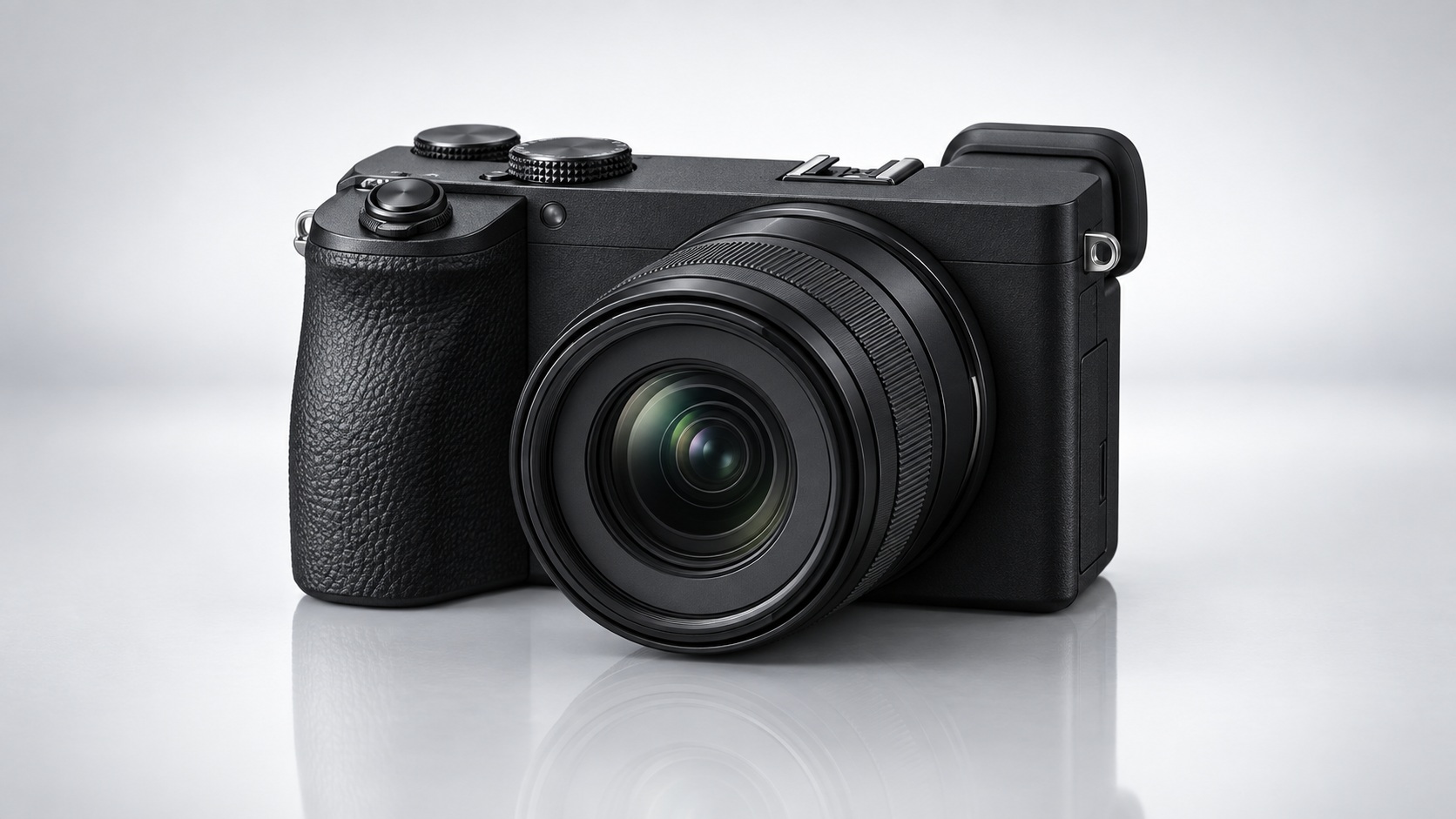
In short
- The Sony A6700 (July 2023) cost 1,699 euros for the camera body only at launch; used in 2026, it is found between 1,150 and 1,350 euros, roughly 20-30% less.
- Compared to the A6400 and A6600, three things truly change: AI-based autofocus with recognition of 6 subject types, 4K 10-bit video up to 120p, and a 26 MP stacked sensor.
- The NP-FZ100 battery is rated for 550 certified shutter counts with the viewfinder, fewer than the 720 of the A6600: the advantage over the older A6400 and A6500 remains, but it is not the best in the family.
- Those who shoot only portraits and landscapes spend less and get more with a used full-frame: a Sony A7 Mark II with stabilization costs 570 euros today.
Since its release, the A6700 is the camera most customers mention at the counter when looking for the best of Sony's APS-C lineup. However, few used A6700 units come our way: it is a 2023 model, and owners tend to keep it. The units that pass through our workshop almost always have fewer than 20,000 shutter count, and the prices asked by private sellers remain high. This changes how the purchase should be evaluated.
In this article, we look at what the A6700 truly offers compared to its older siblings, whether it makes sense to buy it used in 2026, and for whom it is the right choice. We also cover the cases where it is the wrong choice, because there are some: for many photographers, a used full-frame body or an older APS-C body does the same job at half the price. We wrap up with the checks to perform before paying.
What is the Sony A6700 and why it is considered a flagship model
Sony introduced the A6700 in July 2023, almost four years after the A6600. Since then, it has effectively held the top spot in Sony's APS-C photographic lineup. It did not introduce a new designation or launch a new series. Instead, it brought the electronics of the latest full-frame models into the established A6000 family. To determine if it is worth the price it commands on the used market, you need to look at the numbers and ignore the adjectives.
The tech specs, as seen by the user
These are the specs that matter when the camera is in your hands. The rest is in the brochure.
| Item | Data | What it means in the field |
|---|---|---|
| Sensor | APS-C 26 MP back-illuminated (BSI) | Modest crop factor, higher than the 24 MP of previous models |
| Processor | BIONZ XR with dedicated AI unit | It is the engine for subject recognition, not a marketing acronym |
| Stabilization | 5-axis IBIS | Works with any E-mount lens, even those without OSS |
| Burst rate | 11 fps with continuous AF | Sufficient for amateur sports and wildlife, not for the fastest birds |
| Viewfinder | 2.36 million dot OLED | The same as the A6600: no step forward on this front |
| Display | Side-hinged tilting, touch | Useful for video and selfies, a bit less comfortable on a tripod |
| Memory | Single SD UHS-II slot | No real-time backup |
| Video output | Micro HDMI | Fragile connector when working with an external monitor |
| Weight | 493 g with battery and card | About 150 g less than a full-frame Sony in the same class |
The viewfinder deserves a note. Those moving from the A6600 to the A6700 expecting a leap in framing experience will be disappointed. The panel, resolution, and magnification have remained the same.
Top-tier, but not professional
"Flagship" should be understood within Sony's APS-C photographic lineup. Compared to an A6400 or an A6100, it is the most complete. However, it is not a working camera body in the sense that a Sony A7 IV or an FX30 are. The differences are concrete:
- Weather sealing: Sony states a build designed to withstand dust and moisture, but does not specify any IP rating. It holds up in light drizzle, but no one guarantees anything in a downpour.
- Single slot: at a wedding, a corrupted card means losing the ceremony with no backup copy. The A7 IV has two slots, and not by accident.
- Viewfinder: with 2.36 million dots, it is smaller and less defined than the 3.68 million dots of the A7 IV. On long days with manual focus, the difference is noticeable.
- Connections: the micro HDMI is the same as entry-level models. The FX30, designed for cinema, has a standard HDMI and a body with active heat dissipation.
The A6700 is the best APS-C Sony for hybrid photo and video shooters who want a compact body. It is a serious camera. However, professionals working on commission must know its limitations before bringing it to an event that cannot be repeated.
What really changes compared to A6400, A6500 and A6600
The Sony A6500 currently in our catalog for 600 euros stabilizes as well as an A6700. It also focuses with the same 425 points as an A6600. A used A6700 costs 550-750 euros more, so it is worth checking item by item where that money goes.
| Model | Phase-detect AF points | Stabilization | CIPA shutter count (viewfinder) | Video |
|---|---|---|---|---|
| A6000 | 179 | No | 310 | Full HD |
| A6400 | 425 | No | 360 | 4K 30p 8 bit |
| A6500 | 425 | 5 stop | 310 | 4K 30p 8 bit |
| A6600 | 425 | 5 stop | 720 | 4K 30p 8 bit |
| A6700 | 759 | 5 stop | 550 | 4K 120p 10 bit |
The Sony A6000 at 360 euros is a different story: it lacks 4K and stabilization, but it is enough to enter the system. The direct comparison is in the article Sony A6000 vs A6400 used.
AI-based autofocus: where it makes a difference
More than the 759 points versus 425, subject recognition is what matters. The AI unit recognizes six types of subjects: people, animals, birds, insects, cars and trains, and airplanes. The difference is noticeable with birds in flight, in sports, and with running children, which is exactly when the A6400 loses eye focus and focuses on the background. For a posed portrait, the A6400's Eye AF is already sufficient, and paying 700 euros more just for that makes no sense.
5-stop stabilization: what it means without the marketing
The CIPA rating is measured under controlled conditions with short focal lengths. In practice, with a 35 mm lens handheld, a sharp shot at 1/15 s is highly likely, but not at 1/2 s. A moving subject will still be blurred. Furthermore, the A6500 and A6600 both declare the same 5 stops, so on this point the A6700 offers no improvement.
Battery: The NP-FZ100 vs. the Old NP-FW50
With the viewfinder, the A6700 declares 550 CIPA shutter count, compared to 360 for the A6400 and 310 for the A6500 with the NP-FW50. However, the A6600 declared 720 with the same NP-FZ100, so the A6700 consumes more. In real use, a day of travel can be completed with a single battery. If you shoot a lot of video, you will need at least a second one.
Video: 10-bit and 4K 120p, with the crop you need to know
- 4K 30p oversampled from 6K, no crop: this is the most detailed file.
- 4K 60p with a slight crop of the frame.
- 4K 120p with a 1.58x crop: a 16 mm lens frames roughly like a 38 mm equivalent.
- S-Log3 and S-Cinetone in 10-bit 4:2:2.
For videographers, this is the biggest leap. The 8-bit files from older models show color banding as soon as you push the correction on a log profile. For those who only shoot stills, this feature is worth zero euros.
How much does a used A6700 cost in 2026
In September 2026, a used Sony A6700 in excellent condition sells for between 1,150 and 1,350 euros for the camera body only. At launch, the list price was 1,699 euros. After three years, it has lost about 20-30%, which is low for an APS-C mirrorless. There are three reasons: the A6700 is still in production, Sony has not announced a successor, and there are few used units on the market.
For the same reason, the A6700 is not in our catalog today. For comparison, a refurbished Sony a6500 costs 600 euros, about half. A Sony A6000 costs 360 euros, just over a quarter.
Body and kit: real price ranges
The price depends on the shutter count, the cosmetic condition, and what is included in the box. A second original, brand-new NP-FZ100 battery costs around 80 euros. Having it included is a concrete advantage, not a detail. These are the ranges we see in real negotiations:
| Configuration | Used Price 2026 | Note |
|---|---|---|
| Body only, over 20,000 shutter count or visible signs of use | €1,150-1,250 | Negotiable, especially if the box is missing |
| Body only, under 20,000 shutter count, complete with accessories | €1,250-1,350 | Top end of the market |
| Kit with 18-135 mm | body + €250-300 | A versatile kit that holds its value |
| Kit with 16-50 mm motorized | body + less than €100 | Poor resale value; users who upgrade replace it immediately |
If they offer you a kit with the 16-50 mm for 200 euros more than the body, you are paying for a lens worth less than half that amount.
Used or new with cashback: the threshold to keep in mind
The real competitor to used gear is new stock on promotion. During seasonal campaigns, with Sony discounts and cashback, the A6700 body alone sometimes drops below €1,500. In that case, a used unit above €1,350 no longer makes sense. With a €150 difference, you lose the official warranty and a brand-new battery.
- From a private seller, no warranty: the price must be at least 300 euros below the current new price. If the new price is 1,500 euros, the ceiling is 1,200.
- From a shop, with inspection and warranty: the discount compared to the new price can be smaller. However, above 1,350 euros, buying new on promotion is still the better deal.
- The comparison must be made on the day of purchase: use the actual new price at that time, not the launch list price of 1,699 euros. Many private listings use the list price as a reference to appear like a bargain.
Who should buy it used
A used A6700 is worth the extra 500-700 euros over an A400 only if you actually use the features the others lack. In our shop, we see it sell well with three specific profiles. Outside of these three, that same amount usually gets you more value elsewhere.
The hybrid photographer who also shoots video
Think of someone who alternates between photos and clips for social media, a small event, a video for a client, or a wedding as a second camera. Here, every difference truly matters. The 10-bit recording holds up color correction without banding in the skies. The side-hinged display allows you to frame yourself even with a microphone on the hot shoe. In-body image stabilization saves handheld shots. Video autofocus keeps the subject locked without hunting back and forth. If you lack any of these features on a weekly basis, the price difference justifies itself.
Wildlife, birds and amateur sports
The 1.5x crop factor becomes an advantage here. The Sony 70-350 mm G is equivalent to a 105-525 mm and weighs 625 grams. A full-frame lens with the same coverage weighs and costs significantly more. Bird and insect recognition locks focus even through branches, where older A6000 models struggled to focus on leaves. With a used camera body around €1,200 and a used 70-350 mm, you stay under €2,000: it is the lightest and most sensible nature kit we know at that price point. The same applies to your kids' games, motocross, and athletics.
Already have a Sony E APS-C kit
If you are coming from an A6000, A6100, or A6400, you can upgrade without changing your system. The Sigma 18-50 mm f/2.8 and the trio of Sigma f/1.4 lenses in 16, 30, and 56 mm mount without adapters and perform better on the 26 MP sensor than on older camera bodies. Before buying, you should take two things into account:
- Batteries change: A6000, A6100 and A6400 use the NP-FW50, while the A6700 uses the NP-FZ100. The old ones stay in the drawer.
- Old camera bodies are worth little: we sell a Sony A6000 today for 360 euros, and you get even less from a private seller. The value of the kit lies in the lenses, not the body.
Those starting from scratch are in a different position. They have no lenses to recover, so they must also weigh a used full-frame body. If they only shoot, that comparison often favors the A6700.
When it doesn't pay off: the most sensible alternatives
The A6700 costs between €1,150 and €1,350 because it excels at three things: it recognizes and tracks moving subjects, records 4K 10-bit video up to 120p, and fits into a compact camera body. If none of these three features are truly essential for you, you are paying for capabilities you will not use. These are the three scenarios we see most often at the counter, along with our alternative recommendations.
If you only take photos: a used full frame costs half as much
For landscape, posed portraits, or leisurely travel, AI tracking is not needed. What matters is a large sensor and clean files when the light fades. Within the same generation, a full-frame sensor gains approximately one stop in noise performance compared to an APS-C. At 6,400 ISO, the difference is visible in prints, not just when zooming in on the monitor.
- Sony A7 Mark II at 570 euros: 24 MP full frame with 5-axis in-body stabilization. It features the same E mount, so FE lenses you buy today will also work on newer Sony camera bodies.
- Canon EOS RP between 534 and 600 euros, with 9 units available: 26 MP full frame, lightweight, without in-body stabilization. With stabilized RF lenses or on a tripod, this is a minor limitation.
What you lose: an autofocus from a previous generation, small batteries, and a modest burst rate. With a stationary subject, these are limitations that don't matter. We explored this reasoning in depth in used full-frame DSLR or mirrorless: what makes sense.
Sticking with APS-C for under €700
- Sony A6500 at 600 euros: 5-axis stabilization like the A6700, same E mount and 8-bit 4K. The weak point is the NP-FW50 battery: for a full day of shooting, you need at least three.
- Fujifilm X-H1 at 650 euros: in-body stabilization, a proper grip, and film simulations that are already excellent in JPEG. It weighs 673 g, compared to 493 g for the A6700, and its autofocus struggles more with fast-moving subjects. It is not the right choice for sports and birds in flight.
If your use is mainly vlogging and social media video
Those shooting for Instagram, TikTok, or YouTube Shorts often buy the A6700 for the 10-bit capability and never use it. The Canon EOS R50 V at 550 euros was designed specifically for this workflow. It features a side tripod mount for vertical video. It lacks a viewfinder and in-body stabilization: only electronic stabilization is available, which slightly crops the frame.
Log profiles and 10-bit make sense if you do color grading. If you shoot, edit on your phone, and publish, the €600–800 difference won't be visible on a 6-inch screen. Better to spend that on a good microphone and an LED light.
The lens issue: the body is only half the cost
A €1,250 A6700 with the 16-50mm kit lens costs only slightly more than an A6400 with the same lens. The 26 MP and AI autofocus are only noticeable when paired with a lens that resolves enough detail. Therefore, when budgeting, it is advisable to allocate at least €400-700 for lenses in addition to the camera body.
APS-C lenses worth the camera body
The motorized 16-50 mm f/3.5-5.6 is compact, but it is soft at the edges, and from f/5.6 in low light, ISO levels rise quickly. It is the first lens to replace, and used, it resells for little. The optics that truly make the sensor work are these:
| Lens | FF Equivalent | Indicative Used Price | Key Strength |
|---|---|---|---|
| Sigma 18-50 mm f/2.8 DC DN | 27-75 mm | 400-450 € | Constant f/2.8 in 290 g |
| Tamron 17-70 mm f/2.8 VC | 26-105 mm | 500-580 € | Stabilized, longer zoom range |
| Sigma 16 / 30 / 56 mm f/1.4 | 24 / 45 / 84 mm | 200-340 € each | Fast aperture and bokeh at low prices |
| Sony E 70-350 mm G OSS | 105-525 mm | 650-750 € | Lightweight telephoto for nature and sports |
The math is simple: the camera body plus the Sigma 18-50 mm comes to approximately 1,650-1,700 euros. Adding the 70-350 mm G pushes the total over 2,300 euros. With these figures, a Sony A7, currently listed at 400 euros, leaves more than a thousand euros for lenses. We discussed this in our guide to the used first-generation Sony A7.
Full frame FE lenses on APS-C body
FE lenses mount directly on the A6700 without adapters, as the mount is identical. However, the sensor only captures the central portion of the image, resulting in a 1.5x crop. An 85 mm lens thus becomes a 127 mm equivalent, ideal for tight portraits but inconvenient in a room.
The issue is the trade-off between weight, size, and performance. A Sony FE 24-70 mm f/2.8 GM II weighs 695 g and covers a 36-105 mm equivalent on the A6700. The Sigma 18-50 mm offers a more useful framing with less than half the weight and at less than a third of the price.
- It makes sense if the switch to full frame is already on your agenda: the lenses stay, only the body changes.
- It makes sense for FE prime telephotos, where the crop helps: a Sony FE 85 mm f/1.8 at 371 g remains lightweight.
- It does not make sense if you stay on APS-C: you pay for glass and weight for an area of the image that the sensor does not use.
At the counter, our advice is simple. If you're buying the A6700 to stay with it, choose bright APS-C lenses. If you're already considering full frame, evaluate whether it makes sense to start there from the beginning.
What to check on a used A6700
A 2023 A6700 is still too young for wear-related failures. However, it has had plenty of time to end up in careless hands. There are four points to check, and only the first one requires a computer.
Shutter count and shutter
Sony does not display the shutter count in the menu and does not state how many shutter actuations the A6700 shutter can withstand. To read the counter, you need software with the camera connected to a computer. On a three-year-old body, the average ranges from 10,000 to 40,000 shutter actuations. Beyond 80,000, the price is negotiable. However, there is a detail: those who shoot in bursts with the electronic shutter wear down the mechanical part less, so for the same number, two cameras can be in very different condition.
Exposed sensor and stabilization
The A6700 does not close the shutter curtain when the camera is off, so the sensor remains exposed to dust every time you change the lens. Shoot at f/16 against a uniform sky and zoom in to 100%: dust spots can be cleaned, but scratches on the glass in front of the sensor cannot. For the stabilization, take about ten hand-held shots at 1/30 s. They must come out sharp, and the powered-on camera must not produce any unusual humming or clicking sounds. When the camera is off, however, a slight tinkling sound from the sensor is normal.
Micro HDMI, display hinge, SD slot
- Micro HDMI: This is the most fragile port, especially if the camera body has been used extensively with an external monitor. Connect a cable and gently move the connector: the signal must not drop.
- Display hinge: Open and rotate the screen through all positions. The image must not flicker or turn off at any point.
- SD slot: There is only one, so it must function perfectly. Insert a UHS-II V90 card and record for a few minutes in 4K at maximum quality, with no write errors or interruptions.
Provenance, firmware, and warranty
Ask for the receipt or invoice. These documents are essential to determine whether the camera was sold by Sony Italy or is a parallel import, which official support may refuse to cover under warranty. In the menu, check the firmware version and compare it with the latest one published on the Sony support site. Finally, remember that when buying from a private seller, the warranty is effectively zero: if the slot breaks after a month, the problem is yours.
In our workshop, we perform the following checks on every camera body that comes in: we read the shutter count via software, test the stabilization, clean and inspect the sensor, and test all ports. The Sony a6500 currently available for 600 euros has passed the same checks. Like all used equipment from ReflexMania, it comes with a 2-year warranty.
The verdict: yes, but with a precise price in mind
The used Sony A6700 is today the most complete APS-C Sony you can buy, but it is only worth it within a narrow price range. Above €1,350, the difference with a new one on promotion drops to about €150, and the discount no longer offsets the risks of buying used.
After comparing it with its siblings and full-frame models, here is our assessment: it is the right camera for three profiles. The first is for those who alternate between photography and videography and truly utilize 4K 10-bit recording. The second is for wildlife and bird photographers who need subject recognition. The third is for those who already own a set of E-mount lenses and want a more modern body without changing their system. Those who shoot only portraits, landscapes, and travel without video are better served by a used full-frame model like the Sony A7 Mark II.
Thresholds to keep in mind
| Body-only price | Condition | Action |
|---|---|---|
| Under €1,200 | Less than 20,000 shutter count, no signs of impact | Good deal: buy |
| €1,200–€1,350 | Low shutter count, original box and accessories, warranty | Fair price, not a bargain: negotiate |
| Over €1,350 | Any | Check new stock on promotion |
The shutter count matters more than it seems. An A6700 at €1,150 with 45,000 certified shutter count is not worth more than one at €1,250 with 8,000. If the seller cannot or will not tell you the number, calculate the price as if it were high.
If you have decided on the A6700
Used units arrive in small batches. Those with a low shutter count are sold out within days. At ReflexMania, you can ask us to notify you when one arrives at our workshop: before it goes on sale, we inspect it using the same review protocol as every other camera body, and it comes with a 2-year warranty. Tell us your budget and the lens you plan to mount. If the kit doesn't match what you want to photograph, we'll let you know before you spend.
Frequently asked questions
How many shutter count is too many for a used Sony A6700?
It is a 2023 model: most units in circulation have between 10,000 and 40,000 shutter count. Sony does not declare a shutter life for the A6700, so beyond 80,000 shutter count it is advisable to negotiate the price or budget for a possible shutter replacement. The counter is not visible in the menu: it must be read with dedicated software.
Is a used A6700 better than a used Sony A7 III at the same price?
Both can be found between €1,150 and €1,250. The A7 III has a cleaner full-frame sensor at high ISOs and two SD slots, making it better for weddings, events, and low-light photography. The A6700 features more advanced recognition autofocus, 10-bit video, and lighter lenses. Those who primarily shoot stills should choose the A7 III, while those who alternate between photos and video should opt for the A6700.
Does the A6700 overheat when shooting 4K video?
In 4K 30p and 60p, it handles long sessions in normal use, especially when setting the auto power-off temperature to High. In full summer sun and in 4K 120p, a temperature warning may appear after prolonged recordings. For one-hour interviews, external power via USB-C is recommended.
Can I use Sony FE full frame lenses on the A6700?
Yes, they mount directly without adapters and work with autofocus and stabilization. The image is cropped with a 1.5x factor: a 50 mm lens behaves like a 75 mm equivalent. It makes sense if you plan to switch to full frame in the future; otherwise, APS-C lenses are lighter and more affordable.
Is it worth buying a used A6600 instead of the A6700?
For those who only shoot stills, yes: at 800-950 euros, it offers stabilization, an NP-FZ100 battery with higher declared battery life (720 shutter count vs. 550), and Eye AF for people and animals. You lose AI recognition for birds and insects, 10-bit video, and the side-hinged display (the A6600's display only flips up and down). Those who shoot video or photograph moving wildlife should go for the A6700.
Is a parallel import A6700 a problem?
The camera is identical, but the Sony Italy warranty does not cover units imported outside the official circuit. From a private seller, on a camera body that is already two or three years old, the practical difference is often reduced because the manufacturer's warranty has already expired or is about to expire. On ReflexMania, every used item, regardless of its origin, is sold with a 2-year warranty after laboratory inspection.
Looking for a used Sony A6700 or a better alternative for you? Let's talk
If you have doubts about a purchase or need advice for your specific case, contact us. We offer free advice because we are photographers first and sellers second, and because a customer who makes a poor purchase does not return to photography.
Three ways to get in touch:
- Contact form — response within 24 business hours
- WhatsApp at 342 362 3454 (messages only)
- Phone: 071 291 6347 (Mon-Fri 9-13/15-18, Sat 9-13)
And if you want to see what’s currently in our catalog, explore the used gear available today: every camera is certified, comes with a 2-year warranty, and ships within 24-48 hours.
Article written by Matteo for the ReflexMania Team. Last updated: September 2026. Prices and availability refer to the time of publication.