
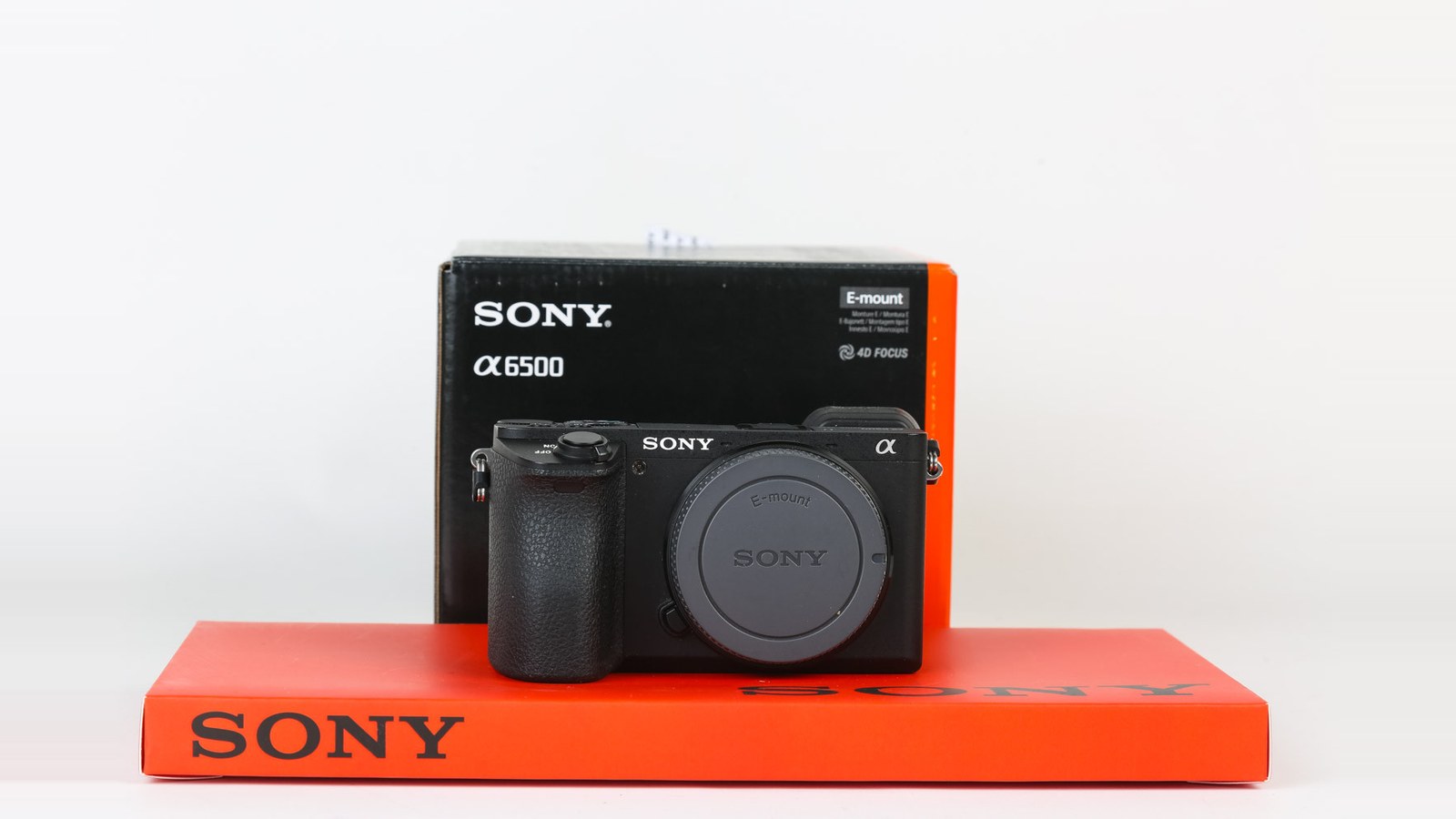
In short
- The Sony A6500 (late 2016, approx. 1,700 euros at launch) was the first Sony APS-C camera with 5-axis in-body image stabilization: 5 stops claimed CIPA, 2-3 stops realistic for handheld shooting.
- On the used market, it is typically found between 450 and 600 euros. We do not currently have it in stock, while a Sony A7 Mark II full frame, also stabilized, costs 570 euros with us.
- Shutter rated for 200,000 cycles and NP-FW50 battery for approximately 350 shutter count: 2-3 batteries are needed for a working day.
- Stabilization does not freeze moving subjects. For sports and children, a Sony A6100 at 550 euros, with a more modern autofocus but no stabilizer, is often more useful.
Looking for a used Sony a6500? The used Sony a6500 page shows current availability and prices, with certified shutter count and a 2-year warranty. See also all used Sony cameras.
At the counter, the question almost always comes up like this: I have a Sony A6000, my indoor evening photos are blurry, do I need a new camera? Half the time the answer is no: the issue is the shutter speed, not the camera. The other half, the answer is yes, and the name that comes up is always the same: the Sony A6500, the first camera to put in-body image stabilization on the sensor in a compact Sony APS-C body.
In this article, we look at what the stabilizer actually does beyond the number printed on the box, what has aged well and what hasn't after nearly ten years, what we check in the lab when one comes in, and how much sense it makes to spend on it today. We also look at stabilized alternatives at a similar price point, because in certain cases the A6500 is not the right choice, even if it seems like the most obvious deal.
Why the A6500 is still relevant in 2026
The Sony A6500 remains the most affordable way to get in-body image stabilization in a compact Sony APS-C camera body. Released in late 2016 at around €1,700, it was the company's first APS-C model featuring 5-axis IBIS. Surrounding the stabilizer is a body designed for serious photographers: a 24 MP sensor, magnesium alloy chassis, touchscreen, and a 2.36-million-dot OLED viewfinder.
Where it fits in the A6000 family
From the outside, the bodies of the A6000 series all look almost identical, but only certain models feature in-body stabilization. When comparing listings that appear identical, this is the first thing to check.
| Model | Release | In-body stabilizer | Key features |
|---|---|---|---|
| Sony A6000 | 2014 | No | Base body of the series, NP-FW50 battery |
| Sony A6500 | 2016 | Yes, 5-axis | Magnesium body, touchscreen, NP-FW50 battery |
| Sony A6100 | 2019 | No | Real-time tracking autofocus |
| Sony A6600 | 2019 | Yes, 5-axis | NP-FZ100 battery, deeper grip |
Today in our catalog we have a Sony A6000 at 360 euros, a camera body still valid for those who shoot during the day with stabilized lenses. There is also a Sony A6100 at 550 euros, which has more modern subject tracking than the A6500. Neither of the two has IBIS, and neither does the A6400. The A6600 and A6700 are stabilized, but on the used market they cost significantly more.
The real audience for this camera
The in-body stabilizer works with any mounted lens, and this is what makes the A6500 worthwhile. At the counter, it is mainly requested by those who already have an E-mount kit built around fast lenses without OSS:
- Bright APS-C primes: Sigma 30mm f/1.4 DC DN Contemporary, Sigma 16mm f/1.4 and Sigma 56mm f/1.4. They are sharp and affordable, but lack optical stabilization.
- Used FE primes on APS-C: Sony FE 35mm f/1.8 and FE 50mm f/1.8, both without OSS. Be careful not to confuse them with the Sony E 35mm f/1.8 OSS and E 50mm f/1.8 OSS, which already have the stabilizer built into the lens.
- Adapted manual lenses: Helios 44-2, Minolta MD, Canon FD, Nikon AI. The adapter does not transmit focal length information, so it must be set manually in the stabilization menu (we discuss this further below).
For these users, the advantage is concrete: they gain slower shutter speeds with the gear they already own, without changing systems. Those who only mount Sony OSS zooms, such as the 18-135mm, derive a much smaller benefit from IBIS and need to think differently.
The 5 declared stops: what they mean with the camera in hand
The 5 stops of the A6500 are a lab figure, not a real-world one. The CIPA standard measures them on a platform that replicates standard shake, with focal length and distance set by the protocol. It’s a useful test for comparing cameras. It doesn’t tell you what happens to you at the end of a day, with the coffee still circulating.
Handheld, on the cameras we test at the counter, repeatable results are 2-3 stops. The starting point remains the safety shutter speed rule, i.e., 1/equivalent focal length. On APS-C, the focal length must be multiplied by 1.5. There is also a detail that marketing ignores: 24 MP on an APS-C sensor show micro-shake before a larger sensor does. If you view the files at 100%, start with a shutter speed double the rule.
| Lens | Equivalent focal length | Safe shutter speed without IBIS (100%) | Realistic with IBIS |
|---|---|---|---|
| 16mm | 24mm | 1/50 s | 1/10 – 1/6 s |
| 35mm | 52mm | 1/125 s | 1/30 – 1/15 s |
| 50mm | 75mm | 1/160 s | 1/40 – 1/20 s |
One thing IBIS never does: freeze the subject. It stabilizes the camera, not the person walking in front of the lens. At 1/15 s, the background will be sharp, but anything moving will be blurred.
With OSS lenses: what stabilizes what
With a Sony OSS lens, the workload is split. The lens corrects pitch and yaw, while the sensor handles rotation around the optical axis and horizontal and vertical shifts. The gain over standalone OSS exists, but it is about half a stop or slightly more, not the leap suggested by the spec sheet. It is the same scheme that debuted on the full-frame model, which we discuss in the comparison Sony A7 vs Used A7 II.
With manual and adapted lenses
This is the strongest use case. In the SteadyShot menu, you manually set the focal length, and the stabilization works even with a Helios 44 or a Takumar 50mm. Concrete example: 50mm manual, inside a church, 1/15 s. Without IBIS, at 100%, it would be a keeper. With the focal length set correctly, you get a sharp file in 7-8 out of 10 shots. If you forget to change the focal length when you change the lens, the correction is misconfigured and the result gets worse.
In video: useful, but not miraculous
When stationary, shooting handheld, the IBIS eliminates the shake that makes footage look amateurish. It also performs well on slow pans. However, while walking, the bounce from your steps remains, as the sensor has a limited range of motion. With wide-angle lenses, micro-jitters and edge distortions may appear. It is not a gimbal: if you are shooting while moving, you still need one.
The rest of the spec sheet in 2026: what holds up and what has aged
Setting the stabilizer aside, the A6500 still takes good photos, but in everyday use, several details weigh you down. The sensor and autofocus are not the issue. The battery, ports, and menus are, which are the things no one prioritized in 2016.
| Holds up well | Has aged |
|---|---|
| Hybrid AF with 425 phase-detection points | Eye-AF limited to people, less responsive |
| 11 fps with a buffer of over 100 RAW files | NP-FW50 battery lasts around 350 shutter count |
| 4K 24p sampled from the full sensor width, S-Log2/S-Log3 | Visible rolling shutter, 1.23x crop in 4K 30p |
| Dust and moisture-resistant magnesium alloy body | Micro-USB port, single UHS-I SD slot, no headphone jack |
| Touch to move AF point | Old-generation Sony menu |
For photography: still fully relevant
The 24 MP on APS-C are sufficient for large prints and cropping with margin. The autofocus keeps up with portrait, travel, street, and reportage. With your eye to the viewfinder, the display acts as a touchpad, allowing you to move the AF point with your thumb without taking your eye off the scene. However, touch is not available for the menus, which remain long and illogical.
The single UHS-I slot does not allow for a backup copy on a second card: for a wedding, this is a concrete risk. Eye-AF only recognizes human eyes, whereas the A6100 locks onto the eye faster and also recognizes animal eyes. The real limitation remains the battery. With 350 shutter count and slow charging via micro-USB, an external charger and spare batteries are a mandatory expense.
For video: a solid foundation with specific limitations
The 4K 24p footage is read across the full width of the sensor and then downscaled: detail is excellent even compared to newer camera bodies. S-Log2 and S-Log3 are available, but internal recording is 8-bit. When shooting in log, exposure must be precise, otherwise banding will appear in post. Before buying it for video, however, it is advisable to be aware of these limitations:
- Rolling shutter: in fast panoramas, vertical lines bend, and the effect is visible with fast-moving subjects.
- Overheating: in summer, during long clips and under direct sunlight, the camera may stop recording.
- Crop in 4K 30p: a 16 mm lens, which is equivalent to 24 mm on APS-C, becomes approximately 30 mm. This is too tight for handheld vlogging.
- No headphone jack: there is a microphone input, but you cannot monitor the audio while recording.
It's perfect for short 24p clips and travel videos. For long interviews, events, or footage with a lot of movement, you'll need other cameras.
What to check on a used A6500 (and what we do in our lab)
If you shake a powered-off A6500, you will hear a slight rattling sound inside, which is normal. The sensor is mounted on a floating unit that is not locked when the camera is off and moves slightly. Many buyers get scared and give up on a healthy camera body. The test that matters must be done with the camera turned on. The sensor must center silently, without humming or abnormal vibrations. With the camera resting on a table, the image in the viewfinder must remain steady.
The stabilizer test
At the counter, we use a repeatable method. We mount a lens with a known focal length and take two sets of shots at slow shutter speeds: one with stabilization active and one with stabilization disabled. Then we compare the files at 100%. If the two sets are nearly identical, the unit is not working. You can perform the same test yourself before paying, using ten shots per set and the same stationary subject.
A faulty IBIS is the worst problem that can happen to this camera body. Repairing it is expensive and makes the purchase pointless, because the stabilizer is exactly the reason for choosing an A6500 over an A6000.
Shutter count, heat, and ports: typical weak points
The shutter is rated for 200,000 cycles, but Sony does not display the certified shutter count in the menu. In our lab, we read it from the file data using dedicated software. Above 100,000 shutter count, the camera should not be discarded, but it must be priced as a body at half its life. Then there is the micro-USB port. On camera bodies used heavily for video, with continuous charging and external power, it is the most frequent fault we see. If the connector is loose or only charges in certain positions, the defect must be reported before closing the purchase.
The rest of the verification follows a fixed list:
- 4K recording of at least 15 minutes: needed to determine if the camera shuts down due to heat before it should, a sign of compromised heat dissipation.
- Sensor: shutter count at f/16 against a white wall to check for dust, residue, and marks left by improper cleaning.
- Dials and rear wheel: each click of the wheel must correspond to a single step, with no skips or double commands.
- Grip rubber: tends to peel off with heat and sweat. It can be replaced, but it says a lot about how the camera body has been used.
- OLED viewfinder and display: uniform screen to look for dead or stuck pixels, plus a touch test across the entire surface.
At ReflexMania, every camera body undergoes these checks before being listed for sale. If it doesn't pass, it doesn't make it to the showcase. We provide a 2-year warranty on all used equipment. If the stabilizer or the port fails after purchase, the repair is on us, not on you.
How much does it cost used, and when the price no longer makes sense
A used Sony A6500 currently costs approximately between 450 and 600 euros. The price mainly depends on three things: the shutter count, the condition of the camera body, and what is included in the box. We do not currently have any in our catalog, so these figures are based on what we see coming through the counter and on the market, not from our own price list.
| Price | What to expect |
|---|---|
| Under €450 | Ask why it costs so little. Usually, there is a defect. |
| €450–520 | Visible signs of use, medium-to-high shutter count, often just the body and one battery. |
| €520–600 | Low shutter count, clean body, original box and accessories. |
| Over €600 | Not worth it: at that price, you can find newer bodies or stabilized full-frame models. |
Under €450, the most common reasons we see are always the same:
- noisy stabilizer or one that causes image shake when the camera is on;
- damaged micro-USB port, meaning the battery can only be charged with an external charger;
- worn shutter, nearing end of life or already replaced without documentation.
A private seller who cannot tell you the shutter count is not necessarily hiding something, but at that price, you are taking the risk on their behalf.
The difference between A6000 and A6100 in euros
The question to ask yourself is how much you are paying for the stabilizer, and whether you will actually use it. The real prices in our current catalog give a clear idea.
- Sony A6000 at 360 euros: same 24 MP resolution, but previous generation sensor and autofocus (179 phase-detection points vs 425), no stabilization and no 4K. It remains a lightweight and honest camera body for beginners.
- Sony A6100 at 550 euros: no stabilization, but a more recent generation autofocus, with real-time tracking and faster Eye-AF.
There is a 160–240 euro difference between a good condition A6500 and the A6000: you are mostly paying for the stabilizer, plus 4K, touchscreen, and a more advanced autofocus. If you only shoot outdoors and during the day, with shutter speeds of 1/250 or faster, that IBIS hardly ever kicks in: that money works better spent on a better lens. With the A6100 the situation changes, because at a similar price you are choosing between two different things. The A6500 stabilizes any lens, the A6100 tracks moving subjects better. Choose based on what you photograph, not based on the spec sheet.
Stabilized alternatives at a similar price: what we have in stock today
If your budget is between 550 and 800 euros and you want in-body image stabilization, we currently have three options in-store, and none of them are a copy of the A6500. However, let us clarify a point we often address at the counter. The Canon EOS RP, which we have in multiple units ranging from 520 to 600 euros, does not have in-body image stabilization, nor does the EOS R. They are good full-frame cameras, but on these camera bodies, stabilization is only available with IS lenses.
A6500 or A7 Mark II: Stabilized APS-C or Stabilized Full Frame
With the same budget, this is the real choice. The Sony A7 Mark II costs 570 euros with us. It features a 24 MP full-frame sensor, 5-axis stabilization with 4.5 stops of declared performance, and the same NP-FW50 battery: those who already have spares can continue to use them.
| Sony A6500 | Sony A7 Mark II | |
|---|---|---|
| Sensor | APS-C, 24 MP | Full frame, 24 MP |
| Stabilization | 5 stop | 4.5 stop |
| Weight with battery | approx. 450 g | approx. 600 g |
| Autofocus | faster, 425 phase-detection points | slower on moving subjects |
| APS-C E-mount lenses | native | crop mode, approx. 10 MP |
| Price | €450–600 on the market | €570 from us |
The hidden cost of the A7 II is the FE lenses, which are larger, heavier, and more expensive at the same focal length. If you already have an APS-C E-mount kit, the A6500 is the winner: on the A7 II, your lenses would operate in crop mode, delivering less than half the resolution. If you are starting from scratch and frequently shoot indoors or at night, the full frame gives you just over one stop of margin on noise, and then the A7 II should be seriously considered. If you are also considering a higher resolution, we discussed it in the article about the used Sony A7R II.
Fujifilm X-H1 and Sony A7s Mark II: when they make sense
The Fujifilm X-H1 at 650 euros features the most effective stabilization in its price range: 5.5 stops declared. As always, the CIPA figure should be discounted, but it remains the best among camera bodies at this price point. It has a proper grip, 4K 24p with F-Log, and Fujifilm colors, which many buyers choose specifically for. The limitation is the system. Those with E-mount lenses must start over from scratch, batteries included.
The Sony A7s Mark II at 800 euros is a different story. It is a stabilized full-frame camera designed for low-light video, and it still does its job well there. For photography, its 12 MP are few: they leave very little room for cropping and large-format printing. We recommend it only to those who primarily shoot video. In other cases, you can find better options for 800 euros.
Who I recommend it to and who I don't
The A6500 makes sense when the issue is camera shake, not subject movement. The verdict depends almost entirely on this distinction. If you are photographing stationary subjects in low light, it is still a smart choice. If the subject is moving, the stabilizer is useless and you are paying for a body that is almost ten years old for nothing.
I recommend it to:
- It already has fixed E-mount APS-C lenses without stabilization, such as the Sigma 16mm, 30mm, and 56mm f/1.4. With IBIS, these bright but unassisted lenses become usable handheld at shutter speeds that previously required a support.
- Use adapted vintage optics. Simply set the focal length manually in the SteadyShot menu, and stabilization will work even on a Helios or Takumar from fifty years ago.
- Shoot indoors, in churches, or at night with stationary subjects: architecture, details, posed portraits, and events with minimal movement. Being able to drop two or three stops in shutter speed means keeping ISOs lower, which is noticeable on APS-C.
- Shoot handheld video while staying still: interviews, short clips, and detail shots. You still need a gimbal to walk while filming.
I do not recommend it to those who:
- You photograph sports, animals, or running children. Here, fast shutter speeds and an autofocus that tracks the subject well are essential. The Sony A6100, which costs 550 euros with us, features real-time tracking and Eye-AF for animals. It lacks in-body stabilization, but at 1/500 of a second, you won't miss it.
- You shoot long 4K videos in summer. For weddings, conferences, or continuous outdoor shooting in July, this camera body is not the right tool.
- You want to reach 700-800 shutter count with a single battery. You won't get there with the NP-FW50. You need an A6600 with the NP-FZ100, which, however, costs significantly more on the used market.
The A6500 is not currently in our catalog. If it is the right camera for your shooting style, you can contact us and we will notify you when a unit arrives, lab-revised and with a 2-year warranty. If you are unsure, tell us what you photograph and which lenses you use: often, a five-minute chat reveals that the suitable camera is a different one, and perhaps costs less.
Frequently asked questions
If I shake the powered-off A6500, I can feel something moving inside: is it broken?
No, that is normal. With the camera powered off, the stabilized sensor is not locked and moves slightly within its housing. The meaningful check should be performed with the camera powered on: no humming, no vibration, and a steady image in the viewfinder when the camera is placed on a surface.
Does stabilization work with adapted manual lenses?
Yes, and it is one of the best reasons to choose it. You just need to manually set the lens focal length in the stabilization menu. With a manual 50mm lens, you can shoot indoors at 1/15 s with a good chance of sharp photos, provided the subject remains still.
Are the 5 stops claimed actually real?
They are values measured using the CIPA standard under controlled conditions. Handheld, in everyday use, you should count on 2-3 stops of repeatable performance. It remains a concrete gain: going from 1/80 to 1/15 s makes a difference in a church or at a dinner.
Does the A6500 overheat in 4K?
This can happen on long clips, especially in summer or in direct sunlight, with the screen closed against the body. For short clips and interviews, it is not a problem. To record one-hour events in 4K, it is better to choose a camera body designed for video.
How many shutter count can the shutter do?
Sony rates it for 200,000 cycles. An A6500 with 20,000-40,000 certified shutter count is young, while one above 100,000 is priced accordingly. The counter is not visible in the menu: we read it on every camera we service.
Is a used A6500 better than an A6600?
The A6600 features the NP-FZ100 battery, offering more than double the battery life, a more modern tracking autofocus system, and a headphone jack, but it costs significantly more on the used market. If you take many scatti in a day or shoot video, the difference is worth the price. For short outings, the A6500 is sufficient.
I have an A6000: is it worth upgrading to the A6500?
Only if your issue is blurry photos of stationary subjects, or if you use fast prime lenses without stabilization or adapted optics. The lenses remain compatible. However, if the out-of-focus photos are of moving subjects, stabilization will not solve the problem: you need a more modern autofocus system, like that of the A6100.
Looking for a used stabilized mirrorless? Let's talk
If you have doubts about a purchase or need advice for your specific case, contact us. We offer free advice because we are photographers first, and because a customer who makes a poor purchase will not return to photography.
Three ways to get in touch:
- Contact form — response within 24 business hours
- WhatsApp at 342 362 3454 (messages only)
- Phone: 071 291 6347 (Mon-Fri 9-13/15-18, Sat 9-13)
If you want to see what we have in stock right away, explore the used equipment available today: every camera is certified, comes with a 2-year warranty, and is shipped within 24-48 hours.
Article written by Matteo for the ReflexMania Team. Last updated: September 2026. Prices and availability as of the date of publication.