
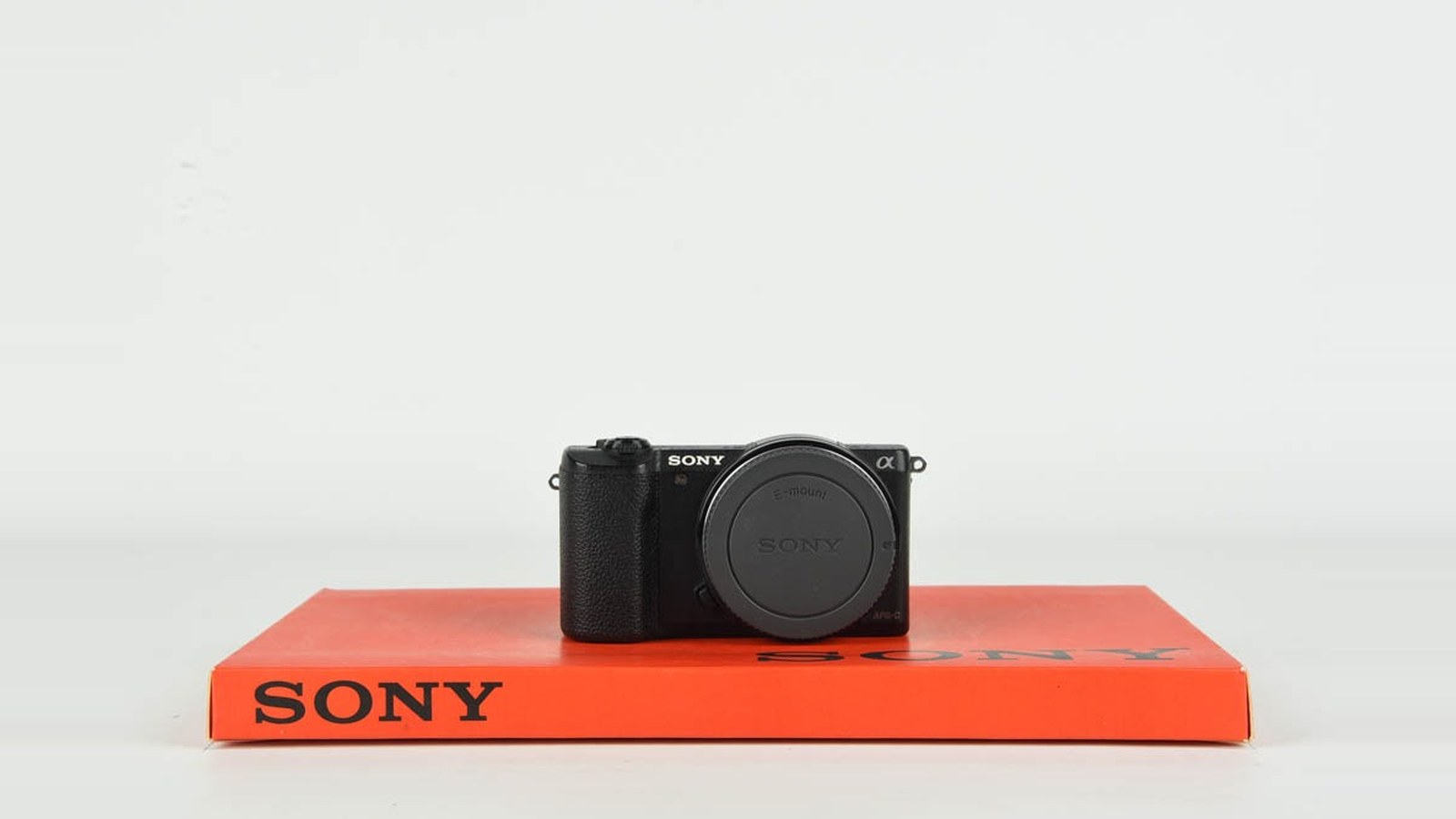
In short
- The A5100 is from 2014 but features the same 24-megapixel APS-C sensor as the A6000, along with 179 phase-detection AF points: in photos, it performs well up to ISO 3200.
- On the private market today, you can find it for 200-260 euros as a body only, and 260-330 euros with the 16-50. Above 300 euros, it is better to look elsewhere: a Canon EOS R100 with a viewfinder starts at 266 euros.
- It lacks a viewfinder, flash hot shoe, and microphone input, and the NP-FW50 battery lasts for approximately 400 certified shutter counts (CIPA). In real-world use, these limitations matter, not the megapixels.
- At the counter, the most frequent fault is the Sony 16-50 power zoom error, caused by the internal flat of the lens: it must be tested by zooming and restarting the camera before paying.
Looking for a used Sony A5100? The used Sony A5100 page shows current availability and prices, with certified shutter count and a 2-year warranty. See also all used Sony cameras.
At the counter, the A5100 almost always arrives in the same way: bought in 2015 for a trip or to photograph children, used for a couple of years, and then left in a drawer with the 16-50 mounted. On the other side, there are those who look for it because it is the cheapest Sony with interchangeable lenses available, and because on paper it is tiny: 283 grams with battery and card. These are two worlds that often meet, and the deal is not always what it seems.
We don't have any in our catalog today, so let's talk about the market in general: what the A5100 still does well after twelve years, which limitations are noticeable in daily use, what we check in the lab when one comes in, the price beyond which it no longer makes sense, and what to choose instead.
What is the Sony A5100 and what does "the smallest" really mean
The Sony A5100 arrived in August 2014 as an affordable entry into the E-mount mirrorless lineup. Sony marketed it as the smallest and lightest in its category, and indeed, its electronics were closer to the A6000 than to the older NEX-5T. Twelve years later, it is worth separating the numbers that still matter from those that were only there to fill up the flyer.
The specs that still matter today
Of the complete technical specifications, only a few points remain relevant in 2026:
- 24.3 MP APS-C Exmor sensor with BIONZ X processor: this is why the camera still has a market.
- 179-point hybrid AF with phase detection and 25 contrast points: for a camera body in this class, it was a spec from a higher-end model at the time.
- ISO 100-25600 native and 6 fps burst: sufficient for family and travel, not for sports.
- 3-inch touch screen tilting 180° upwards.
- Full HD video in XAVC S at 50 Mbps, plus Wi-Fi and NFC to transfer files to your phone.
Everything else, from scene modes to creative effects, is done better today by the smartphone in your pocket.
Small compared to what
The camera body measures 109.6 x 62.8 x 35.7 mm and weighs approximately 283 grams with battery and card. However, the record claimed by Sony had a precise scope: APS-C mirrorless with built-in flash. Remove one of those conditions and the record falls. The Panasonic GM1, released at the end of 2013, less than a year earlier, was already smaller and lighter, with a built-in flash, but with a Micro 4/3 sensor. The claim was true, just very limited.
In practical use, another factor matters more: the real footprint is determined by the lens, not the camera body.
| Configuration | Indicative weight | Where it fits |
|---|---|---|
| Body only | 283 g | Any bag |
| With Sony E PZ 16-50mm f/3.5-5.6 OSS | approx. 400 g | Wide pocket of a jacket |
| With Sony E 18-105mm f/4 G OSS | approx. 710 g | Requires a proper bag |
The 16-50 power zoom is retractable: when powered off, it protrudes less than 3 cm from the mount, keeping the camera's overall thickness at around 6 cm. This combination is what built the A5100's reputation. With an 18-105 in front, you have a lens larger than the camera body, so it might be better to choose a mirrorless camera with a grip and viewfinder. If you are looking for the A5100 for its portability, the calculation should be based on the kit you will actually use, not the bare body.
Where the A5100 still holds up: sensor and autofocus
A RAW file from the A5100 shot at ISO 100 is indistinguishable from one from the A6000. The sensor is the same 24.3-megapixel APS-C Exmor, and regarding image quality, the twelve years of age weigh less than one might think. The limitations of this camera lie elsewhere, and we will look at them further ahead.
Image quality: the same sensor as the A6000
At base ISO, the dynamic range is wide: in backlit situations, 2-3 stops of shadow detail can be recovered without banding noise. However, it should be noted that the A5100 only saves compressed RAW files. In 99% of photos, this is not noticeable, but with highlights pushed to the limit, some artifacts may appear at the edges of strong contrasts.
| ISO | Real-world performance |
|---|---|
| 100-800 | Clean files, suitable even for 40x60 cm prints |
| 1600-3200 | Fine noise, manageable from RAW without losing detail |
| 6400 | Usable for web and social, with noise reduction in post |
| 12800 and above | Emergency use only |
The in-camera JPEGs are good up to ISO 1600. Above that, noise reduction smears fine textures, such as hair and foliage. Those shooting in low light need to work in RAW.
Autofocus: good for 2014, dated for 2026
The 179 phase-detection points cover most of the frame. With AF-S on stationary subjects, the camera locks on quickly and precisely, and tapping the screen to select a point is convenient. AF-C tracks a walking child or a cyclist moving at a constant speed well. Sony's first Eye AF works on static portraits, but loses eye focus as soon as the subject turns their head.
The gap compared to later Sony models is noticeable in unpredictable movement. From the A6400 onwards, and on the A6100, there is real-time tracking: you select the subject and the camera follows it throughout the frame. On the A5100, tracking is present but easily loses focus on other elements, especially with backgrounds full of details. For running dogs or sports, this is a concrete limitation.
The E mount is the real strength
The A5100 accepts the entire Sony E and FE lens lineup, and this changes the camera more than any specification. With the 16-50 kit lens, the difference compared to a recent smartphone is small. With a fast prime, it becomes evident:
- Sigma 16mm f/1.4 DC DN: wide-angle for interiors and handheld night shots.
- Sigma 30mm f/1.4 DC DN: the do-it-all lens, equivalent to approximately 45 mm on full frame.
- Sigma 56mm f/1.4 DC DN: portrait with true optical bokeh, not calculated by an algorithm.
These lenses are sharp even at maximum aperture, and at f/1.4 the A5100 operates at low ISO levels even in scenarios where the 16-50 would force ISO 6400. There is also an advantage that is often overlooked: lenses remain yours even when you change the camera body. A Sigma 30mm purchased today for the A5100 will work tomorrow on an A6100 or an A6700, without losing value.
The limitations you feel in real-world use
The A5100 is chosen for its specifications, but it ends up in a drawer for daily use. Its flaws are not in the file quality: they lie in how it feels in your hand, how you change the settings, and how long the battery lasts. Before buying it, it is advisable to know exactly what you are giving up.
No viewfinder and no hot shoe
The only way to frame is via the 3-inch, 921,000-dot screen. In shade and indoors, it works perfectly. In bright sunlight, at the beach, or in the mountains in summer, it is hard to read: you compose by eye and check focus and exposure at home. The screen tilts only upwards: this helps with low-angle shots, but not with high-angle shots, for example when shooting over a crowd.
Without a viewfinder, you shoot with arms extended, a less stable position than holding the camera up to your face. The sensor is not stabilized: with slow shutter speeds, a lens with OSS is required, such as the 16-50 kit lens. If you mount an unstabilized prime lens, micro-shake becomes frequent below 1/60 of a second.
There isn't even a hot shoe. Only the small built-in pop-up flash remains. No external flash to bounce off the ceiling, no trigger for remote flashes, no level or additional optical viewfinder.
Commands stripped to the bone
There is no mode dial. To switch from Auto to aperture priority or manual, you must navigate the menu. Shutter speeds, apertures, and ISO are adjusted using the single rear wheel and the touchscreen, one setting at a time. In manual mode, changing shutter speed and aperture simultaneously requires switching between parameters, whereas on a body with two dials, it takes just one gesture.
If you want to learn exposure, you can do it here too, but more slowly. The settings are not visible on the camera body and cannot be adjusted without looking at the screen. Your hands do not learn where the controls are. In practice, you end up staying almost always in automatic or aperture priority mode.
Battery and charging
The NP-FW50 is rated for approximately 400 shutter count according to the CIPA standard. In real-world use, with Wi-Fi active to transfer photos to the phone and the screen always on (there is no viewfinder to fall back on), it drops to 250-300 shutter count.
- Half-day outing: the battery in the camera body is sufficient.
- Travel day, 500-600 shutter count: 2 spare batteries are required.
- Charging: in-camera via micro USB, taking more than two hours per battery. This connector loosens with use, unlike the USB-C found in recent camera bodies.
An external battery charger is an inexpensive solution that addresses two issues. It allows you to recharge one battery while shooting with the other, and it stops wearing out the camera's micro USB port, which is a known weak point on heavily used A5100 bodies.
Video and vlogging: a flip screen is not enough
Many bought the A5100 for vlogging because the screen flips 180° upwards. This allows you to see yourself while speaking to the camera. Twelve years later, that screen is still useful. The rest of the video performance, however, shows all its years.
What it still does well in video
In Full HD, the A5100 still delivers clean results. It records in XAVC S at 50 Mbps up to 60p: a sufficient bitrate for YouTube and social media. With 60p, you can also achieve light slow-motion effects in post-production. In video, the autofocus uses the hybrid system with phase detection, so it tracks a slowly moving face without much hesitation. The touch screen allows you to move the focus point during recording. For filming family, a vacation, or short clips to edit on your phone, it is still a good choice.
Why there are better options for YouTube today
In today's video, the A5100 has three issues, and they cannot be bypassed with accessories:
- Audio: there is no microphone input, so recording is limited to the internal microphone. It picks up wind, ambient noise, and power zoom whine. For vlogging, audio matters more than image quality.
- No 4K: it tops out at Full HD. You can't even shoot in 4K and crop the framing in post-production.
- Overheating: clips stop at 29 minutes. In summer, outdoors, the camera may shut down even earlier due to heat. We hear this mostly from customers who were recording events or lectures.
For those starting from scratch with video, the sensible choice is the Canon EOS R50 V. Currently in our catalog, it ranges between 540 and 550 euros, roughly double the price of an A5100, but it addresses exactly the points that matter:
| Sony A5100 | Canon EOS R50 V | |
|---|---|---|
| Max resolution | Full HD 60p | 4K |
| Microphone input | No | Yes, 3.5 mm jack, plus headphone output |
| Accessory shoe | No | Yes, multi-function shoe |
| Screen | Flips up | Swivels sideways |
| Used price | 200-330 euro | 540-550 euro |
The side-tilting screen may seem like a minor detail, but it isn't. On the A5100, the flipped-up monitor ends up positioned above the camera body, exactly where a microphone would be mounted using a bracket. On the R50 V, the monitor opens to the side, leaving the hot shoe free. Additionally, the R50 V utilizes Canon's Dual Pixel AF, featuring eye recognition even in video mode.
To be clear: if video is your primary reason for buying, the A5100 is not a way to save money. It is an intermediate step that will lead you to upgrade your camera within a few months. However, if you use it mainly for photos and occasionally shoot some clips, it is perfectly fine.
Buying it used: what to check and what we do in our lab
When an A5100 arrives at the bench with a defect, the issue is most often not the camera body but the kit lens. That is why the inspection starts there, and only then moves on to the screen, ports, and sensor.
The number one weak point: the 16-50 power zoom
The Sony E PZ 16-50mm f/3.5-5.6 OSS is retractable and motorized: it extends on every power-on and retracts on every power-off. Inside, a thin flat flexes with each cycle and, after years, cracks. At that point, the camera body signals the lens as not mounted, or the optics remain closed or get stuck halfway. The fault is often intermittent, so a few shutter counts are not enough to rule it out.
- Turn the camera on and off 5-6 times in a row, checking that the lens extends and retracts each time.
- Move the zoom from 16 to 50 mm and back using the lever, first slowly and then quickly.
- Take shots at both extremes and verify that the focus locks in without hesitation.
One single mistake during the test. A kit with a defective 16-50 is worth the same as the body alone, and must be priced accordingly.
Body, screen and ports
- Screen hinge: with the camera on, flip the screen 180° and bring it back down several times. If the image flickers or disappears, the flat cable running through the hinge is worn out.
- Micro USB: this is also the charging port, so it gets a lot of use. Plug in a cable and wiggle it slightly: the charging indicator must not turn off.
- Battery door: the plastic tab is fragile. The door must snap shut and stay closed.
- Battery: many A5100 units run on compatible NP-FW50 batteries. Inspect it from the side: if it is swollen, it needs to be replaced, not used.
- Mount: clean, oxide-free gold contacts and no play with the lens mounted.
- Sensor: there is no shutter curtain to protect it when you remove the lens, so it remains exposed during every lens change. Take a shot at f/16 against a white wall and look for spots. Dust can be cleaned, a scratch cannot.
How many shutter counts are too many
Sony does not disclose the shutter count for the A5100. The count can be read from the metadata of an original JPEG file using dedicated software. Ask the seller for a file that was just taken and sent as is: if the photo goes through WhatsApp or an editor, the metadata disappears.
| Shutter count | How we assess it in-store |
|---|---|
| Under 30,000 | Rest assured, the shutter is in the early part of its lifespan. |
| 30,000-60,000 | Normal for a camera body from 2014: overall condition and the tests above are what matter. |
| Over 60,000 | The price must drop, as the risk of a repair increases. |
At ReflexMania, every A5100 goes through our lab before being put up for sale. We certify the shutter count, test the flat and zoom of the 16-50 with repeated power cycles, clean the sensor, and test the battery. Then we add a 2-year warranty: on a twelve-year-old camera, that is the most important part.
What to pay for it in 2026 and when to walk away
Today, an A5100 in good condition is worth between 200 and 330 euros in the private market. The right price depends mainly on two things: whether the lens is included and whether the 16-50 actually works.
Price ranges today
| Configuration | Private sale price | What to check |
|---|---|---|
| Body only | 200-260 euros | Shutter count, screen, micro USB port |
| Kit with working 16-50 | 260-330 euros | Tested zoom and restarts without errors |
| Kit with accessories | At most 20-30 euros more than the kit | Compatible non-swollen batteries, SD card |
Within each price range, the actual condition of the camera is what shifts the price. A camera body with a certified shutter count under 10,000, no signs on the screen hinge, and the original box, commands the upper end of the range. Beyond 30,000 certified shutter counts, with scratches on the display or a loose USB port, the price is negotiated downward. Bags, straps, and compatible batteries inflate the listing but are worth little: do not pay for them as if they were original accessories.
For the kit, the threshold to keep in mind is 300 euros. Above that figure, it is worth looking at a Canon EOS R100: in our catalog it starts at 266 euros and features a viewfinder and a hot shoe, on a camera body that is almost ten years younger.
There is also a cost that the listing does not show. A 2014 camera bought from a private seller has no warranty: if the screen flat fails after a month, you pay for the repair. The same applies to the 16-50, where replacing the internal flat can cost almost as much as the 60-70 euros that separate the camera body from the kit. On a 250 euro spend, a fault like this changes the entire calculation.
Used alternatives worth the difference
Almost all of the A5100's limitations can be resolved in two ways: by spending a bit more or by switching systems. At the counter, we mainly propose these four options. The prices are those from our current catalog.
| Model | ReflexMania Price | What it adds | What it loses |
|---|---|---|---|
| Sony A6100 | 550 euros | Viewfinder, hot shoe, microphone input, 4K, tracking | Only the savings |
| Canon EOS R100 | 266-400 euros | Viewfinder, hot shoe, Dual Pixel AF | Fixed and non-touch screen |
| Olympus PEN E-PL6 | 250 euros | In-body stabilization, minimal size | 16 MP Micro 4/3 sensor, contrast AF |
| Canon EOS R50 V | 540-550 euros | A body designed for video | The A5100 budget |
Staying with Sony: the A6100
The A6100 has the same E mount and the same NP-FW50 battery: the lenses and spare batteries you already have continue to work. With an additional 250-300 euros, you get an electronic viewfinder, hot shoe, microphone input, 4K, and 425 AF points with real-time tracking. Tracking is the real leap. Lock onto the subject once and the camera follows it within the frame, something the A5100 does in a much less reliable way. Battery life, however, remains the same, so plan for a second battery. For those who want to stay with Sony, it is the most sensible choice.
Same spend, different viewfinder: Canon EOS R100
The R100 units we have start at 266 euros, which is what a private seller asks for a low-end A5100 kit. In return, you get a viewfinder, a hot shoe, and Dual Pixel AF, which is fast and reliable even for portraits. The compromise is the screen, which is fixed and non-touch: no low-angle framing, no selfies, and no touch-to-focus. A practical advantage applies to those who already own Canon EF lenses: with the EF-EOS R adapter, they mount on the RF mount without losing autofocus.
Even smaller: Olympus PEN E-PL6
With a pancake zoom, the E-PL6 takes up less space than the A5100 with the 16-50. It features in-body image stabilization, which works with any mounted lens, including adapted manual lenses. In return, the sensor is a 16 MP Micro 4/3 and the AF operates only via contrast detection. It performs well on stationary subjects, but misses more often with moving children and animals. It also lacks a built-in viewfinder (only an optional external electronic viewfinder can be mounted on the hot shoe): compared to the A5100, this is a different choice, not an upgrade.
If only your wallet matters
Before choosing a small mirrorless camera, ask yourself if you will ever change the lens. If the answer is no, a fixed-lens compact fits in a real pocket, not the large one of a jacket. Plus, it doesn't have an exposed zoom flat vulnerable to impacts. We discussed this in the article about the used Sony RX100: for travel and family, it is often the most honest answer.
The verdict: for whom the A5100 is still worth it
The A5100 makes sense in 2026 if you buy it for what it is: a 24-megapixel sensor in a small body, at 250 euros. If you need a complete camera, at that price you are buying limitations. Depending on how you will use it, the picture is quite clear.
It makes sense if
- You want to enter the E mount ecosystem while spending as little as possible. The lenses you buy today will also mount on a newer Sony. The camera body may change, but the optics remain.
- You mainly shoot while traveling and with family. Portraits, dinners, outings, kids in the park. In these situations, physical controls and burst mode are of little use, while weight matters a lot.
- You already have a Sony APS-C and need a pocketable backup body. It uses the same NP-FW50 as the A6000, A6100, and A6400, so the batteries and chargers are the ones you already have in your bag. It is a second body that does not weigh you down.
- You mount a fast prime lens. With a Sony E 35mm f/1.8 OSS or a Sigma 30mm f/1.4 DC DN, the A5100 performs at its best: in low light and with background blur, the difference compared to a smartphone is immediately visible. Keeping it permanently with the 16-50 means wasting half of its potential.
It doesn't make sense if
In these four cases, it remains a poor purchase even at €180, because its limitations affect exactly what you do most often:
- You plan to shoot video with a minimum level of continuity, even just for a personal channel.
- You photograph sports, moving animals, or any subject that requires reliable tracking.
- You shoot a lot outdoors, in the mountains or at the sea, where framing without a viewfinder is done by guesswork.
- You want to learn manual exposure. Without dedicated dials, you will learn the menus, not photography.
If you fall into the second group, adding money makes more sense than saving it. For those who want to stay with Sony, the natural step is the Sony A6100, which we currently have at 550 euros, fully serviced. It costs twice as much, but it covers almost all the points on the list above without changing lenses or batteries.
Before choosing the E mount, those who already own Canon lenses should do the math. EF lenses can be adapted to an A5100, but the adapted autofocus on this body operates with many compromises. It is often better to stay within the Canon system. We discuss this in detail in Canon EF on mirrorless RF: is it still worth it in 2026.
Frequently Asked Questions
Does the Sony A5100 have a viewfinder?
No, and it cannot be added: there is neither a hot shoe nor an accessory port. You can only frame using the 3-inch screen, which is hard to read in full sunlight. If the viewfinder matters, the Sony A6000 or the A6100 are the natural step.
Is it suitable for vlogging or YouTube videos?
To start, yes, thanks to the 180° flip-out screen and Full HD 60p. The real limitation is the audio: there is no microphone input, so recording is done only with the internal microphone. For continuous use, it is better to choose a camera designed for video, such as the Canon EOS R50 V.
How many shutter count is too many on a used A5100?
Sony does not declare the shutter life. At the counter, we consider a body with a shutter count under 30,000 to be safe. Beyond 60,000, the camera may still function perfectly, but the price must reflect this.
Which lenses can I mount on the A5100?
All lenses with Sony E mount, including FE lenses for full frame. The most sensible pairings are compact and bright prime lenses, such as the Sigma 16, 30, and 56 mm f/1.4 DC DN, which make the camera much more capable than the standard 16-50.
Which is better: a used A5100 or an A6000?
The sensor is the same. The A6000 adds the viewfinder, the hot shoe, the mode dial, and more physical controls, and usually costs 80-100 euros more. If you often shoot outdoors or want to learn manual mode, that difference is worth the cost.
Does it charge via USB?
Yes, via the micro USB port, with the battery inside the camera body. It is a slow charge, and the connector is one of the points that wear out. An external charger and a second NP-FW50 battery are almost mandatory.
Does it still make sense compared to a recent smartphone?
With the standard 16-50mm lens and in good light, the difference is smaller than you might think. It becomes clear with a fast lens: real bokeh, portraits, and low-light indoor shots. If you don't plan to buy at least one prime lens, it's worth thinking it through carefully before buying it.
Looking for a used, warrantied compact mirrorless? Let's talk
If you have doubts about a purchase or need advice for your specific case, contact us. We offer free advice because we are photographers first, and because a customer who makes a poor purchase will not return to photography.
Three ways to get in touch:
- Contact form — response within 24 business hours
- WhatsApp at 342 362 3454 (messages only)
- Phone: 071 291 6347 (Mon-Fri 9am-1pm/3pm-6pm, Sat 9am-1pm)
And if you want to see what we have in stock right now, explore the available used gear today: every camera is certified, comes with a 2-year warranty, and ships within 24-48 hours.
Article written by Matteo for the ReflexMania Team. Last updated: October 2026. Prices and availability as of the date of publication.