
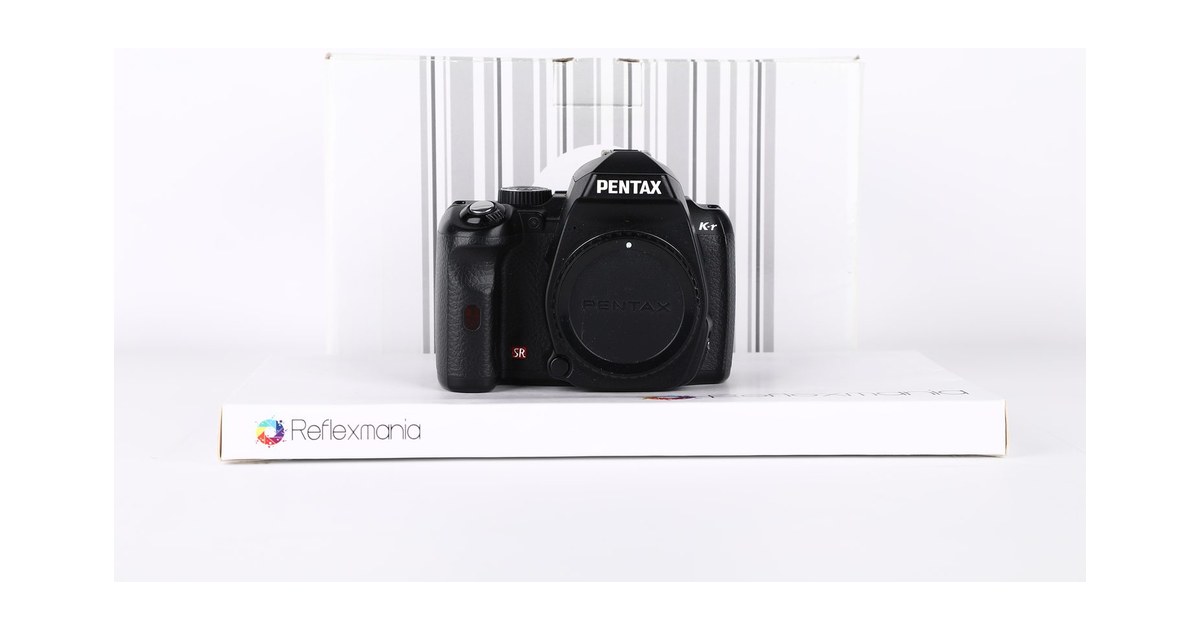
In short
- The Pentax K-5 (2010) features a magnesium alloy body with 77 seals, a 1/8000 s shutter speed, a 100% coverage pentaprism viewfinder, and 7 fps. Used units are found for 200-280 euros, roughly the price of a Canon 60D in excellent condition.
- The Pentax K-r is not weather-sealed, contrary to what is stated in many listings. It has 12.4 MP, 6 fps, a 96% coverage pentamirror viewfinder, and can operate on 4 AA batteries using the D-BH109 adapter.
- The most common defect on the K-r, also reported on some K-5 units, is the aperture solenoid: photos come out randomly overexposed. This is detected by taking 30-50 test shots at a closed aperture, rather than just inspecting the camera body.
- Weather sealing is only effective with a WR lens: a K-5 paired with a non-sealed 18-55mm lens offers no protection. After 15 years, even the seals age, so none of these cameras should be treated as underwater housings.
Pentax cameras rarely make it to the counter, and when they do, they stay there even longer. Most customers walk in looking for a Canon or a Nikon, glance at the K-5 on the shelf, and dismiss it because "nobody uses Pentax." That’s a shame: a 2010 K-5 features a sealed camera body, in-sensor stabilization, and a viewfinder that entry-level Canon and Nikon DSLRs from that era lacked, and today it costs only slightly more than a 600D.
In this article, I lay out what you need to know before buying a used K-5 or K-r: what they actually offer, where the marketing of the time exaggerated, which defects to check for, and when it makes more sense to buy a Canon or Nikon from the same period. An honest premise: we do not currently stock Pentax cameras, so we have no interest in selling them. We are interested in ensuring that anyone who buys one, from us or elsewhere, does not end up with a diaphragm that needs repair after a month.
Why Used Pentax Cameras Cost Less (And Why It Matters Little)
For the same year and price range, a used Pentax often costs less than a Canon or a Nikon: a 2010 K-r can be found for 130-180 euros, while a Canon 600D from the same year costs 190-200. This is not a sign of poor quality nor does it hide a design flaw. The reason is different: few people look for them. In Italy, Canon, Nikon, and Sony are the main brands sold, and those looking for a used DSLR usually start with those three names.
A small market means low prices
Ricoh, which has owned the brand since 2011, today produces few new camera bodies: the K-1 Mark II, the K-3 Mark III, and the KF. If the system is not very visible in stores, it attracts few new customers, and consequently, the used market has fewer buyers. Listings stay online for weeks, and private sellers are happy to negotiate. These are the prices we see in 2026 on the Italian market, for working bodies in good condition:
| Model | Year | Used Price 2026 |
|---|---|---|
| Pentax K-r | 2010 | €130-180 |
| Pentax K-5 | 2010 | €200-280 |
| Pentax K-5 II / K-5 IIs | 2012 | €300-380 |
The difference between the lowest and highest price almost always depends on three things: the shutter count, the condition of the rubber seals, and the presence of the original battery. The version or color matters little. A K-5 at 200 euros without a verifiable shutter count is not a deal compared to one at 260 euros with the count read from the file.
For buyers, the low price is a concrete advantage. Anyone who spends 230 euros on a K-5 and resells it for 170 after three years loses 60 euros, an amount that isn't even enough to buy two original batteries for a mirrorless.
The downside: slow resale and rarer spare parts
The same low demand that saves you money when buying slows you down when selling. We see it at the counter every month: a Nikon D7000 at the right price finds a buyer in a few days, while a K-5 in the same price range can sit in the display case for three or four weeks. If you plan to change cameras in a year, factor that in.
The second point concerns repairs. Pentax no longer supplies parts for these models, so many replacement parts come from donor cameras:
- Electronic boards (main and power supply): available, but only used and without any lifespan guarantee.
- Doors for the battery and SD cards: on the K-r, the hinges often break, and the original new part is no longer available.
- Gaskets and rubber seals: on the K-5, they are part of the weather sealing, and a gasket recovered from another camera is the same age as the one it replaces.
On a camera costing 200 euros, this is not a reason to give up. It is, however, a good reason to buy one that has already been checked, rather than hoping to repair it later.
Pentax K-5: what it really offers in 2026
In 2010, the Pentax K-5 featured specifications that Canon and Nikon reserved for semi-pro camera bodies like the 7D and the D7000. Today, it costs as little as a used entry-level DSLR. The 16.3 MP APS-C sensor is the same Sony unit mounted in the Nikon D7000, and it remains one of the best of its generation.
| Feature | Pentax K-5 | Canon 60D |
|---|---|---|
| Viewfinder | Pentaprism, 100%, 0.92x | Pentaprism, 96% |
| Burst rate | 7 fps | 5.3 fps |
| Minimum shutter speed | 1/8000 s | 1/8000 s |
| Body | Magnesium on steel frame, 77 seals | Polycarbonate on aluminum frame, light sealing |
| Screen | Fixed | Tilting |
| Battery | D-LI90, approx. 980 shutter count CIPA | LP-E6 |
The shutter is rated for 100,000 shutter count and operation is declared down to -10 °C.
In-body image stabilization: what the 4 stops actually mean
Pentax claims up to 4 stops of gain. In practice, with a 50 mm lens, you can reliably drop down to 1/15 s, and sometimes you get a sharp shutter count at 1/8. At 1/4 of a second, it doesn't work for every shutter count: you need a steady hand and a few attempts. The real advantage is different: the stabilizer is in the camera body, so it works with any lens mounted, even with a manual lens from the '80s bought for 50 euros.
ISO: where the K-5 still holds up
- Up to 3200 ISO: very clean files for a 2010 camera and still usable today without compromises.
- 6400 ISO: suitable for web and small prints; noise is visible but remains manageable.
- 51,200 ISO: an extended value, good for brochures. No one uses it for a photo worth keeping.
K-5, K-5 II and K-5 IIs: which one to look for
The K-5 II (2012) features the SAFOX X autofocus system, sensitive down to -3 EV. In low light, the difference compared to the first series is truly noticeable, especially indoors and at sunset. The K-5 IIs is identical but lacks an anti-aliasing filter: it provides sharper fine detail, with the risk of moiré on fabrics and regular patterns. There is an 80-120 euro price difference between the first series and the II/IIs models. If you often shoot in low light, spending that extra amount makes sense. If you mainly shoot daytime landscapes, the original K-5 is more than sufficient.
Pentax K-r: note, not weather-sealed
On Subito and eBay, the K-r is often described as “weather-sealed like the K-5.” This is not true: the K-r has no seals, neither on the camera body nor on the controls. The first weather-sealed entry-level Pentax is the K-30, released in 2012, two years later. Anyone buying it to use in the rain is paying for a feature that does not exist.
Once the confusion is cleared up, the K-r has a precise profile. The 6 frames per second burst rate in 2010 was high for its category. The pentamirror viewfinder covers 96% of the frame with 0.85x magnification. Here is how it compares to the DSLRs from the same period that we currently have in stock.
| Model | Sensor | Burst rate | Stabilization | Video | Used price |
|---|---|---|---|---|---|
| Pentax K-r | 12.4 MP | 6 fps | In-body, with any lens | 720p | €130-180 |
| Canon 600D | 18 MP | 3.7 fps | Only with IS lenses | 1080p | €190-200 |
| Nikon D5100 | 16.2 MP | 4 fps | Only with VR lenses | 1080p | €210 |
| Nikon D3100 | 14.2 MP | 3 fps | Only with VR lenses | 1080p | €150 |
The 600D and the D5100 feature a tilting screen and higher resolution. The D3100 is affordable but lacks an autofocus motor in the body, so with older Nikon AF-D lenses, focus is manual only. For video, the K-r is the weakest in the group, topping out at 720p.
The real strength: AA batteries
The K-r uses the D-LI109 battery, but with the D-BH109 adapter it also works with 4 AA batteries. When traveling or hiking, this is a concrete advantage: AA batteries can be found in any tobacco shop or mountain hut. Alkaline batteries, however, drain quickly, and even faster in the cold. It is advisable to carry low self-discharge NiMH batteries with at least 2,000 mAh, or lithium AA batteries. Regarding the choice of rechargeable batteries, and when buying used is truly worth it, we have written a separate article: used memory cards and batteries, is it worth saving?. A practical note: the adapter is almost always missing in used kits. Before buying, ask if it is included.
Does it make sense in 2026?
- Yes, as an affordable entry-level DSLR: at €130-180, it is the only one in this group that stabilizes any mounted lens, even a €40 manual lens.
- Yes, if burst rate matters more than megapixels: 6 fps versus the 3-4 fps of its competitors.
- No, if you are looking for weather resistance: for that, you need a K-5 or a K-30 with a WR lens.
- No, if you also shoot video: the 600D or the D5100 cost €30-50 more and record in Full HD.
Weatherproofing: what it means for a 15-year-old DSLR
Pentax has never declared an IP protection rating for the K-5. Official specifications state it is "weather and dust resistant," which is different from "waterproof." It means the camera body can handle a day of light rain in the mountains or dust from an unpaved trail. It does not mean you can rinse it under a tap or leave it out in the open during a downpour for ten minutes.
Sealed body plus WR lens, or nothing
Sealing only works if it is complete. The weak point is the mount. If you attach a lens without a rear seal, water will enter from there and travel down towards the mirror and the sensor. A K-5 paired with a standard DA 18-55, the non-WR version, offers the same protection in the rain as any other DSLR. Sealed lenses are identified by the WR or AW designation in the name and by the visible rubber seal around the mount. The exception is DA* lenses with SDM motors: they are sealed even if the designation is missing.
| Lens | Used (indicative) | Note |
|---|---|---|
| smc DA 18-55 mm f/3.5-5.6 AL WR | 50-80 euro | The most affordable option to take advantage of the weather sealing |
| smc DA 50-200 mm f/4-5.6 ED WR | 60-90 euro | Lightweight telephoto, often paired with the 18-55 WR |
| smc DA 18-135 mm f/3.5-5.6 ED AL DC WR | 150-220 euro | Do-it-all travel lens, silent AF |
| HD DA 16-85 mm f/3.5-5.6 ED DC WR | 280-350 euro | The optically best of the four |
A detail that surprises many: the DA Limited (15, 21, 35, 40 and 70 mm), the most beautiful and compact lenses in the Pentax catalog, are not sealed. They are metal optics and built very well, but in the rain they are worth as much as a plastic lens.
What happens to the seals after so many years
The seals are made of rubber, and rubber after 14-16 years is no longer the same as when it left the factory. It hardens, deforms, and sometimes cracks. The first sign is visible without tools: the SD card and battery doors no longer close flush with the body, or remain slightly raised on one side. On a camera like this, the sealing declared in 2010 is only partially present today.
A water-damaged unit is usually easy to spot. Here are the points to check:
- Battery contacts: greenish or whitish film, indicating oxidation.
- Under the SD door: stains, dry residue, or corrosion spots on the pins.
- Grip rubber: if it peels or swells, moisture has penetrated underneath.
- Battery compartment: springs or contacts that appear dull compared to the rest.
At the counter, we always open both battery and memory card doors with a magnifying glass before powering on the camera body: an oxidized contact tells more than any listing. The practical rule is simple. A well-maintained K-5 with a WR lens withstands the rain of a hike. Any K-5, bought without inspection, should be treated like a normal DSLR, meaning with a protective bag in your bag.
Known defects to check before buying
A Pentax K-5 or K-r may look perfect in hand but have a defect that only appears after a few dozen shutter counts. The recurring issues are few and well-known. If you know them, you can test the camera in 10 minutes instead of discovering them at home. The general rules for used equipment are in our guide to buying used DSLRs and lenses. Here we talk only about Pentax.
The diaphragm solenoid: the 50 shutter count test
This is the most common defect on the K-r and also occurs on some K-5 models. The solenoid that controls the aperture blade closure gets stuck. The lens remains open, resulting in a photo that is white or nearly so. Often, the seller is in good faith: if they always shoot at full aperture, the aperture does not need to close, and the problem remains undetected.
- Mount a lens with automatic aperture and set the aperture priority to f/8 or f/11.
- Take 30-50 shots in burst mode of the same scene, with uniform light.
- Review the shots. If even one is significantly brighter than the others, the solenoid needs to be replaced.
It can be repaired, but a workshop is required: the component is inside the camera body and must be replaced, not adjusted.
Shutter count, sensor and stabilizer
- Shutter count: Pentax writes it in the file. Ask for an original JPEG, not resized and not sent via WhatsApp, and read the ShutterCount value with ExifTool. The K-5 shutter is rated for 100,000 cycles, so under 30,000 shutter count you have plenty of margin.
- Sensor: take a photo at f/16 on a clear sky and zoom in. Dust can be cleaned. The spots reported on the first K-5 batches, however, were on the sensor itself and did not go away with cleaning.
- SR Stabilizer: if an error appears at startup, the unit needs to be checked. Then shoot handheld at 1/8 s with a 50 mm, once with SR on and once with SR off. The difference should be visible.
- Autofocus: first-series K-5 models can miss focus under warm light bulbs. Test it indoors as well, not just near the window.
- Battery: a swollen D-LI90 fits into and out of the compartment with difficulty. It must be replaced immediately, not used until it dies.
What we do in our lab
Before entering the catalog, every Pentax arriving at ReflexMania goes through the same procedure:
- reading the shutter count from the file;
- test burst at closed aperture to verify the solenoid;
- inspection of seals, battery door, and card door;
- stabilizer test and sensor cleaning;
- AF test with a reference lens, in natural and artificial light.
If the solenoid misses even a single shutter count, we replace it before putting the camera body up for sale, so it doesn't turn out to be the first return. Then the 2-year warranty applies, as with all our used equipment.
The K mount: the real reason to buy Pentax
A used SMC Pentax-M 50 mm f/1.7 costs 40-60 euros. On a K-5 or a K-r, it becomes a bright 75 mm equivalent medium telephoto lens, and it is stabilized. The K mount was introduced in 1975, and Pentax has never abandoned it. The stabilizer is located on the sensor, not in the lens, so it works even with lenses from forty years ago. When you mount a lens without contacts, the camera asks for the focal length upon startup: you enter it once, and the SR does the rest.
Older stabilized lenses: what works and what doesn't
The practical rule depends on the lens series, which is written on the front ring.
| Series | Aperture and exposure | Focus | Stabilization |
|---|---|---|---|
| FA, DA, D FA | Automatic, all modes | AF | Automatic |
| A (ring set to «A») | Automatic, all modes | Manual | With focal length set |
| K and M | Stop-down with green button | Manual | With focal length set |
| M42 with adapter ring | Stop-down, manual only | Manual | With focal length set |
With K and M lenses, you must first enable the aperture ring in the custom menu; otherwise, the camera will not take any shots. Then, work in M mode: set the aperture on the lens and press the green button. The camera stops down the aperture, measures the light, and selects the shutter speed. It is slower than A mode, but it works well for landscapes or posed portraits.
Screw-drive AF lenses focus because the AF motor is in the camera body, both on the K-5 and the K-r. Many autofocus lenses from the 90s are therefore available at low prices and work without adapters.
Lenses to look for with a K-5
- DA 18-135 mm f/3.5-5.6 WR: the sealed all-rounder to pair with a weather-sealed camera body. It features a silent motor in the lens and covers 27 to 207 mm equivalent. Used, it is found for 150-220 euros.
- DA 35 mm f/2.4: the affordable, lightweight prime that is sharp even wide open. The mount is made of plastic, so it requires a bit of care. Used, it costs around 100-130 euros.
- DA Limited (15, 21, 40, 70 mm): metal body, pancake dimensions, excellent performance. They are the choice for those who want a compact K-5 to carry with them always. Prices range from about 200 euros for a 40 mm to over 400 for the 15 mm.
However, the limitation must be stated clearly. The used market is rich, but the new system today offers few camera bodies and a lens catalog that updates slowly. Buying Pentax today means buying primarily a heritage of existing optics, not a system that will grow significantly in the coming years.
Pentax or Canon and Nikon from the same era: when to choose what
For the same budget, today under 300 euros you can buy a Pentax from 2010 or a Canon or Nikon from the same years. Neither option is absolutely better. The difference is made by where you shoot, the lenses you already have, and how long you plan to keep the camera.
K-5 vs Canon 60D
The Canon 60D in our catalog costs 190-210 euros, which is the same as a K-5 at the lower end of its 200-280 euro range. Both are 2010 semi-pro models with nearly identical prices: the choice depends solely on your usage. The K-5 shoots at 7 fps compared to the 60D's 5.3 fps and withstands rain and dust when paired with a WR lens. The 60D offers an 18 MP sensor, a tilting screen, and, most importantly, the extensive EF and EF-S lens lineup. You can find lenses from any brand at any price, including recent Sigma and Tamron models.
- Choose the K-5 if you shoot in the mountains, at the sea, or in the rain and two or three lenses are enough for you.
- Choose the 60D if you want to expand your kit over time, try different lenses, and resell without waiting months.
K-r vs. Canon and Nikon entry-level models
The spec sheet can be misleading here, as each camera excels in a different area. The K-r features in-body image stabilization, meaning even a €40 manual 50 mm lens becomes stabilized, and it shoots at 6 fps. Its competitors only stabilize with IS or VR lenses, but they offer higher resolution or a tilting screen.
| Model | Price today | Key feature |
|---|---|---|
| Pentax K-r | 130-180 € | Stabilization on every lens, 6 fps, AA batteries |
| Canon 600D | 190-200 € | Tilt screen, 18 MP, Full HD video |
| Nikon D5100 | 210 € | Tilt screen, good 16 MP sensor |
| Nikon D3200 | 210 € | 24 MP, lightweight and simple body |
| Nikon D5200 | 230 € | 24 MP and tilt screen combined |
There is a detail about the three Nikon cameras that is rarely mentioned in listings: they do not have an autofocus motor in the body. AF and AF-D screw-drive lenses can only be focused manually, so AF-S lenses are required. If you already own older Nikon lenses, keep this in mind.
If you are looking for your first DSLR and do not have lenses to recover, Pentax is usually not the right choice. A Nikon has more manuals, more tutorials, and more used lenses available, and in the end, you pay only a little more. We discuss this in the article on used Nikon D3300 and D3200 for beginners. The K-r becomes interesting when you already have manual Pentax lenses in your drawer, or when it is convenient for you to use AA batteries while traveling.
Who it's for, and who it's not
A K-5 at €250 is a great buy for three types of photographers and a wrong purchase for at least as many. Image quality is not the deciding factor, as it remains more than decent at low ISO settings. What matters is how you will use it over the next three or four years.
The right profile
- Those who shoot landscape and mountain scenes, even in bad weather. A K-5 with a DA 18-55 WR is the most affordable sealed kit you can put in your backpack. You can shoot in light rain and dry it off at a hut, without the anxiety of carrying a 600D to high altitudes.
- Those who already have Pentax lenses in the drawer. A set of M or A optics, perhaps inherited along with an old ME Super, finds a digital body that stabilizes them. You spend only on the body, and at that point, the price-to-performance ratio has no rivals.
- Those looking for a robust second body under 300 euros. Those who already work with a K-3 or a KP can keep the K-5 as a backup for riskier outings. Or leave it mounted with a wide-angle lens, so you don't have to change lenses in the dust.
The K-r only falls into the second case, and only for those who shoot in dry conditions. For everything else, the 70-100 euro difference compared to the K-5 is well spent.
When to spend elsewhere
- Video. The K-5 records in 1080p at 25 fps in Motion JPEG, a format that produces huge files and is heavy to edit. The K-r stops at 720p. In video, autofocus is almost unusable, so you have to focus manually. If you want to shoot seriously, you need to look at mirrorless cameras, as we explain in our guide on video and filmmaking with used mirrorless cameras.
- Sports and moving animals. The K-5's 11 AF points are enough for a cyclist coming straight at you. They are not enough for a winger cutting across the field or a bird in flight. For demanding continuous AF, you need a body like the Canon 7D Mark II, which costs more but has 65 cross-type points.
- A system to grow with. If this is your first camera body and in five years you want a full frame or a mirrorless, Canon and Nikon offer a longer path. EF lenses mount on Canon RF with an adapter, and Nikon AF-S lenses on Z with the FTZ.
The most honest criterion is to ask yourself whether the weather sealing and the 100% viewfinder are truly necessary for you. If yes, at this price, the K-5 has no competitors. If no, you are paying for features you will never use.
Frequently asked questions
Is the Pentax K-r weather-sealed?
No. The K-r does not have weather sealing against rain and dust. Among the Pentax cameras from that period, the K-5, K-5 II, K-5 IIs, and, in the entry-level segment, the 2012 K-30 are weather-sealed. If a listing describes a K-r as weather-sealed, the seller is mistaken.
Can I use a K-5 in the rain with any lens?
No. The protection only works with a sealed lens (WR, AW, or DA*), such as the DA 18-55 WR or the DA 18-135 WR. With a non-sealed lens, water enters through the mount. On a 15-year-old camera body, it is still advisable to have the seals checked before relying on the sealing.
What is the Pentax aperture issue?
It is a solenoid failure that controls the aperture blade closure, a frequent issue especially on the K-r, K-30, and K-50, and also reported on some K-5 models. The symptom is randomly overexposed photos, particularly at stopped-down apertures. It is repaired by replacing the component, and it must be done in a laboratory.
How do I check the shutter count on a Pentax K-5?
The shutter count is written in the file's EXIF data and can be read using ExifTool or any software that utilizes it. A single JPEG just taken is sufficient; there is no need to connect the camera. The K-5 shutter is rated for approximately 100,000 cycles.
Which is better: a used Pentax K-5 or a Canon 60D?
It depends on how you shoot. The K-5 features a 100% viewfinder, a sealed body, 7 fps, and in-body stabilization with any lens. The 60D has a vari-angle screen, a much larger selection of lenses on the used market, and better resale value. For hiking and landscape photography in bad weather, the K-5 is the winner.
Do old manual focus Pentax lenses work on the K-5 and K-r?
Yes. A-series lenses operate with automatic aperture, while K and M lenses use stop-down metering via the green button. In all cases, in-body image stabilization works, provided you enter the focal length at startup.
Does it make sense to buy a Pentax in 2026 if I want to shoot video?
No. The K-5 records in 1080p at 25 fps in Motion JPEG, the K-r only in 720p, and video autofocus is almost unusable. For video, a used mirrorless camera is recommended, even from the budget range.
Looking for a rugged DSLR to use in any weather? Let's talk
If you have questions about a purchase or need advice for your specific case, contact us. We provide free advice because we are photographers first, and because a customer who makes a poor purchase will not return to photography.
Three ways to get in touch:
- Contact form — response within 24 business hours
- WhatsApp at 342 362 3454 (messages only)
- Phone: 071 291 6347 (Mon-Fri 9am-1pm/3pm-6pm, Sat 9am-1pm)
And if you want to see what we have in stock right away, explore the used gear available today: every camera is certified, comes with a 2-year warranty, and ships within 24-48 hours.
Article written by Matteo for the ReflexMania Team. Last updated: November 2026. Prices and availability refer to the time of publication.