
In short
- The OM-3 features the same sensor as the OM-1 and the OM-1 Mark II: a 20.4 MP Live MOS stacked sensor, paired with the TruePic X processor. In terms of image quality, all three are essentially the same camera.
- Compared to the OM-1, the OM-3 lacks the 5.76-million-dot viewfinder (dropping to 2.36 million), the second SD card slot, the AF joystick, and the hand grip. In return, it weighs approximately 100 g less (496 g vs. 599 g) and includes a front creative dial.
- Used in 2026, an OM-3 typically ranges from €1,400 to €1,650, compared to its launch price of €1,999 (February 2025). A first-generation OM-1 fluctuates between €1,000 and €1,250.
- If you shoot sports or birdlife with long telephoto lenses, a used OM-1 is the most sensible choice and costs €300–400 less. The OM-3 makes sense if you value compactness, design, and the computational features of the Mark II.
Looking for a used Olympus OM System OM-3? The used Olympus OM System OM-3 page shows current availability and prices, with certified shutter count and a 2-year warranty. See also all used Olympus cameras.
When OM System unveiled the OM-3 in February 2025, two questions immediately came up at the counter: “Is it just a disguised OM-1?” and “How much will it lose in value?” After a year and a half in the used market, we have enough data to answer both. The first answer is almost yes: the core is the same, but everything you hold in your hands and see through the viewfinder has changed.
In this article, we lay out the concrete differences between the OM-3 and the OM-1 (first series and Mark II), focusing on what truly matters in the field. We then look at the current market value of a used OM-3, what to check before buying, and when, honestly, it makes more sense to look elsewhere. No line-by-line reading of the spec sheet: just what changes your way of shooting or how much you spend.
The OM-3 in two lines: an OM-1 Mark II inside a retro body
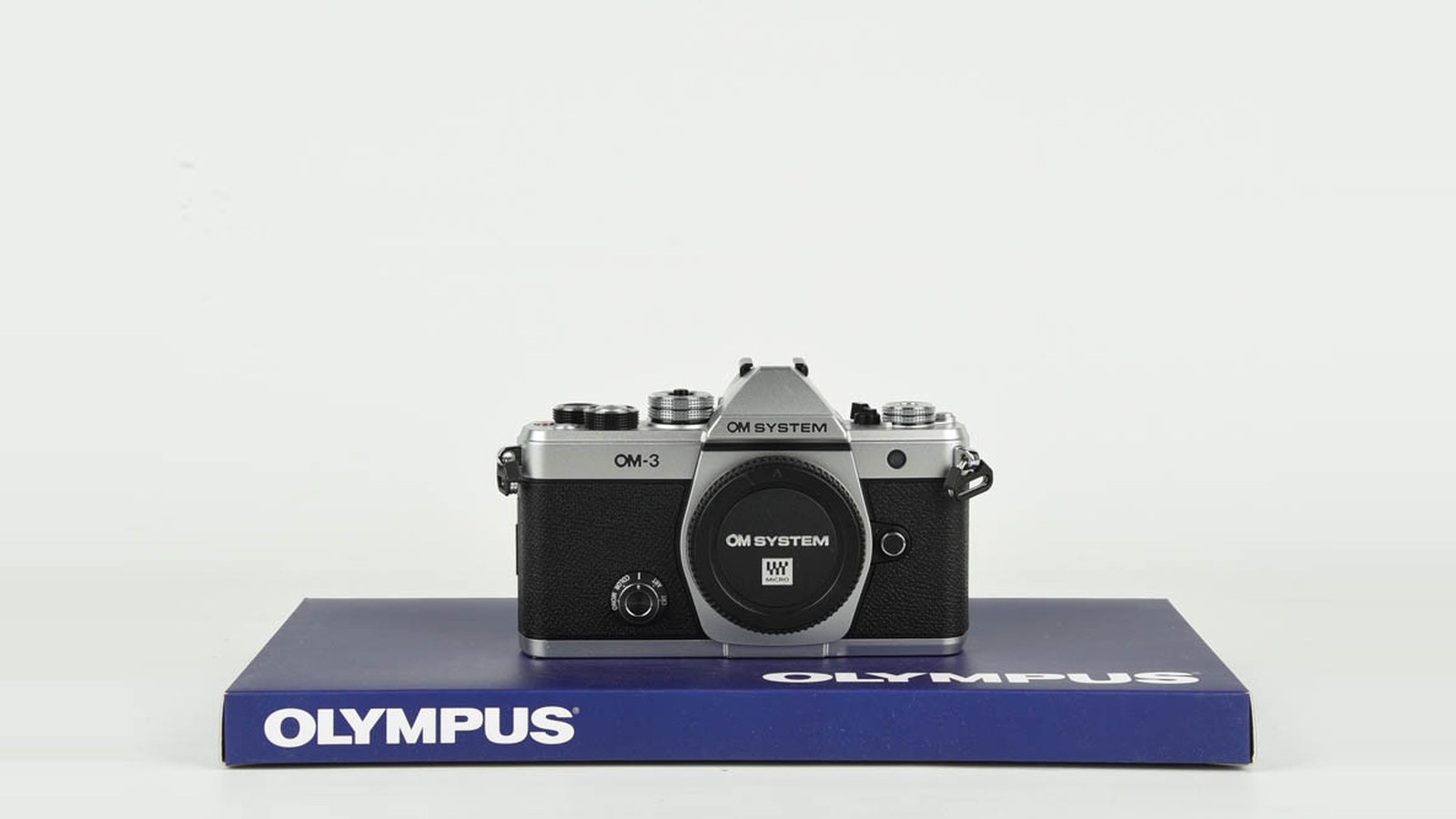
The OM-3 features the sensor from the OM-1 Mark II housed in a body reminiscent of the 1972 film OM-1. It uses the same 20.4 MP stacked Live MOS sensor, the same TruePic X processor, and the same phase-detection autofocus with subject recognition. The launch price in February 2025 was €1,999 for the body only. This is not a camera designed for sports: it is designed for those who want OM-1 series performance in a body suitable for all-day carry.
What it inherits from the OM-1 Mark II
Many describe it as a "vintage OM-1," but the electronics and software come from the Mark II. Here are the features that truly matter:
- Live GND: a simulated neutral density gradient filter, with the effect visible in the viewfinder before the shutter count. The first OM-1 does not have this feature.
- Improved person recognition: body, face, and eye detection is the revised version from the Mark II. You notice it when the subject turns around or is partially covered.
- Starry Sky AF: automatic focus on stars for night photography. This function already existed in the OM-1 family and has been retained.
- 50 MP handheld high resolution: the camera body combines multiple shutter counts into a single file. This was also present on the first OM-1. It works well on stationary subjects, such as landscapes and architecture. Artifacts appear with wind-blown foliage or moving people.
In practice, when comparing the OM-3 to its siblings, the right reference point is the Mark II. What sets them apart are the camera body, the viewfinder, and the ergonomics, not the image quality.
The front creative dial: gadget or real function
The front features a dedicated dial reminiscent of the PEN-F. It has four positions:
- COLOR: Color Profile, to adjust the saturation of twelve separate hues.
- MONO: monochrome profiles with simulated color filters and grain.
- CRT: Color Creator, to shift hue and saturation across the entire image.
- ART: the Art Filters.
Next to it is the CP button, which accesses the computational modes (Live ND, Live GND, high resolution, focus stacking) without navigating through the menus.
Utility depends on your workflow. If you deliver finished JPEGs straight from the camera, for example for a trip, street photography, or a reportage to be published the same day, the dial is a real tool: you change the rendering in a second, whereas before it took six menu steps. If you work only in RAW with Lightroom, those settings remain in the file as metadata that Lightroom does not apply. Only OM Workspace retrieves them. For those who shoot this way, the dial is a pleasant thing to touch, but it does not change the photos.
The CP button, however, is useful for everyone, including those who shoot in RAW. The computational functions produce files that are not as easy to recreate in post-processing.
OM-3 vs OM-1: The 6 differences you can actually feel
On paper, the OM-3 and the OM-1 take the same photos. In hand, however, they are two different machines, and almost all the differences concern how you use them, not the files they produce.
| Feature | OM-3 | OM-1 |
|---|---|---|
| Viewfinder | 2.36 million dots | 5.76 million dots |
| Card slots | 1 SD UHS-II | 2 SD UHS-II |
| AF joystick | No | Yes |
| Grip | Minimal, no battery grip | Protruding, HLD-10 battery grip |
| Weight with battery and card | 496 g | 599 g |
| Front creative dial | Yes | No |
1. Viewfinder: 2.36 million dots vs. 5.76
It is the compromise that weighs heaviest on a camera with a list price of nearly 2,000 euros, as the same sensor is found in mid-range bodies. If you track a bird in flight or manually focus a fast lens, the OM-1's viewfinder gives you a clearer indication of whether you are in focus. For street and travel photography, the OM-3's viewfinder is sufficient.
2. Single SD UHS-II slot
At a wedding or on a commissioned job, recording to two cards is insurance: if one card fails, the job isn't lost. While traveling, when changing cards at the end of the day, the second slot comes in handy.
3. No AF joystick
The AF point moves using the directional pad or by touching the monitor. Photographers shooting moving subjects notice this within the first ten minutes, as their thumb instinctively reaches for the joystick and finds none. Those shooting landscape or architecture set the point once per frame and barely notice its absence.
4. Minimal grip and no battery grip
With the 12-40 F2.8 PRO, the camera remains balanced. With the 100-400 or the 150-400 F4.5, however, your right hand works continuously, and after an hour, you feel it. There is no vertical battery grip available for the OM-3 that compensates for this.
5. Weight and size
It weighs 496 g compared to 599 g. However, more than the hundred-gram difference, the shape matters: the camera body is low-profile and lacks a protruding grip, allowing it to fit into a crossbody bag where the OM-1 requires a backpack. For those who keep the camera on their person all day, this is the real reason to choose it.
6. What DOES NOT change
- Sensor and processor: same 20.4 MP stacked, same TruePic X, same image quality.
- Stabilization: rated for approximately 7 stops on the body alone. With Sync IS lenses, the OM-3 reaches 8.5 stops, while the first OM-1 reaches 8. In practice, with a wide-angle lens, you can shoot handheld at 1-2 seconds. With a telephoto lens, the advantage is significantly reduced, and no stabilizer can stop a moving subject.
- Burst: up to 120 fps with the electronic shutter.
- Weather sealing: IP53 on both.
- Battery: BLX-1, so the batteries you already have fit both.
- Mechanical shutter: rated for 400,000 cycles.
- Video: 4K 60p at 10 bit.
How much is a used OM-3 worth in 2026
A used OM-3 in excellent condition today can be bought for between 1,400 and 1,650 euros. At launch, in February 2025, it cost 1,999 euros for the camera body only. In about 18 months, it has lost 20-25% of its value, like the rest of the Micro Four Thirds system. It is not a crash and not exceptional retention: it is the normal curve for a mid-to-high-end camera body.
| Model | Launch price (body only) | Used 2026, good condition |
|---|---|---|
| OM System OM-3 | 1,999 euros (2025) | 1,400-1,650 euros |
| OM System OM-1 Mark II | 2,399 euros (2024) | 1,450-1,700 euros |
| OM System OM-1 | 2,199 euros (2022) | 1,000-1,250 euros |
The OM-3 has been on the market for a short time, so few used units are available. Most come from buyers who purchased it for its design and ended up using it less than expected. A camera with a high shutter count is an exception, and when it occurs, the reason should be understood.
What drives the price up and down
- Shutter count: on this model, the norm is under 10,000. A body with 25,000-30,000 shutter count is not to be discarded, but must be priced towards the bottom of the range.
- Dial and faux leather: the OM-3 is a camera you buy with your eyes. A marked creative dial or peeling leather on the corners weighs on the price more than on an OM-1.
- Monitor: obvious scratches or a hinge with play reduce the value by 100-150 euros, because replacement costs money.
- Box, second battery and accessories: a complete set with the original box is worth a few tens of euros more and is a good sign of how the camera was kept.
- Italian invoice: this is what makes the manufacturer's residual warranty valid. A body purchased in 2025 with an Italian invoice still has months of coverage, and it makes sense to pay a bit more for it.
- Kit with 12-45 F4 PRO: evaluate the lens separately, at its used price. Do not pay for the kit as a single block without doing the math.
We approach any high-end camera body that comes through our bench this way. It is the same logic we explained for the valuation of a used Nikon D850.
The comparison that matters: used OM-3 vs. used OM-1 Mark II
In the used market, the two price ranges now overlap. An OM-1 Mark II costs at most 50-100 euros more than an OM-3. At that price, the Mark II offers the 5.76-megapixel viewfinder, dual SD card slots, an AF joystick, a proper grip, and a larger buffer. Both cameras share the same sensor and processor.
The conclusion is simple: the OM-3 is not the budget-friendly option in the family. Choose it for its design, weight, and front dial. If the criterion is how much camera you get for every euro, the OM-1 Mark II wins at the same price point.
Used OM-3, OM-1, or OM-1 Mark II: Which to Choose Based on How You Shoot
At the counter, customers rarely ask which of the three is the best. The sensor is the same, so the choice depends on what you shoot and how you carry the camera. We present them to clients like this:
- Wildlife and sports: Used first-generation OM-1. It costs 300-400 euros less than an OM-3 and features a grip, AF joystick, and dual slots. With a long telephoto lens, these aspects matter more than the design.
- Travel, street, and landscape: OM-3. It is the lightest body of the three, featuring the front creative dial and the computational functions of the Mark II.
- For those who want it all and shoot a lot: OM-1 Mark II. It has the ergonomics of the OM-1 and the latest software, but it is the most expensive of the three.
A piece of advice that goes against our interests as sellers. If you shoot in RAW and use the computational features once a year, a first-generation OM-1 with updated firmware covers 90% of cases. The files are the same; the difference lies in the software and the camera body. It only makes sense to pay for it if you actually use that software.
When the OM-3 is the right choice
The OM-3 performs best with compact lenses. An M.Zuiko 12-45 mm F4 PRO, a 17 mm F1.8, or a 25 mm F1.8 balance well on a body without a grip. The kit fits into a shoulder bag and doesn't weigh on your neck by the end of the day. For street and travel, this matters more than any spec sheet.
It is also the camera for those who shoot in JPEG and want to work on color and monochrome profiles directly in-camera, using the front dial. If you like delivering the finished file without going through a computer, the OM-3 saves you hours.
Finally, for those coming from the PEN series. An Olympus PEN E-PL6 like the one we have in stock for 250 euros is an excellent first camera body, but it features contrast-detect AF only and lacks a built-in viewfinder. With the OM-3, you keep the same lenses and gain phase-detect AF with subject recognition, an electronic viewfinder, and weather sealing. The quality leap is significant, and you don't need to change your kit.
When the OM-3 doesn't make sense
- Long telephoto lenses: with a 150-400 mm F4.5 PRO or a 300 mm F4 PRO, without a grip the camera body becomes a small box attached to the lens. You feel it after an hour in a hide.
- Commission work: for a wedding or a paid event, you need the dual slot for real-time backup. The OM-3 has only one SD slot.
- Large hands: the pinky sticks out from the camera body and the barely noticeable grip gets tiring quickly. Before buying, try holding it in your hand in the store.
- Aesthetics only, first purchase: spending 1,400-1,650 euros for the retro look is not a rational choice. Later you will find alternatives with physical dials that cost about half as much.
What to check on a used OM-3 before buying it
A used OM-3 typically has a lifespan of only a few months and fewer than 10,000 shutter count, but this does not exempt it from issues. The defects we see at the bench on OM System cameras of this generation rarely involve the electronics. More often, they stem from usage: dust, forced hinges, and doors opened in the rain. This is the checklist we use:
- Sensor and filter: the SSWF system shakes off most of the dust, but not all. Take a shot of the sky at f/16 and check at 100% zoom to ensure there are no fixed spots.
- Stabilizer: with the camera body on and the lens mounted, there should be no humming, clicking, or vibrations in the viewfinder. If the image "bounces" while the camera is stationary, there is an issue with the IBIS unit.
- Dials and creative dial: every click of the dial must be crisp, with no value skipping. The front creative dial must be tested in all positions.
- Articulating monitor: open it and rotate it in all directions. A loose hinge or an image that flickers in certain positions indicates a fatigued flat cable.
- Card door and seals: the IP53 certification is only valid if the seals are intact. A door that does not close flush means the seal has been compromised.
- USB-C port: test charging and computer connection. A loose connector is an avoidable repair cost.
- Firmware: check the installed version and compare it with the latest available on the OM System website. Old firmware is not a defect, but it says something about how the camera body has been maintained.
- Invoice: without an invoice or receipt, you cannot claim the remaining official OM System warranty. Always ask for it and verify that the date and serial number match.
It is the same method we describe for another highly sought-after model in the article on the used Sony A7 III: what to check and what it is worth in 2026. The details change, but the logic is identical.
How to read the shutter count on OM System
OM System cameras do not display the shutter count in the standard menu. It can be read from the hidden service menu, accessed via a key sequence from the monitor adjustment screen. There you will find two distinct numbers: the mechanical shutter count and the electronic shutter count.
They must be read separately. With the electronic burst at 120 fps, just a few outings in nature are enough to accumulate tens of thousands of shutter counts. An OM-3 with 30,000 electronic shutter counts and 4,000 mechanical ones has a practically new shutter. The number that matters for wear is the second one.
What we do in our workshop
Every camera we sell goes through our workbench before being listed online. We check the sensor, the stabilizer, the autofocus, and the shutter, and record the certified shutter count in the product sheet. All used equipment comes with a 2-year ReflexMania warranty, regardless of any remaining manufacturer warranty.
More affordable retro alternatives to the OM-3
If what appeals to you most about the OM-3 are the dials and the film camera look, for 800 euros you get very similar physical controls. For 600 euros, you can even step up to full frame. However, there is a price to pay, and it is best to consider the full picture before making a choice.
Fujifilm X-T3 and X-T30 II: A different approach to dials
Fujifilm built its identity around dedicated dials long before OM System returned to them. The Fujifilm X-T3, currently available for 800 euros, features shutter speed, ISO, and exposure compensation dials on the top plate. It also includes dual SD card slots and a weather-sealed body. The Fujifilm X-T30 II at 820 euros is smaller and lighter, but it lacks the ISO dial and weather sealing. Both models feature a 26 MP APS-C X-Trans sensor, with film simulations that produce ready-to-use JPEGs without the need for computer processing.
The smallest one costs 20 euros more simply because it is newer. If you are looking for dials, the X-T3 is the most sensible purchase. The real limitation compared to the OM-3 applies to both: there is no in-body stabilization. With stabilized Fujinon zooms, you barely notice it. With a fast prime without OIS, at 1/15 of a second handheld, you can only rely on the steadiness of your hands.
Full frame under 600 euros
If you prioritize sensor quality over system compactness, there are two concrete options. The Canon EOS RP is available from us between 570 and 600 euros, with seven units in stock. It features 26 MP and is one of the lightest full-frame camera bodies, but it lacks in-body image stabilization. The Sony A7 Mark II at 570 euros offers 24 MP and a 5-axis stabilizer. In return, it has dated menus and a battery that drains quickly. If you are considering it, we have compared the first A7 and the A7 II.
However, the weight advantage of Micro Four Thirds disappears as soon as you mount a lens. A full-frame 24-105 F4 weighs around 700 grams, compared to approximately 250 grams for the M.Zuiko 12-45 F4 PRO.
- What you lose compared to the OM-3: in-body stabilization (except on the A7 II), electronic burst mode, and the latest generation of subject recognition AF. You also lose IP53 certification and computational features such as in-camera Live ND, high-resolution mode, and focus stacking.
- What you gain: a larger sensor, approximately 1.6 times the area for APS-C and nearly 4 times for full frame. Most importantly, you save between 600 and over 1,000 euros, which is enough to buy a good lens.
At ReflexMania: OM-3, trade-in and Micro Four Thirds
The most frequent question at the counter is not how much the OM-3 costs. It is what to do with the old Olympus already sitting in the closet. In short, the lenses are kept and the camera body can be used for trade-in. Micro Four Thirds is one of the few systems where a lens from 2012 mounts without adapters on a camera released in 2025, with autofocus and in-body stabilization working properly.
If you are coming from a PEN or an OM-D E-M10, you almost always have two or three lenses in your bag: the kit zoom, a 45mm f/1.8, and sometimes a 25mm. On the OM-3, they continue to work without limitations. Often, they are worth more than the camera body you want to replace. That is why it makes sense to focus on the body and leave the rest of the kit as it is.
How our trade-in works:
- Initial remote assessment: send us photos, the certified shutter count, and the accessories, and we’ll provide an indicative figure. The final amount is determined after the lab inspection, as the sensor, stabilizer, and dials can only be properly evaluated with the camera body in hand.
- Body only, if you prefer: you can trade in the camera body and keep all your lenses. This is usually the most sensible option.
- Value deducted from the price: the trade-in amount is subtracted from the OM-3 or OM-1 you choose. That camera is also lab-inspected and comes with a 2-year warranty.
When it comes to the numbers, we have to be realistic. The Olympus PEN E-PL6 currently in our catalog for 250 euros is a good entry point into the system: it is small and light and accepts the entire Micro Four Thirds lens lineup. However, its trade-in value is less than those 250 euros, because that price includes the service and the 2-year warranty. It makes little difference on an OM-3 worth 1,400-1,650 euros. If you need it as a second pocket camera, keeping it may be worth more than what you would get from a trade-in. Trade-in really impacts newer bodies, such as an E-M5 Mark III or an E-M1 Mark III.
The last point concerns availability. A used OM-3 rarely makes it into the shop, as it has been on the market for less than two years and buyers tend to keep it. If it is not in the catalog when you are looking, the product page features an availability notification module. Leave your email address and we will contact you as soon as a revised unit arrives. The same applies to the OM-1 and the OM-1 Mark II. If the trade-in involves a camera body you want to sell now, we can evaluate it even before the camera you are looking for arrives.
Frequently asked questions
Does the OM-3 take better photos than the OM-1?
No. The sensor and processor are the same, so with the same lens and settings, the RAW files are equivalent. The OM-3 also includes some features introduced with the OM-1 Mark II, such as Live GND and the revised person recognition.
How much does a used OM-3 cost?
In October 2026, a used OM-3 body only generally costs between €1,400 and €1,650, depending on the shutter count, accessories, and remaining official warranty. The launch price was €1,999.
Is a used OM-1 or a used OM-3 the better choice?
It depends on what you photograph. For sports, wildlife, and long telephoto lenses, the OM-1 is better and costs 300-400 euros less. For travel and street, the OM-3 is lighter and more pleasant to carry around.
Is the OM-3 suitable for wildlife photography?
It can do it, because the AF and burst rate are the same as the OM-1 series. However, without a grip, without a joystick, and with a less defined viewfinder, it becomes uncomfortable with lenses like the 100-400 or the 150-400. For this use, the OM-1 remains more suitable.
Do Olympus lenses work on the OM-3?
Yes. The OM-3 has the Micro Four Thirds mount, compatible with all Olympus M.Zuiko, OM System, and Panasonic Lumix G lenses. With compatible M.Zuiko lenses featuring Sync IS, the combined stabilization reaches up to 8.5 declared stops.
How many shutter count does a used OM-3 usually have?
Since it was released in February 2025, the used OM-3 units we see almost always have fewer than 10,000 mechanical shutter counts. The electronic count must be read separately: with the 120 fps burst mode, it increases quickly without wearing down the shutter, which is rated for 400,000 cycles.
Looking for an OM-3 or want to trade in your Micro Four Thirds kit?
If you have doubts about a purchase or need advice for your specific case, contact us. We offer free advice because we are photographers first, and because a customer who makes a bad purchase won't come back to photography.
Three ways to get in touch:
- Contact form — response within 24 business hours
- WhatsApp at 342 362 3454 (messages only)
- Phone: 071 291 6347 (Mon-Fri 9-13/15-18, Sat 9-13)
If you want to see what we have in stock right away, explore the used items available today: every camera is certified, comes with a 2-year warranty, and is shipped within 24-48 hours.
Article written by Matteo for the ReflexMania Team. Last updated: October 2026. Prices and availability as of the date of publication.