
In short
- The used Nikon Z5 today costs between 650 and 800 euros for the camera body only. In 2020 it launched at over 1,500 euros, and the arrival of the Z5 II in 2025 has pushed used prices even lower.
- Under 900 euros, it is difficult to find another full-frame mirrorless with two UHS-II SD slots, 5-axis in-body image stabilization, and a 3.69-million-dot OLED viewfinder.
- The limitations are three: a 4.5 fps burst rate, 4K video with a 1.7x crop, and an AF system that tracks moving subjects worse than the Z6.
- Compared to the Nikon Z6 we have at 850 euros, you lose speed and video quality, but gain the dual slot and SD cards, which cost much less than XQD and CFexpress.
Looking for a used Nikon Z5? The used Nikon Z5 page shows current availability and prices, with certified shutter count and a 2-year warranty. See also all used Nikon cameras.
When a Nikon Z5 comes into the workshop, the first thing I check is the card door. Inside, there are two SD slots, and for those shooting weddings, events, or long trips, this is a detail worth more than half the spec sheet. The alternatives we see most often in this price range don't have it: neither the Canon EOS RP, nor the EOS R, nor the Sony A7 II, and not even the Nikon Z6. Yet the Z5 was introduced as Nikon's 'budget' model, and many dismiss it without taking a proper look.
In this article, we look at what the used Z5 truly offers in 2026, where its concrete limitations lie, and which photographer it suits best. We compare it with the used full-frame alternatives that pass through our counter every week, and we conclude with the checks to perform before buying. If you then realize it is not for you, it is better to know now than after the purchase.
Nikon Z5 in 2026: why used has become interesting
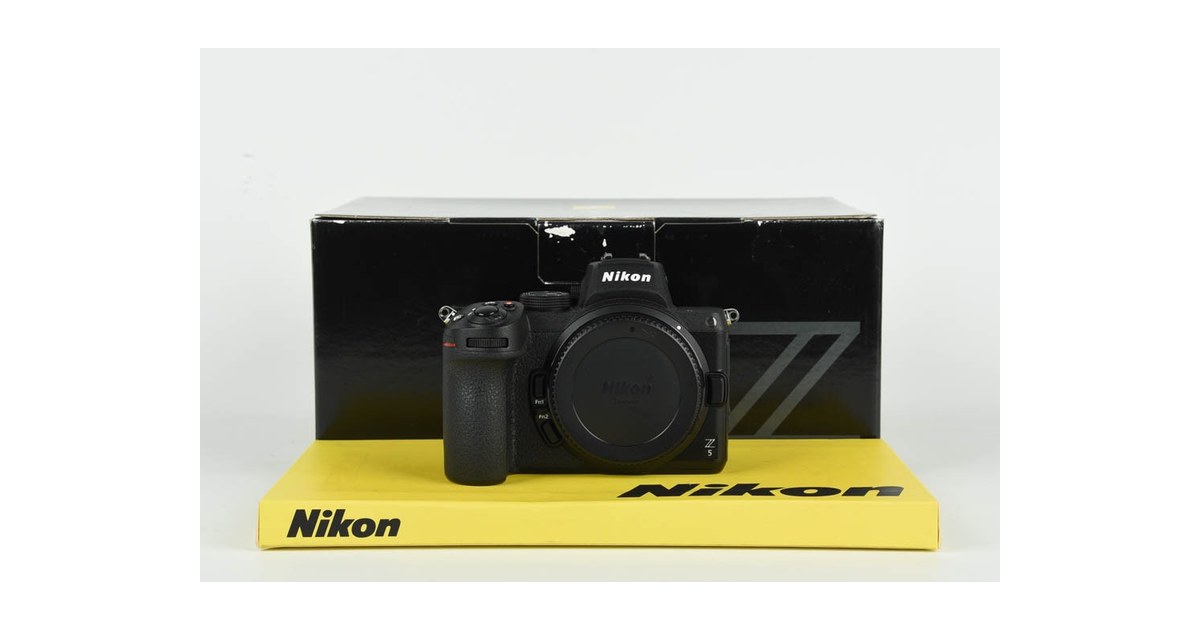
Today, a used Nikon Z5, body only, costs between 650 and 800 euros, less than half the list price. At this price, it is the most affordable Nikon Z full-frame camera to enter the system. Nikon introduced it in 2020 as an entry-level model, below the Z6 and Z7. For those who photograph and do not shoot video, it is still a complete camera.
From €1,500 to less than half: what happened to prices
At launch, the camera body alone cost over €1,500. The price has dropped mainly for two reasons, both independent of the machine's quality.
- The arrival of the Z5 II in 2025. With the Expeed 7 processor and a more recent generation autofocus, the Z5 II has made the first Z5 an outdated model on the price list. A camera that is removed from the price list loses value even in the used market.
- Many photographers change cameras. Many sell it or use it as a trade-in to switch to a Z6 II or the Z5 II. There are many Z5s for sale, and the price drops.
Buyers benefit: there is room to choose the right unit. We often see them come through the counter. However, we do not have any in stock today and prefer to say so upfront. If your budget reaches 850 euros, the Nikon Z6 in our catalog is the closest alternative. It offers higher speed and better video, but has only one card slot.
What's inside: the technical specs that matter
The Z5 spec sheet includes several components that Nikon has carried over from its higher-end models. These are the key factors that truly matter when making a choice:
| Component | Nikon Z5 |
|---|---|
| Sensor | 24.3 MP full frame, FSI type |
| Processor | Expeed 6 |
| Stabilization | In-body, 5-axis |
| Viewfinder | 3.69 million dot OLED |
| Screen | Tilting, touch, 3.2 inches |
| Cards | Two UHS-II SD slots |
| Weather sealing | Stated by Nikon to be equivalent to Z6 and Z7 |
| Battery | EN-EL15c |
The processor and viewfinder are the same as the first Z6. Dust and moisture sealing is declared at the same level as the higher-end siblings. Those coming from a recent Nikon DSLR already know the battery system: the EN-EL15c belongs to the same family as the EN-EL15 used in DSLRs. The sensor is of FSI type, while the Z5 II features a more modern BSI. In the sensor section, we see how much this difference really matters.
The dual SD slot: when it really matters and when it doesn't
An SD card that corrupts halfway through a wedding cannot be fixed in post-production. The bride does not redo her church entrance. The Z5's second slot is primarily there for this. For those who shoot landscapes on the weekend and download everything in the evening, however, it makes little difference.
Backup, overflow, separate RAW+JPEG: the three modes
In the shooting menu, under the option dedicated to the secondary slot, the Z5 offers three options:
- Backup: every file is written to both cards. It is the only mode that truly protects against a card failure.
- Overflow: when the first card is full, the camera switches to the second. It gives you more space, but no protection.
- RAW slot 1 – JPEG slot 2: RAW files go to one card and JPEGs to the other. It is convenient when traveling without a PC, as you can transfer the JPEGs to your phone while keeping the RAWs intact.
A concrete example is a wedding with 2,500 compressed RAW shots. This amounts to approximately 60-70 GB. For backup, you need two 128 GB cards, and by the end of the day, you have two identical copies before even getting to your car. Those working at events must use backup. Those shooting for themselves can keep the overflow.
SD UHS-II or UHS-I: where the difference shows
The slots are UHS-II, but with a burst rate of 4.5 fps, the Z5 does not put pressure on the card. A UHS-II card clears the buffer in a few seconds, while a UHS-I takes significantly longer. The difference is only noticeable if you take long, consecutive bursts, which are rare with this camera. For backup, writing speed is limited by the slower card, so it is advisable to install two identical cards. For portrait, landscape, and ceremonies, a good UHS-I V30 is sufficient.
Counting the cards: SD vs. XQD/CFexpress
The Nikon Z6, currently available for 850 euros, is faster and more comprehensive for video. However, it features a single XQD slot, which is also compatible with CFexpress Type B cards. Here are the indicative new prices for a 128 GB card:
| Card | Indicative price | Two cards | Three cards |
|---|---|---|---|
| SD UHS-I V30 128 GB | 20-30 € | 40-60 € | 60-90 € |
| SD UHS-II V60 128 GB | 70-100 € | 140-200 € | 210-300 € |
| CFexpress B 128 GB | 110-160 € | 220-320 € | 330-480 € |
With three cards, the difference between UHS-I and CFexpress can exceed 300 euros, which is more than the price gap between the two used camera bodies. Original XQD cards are now hard to find, whereas an SD card can be purchased at any electronics store. If you already have a drawer full of them from your DSLR, the Z5 uses them all.
Sensor, stabilization and viewfinder: what lies behind the promises
On the Z5's spec sheet, three numbers drive sales: 24 megapixels, 5 stops of stabilization, and a 3.69-million-dot viewfinder. At the counter, the first and third hold up. The second needs to be put in perspective.
5 stops of stabilization: what it means for handheld shooting
The 5-stop figure comes from the CIPA test. The camera is mounted on a platform that simulates hand shake under repeatable conditions: no breathing, and nothing moves in the frame. The test is designed to compare models against each other. It does not tell you what you will get, standing up, at the end of the day.
With a 50mm lens, the classic rule of thumb suggests 1/60 s, and five stops would lead to 1/2 s. Here is what you actually get handheld, without any support:
- 1/15 s: sharp almost always, even when shooting in a hurry.
- 1/8–1/4 s: repeatable results, if you hold your breath and take two or three safety shots.
- 1/2 s: achievable, but not guaranteed. It's a gamble, not a speed you can rely on.
In practice, it's 3-4 stops: still plenty. However, the stabilizer compensates for hand movement, not for people walking through the frame. The most concrete advantage comes with F-mount lenses mounted on the FTZ. An AF-S 85mm f/1.8 G or a 35mm f/1.8 G don't have VR and become stabilized for the first time with the Z5.
The 24 MP sensor: is it the same as the Z6?
No. The resolution is practically the same, but the Z5 uses a traditional FSI sensor, while the Z6 features a BSI back-illuminated sensor. The BSI places the circuits behind the photodiodes, allowing for faster readout. This speed is particularly important for burst shooting and video.
In photography, the difference is minimal. Up to ISO 6,400, comparing the RAW files, it is difficult to distinguish between the two cameras. From ISO 12,800 upwards, the Z6 delivers slightly cleaner shadows. In landscape photography at ISO 100 and in portraiture, the dynamic range is effectively the same: shadows in backlit scenes are recovered well with both.
Viewfinder and ergonomics
The viewfinder is the Z5's underrated strength. It features a 3.69-million-dot OLED with 0.8x magnification, identical to the Z6. A Canon EOS RP and a Sony A7 II top out at 2.36 million dots. The difference becomes apparent when focusing manually or checking details before taking a shot.
The grip is just as deep as on the Z6, and remains comfortable even with a 24-70 f/4 S mounted. However, the top display is missing: in its place, on the right shoulder, there is the mode dial. In daily use, this makes little difference, as exposure and battery status can be read in the viewfinder or on the monitor. Those who used to check the shutter count by looking at the top LCD of their DSLR will simply need to change their habit.
The real limits of the Z5: burst rate, video, and autofocus
The Z5 was designed to cost less than the Z6, and Nikon cut corners on speed, video, and responsiveness. These are compromises that a spec sheet doesn't highlight, but which you feel immediately as soon as the subject moves. Before buying it, it is worth knowing exactly where its limits lie.
4.5 frames per second
At 4.5 fps, you capture four or five frames in a second. If a child runs across the field, they have already moved half a meter between one shutter count and the next. You only catch the exact moment of footfall or the look into the camera if you anticipate it.
- Kids' sports and soccer: It works, but with many discarded shots and without the complete sequence of the action.
- Birds in flight: This is the wrong camera. The wingbeat is too fast for this shutter speed.
- Portrait, landscape, wedding: 4.5 fps is more than enough.
The Nikon Z6, currently available for 850 euros, reaches 12 fps. It should be noted that at this speed, the exposure remains locked on the first frame: with exposure updated for every shutter count, it drops to 5.5 fps. It remains another machine for those who photograph action.
4K video with 1.7x crop
Here, the limitation is the most distinct. In 4K at 30p, the Z5 uses only the central part of the sensor, with a 1.7x crop. Your 24mm becomes approximately a 41mm, and a room or a panorama no longer fits in the frame. Full-sensor 4K does not exist. To use the entire sensor, you must drop down to Full HD, which goes up to 60p.
It's fine for holiday shoots or a few behind-the-scenes clips at a wedding. However, if you work in video, or plan to within a year, the Z5 will cost you time and money. The Z6 records in 4K across the full width of the sensor, and the difference is visible from the first edit.
273-point AF: excellent for stationary subjects, decent for tracking
On a stationary or slow-moving subject, the Z5's autofocus is precise and silent. Eye detection for people and animals, including dogs and cats, works well in portrait and event photography. Issues arise in AF-C with fast-moving subjects and low light: in an indoor gym or with a dog running towards you, focus acquisition lags and misses a few frames. The Sony A7 IV, Canon EOS R6, and the Z5 II itself perform significantly better.
A practical tip: check the firmware version immediately. Nikon has improved eye detection and tracking with updates, and a Z5 left on the factory firmware performs less than it could. On every camera that goes through our workshop, we install the latest version before sale.
Z5 vs. other used full-frame cameras: Z6, EOS RP, EOS R, A7 II
For between 500 and 850 euros, you can buy a refurbished full-frame mirrorless camera today. However, the five cameras in this price range have different features. Here is how the models in our catalog compare to the Z5, along with the prices at which we sell them today.
| Model | Used Price | IBIS | Slots | Max Burst | 4K Video |
|---|---|---|---|---|---|
| Nikon Z5 | €650-800 (market) | Yes, 5-axis | 2 SD UHS-II | 4.5 fps | 1.7x Crop |
| Nikon Z6 | €850 | Yes, 5-axis | 1 XQD | 12 fps | Full Frame |
| Canon EOS RP | €600 | No | 1 SD | 5 fps | 1.6x Crop |
| Canon EOS R | €690-800 | No | 1 SD | 8 fps | 1.74x Crop |
| Sony A7 Mark II | €500-520 | Yes, 5-axis | 1 SD | 5 fps | No, Full HD only |
Nikon Z6 at €850: is it worth the extra €100-200?
The Nikon Z6 shares the same mount as the Z5, along with the same viewfinder and stabilizer. The sensor is different, featuring a 24.5 MP BSI, and performance is significantly improved: 12 fps burst rate and 4K video across the full sensor width. The trade-off is the single XQD card slot. The extra cost is worth it if you shoot video, sports, or moving animals. If you photograph weddings and want an in-camera safety backup, the Z5 remains the most sensible choice.
Canon EOS RP at 600 euros and EOS R between 690 and 800 euros
The Canon EOS RP weighs 485 grams with battery and card and is the lightest in the group. The Dual Pixel AF is reliable for faces and video. However, the limitations are noticeable: no in-body image stabilization, single card slot, 4K with a 1.6x crop, and an LP-E17 battery rated for approximately 250 certified shutter counts. For travel, you need at least two spare batteries. The Canon EOS R steps up to 30 MP and uses the LP-E6N, which lasts longer, but still lacks IBIS. With non-stabilized RF lenses, such as the RF 50 f/1.8, handheld shooting at slow shutter speeds performs better on the Z5.
Sony A7 Mark II between 500 and 520 euros
The Sony A7 Mark II is the most affordable stabilized full-frame camera we have, which is a real advantage. However, it was released in 2014: it features an AF system from a previous generation, records video only in Full HD, has a single card slot, and uses an NP-FW50 battery that lasts for approximately 300 shutter count. It still works well for landscape and posed portrait photography. For everything else, the Z5 is a more modern camera, and the 150-300 euro price difference is justified.
If you are also considering a full-frame DSLR instead of a mirrorless camera, you can find the comparison between the two options in our guide on used full-frame DSLR or mirrorless.
Lenses: Native Z mount and F-mount lenses with the FTZ adapter
If you are coming from a Nikon DSLR, you already have half the gear needed for the Z5. This is why many customers choose it over a Sony or Canon at the same price point. Native Z lenses are excellent, but expensive. The FTZ adapter allows you to defer that cost, sometimes for years.
F-mount lenses with FTZ: what works and what doesn't
The FTZ does not have an internal motor. This detail determines which lenses retain autofocus and which do not. The rule is simple: AF only works with lenses that have the motor built into the lens.
- AF-S, AF-P e AF-I: full autofocus, automatic exposure, and eye detection. An AF-S 85mm f/1.8G or an AF-S 70-200mm f/2.8G VR II works like on a DSLR, often with more precise focus thanks to on-sensor AF.
- AF and AF-D (screw drive): they mount and meter exposure, but focus is manual only. The classic AF 50mm f/1.8D or AF 80-200mm f/2.8D lose autofocus.
- Sigma and Tamron lenses with F mount: those with internal motors generally work, but older series may have unpredictable behavior. They should be tested before purchase.
As seen in the stabilization section, the Z5's IBIS works with any mounted lens, including those used in manual mode. For those with a kit built around a D750 or a Nikon D810, it is the most painless transition to mirrorless available. The first-generation FTZ can be found used for around 150-200 euros. It features a tripod foot that some find annoying, whereas the FTZ II version lacks this feature.
A case where the FTZ makes less sense: if your F-mount kit consists almost entirely of screw-drive AF-D lenses, the Z5 turns them into manual-focus lenses. Anyone relying on autofocus should budget for replacing their lenses or stick with a DSLR.
The 24-50mm kit: keep it or skip it
Many used Z5 cameras come with the Nikkor Z 24-50mm f/4-6.3. It is a very compact retractable lens, weighing approximately 195 grams, and when retracted, it makes the Z5 nearly pocketable. Those are the advantages. The limitations are an aperture that drops to f/6.3 and a long focal length that stops at 50mm, where even an inexpensive prime lens delivers more bokeh and light.
Our advice: if the kit costs at most 100-150 euros more than the camera body alone, it makes sense to take it as a travel lens. If the difference is greater, it is better to invest in a prime. The Z options we most often recommend at the counter:
- Nikkor Z 40mm f/2: ultra-light and affordable, it is the natural alternative to the kit lens for those who want brightness without overspending.
- Nikkor Z 50mm f/1.8 S: one of the sharpest 50mm lenses on the market, ideal for portraits and general use.
- Nikkor Z 24-70mm f/4 S: the versatile zoom to keep mounted at all times, significantly superior to the 24-50 in edge sharpness and range.
What to check on a used Nikon Z5
A poorly maintained Z5 doesn't show its flaws in listing photos. You can tell within ten minutes using an SD card, a lens, and a precise checklist. These are the points we check first when one comes to the counter.
Both slots, the door, and the seals
Bring two SD cards and take a few shutter count on each, then review the photos on the camera. A slot that fails to read, throws a write error, or only recognizes the card intermittently costs a repair. On a camera bought for the dual slot, this is a serious defect. The door must close with a crisp click and sit flush with the camera body, without any play. Check the rubber seals around the doors and side ports: if they are deformed or detached, the weather sealing is no longer valid. Also inspect the contacts of the slot and the battery with a torch. Green or white stains indicate moisture, and oxidation usually worsens over time.
Sensor and Stabilizer
On the Z5, the sensor remains exposed every time you change the lens. Remove the cap, shine a penlight at it, and look for scratches and spots. Then take a shot at f/16 against a uniform sky or a white wall: dust can be cleaned, but a scratch on the filter in front of the sensor cannot. For the IBIS, run two tests:
- With the camera off, the sensor may move slightly if you shake the body. On a Nikon Z, this is normal and does not indicate a fault.
- With the camera on, the sensor must stop. A faint hum is normal, while rubbing sounds, repeated clicks, or a viewfinder that trembles without reason are not.
- Field test: with a 50 mm lens, take ten hand-held photos at 1/8 second. With healthy IBIS, most should be sharp.
Shutter count and firmware
The shutter count can be read from the EXIF data of a NEF file, for example using ExifTool. Ask for a RAW file taken recently, not an old photo. Nikon does not state the shutter life of the Z5, so it is advisable to reason in terms of ranges:
- under 20,000 shutter count: hobby use, lightly used;
- between 20,000 and 60,000: normal use, no issues if the rest is in order;
- over 60,000: likely worked at events or weddings, and the price must reflect that.
The firmware version is located in the Settings menu. Compare it with the latest version published on the Nikon website: newer firmware updates have improved autofocus, and a camera that has never been updated is also an indication of poor care.
What we do in our workshop
At the ReflexMania workshop, every Z5 is serviced before being put up for sale. We test both slots for reading and writing, check the IBIS at slow shutter speeds, clean and inspect the sensor, and we certify the shutter count ourselves. Then there is the 2-year warranty. If you buy from a private seller instead, repeat these checks point by point: it is the most economical way to avoid paying for a defect as if it were a healthy camera.
Who is the used Z5 for, and when is it worth spending less
The used Z5 is suitable for those who photograph stationary or slow-moving subjects and want a reliable full-frame body, without paying for speed they wouldn't use. Those who follow sports, motorsports, or shoot video regularly will encounter the limitations mentioned above on a daily basis. In that case, it is advisable to look elsewhere, even if it means spending more.
The Z5 is the right camera if...
- Portrait and wedding photographers on a tight budget. Add a used Nikon Z 50mm f/1.8 S to the 650-800 euro body, which can be found for around 400 euros. With 1,050-1,200 euros, you have a ceremony kit with safety backup on two cards. For those working on Saturdays, that second card can save the job.
- You shoot landscape and travel. With a used Nikon Z 24-70mm f/4 S, between 450 and 550 euros, the total rises to 1,100-1,350 euros. It is a compact and sharp lens even at full aperture. For a tripod in the mountains or a city on foot, the viewfinder and dynamic range matter, not the burst rate.
- You already have a Nikon F kit. Add a used FTZ adapter to the body, around 150-200 euros, and your lenses start working again without selling anything. With about 1,000 euros, you switch to mirrorless and keep the lenses you know.
If your budget is under 500 euros
Here, the Z5 is out of reach, and buying it while giving up on a decent lens is a mistake. You end up with a good camera body and a lens that doesn't make the most of it. The most affordable entry point to full frame remains the Sony A7, which we currently have for 350 euros. However, the compromises need to be stated clearly:
- no in-body image stabilization;
- slow autofocus in low light;
- small NP-FW50 battery: you need at least two or three for a full day;
- single card slot.
The 24 MP sensor still holds up well in print and post-production. We discussed this in detail in the guide to the used Sony A7 first series.
For about 150 euros more, there is the Sony A7 Mark II, which we have between 500 and 520 euros. It adds in-body image stabilization, which makes a difference with adapted manual lenses. The card slot remains single.
If you reach 600 euros and weight is your priority, look at the Canon EOS RP: 485 grams versus the Z5's 675, with the limitations already seen in the comparison (no stabilization, single slot, LP-E17 battery with short life). With a lightweight 35mm lens, it becomes an honest travel companion.
Frequently Asked Questions
Is a used Nikon Z5 or a used Nikon Z6 the better choice?
It depends on what you shoot. The Z6 costs 50-200 euros more and offers 12 fps, full-frame 4K, and a slightly cleaner BSI sensor at high ISOs. The Z5 has two SD slots and cards that cost much less. For weddings, portraits, and landscapes, the Z5 is sufficient. For sports and video, you need the Z6.
Are UHS-II SD cards mandatory?
No. UHS-I cards work without issues; the only difference is the buffer clearing time after a long burst. At 4.5 fps, most photographers won't notice a difference. UHS-II cards are for those shooting continuous bursts in RAW.
Do old EN-EL15 batteries from Nikon DSLRs work on the Z5?
Yes, the Z5 accepts EN-EL15, EN-EL15a, EN-EL15b, and EN-EL15c. However, in-camera USB charging only works with the EN-EL15b and EN-EL15c. The original EN-EL15 batteries also provide lower battery life.
How many shutter counts are too many for a used Z5?
Nikon does not declare an official shutter life for the Z5. Below 20,000 shutter count, the camera is lightly used; between 20,000 and 60,000, it is normal use if the inspection is positive; above 60,000, the price must drop. More important than the number is that it is certified and that the camera has a warranty.
Do Nikon F lenses for DSLRs work on the Z5?
Yes, with the FTZ adapter. AF-S, AF-P, and AF-I lenses retain full autofocus and are stabilized by the Z5's IBIS. Older AF and AF-D lenses with screw-drive motors in the body only function in manual focus.
Now that the Z5 II is out, does it still make sense to buy the Z5?
Yes, if the budget is under 900 euros. The Z5 II is much faster and has a more recent AF, but used it still costs almost twice as much. For still photography, the image quality of the Z5 remains the same as it was in 2020.
Looking for a used and certified Nikon full frame?
If you have questions about a purchase or need advice for your specific case, contact us. We offer free advice because we are photographers first and sellers second, and because a customer who buys poorly won't return to photography.
Three ways to get in touch:
- Contact form — response within 24 business hours
- WhatsApp at 342 362 3454 (messages only)
- Phone: 071 291 6347 (Mon-Fri 9-13/15-18, Sat 9-13)
And if you want to see what we have in stock right away, explore the used gear available today: every camera is certified, comes with a 2-year warranty, and ships within 24-48 hours.
Article written by Matteo for the ReflexMania Team. Last updated: November 2026. Prices and availability as of the time of publication.