
In short
- The D7100 features a 24 MP APS-C sensor without an anti-aliasing filter: in terms of fine detail, it holds its own against DSLRs released five years later.
- The buffer is its structural weakness: 6 RAW shots at 14 bit before slowing down, compared to the 18 on the D7200 that replaced it.
- In the used market, a D7100 in excellent condition ranges from 250 to 350 euros for the body, with bodies exceeding 100,000 shutter count often sold without disclosure.
- The shutter is rated for 150,000 cycles: at 60,000 shutter count, the camera still has 60% of its rated life remaining.
Looking for a used Nikon D7100? The used Nikon D7100 page shows current availability and prices, with certified shutter count and a 2-year warranty. See also all used Nikon cameras.
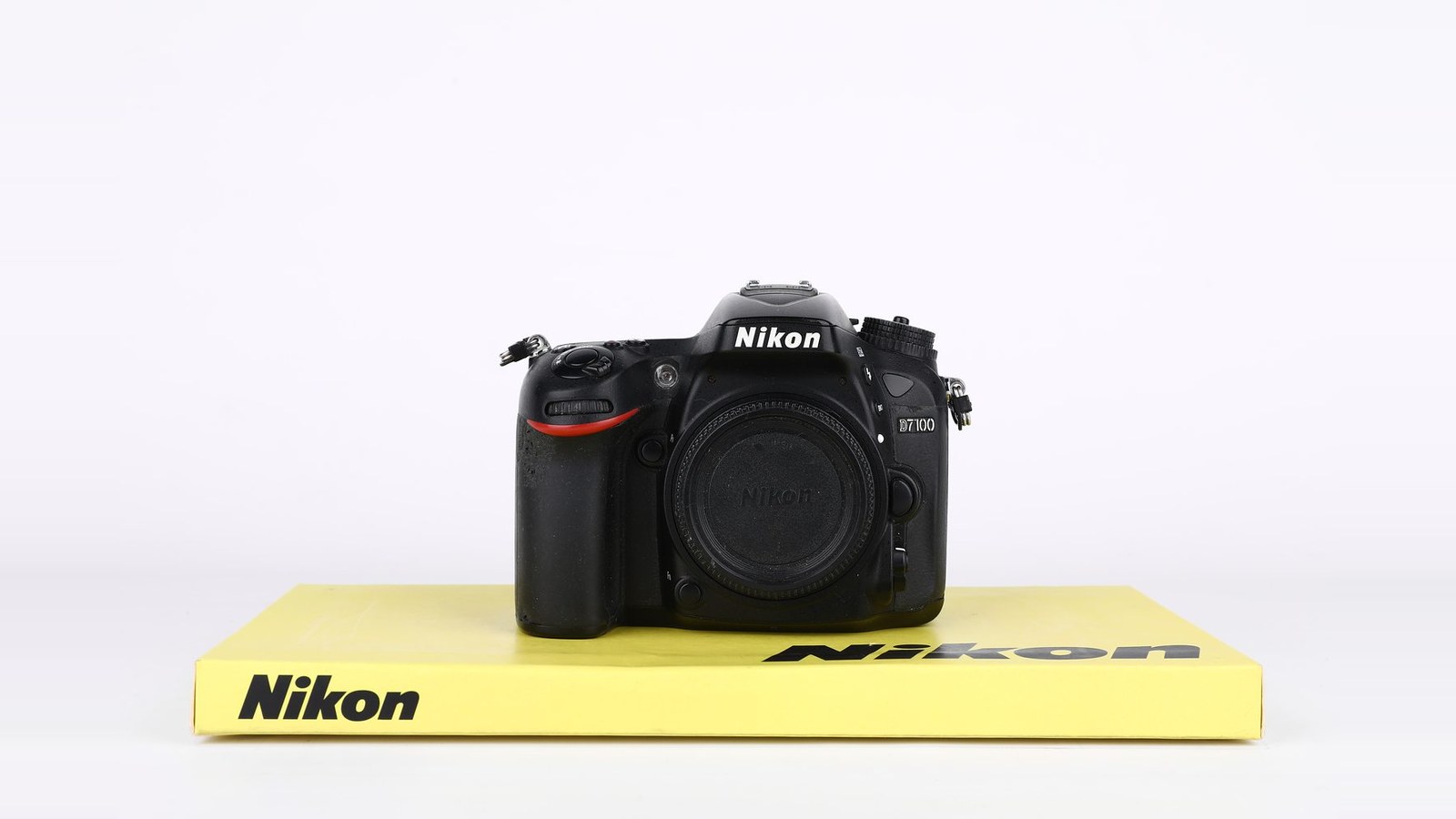
The Nikon D7100 was released in February 2013 and served as the reference APS-C DSLR in Nikon's catalog for two years, until the D7200 took its place. It continues to come to the counter, both as a trade-in and upon request: people selling to switch to mirrorless, and people looking for it because they read that it "has a sensor without an anti-aliasing filter" and want to know if it really makes a difference.
This article outlines what the D7100 still does well thirteen years later, where it falls short compared to a modern camera, and whether it makes sense to pay for it today. It also covers the specific checks to perform on a used unit: the D7100 has two recurring weak points that are only visible if you know where to look, and one of them will not reveal itself in any thirty-second in-store test.
What the D7100 really packs under the shutter button
The D7100's technical specifications in 2013 were those of a semi-professional: 24 MP without an anti-aliasing filter, 51 AF points inherited from the D300s, a pentaprism viewfinder with 100% coverage, and dual SD slots. Thirteen years later, three of these four features are still felt when you take certified shutter counts. The fourth is felt less than the number might suggest.
The 24 MP sensor without anti-aliasing filter
The optical low-pass filter (OLPF) is a layer in front of the sensor that slightly blurs the image before it is sampled. It serves to prevent moiré, i.e., those colored patterns that appear when the subject's texture has a frequency close to that of the photosites. Nikon removed it on this camera body: more real detail reaches the sensor, and it shows in the files.
It is important to state where the difference is visible and where it is not. At 100% zoom on screen, with a decent lens and on a tripod, the difference compared to a D7000 is evident on bark, stones, grass, and fine textures. In prints up to A3 size and on social media, it practically disappears. The downside is real and concrete: fabrics with tight weaves, pinstripe jackets, tents, metal nets, and facades with repetitive windows can generate moiré, and in RAW it can only be corrected to a certain extent.
Wedding and portrait photographers shooting formal attire will definitely encounter this defect. Landscape, architecture without repetitive patterns, and macro photographers will only benefit from it.
51-point AF: how many do you actually use
The module is the Multi-CAM 3500DX, the same 51-point system mounted on the 2009 D300s. Not all 51 points are equal:
- 15 cross-type points, concentrated in the central area: these are the ones that truly lock on, even in low light and with f/5.6 optics.
- 36 single-line points, peripheral: they work on high-contrast subjects but hesitate on low contrast or poorly oriented lines.
- Coverage is limited to the center of the frame, not extended to the edges as on current mirrorless cameras.
In practice, this means one thing: in a half-body portrait with off-center eyes, you often lack a focus point where you need it and must recompose after focusing. At f/1.8 on a 50mm, focus-and-recompose shifts the focal plane enough to lose the eye. It is the most annoying practical limitation of the camera body, more so than the megapixel count.
100% pentaprism and build quality
The optical viewfinder covers 100% of the frame with 0.94x magnification. It may sound like a spec sheet detail, but it’s the difference between composing and hoping: what you see in the viewfinder is exactly what ends up in the file, edges included. Entry-level Nikon models stop at 95% coverage with a smaller, dimmer pentamirror.
The body is mixed: the top and rear are made of magnesium alloy, while the rest is polycarbonate. It is weather-sealed, but only partially, designed for light rain and dust, not for a thunderstorm. The Nikon D7000, which we have for 200 euros, uses the same construction approach and the same 100% viewfinder: in this regard, the two cameras are equivalent.
The buffer: the limit nobody tells you about before you buy
Hold down the shutter button in 14-bit RAW and the D7100 gives you six frames. Then the 6 fps burst collapses to one or two shutter counts per second until the card catches up. Six shutter counts at 6 fps means a one-second burst: the time of a gesture, not an action. In 12-bit lossless compressed RAW you get seven, in fine JPEG around 33, and the problem almost disappears.
The reason is architectural. The D7100 pairs a 24 MP sensor with a small buffer: files accumulate faster than the body can write them to the card. No firmware has ever fixed this, and no memory card solves it entirely, because the bottleneck lies before the card.
What changes with a 1.3x crop
The 1.3x crop mode boosts the burst rate to 7 fps and significantly extends the buffer, as file sizes drop to approximately 15 MP. The overall crop factor becomes 2x relative to full frame: a 300 mm lens frames like a 600 mm. For birding and long-range sports, this is a genuine feature, not a compromise: the AF points cover nearly the entire cropped frame, which is why many bird photographers keep the D7100 in crop mode by default.
It becomes a patch when you use it solely to gain buffer on close subjects. There, you are wasting 9 MP, and the viewfinder shows a smaller frame within the pentaprism, which gets tiring after half a day. Choose the crop for framing, not for the buffer.
Living with it: settings that help
- RAW 12 bit lossless compressed: one extra shutter count and lighter files. The difference in dynamic range is measurable but rarely visible on a file recovered by two stops.
- Fast real SD UHS-I: the D7100 does not utilize UHS-II, so a 300 MB/s card is useless beyond computer offloading. A solid UHS-I card with 90 MB/s write speed is the maximum useful option.
- Active D-Lighting set to Off: processes files on output and occupies buffer. In RAW, you recover shadows better in post.
- Long exposure noise reduction set to Off: doubles the time of every shutter count beyond one second.
Honest expectations: with everything optimized, you go from six shutter counts to seven or eight, and recovery after the burst is faster. It does not become an action camera.
When the buffer is a real issue and when it isn't
For landscape, portrait, still life, street, travel, and studio work, the issue is irrelevant: in three years at the counter, I have never seen a landscape photographer complain about the buffer of the D7100. For team sports, children running towards you, and birds in flight, it is a deal-breaker, and no setting will save you.
Be honest with yourself before buying. If the second list describes you, the used D7200 with its 18 RAW shutter count resolves exactly this, and it is the only serious reason to spend the difference.
D7100 vs D7000, D7200 and Nikon entry-level models
If you're considering the D7100, you likely already have three or four camera bodies open on your screen, and it's almost always these. Between the €200 of a D7000 and the €450 of a D7200, there's a €250 gap: in such a narrow range, the choice isn't made on the spec sheet but on what you actually shoot.
| Model | Sensor | RAW Buffer | AF Motor in Body | Used Body Price |
|---|---|---|---|---|
| Nikon D7000 | 16 MP, with OLPF | approx. 10 shutter count | Yes | 200 euros |
| Nikon D7100 | 24 MP, without OLPF | 6 shutter count at 14 bit | Yes | 250-350 euros |
| Nikon D7200 | 24 MP, without OLPF | 18 shutter count at 14 bit | Yes | 400-450 euros |
| Nikon D3300 / D3400 | 24 MP, without OLPF | 6 shutter count | No | 220-250 euros |
D7000: 16 MP, healthier buffer, half the price
The Nikon D7000 we have in stock for 200 euros handles much of the D7100's workload with a more generous buffer and significantly lighter files. The D7000's 16 MP files do not stress its buffer the way the 24 MP files do with the D7100, and it shoots twice as fast in continuous mode.
If you shoot in JPEG, don't print larger than A3, and your subject is moving, the 100 euro difference is not justified. You can see the resolution jump at 100% on screen, not in the prints you actually make. Both cameras have the pentaprism and AF motor: in terms of compatible lenses, the two bodies are identical.
D7200: what the extra 100-150 euros buy you
18-shot RAW buffer at 14-bit instead of 6, Multi-CAM 3500 II DX AF module with a declared sensitivity of up to -3 EV, improved battery life with the same EN-EL15, and integrated Wi-Fi. These are exactly the four areas where the D7100 is weak.
If your budget reaches 400 euros and you shoot sports, children, or animals, the D7200 is the sensible choice and there is no debate. The D7100 makes sense when the budget stops earlier, or when you shoot landscape and portrait and the buffer never comes into play.
D3300, D3400, D5100: the entry-level range
The price drops slightly, but you lose a feature that is expensive to recover. The Nikon D3300 at €220 and the Nikon D3400 between €225 and €250 feature the same 24 MP sensor without an anti-aliasing filter: you lose nothing in the raw file. The Nikon D5100 at €200 drops to 16 MP but adds an articulating screen.
What you leave behind as you go down:
- Internal AF motor: AF-D lenses without a built-in motor remain in manual focus. This is the factor that changes the equation for those with older lenses in their bag.
- Dual SD slots: no in-camera backup copy.
- Pentaprism viewfinder: darker and with coverage below 100%, noticeable with slow lenses.
- 11-point AF versus the 51 points of the D7100, and single dials instead of dual.
For those starting from scratch and buying new AF-S lenses, the entry-level range is a legitimate choice: we explained the logic in detail when discussing the used D5600. For those who already own a 50mm f/1.8D or an 80-200 f/2.8D, going below the D7100 means buying a body that cannot focus half of your kit.
The lenses that hold the conversation together
The D7100 has the autofocus motor built into the camera body. It may look like a footnote in the spec sheet, but it is the main economic reason why this camera still makes sense in 2026. With that motor, you gain access to twenty years of used Nikon AF-D lenses that cost a fraction of their modern equivalents and focus automatically.
The internal AF motor and the used AF-D lens lineup
AF-D lenses do not have a motor: they rely on the screw driven by the camera body. Entry-level Nikon bodies do not have this screw. On a Nikon D3400 — which we have in stock for between 225 and 250 euros — a 50mm f/1.8D lens mounts, exposes, and functions, but remains in manual focus with only electronic rangefinder confirmation. The same applies to the D5000 series. On the D7100, these lenses autofocus normally.
The three models we see most often at the counter, with actual prices for the Italian used market:
- AF-D 50mm f/1.8D — 90-130 euros. Sharp even at f/2.8, extremely lightweight. On APS-C it becomes a 75mm equivalent: pure portraiture, a bit long for general use.
- AF-D 35-70mm f/2.8D — 250-350 euros. Constant aperture, professional zoom build from the 90s. On DX format it covers 52-105mm equivalents. It has a push-pull zoom mechanism, which is either loved or hated: try it before buying.
- AF-D 80-200mm f/2.8D — 350-500 euros depending on the version. Serious lens, heavy, without stabilization. It becomes a 120-300mm equivalent. The screw-drive autofocus is noisy and not instantaneous on approaching subjects: it works for indoor sports, but not for competitive football.
The 24 MP sensor without OLPF demands high-quality lenses
Removing the anti-aliasing filter only makes sense if the glass in front of it can resolve that level of detail. With the 18-55 VR kit, almost all of that advantage is lost: the zoom is honest, but at the edges and wide open, it doesn't reach the resolution of the sensor. Anyone buying a D7100 and sticking with the kit is paying for a feature they won't use.
The first sensible upgrade costs little. The AF-S 35mm f/1.8G DX ranges from 120 to 150 euros used and is the normal of the camera, 52mm equivalent. The 50mm f/1.8G ranges from 150 to 180 euros and has a silent focus that AF-D lenses do not have. One hundred and fifty euros on a prime lens change the images more than two hundred euros more on the body.
What to check on a used D7100 before paying
A D7100 can come from an owner who has taken 8,000 shutter counts in ten years or from a wedding photographer who has taken 140,000 in three seasons. Aesthetically, they may look identical: the D7100's polycarbonate and magnesium finish ages well and reveals almost nothing. All you need to know is in the menus and in a couple of test shots. It takes fifteen minutes, and it completely changes the value of what you are buying.
Shutter count and remaining shutter life
Nikon rates the D7100 shutter for 150,000 cycles. This is a statistical test value, not an expiration date: in our workshop, we have seen units pass 200,000 without a hitch and others fail at 90,000. It remains the most honest reference for understanding how much life is left in the camera.
The count can be read from the EXIF data of any JPEG shutter count taken on the spot. Nikon writes it in the MakerNotes fields, so Windows and Mac previews do not display it: you need a complete, free EXIF reader on your phone or laptop. Ask the seller for a shutter count taken at that moment, not a file from their archive.
- Under 30,000 — light amateur use, practically like new. The price can sit at the top of the range.
- 30,000-80,000 — the normal condition of a healthy D7100. No reason to discount just for this.
- 80,000-120,000 — still usable, but the shutter has consumed well over half of its rated life. A real discount is warranted.
- Over 120,000 — buy only at a spare body price, factoring in shutter replacement.
If the seller cannot tell you the shutter count or dodges the question, that is already the answer you were looking for.
The shutter/mirror lock-up issue
A portion of the D7100 production is affected by a known defect: the camera displays ERR on the top LCD, the mirror remains raised, and the shutter gets stuck halfway through its stroke. It can be reset by powering off and removing the battery, after which it resumes operation — and that is precisely the issue.
The fault is intermittent and typically emerges under stress: long bursts, repeated short shutter speeds, low temperatures. Thirty single shutter counts in-store almost never detect it. The only meaningful test is a sequence of repeated 6 fps bursts with varying shutter speeds for a few minutes. If the seller is a private individual, explicitly ask if they have ever seen an ERR: anyone who has experienced it remembers it.
Sensor, dust and oil
One shutter count at f/16 on a light, uniform surface — a white wall, an overcast sky — with manual focus set to infinity. Then open the file and increase the contrast.
Sharp, isolated dark spots are dust: they can be removed in ten minutes of cleaning and do not affect the price. Blurred, round stains that reappear in the same area even after cleaning are a different matter: they are oil splashes from the mirror mechanism, indicating ongoing mechanical wear. On the D7100, this is not an epidemic defect like it was on the D600 of those years, but when it occurs, it tends to come back.
SD slots, battery and original accessories
- Both SD slots, one at a time, with a real card: write, read back, format. Slot 2 is the one almost nobody tests and almost nobody has used.
- EN-EL15 battery: from the Settings menu, Battery Info item, you can read the remaining charge, the shutter count on the current charge, and above all the Degradation level from 0 to 4. Above 2, the battery is at the end of its life and needs to be budgeted for.
- Original MH-25 charger: if it's missing, and the camera arrives with two compatible marketplace batteries, it usually means the original has been dead for a long time and nobody replaced it.
- Body cap, strap, DK-23 eyepiece: small details, but a body complete with accessories tells you about an owner who cared for the camera.
What it costs today and when the price doesn't come back
A D7100 body in good condition today costs between 250 and 350 euros. Below 220 euros, there is almost always a reason: high shutter count, a shutter that is already noisy, detached rubber seals on the cage, or a seller who has never read the EXIF data of their own camera. Above 400 euros for a body, you enter the territory of the D7200, which has a triple buffer and costs only slightly more.
| Configuration | Private | Shop with warranty |
|---|---|---|
| Body only | 220-280 € | 280-350 € |
| 18-105 VR kit | 300-370 € | 380-450 € |
| Dual lens (18-55 + 55-200/55-300) | 350-420 € | 440-520 € |
What drives the price within these ranges are three things, in this order: shutter count (below 30,000 you pay a real premium, above 100,000 the value drops), presence of the original EN-EL15 battery and not a tired compatible one, and condition of the rubber grip, which on this model tends to peel off over the years.
Private seller, marketplace, and shop: three different prices for three different risks
Private sellers charge 60-70 euros less. In return, they do not declare the shutter count, almost never because they lie: they simply do not know where to read it. The calculation is this: replacing a D7100 shutter costs 200-250 euros for the part plus labor, exceeding the value of the camera. Saving 80 euros on a body with 130,000 shutter count means buying a 250-euro lottery ticket.
The marketplace sits in the middle: there is coverage for the transaction, not for the camera's performance six months later. In-store, you pay for the verification performed before the sale and the warranty that covers it afterwards. Anyone used to buying used full-frame gear already knows this difference — we discuss it as well regarding the Nikon D700, where the stakes are even higher.
What we do in the lab with an incoming D7100
A D7100 coming from a trade-in or a buyback does not go on display the next day. It goes to the workbench, where it typically stays for two to four business days. This is not a matter of courtesy towards the customer: it is the only way to know exactly what we are selling before putting a price on it.
The first data point we check is the shutter count, extracted from the metadata of the last file written by the camera, not declared by the seller. On this model, it is the number that decides almost everything: a body at 40,000 shutter counts and one at 130,000 are two different cameras, even if they look identical. With the shutter rated for 150,000 cycles, above 100,000 the body either leaves our sales channel or is priced accordingly, with this clearly stated in the listing.
Then we move on to the instrumental tests. This is the actual order of the workbench:
| Check | What we look for | When we reject |
|---|---|---|
| Shutter across the full range | Actual shutter speeds from 30s to 1/8000, consistency between shutter count and shutter count | Drift at fast shutter speeds or banding in exposure |
| AF alignment on the 51 points | Front and back focus, using a test chart and a reference lens | Error not correctable via the fine AF adjustment in the menu |
| Sensor | Dust, haze, oily spots from shutter lubricant | Vertical lines or dead pixels in columns after cleaning |
| Both SD slots | Write and read performance on each slot, tested separately | Oxidized contacts or slot 2 not accepting the card |
| Battery EN-EL15 | Degradation index read from the battery info menu | Cell beyond threshold: we replace it, we do not sell it as is |
| Firmware | Onboard version | We update to the latest official Nikon release |
Slot 2 deserves a separate mention. It is the check that private sellers almost always skip, because after thirteen years of daily use, many have never inserted a card into it. It often arrives oxidized or with a bent contact more frequently than one might think, and you only notice when you need a real-time backup.
The 2-year warranty on all used equipment is not a commercial promise made to reassure: it is the arithmetic consequence of this process. If we know what comes off the bench, we also know how many bodies will come back. On a camera we have not opened and measured, we could not afford those two years.
Who really needs a D7100 in 2026
The D7100 makes sense for those who already own Nikon glass, not for those starting from scratch. This is where the discussion ends: the camera body costs 250-350 euros, but the real value lies in the internal AF engine and the 100% viewfinder, two features that only matter if you have lenses to put in front of it or needs that the basic kit does not cover.
The camera operates in four distinct profiles:
- Who has AF-D optics without a motor. A 50mm f/1.8 AF-D or an 85mm f/1.8 AF-D sitting in a drawer is worth the upgrade on its own: on the D3300 or D5300 you focus manually, on the D7100 you cannot.
- Who shoots landscape. 24 MP sensor without an anti-aliasing filter, tripod, base ISO, no burst mode to sustain. Here, the camera's structural flaw never manifests, and the advantage in detail is visible when printing.
- Who shoots environmental portraits. Same logic: single shutter count, shutter speeds dictated by the subject, 51 AF points are more than sufficient for a stationary person.
- Who is looking for a second body. If you already have a D7200, a body at 300 euros that shares EN-EL15 batteries and DX lenses is a sensible backup. Even those with an FX body using EN-EL15 (D610, D750, D800) will at least share the batteries. Dual SD card slots included.
Then there are cases where the D7100 is the wrong camera, and it’s better to say so upfront:
- Sports, running children, moving animals. Six RAW frames and the buffer closes. This is not a limit you can bypass with a faster card.
- Those starting from scratch without lenses. The AF motor in the body is useless for those who will buy modern AF-S lenses anyway. In that case, it is better to spend less on the body and more on the glass: a Nikon D5100 at 200 euros produces 16 MP images that hold up perfectly for A3 printing, and leaves you 150 euros in your pocket for a 35mm f/1.8 DX. The same reasoning applies to the D5300, which we analyzed separately as an entry-level DSLR.
- Those who want video. The D7100 does 1080p, but with slow autofocus in live view and no in-body stabilization: for shooting, it must be used in manual mode on a tripod. In 2026, any used mirrorless does better.
- Those looking for the cheapest possible DSLR. A Nikon D7000 at 200 euros has the same internal AF motor, the same alloy body, a more generous buffer, and 16 MP that are sufficient. You can only justify the 100-150 euro difference if fine detail is truly necessary for you. And those who just want to learn can start with a Nikon D90, also at 200 euros, which teaches the same things with fewer demands.
The final criterion is just one: how much Nikon glass you already own and how fast your subjects move. If the answer is "plenty of glass, stationary subjects," the D7100 in 2026 is still an excellent buy. If it's "no glass, moving subjects," you're looking at the wrong camera.
Frequently asked questions
How many shutter count can a Nikon D7100 do before breaking?
Nikon rates the shutter for 150,000 cycles, which is a statistical average, not an expiration date. In the lab, we often see camera bodies exceeding 200,000 certified shutter counts that still function perfectly, while some fail at 90,000. Below 60,000 certified shutter counts, the camera still has most of its useful life ahead. Shutter replacement costs approximately 200-250 euros for the part plus labor: on a camera body purchased for 280 euros, the math needs to be done before buying, not after.
Does the sensor without an anti-aliasing filter really cause moiré issues?
Yes, but in specific situations: fine-woven fabrics, shirts with narrow stripes, nets, and facades with elements repeated at a distance. In portrait and landscape photography, it is practically non-existent. When it does occur, Lightroom or Capture One features a moiré reduction brush that resolves most cases. The sharpness advantage is only visible when examining files at 100% and using decent lenses: with the kit 18-55, the difference compared to a sensor with a filter is marginal.
Is a used D7100 better than a new entry-level mirrorless at the same price?
It depends on what you photograph. In terms of the optical viewfinder, ergonomics, and battery life (approximately 950 shutter count versus 300-400 on an entry-level mirrorless), the D7100 still wins. On video, autofocus in live view, and eye detection, there is no contest: it loses. If you shoot stills, portraits, landscapes, or travel, the D7100 is the better camera. If you shoot video or need subjects in motion tracked automatically, the D7100 is the wrong choice at any price.
Can I use old Nikon AF-D lenses on the D7100?
Yes, and in autofocus. The D7100 has the focus motor in the camera body, so it can autofocus AF and AF-D lenses without an integrated motor. This is the main reason to prefer it over a D3300, D3400, or D5100, where those same lenses only work in manual mode. If you already have a 50mm f/1.8 AF-D or an 80-200 f/2.8 in your collection, this compatibility alone is worth the price difference.
Does the 6-shot RAW buffer make the D7100 unusable for sports?
For team sports and flying birds, this is a serious limitation: six frames are exhausted in just under a second, after which the camera slows down to one or two shutter counts per second until the buffer is cleared. You can mitigate this by shooting in compressed 12-bit RAW, using a fast UHS-I SD card, and disabling Active D-Lighting, but you only gain one or two shutter counts, not ten. If sports is your primary use case, look at the D7200 or the D500: the buffer is the reason those cameras exist.
How do I know the shutter count of a D7100 I am about to buy?
The count is written in the EXIF data of every JPEG shutter count. Ask the seller for a freshly taken, unedited photo that has not been sent via WhatsApp (which strips the metadata), then upload it to an online EXIF reader and look for the shutter count field. If the seller refuses to send it, you already have the information you need. On the cameras we handle, the count is read in the lab and declared in the product sheet.
Is the D7100 weather-sealed? Can I use it in the rain?
It features seals on the doors and main controls, with a protection level comparable to that of the D300s. It withstands light rain and dust, but not immersion or a prolonged downpour. Keep in mind that on a camera body thirteen years old, the seals have aged: the rubber ones harden and lose adhesion. Treat it as splash-resistant, not waterproof, and dry it immediately.
Do you want a D7100 with a certified shutter count and a 2-year warranty?
If you have doubts about a purchase or need advice for your specific case, contact us. We offer free advice because we are photographers first and sellers second, and because a customer who makes a bad purchase won't return to photography.
Three ways to get in touch:
- Contact form — response within 24 business hours
- WhatsApp at 342 362 3454 (messages only)
- Phone: 071 291 6347 (Mon-Fri 9-13/15-18, Sat 9-13)
If you want to see what we have in stock right away, explore the used gear available today: every camera is certified, comes with a 2-year warranty, and ships within 24-48 hours.
Article written by Matteo for the ReflexMania Team. Last updated: September 2026. Prices and availability as of the time of publication.