
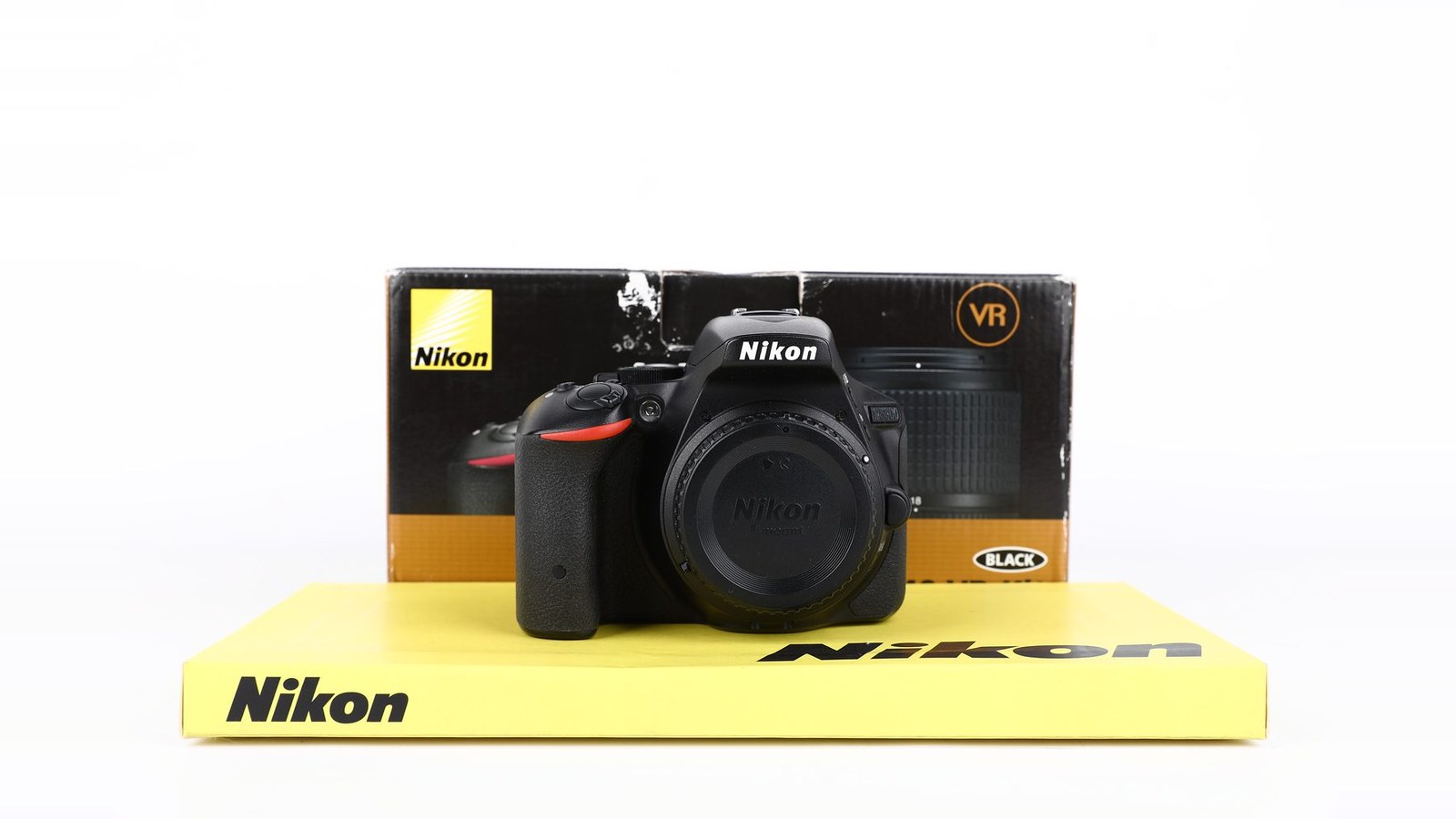
In short
- The Nikon D5500 (2015) weighs approximately 470 grams with battery and card. It features a 24.2 MP APS-C sensor without a low-pass filter, 39 AF points, and a 3.2-inch tilting touchscreen display.
- On the used market, a D5500 body only typically ranges from 250 to 330 euros. With the 18-55 kit lens, prices rise to 330-400 euros, depending on the shutter count and condition.
- Compared to the D5600, the main differences are the Bluetooth SnapBridge and approximately 150 additional shutter count per charge. The sensor and autofocus are identical, so a 60-80 euro price difference is rarely justified.
- The body lacks an AF motor: autofocus works only with AF-S or AF-P lenses. AF-P lenses require firmware 1.02 or later, which should be verified before purchase.
Looking for a used Nikon D5500? The used Nikon D5500 page shows current availability and prices, with certified shutter count and a 2-year warranty. See also all used Nikon cameras.
At the counter, I recognize the D5500 by its weight before even reading the model name. Anyone who picks it up after handling a D7100 or a Canon 70D almost always assumes the battery is missing. It is the most compact Nikon DSLR of its generation, featuring a one-piece composite body. We have serviced quite a few in our workshop, nearly all purchased by those looking for a serious first camera without carrying a kilogram of gear.
Here is what the D5500 actually offers in 2026, how it differs from the D3400, D5300, and D5600, whether it is worth the investment, what to check on a used unit, and when it makes sense to leave it on the shelf. An honest note: we do not currently have one in our catalog. That is why I also list the alternatives we have in the shop, which may make more sense for a beginner.
What is the Nikon D5500 and who it makes sense for in 2026
The Nikon D5500 was released in 2015. Even today, it produces files that will take a beginner years to truly master. For those who want to learn photography with a DSLR while spending a reasonable amount, it remains one of the most sensible choices on the used market.
The profile it suits is precise. It’s for those who want an optical viewfinder rather than an electronic screen, who often go out on foot or travel, and who take many more photos than videos. If you identify with these three things, the D5500 is the right choice for you.
In listings, you often find it described as an "evolved" DSLR. It is, compared to the D3000 series, because it has more AF points, a tilting touchscreen, and a more refined camera body. Compared to a D7100, however, it is not: it lacks the top display and the viewfinder uses a pentamirror, not a pentaprism. It is a DSLR designed to learn well, not a disguised semi-professional.
Technical specs in plain language
| Specification | What changes when you shoot |
|---|---|
| 24.2 MP APS-C DX sensor without low-pass filter | Finer detail. Moiré appears only on highly repetitive patterns like fabrics or grids, and is rare in normal use. |
| Expeed 4, ISO 100-25600 | Files remain clean up to ISO 3200. Beyond that, grain becomes visible, but with some noise reduction they are still usable. |
| 39 AF points, including 9 cross-type | Tracks a running child or a dog in the garden better than the 11 points of the D3000 series. Cross-type points lock on more securely when light levels drop. |
| 5 frames per second | Sufficient for family sequences or travel. It is not a sports camera. |
| Pentamirror viewfinder, 95% coverage | You see slightly less than what the camera records, so a bit more enters at the edges of the photo. It is also less bright than a pentaprism. |
| 3.2" tilting touch display | Convenient for low-angle shots or shooting over crowds. In live view, select the focus point by touching the screen. |
| 1080p video at 60 fps and Wi-Fi | Smooth clips for memories and photos to your phone without cables, via the Nikon app. |
Weight as a genuine argument
With battery and card, the D5500 weighs approximately 470 grams. The D5300 comes in at around 530 grams, and the D5100 at about 560. With the 18-55 AF-P mounted, the D5500 stays under 700 grams in total.
Ninety grams may seem like little on paper. After eight hours around your neck exploring a city, however, you feel the difference. At the counter, we often see customers who bought a heavier camera body, thinking "it's almost the same," only to leave it in the closet after the first trip. The camera that takes photos is the one you have with you.
The D5500's unibody design is also thinner, and the grip is deeper. It holds well in one hand, even with small hands, without straining the wrist.
D5500 vs. the Nikon entry-level models you find in store
Today in store we have four Nikon models that cost less than a D5500, ranging from 150 to 225 euros. Two of them feature the same 24 MP sensor. Among these machines, the main differences lie in usability and autofocus. Image quality matters less than one might think.
| Model | Price | Sensor | AF Points | Burst | Screen | Wireless |
|---|---|---|---|---|---|---|
| D5500 | 250-330 € (body) | 24.2 MP | 39 | 5 fps | 3.2" tilting touch | Wi-Fi |
| D3400 | 225 € | 24.2 MP | 11 | 5 fps | 3" fixed | Bluetooth |
| D3300 | 220 € | 24.2 MP | 11 | 5 fps | 3" fixed | no |
| D5100 | 200 € | 16.2 MP | 11 | 4 fps | 3" tilting | no |
| D3000 | 150 € | 10.2 MP CCD | 11 | 3 fps | 3" fixed | no |
D3300 and D3400: same sensor, less convenience
The Nikon D3300 costs 220 euros and the Nikon D3400 225. Both feature a 24.2 MP sensor without a low-pass filter, just like the D5500. For landscapes, portraits, and travel photography, the image quality difference is negligible. The real compromise lies in the AF points: 11 instead of 39, with only a single cross-type point in the center. On a stationary subject, you won't notice; with a running child, you will.
The screen is fixed and non-touch, so no low-angle framing is possible. The D3400 makes up for it in battery life. It achieves 1,200 shutter count per charge according to the CIPA standard, compared to 820 for the D5500, and features Bluetooth SnapBridge for transferring photos to your phone. The D3300 stops at 700 shutter count and lacks integrated connectivity. You lose nothing on weight: with battery and card, the D3400 weighs approximately 445 grams and the D3300 approximately 460 grams, both slightly lighter than the D5500. With a savings of 25-100 euros, the D3400 is the most rational choice for those photographing static subjects while looking through the viewfinder.
D5100: the tilting display at 200 euros
The Nikon D5100 costs 200 euros and is the most affordable DSLR with a rotating screen. Released in 2011, it features 16.2 MP, 4 fps, an articulating but non-touch display, and no Wi-Fi. With battery and card, it weighs approximately 560 grams, 90 grams more than the D5500. The 16 MP resolution handles a 30x40 print without issues. It makes sense if your budget is fixed at 200 euros and low-angle shots are essential.
The D3000 at 150 euros: when it still makes sense
The Nikon D3000 costs 150 euros and belongs to a different generation. It features a 10 MP CCD sensor and lacks live view and video capabilities: shooting is possible only through the viewfinder. It is not a camera to keep for five years. It serves to learn shutter speeds, apertures, and composition while spending the minimum, before choosing a more recent camera body.
The closest relative to the D5500, however, is the D5300, which is often found on the used market. It features the same sensor, 39 AF points, and built-in GPS, but the screen is not touch-enabled and it weighs approximately 60 grams more. We analyzed it in the guide to the used Nikon D5300.
D5500 or D5600: Is the difference really worth the money?
Opening the two camera bodies in the lab reveals the same 24.2 MP DX sensor without a low-pass filter and the same Expeed 4 processor. The 39-point autofocus module is identical, as is the pentamirror viewfinder with 95% coverage. With the same lens and settings, a file from the D5500 and one from the D5600 are indistinguishable. The difference lies entirely in connectivity and a few peripheral features.
| Feature | D5500 | D5600 |
|---|---|---|
| Sensor, processor, AF, viewfinder | Identical | Identical |
| Wireless connection | Wi-Fi | Wi-Fi, Bluetooth SnapBridge, NFC |
| In-camera time-lapse | No | Yes |
| Declared CIPA battery life | 820 shutter count | 970 shutter count |
On the used market, this package typically costs 60-80 euros more. The additional 150 shutter count per charge represents an increase of approximately 18%. For those who carry a spare battery, this makes no difference, and an extra EN-EL14a costs less than the price difference. In-camera time-lapse is convenient, but those who actually use it usually edit the sequence on a computer anyway.
Wi-Fi versus SnapBridge in practice
On the D5500, the transfer is manual every time. You enable Wi-Fi from the menu and connect your phone to the camera's network, losing your internet connection for that duration. Then, you open the Nikon Wireless Mobile Utility app and select the photos to download. The app is now outdated and may have compatibility issues on recent phones. At the counter, we often hear the same story: after two weeks, the customer stops using it.
The D5600 can only be paired once via Bluetooth. From that point on, with the default settings, photos are automatically transferred to the phone in a reduced 2 MP version. To get the full-resolution file, you still need to open the app and switch to Wi-Fi. The always-on Bluetooth connection drains the battery: if you leave it on all day, you won't get the 970 certified shutter counts.
The rule we give our customers is simple:
- Pay the difference if you upload photos to your phone every evening for sharing or initial editing. SnapBridge eliminates a step you would likely skip with the D5500.
- Keep the 60-80 euros if you transfer photos to your computer using a card reader. For you, the two cameras are the same, and that money is better spent on a better lens.
If the phone workflow is a deal-breaker for you, you'll find price ranges and specific checks in our guide to the used Nikon D5600.
Lenses: what the D5500 supports and what it doesn't
The D5500 does not have an autofocus motor in the camera body, so it can only autofocus using lenses that have a built-in motor. In practice, AF-S and AF-P lenses work. With older AF and AF-D lenses, focusing remains manual, although the light meter continues to function.
AF-P lenses come with an additional requirement: firmware version C 1.02 or later is mandatory. You can verify this in the Settings menu under Firmware Version. With an older firmware version, the lens will mount, but the autofocus will not respond as intended.
If you're starting from scratch, these are the three combinations that make sense:
- AF-P DX 18-55mm f/3.5-5.6G VR: the standard kit lens. It is lightweight, stabilized, and quiet in live view. Many used D5500 units come with the older 18-55 AF-S VR II: it is still perfectly fine, no need to replace it.
- AF-S DX 35mm f/1.8G: the first prime, bright and compact. We discuss it below.
- AF-P DX 70-300mm f/4.5-6.3G ED: for those who want a telephoto. On DX format, it is equivalent to approximately 105-450 mm, sufficient for amateur sports and wildlife at a distance.
The first lens to add after the kit
The 35mm f/1.8G DX is the purchase we most often recommend at the counter to those who have just bought a D5500. On the used market, it is generally found between 100 and 140 euros. On the DX sensor, it frames like a 50mm on full frame, making it a natural framing for portraits, travel, and interiors.
The difference compared to the 18-55 is immediately apparent. At 35mm, the kit lens zooms open to around f/4.5-5: at f/1.8, the prime lens captures nearly three stops more light, meaning 6-8 times as much. The background truly blurs, and indoors in the evening, you can take shots without raising the ISOs too much.
AF-D Trap: The Lens That Won't Focus
The typical case at the counter is the 50mm f/1.8D. It costs little, has good reviews, and someone buys it online for the D5500. Then they mount it and discover that the focus ring has to be turned by hand. The lens is not broken: simply the body does not have the motor to move it.
The same trap exists in kits sold by private sellers. A D5500 with “three lenses included” often includes old AF-D lenses inherited from a film DSLR or a D7000. Before paying, read the marking on the lens barrel: if it does not say AF-S or AF-P, count that lens as manual.
Manual focus is not impossible, as the focus confirmation point in the viewfinder lights up when the subject is in focus. However, for a beginner, it is a frustration not worth the 40-50 euros saved.
What to check on a used D5500
A D5500 sold by a private seller can be checked in fifteen minutes. All you need is an empty SD card, a lens, and a computer or smartphone to read the files. In addition to the display and the shutter count, which we discuss below, there are six points to verify on the spot.
- Touchscreen: touch the entire surface, including the corners. Browse photos and move the AF point in live view. If an area does not respond, the panel needs to be replaced.
- Sensor: take a shot at f/16 against a white wall or the sky, with manual focus out of focus. View the photo at 100%: dark dots are dust, irregular spots may be oil.
- Card door and grip: the door must close with a crisp click, without any play. The grip rubber must not be lifted at the edges or sticky.
- Firmware: in the Settings menu, under Firmware Version, note the number. You need this to know which lenses will work in autofocus.
- Wi-Fi: connect the camera to your phone and transfer at least one photo. If the connection drops every time, forget it.
- Battery: the original is the Nikon EN-EL14a. Compatible ones work, but often last much less than the 820 certified shutter counts declared. Ask which battery is included and how long it has been in use.
Tilt-and-swivel display: the weak point of heavily used cameras
The D5500 display rotates on a side hinge, and the flat cable connecting it to the camera body passes directly through the hinge. After thousands of openings and rotations, that cable wears out. Typical symptoms include flickering or the screen turning black at certain angles. The test takes 30 seconds: activate live view, open the display, and slowly rotate it through all positions, including turning it towards you. The image must remain stable from start to finish. The display must also stay firmly in the position you leave it in.
Shutter count: how many is too many for a D5500
For this price range, Nikon does not state the shutter life, so the shutter count must be read and interpreted. The number is recorded in the EXIF data of every file. Ask the seller for an original JPG just taken, not one sent via WhatsApp, because WhatsApp strips the metadata. Then read it with ExifTool or an online EXIF reader.
| Shutter count | What it means |
|---|---|
| Under 20,000 | Little used camera |
| 20,000 – 50,000 | Normal use, no issues |
| Over 50,000 | Price negotiable |
These thresholds are not factory limits. A D5500 with 60,000 shutter count can still function for years: the number helps determine its value, not whether to discard it.
What we do in our lab
Every D5500 that arrives at our store goes through the workshop before sale. We read the shutter count and report it in the product sheet. We clean the sensor and verify the autofocus with AF-S and AF-P lenses. Then we test the touch on the entire surface, the hinge in every position, the Wi-Fi, and the battery retention. The camera comes with a 2-year warranty: if the flat fails after six months, the repair is on us.
Fair price and Canon alternatives in the same range
A D5500 body only in excellent condition is worth between 250 and 330 euros today. If it costs more, it is better to look elsewhere. If it costs much less, it is worth asking why the seller is in such a hurry.
| Configuration | Used market price range | What affects the price |
|---|---|---|
| Body only, under 20,000 shutter count | €290-330 | Box, second battery charger, display without signs of use |
| Body only, normal use | €250-290 | Worn rubber, scratches on the bottom plate |
| Kit with 18-55 | €330-400 | 18-55 AF-P VR or AF-S VR II; a non-stabilized 18-55 is worth less |
| Over 60,000 shutter count or with several signs of use | under €230 | At that price, you should already be considering other models |
In the same price range, a beginner will almost always find three Canons as well. However, before comparing them, one thing must be kept in mind. You will change the camera body in a few years, but not the lenses. Choosing Nikon means buying F-mount optics, while choosing Canon means buying EF-S and EF optics. There is no direct compatibility between the two series. The brand you choose today therefore determines where the 300-500 euros you will spend on lenses later will go.
Canon 760D: the direct rival
The Canon 760D, currently available for 300 euros, was released in 2015 as the D5500. It features 24 MP, a tilting touchscreen, Wi-Fi, and NFC. Additionally, it has 19 cross-type AF points and a small top display, convenient for checking shutter speeds and apertures without turning on the rear screen. However, it weighs approximately 565 grams, nearly 100 grams more than the Nikon.
On RAW files, the Canon sensor of that generation is a bit less forgiving when recovering shadows by two or three stops. This is noticeable in backlit landscapes, but almost never in portraits or everyday photos. In practice, the two cameras are equivalent: choose based on how they feel in your hand and the lenses you are interested in.
If your budget is tighter, the Canon 700D at 260 euros retains the tilting touchscreen but drops to 18 MP and 9 AF points. It lacks Wi-Fi. It is a good DSLR for learning, but compared to the D5500, it compromises on every front.
Canon 100D: if weight is the absolute priority
The Canon 100D weighs approximately 407 grams, even less than the D5500. We have three units in stock, ranging from 198 to 220 euros. The screen is touch-enabled but fixed, featuring 9 AF points and an 18 MP sensor. With an 18-55 retractable lens, it fits in a small bag.
It makes sense for those who want the smallest possible DSLR and shoot mostly while traveling or with family. If, however, you need a tilting screen for low-angle shots or more AF points for moving subjects, the extra 30-130 euros for a D5500 are well spent.
When the D5500 is not the right choice
Every week at the counter, we advise at least one customer against the D5500. Not because it is a bad camera, but because it is designed for a specific use. If your use case is different, you are buying a limitation that you will carry with you for years.
- If you mainly shoot video. In live view, the autofocus operates via contrast detection: it is slow and during recording it hunts back and forth before locking on. There is a 3.5 mm microphone jack, but no headphone output, so you cannot monitor the audio while recording. It is fine for occasional vlogging, but not for serious work.
- If you photograph sports or moving animals. With 5 frames per second and a buffer that fills up after a few shutter count in RAW, you often miss the decisive sequence. A running dog or action on the sidelines immediately highlights the limitation.
- If you have less than 230 euros. Get the Nikon D3400 for 225 euros: same 24 MP files, you only give up the tilting touchscreen and some AF points, which are not needed to learn with the optical viewfinder.
The reason is simple: spending more on a camera body you don't need takes money away from the lens. In terms of image quality, the lens matters far more than the difference between a D3400 and a D5500.
If you want two dials and an AF motor
Then there are those who start as beginners but already know they will want to grow quickly. Perhaps they have a 50mm f/1.8 AF-D from their father at home, or they want to buy old AF-D zooms at a good price on the used market. On the D5500, those lenses focus only manually. In this case, it is advisable to step up to the D7100.
The D7100 has the AF motor in the camera body, so autofocus works with AF-D lenses. It features two dials, one for shutter speed and one for aperture: in manual mode, you no longer need to press a button to switch between them. It adds 51 AF points, two SD card slots, and a top display to read settings without turning on the rear screen.
The price is paid in weight. With battery and card, the D7100 comes in at around 765 grams, nearly 300 grams more than the D5500. With a zoom lens mounted, the difference is noticeable at the end of a day of travel. If it is a compromise you accept, you can find all the details in our guide to the used Nikon D7100.
Frequently asked questions
Is the Nikon D5500 suitable for an absolute beginner?
Yes. It has automatic and scene modes to get started, but also full manual controls when you want to learn about exposure and depth of field. The touchscreen makes selecting the focus point and navigating menus quick and easy.
How many shutter counts are too many on a used D5500?
Nikon does not declare the shutter life for this class. As a practical guideline, under 20,000 shutter count the camera is lightly used, and above 50,000 the price should be negotiated. However, the count alone is not enough: the display, hinge, and sensor also matter.
Can I use old Nikon AF-D lenses on the D5500?
They mount, but focusing remains manual because the camera body lacks an AF motor. Autofocus works only with AF-S and AF-P lenses. AF-P lenses require firmware 1.02 or later.
Which is better used: a D5500 or a D5600?
The sensor, autofocus, and image quality are identical. The D5600 adds Bluetooth SnapBridge, NFC, and approximately 150 more shutter count per charge. If you do not transfer photos to your phone daily, the D5500, which is 60-80 euros cheaper, is the most sensible choice.
Is the D5500 suitable for video?
Records in Full HD at 60 fps with good quality, but the autofocus in live view is contrast-detection based and slow. It is suitable for occasional video. For those who primarily shoot video, a mirrorless camera is a better choice.
Which lens to buy after the kit 18-55?
The 35mm f/1.8 DX AF-S is the first purchase we recommend. It is inexpensive on the used market, fast, and teaches you how to use a blurred background. Those who want to get closer to distant subjects can add the 70-300 AF-P DX.
Looking for a lightweight DSLR to get started? Let's talk
If you have doubts about a purchase or need advice for your specific case, write to us. We offer free advice because we are photographers first, sellers second, and because a customer who buys poorly won't come back to photography.
Three ways to get in touch:
- Contact form — response within 24 business hours
- WhatsApp at 342 362 3454 (messages only)
- Phone: 071 291 6347 (Mon-Fri 9-13/15-18, Sat 9-13)
If you want to see what we have in stock right away, explore the used inventory available today: every camera is certified, comes with a 2-year warranty, and is shipped within 24-48 hours.
Article written by Matteo for the ReflexMania Team. Last updated: September 2026. Prices and availability as of the date of publication.