
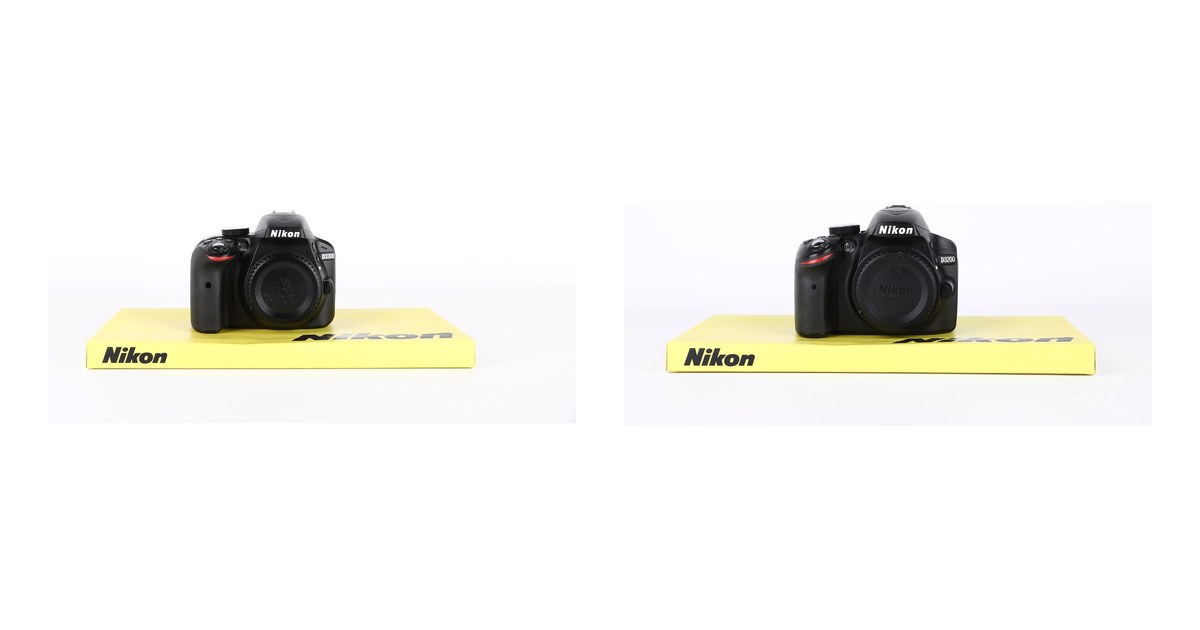
In short
- The D3200 (2012) and D3300 (2014) both feature a 24.2 MP APS-C sensor and the same 11-point autofocus system. On a used camera body costing 200 euros, resolution is not the limiting factor.
- The D3300 removes the low-pass filter, upgrades to the Expeed 4 processor, shoots at 5 fps instead of 4, records 1080p video at 60 fps, and delivers approximately 700 shutter count per charge compared to 540.
- Neither model has an AF motor in the camera body. Autofocus does not work with screw-drive AF-D lenses. AF-P lenses function only on the updated D3300, not on the D3200.
- At ReflexMania today, the Nikon D3200 is priced at 200 euros with 2 units available, and the D3100 at 150 euros with 3 units. All units are workshop-revised and come with a 2-year warranty.
Looking for a used Nikon D3300? The used Nikon D3300 page shows current availability and prices, with certified shutter count and a 2-year warranty. See also all used Nikon cameras.
At the counter, the question comes up at least once a week, almost always with the same words: “I want to start with a DSLR, I have 200 euros, what should I buy?” Many times, the person asking has already looked at the listings and stopped at a Nikon D3200 or D3300. They saw 24 megapixels at a price that seems like a mistake and want to understand where the catch is. We have processed several hundred of these two models through our workshop. Some had 4,000 shutter counts, while others reached 80,000 with a worn mode dial and a dust-covered sensor.
Here is what you need to make a decision: what actually changes between the D3200 and D3300, which limitations they share, and which lenses make sense. Then, what to check on a used unit and how much it is reasonable to spend today. I also tell you when it is worth adding a few tens of euros to move up a class, and when one of the two is more than enough for the first two or three years.
Why the D3200 and D3300 are still the DSLRs to start with in 2026
For 200 euros, you can still buy a 24-megapixel APS-C sensor with interchangeable lenses and an optical viewfinder. That is why the D3200 and D3300 still pass through our counter every week, almost always destined for those buying their first DSLR.
What they are in the Nikon range
The D3200 is from 2012 and the D3300 from 2014. They are the entry-level models of the D3xxx series, which in Nikon's DX lineup sat below the D5xxx and D7xxx. Nikon sold huge numbers of these in kits to beginners, and many saw little use before ending up in a drawer. Nikon then shifted its development focus to Z mirrorless. High supply and low demand have pushed used prices below 200-250 euros.
Against today's smartphone, they fall short on convenience, sharing, and video stabilization. However, they excel where it matters for learning:
- APS-C Sensor: it has a surface area several times larger than the main sensor in a phone. This is visible in indoor and sunset photos, without software having to reconstruct details.
- Interchangeable Lenses: the same body works with a bright 35 mm lens or a telephoto. The phone is stuck with the focal lengths it has.
- Optical Viewfinder: it covers 95% of the frame, is readable in sunlight, and has no lag.
- Real Bokeh: it comes from the lens, not from an algorithm that fails on hair, glasses, and edges.
These are for those taking a first photography course, the student who needs to learn exposure, and the parent who wants something better than a phone for school performances. They are not for those who shoot mainly to post immediately on social media: there, the DSLR stays in the backpack and the phone wins.
The Guide Mode: genuinely useful or just marketing
Both feature the GUIDE mode on the dial. Here’s how it works: instead of asking for aperture and shutter speed, it asks what you want to achieve. Choose “blur the background” and the camera switches to aperture priority. Choose “freeze motion” and it sets shutter priority, complete with a sample image showing the effect.
In the first few months, it is truly useful because it links every adjustment to a visible result. However, it has two drawbacks: every shutter count requires more menu steps, and some settings remain hidden. The advice we give at the counter is simple: use it for two or three months, then switch to A, S, and M. It only becomes a limitation if you stay there, because at that point you are selecting a scene from the menu without understanding exposure.
When you switch to A, observe how the background changes between f/3.5 and f/8: on a single afternoon, the camera teaches you more than any automatic mode ever could.
D3200 vs D3300: the differences that matter
Both camera bodies share the same resolution, 24.2 MP on APS-C, and the same 11-point autofocus. What changes is what surrounds them, and not everything carries the same weight when the camera is in hand. The table provides a point-by-point comparison, highlighting the real-world impact of each difference.
| Feature | D3200 | D3300 | In practice |
|---|---|---|---|
| Low-pass filter | Yes | No | Only noticeable with good lenses |
| Processor | Expeed 3 | Expeed 4 | Half to one stop more at high ISOs |
| Native ISO | 100-6400 | 100-12800 | Above 3200 is rarely useful on either |
| Burst rate | 4 fps | 5 fps | Marginal difference |
| Full HD Video | up to 30 fps | up to 60 fps | Useful for slowing down in post |
| CIPA battery life | 540 shutter count | 700 shutter count | Useful for travel, less so for daily use |
| Weight with battery | approx. 505 g | approx. 460 g | Barely noticeable when worn around the neck |
| Kit lens | 18-55 VR | 18-55 VR II retractable | With the D3300, a smaller bag is enough |
Low-pass filter: how much is visible
Nikon removed the filter from the D3300 to gain more detail, and the improvement is there. However, it is only visible with a sharp lens and when viewing the file at 100%. With the kit 18-55, at f/8 and on a 20x30 print, distinguishing between the two cameras is difficult. The downside is moiré: with closely striped shirts or technical fabrics, the D3300 may show colored bands that need to be corrected later in post-production.
High ISO Noise: Expeed 3 vs Expeed 4
With the cameras that pass through our bench, the D3200 stays clean up to ISO 1600 and is acceptable at 3200, provided you don't crop. The D3300 recovers from half a stop to a full stop: at 3200, it is still usable without much thought. The difference matters in interiors, at birthday parties, and in gyms. To freeze a running child at 1/500 with the kit lens at f/5.6, under the lights of a sports hall, you are almost always above 3200 ISO.
Video, burst and battery
- Video: both record in 1080p, but only the D3300 reaches 60 fps. For standard shooting at 25 or 30 fps, they are equivalent. 60p is only useful if you plan to slow down footage by half in post-production.
- Burst: 4 fps vs 5 fps. Neither is a sports camera, and one extra frame per second won't change the outcome of a match.
- Battery: EN-EL14 and EN-EL14a batteries are compatible with both, so spare batteries can be swapped without issues. According to the CIPA standard, the D3300 delivers 700 shutter count per charge, while the D3200 delivers 540: on a day out with a spare battery, neither will run out of power.
If you mostly shoot during the day with the kit lens, a Nikon D3200 at 200 euros gives you almost everything the D3300 offers. The D3300 is worth the premium if you frequently shoot indoors or if 60p video is truly essential for you.
The limitations both have, to know before buying
Most of the inquiries we receive about these two cameras come after purchasing a lens that "doesn't focus." The camera works: it's simply that the D3200 and D3300 have three design limitations that no listing mentions. They are not defects. They are trade-offs to be aware of beforehand, so you don't discover them after six months.
No AF motor in the body: which lenses work
Entry-level Nikon cameras do not have the motor that drives the screw of older autofocus lenses. The motor must be built into the lens. In practice, the situation is as follows:
| Lens type | D3200 | D3300 |
|---|---|---|
| AF-S (e.g., 35mm f/1.8G DX, 50mm f/1.8G) | Autofocus yes | Autofocus yes |
| AF and AF-D screw (e.g., 50mm f/1.8 D, 80-200 f/2.8 D) | Manual only | Manual only |
| AF-P (e.g., 18-55 AF-P VR, 70-300 AF-P DX) | Incompatible | Yes, with updated firmware |
The 50mm f/1.8 D at 80 euros looks like a bargain, and on paper it is. However, on these cameras you focus manually, using the focus confirmation dot in the viewfinder. The light meter works, but autofocus does not. Before buying a used lens separately, look for the AF-S or AF-P designation in the name.
11-point autofocus and pentaprinder viewfinder
The 11 points are few, but the real limitation is another: there is only one cross point, the central one. The other 10 are more sensitive to lines in a single direction and lose precision in low light. For portraits, landscapes, travel, and family photos, this is more than enough. For sports, running children, or birds in flight, AF-C tracking loses the subject too often.
The viewfinder covers 95% of the frame, so something you didn't see ends up in the photo at the edges. Being a pentamirror, it is also smaller and darker than the pentaprism of a Nikon D7000. With manual focus, the difference is noticeable.
Controls: a single dial and no Wi-Fi
These are the limitations you notice after 6-12 months of serious use, once you start shooting in manual mode:
- One dial only. In M mode, the dial controls shutter speed; for aperture, you must hold down the exposure compensation button. ISO and white balance are accessed via the quick menu. You can do everything, but more slowly.
- No built-in Wi-Fi. You need the Nikon WU-1a adapter, which must be purchased separately, and the app that manages it is outdated. In practice, photos are downloaded from the SD card.
- Slow live view. On-screen focusing uses contrast detection and takes 1-2 seconds. It works fine for stationary subjects, but much less so for videos with moving subjects.
If you shoot on weekends, in automatic or aperture priority mode, you will hardly notice these limitations. However, if you enroll in a course and switch to manual mode right away, keep them in mind.
What to check on a used D3200 or D3300
On these two Nikon models, the sensor rarely fails. What wears out is the small mechanics, the parts the first owner touched every day. Ten minutes of testing when you meet the seller avoids almost all surprises.
Shutter count: how to read it and when it's too high
Nikon cameras store the shutter count in the EXIF data of every photo. Ask the seller for a recently taken, unedited JPG. Do not send it via WhatsApp, as it strips the metadata. Open it with ExifTool or an online EXIF viewer and look for the "Shutter Count" field.
Nikon does not specify the shutter count lifespan for its entry-level models. We rely on our counter experience. Below 20,000 shutter count, the camera is lightly used; between 20,000 and 50,000, it is within normal limits. Beyond 50,000, the camera body still functions, but the price must be lower.
Typical defects we see at the counter
- Mode dial: rotate it through all positions. If it feels sluggish, skips a position, or does not stop with a crisp click, the internal contacts are worn.
- SD card door: the plastic latch breaks frequently. If the door does not stay closed on its own or is held shut with adhesive tape, factor that in.
- Pop-up flash: in Auto mode, in a dark room, it must rise on its own and fire. If it stays down or stops halfway, the mechanism needs repair.
- Grip rubber: if it is peeling or swollen, it is purely a cosmetic issue. However, it tells you how the camera body was stored.
- Sensor: take a shot at f/16 against a uniform sky and zoom in on the image. Sharp dots are dust. Softer, more concentrated spots in a specific area are often oil.
- Display: view a dark photo in full screen. A colored dot that is always on in the same spot is a dead pixel.
- Battery: the D3200 uses the Nikon EN-EL14, the D3300 the EN-EL14a. Cheap compatible batteries last much less and are sometimes sold as originals. Check the brand and label.
They are almost all the same shots from the guide to the used Nikon D5300, which has a very similar mechanical structure.
What we do in our workshop
Every camera body undergoes a shutter count check and sensor cleaning. We test the autofocus using a reference AF-S lens, ensuring that any defect in the body is not confused with one in the lens. Then we check the light meter, flash, USB and HDMI ports, and record a test video. The shutter count is included in the certificate, and the warranty is 2 years.
What do they cost today and what can you find on ReflexMania
Today, a refurbished Nikon D3200 costs 200 euros, and we have 2 units in stock. The D3300, on the other hand, is currently unavailable. It is best to be upfront: anyone looking for that model needs to decide whether it is worth waiting for it or buying the D3200 immediately.
The right price for a D3200 and a D3300
Those 200 euros are the reference for a lab-tested camera body, with original battery and charger, and a 2-year warranty. On the used market, the D3300 is generally a few dozen euros higher. More than the model itself, it is the kit lens that causes the price to fluctuate: the presence of the 18-55 and its specific version affect the final price more than the difference between the two camera bodies.
Under €120–130 from a private seller, you should be wary. In the cases we see at the counter, at that price the charger is missing, the battery is not original, or the shutter count is high. The €70 savings disappear with the first compatible battery that swells or the first shutter that needs replacing.
Waiting for the D3300 makes sense in three specific cases:
- Video recording and you need 1080p at 60 fps for smoother motion.
- You want to use AF-P lenses, which do not focus on the D3200.
- You shoot long days without being able to recharge, and the battery life difference matters to you.
For everything else (family photos, travel, a first course), the difference in image quality does not justify weeks of waiting.
Nikon alternatives in the same price range
If your budget is fixed, our catalog features other Nikon DSLRs between 110 and 200 euros. They cost roughly the same, but they don't serve the same users.
| Model | Price | Units | Who it's for |
|---|---|---|---|
| Nikon D3100 | €150 | 3 | 14 MP. Only if your budget is truly tight. |
| Nikon D3000 | €150 | 1 | 10 MP CCD sensor. Not recommended for those looking to advance their skills. |
| Nikon D5100 | €200 | 2 | 16 MP and articulating screen. A solid choice for video shooters. |
| Nikon D70S | €110 | 1 | Features an AF motor but only 6 MP. For enthusiasts and collectors. |
With 200 euros in your pocket, the D3200 is the choice for those who photograph, while the D5100 is for those who alternate between photos and video. The D3100 saves you 50 euros but forces you to give up 10 megapixels on a camera body you will keep for years. The D70S is the only one on the list that can focus with older AF-D lenses. However, with 6 MP, it is more of a collector's item than a camera to learn with.
Which lens to pair to make the most of 24 megapixels
At 24 megapixels on APS-C, the lens is evident in every file. A 100% crop immediately reveals whether the limitation lies with the lens rather than the sensor. The camera body, on the other hand, matters less than one might think. For this reason, the order of purchases carries weight, and with these two cameras, the AF-S/AF-P constraint must always be prioritized.
The 18-55 kit lens: VR or non-VR, retractable or not
The D3200 shipped with the AF-S DX 18-55mm f/3.5-5.6G VR, while the D3300 came with the retractable 18-55 VR II. These are honest lenses. Stopped down to f/8, they deliver sharp files in the center and acceptable results at the edges, more than sufficient for a 30x40 print. The retractable design takes up less space in your bag, but it has an extra mechanism that tends to develop play with use. Before buying, check that it extends and locks without any effort.
Handheld, the stabilizer delivers roughly 2-3 real stops, less than the box promises. It saves you a 1/15 second on a stationary subject. It won't freeze a walking person and is useless for running kids: there, shutter speed is what counts. If you find an 18-55 without VR for a few euros less, it's perfectly fine for daytime photography.
Your first real purchase: AF-S DX 35mm f/1.8G
If you have to spend money on just one thing, spend it here. The 35mm f/1.8G DX can be found used for between 100 and 150 euros and is equivalent to a 50mm on APS-C. It gives you three things the kit lens cannot:
- Indoor lighting: f/1.8 versus f/5.6 is more than 3 stops. This means ISO 800 instead of ISO 6400, and these sensors make a real difference.
- True bokeh: the background separates even at half-body length, something impossible with a 55mm kit lens.
- Sharpness: already at f/2.8 it makes full use of the sensor, especially on the D3300 which lacks a low-pass filter.
Those who primarily shoot portraits can choose the AF-S 50mm f/1.8G, which becomes a 75mm equivalent on APS-C. Do not confuse it with the 50mm f/1.8 D, which is cheaper and more widespread: on these cameras, it can only be focused manually.
Budget tele: AF-P 70-300 only with the D3300
The AF-P DX 70-300mm f/4.5-6.3G ED VR is lightweight, quiet, and fast to focus. However, it only works on the D3300 with updated firmware. The D3200 does not support the AF-P, so the older AF-S DX 55-200mm VR is required, which is shorter and slower but fully compatible.
If you already know you want to photograph your children's sports, animals, or birds, this difference alone may lead you to choose the D3300. The same applies to a more recent camera like the one we describe in our guide to the used Nikon D5600. Those who buy the Nikon D3200 for 200 euros should budget for the 55-200. The sensible order of purchases remains this:
- 18-55 from the kit, to get started.
- 35mm f/1.8G, for a step up in quality.
- Telephotos: AF-P 70-300 on the D3300, AF-S 55-200 VR on the D3200.
When it’s worth spending more and stepping up to a higher tier
Not everyone who walks into our store asking for a D3200 should leave with a D3200. There are two specific situations where the cheaper option becomes the more expensive one within a year, and one where it is the right choice.
If you already have AF-D lenses at home
It happens often: the customer arrives with their father's 50mm f/1.8 D or an old AF-D zoom bought with a film camera. On the D3200 and D3300, these lenses mount, but they must be focused manually. With the small viewfinder of these two bodies, manual focusing at f/1.8 becomes difficult to nail down.
The D7000 and D7100 have the AF motor in the camera body, allowing these lenses to operate in autofocus. They also feature the dual command dials, a 100% viewfinder, and a 39-point AF system (D7000) or 51-point AF system (D7100). If you already own two AF-D lenses, the camera body costs more, but you don't need to buy new lenses, resulting in a lower total expenditure. For more details, check out our article on the used Nikon D7100.
If you shoot sports, running kids, or video
With 11 AF points, only one of which is a cross-type, a subject moving laterally exits the active points and the camera focuses on the background. The 95% viewfinder does the rest: you see at the edges what you hadn't noticed. In a children's football match, this means wasting many shutter counts.
- For action: D7000 or D7100, for the AF points and faster handling with the two dials.
- For video and low or high angles: D5300 or D5600, with 39-point AF in the viewfinder, articulating screen and built-in Wi-Fi. The D5600 also has a touch screen, which in live view allows you to select the focus point with a finger.
A note on the Nikon D5100, which we currently have for 200 euros: it features a tilting screen, useful for video and low-angle shots. However, it retains the same 11-point AF system and a 16 MP sensor. For video, it costs the same as a D3200 but performs better, yet it offers no real advantage for sports photography.
If your budget is 200 euros and that's all you have
In this case, the answer is simple: a D3200 with the 18-55 VR. To learn exposure, composition, and light usage, nothing else is needed, and the limitations mentioned above do not weigh on those who photograph landscapes, portraits, travel, and family.
What you save on the body goes into the 35mm f/1.8 DX, which works in autofocus on this camera. It is the purchase that improves your photos more than any jump in body class. You upgrade the body later, once you know which limit you are actually hitting.
Frequently asked questions
Which is better, a used Nikon D3200 or a D3300?
If the price difference is within 30-40 euros, go for the D3300: it is cleaner at high ISOs, has better battery life, records video in 60p, and works with AF-P lenses. If you find a refurbished D3200 for 200 euros and the D3300 costs significantly more, the D3200 remains an excellent starting point.
How many shutter counts can a D3200 or a D3300 handle before failing?
Nikon does not declare an official shutter lifespan for these entry-level models. At our workshop, we consider camera bodies with under 20,000 shutter counts to be lightly used; beyond 50,000, the price should be lower. Many units easily exceed 70,000-80,000 shutter counts.
Does the 50mm f/1.8 D focus on the D3200 and D3300?
No. Neither has an autofocus motor in the camera body, so with AF and AF-D lenses, focus is manual only. For autofocus, you need an AF-S lens, for example the 50mm f/1.8G or the DX 35mm f/1.8G.
Can I use AF-P lenses on the D3200?
No: Nikon does not list the D3200 among the camera bodies compatible with AF-P lenses. The D3300 is compatible if the firmware is updated to at least version 1.02. Verify this before buying an AF-P 18-55 or 70-300.
How do I read the shutter count of a used Nikon?
Take a shot and open the file with ExifTool or an online EXIF reader: Nikon cameras save the shutter count in the metadata. Be wary of sellers who only send resized photos or images shared via social media, as EXIF data is usually removed.
In 2026, does a €200 DSLR still make sense over a smartphone?
Yes, if you want to learn exposure, depth of field, and lens usage. The 24 MP APS-C sensor has an area approximately 3 times (compared to top-tier phones with 1-inch sensors) to over 10 times (compared to many mid-range phones) that of a smartphone's main sensor, and the bokeh is optical, not calculated. However, if you only take shots for social media and have no intention of changing lenses, a smartphone is sufficient.
Want a Nikon DSLR checked by our lab?
If you have doubts about a purchase or need advice for your specific case, contact us. We offer free advice because we are photographers first, sellers second, and because a customer who buys the wrong gear stops taking photos.
Three ways to get in touch:
- Contact form — response within 24 business hours
- WhatsApp at 342 362 3454 (messages only)
- Phone: 071 291 6347 (Mon-Fri 9-13/15-18, Sat 9-13)
And if you want to see what we have in stock right now, explore the used gear available today: every camera is certified, comes with a 2-year warranty, and ships within 24-48 hours.
Article written by Matteo for the ReflexMania Team. Last updated: November 2026. Prices and availability refer to the time of publication.