
In summary
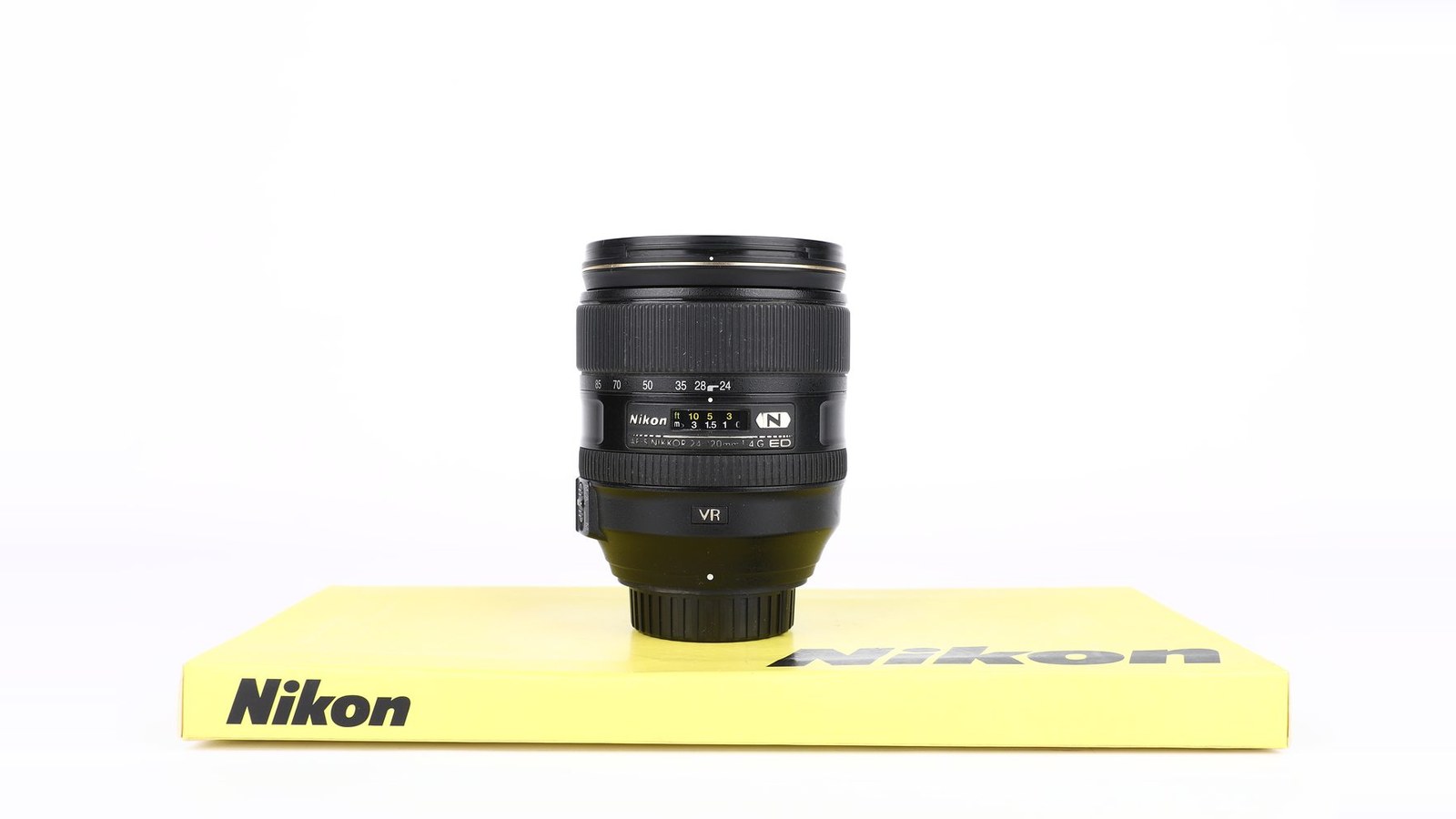
- There are three 24-120 Nikon lenses: the AF-S f/3.5-5.6G from 2003 (to be avoided), the AF-S f/4G ED VR from 2010 (the right one for F-mount), and the NIKKOR Z 24-120mm f/4 S from 2021.
- The f/4G ED VR weighs 710 grams, accepts 77mm filters, and focuses from 45 cm: used, it ranges from 320 to 480 euros, often separated from D750 and D810 kits.
- At 24mm, barrel distortion and soft corners at maximum aperture are real: from 35 to 85mm performance improves and remains constant up to 120mm when stopped down to f/5.6.
- The NIKKOR Z 24-120mm f/4 S has no optical stabilization and relies on the camera body's IBIS: used, it ranges from 750 to 900 euros, about twice the price of the F-mount version.
Looking for a used Nikon 24-120mm f4 G ED VR? The used Nikon 24-120mm f4 G ED VR page shows current availability and prices, with a 2-year warranty. See also all used Nikon lenses.
At the counter, the same scene plays out. Someone walks in with a used D750 and a 50mm f/1.8 in their bag, asking which zoom to get so they don't have to change lenses ten times a day. Nine times out of ten, we end up talking about the 24-120mm f/4, because it's the lens that came in the original kit for that camera body and is now available separately, at a low price, in excellent condition.
In this article, I summarize what I have seen come through the workshop for this lens: the three existing versions and which one to avoid, where it truly performs and where it falls short, its current used market price, and the specific defects to check before paying. At the end, you will also find the cases where the 24-120 is not the right choice and spending less leads to better results.
Three lenses with the same name: which one are you actually buying
Searching for "Nikon 24-120" on the used market returns listings ranging from 130 euros to 880 euros. This is not a negotiation range: these are three different lenses, designed eighteen years apart, that share only the focal length. Whoever buys the cheapest one thinking they've struck a bargain is buying the version the market has already rejected.
AF-S 24-120mm f/3.5-5.6G IF-ED VR (2003): the one to keep on the shelf
You can tell it apart in two seconds: the front ring says 1:3.5-5.6, not 1:4. It is the only one of the three with a variable aperture, and at 120mm it operates at a fixed f/5.6. The VR is first generation, rated for two stops, compared to the four stops of the VR II mounted on the f/4G (the Z, for its part, does not have optical VR at all).
The real issue isn't the aperture: it's the performance at the extremes. At 24mm, the corners remain soft even when stopped down, and at 120mm, contrast drops noticeably on 24-megapixel files. In 2003, it was mounted on 6-megapixel camera bodies and held up. On a D750, it no longer does. Paying 150 euros means spending a third of the price for a tenth of the satisfaction, and reselling it will be slow: informed used-gear buyers avoid it.
AF-S 24-120mm f/4G ED VR (2010): the reference version in F-mount
This is the lens discussed in the rest of the article. 17-element design in 13 groups, including 2 ED and 3 aspherical elements, Nano Crystal Coat coating, 9 rounded aperture blades. Constant f/4 aperture throughout the zoom range, VR II rated at four stops, minimum focus distance of 45 cm, 77mm filter thread, 710 grams.
There are many on the used market for a specific reason: it was the kit lens for the D750, D810 and D610. Thousands of people bought the kit, kept the body, and resold the lens within six months. This is why prices are reasonable and, often, examples have very little use.
NIKKOR Z 24-120mm f/4 S (2021): the mirrorless reissue
Redesigned from scratch for the Z mount: 630 grams, minimum focus distance of 35 cm with an approximate 1:2.6 magnification ratio at 120mm, dual stepping motors, programmable L-Fn button, OLED display on the barrel, and weather sealing.
A detail that marketing doesn't put front and center: it has no optical stabilization. It relies entirely on the body's IBIS. On a Z6 II or Z7 II, it's not an issue. On a Z50 or a Zfc, which lack IBIS, you're left with no stabilization at all.
Comparing the three versions of the Nikon 24-120mm
| Model | Year | Mount | Weight | Filter | Min. Focal Length | Used Price |
|---|---|---|---|---|---|---|
| AF-S 24-120mm f/3.5-5.6G IF-ED VR | 2003 | F (FX) | 575 g | 72 mm | 50 cm | 120-180 € |
| AF-S 24-120mm f/4G ED VR | 2010 | F (FX) | 710 g | 77 mm | 45 cm | 320-480 € |
| NIKKOR Z 24-120mm f/4 S | 2021 | Z (FX) | 630 g | 77 mm | 35 cm | 750-900 € |
Field performance: where it excels and where it falls short
A 24-120 f/4 is not a lens that excels everywhere: it is a lens that excels in a precise range of the zoom and pays the price at the extremes. Those who use it for years learn which focal lengths to trust at full aperture and which not to. Below is the map, without the filter of review enthusiasm.
24mm: the weakest focal length in the range
At 24mm, barrel distortion is pronounced and visible to the naked eye on any straight line near the edge of the frame: architecture, doorframes, sea horizons. Vignetting at f/4 is equally evident, especially on full-frame camera bodies. The corners lag behind the center until f/5.6, and only truly recover around f/8.
This is a distinction that many reviews overlook. Distortion can be corrected: Nikon in-camera profiles for JPEGs and Adobe profiles for RAW files straighten it out automatically, without you having to do anything. Corner detail, however, cannot. No software profile can reconstruct resolution that the lens did not imprint on the sensor. If you print large or crop into the edges, you will still see that difference.
Practical rule: if your 24mm work involves landscapes or interiors with detail extending to the corners, stop down to f/8 and use a tripod. If it's handheld reportage, f/4 is fine because the corners in that type of image rarely carry critical information.
From 35 to 120mm: the range where the lens performs best
From 35mm upwards, the situation changes. The center is sharp already at f/4, and uniformity across the frame becomes good at f/5.6, remaining constant up to 120mm. This is the range where this lens justifies its price.
- 85-120mm f/4 — environmental portrait: at 2-3 meters from the subject on full frame, the background separates in a credible way. It is not an 85mm f/1.8, but it separates.
- 35-50mm — reportage and events: sharpness ready at full aperture, no need to stop down.
- 85-120mm f/5.6-f/8 — light still life and product details, with a minimum focus distance of 45 cm that covers small subjects without changing the lens.
On a high-resolution camera body, the difference between the two ranges is more noticeable: if you are considering pairing it with a used Nikon D810 with 36 megapixels, keep in mind that its sensor highlights any corner weaknesses at 24mm, while it performs excellently in the 35-120mm range.
The declared VR and what you actually get in hand
Nikon claims approximately 4 stops of VR II performance when mounted on this lens. In practice, with a stationary subject and clean technique, 1/15s at 120mm succeeds with a good success rate — but "good success rate" does not mean every shutter count. In a sequence of ten, expect to discard a few.
The most costly misunderstanding concerns what VR stabilizes. It compensates for your movement, not that of the subject. In an indoor setting at f/4, with a moving person, 1/15 sec will give you a stable image but a blurred subject. In that case, the solution is to raise the ISO to achieve 1/125 or 1/250 sec, rather than relying on stabilization.
Which Nikon camera bodies make sense to mount it on
This lens was designed to complement a 24-megapixel sensor, and on that type of camera body it continues to deliver its best performance. Moving to higher resolution doesn't break anything, but it changes what you see when you open the file at 100%. It is advisable to do the math before buying, not after.
D750 and D610: the natural pairing
These are the camera bodies with which the 24-120mm f/4G was sold in a kit, and it is no coincidence. The 24 megapixels of the sensor do not put pressure on the edges of the image: what is soft at 24mm f/4 in the corners remains within an acceptable threshold for printing up to 30x40. The balance in hand is correct, without the heavy nose that an f/2.8 zoom gives you.
The total weight is around 1.5 kg with battery and card included. It's a camera you can carry around your neck all day without hating it by the fifth hour. If you're considering the camera body in addition to the lens, we've written a dedicated piece on the used Nikon D750 and why it remains the most balanced Nikon full frame on the used market.
D810 and D850: when the sensor sees the lens limits
With 36 and 45 megapixels, the discussion changes. At 24mm f/4, soft corners are no longer a detail for pixel peepers: you see them at 100% without looking for them, and you see them even if you crop the edge of a frame. The lens remains perfectly usable — at 50mm f/5.6 on a D850 it takes photos that no one would dispute — but there is a fundamental contradiction.
If you invested in a high-resolution camera body, it was for the detail. Pairing it with a zoom that fails to resolve fine details at the extremes is an elegant way to waste half the megapixels. On these bodies, a 24-70mm f/2.8, or a prime lens directly, delivers what the sensor is capable of recording.
On DX bodies: becomes a 36-180mm equivalent
The 1.5x crop factor shifts everything toward the telephoto end. You lose the wide-angle, which was half the reason for buying this lens, and end up with a good travel zoom on a D7200 or D500.
- It makes sense if you shoot portraits, details, or street photography at medium distances and never need a wide-angle.
- It doesn't make sense if you photograph interiors, landscapes, or architecture: 36mm equivalent is too narrow.
- The correct alternative on DX is the Nikon AF-S DX 16-80mm f/2.8-4E ED VR, which covers 24-120mm equivalent and was designed for these sensors.
Adapted to Z bodies with FTZ
The AF-S has a built-in autofocus motor, so via the FTZ adapter it maintains full autofocus on the Z6, Z7, and derivatives. The lens's optical VR remains active and works in conjunction with the body's IBIS, without conflicts.
The price to pay is physical: the FTZ adds approximately 3 cm in length and 135 grams. The result is a long, front-heavy setup that is manageable on a Z6 but not elegant. It works as a bridge solution for those who already have the lens; however, if you are planning a purchase specifically for a Z body, it is worth considering other options.
Version F or Version Z: Is the difference worth double the price?
The NIKKOR Z 24-120mm f/4 S costs about twice as much used as the AF-S 24-120mm f/4G ED VR. The right question is not which one is the best — we know it's the Z — but whether that 400 euro difference produces better photographs in your specific case. Often the answer is no, and anyone telling you otherwise has an interest in selling you the 900 euro one.
What you really get with the Z S-line
The real, measurable differences, verified at the counter and in the field, are these:
- Minimum focus distance of 35 cm versus 45 cm. Ten centimeters may seem like little, but at 120mm they change the type of close-up you can achieve without changing the lens.
- Usable corners at f/4. On the F version, the corners at 24mm require f/5.6 to be sharp. On the Z, they hold up at full aperture.
- Silent AF in video. The motor of the F version is audible on the direct audio. If you record with the internal microphone, it is a concrete problem.
- More serious weather sealing and 80 grams less compared to the 710 grams of the F version.
In exchange, you give up the stabilization inside the lens: on a body without IBIS, the F version keeps its VR regardless, the Z does not.
The price in euros, no rhetorical discounts
| Version | Used price | What you get extra |
|---|---|---|
| AF-S 24-120mm f/4G ED VR | 320-480 euros | Integrated optical VR, widely available 77mm filters |
| NIKKOR Z 24-120mm f/4 S | 750-900 euros | Corners, minimal MAF, video AF, build quality |
The difference is around 400 euros. To put that figure in perspective: in our current catalog, a Canon EOS RP ranges from 520 to 600 euros, and a Sony A7 Mark II is priced at 570 euros. With the price gap between the two versions of the 24-120, you are almost at the cost of a second used full-frame camera body.
I am not suggesting you switch systems: if you already have a Nikon lens park, that comparison would be pointless. It is simply there to remind you where your budget should go. If you shoot on a Z8 or a Z9 and print large, you will recover the extra 400 euros in image quality. If you mount on a D750 or a Z5 and publish online, the F version with 400 euros saved is the clear choice.
When the 24-120 is not the right choice
Out of every three people who ask us about the 24-120 f/4G, at least one would be better off spending their money elsewhere. Not because the lens is poor, but because its convenience — a single piece covering wide-angle and medium telephoto — solves a problem that person doesn't have. It's worth being honest about three situations where the numbers don't add up.
Shooting indoors or at night: f/4 is not enough
The fixed f/4 aperture is constant, not bright. In a church, a restaurant, or at a wedding after sunset, you'll find yourself shooting at 1/60 second with ISO 3200. At that point, VR keeps the camera steady but not the moving people. Subject motion is the real limit, not micro-shake.
Those who frequently work in such conditions have two sensible options:
- Nikon AF-S 24-70mm f/2.8G ED, used around 700-800 euros, approximately 900 grams. A full stop means ISO 1600 instead of 3200, or 1/125 instead of 1/60. You lose the reach up to 120mm and carry almost 200 grams more on your shoulder.
- Nikon AF-S 35mm f/1.8G ED full frame, used around 300 euros. A 305-gram prime that handles low light better than any f/4 zoom, and costs less than half. You have to accept a single focal length and move with your feet.
If 70% of your shutter count is indoors without flash, the 35mm f/1.8G at 300 euros delivers better results than the 24-120 at 400. It is not a compromise; it is the correct choice.
If weight matters: the 24-85mm f/3.5-4.5G VR
For travel and street photography, 710 grams hanging around your neck for eight hours is noticeable. The Nikon AF-S 24-85mm f/3.5-4.5G ED VR weighs 465 grams, accepts 72mm filters, and can be found used between 180 and 250 euros — often detached from D610 and D750 kits.
| 24-120 f/4G | 24-85 f/3.5-4.5G VR | |
|---|---|---|
| Weight | 710 g | 465 g |
| Filters | 77 mm | 72 mm |
| Used | 320-480 € | 180-250 € |
Yields 35mm in the rear and about a third of a stop at the telephoto end. Anyone who doesn't print larger than 30x45 or crop aggressively won't notice the difference, saving both on price and back strain.
If you are still choosing your system
Here, the mistake is one of order, not model. Buying the lens before the body ties a €1,000 decision to a €400 purchase. If you already have F-mount lenses and a DSLR, the issue is different: we addressed this in the comparison between used Nikon D700 and D750, and in that case, the 24-120 f/4G remains the most coherent choice.
If you are starting from scratch with full frame, the calculation changes. A Sony A7 at 400 euros or a Sony A7r at 700 euros provide access to a lens lineup and adapters that a DSLR does not have. Choose the camera body first, then the lens: the reverse order costs twice as much when you change your mind.
24-120mm f/4G and its alternatives on the used Nikon F
| Lens | Weight | Useful range | Aperture | Indicative used price |
|---|---|---|---|---|
| 24-120mm f/4G ED VR | 710 g | 5x, wide-angle to short telephoto | constant f/4 | 320-480 € |
| 24-85mm f/3.5-4.5G ED VR | 465 g | 3.5x, travel | f/3.5-4.5 | 180-250 € |
| 24-70mm f/2.8G ED | 900 g | 2.9x, no telephoto | constant f/2.8 | 700-800 € |
| 35mm f/1.8G ED (prime) | 305 g | single focal length | f/1.8 | 280-330 € |
What to check before buying used
The 24-120mm f/4G ED VR was released in 2010 and remained on the market for over a decade: this means a unit in the shop window could be fifteen years old or just five. The difference is not visible from the camera body, which ages well, but from four mechanical details that always come up the same way on our workbench. If you buy from a private seller, you have ten minutes to check them, and it is worth using every single one of them.
The four typical defects of the 24-120 f/4G
These are known issues, not factory defects: they arise from use and how the lens has been handled.
- Zoom creep. Point the lens downwards at 24mm and release the ring. If the barrel extends on its own, the internal friction is worn. It does not compromise image quality, but it becomes annoying on a vertical tripod and cannot be fixed with a simple adjustment.
- Noisy VR. With VR set to OFF and the camera powered off, shake the lens near your ear. A dry rattle from the stabilizer group is normal. Continuous ticking or vibration with VR active indicates a failing unit: repair costs often exceed the value of the used lens.
- Oxidized contacts. Check the gold contacts on the mount. Greenish or dull spots indicate years of storage in a humid bag. They cause intermittent communication errors, typically a stuck aperture or out-of-scale exposures on one frame in twenty.
- Missing HB-53 lens hood. It is easily lost and costs around 45 euros separately. If missing, it is a concrete point of negotiation, not an aesthetic detail: it is truly necessary for a wide-angle lens with a bulging front element.
Fungus, haze, and delamination: how to inspect them properly
Stop holding lenses up to the window: it shows nothing useful. You need a flashlight pointed from the side, at an oblique angle to the optical axis, first on the front element and then on the rear element.
Internal dust is normal on any zoom lens with fifteen years of usage: small dark specks suspended in the air do not measurably affect contrast. What you should look for is different: a whitish, branching web that starts from the edge of the lens and extends toward the center. That is fungus; it grows and does not stop on its own. A uniform, milky haze instead indicates cement separation between the glued elements.
Then the aperture blades. Detach the lens, actuate the diaphragm lever on the mount and release: they must close and reopen instantly, without hesitation. If they remain sluggish or you see a moist reflection on the blades, oil has migrated from the group. On a lens that costs 320-480 euros, that repair is not worth it.
What we do in our workshop
Every lens that comes to us is opened for inspection, not just visually checked. We test them on an optical bench at all focal lengths, check back and front focus, verify that the VR operates within tolerance, and clean internal dust and residue. If the VR is out of spec, the lens is not put up for sale: we do not discount it, we hold it back. Lenses come with the same 2-year warranty as camera bodies.
Real prices today and what to expect from the negotiation
The 24-120mm f/4G ED VR has a broad and stable used market: high volume, stable prices, and overpriced units sit unsold for months. This benefits buyers by eliminating the uncertainty typical of rare lenses. You know exactly what you should pay before starting negotiations.
Price ranges by condition
These are the price ranges we see today in the Italian market, based on units that pass through our counter or that customers offer us as trade-ins.
| Condition | Price | What it means |
|---|---|---|
| Several signs of use, missing lens hood | 300-340 euros | Barrel shows wear, rubber is shiny. The original HB-53 lens hood costs around forty euros separately |
| Excellent condition with box | 380-430 euros | The most common range. Regular use, no functional issues |
| Like new | 450-500 euros | Often separated kits or second body examples |
Under €280, stop and ask why. It is not always a scam: sometimes it is a unit with a dead VR, other times it is the wrong version sold as the right one, and other times there is internal dust that the seller calls "normal for the age". In all three cases, the difference compared to a healthy unit far exceeds the savings.
The detached kit factor
Many 24-120 f/4G units in circulation come from D750 and D810 kits. Buyers of those camera bodies often already had their own lenses and resold the lens almost immediately: we are talking about examples with only a few months of real use, sometimes with fewer than ten shutter counts on their shoulders. These are the best deals in the category.
- Box with kit code: it references the body, not the code of the lens sold individually
- Original bag or strap, never opened: an accessory nobody uses, it stays in the packaging
- Caps still shiny: Nikon caps scratch quickly; if they are intact, the lens has seen little use
If you still need to buy the camera body, the €450 price of the lens weighs heavily on the total budget: we discussed this by looking at current prices for the used Nikon D700.
Frequently asked questions
Is the Nikon 24-120mm f/4 suitable for weddings?
As a second lens, yes; as the only one, no. At f/4 in a church or reception hall, you are forced to use ISO 6400 and above, even on a D750. It works for preparations with window light and for outdoor shots, but for the ceremony, you need an f/2.8 or a fast prime.
How do I distinguish the f/4 version from the f/3.5-5.6 version in a listing?
The marking is printed on the front ring around the lens and in the full name. The f/4 takes 77mm filters, the f/3.5-5.6 takes 72mm filters. If the listing only mentions 24-120 VR without the aperture, ask for a photo of the front before negotiating.
Does the NIKKOR Z 24-120mm f/4 S work on Z5 and Z6 without issues?
Yes, and on those camera bodies, stabilization comes from IBIS because the lens does not have optical VR. On a Z50 or Z fc, which are APS-C and lack IBIS, it becomes a completely unstabilized 36-180 equivalent: a nonsensical combination.
Is it worth buying the 24-120mm f/4G to use on Z with an FTZ adapter?
It makes sense if you already have the lens or if your budget is under 500 euros. Autofocus works well because the AF-S has a built-in motor. If, however, you are starting from scratch and your budget reaches 800 euros, the native Z version is optically better and saves you 135 grams of adapter.
How long does the VR on these lenses last?
On units that pass through the lab, the VR is generally healthy even after ten years. Problematic cases can be identified by the noise: a continuous ticking or a vibration perceptible with the VR turned off indicates that the stabilization unit is not locking into its resting position.
Is the lens weather-sealed?
The f/4G version has a gasket on the mount but is not sealed like the 24-70 f/2.8. It can handle light rain with the lens hood attached, but not a day in the rain. The Z S-line version has more extensive sealing and a fluorine coating on the front element.
Is the 24-120mm f/4 better than two budget primes?
It depends on how you shoot. If you move between different situations at the same event, the zoom wins for practicality. If you know in advance what you are photographing, a 35mm f/1.8G plus an 85mm f/1.8G cost about 580 euros used together and give you two stops more with superior rendering.
Want an opinion on your next Nikon lens?
If you have any doubts about a purchase or need advice for your specific case, contact us. We offer free advice because we are photographers first, sellers second, and because a customer who makes a bad purchase won't come back to photography.
Three ways to get in touch:
- Contact form — response within 24 business hours
- WhatsApp at 342 362 3454 (messages only)
- Phone: 071 291 6347 (Mon-Fri 9-13/15-18, Sat 9-13)
And if you want to see what we have in stock right away, explore the used gear available today: every camera is certified, comes with a 2-year warranty, and ships within 24-48 hours.
Article written by Matteo for the ReflexMania Team. Last updated: September 2026. Prices and availability refer to the time of publication.