
In short
- A used SD card costs 40-50% less, but NAND cells have a finite number of write cycles and no seller discloses this: you save 15 euros and risk an entire session.
- Used original batteries make sense: a new Sony NP-FZ100 costs 85 euros, while a used one with 40 cycles costs 45 and retains 80-90% of its rated capacity.
- New compatible batteries costing 20 euros often deliver only 60-70% of their rated mAh: on a Canon EOS RP, which uses the LP-E17 (1040 mAh), this means about 180 shutter count instead of the rated 250.
- Practical rule: used original battery yes, used memory card no. The price difference in euros between a new and a used SD card does not cover the cost of a single lost shoot.
At the counter, the question always comes up at the end, once the camera body has already been chosen. "I'll bring my own cards and batteries from home, the old ones still work fine." Sometimes that's true. Other times, that statement is the beginning of a phone call I receive three weeks later, from a customer who lost half of a wedding because a second-hand SanDisk stopped writing in the middle of the ceremony.
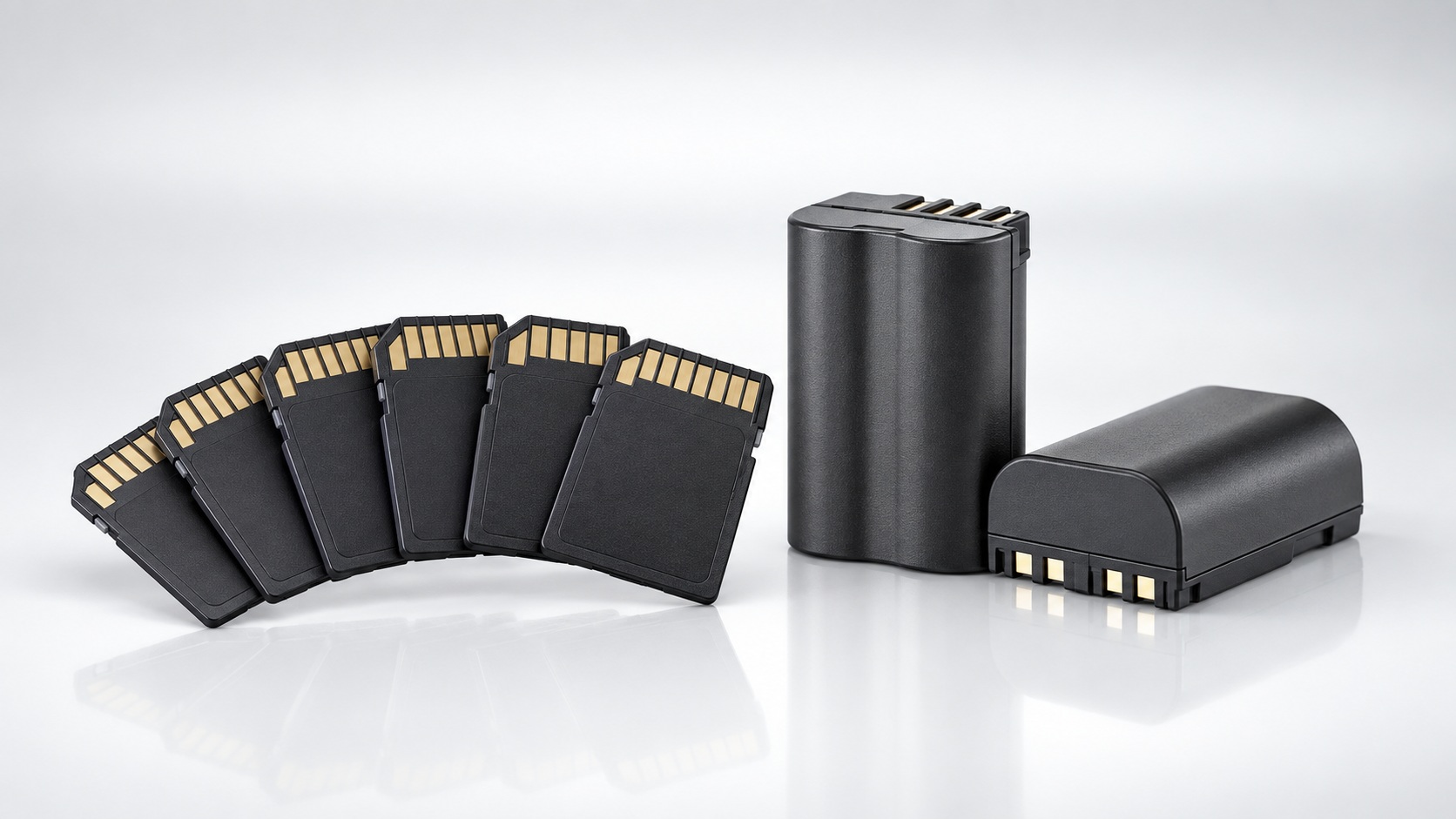
Memory cards and batteries are the only two photographic accessories that truly wear out. A well-used lens lasts thirty years, while a lab-reconditioned camera body lasts another ten. An SD card and a lithium-ion battery, however, degrade with every use in a measurable and irreversible way. This article explains how much they degrade, how to verify degradation before buying, and why the correct approach differs for the two components.
Why memory cards and batteries are a special case in the used market
In the used photography market, there is a rule that applies to 90% of the gear we buy: if a piece is intact today and works, with a serious overhaul it will last another ten years. That rule stops applying to memory cards and batteries, and neither of them tells you how much life is left in them.
The distinction to keep in mind is between mechanical wear and electrochemical wear. The former can be stopped and reversed. The latter goes in one direction only.
The camera body is serviced, the cell is not
In our workshop, a worn-out shutter is replaced, resetting the certified shutter count to zero on the new unit. A dusty sensor is cleaned. An oxidized mount contact is re-soldered. A loose ring is disassembled and adjusted. All these interventions restore the camera to its previous condition, with a cost known in advance.
A lithium cell that has lost 30% of its capacity cannot be regenerated: the degradation is chemical, occurring within the electrolyte, and no one can reverse it. A NAND block that has exhausted its write cycles is marked as unusable by the controller and permanently removed from the available space. For these two components, there is no maintenance, only replacement.
It changes the risk calculation. With a camera body, the question is "how much does it cost to get it back in shape". With a battery, the question is "how long do I have before I have to throw it away", and no one can give you a definite answer.
The cost of the repair is not the cost of the part
A new 64 GB UHS-II SD card costs around 45–55 euros. You can find one used for 25 euros. That’s a 25 euro saving. The photo shoot you record on it is worth between 400 and 1500 euros in fees, travel, and reputation, and in many cases it’s not repeatable: you don’t reshoot a wedding.
The criterion I use at the counter is the ratio between savings and potential damage:
- Used original battery — 40 euro savings, worst-case failure: the camera shuts down sooner and you swap in the second battery. Recoverable damage within twenty seconds.
- Used memory card — 20-25 euro savings, worst-case failure: corrupted files discovered at home, after the event is over. Unrecoverable damage.
- Used, refurbished camera body — 300-800 euro savings, worst-case failure: laboratory intervention with a predictable cost. Recoverable damage for a known expense.
It is the same reasoning we apply internally when deciding what to list for sale and what not to.
How a memory card actually wears out
An SD card doesn't die slowly like a battery. It stops working in an instant, almost always at the worst possible moment, and in most cases, it's not due to cell wear. A seller of a used card will tell you "it has taken few photos," but that data doesn't describe any of the mechanisms that actually cause it to fail.
Shutter count: what the manufacturer's numbers mean
Flash memory has a finite number of program/erase cycles per cell. The stated values vary by two orders of magnitude depending on the type of NAND.
| NAND Type | Bits per Cell | Declared P/E Cycles | Where Found |
|---|---|---|---|
| SLC | 1 | ~100,000 | Industrial cards, dashcams |
| MLC | 2 | 3,000 - 10,000 | High-end pro cards |
| TLC | 3 | 500 - 1,000 | Almost all consumer SD cards |
Wear leveling distributes writes across all blocks, so a 64 GB TLC SD card can theoretically withstand several thousand full writes. But that number is measured per cell, in a lab, at controlled temperature. It is not the number of full writes for the card in your bag at 38 degrees inside a car parked in the sun. The controller, the blocks reserved for mapping, and the management memory degrade on different curves, and none of them are declared.
The real killer isn't wear and tear, it's improper formatting and the controller
In practice, the batteries we receive back have not exhausted their cells. They fail for other reasons:
- File system corruption: card formatted on the computer instead of in the camera, or used on two different camera bodies without reformatting.
- Extraction during writing: door opened while the LED is still on. The allocation table remains incomplete.
- Controller failure: the NAND is intact, but the chip governing it no longer responds. The card becomes read-only or disappears from the system.
None of these three factors leaves a visible trace on a used camera body. The piece of plastic is identical before and after.
Counterfeits: the number one problem in the used market
SanDisk Extreme Pro and Lexar Professional are among the most counterfeited photographic products on the market. The mechanism is always the same: a card with 16 GB of actual storage and modified firmware that reports 128 GB to the operating system. You copy the files, the computer confirms the write, and the data beyond the first 16 GB vanishes. You notice when you reopen the folders.
On a second-hand listing, you don't have the box, you don't have a serial number verifiable on the manufacturer's website, and you don't have a retailer to hold accountable. You have a card in a small bag and the word of a stranger.
How to verify a used card before trusting it
A card can be tested in an hour, and the test costs zero euros. If the seller does not give you the time to do this before payment, you already have the answer you are looking for. The procedure that follows applies to SD, microSD, and CFexpress cards, and also to the cards you already have in your drawer and whose history you do not remember. You need a decent card reader connected directly to the computer: cheap USB hubs distort speed measurements and can corrupt the test.
Real capacity test with H2testw or F3
H2testw on Windows, F3 on Mac and Linux. Both do the same thing: they write verification files across the entire free space, then read them back and compare the checksums. It is the only way to know if the declared gigabytes actually exist and are readable.
Real-world times on a UHS-I reader: a 64 GB card takes 40-60 minutes for writing and reading, while a 128 GB card can take up to two hours. Let it run while you do something else. Here’s what you might get:
- Actual capacity matches the declared one, zero errors: healthy card, proceed.
- Actual capacity significantly lower (a "256 GB" card that only writes 29): counterfeit card with manipulated firmware. They are still in circulation, especially on generalist marketplaces.
- Correct capacity but scattered checksum errors: dead blocks that the controller failed to reallocate. Here the problem is worse than counterfeiting, because the card works until it suddenly stops.
Real speed with CrystalDiskMark
The capacity test tells you if the card is intact, not if it can handle your workflow. For that, you need CrystalDiskMark: check the sequential write value, not the random one, and compare it with the class printed on the card.
A card marked U3 must sustain a minimum of 30 MB/s in continuous write, while a V60 must maintain 60. These are guaranteed minimums, not peak speeds. If a used U3 measures 12 MB/s, single shots will continue to look normal, and the issue will only manifest in video: 4K recording will stop mid-clip, often without a comprehensible error message. The same applies to long RAW bursts, where the buffer empties at the speed of the card, not the camera.
Format the camera, always
Once the card has passed the tests, format it from the camera that will use it, never from the computer. Every camera body writes its own directory structure and cluster alignment, and a format performed by Windows or macOS leaves a geometry that the camera must then work around with every write.
This also applies to cards just bought new in-store, and it applies every time you move a card from one body to another. If you use the same card on a Nikon and a Sony, reformat it at each switch instead of deleting the photos from the menu: deleting leaves the previous body's structure in place.
Used batteries: degradation is measurable, and often low
The logic here is the opposite of what applies to memory cards. A lithium-ion battery does not hide its condition: it reports it to the camera body, which displays it in a menu. With a thirty-second check, you know whether you are looking at a healthy cell or one that should be discarded, and this completely changes the risk profile of the purchase.
Shutter count and remaining capacity: the real numbers
A lithium cell retains approximately 80% of its original capacity after 300-500 complete charge cycles. The point is that an amateur photographer performs 40-80 cycles per year: it takes six or seven years of normal use to reach that threshold. A five-year-old battery with amateur use is still above 85%, which on a shooting day means a handful of fewer shutter count, not an interrupted session.
Wedding and event photographers consume two or three batteries per event and reach 300 cycles within two seasons. However, those batteries rarely end up on the used market: they are used until they die.
Age matters as much as shutter count
Lithium degrades even when idle, and it is the aspect that almost no seller considers. A cell stored at 50% charge at room temperature loses 2-3% per year. Left at 100% inside a warm drawer, or completely discharged for months, it loses significantly more and may enter permanent protection.
Practical consequence: a 2015 battery that is "unused, still sealed" is not like new. It has lost 20-25% of its capacity and is worth less than a 2022 battery with 60 cycles. Be wary of the "zero shutter count, zero wear" argument: it does not apply to battery chemistry.
The shutter count in modern cameras
Before paying, insert the battery into the camera body and open the menu. It is the quickest test there is:
- Canon — "Battery Info" item: displays the residual charge as a percentage and charging performance across three bars. Available on the Canon EOS RP (from 520 euros, the most affordable full-frame entry into the RF system) and the Canon EOS R100 (from 375 euros, an ultra-light APS-C body, excellent as a second camera body). Both use the 1040 mAh LP-E17, so the batteries are interchangeable between the two.
- Nikon Z — "Battery Info" reports the cell age on a 0-4 scale: from 0 (new) to 4 (needs replacement). The most readable data point by far.
- Sony — on the α6000 and α7 series, the display shows the exact percentage instead of bars, which is useful for comparing two identical batteries.
Three full bars on Canon or a value of 0-1 on Nikon indicate a healthy cell. Two bars or a value of 2 are acceptable as a backup battery, not as a primary one. Below that, do not buy at any price.
Used originals vs. new compatibles: the real comparison
With 45 euros in hand, you have two options: an original used Sony NP-FZ100 with 40 cycles, or two new compatible batteries at 20 euros each, still in their sealed packaging. The second package may seem more cost-effective, and sellers of compatible batteries often aim to create exactly that impression. In practice, in the field, the two options do not deliver the same energy and do not communicate with the camera body in the same way.
| Aspect | Original used (40 cycles) | New compatible |
|---|---|---|
| Actual capacity | 80-90% of rated | 60-75% of rated |
| Percentage reading | Accurate to 1% | Often in three steps or absent |
| Body firmware | Recognized, updates OK | Some bodies block updates |
| Electronic protections | Overcharge and overheat protection standard | Circuit reduced to a minimum |
| Body damage | Covered by manufacturer | No real coverage |
Declared mAh of compatible batteries
A compatible battery claiming more mAh than the original is almost always lying. The lithium cells available on the market are the same for everyone: if Sony can fit 2280 mAh in that volume, a brand selling for 18 euros cannot fit 2600. The number printed on the label is not measured; it is decided by the marketing department.
The practical result is visible on the Canon EOS RP: the 250 certified shutter count declared with the original LP-E17 (1040 mAh) drops to approximately 180 with a compatible battery that actually delivers 650-750 mAh. This is not a nitpicky detail; it is a third of the battery life that disappears by midday.
What you lose with a compatible lens, even when it works
- Three-segment charge indicator instead of a precise percentage: you go from knowing you have 34% left to seeing a segment that lasts twenty minutes or two hours.
- Blocked firmware updates: several camera bodies refuse the update if they do not read an authenticated battery.
- Reduced protections against overcharging and overheating, the aspect cut to reach the 18 euro price point.
- No warranty if the battery damages the camera body's electronics. A power board repair costs more than all the compatible batteries you will buy in ten years.
When a compatible lens still makes sense
There is one case where a new compatible battery wins: older camera bodies whose original batteries are out of production. On a first-generation Sony A7 priced at 400 euros, the original NP-FW50 batteries in circulation are often ten years old and have spent half their time discharged. The same applies to the DMW-BLF19 batteries for a Panasonic GH4 priced at 320 euros.
A new compatible battery, kept as an emergency spare, is better than an original from 2013 with slightly swollen cells. On more recent bodies like the Sony A6000 at 360 euros, the used original market is still active and the choice changes: if you are evaluating which APS-C Sony to buy, the comparison between used A6000 and A6400 also touches on battery life. In our lab, we test every battery that comes out with a body, and we never mount compatible batteries on a camera for sale.
Warning signs on a second-hand battery
You can assess a battery in thirty seconds, before even inserting it into the camera body. Place it on a table, inspect it against the light, and check the contacts. Skipping this step means buying blind and then complaining about the used gear. Most serious issues are visible to the naked eye; the rest will surface during a field test that takes less than ten minutes.
Bulging: always reject
Swelling is the one defect with no appeal. A battery that does not sit perfectly flat on a table, or that fits with difficulty into the compartment when it used to slide in easily, has swollen cells due to electrolyte degradation. The gas produced by the chemical reaction does not reverse: there is no regeneration, no recalibration, and no charger that can fix it.
The risk is not only functional. A swollen cell can, in rare cases, undergo thermal runaway, which is more likely to occur during charging than during use. Dispose of it in designated battery waste containers; do not attempt to recover it. If a seller tells you that "you just need to fully discharge and recharge it," they are referring to a technology that has not existed since 2005.
Oxidized contacts and sudden charge drop
Metallic contacts must be shiny and uniform. Dull, dark, or greenish traces indicate moisture during storage, meaning the camera was kept in a basement, garage, or left in a car. Surface oxidation can be cleaned with isopropyl alcohol, but the real issue is what that moisture has done internally during the months the battery sat idle.
The second sign is behavioral. A battery that drains steadily down to 60% and then crashes to zero in a few minutes has an unbalanced cell compared to the others. The pack is not balanced, and it will not become balanced again: the internal electronics read the weakest cell and cut the power supply to protect the circuit. On a Sony A7 Mark III worth 750 euros, excellent precisely for the battery life of the NP-FZ100, a battery like this will leave you stranded in the middle of the ceremony.
The test we run in our lab
Our protocol for every battery that comes in is always the same:
- Full charge using the original charger, noting the time taken: an anomalously fast charge indicates low residual capacity.
- Inspection with a warm battery, immediately after charging: this is when marginal swelling becomes apparent.
- Continuous shooting sequence with the screen on, counting the images until the 20% threshold.
- Comparison with the CIPA rating declared for that camera body: below 70% of the nominal value, the battery does not leave the store.
The method also works on older camera bodies. On the Fujifilm X-H1 at 650 euros, which is strong in terms of stabilization and weather-sealed construction, the NP-W126S has modest battery life even when new: here, comparing it against the CIPA rating is the only way to distinguish a tired battery from a design limitation.
How much you actually save: the numbers
Savings on a common used memory card are 15-20 euros. Savings on a used original battery are 40 euros. These figures may seem close, but the associated risk is completely different, which changes the meaning of the purchase. You notice a battery losing capacity on the first day and replace it. You notice a corrupted card in the evening, when you download your photos.
| Item | New | Used / compatible | Savings | Worth it? |
|---|---|---|---|---|
| SD 64 GB UHS-I well-known brand | 28-35 € | 15-18 € | 13-17 € | No |
| SD 128 GB UHS-II | 85-110 € | 45-60 € | 35-50 € | No |
| Sony NP-FZ100 original | 85 € | 45 € (used, 40 cycles) | 40 € | Yes |
| Canon LP-E17 original | 65 € | 30-35 € (used) | 30-35 € | Yes |
The cost per year of use, not the purchase price
A new SD card costing 30 euros and lasting five years costs 6 euros per year. A used one bought for 15 euros, with an unknown history, that fails after eighteen months costs 10 euros per year. The 50% savings at the time of purchase turned into a 65% higher cost, and in the meantime, you lost what was on it.
When it comes to batteries, the math works in the opposite direction. An original NP-FZ100 at 45 euros with 40 cycles still has several hundred useful cycles ahead before dropping below 80% capacity. Over three years of amateur use, that’s 15 euros per year compared to 28 for a new one, and the degradation is gradual and measurable: no sudden surprises.
Accessory budget within the total budget
When buying a used camera body, most buyers focus almost exclusively on the body price. It’s the same mistake we see when choosing between a used full-frame DSLR and mirrorless: you compare two numbers and forget everything else needed to actually use the camera.
The minimum sensible setup is two batteries and two reliable memory cards. Here is what that means in practice for three camera bodies currently in our stock:
- Canon EOS RP — from 520 to 600 euros, the most affordable full-frame option to enter the RF system. Accessories: two LP-E17 (one used original at 35 € + the one included) and two new UHS-I SD cards, approximately 100-120 euros. 20% of the camera body.
- Canon EOS R50 V — 550 euros, APS-C oriented towards video. Here, memory cards weigh more: prolonged video recording requires fast UHS-II or UHS-I V30, so accessories cost 130-160 euros.
- Sony a6500 — 600 euros, in-body stabilization and still very solid. It uses NP-FW50, small and high-drain batteries: here you need three batteries, not two, and the accessory budget rises to 140 euros.
Budget 120-160 euros for accessories before purchase, not after, to avoid the classic trap: spending everything on the camera body and then saving 15 euros on a card of unknown origin.
What comes with a used ReflexMania camera body and what we check
When a used body leaves our workshop, it has a battery tested under load and no memory card in the slot. These two things are not accidental: they are the operational translation of everything you have read so far. The battery is measured and verified, so we can guarantee it. The NAND of a card cannot be measured reliably, so we do not assume that responsibility.
The included battery passes the test bench
Every camera body entering the shop is opened, cleaned, and serviced before being placed on the shelf. For the battery, we perform three steps:
- Full charge cycle to 100% on the original charger, ensuring no abnormal heating and that it reaches full charge without stopping prematurely.
- Real-world shooting test: the camera body operates with the display on and AF active until the indicator drops below half. A degraded cell drops from 80% to 30% in a few minutes, and that is clearly visible.
- Visual inspection of contacts, housing, and signs of swelling, using the same criteria as the checklist above.
If the battery doesn't hold a charge, we don't sell it with the camera body: we replace it with another tested original. The certified shutter count and the 2-year warranty cover the camera body; the battery is a consumable, and on a consumable we guarantee that it works as it should upon delivery. It's an honest distinction, not a loophole: no one can promise two years of life to a lithium cell, and whoever does is selling air.
Memory cards: we only sell new ones, and that's a choice
On the used market, memory cards would offer an interesting margin, and that is precisely why we have consciously chosen not to sell them. The risk is not ours, it is yours: a card that passes tests today may reallocate blocks in three months, and you will pay the price with the photos from a wedding. Therefore, anyone buying a Sony A7 Mark II for 570 euros — a 5-axis stabilized camera body, the best entry point into Sony full frame — takes home a new card, not one recovered from a lot.
The same applies to the Sony A7r Mark II at 800 euros, where 42-megapixel files fill a card quickly and write speed truly matters, and to the Sony A7r at 700 euros, the most affordable way to get 36 full-frame megapixels on a Sony camera body. On these machines, saving 15 euros on memory is the definition of false economy.
We apply the same criterion to accessories in general: where wear is verifiable and reversible, used makes sense; where it is not, we prefer new. If you are also considering shipping, the reasoning is similar to what we outline in the guide on used camera backpacks and bags: what matters is the condition of what protects the gear, not just the price on the label.
Frequently asked questions
Is it worth buying a used memory card to save money?
No, and the reason is economic before it is technical. The average savings on a 64 GB SD card is 15-20 euros, while the risk is the total loss of a session's content. No private seller can certify the write cycles already consumed nor rule out that it is a counterfeit with inflated capacity via firmware. On memory cards, the ratio between savings and potential damage is among the worst in the entire photographic sector.
How many recharge cycles can a camera battery withstand?
A lithium-ion camera battery retains approximately 80% of its original capacity after 300-500 complete charge and discharge cycles. An amateur photographer consumes 40-80 cycles per year, so even a five-year-old battery can still be above 85% if it has been stored correctly. Degradation accelerates if the battery is left completely discharged for months or kept at 100% in hot environments.
How can I tell if a used SD card is counterfeit?
Verify using H2testw on Windows or F3 on Mac and Linux. These programs write control files across the entire available space and then read them back to verify the checksums. A 64 GB card requires 40–60 minutes for a complete test. If the actual capacity written and correctly read back is lower than the declared capacity, the card is counterfeit or has already dead memory blocks. There is no way to recognize this by eye: modern counterfeits reproduce silkscreens and packaging in a convincing manner.
Can a compatible battery damage the camera?
In most cases, no, because the camera body has its own protections on the power input. The real risk is concentrated during charging, where a cell without over-temperature protection can swell or catch fire in the charger. The most frequent issue is not damage, but unreliability: inaccurate charge percentage, sudden shutdowns with 30% indicated on the display, and incompatibility after a firmware update. If the body is still under warranty, damage caused by a non-original battery is not covered.
Are the batteries included in ReflexMania's used cameras reliable?
Every camera body entering the workshop is serviced, and the supplied battery is charged to 100% and tested under continuous shooting. If it does not sustain a shutter count consistent with the CIPA rating of that model, it is replaced before sale. The 2-year warranty covers the camera body; the battery is verified to be functional at the time of delivery. For intensive use, we still recommend having a second original battery, whether used or new.
Is a used original battery better than a new compatible one at the same price?
Used original, with one exception. The original retains full communication with the camera body, providing precise charge percentage and certified protections, and after 40-80 cycles it still delivers 85-90% of the rated capacity. The exception concerns older camera bodies for which the original is no longer in production: for a Panasonic GH4 or a first-series Sony A7, a new compatible battery outperforms a 2014 original that has been sitting in a drawer for ten years.
How many memory cards and batteries do you actually need to get started?
Two memory cards and two batteries cover the vast majority of amateur and semi-professional uses. Two memory cards because the risk should be distributed: if one gets corrupted, you don't lose the entire day's work. Two batteries because the CIPA rating for mirrorless cameras is conservative but not generous, and a second charge eliminates the problem. For a camera body costing 600 euros, a sensible accessory kit is worth 120-160 euros, and should be budgeted together with the body, not postponed to the following month.
Want advice before you buy?
If you have doubts about a purchase or need advice for your specific case, contact us. We offer free advice because we are photographers first and sellers second, and because a customer who makes a poor purchase will not return to photography.
Three ways to get in touch:
- Contact form — response within 24 business hours
- WhatsApp at 342 362 3454 (messages only)
- Phone: 071 291 6347 (Mon-Fri 9-13/15-18, Sat 9-13)
If you want to see what we have in stock right away, explore the used gear available today: every camera is certified, comes with a 2-year warranty, and ships within 24-48 hours.
Article written by Matteo for the ReflexMania Team. Last updated: August 2026. Prices and availability refer to the time of publication.