
In short
- The Lumix S5 was released in September 2020 at €1,999 for the camera body only. Today, on the used market, it can be found for around €800-1,000, which is less than half, featuring a 24-megapixel full-frame sensor.
- In video, it records internally in 10-bit with V-Log and has in-body image stabilization. A Sony A7 III at the same price, €1,000 at our store, is limited to 8-bit.
- The weak point is the DFD contrast autofocus. It performs well in still photography, but in video with moving subjects, the focus pulses. This is the reason Panasonic changed it on the S5 II.
- On a used camera body, four things are checked: sensor, stabilizer, SD slot, and shutter count. The shutter count on Panasonic does not appear in the standard menus; it must be read using service tools.
Looking for a used Panasonic Lumix S5D or Panasonic S5? The used Panasonic Lumix S5D and used Panasonic S5 pages show current availability and prices, with certified shutter count and a 2-year warranty. See also all used Panasonic cameras.
At the counter, the question always comes in the same form: I want a full-frame camera that works well for both photos and videos, and I don't want to spend 2,000 euros. The person asking has usually seen the Lumix S5 in reviews by some videomakers, read about V-Log and 10-bit, and wants to understand if that 2020 camera body still makes sense. In recent months, the S5D has been added to the S5, bringing a few more doubts about what really changes between the two.
In this article, we explain what the S5 does well in 2026 and where it shows its age, starting with autofocus. We look at what to check on a used unit and whether it makes sense to pay for it. The comparison is with full-frame alternatives that actually pass through our workshop. In some cases, a used Sony or Canon is the best choice, and we say so clearly.
Lumix S5 and S5D: what they are and what differs between the two
In listings, the S5D designation appears far more often than you would actually see it on a shop counter. Almost always, those looking for it actually want an S5, the compact full-frame body that Panasonic launched for those who shoot video and take photos with the same camera body. It is therefore advisable to start with the machine that is actually available and treat the S5D as a separate case to be verified.
The S5 in numbers: the body to start from
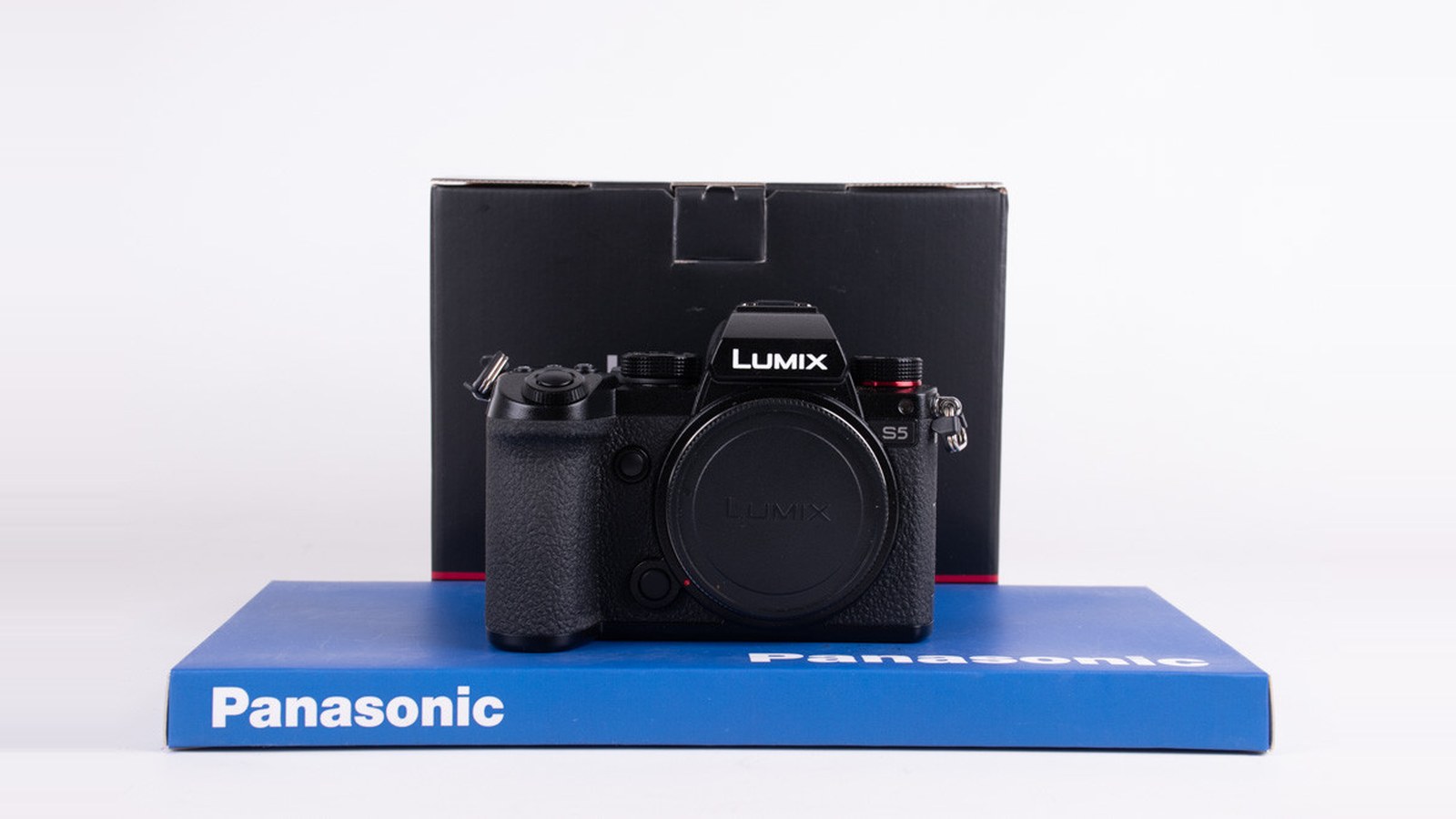
The Lumix S5 was released in September 2020 at €1,999 for the camera body only. It features a 24.2-megapixel full-frame sensor with an L-Mount, the same standard shared with Leica and Sigma within the L-Mount Alliance. The sensor is stabilized, and internal video reaches 10-bit: these are the two key factors that truly set it apart in the used market, and we analyze them in the next section.
In practical terms, this is a body designed for work. The screen is tiltable on a side hinge, allowing you to rotate it towards yourself for self-portraits or to shoot at ground level. It features two SD slots, the first UHS-II and the second UHS-I, enabling simultaneous backup or sequential recording. It weighs approximately 714 g with battery and card, a figure typical of a compact full-frame body rather than a flagship.
The battery is the DMW-BLK22, the same one used in the Lumix S5 II and GH6. If you already own a recent Panasonic kit, this is a concrete advantage: the spare batteries you carry in your bag will work here as well.
The S5D: What We Know and What to Check Before Buying
The S5D is a later variant of the same camera body. It circulates in very few units on the Italian used market, and the documentation available in Italy is scarce. We do not report technical differences that we cannot verify on the official Panasonic datasheet: regarding autofocus, firmware, distribution channel, and warranty, the reference remains the individual unit. When faced with an S5D for sale, before discussing price, we always ask:
- Provenance: official distribution by Panasonic Italia or parallel import, with documentation to prove it.
- Firmware version: the installed version and the possibility to update it using the packages from the Italian Panasonic website.
- Menu language: a unit intended for another market may not have Italian, or even English.
- Warranty: who covers it, for how much longer, and whether Panasonic support in Italy accepts that serial number.
If the seller cannot answer these four questions, the savings compared to an S5 do not offset the risk. That is why this article focuses primarily on the S5. It is the camera body that is actually bought and resold in Italy, and everything that follows, from the strengths to the control over the used market, also applies to an S5D whose provenance has been verified.
What it still does well in 2026: 10-bit video and stabilization
The S5 records internally in 10-bit and includes V-Log, with no additional licenses to purchase. The 4K 30p utilizes the full sensor width, while the 4K 60p switches to an APS-C/Super 35 crop. These are the two reasons why this used camera body still makes sense, but they should be weighed without enthusiasm.
10-bit and V-Log: when they truly matter
A 10-bit file has 1,024 levels per channel, compared to 256 for 8-bit. In practice, you can push color and exposure in post-production without banding appearing in skies and gradient backgrounds. This is essential for those shooting in V-Log, applying LUTs, and working in DaVinci Resolve or Premiere. If, however, you publish clips to social media straight from the camera with a standard profile, no one will notice the difference.
The most useful comparison is with the Sony A7S II, which currently costs 800 euros at our store. It captures 4K at full width and still performs very well in low light, but it records in 8-bit and focuses only by contrast. You can grade 8-bit S-Log, but with caution: banding appears precisely there. If you do color grading, at the same price the S5 gives you more headroom in the file.
Stabilization: Declared vs. Real Stops
Panasonic claims 5 stops of in-body stabilization and 6.5 stops with Dual IS 2 on stabilized lenses. Each stop doubles the usable shutter speed. At 24 mm, the classic rule of thumb suggests around 1/25 s, so 5 stops would push it beyond one second. In the field, the numbers are as follows:
- Shutter speed data: approx. 1 s at 24 mm using only in-body image stabilization.
- Real-world use with good technique: sharp photos between 1/4 and 1/2 s, with elbows braced against the body and a burst of 3 shutter count.
- Beyond half a second: the margin for error increases significantly and a support is required.
CIPA tests are conducted under controlled conditions, not after climbing two flights of stairs. The real advantage becomes apparent in handheld video. Slow walks, fixed framing without a gimbal, and handheld interviews remain clean. On this point, the S5 outperforms most used camera bodies in its price range.
Recording limits and heat
The S5 does not have a fan, unlike the S5 II, and dissipates heat only passively. Some 10-bit modes, including 4K 60p, have a 30-minute limit per clip. For interviews and short shoots, this makes no difference. For a conference, ceremony, or concert recorded without interruptions, however, you must plan when to restart recording. Alternatively, you can drop to 4K 30p 8-bit, which puts less strain on the electronics. In summer and outdoors, it is advisable to run a test before the actual job.
The real limit: DFD contrast autofocus
The S5 does not have phase-detection pixels on the sensor. Panasonic uses the DFD, Depth From Defocus system: it reads the contrast and compares it with a stored blur profile for each lens. However, to determine which direction to move, the camera body must continuously move the focus back and forth. This movement is the limitation that no firmware has ever eliminated. Panasonic effectively acknowledged this in 2023 when it switched to phase detection with the S5 II.
In the photo: where it's enough and where it's not
With single AF, the system is precise, and face and eye recognition works well if the subject is stationary or moves slowly. Posed portraits, landscapes, still life, and slow-paced street photography are not affected by this limitation. Problems arise with continuous AF on fast-moving subjects, especially when they are moving toward you. In a burst of a running child or a dog coming in for a retrieve, some of the shutter count results in soft images. The focus point lags one step behind the subject.
In video: pulsing and how to work around it
In the video, continuous AF makes the defect visible to everyone. Even with a stationary subject, the focus occasionally oscillates slightly back and forth to verify distance, which is noticeable at wide apertures. When the subject approaches the camera, tracking loses grip and takes a moment to reacquire. Professionals using the S5 typically manage it this way:
- Manual focus with active focus peaking, which on the S5 is clear and adjustable.
- AF only for repositioning: focus is set between takes, then locked and switched to manual.
- Reduced AF speed and sensitivity in video settings: the pulsing is mitigated, but does not disappear.
For interviews, tripod shots, and slow-paced documentaries, this method works well. If you're shooting solo on the move, using a gimbal or handheld, you can't focus manually and track the framing at the same time.
For this reason, the S5 is not the right camera for those shooting weddings in run-and-gun, sports, children, or animals. In these cases, it is better to spend similar amounts on a system with phase detection. The Sony A7 Mark III, which we currently have for 1,000 euros, features reliable eye-tracking autofocus for both stills and video. It records in 8-bit, but a correct focus matters more than a file to grade when the scene cannot be repeated. We compare other alternatives with more reliable autofocus further ahead.
What to check on a used S5 or S5D
A 2020 S5 is six years old today. In six years, a video-focused camera body may have seen very little use or been operated daily. From the outside, it is often hard to tell, as the chassis holds up well and a heavily used camera can look almost new. The checks that follow apply to both the S5 and the S5D, as the base body is the same.
Sensor, stabilizer and viewfinder
It takes ten minutes and any lens. These are the same tests we perform at the counter:
- Dust and improper cleaning: take a photo at f/16 against a uniform sky or an out-of-focus white wall. Dark spots are dust and can be removed. Halos and thin lines, however, are signs of cleaning done with the wrong materials, and those are a serious problem.
- Hot pixels: take a 30-second exposure at base ISO with the lens cap on. A few bright spots are present on any sensor. If you see dozens, walk away.
- Stabilizer: with the camera off, the sensor is free, so if you shake the body you will hear a slight noise. This is normal. With the camera on, the sensor must remain silent. With a 50 mm lens, take five photos at 1/8 s: holding the camera firmly, almost all should be sharp. If the viewfinder vibrates or you hear a continuous hum, the module is faulty.
- Viewfinder: 2.36 million dots are few for a full frame. It does not depend on the individual unit, but it must be checked in person before buying, especially if you wear glasses.
Slots, battery and shutter count
Slot 1 is UHS-II and is the one that handles the highest video bitrates. Test it with a fast card by recording a few minutes of 4K. A damaged contact causes write errors that you wouldn't see with a slow card. The battery is the DMW-BLK22: ask if it is original and record ten minutes of video while watching how much the indicator drops. In the menu, also check the firmware version and compare it with the latest one published by Panasonic.
On Panasonic, the shutter count is not available in the standard menus: it can only be read using service tools. If a private seller tells you "it has 8,000 shutter count" and does not provide any proof, that number is meaningless. On a camera body that is four to six years old, also ask how much video has been recorded. Many hours of 4K 60p heat up the electronics, and this type of wear is not reflected in the shutter count.
What we do in our workshop
Every L-Mount camera body that arrives at our shop undergoes a complete overhaul before being listed for sale. We read the certified shutter count using service tools and record it on the product page. Then we clean the sensor and test the stabilizer at slow shutter speeds and in video. Finally, we test the UHS-II and UHS-I slots and update the firmware. The camera comes with a 2-year warranty: if the stabilizer, a slot, or the electronics fail during that period, the repair is on us.
The L-Mount lens count
The body is only half the cost. On the used L-Mount market, there is less supply than on Sony E or Canon RF, so lenses retain their value better and bargains are rarer. Before deciding on the price of the S5 body only, it is worth calculating the cost of the complete kit.
The sensible starter kit
The Lumix S 20-60 mm f/3.5-5.6 is the lens that was sold in kit with the S5. It weighs approximately 350 grams and starts at a true 20 mm, useful for interiors and handheld video. The limitation is the aperture: at 60 mm you are at f/5.6, and in a church or a club the ISOs rise quickly.
That is why it makes sense to pair it with a Lumix S f/1.8 prime: 18, 24, 35, 50, and 85 mm. The five lenses share the same external dimensions, 67 mm filter threads, and weigh around 300 grams. For those shooting video, this is a practical advantage: when you change lenses, the gimbal requires only minor rebalancing, and the follow focus stays in place. None of the five lenses are stabilized, so they rely solely on the IBIS of the camera body.
A rough estimate for used equipment:
- Lumix S5 body only: 800-1,000 euros
- Lumix S 20-60 mm f/3.5-5.6: 250-350 euros
- Lumix S 50 mm f/1.8: 250-300 euros
- Total: 1,300-1,650 euros
With a higher budget, the Sigma DG DN in L-Mount expand your options. The 24-70 mm f/2.8 Art is the bright zoom for professional work. The 35 mm f/2 and the 45 mm f/2.8 from the Contemporary series are for those who want a compact kit. Before buying, test the AF in video on your camera body: compatibility stated on paper does not tell you how it focuses with DFD.
Adapted lenses: why they offer little value here
If you come from Canon EF, you immediately think of an adapter, such as the Sigma MC-21. It works, but DFD calculates distance using the bokeh profiles of Lumix lenses. With an adapted lens, that data is missing, so the camera relies solely on contrast, resulting in more hunting and slower focus.
On a Canon RF, an adapted EF lens maintains autofocus performance almost identical to the original. On the S5, the adapter exacerbates the flaw we described above. It makes sense for manual lenses or for video on a tripod with manual focus. In other cases, a used Lumix prime is better than an adapted EF kit.
Used S5 vs. full-frame alternatives from our counter
With 570-1,000 euros today on our bench, there are five full-frame bodies that anyone considering an S5 ends up looking at. The criterion for choosing is simple. The S5 wins if 10-bit video and stabilization come first. It loses as soon as you need an autofocus that doesn't miss.
| Body | Price | Sensor | In-body stabilization | Internal video | Autofocus |
|---|---|---|---|---|---|
| Lumix S5 | 800-1,000 euros (market) | 24 MP | Yes | 4K 10-bit | DFD Contrast |
| Sony A7 III | 1,000 euros | 24 MP | Yes | 4K 8-bit | Phase detection |
| Sony A7S II | 800 euros | 12 MP | Yes | 4K 8-bit | Contrast |
| Canon EOS R | 800 euros | 30 MP | No | 4K, 1.74x crop | Dual Pixel |
| Canon EOS RP | 570-600 euros | 26 MP | No | 4K, 1.6x crop | Dual Pixel (up to Full HD only) |
| Sony A7 II | 570 euros | 24 MP | Yes | Full HD | Hybrid, slow |
If video comes first: S5 or A7S II
The Sony A7s Mark II at 800 euros features large pixels, and in low light at high ISOs it still performs better than the S5. The trade-off is the 12 MP resolution. A crop in a photo makes this immediately noticeable, and the video file does not withstand heavy color correction. Those who work extensively in post-production find the S5 to be a more complete camera body: more color headroom, 24 MP for photos, and a dual slot. The A7S II remains a sensible choice for those shooting concerts or dark venues who deliver footage with almost no corrections.
If autofocus comes first: A7 III or EOS R
For events, family, and moving subjects, these two are the safest choice. The Sony A7 Mark III at 1,000 euros features phase-detection AF, in-body stabilization, dual card slots, and the NP-FZ100 battery that lasts until the end of the day. The Canon EOS R at 800 euros costs 200 euros less and offers 30 MP with Dual Pixel. In return, it lacks in-body stabilization, has a single card slot, and its 4K is so cropped that it is effectively a stills camera.
If your budget is under 600 euros: EOS RP or A7 II
Below this price point, serious video is out of the question. The Canon EOS RP, which we currently have in 7 units ranging from 570 to 600 euros, is the lightest full-frame model in the group and features Dual Pixel AF in stills. However, in 4K it applies a 1.6x crop and switches to contrast-detect AF. The Sony A7 Mark II at 570 euros offers in-body image stabilization, but it is limited to Full HD, and its AF struggles with moving subjects.
If you mainly take photos, this is enough, and the €300-400 saved on the S5 can be used to buy a good lens. Those who want to spend even less and don't shoot video can look at the used Canon 6D, the most affordable full-frame DSLR that passes through our workshop.
How much to pay and when it doesn't make sense to buy it
A used Lumix S5 body only, in Italy, currently costs between 800 and 1,000 euros. We do not currently have any Lumix full-frame models in stock, so the advice that follows is entirely impartial.
The right price range in 2026
The price range depends on three factors: how much it has been used (shutter count and video hours), the condition of the camera body, and what is included in the box. This is the grid we would use to evaluate it at the counter.
| Asking price | What to expect |
|---|---|
| Under €800 | Red flag. Ask why it costs so little: drops, faulty SD slot, buzzing stabilizer, or a parallel import without documentation. |
| €800-900 | Functional body with visible wear, single battery, undocumented shutter count, or a history of intensive video use. |
| €900-1,000 | Shutter count verified with service tools, clean sensor, original box, two batteries, receipt or active warranty. |
Above €1,000, the S5 stops being a bargain. At that price, you can already get a Sony A7 Mark III, which costs €1,000 with us and features a much more reliable autofocus. Paying more for an S5 only makes sense if it comes with video accessories you actually need.
Who this choice is right for, and who it isn't
It makes sense if you work solo in video, with slow-paced workflows and controlled environments:
- solo videomakers shooting on a tripod, with focus locked or managed manually;
- interviews and fixed-camera content, where the subject remains at the same distance;
- slow-paced documentaries, with handheld shots where stabilization makes the difference;
- those looking for in-body stabilization and internal 10-bit recording for under 1,000 euros.
It makes no sense if you fall into one of these three cases:
- You only take photos. A used full-frame DSLR costs less and has a huge lens park behind it: we discussed this in the article about the used Canon 5D Mark III. If you want a lightweight mirrorless, the Canon EOS RP costs 570-600 euros and features Dual Pixel.
- You need autofocus for video. In this case, the A7 III at 1,000 euros is the safest choice, even though it records in 8-bit.
- You want many used lenses to choose from. The selection on L-Mount is more limited and prices drop more slowly.
If your budget allows, the next step up is the Lumix S5 II. It features the same video system, but with phase-detection autofocus, it resolves the most significant drawback of the S5. Even used, it costs more, but for those working in video with moving subjects, that price difference is justified.
Frequently asked questions
What is the difference between Lumix S5 and S5D?
They share the same base: a 24 MP full-frame sensor and L-Mount. The S5D is a later and less common variant, so few units are available on the Italian used market. Before buying, it is advisable to check the official Panasonic datasheet and purchase documents to see what differs for the specific unit: autofocus, firmware, menus, and warranty.
Is the Lumix S5 autofocus really that poor?
In photos of stationary or slow-moving subjects, it is reliable. The problem is video with continuous AF, where the DFD contrast-detection system tends to hunt and lose moving subjects. For interviews and tripod-mounted shoots, it is manageable, but for moving events, a body with phase detection is better.
Is a used Lumix S5 better than a used Sony A7 III?
It depends on your priorities. The S5 records in 10-bit with V-Log and has very effective video stabilization. The A7 III has a significantly more reliable autofocus and a wider used lens selection. Those who mainly shoot video for post-production choose the S5, while those who photograph moving subjects choose the Sony.
How much does a used Lumix S5 cost in 2026?
Body only, approximately between 800 and 1,000 euros, depending on shutter count, condition, and accessories. At its launch in 2020, it cost 1,999 euros. Below 800 euros, it is worth asking why and verifying the stabilizer and slot with greater attention.
How to read the shutter count on a Panasonic?
It does not appear in the standard menus as it does on other brands. A service procedure or dedicated software is required. If a private seller states a number without providing proof, it should be considered unverified. We read it in our laboratory and indicate it in the data sheet of every camera body.
Can I use my Canon or Nikon lenses on the S5?
Yes, with an adapter, but the contrast autofocus of the S5 becomes even slower and less reliable with adapted lenses. It makes sense for manual focus lenses or video shooting with manual focus. For everyday use, it is advisable to start with native L-Mount lenses.
Looking for a full frame for photos and video? Let's talk before you buy
If you have any doubts about a purchase or need advice for your specific case, contact us. We offer free advice because we are photographers first, and because a customer who makes a poor purchase will not return to photography.
Three ways to get in touch:
- Contact form — response within 24 business hours
- WhatsApp at 342 362 3454 (messages only)
- Phone: 071 291 6347 (Mon-Fri 9-13/15-18, Sat 9-13)
And if you want to see what we have in stock right away, explore the available used gear today: every camera is certified, comes with a 2-year warranty, and ships within 24-48 hours.
Article written by Matteo for the ReflexMania Team. Last updated: October 2026. Prices and availability as of the date of publication.